How to build your own sports analytics team with AI agents
文章目录
All day long I see people posting about their model, or about something their agent did. What I almost never see is anyone explaining how to build a team of agents that does sports analysis and modeling for you, day after day.
You can do this right now. With today's agent setups and automation tools like n8n, OpenClaw, and Hermes, you can build these systems with free, open source tools. It takes some wiring, but it works.
If you use Grok Bot, the process gets a lot simpler. You create the agents, give each one a job, and let them run on a schedule. Then you hand them two things I built and use myself: Sports Leader MCP, which gives them the data and tools, and the sports-analytic-skills pack, which tells them how to do the work. Here's how the pieces fit together.
Why a team, and not one chatbot
If you ask one chatbot to pull data, build a model, check its own work, and write it up, you get something different every time. It skips steps, makes up numbers when data is missing, and grades its own homework.
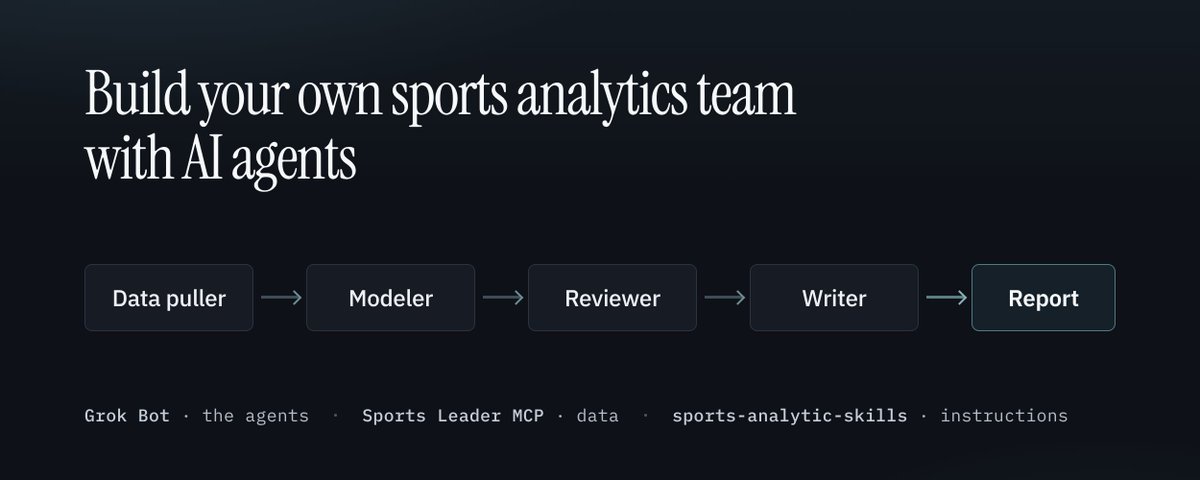
A team fixes that by splitting the work. In my setup there are four roles:
-
A data puller that grabs the day's games, injuries, and prices, and saves a clean file.
-
A modeler that works only from that file and answers a question you set up ahead of time.
-
A reviewer that checks the data and the model before anything gets written.
-
A writer that turns the checked work into a report you actually read.
In Grok Bot each of those is its own agent with its own instructions. They hand work to each other, and they run on a schedule, so the report is waiting for you instead of you remembering to ask for it. If you follow more than one sport, you can set up a team for each one.
The data: Sports Leader MCP
An agent is only as good as what it can see. Sports Leader MCP is a free connector that lets an agent pull sports data on its own. There's no ESPN login and no API key.
It has 43 tools and covers 30 leagues across 11 sports, including the NFL, NBA, MLB, NHL, college football and basketball, the big soccer leagues, golf, tennis, UFC, F1, and NASCAR. The agents can pull scoreboards, play-by-play, standings, rosters, player stats and game logs, injuries, sportsbook lines with no-vig probabilities, and Kalshi and Polymarket prices.
There's also a free historical export for MLB, NBA, NFL, NHL, college football, and men's college basketball, from the 2021 season to today, updated nightly. That's what the modeler uses when it needs history to train on.
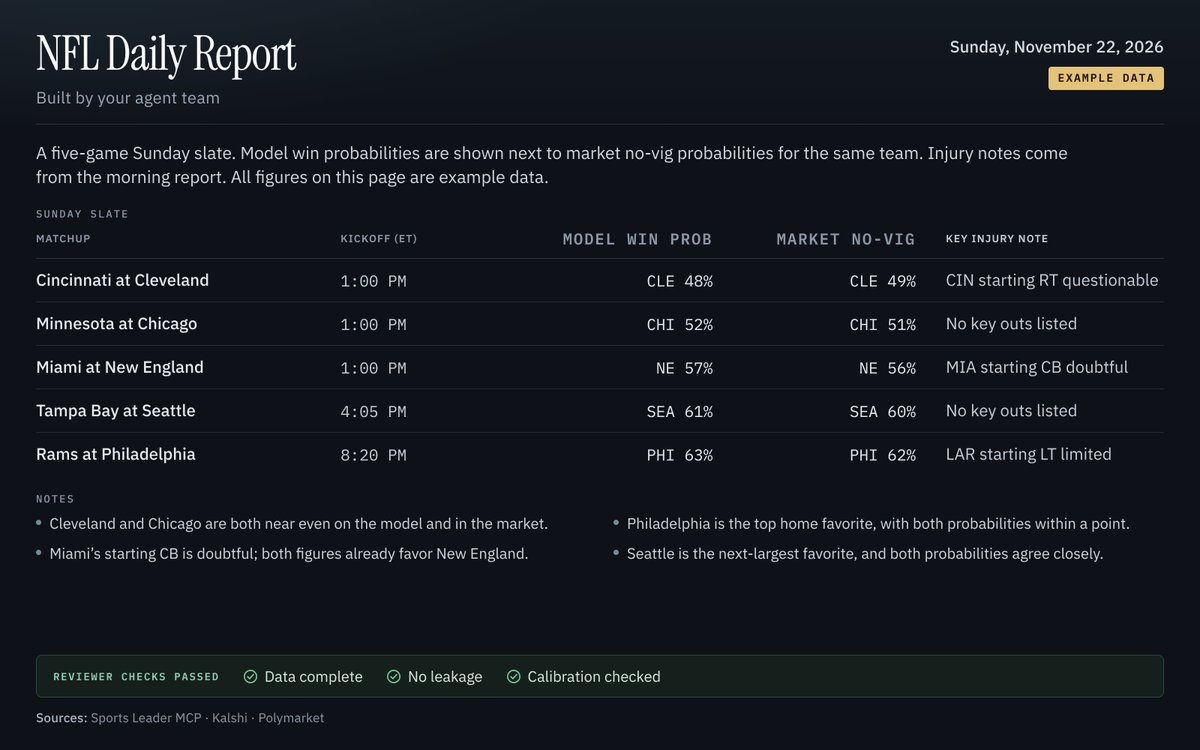
Here's what that looks like in practice. My data agent makes one call in the morning and gets the whole day's slate back: matchups, market win probabilities, and the key injuries. For any game I care about, a second call adds lineups or probable starters, weather, and prediction market prices.
The instructions: the sports-analytic-skills pack
Data alone isn't enough. Give an agent tools and no instructions and it will improvise, and improvising is how you get numbers you can't trust.
The sports-analytic-skills pack is 24 skills that spell out how the agents should work, step by step, the same way every time. You install it with one command:
npx skills add WalrusQuant/sports-analytic-skills
The skills walk an agent through the work a good analyst would do:
-
Lock down the question first: what you're predicting, when you'd know the answer, and what simple baseline you have to beat.
-
Check the data for missing games, gaps, and anything that looks off before using it.
-
Only use information you would actually have had before the game. This is where most homemade models quietly cheat.
-
Start with simple baselines, then test the real model on games it hasn't seen, in time order.
-
Check that the probabilities are calibrated, then write up results with the sample size and the limits.
The point is that a question asked today and the same question asked next month get answered with the same rules, and you can see how every number was made.
Getting the report wherever you want it
Everything the team does rolls up into one report. Where it goes is up to you. It can be a Page in Grok Bot, an email in your inbox every morning, or a post on your own website. It can be a daily slate, a weekly recap, or an alert when a number moves.
Here's a mock of what a daily NFL report could look like. Every number on it is made up. The format matters more than the numbers: keep it the same every day so you're reading changes in the games, not changes in the layout.
What this won't do
This doesn't hand you an edge. A model estimate isn't an edge, and neither is a market price. The skills pack is an operating manual for doing analysis properly. It's not a picks service.
The output is only as good as the data and the question. Feeds can be late. The historical data covers six leagues back to 2021, not every league. A sloppy question just gets you sloppy answers more consistently. That's why I'd never skip the reviewer.
Where to start
Don't build all four roles on day one. Start with one sport and two agents: one that pulls the data and writes the report, and one that reviews it. Once that's running every day, add a modeler with a single question you want answered the same way each time.
-
Grok Bot: https://x.ai/bot
-
Sports Leader MCP: https://github.com/WalrusQuant/sports-leader-mcp
-
sports-analytic-skills pack: https://github.com/WalrusQuant/sports-analytic-skills