561K Google AI impressions in 90 days. 24 actions to give Fable 5.2
文章目录
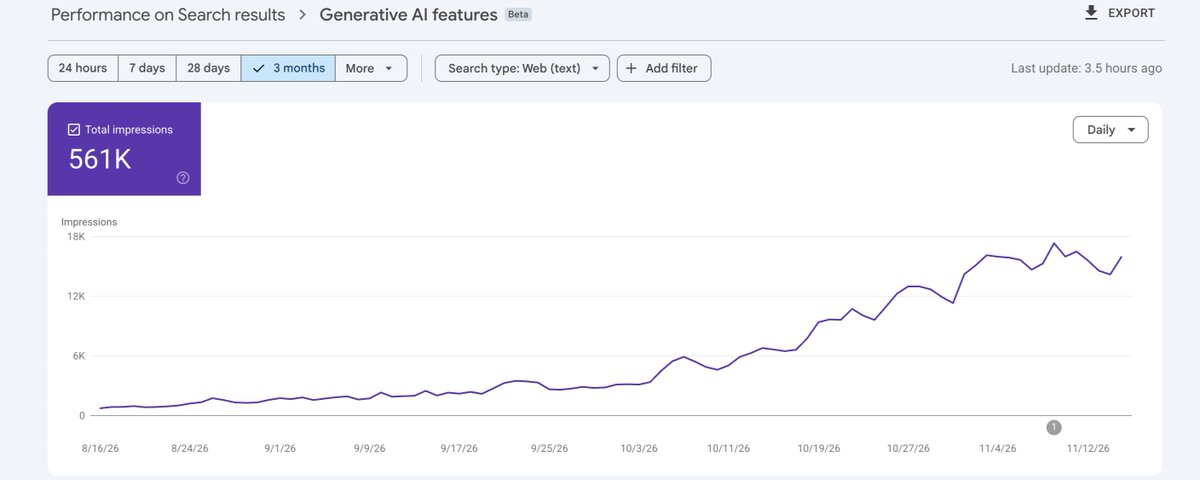
561K impressions in Google's AI features in 3 months. Daily went from about 700 to about 17K.
That's Google's own Search Console report, on one of our own sites. Not a third-party "AI mentions" score.
You don't need 232 tactics. You need a short list, ranked by clear rules, that you can run on your own data.
Below: 24 moves in tiers, with the rules for each. Every S and A move has a prompt for Claude. No tool to buy.
What we shipped, in order
This is what went live on that site while the line climbed. It's a timeline, not proof that any one item caused any one jump.
-
Mid-Aug (about 700 a day): one H1 per page (one page had 11), stronger titles on the main landing pages, Organization, Article and FAQ structured data. Whole site prerendered: 229 pages, server response 0.1 to 0.2s (was 0.5s+, and 1.3 to 3.1s on non-English pages). Hub navigation changed from JavaScript buttons to real links.
-
Late Aug (about 1K to 2K): homepage rebuilt around the main search. Hard facts in the hero, live stats from our own database, headings written as the questions people search, FAQ from 10 to 17 questions. A guide section under the main hub. Our 136 one-to-one comparison pages rebuilt: a clickable matrix on the hub, a verdict and a next step on each, FAQ schema.
-
Late Aug to mid-Sep (about 2K, then 3.5K): everything translated into 11 more languages (12 in total) with hreflang. Every English title and description de-duplicated and rewritten.
-
Late Sep (steps to about 6K around Oct 3 to 5): long URLs consolidated to short ones with redirects, related posts under every post, 16 new hub pages of 1,500 to 1,900 words each.
-
Oct (about 9 to 10K, then 13K): a free interactive tool with a score table and live averages from our own users' results. Five short quizzes. 3 more languages on a staged rollout (15 total). Content routes fully static and cached at the edge.
-
Early Nov (16 to 17.5K): homepage title and description updated with exact facts.
No paid ads ran. The blog posts went out on a schedule the whole time. That's the backbone of the tiers below.
How to use this
-
In Search Console, open Performance > Search results, set the last 3 months, and export. Keep Queries.csv and Pages.csv. For the translation move, also keep Countries.csv.
-
Open Claude (Claude.ai or Claude Code). Paste the Base rules below, then one tactic prompt, then attach the files. Add your site URL, brand name and 3 to 5 facts about what you sell.
-
Pick one tier and work it for a week. Don't jump around.
Base rules (paste first, every time):
Attached: Queries.csv and Pages.csv from my Search Console Performance export (last 3 months). Columns: Top queries, Clicks, Impressions, CTR, Position / Top pages, Clicks, Impressions, CTR, Position.
My site: [URL]. My brand: [brand]. What I sell: [3 to 5 facts].
Rules: use code for all math. Only use numbers from the files, no industry averages. Drop every query containing my brand and tell me how many. If brand is over 20% of impressions, stop and ask. Ignore queries under 100 impressions (20 if fewer than 20 queries remain). The export doesn't say which page ranks for which query, so any pairing is a "likely page" I must confirm in Search Console. Plain English, no filler.
How we ranked it
-
S: fastest to do, and it works on pages Google already shows. Do first.
-
A: big effect, but weeks, not days.
-
B: depends on your niche. Check the fit.
-
C: do once. Hygiene.
-
Skip: popular, we don't do it.
S tier: do first
1. Write headings as the questions people search, then answer in one direct line. Add an FAQ with matching schema.
Why S: 2 to 3 lines per page, no new page. We did this on the homepage and hubs.
Task: find queries starting with how, what, why, when, can, is, does, should, which with CTR below my median CTR. Top 15 by impressions: query, likely page, impressions, position, the exact H2 to add, a 40 to 60 word answer from my facts only. Mark what needs my input.
2. Fix titles, H1s and descriptions. One H1 per page, main search in the title, no duplicate metas.
Why S: 10 minutes a page. We did all three.
Task: round each query's position to a whole number. For positions 1 to 5, take the median CTR per position (group 1 to 3 and 4 to 5 if under 5 queries). List queries with CTR under half the median: query, likely page, impressions, CTR vs median, 2 new titles under 60 characters, a description under 155. Extra clicks per month = impressions x (median minus current CTR) / 3.
3. Add a better section for searches stuck at position 8 to 20. Not a new page.
Why S: closest to page 1 for the least work.
Task: queries at average position 8 to 20, skip one-word queries. Top 15 by impressions: query, likely page, impressions, position, the heading plus 2 sentences to add. Extra clicks per month = impressions x (my median CTR at positions 3 to 5 minus current CTR) / 3. Say it's what it's worth if it reaches the top 5.
4. Fix the page Google already shows for your best money search.
Why S: one cause per page, and it already has impressions.
Task: my 10 pages with the most impressions that could bring a sale or enquiry. For each, stop at the first real problem: 1) another page of mine looks aimed at the same search, 2) wrong page type for the search, 3) main query not in title or H1 or not answered near the top, 4) too thin for the topic. Table: page, main query, impressions, position, first problem, one-line fix. Say what you can't check without the live page.
5. Refresh pages that lost 30% or more of their clicks. (Export with Compare: last 3 months vs previous period.)
Why S: Google already trusted them.
Task: needs the compare columns (last 3 months vs previous 3). If missing, say so and stop. In Pages.csv, find pages with clicks down 30% or more (skip pages under 10 clicks before). If position got worse by 1 or more: refresh. If position held but impressions fell: demand, leave it. Table plus the first 3 refreshes in detail.
6. Link with real links, not JavaScript buttons. Then link from pages that get traffic to pages that make money.
Why S: crawlers follow links. We changed hub navigation to real links.
Task: my top 10 pages by clicks, and my money pages: [URLs]. For each money page give 3 source pages from the top list, a sentence where the link fits and a descriptive anchor (no "click here").
A tier: big effect, slower
7. Publish first-party data nobody else has. A free tool, calculator or stats page fed by your own users' results.
Why A: Google has nothing else to quote. Ours had a score table and live averages.
Task: from my queries, find topics asking for a number, a score, a price or an average. List 5 with impressions and what data I'd need. Then ask me what data I actually hold, one topic at a time. Don't invent any figure.
8. Build one-to-one comparison pages for every pair in your category. A matrix on the hub, a verdict and a next step on each.
Why A: we have 136 and rebuilt them all in August. Slow to build, easy to scale.
Task: find queries with "vs", "or", "alternative", "compare" or "difference". Group by pair. List pairs with impressions, and the page to build: title, 5 sections, a verdict line. If I have no pair-style queries, say so.
9. Translate your proven pages into languages Search Console already shows impressions from.
Why A: demand exists before you write. We went to 15 languages in stages. Add hreflang.
Task: from Countries.csv (and Queries.csv), list countries with impressions but few clicks where English isn't the main language. Rank by impressions. For the top 5, name the language, the 10 pages from Pages.csv to translate first, and what to check after (hreflang, broken placeholders in the text).
10. Give each hub a guide section under the grid. What the parts mean, how to choose, FAQ, breadcrumb schema.
Why A: hubs hold everything together. We built 16 hubs of 1,500 to 1,900 words each.
Task: from Pages.csv, find hub or category pages with high impressions and low clicks. For the top 5, outline a guide section: 4 H2s from queries in the file, a 5-question FAQ, and what to link to. No filler.
11. Build the pages you're missing.
Why A: new pages take weeks, but this is where growth lives.
Task: cluster my queries by topic. List clusters over 200 total impressions where no page in Pages.csv has matching URL words. Table: topic, example queries, impressions, page to build, page type. Max 10.
12. Consolidate duplicate and long URLs with redirects. Keep one page per search.
Why A: stops two pages splitting one search. We moved long URLs to short ones.
Task: group my queries by topic. Flag topics where 2 or more pages have matching URL words and both have impressions. Table: topic, pages, combined impressions, advice (keep one and redirect, or retarget). Remind me to confirm in Search Console (click the query, Pages tab).
B tier: depends on your niche
13. Get links to pages whose content is already right. Why B: pays only after content is fixed.
14. Answer real questions on Reddit and Quora as a real person. Why B: slow, and only where your buyers ask.
15. Local business: match name, address and phone on every listing. Why B: local only.
16. Publish on a schedule. Why B: we did it the whole time. It compounds, but slowly.
17. Programmatic pages, only with a unique data table each. Why B: same text with a new city doesn't count.
C tier: do once
18. Make pages static and fast. Why C: ours went from 0.5s+ to 0.1 to 0.2s. Nobody ranks for speed alone.
19. Add structured data that matches the visible text. Why C: Google says no special schema is needed for AI features.
20. Submit a sitemap and check indexing. Why C: catches silent problems.
21. Set hreflang right and scan translations for broken text. Why C: easy to ship wrong.
Skip: popular, we don't do it
22. Parasite SEO. Why skip: Google's site reputation policy targets third-party content published mainly to borrow the host's ranking signals.
23. llms.txt. Why skip: Google's docs say you don't need AI text files for AI Overviews or AI Mode.
24. Mass AI pages that say nothing new. Why skip: Google's scaled content abuse policy covers many pages made mainly to manipulate rankings.
How to track it
Search Console > Performance > Search results > Generative AI features (Beta). Search type: Web (text). That shows Google. It doesn't show what ChatGPT or Perplexity say about you. We built MentionFlow (mentionflow.ai) for that. It's ours.
Comment TIERS and I'll send all the prompts in one file.
沿着这个主题继续读
从一篇文章,找到相关的教程、经验和阅读路径。