The AI Ad Creative Masterclass: Skills, Tools, and the 21 Formats Top Brands Run
文章目录
部分视频或图片暂未收录,已在正文保留提示;需要时可查看原文。查看原文 ↗
The best brands don't run one kind of ad. They run a dozen formats at once, and the ads that last longest are the boring ones, like a clean product photo, an offer card, or one line of text over a picture.
We pulled 336 live ads from 48 well-known DTC brands on Meta and looked at every one, the videos frame by frame. Below is every format we found, with real examples, how often it shows up, how long the winners run, and how to make it with AI when you don't have a studio or a creator budget. It's long (about a 17 minute read), so save it for the next time you plan a batch of ads.
If you've been told to just run UGC, the pull tells a different story. Creator videos were the most tested video format, and among the fastest to get switched off. Of the 34 ads that had been running longest (203 to 572 days), 24 are stills: the product, an offer, a line of text.
What we pulled
Meta's Ad Library shows every ad running on Facebook and Instagram, and for US ads it lets you sort a brand's ads by impressions. We did that for 48 DTC brands, half of them from a list of heavy Meta spenders, from Huel, AG1 and Liquid Death to Skims, Ruggable and eight coffee brands. Plenty of them are well past $100 million a year. Skims did about $750 million in sales in 2023 (Fortune), Huel did £214 million in its 2024 year (Huel annual report), and Oura was on track for $1 billion in 2025 (CNBC). From the top of each brand's list we kept a mix: the longest-running ads, the top ads by impressions, and ads running in several versions. That gave us 336 live US ads on November 16, 2026: 189 images, 8 carousels and 139 videos.
Then we looked at all of them. Every image, every carousel card, and 94 of the videos as frame-by-frame contact sheets (the other 45 only as a poster frame, and nothing with sound). For each ad we logged the format, the first second, where the eye lands, when the product shows up, and how it was made.
A word on "days running", because you'll see it under every example. Meta doesn't publish results, so the best public signal is age. Brands switch off ads that lose money, so an ad still live after 200 days is probably paying for itself. Age suggests an ad pays. It doesn't prove it. Some heavy spenders refresh everything (we found no Gymshark ad older than 14 days and no Oura ad older than 11). And we pulled two weeks before Black Friday, so there are more offer cards than usual.
What 336 ads taught us
Before the formats, here's what showed up across the whole pull.
-
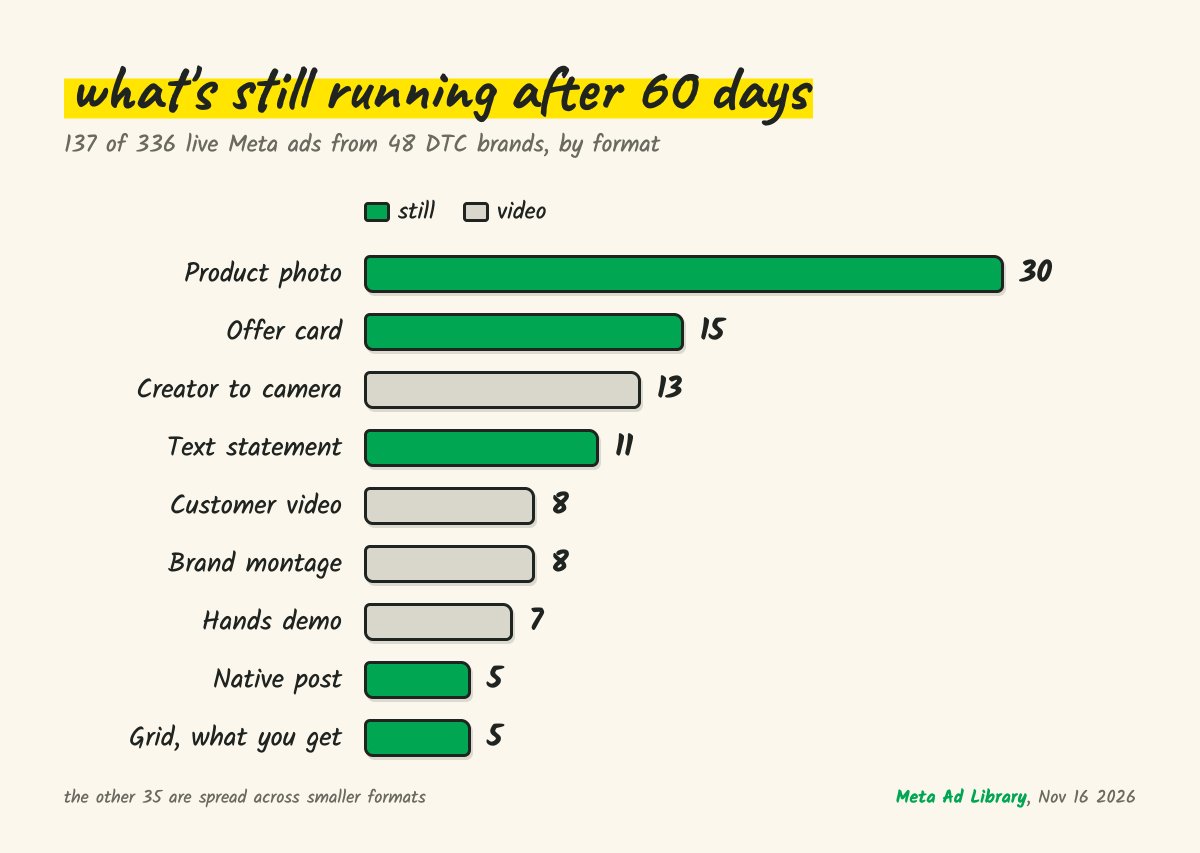
The ads that last are mostly stills. Among the 137 ads that had run 60 days or more, the plain product photo leads by a wide margin (chart below). Of the 34 oldest, 24 are stills.
-
Creator video gets tested hard and dropped fast. There were 50 creator ads, more than any other video format, and their median age was 38.5 days. Only 13 of the 50 made it to 60 days (26%, against 41% for the whole pull). Customer-style videos held up better (8 of 18), and the single oldest ad in the pull is one of them.
-
Videos lean on a face or a pair of hands. In 46 of the 94 videos we watched frame by frame, the main human is someone talking to camera. In 18, it's hands holding the product. About a quarter of all the videos (34 of 139) open on a caption that's already mid-sentence.
-
The product shows up right away. 192 of 197 stills show it at once. 68 of 94 videos show it in the first 2 seconds, and 9 never show it at all.
-
Videos are shot on phones. Stills are shot in studios. 61 of 94 videos are phone footage, and 165 of 197 stills are studio work. Motion graphics are only 7% of everything.
-
Vertical, and longer than you'd think. 230 of 336 ads are 9:16. The median video runs 34 seconds, and only 19 of 94 are 15 seconds or shorter.
-
Winners get cloned. 120 of the 336 were running the same creative as two or more separate ads, up to 14 copies. When something works, brands put more money behind the exact same file.
One category note. Coffee brands ran their ads twice as long as everyone else (a median of 84 days against 42), and they lean on hands. Hands are the main human element in 38% of coffee ads and 9% of the rest.
So a good batch has stills that can run for months and new videos every few weeks.
The stills
Nine still formats. For each one: what it looks like, how many showed up (and how many had run 60 days or more), real examples, and how to make it.
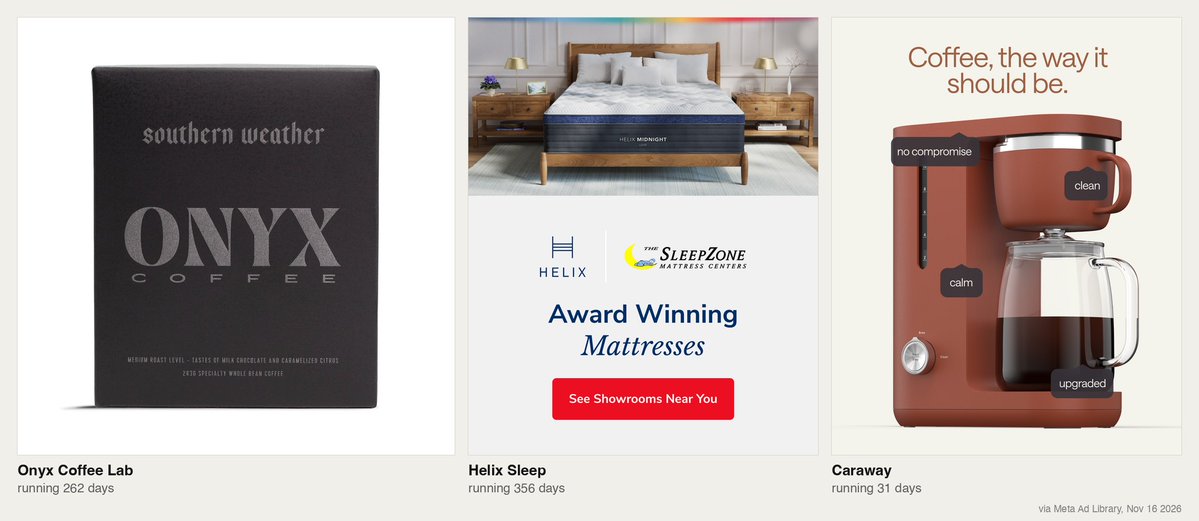
1. The product photo. The product alone, big, on a plain background, with one line of text or none. It's the most common format in the pull (84 ads) and the most common among the long runners (30 past 60 days). 38 of the 84 have no text at all. Caraway's version pins one-word tags to the parts of its coffee maker.
Make it: start from a sharp photo of your real product. Use GPT Image 2.6 to change the background and the light, never to invent the product. Then set the words in HTML so they're spelled right.
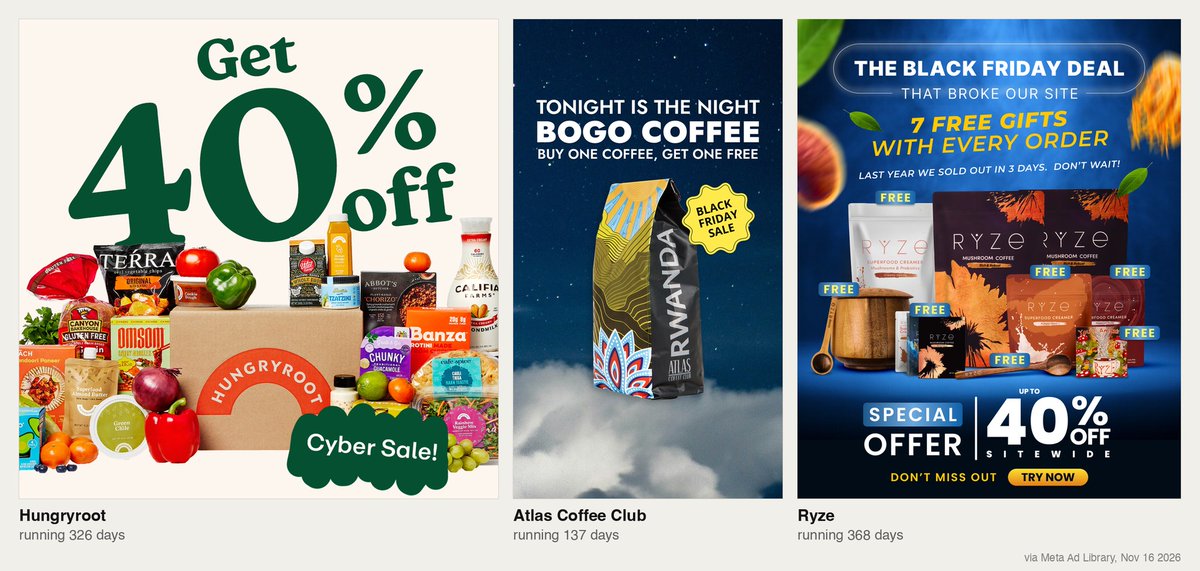
2. The offer card. The offer in the biggest type on the page, then what you get, then the terms. 40 ads, 15 past 60 days (Black Friday inflates this one). Hungryroot's "Get 40% off" had run 326 days. Ryze's "Black Friday deal that broke our site" was from last year and still live at 368 days, which tells you it works, or that nobody switched it off.
Make it: lay out everything in the offer and shoot it from above, or put the real product into a scene with GPT Image 2.6. Every number goes in HTML so every digit is right, and the page it clicks to shows the same offer.
3. The text statement. One line in big type over one photo. 30 ads, 11 past 60 days, and a median age of 18 days, so brands test lots of these and keep a few. Atlas Coffee Club's "We dare you to drink our espresso black..." had run 312 days. Huel's "GLP-1 killed your appetite." rides something its buyers are living through right now.
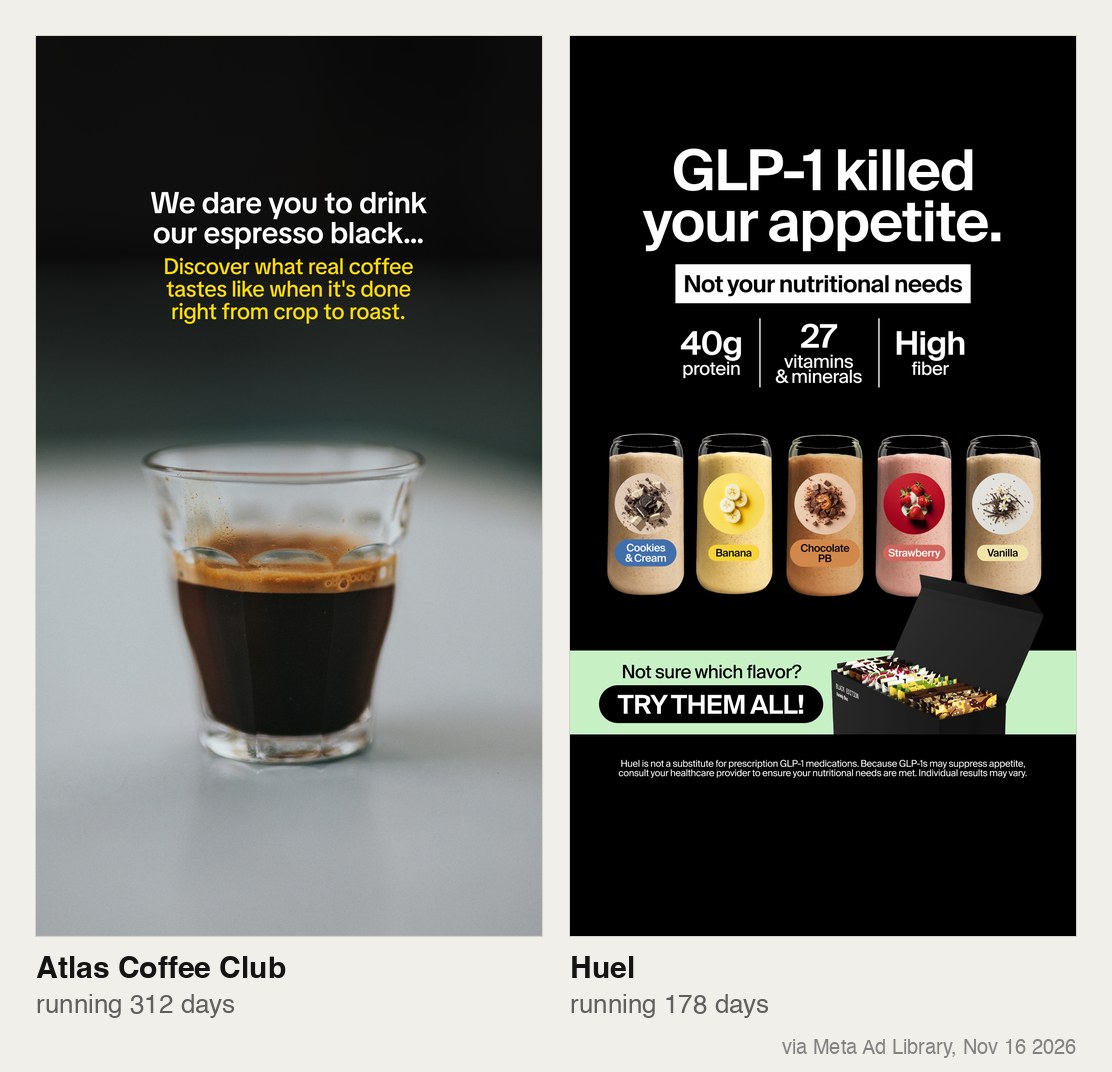
Make it: one photo and one sentence. Never words on a flat gradient. For a physical product, the product or the one object the line is about stays in the frame.
4. The review or quote. A real review as the headline, the name and source under it, the product beside it. Huel ran one reviewer's line, "Lost 80lbs (so far) with Huel.", in three designs, two at 247 days and one at 162. That's the loop. Keep the words that work and change the picture.
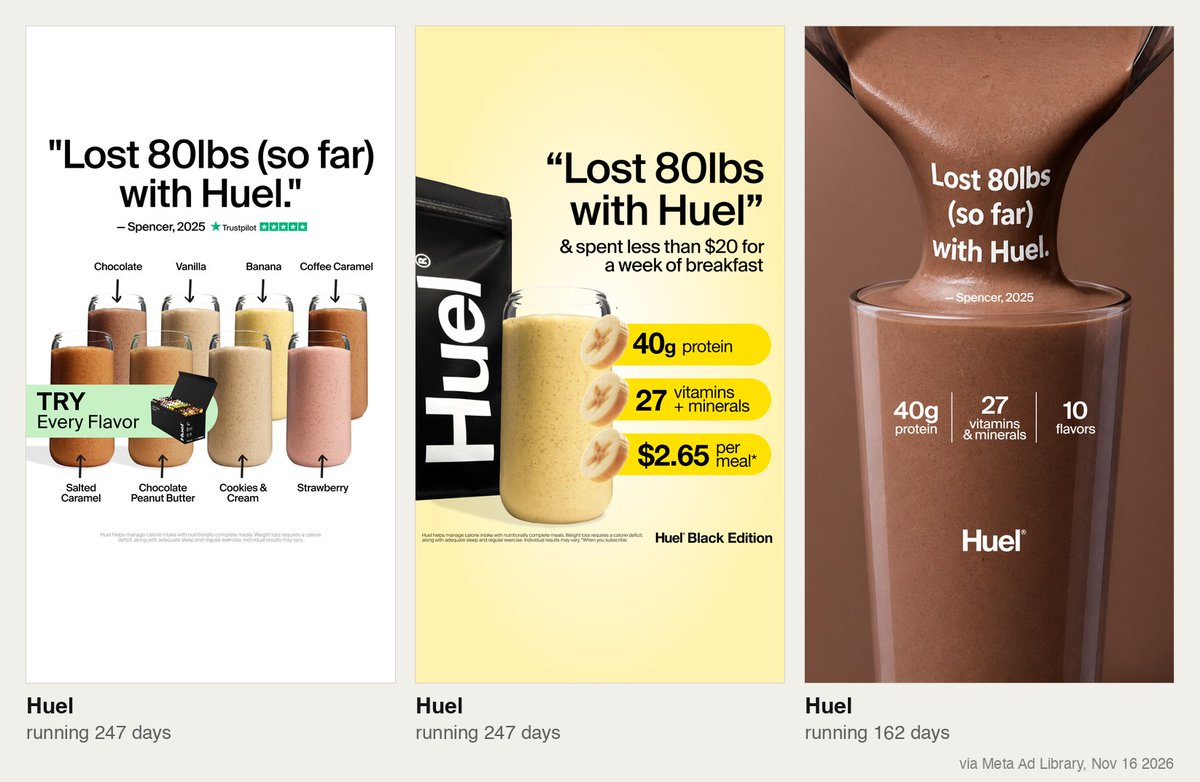
Make it: export your real reviews and quote them exactly. A model can make the scene, but never write or credit the review.
5. The native post. A phone photo or a screenshot that could pass for a friend's post, with caption boxes, a search bar or a handwritten note. 9 ads, 5 past 60 days. Hungryroot's packed fridge with an "I used to think..." caption had run 365 days. Trade Coffee puts a real question in a search bar, then answers it with the bag.
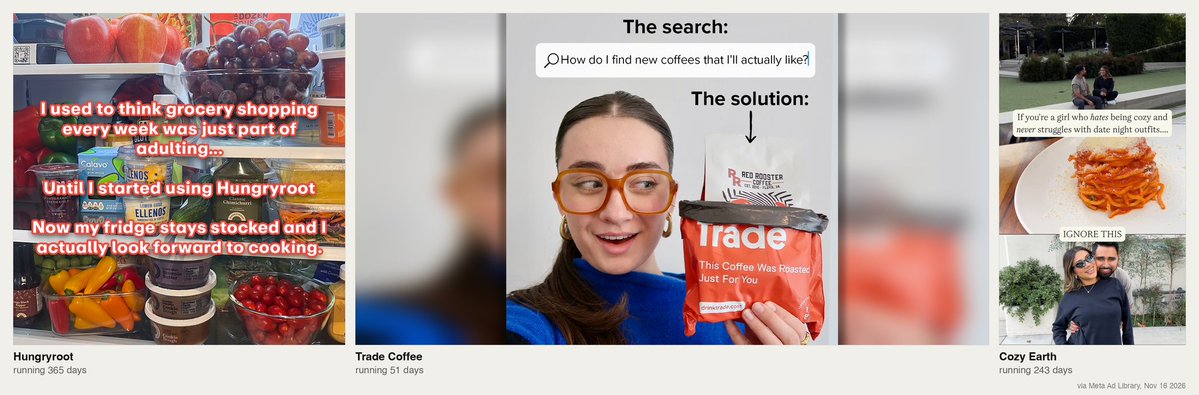
Make it: a staff member's phone photo of the product where it lives, or GPT Image 2.6 prompted as a phone photo (flash, a slight tilt, an ordinary room). Caption boxes go on in HTML. Never fake a customer's message or invent engagement numbers.
6. Before and after. The same thing twice, labeled. Only 4 ads, but all 4 had run past 60 days, with a median of about 145 days, the highest of any format with four or more ads. Bioma (392 days) and Cozy Earth (131 days) both drew the change instead of photographing bodies.
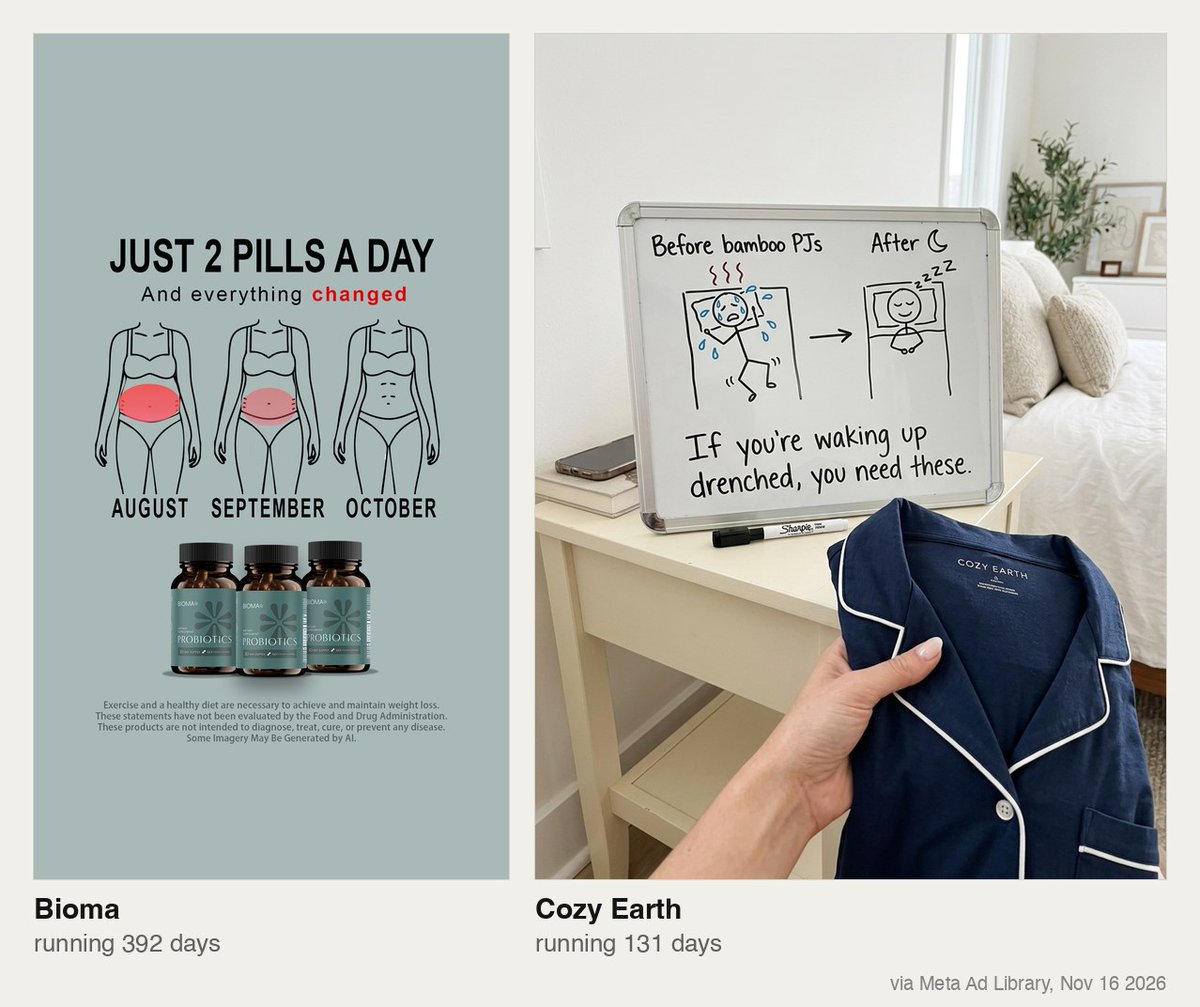
Make it: real photos from the same spot, angle and light. A model can draw a whiteboard version of a true, typical change, never a fake "after". Meta restricts body and health before-and-afters, so check the rules for your category.
7. Us vs them. Your product beside a plain stand-in, with a short table of numbers. 9 ads, 2 past 60 days. Liquid Death's can next to a blank "SODA" can had run 200 days. The long runners compare against an unbranded stand-in, not a named rival.
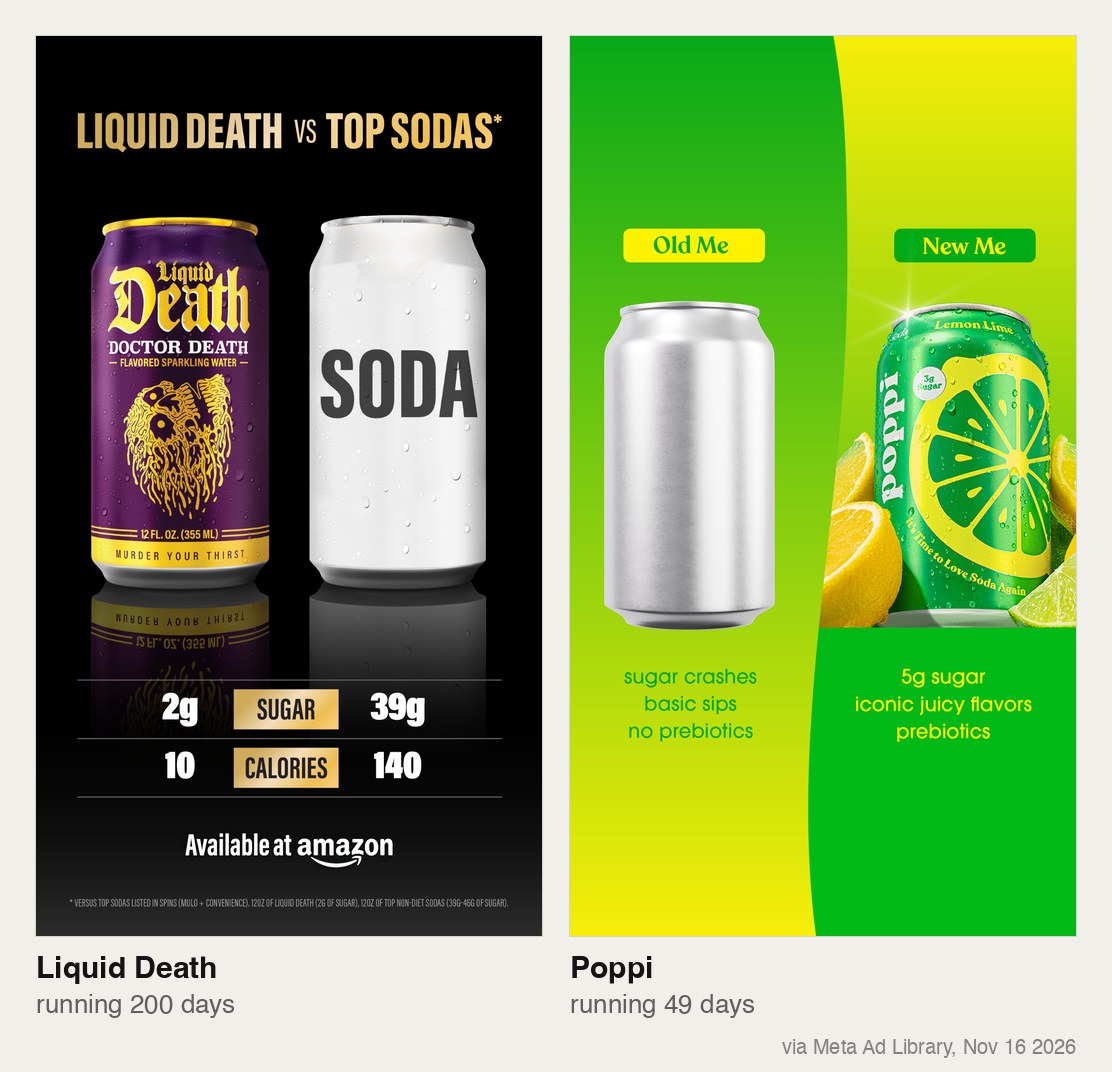
Make it: your product photo, a generic stand-in (models are good at blank cans) and the table in HTML. Every number sourced and matching the pack. AI ad tools invent claims about competitors, so build the rows from your own facts.
8. The grid, or "what you get". The range or the box contents in an even grid, with one headline. 13 ads, 5 past 60 days. Atlas Coffee Club's 3x3 grid of country bags had run 384 days. Huel's Trial Box adds a stat row: 16 meals, 40g protein, 8 flavors.
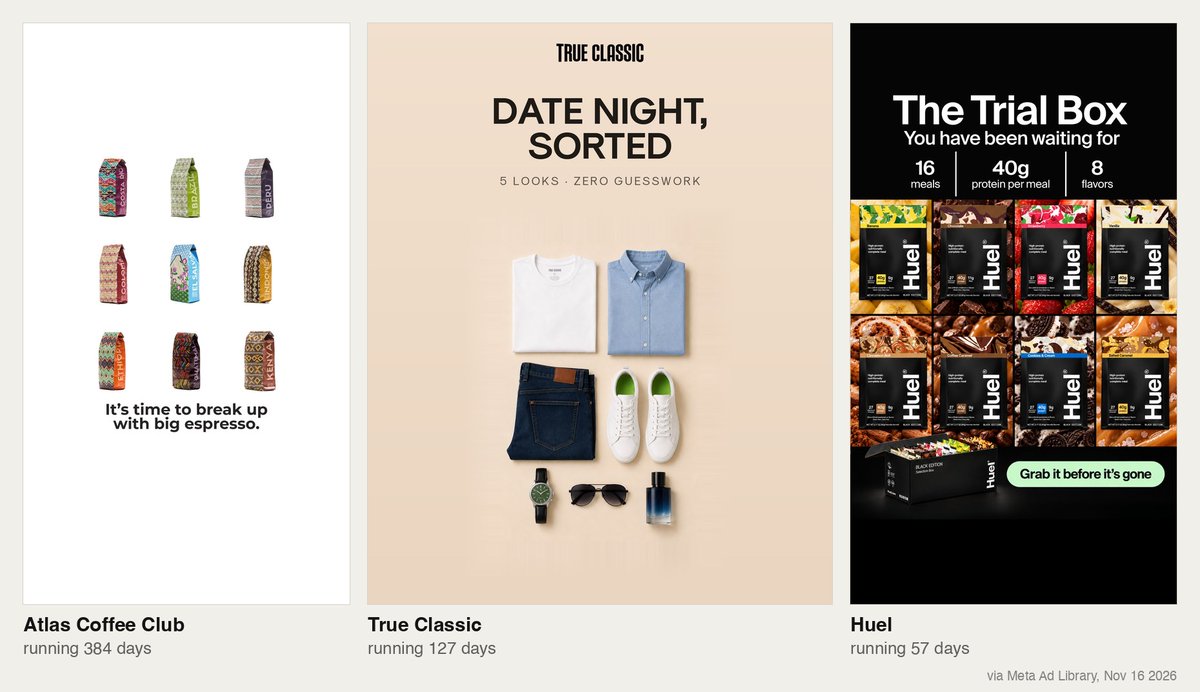
Make it: a flat lay shot from above, or separate product photos made consistent with GPT Image 2.6. The grid and the numbers go in HTML.
9. The lifestyle photo. One person using or holding the product, and one line. Only 7 ads, but 6 had run past 60 days (median 123). Helix's man hugging a pillow is the oldest still in the pull, at 503 days.
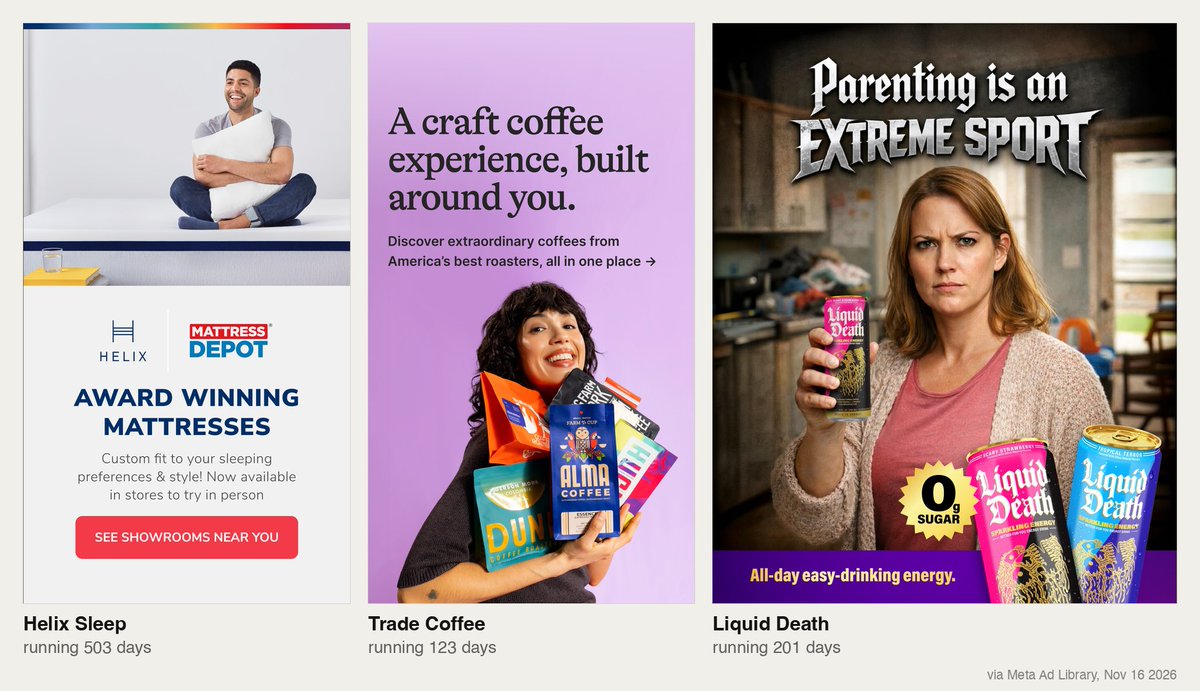
Make it: a staff member or a customer, with permission, or a half-day shoot. An AI person can model the product in a scene, but is never captioned as a customer.
The videos
Twelve video formats. Each GIF is the first 4 seconds of two real ads, the part that decides whether anyone watches the rest (#21 is a still, because we only had its poster frame). The median video runs about 34 seconds.
10. Creator to camera. A creator talking to their phone with the product in hand, captions on. The most tested video format, and the fastest to rotate. 31 of the 50 ran from the creator's own page, not the brand's. Trade Coffee's opens on the bag pushed at the lens with the caption already mid-sentence, "Delicious coffee and it". PetLab's presenter has a dog photo in the corner from the first word, and ends on "Actor portrayal" in small type.
Make it: a paid creator who actually used the product, or the owner. Have them film three different first lines over the same demo, so one shoot gives you three ads. An AI presenter can demonstrate the product (Higgsfield's Marketing Studio did this best in our tests), but it never says it has used it.
11. The customer-style video. A regular person on their own phone, talking about their own use. From the ad alone you can't tell whether they're a real customer, so we call these customer-style. 18 ads, all phone-shot, and they last longer than creator videos (8 of 18 past 60 days). The oldest ad in the whole pull is one of them, from Atlas Coffee Club at 572 days. It opens on a woman holding up her Keurig, captioned "I was about to throw my Keurig away".
Make it: real customers only. Ask happy ones after a good review, offer a gift card, get written permission, and say they were paid. A model can make product shots under their voice, never the person.
12. The hands demo. Hands using the product, close, often with no face at all. 14 ads, 7 past 60 days, and a coffee staple (5 of the 14). Cometeer drops a frozen coffee puck into a glass and pours hot water over it. Blue Bottle whisks matcha without a word.
Make it: anyone's hands and a phone overhead. For a 3 to 5 second close-up (a pour, steam, a crinkle), Seedance 2.5 can animate your product photo, with real-sounding sound built in. Never show the product doing something it doesn't.
13. The unboxing. Hands opening the box and naming what's inside. 5 ads. Atlas Coffee Club's breakup joke over bags coming out of the box had run 394 days. Hungryroot's guy unpacks groceries under "POV: This is what happens when you say yes to outsourcing".
Make it: the owner, staff or a customer at a counter. Hands only is fine. Higgsfield has an unboxing mode if you want a presenter.
14. The podcast clip. Someone at a microphone mid-story, with big captions a few words at a time. Only 3 ads, but all 3 had run past 60 days (median 203). Huel cut two clips from one set: a guest saying the host eats "Huel and only Huel", and the founder on living on it.
Make it: a real conversation, two clip-on mics and two phones on stands. Cut the best 30 to 45 seconds. No AI guests.
15. The expert. Someone with a visible credential explaining one thing. 5 ads, all face to camera. PetLab's vet in scrubs opens on "If your dog eats grass..." AG1's scientist gets a name and a credential on screen in the first second.
Make it: a real expert with a real credential, and their tie to the brand disclosed. Never an AI expert.
16. The founder or maker. The founder with the product, cut with how it's made. 3 ads. Cometeer's guy in a hairnet pushes a steaming frozen tray at the lens. Graza's opens on a man at a table saying "We grew eleven million pounds of potatoes".
Make it: the founder on a phone at work, plus footage of the process. Don't fake the factory.
17. The skit. A short scene that's already underway. 7 ads, 4 past 60 days. Liquid Death's couple in a car with a can in the cup holder had run 200 days. Everyday Dose's acts out a scene at home, captioned word by word.
Make it: staff or creators acting, labeled a dramatization if anyone could take it as real. AI actors work for plainly fictional skits, never as customers.
18. Reply to a comment. A comment bubble at the top, someone answering it. Only 4 videos open this way, and none had reached 60 days yet, but it's a direct way to answer an objection. MUD\WTR's guy answers "This sh*t is expensive!!!", and Comfrt answers "My kiddo would love it" holding up the kids' hoodie.
Make it: the owner or staff answering a real comment, with the commenter's name blurred unless they agree. Pick an objection people really raise, like price, where the answer is the pitch.
19. The recipe or how-to. The finished thing first, then the steps. 2 ads, and 9 more use it as a second format. Onyx opens on the pour, titled "How to make: tropical soda". Ka'Chava's creator makes a bowl in her kitchen.
Make it: hands and a phone overhead. Seedance 2.5 can make the hero pour or steam shot.
20. The brand montage. Five to eight short, well-lit shots of the product in use, with little or no text. 18 ads, 8 past 60 days. Onyx's sunlit counter (171 days) and Poppi's can close-ups (94 days) have the product in every shot.
Make it: a short shoot of the product where it's really used, or Seedance 2.5 clips made from your product photo, with natural sound.
21. The animated explainer. An animated picture of what's happening inside, in a body or a machine. It's rare. PetLab's see-through 3D dog licking a glowing sore paw (148 days) was the only ad in the pull that showed the inside.
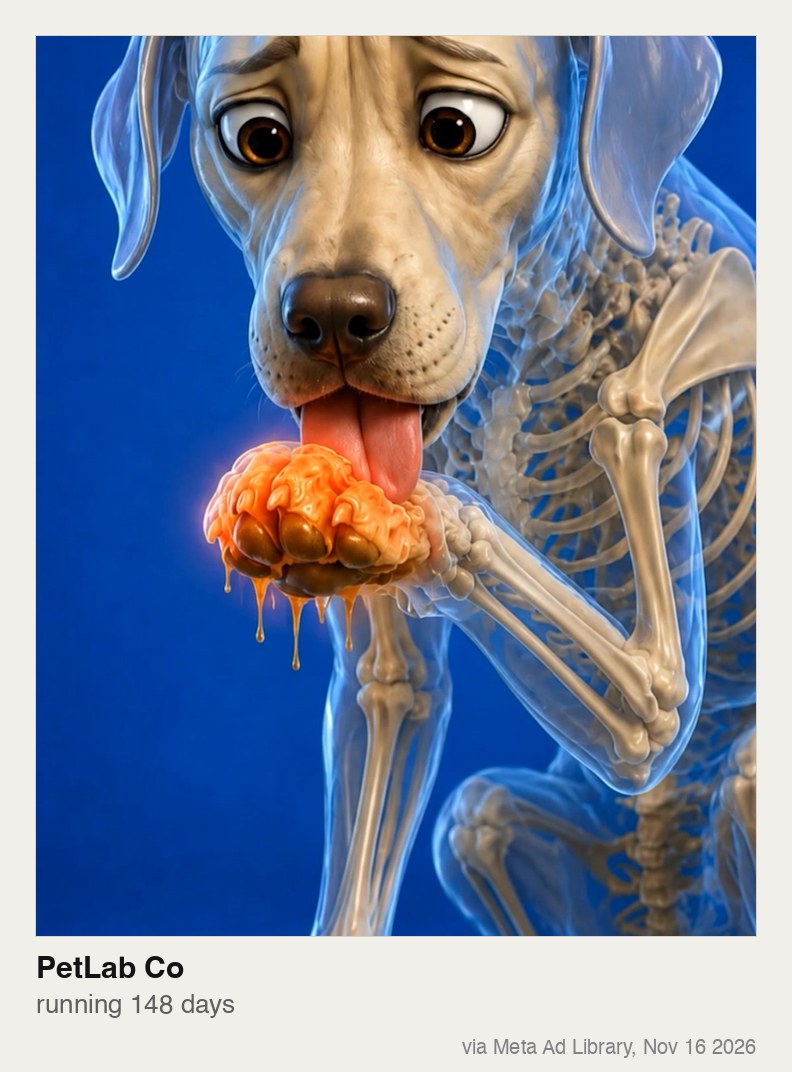
Make it: Seedance 2.5, or a GPT Image 2.6 GIF as a cheap storyboard first. An animated mechanism is still a claim, so it needs proof behind it.
The first second
The format is the container. The hook is what someone sees and reads in the first second, with the sound off. For a still, it's where the eye lands. For a video, it's the first frame plus the first caption. Twelve openings kept showing up.
-
The confession. "I was about to throw my Keurig away" (Atlas Coffee Club, 572 days). For a product that replaces something people already own or gave up on. Real people only.
-
The myth or tip. "Why I never put oily beans in my espresso machine" (Atlas Coffee Club, 396 days). For anything with a wrong way to do it.
-
The callout. "If you're waking up drenched, you need these" (Cozy Earth, 131 days). Name the situation, never a personal trait. Meta rejects "Are you overweight?" and accepts "Waking up drenched?"
-
Reverse psychology. "If you're a girl who hates being cozy..." then "IGNORE THIS" (Cozy Earth, 243 days).
-
The question. "Want brunch without the bloat?" (Lemme, 111 days). Take the question from reviews and sales calls, not from your head.
-
The timely line. "GLP-1 killed your appetite." (Huel, 178 days). Something your buyer is living through right now. Dated hooks expire, so give them an end date.
-
The result quote. "Lost 80lbs (so far) with Huel." (Huel, 247 days). Word for word, from a real reviewer.
-
The velocity stat. "One tub sold every 12 seconds" (PetLab Co, 149 days). Counted, current and checkable.
-
The dare. "We dare you to drink our espresso black..." (Atlas Coffee Club, 312 days). Works best with a guarantee behind it.
-
POV. "POV: asking neighbors for eggs" (True Classic, 77 days). A small everyday moment the product changes.
-
Reply to a comment. "This sh*t is expensive!!!", answered on camera (MUD\WTR, 41 days).
-
The mid-sentence caption. "Delicious coffee and it" (Trade Coffee, 109 days). Cut the first half second of breath, so the caption is already moving when the ad starts.
Three rules for testing them. For a video, film three different openings over the same body, so you're testing the hook and nothing else. For a still, change the line and keep the picture, or the other way round, never both at once. And use at least three different patterns in a batch, not three wordings of one.
Before a hook goes in, ask four things. Would you stop for it at 11pm, tired, thumb moving? Could ten other products run it word for word (then it's too generic)? Can you deliver what it promises? Is it as short as it can be?
Make a batch with AI
Why run so many formats at once? Meta's ad system now scores every eligible ad for each person before the auction even starts (Meta Engineering, October 2026). Most media buyers read that as the creative doing a lot of the targeting. So test different formats and angles, not ten versions of one idea.
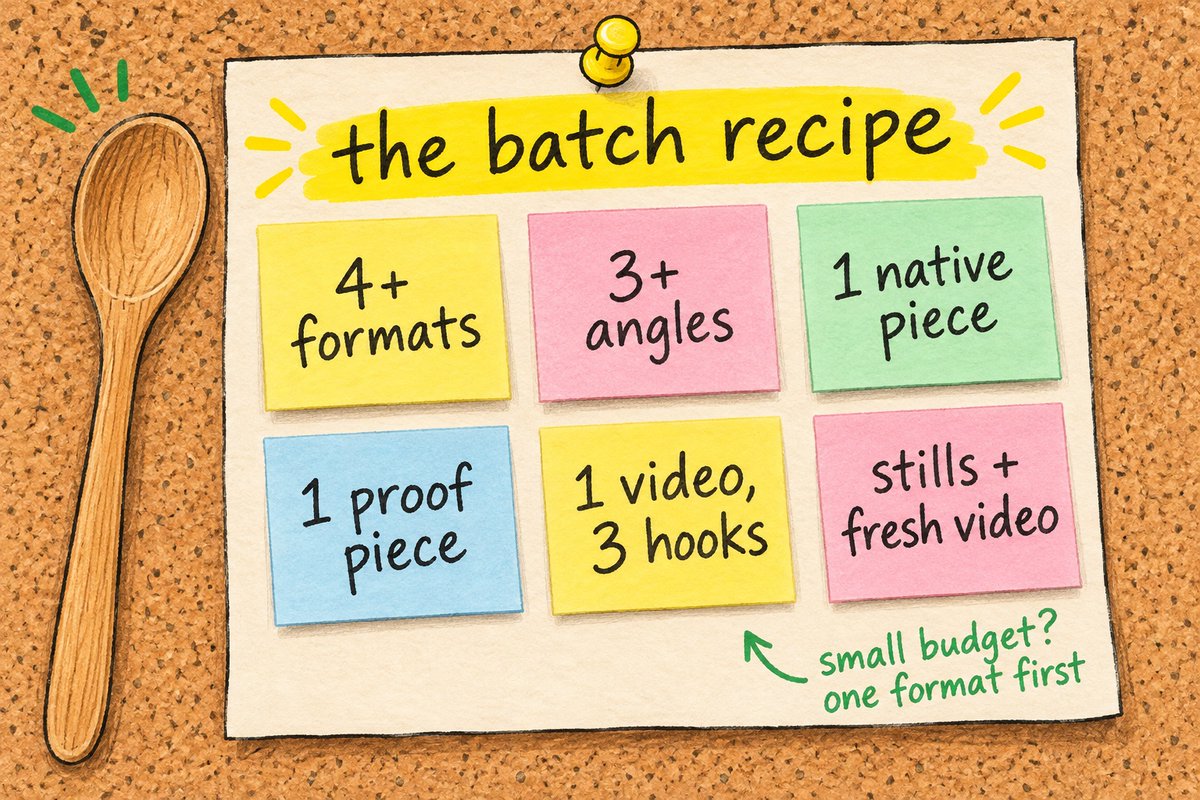
Every batch meets six rules:
-
At least 4 formats, across stills and video.
-
At least 3 angles. An angle is the reason to buy (freshness, taste, price, convenience). If the budget allows, run the strongest angle in two formats, so a winner tells you whether the angle or the format won.
-
At least one native piece: a native post, a customer video, a reply to a comment or a POV.
-
At least one proof piece: a review, a before and after, or a comparison.
-
At least one creator or customer video with 3 hooks.
-
Both lifespans. Stills that can run for months, and videos you replace every few weeks.
On a small budget (under about $50 a day), start with one format and test the angles in it. Run the full mix once you can afford it, and judge nothing before it has had about 1,000 impressions.
Then make each piece the first way the business can:
-
Real. The owner, staff, a customer or a creator shoots it on a phone. Vertical, 4K at 30 fps, window light, a clip-on mic. It's the only way to make anything that claims a customer's experience.
-
Model. GPT Image 2.6 for stills (and now GIFs). Seedance 2.5 for short clips with natural sound. Higgsfield's Marketing Studio for presenter videos. Its still-ad tool drafts formats fast, but rebuild the words in HTML (more on why below). ElevenLabs for voiceover.
-
Code. HyperFrames or Remotion cut the footage together with captions and an end card, and HTML sets every word on a still, so a misspelled word from the model never ships.
A batch we made with AI
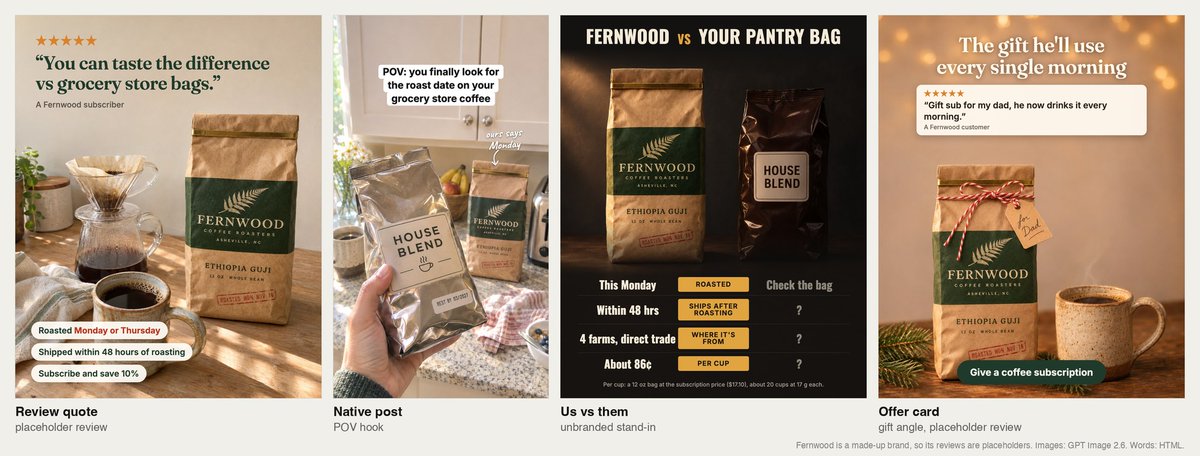
Fernwood is a made-up coffee brand we use for testing. While building the skill, we made it a mixed batch from one generated product photo (Fernwood has no real bag), with the same tools and steps the skill now follows. Fernwood has no real customers either, so the reviews on these are placeholders. Four stills, in four formats and three angles:
Three videos: a hands demo with a POV hook, two bags arguing about when they were roasted, and an AI presenter brewing a cup. The presenter demonstrates. It never says it has used the coffee.
GPT Image 2.6 can also return an animated GIF now. Nobody in our pull of 336 ran one yet, which is a reason to test it.
What we learned making it:
-
Make a product reference image first, and hand it to every scene and every video's first frame. The bag stayed the same across all 15 pieces we made (7 are shown here).
-
Put the words in HTML over the picture, not inside the model. Exact words, brand fonts, no typos.
-
Start video from a sharp first frame, with small motion. When the bag turned mid-clip, Seedance garbled the date sticker. "Small natural handheld motion only" fixed it.
-
Use the built-in sound. Seedance 2.5's audio gave us foil crinkle, beans into a grinder and a kettle pour for free. Lines of dialogue written in double quotes came out word for word.
-
Check the end card too. "At your door this week" got caught and changed to "Shipped by Wednesday", because the business only promises shipping within 48 hours of roasting.
Do it with your agent
All of this is in the creative skill in Boring Marketing Skills: the 21 formats with their real examples, the hook bank, a script that pulls any brand's live ads from the Ad Library, the batch rule, and a visual check every ad has to pass. Three prompts get you from nothing to a batch.
First, see what's working in your category:
Use the creative skill to pull the live Meta ads for [3 to 5 brands that
sell what we sell], sorted by impressions. Keep the ones that have run
60+ days, look at every one, and tell me which formats and hooks they
lean on.
Then plan the batch:
Use the creative skill to plan a first Meta ad batch for [brand], from
the angles in our reviews. Follow the batch rule. For each piece give the
format, the hook, the material it needs and how we make it (real, model
or code).
Then make it:
Use the creative skill to make pieces 1 to 4 from the batch plan,
starting with a product reference image from [product photo]. Shot
lists and creator briefs for anything we have to film.
The pull uses a free Firecrawl key. Without one, the skill gives you the Ad Library links to open yourself. If you don't have angles yet, the positioning-angles skill finds them in your reviews first.
It also learns from your edits. When you fix something it made, it saves your fix as a yes or no check that every later batch has to pass. After the ads run, the performance-review skill reads the results and keeps the winners as examples for the next batch.
What breaks
-
Trusting run time too much. Age is the best public signal, and it's still only a signal. A Black Friday card from last year was still live, and some of the biggest spenders replace everything every two weeks.
-
AI tools that make things up. We tested Higgsfield's still-ad tool, and 3 of its 4 ads invented something we'd told it not to: a name on a real review, a website, claims about competitors. Check every line against what's true before anything ships.
-
AI people posing as customers. An AI presenter can demonstrate. It never says "I've used this for three weeks", never gives a testimonial, and never stands next to a real review where it reads as the reviewer. Label it where the platform asks.
-
Garbled text in video. Models mangle small text when things move. Start from a sharp frame, keep the motion small, and put captions on in the edit.
-
Words on a gradient. For a physical product, a line of text on a color isn't an ad. Show the thing.
-
Copying the look instead of the reason. The Keurig ad works because it opens on something viewers own and are fed up with. A copy that keeps the trash can and loses that reason won't work.
-
Calling it too early. Give each piece about 1,000 impressions before you judge it, and change one thing at a time.
-
Our own blind spots. We watched 94 videos frame by frame but heard none of them, and the pull is all DTC. A plumber or a software company will see different winners, so the skill translates every format for local services, software and professional practices. Still, test on your own numbers.
The oldest ad in our pull opens on a woman holding up her Keurig, captioned "I was about to throw my Keurig away". It was shot on a phone, and it had been running for 572 days when we found it.
Pick four formats from this list and three angles, and make the batch this week.
Want the skills? The creative skill is one of 32 free skills in Boring Marketing Skills. They work in Claude Code, Codex, Cursor and other agents, for any kind of business.
Install them with one line:
npx skills add boringmarketer/boring-marketing-skills
Then type /start-here and name your business.