How to Become a GTM Engineer: The Complete Guide

文章目录
2 years ago I was working in fashion, selling screen-printed merch and staff holiday gifts to companies. I had no idea what a GTM engineer was.
Today I'm co-founder of Frontal, the GTM agency that grew out of ColdIQ. We've worked with 300+ B2B companies so far.
ColdIQ hired me as a GTM engineer in February 2025, with no experience in tech. A week in, I gave away my first n8n workflow on LinkedIn. It pulled businesses from Google Maps, scraped their sites for emails and sent a clean list to a Google Sheet.
The post had 1 like after 45 minutes and I almost deleted it. The next day I had 350 new followers, so I kept posting builds.
Within a year I was Head of GTM. 20 months after they hired me, I became co-founder.
GTM engineer jobs pay $130K to $295K right now, and the average posting asks for 4.11 years of experience. I got into this field with 0.
This is the guide I wish I'd had: what the job is, what to learn, the 5 systems to build and how to get hired. It's 9 steps, with the tools and numbers we use at Frontal. Bookmark it and work through 1 step at a time.
Step 1: Know what the job is:
4 roles get mixed up:
-
An SDR (sales development rep) books meetings from a list someone else built.
-
RevOps keeps the existing revenue machine running. GTM engineering builds new capability.
-
A GTM engineer builds the systems behind outbound: AI account research, a map of the total market (the TAM), verified contact data and automated outreach. SDRs and account executives work from what they build.
-
A forward deployed engineer works inside the customer, builds the last mile and ships the reusable parts back into the product.
We hire from a map with 2 axes: business sense and technical skill. The hire sits where both are high.
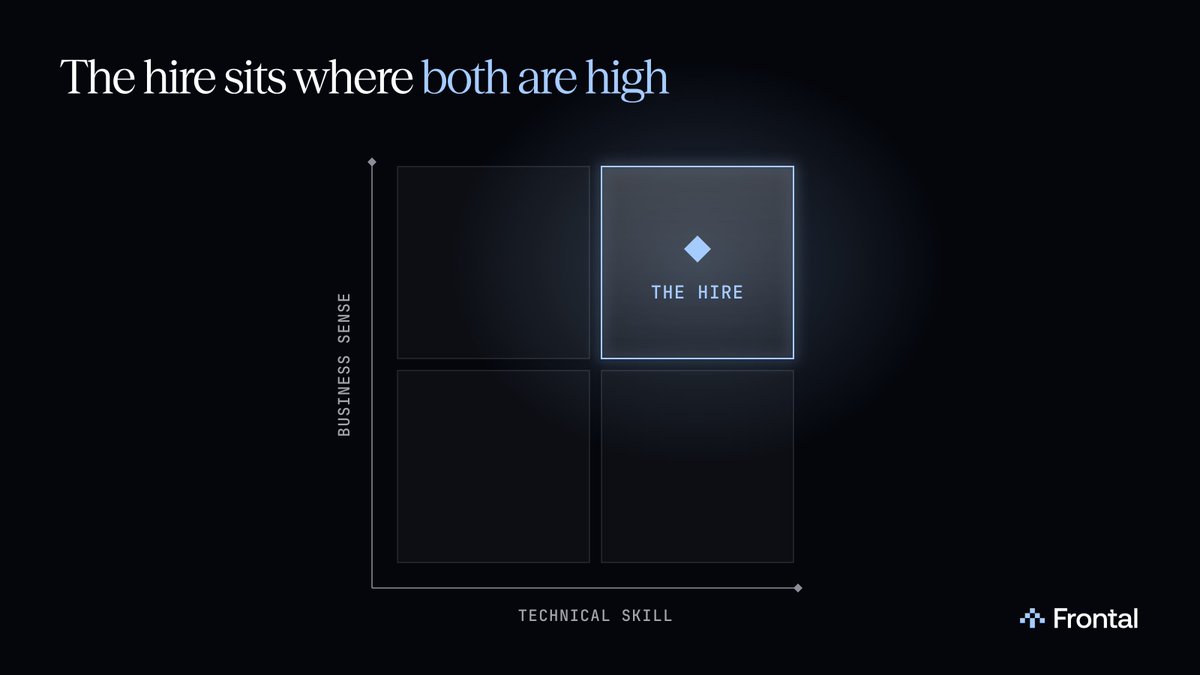
The job is also splitting into 2: people who run the tools and people who build them. The builders get paid more (Step 9).
Here's what 1 builder did at Vercel. A GTM engineer there built a lead agent part-time in 6 weeks. It costs about $1,000 a year to run, 9 of their 10 inbound SDRs moved to outbound, and conversion held flat. Their COO shared it on Lenny's Podcast.
What the work looks like now:
We run 37 agents at Frontal. 5 of them changed how we work:
-
Lead scoring: a raw list goes in, and every company comes out with a score and a tier.
-
Pre-call research: a booking fires a webhook, Clay enriches the person and the company, and the brief lands in Slack in 90 seconds. It used to take a rep 15 minutes a call.
-
Signal to sequence: a hiring post, a funding round or a stack swap writes its own first line and pushes the contact into Instantly, our email sequencer.
-
Copy intelligence: I ask what to send, and it answers from 11,000+ campaigns we've already run.
-
Meeting action items: a call transcript from Fireflies goes in, and the next steps get written into the CRM.
A GTM engineer builds and maintains agents like these. You still plug in your own API keys and debug what breaks.
Step 2: Read what the job posts ask for:
These are 6 live postings and what each one pays. The dashed line is the US median: $159K across 509 postings, per Cargo.
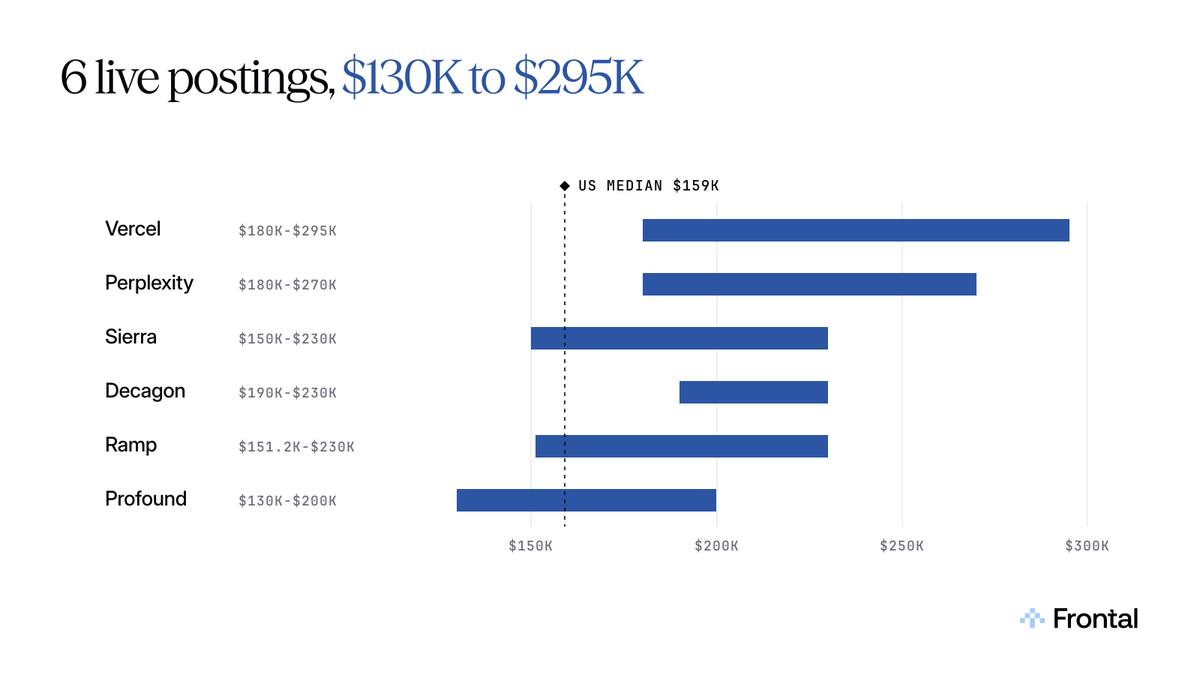
| Company | Pay | Experience |
|---|---|---|
| Perplexity | $180K to $270K | 2+ years |
| Vercel | $180K to $295K | 4+ years full-stack |
| Sierra | $150K to $230K | 3+ years |
| Profound (Pre-Sales) | $130K to $200K | Not listed |
| Decagon | $190K to $230K | 4+ years |
| Ramp | $151.2K to $230K | 7+ years on Salesforce |
What the 6 have in common:
-
Python or SQL appears in 5 of the 6, Salesforce in 4 and Clay in 3.
-
The titles already vary. Decagon is hiring a GTM Analytics Engineer, and Ramp a GTM Business Systems Engineer for quote-to-cash.
-
The lowest stated bar is 2+ years. None of the 6 is a junior role.
Bloomberry's wider analysis of GTM engineering jobs leans more on sales tools. HubSpot appears in 52% of postings, Outreach in 49%, Salesforce in 45%, and SQL and Python in 38% each.
The same analysis puts the average ask at 4.11 years of experience. Step 7 covers how to compete with fewer.
Step 3: Learn to build, in this order:
The job runs on 5 tools. This is the order I'd learn them in.
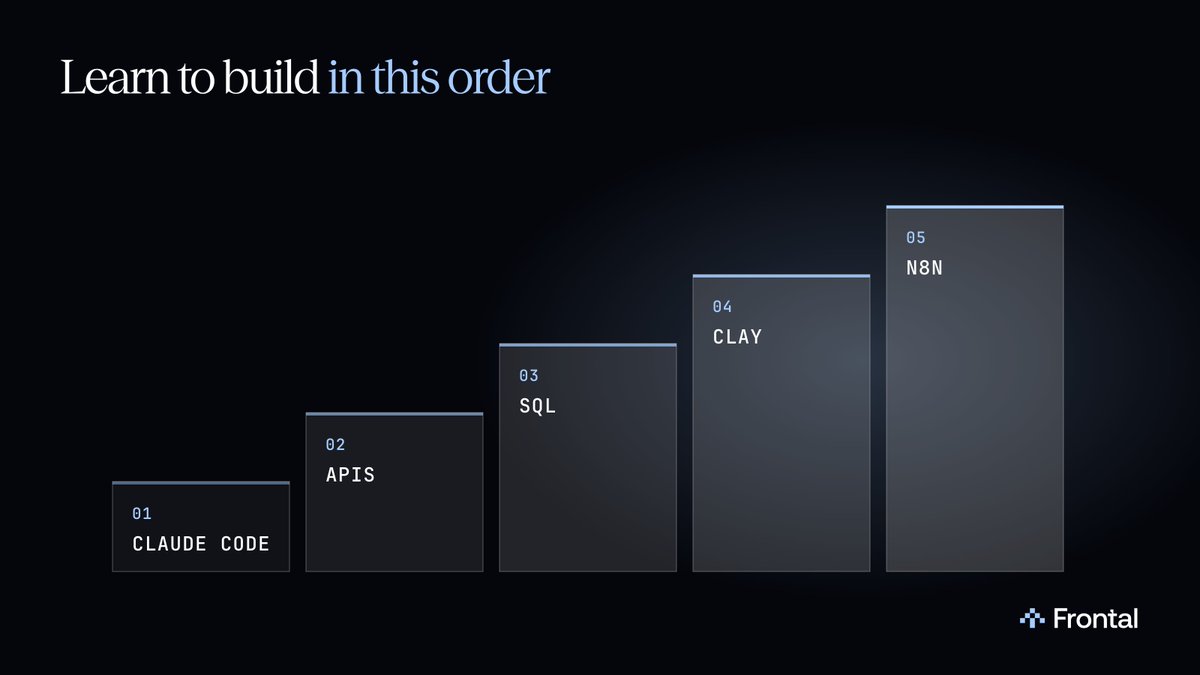
1. Claude Code:
Use it as your builder and your tutor. Have it write a script, then explain every line back to you. That's how you pick up enough Python to read what it writes.
Learn 3 things inside it:
-
CLAUDE.md: the file Claude reads at the start of every session. Cap it at 200 lines, because past that it sprawls.
-
Skills: a saved instruction file that teaches Claude 1 job.
-
MCP servers: the connections to your tools. I run 18 of them every day.
Skills handle knowledge. MCP handles actions.
2. APIs:
Learn auth, rate limits, pagination and errors on a real job. Pulling contacts from the Apollo API is a good first one. Keep your keys in a private .env file, never in the repo.
Then chain a few together. This is the chain I ran for a 300-company SaaS campaign:
-
AI Ark for the companies: 300 SaaS companies at 200 to 500 employees, in under 2 minutes.
-
PredictLeads for the signals: 186 of the 300 were hiring for sales and marketing roles.
-
BlitzAPI for the decision-makers at the flagged companies.
-
A second email provider for the gaps the first one missed.
-
FullEnrich for mobile numbers.
-
Instantly to create the campaign and push the leads, in draft mode.
All 6 ran from natural language prompts in Claude Code.
3. SQL:
Put your TAM lists, contacts, campaigns and daily campaign numbers in 1 database and learn to query it. At Frontal every GTM engineer queries the same database, and campaign performance gets tracked daily with no manual report.
4. Clay:
Clay is a spreadsheet that enriches every row with data and AI. Build 1 table by hand first: a company list, a research column run by Claygent (Clay's AI agent) and an email waterfall, which runs several email finders in a row until one finds the address. Tables cap around 50,000 rows, and someone has to be there to run them. Past that, move the job to a Clay workflow. It has no cap, fires on a webhook or a schedule, and records every step so you can see which node failed. Keep work that needs judgment or rich context in Claude Code.
5. n8n:
n8n connects your tools with automated workflows. Learn webhooks and schedules. When I tested it in late 2025, Claude could build 90% of an n8n workflow once I gave it the docs. You'll still add your own API keys and debug a step or two.
Start with the 6 core flows I automate in n8n and Make:
-
Ghosting: auto-close deals with no activity for 30+ days.
-
Discovery: trigger sequences for cold leads.
-
Offer tracking: follow up after proposals.
-
Closed won: kick off onboarding tasks.
-
Lead creation: route inbound fast.
-
Sales handoff: notify AEs on qualified leads.
How to pick tools:
-
Go deep on a few.
-
Pick the ones an agent can drive. Ours connect straight to Claude: Instantly, Fireflies, Notion, Clay, Apollo and Attio.
What you ship: a Google Maps list for 1 niche in 1 city. Scrape it with Apify at about $7 per 1,000 businesses, dedupe it and load it into a sheet.
Step 4: Learn who to go after, what to say and how to send it:
This step decides which accounts go on the list, what you say to them and whether the email lands.
Start from the ICP math:
Take 1 ICP (your ideal customer profile), 3 segments, 2 personas and 3 copy variations each. That's 6 lists and 18 tests.
Look where other teams don't:
We mapped 60+ data sources for outbound. Most teams live in 3: LinkedIn, ZoomInfo and Apollo. A few we use all the time:
-
Product Hunt launches, where founders list their email on day 1.
-
G2 reviews, where buyers complain about your competitor by name.
-
GitHub repos, where technical buyers show you their stack.
All of them are reachable with Apify scrapers and some workflow logic in Clay.
Filter on signals before you write a word:
We filtered one list on sales teams up 30%+ in 90 days, funding in the last 6 months, and Salesforce or HubSpot. It went from 10,000 contacts at 4.2% replies to 3,200 at 6.8%.
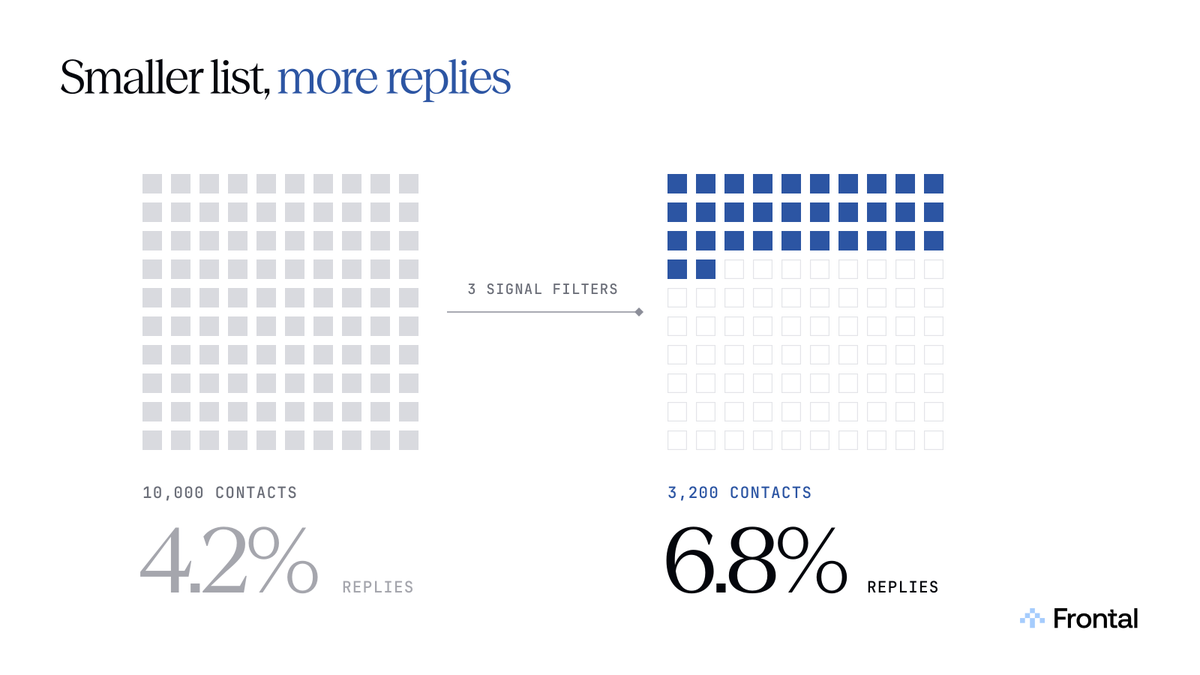
The replies changed too. "Try again in 6 months" became "What does your calendar look like?"
Know the 2 kinds of signal:
-
Company signals: a hiring surge (5+ new roles live), fresh funding, an office expansion, a new tech stack, a leadership change.
-
Behavior signals: website visits, content downloads, LinkedIn profile views, email engagement, competitor research.
Give every trigger an age limit:
A trigger is a recent change that gives you a reason to email. My library has 50 of them. Only 7 go live on day 1, and they include funding rounds, leadership moves, job posts, site visits and post engagement.
Every trigger gets an age limit, so a funding round from 4 months ago doesn't still push an account up the list. 2 windows we use:
-
New leaders: VP and above in sales, marketing or RevOps, under 90 days in the seat.
-
Funding: every Friday, pull the rounds from the last 7 days and skip seed.
Write the first line from the signal:
Open on what changed at the account, like a new funding round or 3 open SDR roles.
The shape we use after 10,000,000+ emails:
-
Line 1: the trigger or observation.
-
Lines 2 and 3: how you solve it.
-
Line 4: an open-ended question.
-
P.S.: a personalized touch.
Keep it to 70 to 80 words, with 1 clear CTA.
Time the sequence to the deal size:
-
SMB: 5 to 8 touchpoints over 30 days. Email on day 1, a follow-up on day 3, a LinkedIn connection on day 5, a value email on day 8, a case study on day 12 and a final attempt on day 17.
-
Enterprise: 10 to 18 touchpoints over 60 days, with longer gaps and half the touches on calls and LinkedIn.
Learn from your own winners:
After 10,000+ emails, connect Claude Code to the Instantly API, pull every campaign and have it find 3 to 7 frameworks in your best sequences. Test 1 variable at a time.
Know the sending math:
-
20 secondary domains. Your main domain never sends.
-
40 mailboxes at 20 to 25 sends each a day, so 800 to 1,000 a day.
-
2 weeks of warm-up, with SPF, DKIM and DMARC on every domain. Every domain forwards to the main brand site.
-
Bounces under 2%. Retire domains at 9 to 12 months, with backups always warming. The goal is 95%+ landing in the primary inbox.
Read the right numbers:
I ignore opens and click rate. I watch:
-
Reply rate: 1 to 5% is the industry norm, 10%+ is good, 25%+ is great.
-
Positive reply rate: 0.1 to 0.5% is the norm, 1 to 3% is good.
-
Show rate: 70 to 80%.
-
Spam rate: under 0.1%.
What you ship: 1 campaign for 1 real ICP, built from your 6 lists and your 7 day-1 triggers. For every account on it, you can say in 1 sentence why it's there.
Step 5: Write prompts that hold up at volume:
Every system in Step 6 runs on prompts, so write them first.
-
Write the disqualifiers first. A roofer search also finds roofing suppliers.
-
Ask for a 1-line reason next to every verdict.
-
Make "not found" an allowed answer, so the model leaves a blank where it has no data.
-
Write each prompt in 4 parts: input, 1 job, validation, output.
-
Spot-check by hand before you scale. In one test, a VA took 4 hours on 100 company websites. Clay took 11 minutes, and 19 of the 20 we checked were right.
-
Run the cheap model first, then test it. My co-founder @itsalexvacca open-sourced a bot that runs on Haiku, Claude's cheapest model. It ships with a test: label 100 examples by hand, then run Haiku and Sonnet on the same 100. If Haiku misses too many, move that job to Sonnet.
What you ship: your hit rate on 100 examples you labeled yourself.
Step 6: Build the 5 systems, in order:
Build them in order and measure replies after each one, so you know which system drove the lift.
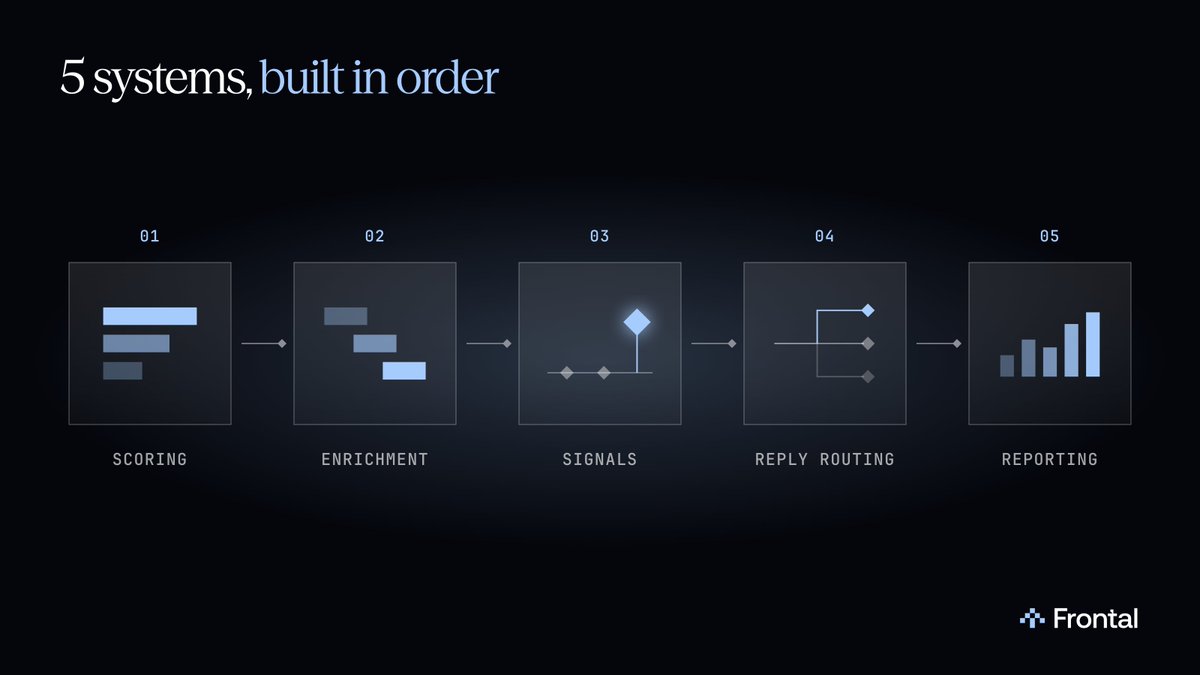
1. Scoring:
A raw company list goes in. Tier 1, 2, 3 or disqualified comes out. Claude Code reads your criteria file and writes a Python script that scores every company. On one of our builds, it scored 110 companies in under a minute.
Every account gets 2 scores:
-
Fit: how close it is to the companies that already bought from you. This sets the tier.
-
Intent: what changed recently, and how much it counts. An exec hire or a funding round outweighs 1 page visit.
Set the starting weights from your closed-won deals. Your first weights will be wrong, so tune them off reply data. Tier 1 gets a person doing real research before a word is written. Tier 3 goes into the sequencer and nothing else.
Read scoring.md. Write a Python script
that tiers companies.csv: 1, 2, 3 or
disqualified, with a 1-line reason.
2. Enrichment:
Tier 1 and 2 companies go in. Verified contacts come out. With a Wiza, FullEnrich and Prospeo waterfall, coverage can push past 90%. On one build, Claude Code pulled 153 contacts from the Apollo API in about 90 seconds, and a second provider got 149 of them to a verified email.
Find the VP Sales at each tier 1-2
company. Run misses through the next
provider. Write "not found" if all
fail. Save which provider found it.
3. Signals:
Your account list goes in. Dated signals come out. Where we get them:
-
Funding, leadership changes and hiring spikes: PredictLeads.
-
Site traffic: RB2B or Vector.
-
Post engagement and past champions in a new seat: Trigify.
-
G2 complaints and Product Hunt launches: an Apify scraper.
Save each one on the company record in your CRM with a date, a source link and a weight. Let scores decay daily and re-rank every morning.
Check each account for funding, new
VP hires and open sales roles in the
last 90 days. Save signal, date and
source URL. Re-rank the list.
4. Reply routing:
Replies go in. Positive ones reach a person with the account context attached. Put an approval gate in front of every send, so a person signs off before anything goes out.
Label each new reply: positive, not
now, wrong person, unsubscribe. Post
positives to Slack with the account
file. Send nothing yourself.
5. Reporting:
Campaign data goes in. 1 snapshot per campaign comes out every day. Watch spam and bounce rates first, because they move before replies do.
Pull analytics for every live
campaign. Save sends, positive
replies and bounces per day. Flag
any campaign with bounces over 2%.
Make each one fire on an event: a booking, a reply or a new signal. The agents we use most never wait for someone to open them.
Put all 5 in 1 GitHub repo, with a context file per client and a skill per repeatable job.
gtm-os/
  CLAUDE.md   team rules: ICP, tone,
              what never to send
  skills/     one folder per skill
  clay/       workflows built with
              the Clay CLI
  context/    ICP, personas,
              proof points
What you ship: all 5 systems running end to end on 1 ICP, in 1 repo.
Step 7: Build a public portfolio:
Clay's certification has been closed to new submissions since March 2026. A public build is your proof now.
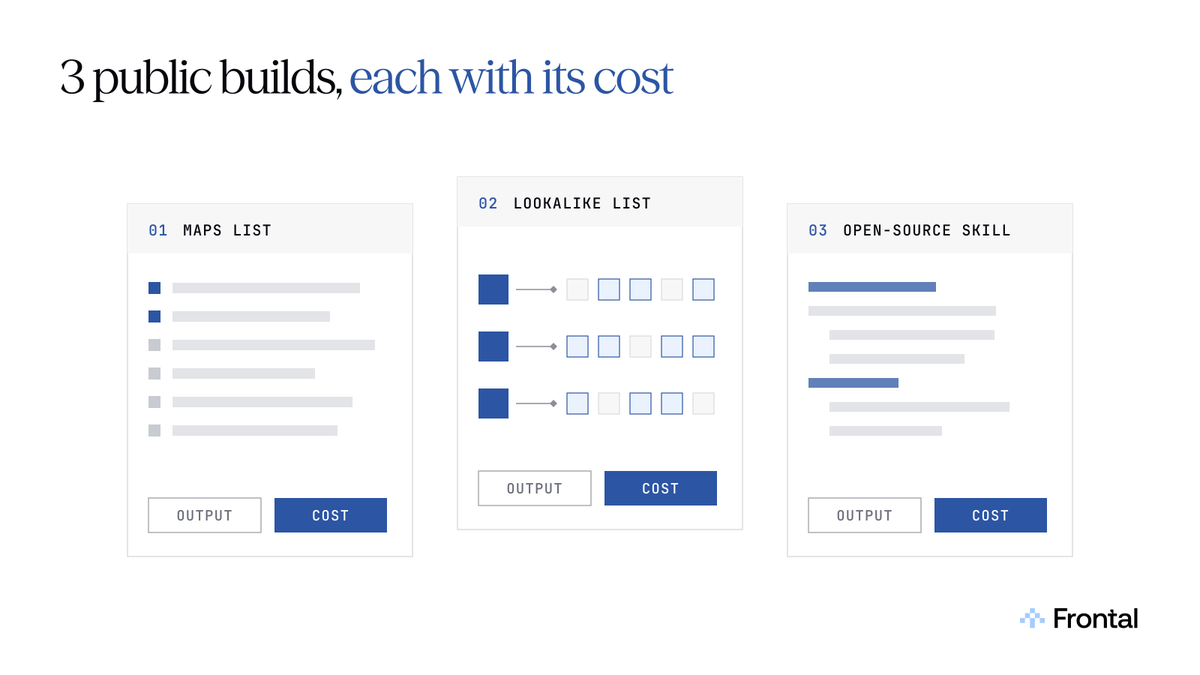
Build 3 projects and publish each one with its output and what it cost:
-
A local business list from Google Maps (the Step 3 build).
-
A lookalike list. Take 30 to 50 customers of a company you'd want to work for, from its public logos and case studies. Pull 50 similar companies per seed with CompanyEnrich, cut the wrong ones by hand and have Claude tier the rest.
-
An open-source skill or repo, like Alex's Haiku bot.
Then send it to someone. A company's next hire can be your next outbound campaign. Run that play on yourself: find a company hiring a GTM engineer, build a sample of the list that role would own, and send it to the person making the hire.
If you have 0 years, start with agencies:
None of the 6 postings in Step 2 is a junior role. An agency hired me with 0 years and started me on 2 or 3 client accounts. The reps add up fast.
What you ship: 3 public builds, each with its output and its cost.
Step 8: Pass the hiring test:
The tools won't tell you who to go after. An agent builds a clean list of the wrong people faster than you ever could. So the interview tests your judgment.
Alex opens with a 30-second test. He hands a candidate an ICP and listens to their first question. If it's "What list should I build?", he sees an SDR with a Clay license. He wants to hear: "What signal tells us this account is ready to buy, and how do we automate around it?"
Then comes the build: a Clay workflow from scratch, and you defend why those accounts fit the offer.
Bring your 3 builds from Step 7. For each one, know why every account is on the list and what your hit rate was on a sample you labeled.
Practice all of it out loud before your first interview.
Step 9: Grow into more accounts:
You move up by running more accounts. By March 2026, each GTM engineer at ColdIQ managed 10 clients. In 2023 it was 3.
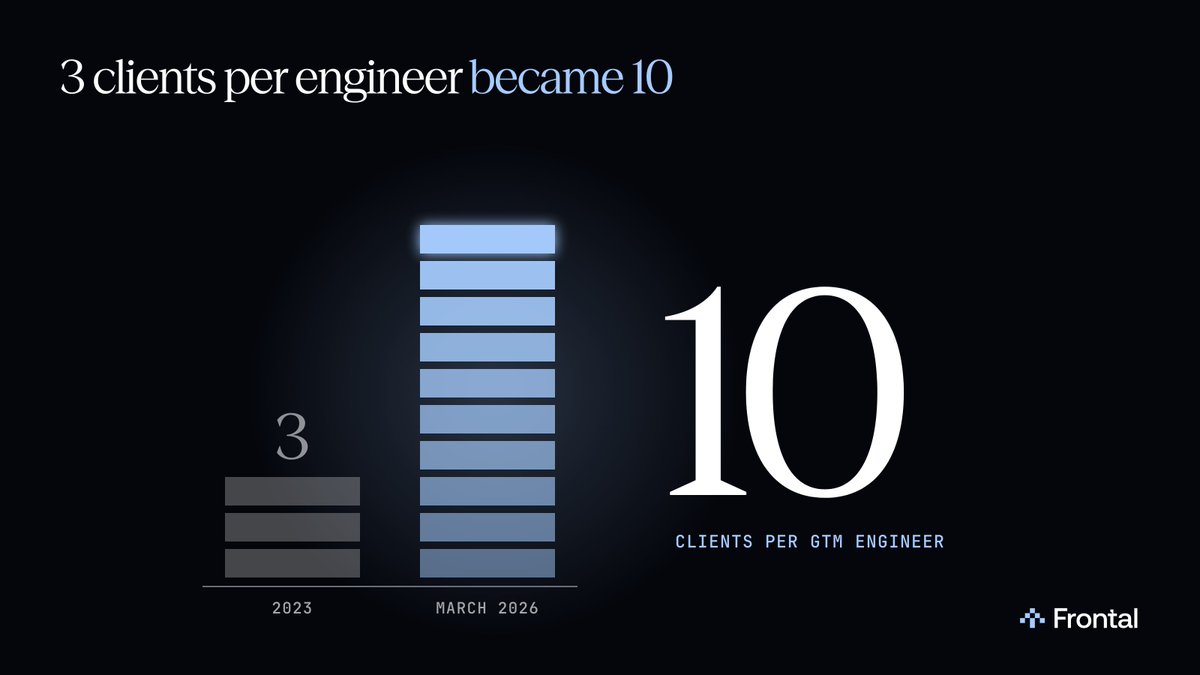
I run outbound for 15 of our 70+ clients myself, from 1 terminal. 3 things make that possible:
-
Every client is a folder with 1 context file: ICP, offer, personas, what's working, what's not. When a new client signs, I copy the folder and rewrite that 1 file.
-
Every repeatable job is a skill: 1 file, 1 job. I write it once and every account uses it.
-
Agents fire on events. A booking, a reply or a new signal starts the work, so nothing waits for me to open it.
Track how many accounts you run end to end. Ask for the next one once your current ones run on your systems.
The pay follows. Cargo's middle half runs from $135K to $190K. Bloomberry's median, from a different set of postings, is $127,500. Alex says the engineers who build go for $40K to $60K more than a comparable RevOps hire. His bet is that 1 engineer who builds the tools is about to be worth 10 who run them.
What my first 12 months looked like:
-
Month 1 felt like a classroom every day. I studied what was working for the people ahead of me, broke it down and made my own version.
-
I posted every day from my first weeks and gave something away in each post. My followers grew 42.2% in 7 days, and 3 people reached out about ColdIQ's services in a single day.
-
I built multiple internal tools for the team.
-
11 months in, I became Head of GTM.
None of it needed 4 years of experience.
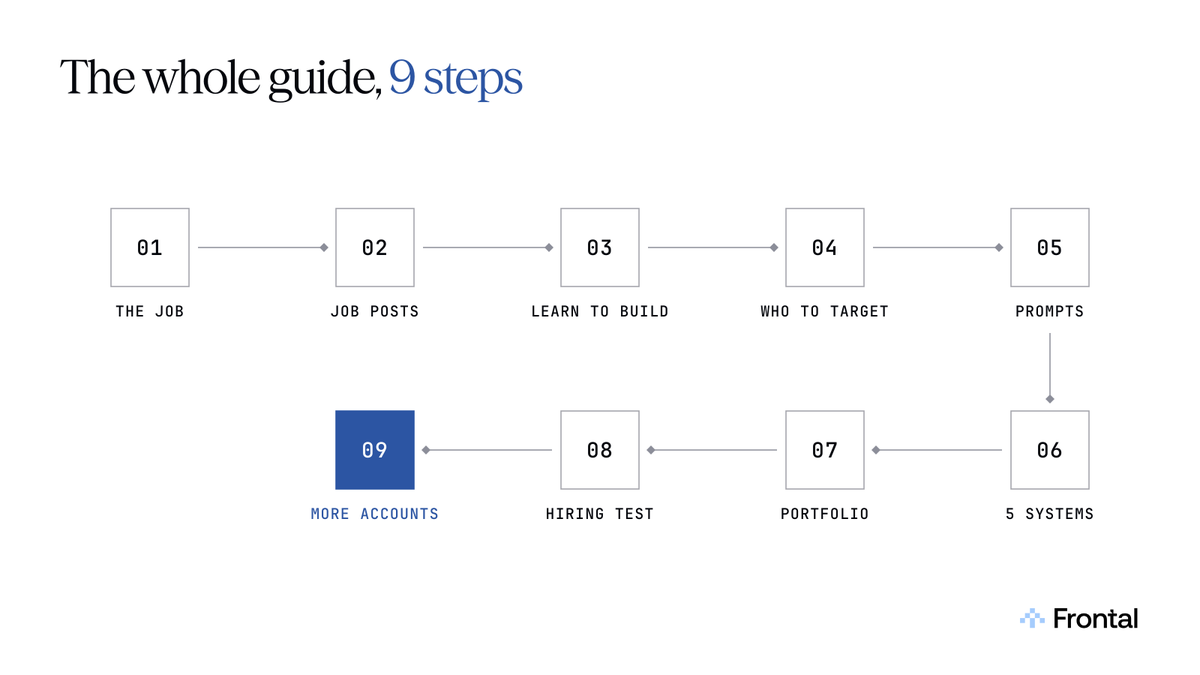
The whole guide on one page:
-
Know the job. You build the systems sales reps work from.
-
Read the job posts. Python or SQL shows up in 5 of 6, Salesforce in 4, Clay in 3.
-
Learn to build: Claude Code, APIs, SQL, Clay, n8n. Ship a Google Maps list.
-
Learn who to go after, what to say and how to send it. Ship 1 campaign from 6 lists and 7 triggers.
-
Write prompts that hold up at volume. Ship your hit rate on 100 labeled examples.
-
Build the 5 systems: scoring, enrichment, signals, reply routing, reporting. Ship them in 1 repo.
-
Publish 3 builds, each with its output and its cost.
-
Pass the hiring test. Ask about the signal first, then defend every account on your list.
-
Run more accounts. 1 context file per client, 1 skill per repeatable job.
This is how you can get started
The tools in this guide will change. I've replaced every tool in my GTM stack in the last year, and I'll replace them again.
The job won't. Someone still has to decide who's worth reaching, build the system that reaches them and check what it sends.
That's the skill companies are paying $130K to $295K for, and you build it by shipping. So skip the plan to learn all 9 steps first. Build the Step 3 list this week, for about $7 per 1,000 businesses, and put it where people can see it.
Then build the next one.