How to Write Hooks That Hit 45%+ Hook Rate

文章目录
Your best ad is slowing down, and you're about to write a new script for it.
Before you do, look at where it's actually tired. Most of the time it's the first 3 seconds, and the body you already paid to prove is still fine.
Me and Claude went over 40 video ads that brands have kept running on Meta for 90 days or more. Half of them have been live for more than 280 days.
Here's how we write hooks that hit 45%+ hook rate, and how to put them in front of an ad that already works.
What's inside:
-
The 3 jobs every hook has
-
The fatigue check: is the hook the tired part?
-
The 4 kinds of first lines that keep running
-
What the 40 have in common, counted
-
The visual is half the hook
-
How many hooks to test under Andromeda
-
The swap: 10 new hooks on a proven body
-
3 Claude prompts to do it this week
-
Where this breaks
1. The 3 jobs every hook has
A hook has to do at least one of these three things.
Relevance. It speaks to a problem your buyer has already felt. "Your toes will never be cold again."
Curiosity. It opens a loop the viewer wants closed. One of our pet ads opens on "So vets recommend something called occupational chewing therapy to help calm dogs naturally." Nobody has heard of it, so they keep watching. The same phrase becomes the mechanism later in the ad.
Emotion. It forces a reaction. Surprise, frustration, a belief pushed against.
And one thing on top of all three: the hook has to stop the right person.
A 10% hook rate from your buyers is worth more than a 100% hook rate from people who will never buy. Hook rate on its own tells you who stopped. It doesn't tell you if they were worth stopping.
2. The fatigue check: is the hook the tired part?
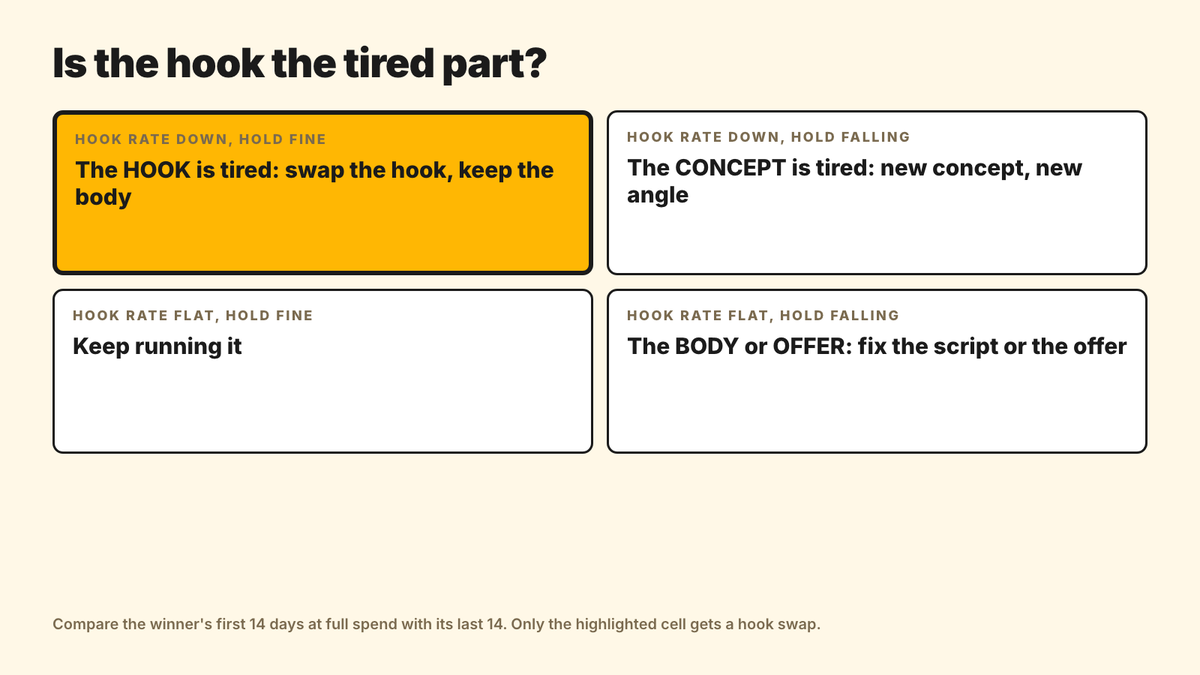
Before you touch the hook, pull your winner's numbers for two windows: its first 14 days at full spend, and its last 14 days.
-
Hook rate = 3-second plays divided by impressions
-
Hold rate = ThruPlays divided by 3-second plays
Then read the pattern:
| Hook rate | Hold rate and CTR | What's tired | What to do |
|---|---|---|---|
| Down | Flat or up | The hook | Swap the hook, keep the body |
| Flat | Down | The body or the offer | Fix the script or the offer first |
| Down | Down | The concept | New concept, new angle |
| High | Low from the start | It only worked as a thumbnail | Keep the first frame, rewrite the script |
Only the first row gets a hook swap. If the body is the problem, a better hook just brings more people to the same drop-off.
On one account we manage, the best old ad ran a 25% hook rate and everything after the first 3 seconds was fine. We put a hook from another ad that pulled 58% in front of the same footage, and that ad scaled. That's why we treat 40%+ as a strong hook.
Is the hook the tired part?
3. The 4 kinds of first lines that keep running
We grouped the 40 first lines the way we brief hooks: who it calls out, a moment the buyer knows, proof, or a pattern break.
Call-out hooks (8 of 40). They name who it's for or the exact situation.
-
"Say goodbye to dull, lifeless skin." (Jones Road Beauty, 605 days live)
-
"This is the perfect gift for the golfer who has everything." (Awesome Maps, 363 days)
Template: "[The exact person] who [the exact situation], this is for you."
Moment hooks (13 of 40). A first-person moment the buyer has lived.
-
"I gave up on DIY nails years ago until I found these." (Sassy Saints, 282 days)
-
"I didn't think an LED mask could actually firm my skin this fast, but here we are." (Luna&Skin, 475 days)
Template: "I [gave up on / didn't believe in] [the category] until [the product moment]."
Proof hooks (7 of 40). A number, a study, a test or a demo in line 1.
-
"Three reasons this scrub ended the flakes in my parts." (Living With Psoriasis, 92 days)
-
"With the sample kit from Brickell Men's Products, I get the opportunity to try out eight of their best-selling body and skincare products." (Brickell, 1,146 days)
Template: "[Number] reasons [product] [ended the problem]."
Pattern-break hooks (12 of 40). A contrarian line, a warning, an odd scene or a pure reaction.
-
"Steroid creams aren't fixing your eczema, they're making it worse." (Derma Root, 557 days)
-
"Don't buy Nutrivena's Lymphatic Drops. Here's why." (107 days)
-
"Oh my goodness." (Cozy Earth, 236 days)
Template: "[What they use now] isn't fixing [the problem], it's making it worse."
4. What the 40 have in common, counted
-
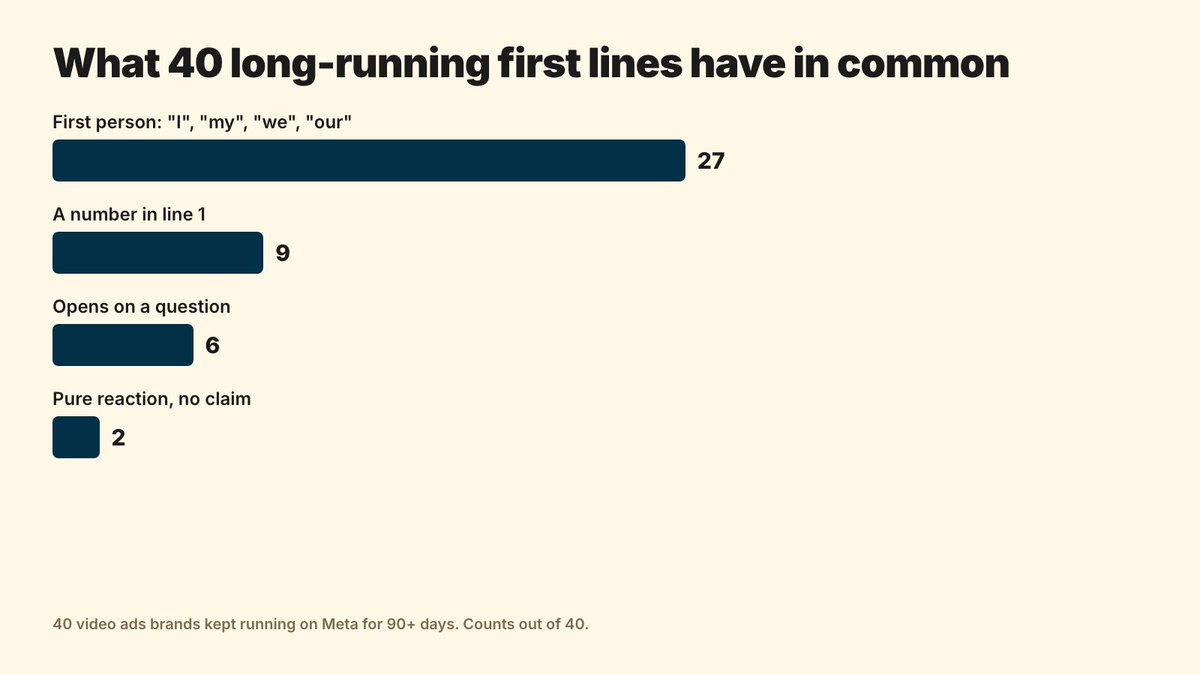
27 of the 40 first lines say "I", "my", "we" or "our"
-
9 put a number in the first line
-
6 open on a question
-
2 are a pure reaction with no claim at all, and they were still live after 236 and 550 days
So the hooks that last sound like a person talking. Two thirds of them are first person. That's a format choice as much as a copy choice: someone on camera, saying something they'd say to a friend.
What 40 long-running first lines have in common
5. The visual is half the hook
You can write the perfect line, and if the first frame doesn't match it, it won't land.
Three things we look for in frame 1:
-
It looks like the feed. Shot like an organic clip, so it doesn't read as an ad.
-
A close-up and an expression. Faces make people stop before they decide to.
-
Immediate context. Drop the viewer into a situation they know. "Shortness of breath. Always tired. Random heart palpitations. I thought this was just a part of getting older until I got my blood test back."
This is also why two-person formats work so well for hooks. A podcast clip, a street interview, a skit: a real conversation looks like content, so it reaches people who aren't shopping yet.
6. How many hooks to test under Andromeda
Test 3 hooks per concept, not 10.
Usually 1 of the 3 wins, sometimes 2, rarely more. More hooks on the same concept mostly compete with each other for the same people.
Andromeda changed what hooks are for. Different concepts reach different parts of your buyer base. Different hooks on one concept decide which one of them scales. So you need both: diversity across concepts, and 3 hooks inside each one.
7. The swap: 10 new hooks on a proven body
If the fatigue check says the hook is tired, run the swap gate first. All 5 have to be true:
-
The ad still takes real spend at a cost per result you accept
-
Its hook rate is under 40%
-
Hold rate and clicks after the hook are fine
-
You have hooks over 40% in your account, or strong first lines from the 4 groups above, that fit this ad's promise
-
The new hook doesn't contradict what the ad goes on to say
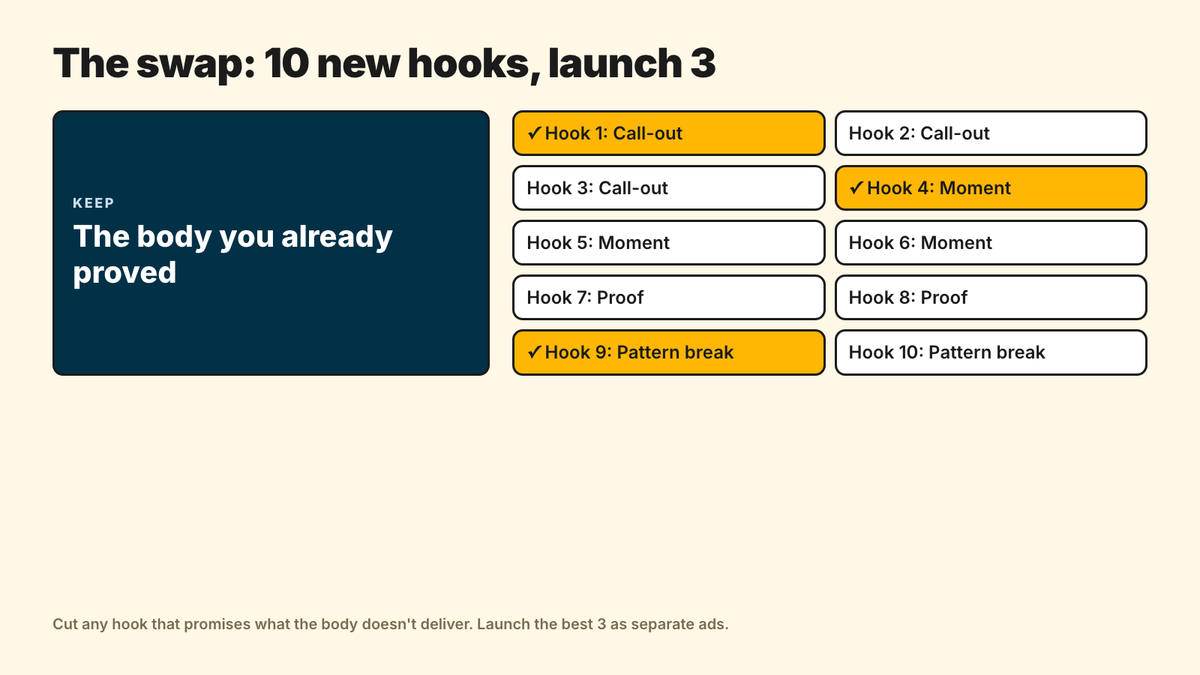
Then write 10 new first lines for the same body: 3 call-outs, 3 moments, 2 proof, 2 pattern breaks. Cut any that promise something the body doesn't deliver. Keep the 3 best and launch them as separate ads.
The swap: 10 new hooks, launch 3
8. 3 Claude prompts to do it this week
Prompt 1: write.
"Here is the transcript of my winning ad, with the first 3 seconds marked. Here are 40 first lines from ads that ran 90+ days, in 4 groups. Write 10 new first lines for the same body: 3 call-out, 3 moment, 2 proof, 2 pattern break. Each must lead into the line that comes right after the current hook."
Prompt 2: rank.
"Rank these 10 hooks for [buyer]. For each one say who it stops, and whether that person can buy at [price]. Put the ones that stop the wrong people last."
Prompt 3: cut.
"Read each hook next to the rest of the script. Cut any hook that promises something the body doesn't deliver. Return the 3 I should launch."
9. Where this breaks
-
A tired concept. If hook rate and hold rate are both falling, new hooks won't hold it up. You need a new angle.
-
A body problem. If people stop and then leave, the swap makes it worse.
-
The data. These 40 are ads that survived, so I can see what kept running, and I can't see the hooks that died or anyone's CPA.
If you're spending $50K+ a month on Meta and your best ads are slowing down, we write and shoot new hooks and new concepts in formats your account doesn't have yet. The link in my profile books a call.
Talk soon
Lorenzo