The Nvidia Fraud Question Nobody Is Asking and The Story Everyone Is Missing
文章目录
Everyone is chasing the Nvidia spy scandal. But the bigger scandal may be sitting in plain sight, in Nvidia's own SEC filings. Read on for a deep dive into "the Singapore line," Nvidia's Singapore revenue disclosures, and for the questions the SEC, the DOJ, the PCAOB and Nvidia's board should already have asked. Then see what really lies ahead for Nvidia.
For two weeks the Nvidia story has been told as a spy novel. A celebrated founder, an alleged Chinese intelligence asset, a Singapore customer nobody had heard of, and a resignation announced on November 12. Congress wants testimony, and its letters have gone to Nvidia, Huang, the White House and the Commerce, State and Justice departments. I have not found one addressed to the SEC, the Public Company Accounting Oversight Board (PCAOB) or PwC. The Treasury Secretary and the Commerce Secretary are blaming each other on television. The national security questions are serious, and plenty of capable people are asking them. I am going to leave those questions to them.
My question is the one I spent my career asking. Were Nvidia's periodic reports accurate and complete, and if they were not, who knew?
Consider one number. From fiscal 2023 through the first half of fiscal 2026, Nvidia's 10-Ks and 10-Qs attributed roughly $52 billion of revenue to Singapore, a city-state of about six million people. That total is my own addition of the figures in those filings. Nvidia never published it as a single number. Nvidia explained in its footnotes that Singapore was mostly an invoicing address and that the chips went somewhere else. Then, one quarter after Nvidia reportedly put its largest Southeast Asian customer on an internal block list, the Singapore line disappeared from the filings altogether. The revenue did not. Nvidia had switched to reporting by customer headquarters, and the totals stayed the same.
That sequence does not prove fraud, and I will not pretend it does. But it hands an enforcement lawyer every predicate needed to open a formal investigation. There is a material line item. There is a disclosure change with curious timing. There is internal knowledge the filings never mentioned, a government inquiry the filings never mentioned and a series of public denials that have aged badly. And there is a chief executive who signed the certifications and has now resigned under a cloud.
When I was at the SEC, my colleagues and I had a name for a matter like this. We called it a no-brainer. I am not talking about the outcome, because nobody outside the company knows enough to say whether anyone did anything wrong. I am talking about the decision to open the case, staff it with the best people in the building and start issuing subpoenas. Whether anyone in Washington is still willing to make that call is the subject of everything that follows.
There is a second question running underneath the first, and it may prove the more uncomfortable one. None of this is new. The Singapore line has been the subject of public commentary since at least December 2023. A widely read newsletter flagged it in January 2025. Singapore's government addressed it in Parliament the next month. Congress wrote to Nvidia about it that April. The New York Times investigated Megaspeed in October 2025, and a United States senator wrote to the Commerce Department within days. A short seller published forty pages on it in May 2026. Any one of those should have been enough to prompt at least an informal inquiry at the SEC, which requires nothing more than a staff attorney, a supervisor's approval and a letter.
So this cannot be something that only landed on the Commission's doorstep two weeks ago. Either the SEC has been looking at Nvidia's Singapore disclosures for some time, in which case the public is entitled to ask what it found and why nothing came of it, or the SEC never followed up on repeated public allegations about one of the most important companies in the world. I do not know which it is. SEC investigations are confidential, and one may well exist. But the old Washington question applies with full force. What did the SEC know, and when did it know it?
A roadmap for this article: I start with the facts as reported, the customer and four years of Nvidia's own filings. Then I turn to the law, to the CFO and the auditor who signed off, and finally to what the SEC, the Justice Department, the PCAOB and Nvidia's board should already be doing.
One critical note, which I also explain in more detail in my disclaimer: In my experience, the facts in a situation like this are volatile and fluid, and the story on day fifteen rarely survives to day ninety. I really do not know what happened here. What I do know, after almost 20 years in SEC enforcement, is what the questions are and who is supposed to be asking them. That is what this article is about.
Review both my full Disclaimer and my Source List here.
What We Know So Far
The public record breaks into two piles. One is Nvidia's own filings, which its officers certify and whose annual financial statements PwC audits. The other is two weeks of press reporting, which has neither safeguard. I rely on the first and treat the second as allegation.
Here is the short version of the second pile. On October 29, 2026, the New York Times reported a close relationshipbetween Nvidia chief executive Jensen Huang and Alice Huang, no relation, a former executive of a Singapore company called Megaspeed whom U.S. officials reportedly regard as a Chinese intelligence asset. China's foreign ministry calls the allegation groundless. The Attorney General said on November 12 that the Justice Department had not concluded whether she was a spy. On November 8, Huang admitted infidelity in a letter to employees, and the board announced an independent investigation, assisted by Wachtell, Lipton, Rosen & Katz. The next day a shareholder filed a proposed securities class action in San Jose. On November 12, Nvidia announced that Huang had resigned as chief executive and director, that chief financial officer (CFO) Colette Kress would serve as interim chief executive officer (CEO) while keeping the CFO job, and that longtime director Harvey Jones would become the company's first board chair.
Meanwhile, the money trail came into focus. Trade records cited by the Times put purchases of equipment containing Nvidia technology by Megaspeed's Malaysian affiliate, Speedmatrix, at no less than $4.8 billion between June 2024 and February 2026. The Information reported that companies tied to Alice Huang's family moved at least $7.5 billionof Nvidia chips to Chinese buyers. Those figures cover different companies, periods and measures. They cannot be added together, and none of them is Nvidia's own revenue. Bloomberg reported that Nvidia's general counsel called a senior Commerce official about the Megaspeed probe in 2025, and that, by Bloomberg's own analysis of trade records, the counts Nvidia gave the government of chips sold to Megaspeed through hardware partners came up about 50,000 units short. Nvidia says the outreach was routine. On the chip count, Nvidia has said it later found the hardware in additional warehouses, witho›ut giving a number. Semafor reported that the U.S. Department of Justice (DOJ) has three inquiries touching the affair: an antitrust probe focused on Nvidia, and two others focused on Megaspeed and Supermicro.
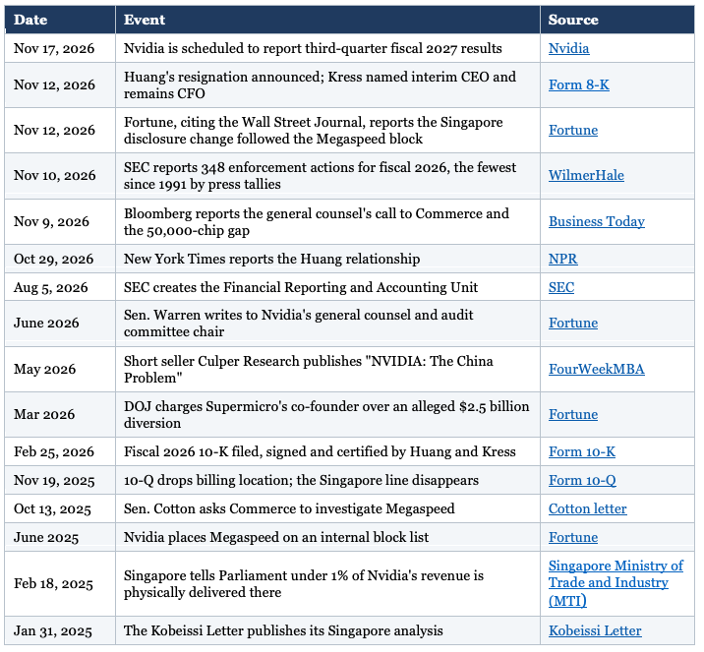
Here are the key dates, most recent first. The order turns out to matter a great deal, and the most critical question remains: So who was buying all of this hardware?.
The Timeline
Sources for this table: Nvidia (Nov 17, 2026); Form 8-K (Nov 12, 2026); Fortune (Nov 12, 2026); WilmerHale (Nov 10, 2026); Business Today(Nov 9, 2026); NPR (Oct 29, 2026); SEC (Aug 5, 2026); Fortune (June 2026); FourWeekMBA (May 2026); Fortune (Mar 2026); Form 10-K(Feb 25, 2026); Form 10-Q (Nov 19, 2025); Cotton letter (Oct 13, 2025); Fortune (June 2025); Singapore Ministry of Trade and Industry (MTI)(Feb 18, 2025); Kobeissi Letter (Jan 31, 2025).
What We Know About Megaspeed
On the public record, Megaspeed looks less like a hyperscaler and more like a nameplate. I say that carefully, because a company can be thinly staffed and perfectly lawful. But the corporate history has the kind of red flags that make an investigator sit up.
The company was registered in Singapore in 2015 as 7Road International, the local arm of a Chinese gaming company, according to Fortune. Sen. Tom Cotton's letter to Commerce, relying on New York Times reporting, describes 7Road as Chinese government-owned. In March 2023, a few months after Washington restricted advanced artificial intelligence (AI) chip exports to China, the Singapore entity was renamed Megaspeed International, and its shares were transferred to a British Virgin Islands company called Huang Le Ltd, according to filings described by the Associated Press.
Huang Le is the Chinese name of Alice Huang. She is a Chinese national, a former television journalist who moved into private equity, and by Bloomberg's account the founder of Megaspeed. The Washington research group C4ADS, which reviewed the corporate records, says she became the controlling shareholder that same month, as Reuters reported.
Then came the hand-off. In November and December 2023, Megaspeed's shares were transferred to Swiftdata, a Singapore company that CNBC reports had been incorporated only the month before. Swiftdata's owner, a Singaporean named Tan Yong Pong, became Megaspeed's sole director. Bloomberg called the buyer a Singapore shell company. C4ADS traced all 10 million Megaspeed shares moving from Alice Huang to Swiftdata in two steps, on November 10 and December 1, 2023, and warned in September 2026 that the question of who really controls the company remained unresolved.
So on paper, Alice Huang was gone by the end of 2023. In practice, the record says otherwise. CNBC describes her as the company's de facto leader. CBS News describes her as chief executive as late as mid-2025. When the U.S. Bureau of Industry and Security wanted to interview someone during a post-shipment check in June 2025, it was Alice Huang who flew to Singapore to sit for it, not the sole director. Singapore police impounded her passport that day, held it for eight months and ultimately barred her from the country after finding she had given "inaccurate information" about her role at Megaspeed. In fairness, the same statement says Singapore did not investigate her for espionage and found insufficient evidence that she committed the offenses it was examining. Its investigation of Megaspeed continues.
On November 15, Megaspeed said Alice Huang left the company effective August 30, 2025, has no current role and that it has hired outside lawyers to run an internal investigation. That is the company's account, and nobody has tested it yet. It also says nothing about who was running Megaspeed before that date, which is when most of the sales at issue were made.
The physical footprint is no more reassuring. Cotton's letter describes near-empty offices in Singapore and Malaysia, staff who rarely saw the executives, executives based mostly in China, and a Malaysian data center where U.S. officials found export-controlled chips still sitting in their boxes. Against that backdrop, the volume is startling. A Malaysian subsidiary, Speedmatrix, was set up in 2024, and the Times counted more than 200 shipments of restricted Nvidia technology to it between June 2024 and June 2025. Cotton's letter says the purchases approached 2% of the supplier's worldwide data center sales for the year.
As for where the computing power went, The Information reported that the hardware ended up powering data centers built by Shanghai Century Litong, a company that sells capacity to Alibaba and Tencent, and that Alice Huang's younger sister was a founding shareholder.
Fairness requires the other side of the ledger. No charges have been filed against Megaspeed in Singapore or the United States. Megaspeed says there is no evidence of illicit transfers and has hired a U.S. law firm to count its graphics processing units (GPUs). It has also said that inspections by U.S. and Malaysian authorities found no violations. On November 13, Malaysia's trade ministry said it had never cleared Megaspeed or its Malaysian affiliate, that its site visits were routine monitoring, and that "any suggestion otherwise is inaccurate." The ministry said it is still checking whether any chips were re-exported. And one legal distinction matters. Renting Nvidia computing power in Malaysia to a Chinese company is, according to the Atlantic Council, generally not a violation of current export rules, though the answer can turn on who the customer is and what the computing is used for. Physically moving controlled chips into China without a license is a violation. The reporting alleges both.
Why Megaspeed Is an Accounting Question
Now set the espionage aside, because my interest is narrower. From a financial reporting standpoint, the facts above describe a counterparty with one director, a weeks-old parent, a recent offshore ownership chain, thin offices and purchases in the billions. The ownership changes sat in public registries in 2023 and 2024. The thin offices and the scale of the purchases came out in later reporting, and an investigator would want to know when Nvidia learned each one.
That matters to the books for three reasons. First, customer due diligence is an internal control. A company that grants partner status and scarce allocation to a buyer like this either vetted it and accepted the risk or did not vet it, and either answer is written down somewhere. Second, Megaspeed reportedly bought mostly through Nvidia's server partners, which makes it what Nvidia's filings call an indirect customer. Nvidia's 10-K discusses indirect customersthat individually account for 10% or more of revenue, so the company plainly tracks who they are. Third, the person with the last word on allocation was, if the reporting is right, in an undisclosed personal relationship with the person running the buyer.
Whether chips were sold onward to China is a matter for the export-control authorities. What Nvidia knew about this customer, when it knew it, and what it told investors and its auditor is a matter for the SEC.
The Singapore Line: Four Years of Filings
A fair account has to start with what Nvidia actually disclosed, because the popular version gets it backwards. Nvidia never told investors its chips were being used in Singapore. It told them the opposite. And yet, the closer I read the filings across the last four years, the more the disclosure looks like a moving target.
How the Number Grew
Until late 2025, Nvidia's financial statement notes reported revenue by customer billing location, and Singapore was one of five lines alongside the United States, Taiwan, China and Other. Watch what happened to that line after the export controls arrived in October 2022.
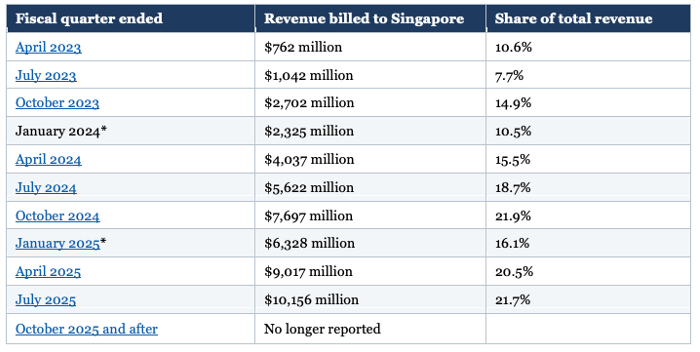
Sources: Nvidia Forms 10-Q for the quarters ended April 2025 and July 2025, which also give the year-earlier figures; earlier quarters as derived from the filings by FourWeekMBA. Shares for April and July 2024 are my arithmetic from the reported totals.
- January quarters are calculated as the fiscal-year total less the first nine months. Shares are calculated to one decimal; Nvidia's own filings round the April 2025 and July 2025 shares to 20% and 22%.
Filings linked in this table: Form 10-Q for the quarter ended April 28, 2024; Form 10-Q for the quarter ended July 28, 2024; Form 10-Q for the quarter ended October 27, 2024; Form 10-K for fiscal 2025; Form 10-Q for the quarter ended April 27, 2025; Form 10-Q for the quarter ended July 27, 2025; Form 10-Q for the quarter ended October 26, 2025.
In a little over two years, the Singapore line grew more than thirteenfold. For fiscal 2025 as a whole it came to $23.7 billion, or 18% of revenue.
People noticed. On January 31, 2025, the markets newsletter The Kobeissi Letter pointed out that over the prior three quarters Nvidia had booked $17.4 billion of revenue to Singapore against $11.6 billion to China. I went back and checked. Those figures hold up. Nvidia's 10-Q for the quarter ended October 2024 shows $17,356 million for Singapore and $11,574 million for China, including Hong Kong, for the first nine months of fiscal 2025. Kobeissi paired that with a data center count: about 5,375 in the United States, 448 in China and 99 in Singapore. I have not been able to verify those counts independently, so treat them as Kobeissi's. But the basic point does not depend on them. Nvidia's own footnotes said most of the products billed to Singapore were shipped somewhere else.
Kobeissi now says that Nvidia's head of public relations contacted the newsletter within 24 hours to explain that the filings report "bill to" and not "ship to" locations. Three weeks later, Singapore's own government weighed in. Second Minister for Trade and Industry Tan See Leng told Parliament that physical delivery of Nvidia products to Singapore represented less than 1% of Nvidia's overall revenue. In other words, the country named on the invoices was telling the world that the chips were not there.
How the Explanation Kept Changing
That brings me to the footnotes, and here the history gets interesting. Nvidia's explanation of the Singapore line changed four times in about eighteen months.
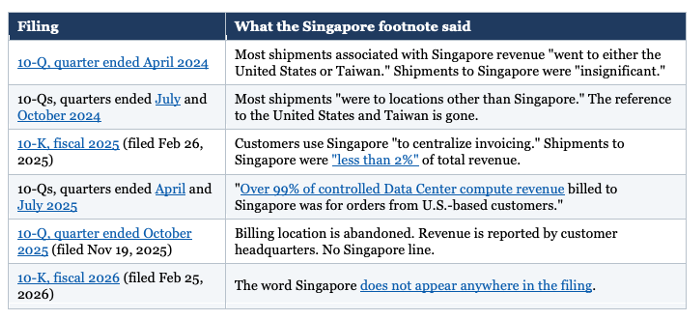
The Footnote at Issue
Sources: footnote language as compiled by FourWeekMBA and confirmed where I could read the filings directly: the April 2025, July 2025 and October 2025 10-Qs and the fiscal 2026 10-K.
Filings linked in this table: Form 10-Q for the quarter ended April 28, 2024; Form 10-Q for the quarter ended July 28, 2024; Form 10-Q for the quarter ended October 27, 2024; Form 10-K for fiscal 2025; Form 10-Q for the quarter ended April 27, 2025; Form 10-Q for the quarter ended July 27, 2025; Form 10-Q for the quarter ended October 26, 2025; Form 10-K for fiscal 2026.
Read down that column as an investigator would. In April 2024, Nvidia was willing to say where the Singapore-billed products went: the United States or Taiwan. One quarter later it would say only where they did not go. That is a retreat from a specific statement to a vague one, made in the very quarters when the Singapore number was climbing fastest. Somebody decided to drop "the United States or Taiwan." I would like to know who, and what they had learned.
Then, in the spring of 2025, after the DeepSeek furor and after Congress wrote to Huang about Singapore, the footnote swung the other way and became very specific indeed. Over 99% of controlled data center compute revenue billed to Singapore was for orders from U.S.-based customers. Kress herself repeated the point on the August 2025 earnings call. Her words: "Over 99% of Data Center compute revenue billed to Singapore was for US-based customers." Read the two versions side by side. The footnote says "controlled" Data Center compute. Kress's sentence on the call does not. Whether the broader spoken version was intended, and whether it was accurate, is a question Nvidia should answer. That sentence, it seems to me, is the single most important sentence in this entire affair, and I will come back to it.
Here are the two sentences, word for word.
The 10-Q for the quarter ended July 27, 2025: "Over 99% of controlled Data Center compute revenue billed to Singapore was for orders from U.S.-based customers for the second quarter and first half of fiscal year 2026."
Kress on the August 27, 2025 call: "Over 99% of Data Center compute revenue billed to Singapore was for US-based customers."
One word fell out between the filing and the microphone, and it is the word that limited the promise to export-controlled products.
How the Line Disappeared
Finally, lay the reported events against the filing dates. In February 2025, Singapore opened an investigation into Megaspeed. In June 2025, Nvidia put Megaspeed on an internal block list, according to the Wall Street Journal, a step an Nvidia spokesperson has since confirmed. In late summer 2025, Nvidia's general counsel called the Commerce undersecretary who oversees export controls. On August 27, 2025, Nvidia reported its largest Singapore figure ever, $10.2 billion. And in the very next 10-Q, the Singapore line was gone.
Nvidia's stated reason is in the footnote. Billing location often reflected a centralized invoicing point, the company wrote, and headquarters location "provides a better representation" of its geographic profile. Taken alone, that is a defensible accounting judgment. Companies are allowed to improve their segment notes. But look at what the recast did to fiscal 2025.
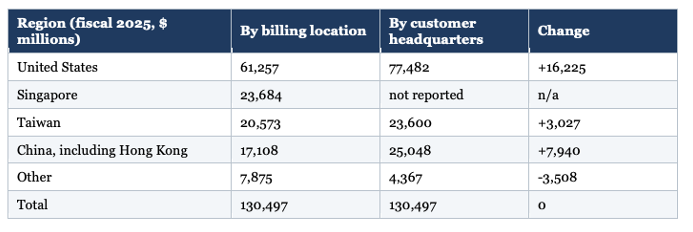
The Footnote's Disappearance
Sources: Nvidia filings as tabulated by FourWeekMBA and Capital & Compute; headquarters figures confirmed in the fiscal 2026 10-K.
Filings for this table: Form 10-K for fiscal 2025 (billing-location basis); Form 10-K for fiscal 2026 (customer-headquarters basis, prior year recast).
On the new basis, revenue from China-headquartered customers for fiscal 2025 jumped by $7.9 billion, from 13.1% of the total to 19.2%. I want to be careful here, because that is not evidence of smuggling. It also cuts against the simplest theory. A company trying only to hide its China exposure would not pick a method that made the China line $7.9 billion bigger. Anyone who claims the change was meant mainly to conceal China exposure has to account for that increase. What it does mean is that, net, nearly $8 billion of one year's revenue from China-headquartered customers had been presented to investors under some other flag. The tables do not say which flag, because Nvidia has never published a customer-level bridge. Anyone trying to size Nvidia's China exposure during the fiercest export-control debate in the industry's history was working from the smaller number.
Nvidia did not answer Fortune's questions about whether the change had anything to do with Megaspeed. Columbia accounting professor Shivaram Rajgopal told Fortune that public information cannot establish a link, and he is right. He also said, "the timing is curious," and he is right about that too. One more reported fact belongs in the file. Bloomberg found Malaysian trade records showing that Megaspeed imported roughly $787 million of Nvidia GB300 chips in November 2025, five months after Nvidia says it cut the company off. Nvidia says Commerce has since allowed it to ship parts and replacement components. Whether that explains $787 million of GB300 chips is a question for investigators. Bloomberg also reported that Megaspeed was still listed as an official Nvidia Cloud Partner, a status Nvidia generally withdraws when it stops doing business with a company.
What May Have Been Wrong, and What the Footnotes Should Have Said
First, what the filings do not show. They never said the chips were used in Singapore. They do not say how much of the Singapore line was Megaspeed. And Nvidia has announced no restatement. The recast left the fiscal 2025 total exactly where it was, at $130.5 billion.
Here is the theory, as precisely as I can state it. The theory is not that Nvidia booked sales to Singapore that really went to China. Nvidia said from the start that the goods went elsewhere. The theory is that Nvidia's explanations of the Singapore line were incomplete, shifting and, at the critical moment, possibly wrong, and that the company then removed the line instead of fixing the explanation. Let me take the specific problems one at a time.
The 99% sentence is narrower than it sounds. It covers only "controlled" data center compute. It says nothing about the rest of the revenue billed to Singapore, and nothing about how large the controlled slice was. Nvidia never said what share of Singapore billings was controlled product, so investors could not tell how much of a $10 billion quarterly line the assurance covered. The footnote never gave them the denominator.
Nobody defined "U.S.-based." Does a Singapore subsidiary of an American hyperscaler count? Almost certainly. Does a Singapore company with a Delaware affiliate count? Megaspeed reportedly has a U.S. subsidiary. I do not know how Nvidia classified it, and that is exactly the point. A statistic offered to reassure investors about China exposure should have come with a definition.
The sentence does not say whose orders it counted. Megaspeed reportedly bought through Nvidia's server partners. A server maker headquartered in the United States or Taiwan that buys chips and resells finished servers to a Singapore shell may well count, for Nvidia's purposes, as a U.S. or Taiwanese customer. If so, the footnote could be literally true while billions of dollars of product flowed to the very kind of buyer investors were worried about. Nvidia should say how it counted them.
Nvidia could trace end customers when it wanted to. This is the detail that struck me most. When Nvidia switched to the headquarters basis, it added a footnote estimating that 86% of data center revenue from Taiwan-headquartered customers was attributable to end customers in the United States and Europe. The fiscal 2026 10-K puts the full-year figure at 76%. So the company has at least some end-customer data and is willing to publish it when the data points toward the United States. It published nothing comparable for Southeast Asia.
The company appears to have known things the footnotes did not say. By the time the July 2025 10-Q was filed on August 27, 2025, Nvidia had, by its own account, blocked Megaspeed. By the reporting, its general counsel contacted Commerce about a government probe in August or late summer 2025. Whether that was before or after the filing is something investigators should pin down. Nvidia has told Bloomberg he did not know of the affair when he made the contact. Reuters has since reported, citing two sources and October 2026 messages it reviewed, that Huang misled his own general counsel about the relationship. If that is right, it bears on what the legal and disclosure functions were told. It does not show what Kress or PwC knew. The footnote in that filing reassured investors about Singapore and did not mention the block. Nor did the fiscal 2026 10-K, filed six months later. The words Megaspeed and subpoena do not appear in it, and the only specific government requests for information it describes come from competition regulators. The same two words are missing from the 10-Q Nvidia filed on August 26, 2026, after Culper's report and Sen. Warren's letter had both arrived.
Complete and candid disclosure, in my view, would have looked like this. None of it is exotic.
-
A second table showing revenue by ship-to destination next to the bill-to table. Nvidia had at least its own shipping records, since it could say shipments to Singapore were under 2%.
-
The share of Singapore-billed revenue that was "controlled" product, so the 99% figure had a denominator.
-
A plain definition of "U.S.-based customer," and a statement of whether it looked through to the ultimate parent.
-
Disclosure of significant indirect customers in Southeast Asia buying through server partners, with the same end-customer estimate Nvidia gave for Taiwan.
-
A statement that Nvidia had terminated sales to a significant regional customer over diversion concerns and had been contacted by, or had contacted, the government about it.
-
When the basis changed, a reconciliation between the old presentation and the new one for every period, with the Singapore amounts traced to where they landed.
The governing accounting standard, Accounting Standards Codification (ASC) 280, lets a company choose how it attributes revenue to countries so long as the method is reasonable, consistently applied and disclosed. Nvidia will say, correctly, that it disclosed the basis every time. But choosing a basis the company itself admits does not reflect where its products go, qualifying it four different ways, and then dropping it for a new one a quarter after a problem customer is blocked is not the kind of disclosure the securities laws have in mind. The laws have a rule for statements that are literally true and still misleading. It is called Rule 12b-20, and it leads directly to the question of what violations are on the table.
The Law: What a Wrong or Misleading Footnote Violates
Nobody gets excited about a footnote. I spent years at the SEC learning that the footnotes are where the bodies are buried. The notes are part of the financial statements. In a 10-K they are covered by the audit opinion, in a 10-Q by the auditor's quarterly review, and in both by the officers' certifications. When a footnote in a 10-K or 10-Q turns out to be wrong or misleading, a predictable set of possible violations comes into play, and they sort neatly by agency. Three agencies would examine the same facts. The SEC and the PCAOB need only a preponderance of the evidence. DOJ has to prove its case beyond a reasonable doubt. I will take them one at a time.
The SEC's Violations
The SEC's civil charges form a ladder, and the lowest rungs require no proof of intent at all.
At the bottom are the reporting provisions. Section 13(a) of the Exchange Act and Rules 13a-1 and 13a-13 require annual and quarterly reports that are accurate. Rule 12b-20 adds that a report must include whatever further information is needed to keep the required statements from being misleading. An issuer violates these provisions by filing a report that is materially inaccurate or that leaves out material information the rules require. The SEC does not have to prove intent. Good faith is not a defense. In addition, Regulation S-X presumes that financial statements not prepared in accordance with generally accepted accounting principles (GAAP) are misleading, which is how a defective geographic note under ASC 280 becomes a securities law problem.
One rung up are the books-and-records and internal-control provisions. Section 13(b)(2)(A) requires books and records that accurately reflect the company's transactions in reasonable detail. Section 13(b)(2)(B) requires a system of internal accounting controls. Rule 13a-15 requires disclosure controls, meaning the procedures that make sure what the company knows reaches the people who write the filings. If Nvidia's sales and legal organizations knew about the Megaspeed block and the Commerce contacts while the disclosure committee signed off on reassuring Singapore footnotes, that would point to a disclosure controls failure, and investigators should find out whether it happened. The SEC's 2022 order against Nvidia rested in part on that same disclosure controls rule. It did not charge books-and-records or internal accounting controls violations. That case, which cost Nvidia $5.5 million, was also about a revenue line whose real driver the filings did not explain: cryptomining demand inside the gaming business.
Next come the provisions aimed at individuals. Rule 13a-14 requires the chief executive and chief financial officer to certify each report, and a false certification is its own violation. Rule 13b2-1 prohibits any person from falsifying books and records. Rule 13b2-2 prohibits officers and directors from making materially misleading statements to the auditor, or omitting material facts, in connection with an audit. Section 13(b)(5) prohibits knowingly circumventing internal controls.
At the top of the ladder is fraud. Section 17(a) of the Securities Act reaches misstatements in the offer or sale of securities, and two of its three prongs require only negligence. Section 10(b) of the Exchange Act and Rule 10b-5require scienter, meaning intent or recklessness, and they apply to press statements and earnings calls as fully as to a 10-K.
Around all of this sit the disclosure items of Regulation S-K. Item 303 requires management to discuss known trends and uncertainties. One limit applies. Under the Supreme Court's 2024 decision in Macquarie Infrastructure v. Moab Partners, leaving something out of that discussion is not fraud under Rule 10b-5(b) unless it makes something the company did say misleading. The SEC can still charge the omission as a reporting violation. Item 105 requires risk factors, and the SEC has repeatedly charged companies that describe as hypothetical a risk that has already come to pass. Facebook paid $100 million in 2019 on exactly that theory. Nvidia's fiscal 2026 10-K warns that "reports of diversion of controlled products, even when unsubstantiated and untrue," may hurt the business, and that penalties could follow if it "were ever found to have violated" export laws. If management had already blocked a multibillion-dollar customer over diversion concerns, the word "ever" is doing a lot of work. To be fair, blocking a customer is not the same as knowing that Nvidia itself violated the export laws, and that is the comparison investigators would have to make. Item 404 covers related-person transactions, and whether the chief executive's relationship triggers it depends on facts not yet public.
Everything turns on materiality. Here the SEC's own guidance is unhelpful to Nvidia. Under Staff Accounting Bulletin No. 99, a numerically small misstatement can be material if it conceals an unlawful transaction, affects compliance with regulatory requirements or concerns a part of the business that plays a significant role in the company's operations. And there is nothing numerically small about a line that reached 22% of revenue. The size of the line is not the size of any error. It is the reason the question matters.
As for remedies, the Commission can seek penalties, disgorgement, officer-and-director bars, and, if a restatement results from misconduct, clawback of the chief executive's and chief financial officer's bonuses and stock profits under Section 304 of Sarbanes-Oxley.
The Auditor's Violations and the PCAOB
If the SEC's question is whether the company told the truth, the question for the PCAOB is whether the auditor did its job. A misleading footnote that sails through an integrated audit raises a standard list of possible failures under the Board's auditing standards.
First is the duty of care itself. Auditors must exercise due professional care and professional skepticism, and must obtain sufficient appropriate evidence for the opinion, including the disclosures. An auditor that accepts a management schedule supporting a figure like "over 99%" without testing the underlying data has an evidence problem.
Second is fraud and illegal acts. PCAOB standards require the auditor to assess fraud risk, and they treat revenue as a presumptive fraud risk. Auditing Standard (AS) 2405 governs illegal acts by clients. On top of the standards sits a statute: Section 10A of the Exchange Act requires an auditor who becomes aware of information indicating an illegal act may have occurred to determine whether it is likely, to consider its effect on the financial statements, and to make sure the audit committee is informed. If the auditor concludes that the illegal act is material to the financial statements, that management has not taken timely and appropriate remedial action, and that the failure is reasonably expected to require a modified audit report or the auditor's resignation, it must report those conclusions to the board. The board then has one business day to notify the SEC. If it does not, the auditor must resign or go to the SEC itself.
Third is internal control. In an integrated audit the firm opines separately that internal control over financial reporting is effective. PwC gave that opinion for fiscal 2026. If the controls behind the geographic disclosures, or the controls that should have routed the Megaspeed information to the disclosure committee, were deficient enough to amount to a material weakness, the internal control opinion is in question. Whether the financial statement opinion is too depends on whether the statements themselves were materially misstated.
Fourth is the back end of the audit. The auditor must evaluate whether the disclosures as a whole are fairly presented, communicate significant matters to the audit committee, and identify critical audit matters. And when facts surface later that existed at the report date, AS 2905 requires the auditor to determine whether they are reliable and whether the report can still be relied upon.
The PCAOB can sanction a firm and its partners for violating any of these standards under Section 105 of Sarbanes-Oxley, with penalties, practice bars and, in the extreme, revocation of registration. The SEC has parallel authority. It can charge Section 10A directly, and it can discipline accountants for improper professional conduct under Rule 102(e). I will return to PwC shortly.
The Justice Department's Violations
That leaves the criminal side. The same misleading footnote becomes a crime only when the government can prove that someone made a materially false statement knowingly and willfully, and the proof must be beyond a reasonable doubt. That is a much higher bar, which is why most accounting cases stay civil. But the statutes matter, because they define what DOJ should be looking at.
Section 32(a) of the Exchange Act makes it a crime to willfully violate the Act or its rules, or to willfully make a false or misleading statement in a required filing. The penalty is up to 20 years. Knowingly falsifying books and records or circumventing internal controls is prosecuted through the same section.
Sarbanes-Oxley added two more. 18 U.S.C. 1348 is the standalone securities fraud statute, with a 25-year maximum. 18 U.S.C. 1350 makes it a crime for a chief executive or chief financial officer to certify a periodic report knowing it does not comply, with up to 10 years for a knowing violation and 20 for a willful one. That statute was written with exactly this kind of scenario in mind.
Beyond the securities statutes, 18 U.S.C. 1001 covers false statements to federal agencies. It matters here because of the chip counts and site inspection results Nvidia reportedly furnished to Commerce. 18 U.S.C. 1519 covers falsifying or destroying records to impede a federal investigation, and the conspiracy and wire fraud statutes are available where their own elements can be proved.
I list these not because I think anyone at Nvidia committed a crime. I have no idea. I list them because they show that DOJ's jurisdiction over the financial reporting questions is entirely separate from its jurisdiction over export diversion, and one inquiry does not substitute for the other.
Will Nvidia Have to Restate?
On what is public today, I would not predict a restatement of revenue or earnings. Nothing in the reporting suggests the sales were fictitious or that Nvidia was not paid. A customer who lies about where the product is going still pays the invoice.
The exposure is narrower, and still serious. The geographic tables and their footnotes are financial statement disclosures, audited in the 10-K and reviewed in the 10-Qs. If they were materially wrong, they must be corrected, and a correction of that kind raises the same questions about internal control as any other restatement. Beyond the financial statements, the Management's Discussion and Analysis (MD&A), the risk factors and the contingency disclosures may need to be amended once the board's investigation establishes what management knew in 2025. On contingencies, one outside analysis put a theoretical worst-case export penalty on $4.8 billion of reported equipment purchases at $9.6 billion, since civil penalties can reach twice the value of the transaction. ASC 450 requires disclosure of a material loss that is reasonably possible, and an accrual only when the loss is probable and can be reasonably estimated. The $9.6 billion figure is arithmetic on a reported purchase total. It is not an estimate of what Nvidia might owe. The SEC has enforced the disclosure requirement against a company that kept quiet about a government investigation. In 2019, Mylan paid $30 million for failing to disclose the possible loss from a Justice Department probe until the day it announced a settlement.
The more immediate issue, however, is reliance. An audit opinion rests in part on management's representations. PwC's February 2026 opinions relied on representations from a chief executive who has now resigned amid an investigation into his candor. PwC has to reassess those representations. If the company concludes that earlier financial statements should no longer be relied upon because of an error, or if PwC notifies the company that its prior audit report or completed reviews should no longer be relied upon, the result is a Form 8-K under Item 4.02.
I do not expect that on November 17, when Nvidia reports its third quarter. An auditor does not issue an opinion on a quarter. It performs a review, and a review does not produce a public opinion that could be qualified on an earnings call. A serious problem can still keep the auditor from finishing that review, and a late 10-Q would be the tell. The signals to watch are different, and there are seven of them:
• Does Nvidia file its 10-Q on time, or seek an extension?
• Does the 10-Q disclose any subpoena, inquiry or investigation by the SEC, DOJ or Commerce directed at the company?
• Does it disclose a material weakness, or any change in internal control?
• Do the risk factors stop speaking hypothetically about diversion?
• Does a contingency note appear for export-control exposure?
• Who signs the certifications, and what does the 10-Q say about controls?
• Does management say whether the board's investigation reaches the financial statements, or only the former chief executive's conduct?
The analysts on the call will ask about demand and gross margin. Somebody ought to ask these instead. And the sixth question, about who signs, is a bigger one than it looks.
The CFO Who Signed Is Now the CEO
Now for the part of this story that almost nobody is talking about, and that I find most remarkable. When Nvidia's board needed someone to replace the chief executive, it chose the chief financial officer, and it let her keep both jobs.
Colette Kress has been Nvidia's CFO since September 2013. The financial statements now in question are her financial statements. I went and found the signatures. On February 25, 2026, Kress signed the fiscal 2026 Form 10-K as principal financial officer, right below Huang and right above chief accounting officer Donald Robertson, who retired from that post in May 2026. The same day she signed Exhibit 31.2, her certification under Sarbanes-Oxley Section 302, and Exhibit 32.2, her certification under Section 906.
Executives sign those certifications so routinely that people forget how personal they are. Read what she actually put her name to. In Exhibit 31.2, Kress certified that, based on her knowledge, the report contained no untrue statement of a material fact and omitted no material fact needed to make it not misleading. She certified that the financial statements fairly presented Nvidia's financial condition in all material respects. She certified that she and Huang were responsible for the company's disclosure controls and its internal control over financial reporting and had evaluated them. And she certified that the two of them had disclosed to PwC and to the audit committee all significant deficiencies, all material weaknesses and any fraud, whether or not material, involving management.
She signed the same certifications for fiscal 2025, as the filing index shows, and for every quarter in between. She signed the 10-Qs containing the 99% footnote. She signed the 10-Q that deleted the Singapore line. And in her prepared remarks on the August 27, 2025 call, she personally delivered the 99% message to investors. She had made the same point on the May 2025 call. Kress has described her job in these terms herself. "I am the CFO, and I will follow Sarbanes-Oxley and the laws of this nation," she said in August 2025, according to Bloomberg. That is the right standard, and it is the one she should be held to.
Here is what we do not know about Kress, and it is a lot. No public evidence shows that Kress knew about the relationship between Huang and the Megaspeed executive. No public evidence shows the reporting change had anything to do with Megaspeed. Professor Rajgopal told Fortune he would not say she "must have known." The Wall Street Journal has reported that Huang privately belittled her, which hardly suggests a confidante. She may turn out to be exactly the steady hand the company needs.
But consider the governance of it. The CFO owns the financial statements. The geographic note, the 99% sentence, the decision to recast, the disclosure controls and the representations to PwC all ran through her organization. The board has now put the person whose work product is under examination in charge of the company while it is examined. Three practical problems follow.
The first is the certifications themselves. Section 302 calls for certifications from the principal executive officer and the principal financial officer. At most companies that means two people, each a check on the other. If Kress signs the next 10-Q as both principal executive officer and principal financial officer, that design collapses into one person certifying her own work. SEC staff guidance allows it. So the arrangement breaks no rule. The problem is practical.
The second is the internal investigation. The board's lawyers report to the independent directors, but their witnesses now include the sitting CEO, who controls the employees and the documents they need.
The third is the board itself. The new chair, Harvey Jones, has been a director since 1993, sits on the audit committee and signed the same 10-K. So did the audit committee chair, Brooke Seawell, who also received Sen. Warren's June 2026 letter asking about the compliance program. That letter put a direct question to the committee: did it agree that the unlawful diversion of Nvidia products "totaling billions of dollars presents a material legal or regulatory risk"? It asked for answers by June 18. Nvidia's proxy says the audit committee met four times in fiscal 2026, the year the Singapore line disappeared. The agenda highlights it lists are capitalization, tax, treasury, internal audit, information security, enterprise risk management and insurance. Export controls and the geographic note are not on the list, though the proxy calls the list a selection. Trade compliance does appear in the proxy, on the agenda of a different committee, the nominating and corporate governance committee, which met three times. Harvey Jones sits on both. How information moved between those two committees, the disclosure process and PwC is something the board should explain. What the committee did with Sen. Warren's letter, and what it told PwC, is now a question for the committee to answer about itself.
None of this is an accusation. It is, however, the reason enforcement staff do not wait for a company to finish investigating itself before they start. And Kress is not the only one who signed off on these financial statements.
PwC: What Did the Auditor Test?
PricewaterhouseCoopers has audited Nvidia since 2004. Its San Jose office signed the fiscal 2026 audit report on February 25, 2026, with an unqualified opinion on the financial statements and an unqualified opinion that internal control over financial reporting was effective. Nvidia's proxy materials report audit fees of about $10.2 million.
The report identifies exactly one critical audit matter, and it is the valuation of inventory and excess purchase commitments. Export restrictions appear in it only as a market condition that affects demand assumptions for inventory. It does not identify revenue, geographic disclosure or customer end use. For a company with $216 billion of revenue, nearly a third of it from customers headquartered abroad, operating under the most consequential export regime in its industry, that is a choice the engagement partner should be prepared to explain. The standard leaves the selection to the auditor's judgment, and leaving a subject off the list is not by itself a violation.
An audit is not a guarantee, and auditors are not export-control police. But by February 2026 the red flags were not hidden in a ledger. They were in the newspapers. Singapore had been investigating for a year. A senator had written to Commerce. The New York Times had published its Megaspeed investigation. Nvidia had blocked the customer. Against that background, these are the questions I would put to the engagement partner, under oath, with the workpapers on the table.
What procedures did PwC perform on the geographic revenue note, and on the 99% statement in particular? Did it test the customer data or accept a management schedule?
-
When did PwC learn that Nvidia had placed Megaspeed on a block list, and from whom?
-
Was PwC told about the general counsel's contact with Commerce, the Singapore investigation or any government request for information?
-
Did PwC evaluate whether a possible illegal act had occurred under Section 10A? Is there a memo?
-
What did PwC conclude about the change from billing location to headquarters, and who proposed the change?
-
What did the audit committee tell PwC about Sen. Warren's letter and the short-seller report it cited, both of which arrived after the February audit opinion, and what did PwC do once it knew?
-
Did PwC's national office weigh in, and did anyone on the engagement team disagree?
-
Since October 29, what has PwC done to determine whether its prior reports can still be relied upon?
If PwC has good answers, it is entitled to have that established. If it does not, investors are entitled to know. Either way, somebody with subpoena power has to ask, and that brings me to the three agencies.
The SEC: Jurisdiction Is Not the Problem
The SEC's authority here is complete. Nvidia is a registrant, its reports are filed with the Commission, and the staff can investigate the company, its officers, its directors and its auditor under every provision I described above. Most of the reporting and controls charges require no proof that anyone intended anything, let alone that anyone intended to help China. That is why I called opening this case a no-brainer at the outset.
The problem is appetite. On November 10, the Commission announced its fiscal 2026 results: 348 enforcement actions, down from 456 the year before and 583 the year before that. Press accounts called it the fewest since 1991. Monetary relief fell to about $1.1 billion. A Cornerstone Research and NYU database counted just 16 actions against public companies and their subsidiaries, a 71% drop and the lowest since the database began in fiscal 2010. Enforcement Director David Woodcock told a Fordham audience that "activity and effectiveness are not the same."
Fair enough. Here is a chance to show effectiveness.
The New Financial Fraud Unit Meets Its Moment
As it happens, the SEC has just built a unit for precisely this. On August 5, 2026, the Commission announced the Financial Reporting and Accounting Unit inside the Enforcement Division, with a mandate covering accounting and financial reporting fraud and misconduct by accountants and auditors. It is led by Timothy Zimmerman, who joined the Division in May 2026 after serving as deputy general counsel of an international accounting firm. The Commission says its Enforcement Division is already using AI to spot reporting anomalies.
Chairman Paul Atkins says he wants the agency back on its core mission of fraud, manipulation and abuses of trust. I have been publicly skeptical about how much of that is program and how much is press release, and I remain so. But this matter will settle the argument one way or the other.
Look at how squarely it fits. It involves a large-cap issuer. It involves the periodic reports. It involves the auditor. It involves a company the SEC has sanctioned before for a disclosure failure, and which restated its results in 2002 after an audit committee review begun at the SEC staff's request. And it involves an anomaly that any detection tool worth the name should have flagged a year ago, because a line item worth 22% of revenue vanished between one quarter and the next. If the unit built for exactly this does not open exactly this, then the unit exists on paper only.
The SEC declined to comment to Reuters on whether it is investigating. That is standard practice and proves nothing either way. But it brings me back to the question I raised at the outset.
What Did the SEC Know, and When Did It Know It?
Start with how little it takes for the SEC to begin asking questions. The staff does not need a whistleblower, a confession or a subpoena. It can open what is called a matter under inquiry on the strength of a newspaper article, and it can send a company a voluntary request for documents the same week. A formal order of investigation, which carries subpoena power, takes more process but not much more evidence. In my years in the Division, a credible press report about a large issuer's revenue disclosures was more than enough to get a matter opened. Often a single analyst's note would do it. The legal threshold for a formal investigation is nothing more than "official curiosity," a phrase the Supreme Court used decades ago about the Federal Trade Commission and one that has been applied to the SEC ever since. The requests still have to be relevant and within the agency's authority, but it is about as low as a standard can get.
Now measure that low threshold against what was sitting in plain view.
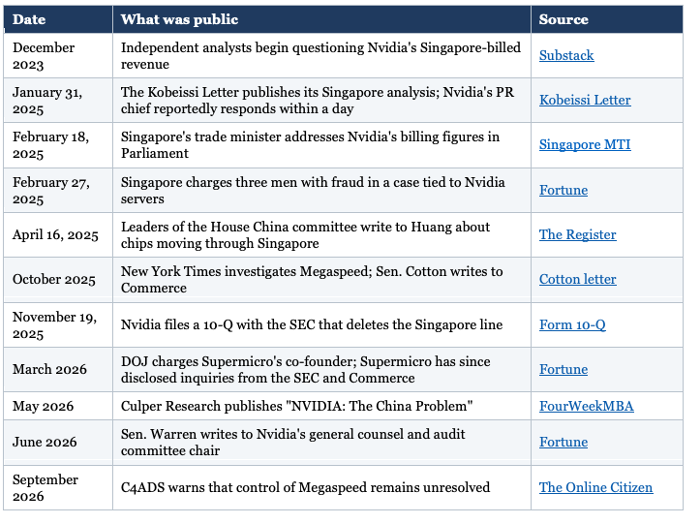
In Plain View
Sources for this table: Substack (December 2023); Kobeissi Letter (January 31, 2025); Singapore MTI (February 18, 2025); Fortune (February 27, 2025); The Register (April 16, 2025); Cotton letter (October 2025); Form 10-Q (November 19, 2025); Fortune (March 2026); FourWeekMBA(May 2026); Fortune (June 2026); The Online Citizen (September 2026).
That is nearly three years of warnings, and two entries on the list stand out. One is the 10-Q of November 19, 2025. That document was not a rumor on social media. Nvidia filed it with the SEC itself, and it removed a line worth 22% of revenue five weeks after a senator's letter about a Singapore customer. The other is Supermicro. According to Fortune, Supermicro, whose co-founder is charged with diverting servers containing Nvidia chips and has pleaded not guilty, while a co-defendant has pleaded guilty, has disclosed inquiries from the SEC among other authorities. Supermicro's own 10-K is more specific. It says the SEC subpoenaed documents "relating to certain customers, including one customer that is the subject of the allegations in the Indictment, and the Company's controls and procedures." So SEC enforcement staff were already asking about customers and controls one link down Nvidia's supply chain. In fairness, Supermicro says Megaspeed was never its customer, and neither Supermicro nor Nvidia has been charged. But did nobody walk upstream?
One more data point, and I mention it only in passing because it belongs to a different fight. On November 13, Treasury Secretary Scott Bessent told CNBC that Treasury, the Pentagon, the State Department and the U.S. Trade Representative had all favored putting Megaspeed on the Commerce Department's Entity List "for months," but that "Commerce has the pen." Axios had reported days earlier that Bessent confronted Commerce Secretary Howard Lutnick about it in the Situation Room after the midterms, that White House and intelligence officials had been pressing Commerce to act since the fall of 2025, and that Commerce has not added a single company to the list in more than a year. Commerce denies the Situation Room exchange, and Lutnick has agreed to testify before the Senate Banking Committee, so the export-control story will get told elsewhere. My point is narrower.
If Bessent is right that four cabinet-level departments concluded months ago that a major Nvidia customer in Singapore was too dangerous to sell to, that judgment was sitting inside the same government that houses the SEC. A customer that Treasury and State want blacklisted is a customer whose revenue an issuer may have a hard time collecting, sustaining or describing accurately. That is a disclosure question, and if word of it reached the SEC, it should have put Nvidia's Singapore footnotes on an enforcement attorney's desk the same week.
There is also the Division of Corporation Finance to consider. Sarbanes-Oxley requires the SEC to review every public company's filings at least once every three years, and the largest companies get looked at far more often. A review can be limited in scope, and it can end without a comment letter. Reviewers send comment letters when a disclosure puzzles them. A geographic revenue table that the company itself kept re-explaining is the kind of thing that draws a comment. I have not seen a public comment letter on Nvidia's Singapore disclosures. If one exists, it should be read closely. If none exists, somebody should ask why.
So the possibilities narrow to three, and none of them is comfortable.
The first is that the SEC opened an inquiry long ago and it is quietly proceeding. That would be the best case, and I would be glad to learn it. But then one has to ask why, after all this time, Nvidia's filings have never disclosed an SEC inquiry, why the footnotes were allowed to change shape four times, and why the line was permitted to vanish without a public word.
The second is that the SEC opened an inquiry and closed it. In that case there is a closing memorandum with names on it, and it rests on representations somebody at Nvidia made to the staff. Those representations are now evidence.
The third is that the SEC never looked at all. That would mean the agency responsible for the integrity of public company disclosure passed over years of public allegations about a company this size, during the very period it was telling the public that it had refocused on financial fraud.
I do not know which of the three is true, and I am not accusing the staff of anything. I worked with those people, and the career staff are as good as any in government. But the question has an answer, the answer is sitting in the SEC's own files, and Congress, the Inspector General and the public are all entitled to it. What did the SEC know, and when did it know it?
This Should Be an Earthquake Inside the SEC
I joined the SEC as a staff attorney in 1991 and left in 2009. I was in the building for Enron. I was there for WorldCom. I was there for Madoff. I know what the place feels like when something this size breaks, because I walked those hallways.
It dominated everything. It was the only conversation in the elevators, in the hallways and in every office with the door open. Nobody had to be told it mattered. The Director of Enforcement said, in substance, we have got to get to the bottom of this, and the agency reorganized itself around that sentence. The best lawyers were put in charge. So were the best accountants, the best examiners and the best analysts. Everybody rallied, because the public expected the SEC to find out what happened and the staff expected it of themselves.
There was a second reaction too, less noble and every bit as important. I think of it as the gotcha movement. The moment a giant fraud surfaced, somebody started asking the uncomfortable question inside the building. Did we have this? Did a tip come in? Did an examiner flag it? Did somebody close a matter that should have stayed open? After Madoff, that question was asked formally by the Inspector General, and the answer was devastating: the agency had received more than ample information over the years and never ran it to ground. I testified before the SEC's Inspector General roughly half a dozen times in my career, so I know how thorough that process can be when someone decides it should be.
Both reactions should be under way at this moment.
The first means a formal order of investigation, a team drawn from the new accounting unit and the strongest people in the regional offices, and a Director who says out loud that this is the priority. A company worth trillions, a resigned chief executive, a vanished line item and a Big Four auditor is not a matter for the next available staff attorney.
The second means looking backward without flinching. The SEC keeps a database of tips, complaints and referrals, and someone should already have searched it for Nvidia, Megaspeed, Singapore and every related name. The Division of Corporation Finance reviews large filers on a regular cycle, and someone should already have pulled every comment letter and every reviewer's note on Nvidia's geographic disclosures. If an inquiry was ever opened and closed, the closing memo should be on the Director's desk.
And the Inspector General should not wait to be asked. An Inspector General who starts that review now protects the agency. One who starts it after a congressional subpoena does not.
What worries me is that I am not sure the hallways sound the way they used to. An agency that has shrunk, that measures itself by what it declines to bring, and that posted what the press counted as its lowest case count in 35 yearson November 10 may have lost the reflex. I hope I am wrong. And even if the SEC rises to it, the Justice Department may well get in the way. It usually does.
The Justice Department: Secrecy and the Stand-Down
According to Semafor, it currently has three inquiries: the antitrust probe of Nvidia and the Megaspeed and Supermicro matters. The New York Times has reported that DOJ took over the federal Megaspeed investigation from Commerce. The reporting gives no indication that prosecutors intend to charge Nvidia or Huang. The President, for his part, has said the Federal Bureau of Investigation (FBI) is "looking into it" and has called Huang "a fine person."
Notice what is missing: any reported criminal inquiry into Nvidia's financial reporting.
I have lived what typically happens next. Prosecutors open a grand jury investigation, and under Rule 6(e) its work is secret. Then they ask the SEC, and by extension the PCAOB, to stand down: no testimony, no document requests, no transcripts.
The practice has its reasons. But the Supreme Court has long permitted parallel civil and criminal proceedings, so the two tracks can lawfully run side by side.
In this matter, however, a stand-down would be costly on four counts. The first is time, because criminal investigations of this kind take years while the five-year limitations period for SEC penalties keeps running. The second is scope, because a criminal team looking at smuggling is not examining the segment note, the audit workpapers or the disclosure committee minutes. The third is the standard of proof, because DOJ needs willfulness beyond a reasonable doubt while the SEC can bring negligence-based and strict-liability charges on a preponderance. Many matters that never become criminal cases make solid civil ones. And the fourth, frankly, is politics. A criminal inquiry inside a Department whose leadership answers to a President who has publicly vouched for the central figure is not one I would treat as a reason for everyone else to wait.
An investigation built on the company's own filings and its auditor's workpapers can go a long way without touching anybody's grand jury. If DOJ asks the SEC to stand down, the right answer to anything open-ended is a polite no. Pause what poses a real risk and keep working on the rest. The PCAOB should give the same answer.
The PCAOB: The Auditor's Regulator, If It Still Regulates
Congress created the Public Company Accounting Oversight Board after Enron and WorldCom for one reason. Auditors had been policing themselves, and it had not worked. Sarbanes-Oxley gave the Board power to inspect registered firms, investigate them, compel their workpapers and testimony, and impose sanctions.
PwC is a registered firm that is inspected every year, and the Nvidia engagement is the audit of one of the most valuable companies in the world. The Board could open a formal investigation of that engagement today, without waiting for anyone, and obtain what no outside observer can see: the planning memos, the risk assessment, the testing of the geographic note, the Section 10A analysis if there was one, the management representation letters and the communications with the audit committee.
Whether it will is another matter. Consider the past year and a half. In July 2025, Chairman Atkins removed PCAOB Chair Erica Williams, and in January 2026 the SEC named four new board members. Congress tried and failed to abolish the Board in the 2025 reconciliation bill. The SEC then approved a 2026 budget of $362.1 million, down 9.4%, and cut the chair's pay by 52% and the other members' pay by 42%, which Atkins called an "initial step." Funding for the enforcement division was cut by about 15%, according to a Brattle Group analysis. The new chair, Demetrios Logothetis, a 40-year veteran of Ernst & Young, was sworn in on February 10, 2026. And auditor enforcement by the PCAOB and the SEC combined fell to 39 actions in 2025, down 33%, with Brattle finding that 84% of the PCAOB's actions and 98% of its penalties came before Williams left.
So a Board led by a career Big Four partner, with a smaller budget and a shrinking docket, now faces a question about a Big Four firm's audit of the most valuable client that firm has. I am not prejudging the answer. I am saying the answer will tell us what the PCAOB is for.
The FCPA: The Statute Almost Nobody Is Enforcing
Most people think of the Foreign Corrupt Practices Act (FCPA) as a bribery law. In fact it is two laws. The anti-bribery provisions prohibit corrupt payments to foreign officials to win business. The accounting provisions are the same Sections 13(b)(2)(A) and 13(b)(2)(B) I described above, and they apply to every issuer whether or not anyone was bribed. They are the workhorse of financial reporting enforcement, and they fit this matter exactly. A company whose records could not reliably show where its products went, who its customers really were or how many units a blocked buyer received has a books-and-records and controls problem on its face.
On the anti-bribery side, caution is in order. Nothing in the public reporting alleges that Nvidia or anyone acting for it paid a foreign official. But a relationship between a chief executive and a person U.S. officials reportedly regard as an agent of a foreign government, coinciding with billions in sales to her company, is the kind of fact pattern an FCPA unit exists to run down. You do not know until you look.
And who, exactly, would look? In February 2025, the President signed an executive order pausing FCPA enforcementfor 180 days. DOJ resumed in June 2025 under narrower guidelines. Its FCPA Unit shrank from 32 prosecutors in 2024 to 22 in 2025, according to Paul Weiss, and has kept losing experienced lawyers. The SEC brought no FCPA actions in 2025, its FCPA Unit chief and deputy chief left, and the unit was effectively disbanded. Fiscal 2026 was the first year in the Cornerstone database, which tracks cases against public companies and their subsidiaries, with no SEC action involving FCPA allegations at all. Both agencies have spent 2026 closing inherited FCPA investigationswithout action.
The damage goes beyond bribery cases. The SEC's FCPA Unit was where the agency kept its deepest bench of lawyers who knew how to investigate a multinational's books: how to get documents out of Singapore and Malaysia, how to work with foreign regulators, how to read a distributor agreement. That is precisely the expertise an Nvidia investigation needs. Singapore's government has said publicly that it asked the Justice Department and the FBI for help on this matter several times and got little. Those requests did not go to the SEC. But a government with a functioning international enforcement program does not leave a cooperative foreign regulator waiting.
This is what deterrence looks like once it has been removed. Companies calibrate their compliance spending to the odds of getting caught. Tell them the unit is closed, and they hear you.
That covers the agencies. What about the people who may already have tried to warn them?
Whistleblowers: Was Anyone Already Knocking?
I searched for any public report of a whistleblower submission to the SEC about Nvidia's Singapore revenue, its China exposure or Megaspeed, and I found none. That tells us very little, since whistleblower tips are confidential and the SEC does not confirm them.
What the public record does show, as the timeline above makes plain, is that the warnings were anything but subtle, and at least one of them came from a former insider. Culper Research, a short seller with a position against the stock, quoted in its May 2026 report an unnamed former senior Nvidia employee calling the Megaspeed relationship "the tip of the iceberg."
The SEC received about 26,000 whistleblower tips in fiscal 2026. I find it hard to believe that none of them mentioned Nvidia during a year of headlines like these. A former senior employee was willing to talk to a short seller. Did that person, or anyone like that person, also file a tip with the Commission?
The state of the whistleblower program sharpens the question. Chairman Atkins has long been a critic of it. After his confirmation the Commission issued a long run of consecutive award denials, and it denied all 24 claims decided in the first quarter of fiscal 2026. Awards recovered later in the year, to more than $158 million for 65 people. But would-be whistleblowers read the denials, and their lawyers read them more closely.
If a credible Nvidia tip came in and was shelved, that is a scandal of its own, and it is the Inspector General's job to find it. If no tip came in, the agency should ask itself why insiders at a company with this much smoke did not think the SEC was worth calling. In either case, the best witnesses are probably not the ones still on the payroll.
Former Employees: The Investigator's Best Friend
If I were running this investigation, my first calls would not go to Nvidia. They would go to people who used to work there.
When the staff wants to interview a current employee of a represented company, it generally goes through company counsel, so the company learns who is being interviewed and can infer why. The employee is offered a lawyer, usually the company's lawyer at the company's expense. Most say yes, because saying no feels like a declaration of disloyalty.
Before any of that, the company's lawyers have usually interviewed the employee themselves, and they open with what is called an Upjohn warning, after the Supreme Court's 1981 decision in Upjohn Co. v. United States. In plain English it says: I represent the company, not you. What you tell me is privileged, but the privilege belongs to the company, and the company alone decides whether to waive it and hand what you said to the government.
Think about that from the employee's chair. The lawyer sitting next to you in SEC testimony, even one who has agreed to represent you as well, owes a duty to your employer. If your interests and the company's diverge, and in an accounting case they often do, your lawyer has an obvious conflict. The result is predictable. Current employees prepared by company counsel tend to remember less, volunteer nothing and tell a consistent story. I am not suggesting anyone suborns perjury. I am describing how the incentives run.
Former employees are different in every way that matters. The staff can generally contact them directly, and the company does not even need to know. They no longer depend on the company for a paycheck. They often left for a reason, and sometimes the reason is the case. They know the systems, the names and where the documents live, and they can tell you which current employees to subpoena and what to ask.
In my experience, the road into an accounting case almost always ran through a former controller, a former sales operations manager, a former compliance analyst or a former assistant who kept the calendar. At Nvidia, I would want the people who have left sales operations, export compliance, revenue accounting, the Asia-Pacific partner organization and internal audit since 2023. LinkedIn will produce that list in an afternoon. One name is already public. Donald Robertson, who signed the fiscal 2026 10-K as principal accounting officer, retired from that role in May 2026 and was due to leave the company on July 1, according to Nvidia's own 8-K. Nothing suggests his retirement had anything to do with these events. But few people know more about how the geographic note was built.
I would build a second list at the same time, and it would be former PwC people. Audit teams turn over constantly. Nvidia's proxy says the lead PwC partner serves no more than five consecutive years, and the managers and seniors who do the actual testing leave Big Four firms for jobs in industry every year. I would want every former PwC partner, manager, senior and staff accountant who worked on the Nvidia engagement since fiscal 2024, along with anyone from the firm's national office who was consulted on the geographic note. They know what was tested and what was taken on management's word. They know who raised a question and what became of it.
PCAOB standards require the firm to keep its workpapers for seven years, so what they remember can be checked against the file. And a former auditor no longer has a client to keep happy. Nor can the client silence that auditor. Federal law recognizes no accountant-client privilege, so a former auditor who receives an SEC subpoena has to appear and answer the staff's questions. The only shelters left are the ones every witness has, such as the Fifth Amendment and a genuine attorney-client privilege. A firm's confidentiality rules may limit what its alumni volunteer. They are no answer to a subpoena.
One more point, addressed to any of those people who may be reading. A severance agreement or a non-disclosure agreement cannot lawfully stop you from talking to the SEC about a possible securities law violation. Rule 21F-17 prohibits it, and the Commission has enforced that rule many times. It binds PwC exactly as it binds Nvidia.
So if the agencies were doing their jobs, what would already be done?
The Playbook: What Should Already Have Happened
The New York Times story ran on October 29. It is now mid-November. In a functioning enforcement program, the first month looks roughly like this.
In the first week, the Commission issues a formal order of investigation, which gives the staff subpoena power. Preservation demands go to Nvidia, PwC, the board's counsel, Huang personally and the major server partners. Subpoenas go to Nvidia for the ledger detail and customer master data behind every geographic revenue table since fiscal 2023, for the workpapers and emails supporting the "over 99%" and "less than 2%" footnotes, for every memo, draft and set of minutes concerning the switch from billing location to headquarters, and for the complete Megaspeed file, including onboarding, credit, partner status, the block decision and every communication with Commerce.
Over the following weeks, the staff obtains PwC's audit and review workpapers for fiscal 2024 forward, along with every management representation letter and any Section 10A documentation. It searches its own tips database and Corporation Finance's review files. It reaches out to former employees of both Nvidia and PwC, to the Culper source and to any whistleblower already on file. It sends requests for assistance to the authorities in Singapore and Malaysia, asks Commerce for what Nvidia submitted, and pulls trading records for every officer and director to compare sales against what each knew and when.
The public filings already give the staff a place to start. Nvidia's August 2026 10-Qshows that its general counsel adopted a Rule 10b5-1 selling plan on May 22, 2026, nine days after Culper's report, and that Kress adopted one on June 16, two weeks after Sen. Warren wrote to the audit committee chair. Director Mark Stevens reportedly sold about $947 million of stock between August 31 and September 18 without a trading plan. More precisely, his Form 4 filings do not identify the sales as made under a plan. None of that is evidence of wrongdoing. Executives adopt these plans all the time, and the rule makes them certify that they hold no inside information when they do. But dates like these are what an enforcement lawyer lays next to the documents.
Only after the documents arrive does testimony begin, and the order matters: the revenue accounting staff who built the geographic schedules first, then the disclosure committee, the chief accounting officer who signed the filings and his successor, the general counsel and the audit committee chair, then the PwC engagement partner, and last of all Kress and Huang. Documents before witnesses, junior before senior, former before current, and the executives at the end, when the staff already knows the answers.
There is nothing advanced about any of this. It is the first month of any accounting investigation I ever worked on. If Nvidia's next 10-Q does not disclose the receipt of an SEC subpoena, then either the subpoenas have not gone out or Nvidia has decided it need not disclose them. Neither possibility would be reassuring. Still, companies are not always required to disclose a subpoena, so silence alone will prove nothing.
The Need for an Independent Inquiry
I have spent most of this article on what the government should be doing. But the company has obligations of its own, and they cannot wait for Washington. So let me say what Nvidia should do, because over the years I have watched companies handle moments like this well and handle them very badly, and the difference is almost always the same.
Whenever a problem of this kind surfaces at a public company, the best way for a new chief executive to manage it is to ask the independent directors to commission a truly independent inquiry and then get out of its way. That is not a public relations strategy. It is the only approach I have ever seen work. It tells regulators the company is not hiding anything, it tells employees that the old rules are gone, and it gets the board the facts before a prosecutor delivers them.
What a Real Inquiry Looks Like
It starts with outside counsel, and not just any outside counsel. The company should hire a very seasoned law firm that has never represented Nvidia in anything material or substantive and that agrees not to take on such work for Nvidia afterward.
Next, that law firm should retain an equally seasoned investigations firm. Lawyers are good at many things, but digging is a specialty. The team needs former FBI agents, former federal prosecutors, former Secret Service agents, former Treasury investigators and forensic accountants, people who have spent careers following money, reconstructing deleted files and interviewing witnesses who would prefer not to talk. A matter that runs through Singapore, Malaysia, the British Virgin Islands and Shanghai is not going to be solved from a conference room in Santa Clara.
Then there is access. The independent directors have to demand it, and the new CEO has to deliver it. The investigators need unfettered access to every document, every system, every employee and everything else going on inside the company. No carve-outs, no gatekeepers and no advance screening by the people whose conduct is under review. The instruction to the workforce should be equally blunt. Preserve everything, cooperate fully and tell the truth, and understand that obstruction will cost you your job.
The work should be done under the attorney-client privilege and work-product protection, which cover legal advice and counsel's interviews. It does not protect the underlying facts or the company's business records. The results then go to the board, and specifically to the independent directors, who decide what to share with the government and the public. Given everything I said earlier about the certifications, I would add that the report should go to directors who had no hand in the disclosures at issue.
Who Should Lead The Internal Investigation?
None of that structure matters without the right person in charge. The leader has to be apolitical, credible to regulators and investors alike, and of unquestioned integrity. It has to be someone with real mileage, who goes where the evidence leads and nowhere else.
Very few people actually fit that description. In my professional life, the model has always been the legendary Bill McLucas, who served as Director of the SEC's Division of Enforcement for more than eight years, longer than anyone in the Commission's history. He held the job when I was a young staff attorney. He went on to represent the special committees of the boards of both Enron and WorldCom. He has been his own man from day one, and he is tough as nails. I mention him because he is the standard, and Nvidia's board should be asking itself who meets it.
One condition applies to whoever is chosen, and it is not negotiable. This must be the first time the lawyer and the firm have been hired by Nvidia for anything material, and the engagement letter should record that neither will be hired for such work again. That is a great deal to ask of a major law firm. That is exactly why it works. A lawyer with no real past at the company has nothing to protect, and a lawyer with no real future there has nothing to gain. The only thing left to serve is the truth.
Why I Am Shocked
This needs to happen immediately, and I am frankly shocked that it has not happened yet.
To be precise about what has happened, Nvidia's board announced on November 8 that it was opening an independent investigation, and it retained Wachtell, Lipton, Rosen & Katz and former federal prosecutor Joon H. Kim. Those are serious people. But as publicly described, that review is aimed at whether the former chief executive was the target of a foreign intelligence effort. So far it is an investigation of Huang, and nothing the company has said puts the books within its scope. What has not been announced, as far as I can find, is an inquiry into the sales themselves, the customer, the Singapore footnotes, the decision to delete the line, the certifications and what the auditor was told. Nor has the company said whether its chosen firm has represented Nvidia before in any material way, or whether a forensic investigations team has been engaged.
Those are different questions, and the second set is the one that determines whether investors were misled. A board that investigates the affair and not the accounting has investigated the wrong thing. None of this means scrapping the review already under way. It means widening it, or adding a second team, until the accounting is covered.
The timing matters too. Nvidia reports earnings on Tuesday, November 17, and that call is the last natural moment to get this right. Kress should open it by announcing that the board has expanded its inquiry to the sales, the Singapore disclosures, the certifications and the audit, that it has retained a firm with no history at the company and a forensic team to go with it, and that the work reports to directors whose independence from the decisions under review has been tested. Better still, the company should say so in an 8-K before the call, so the announcement is not buried under a quarter of record revenue. If November 17 comes and goes with nothing but a reference to the Huang review, investors will still not know whether anyone is examining the accounting. Silence would not prove the board has refused. It would be reason enough for the regulators to ask.
A company that commissions the kind of inquiry I have described is telling regulators, investors and its own employees that it wants the truth more than it wants a good quarter. A company that does less is telling them something else. And that choice is part of the same test the agencies face.
The Questions Are Written. Somebody With a Subpoena Just Needs to Ask Them.
Since January 2025, the federal government has made a series of choices about corporate enforcement. It paused the FCPA. It dissolved the SEC's FCPA Unit. It replaced the PCAOB's board, cut its budget and stood by while Congress tried to abolish it. It let the SEC's case count fall for two straight years to a level last seen in 1991. Its officials say this is focus and not retreat, and that the agencies now concentrate on real fraud that harms real investors.
I have been a skeptic to say the least. But a claim like that can be tested, and now it will be.
Nvidia is not a crypto token or a penny stock. It is the second most valuable company in the world, held in index funds and retirement accounts across the country. If a line item worth more than a fifth of quarterly revenue can be explained away by footnote, recast out of sight one quarter after a problem customer is blocked, and certified by executives who may have known things the filings did not say, and if nobody with subpoena power so much as asks a question, then the periodic reporting system is running on the honor system.
The argument for vigorous regulators was never that most companies cheat. Most probably don't. The argument is that every company decides, every quarter, how much candor to buy, and the price of candor is set by the odds that someone will check. An active and aggressive SEC, an active and aggressive PCAOB and a working FCPA program are how the government sets that price. Take them away and you have not lifted a burden. You have told every disclosure committee in America that the close calls can go management's way, and you have told every company just how little is at stake if it breaks the law.
People like to say the regulators are asleep at the switch. They are not asleep. Too often they have chosen not to show up, and companies have noticed.
This did not begin on October 29. The Singapore line was questioned in public for the better part of three years, by analysts, by a foreign government, by members of Congress in both parties and by Nvidia's own shifting footnotes. A healthy SEC would have opened an inquiry long ago and would know the answers by now. Perhaps it did. Investigations are confidential, and I cannot rule that out. So before anyone at the Commission issues a statement about how seriously it takes these events, it owes the public an accounting of the past. What did the SEC know, and when did it know it? If the answer is that it knew plenty and did nothing, then the scandal is no longer only about Nvidia.
So here is the scorecard, and I intend to come back to it. Does the SEC say whether it ever looked at the Singapore disclosures before last month, and what became of it? Does the SEC open a formal investigation, staff it from its new accounting unit and decline any request to stand down? Does DOJ assign prosecutors to the financial reporting questions, separately from the export and antitrust inquiries? Does the PCAOB open an investigation of PwC's Nvidia audits? Does the SEC's Inspector General review what the agency knew and when? Does PwC tell investors whether its prior reports can still be relied upon? And does Nvidia commission a truly independent inquiry into the sales and the reporting, led by someone whose integrity is beyond question, and hand that person the keys?
I will end where I began. I do not know whether Nvidia's filings were false. Nobody outside the company does, and the facts may look very different a month from now. But finding out is the job, and the people whose job it is have every tool they need. When I was at the SEC, we would have been fighting over who got to work on it.
For two weeks everyone has asked what Jensen Huang did. The better question is what Nvidia told its shareholders, and the best one is still the oldest in Washington. What did the SEC know, and when did it know it? It is time somebody answered.
Review My Disclaimer and my Source List here.