AI Buildout Monitoring Signals

文章目录
This month amid all the chaotic headlines, every AI trade investor needs to deeply re-assess if they still believe in the AI buildout. @ChairmansLedger cleanly writes his (1) out so he doesn't get swayed by media headlines. I'll add my thoughts.
1. The money behind AI runs out.
AI is currently funded from three sources: A) VC money B) Independent Cashflow, predominantly Mag 7 but significant from tier 2 SaaS enterprises. C) Debt
We have two potential source are not currently not significant parts of the game yet: D) Sovereigns E) Returning cashflow on AI Investment
A) The Big VC - Softbank
This is a large and diverse pool of capital with some red flags, yellow flags, and green flags. I will go over some of the more important ones.
Softbank is a big funder of AI demand and this week it just announced it booked a 3.7B loss to forfeit a large gas turbines order (2). What the media doesn't tell you is that the 3.7B is $2.85B in loss deposits and $0.88B loss in contract modifications and settlements (2).
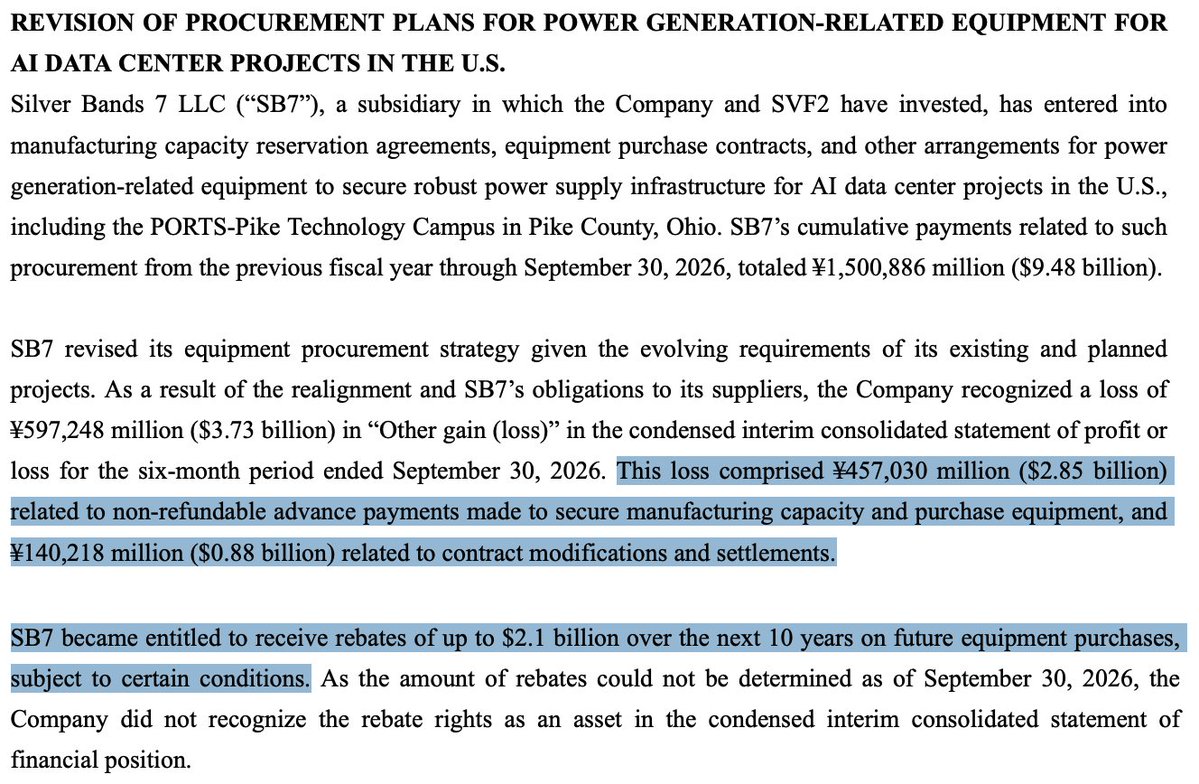
Media only reports half the story. Softbank is choking on delays causing their order of turbines to be reduced but Softbank is far from dead.
$0.88B is a really big fee to pay for potential $2.1B rebates over the next 10 years but Softbank is not doing a default on the contract. What's likely happened is that restrictive financing conditions and datacenter delays have forced everyone to slow down their buildouts, Softbank included.
People imagine Softbank as a over leveraged fund but that's not entirely true as Softbank is also Japan's largest company with with 49B of annual revenue (5) and if you back out it's appreciation from investments and investment purchases, Softbank has cashflows of $6.4B (5)! Of course none of that is free cashflow because all of it is going into AI investments. The concern is that Softbank is taking that 6.4B and leveraging it into additional funding to invest into OpenAI. This is a valid concern but the leveraged is backed by assets including ARM. This does not include it's 20.1B Vision Fund or other private holdings like ByteDance, Revolut, Flipkart and of course it's 13% holdings in openAI.
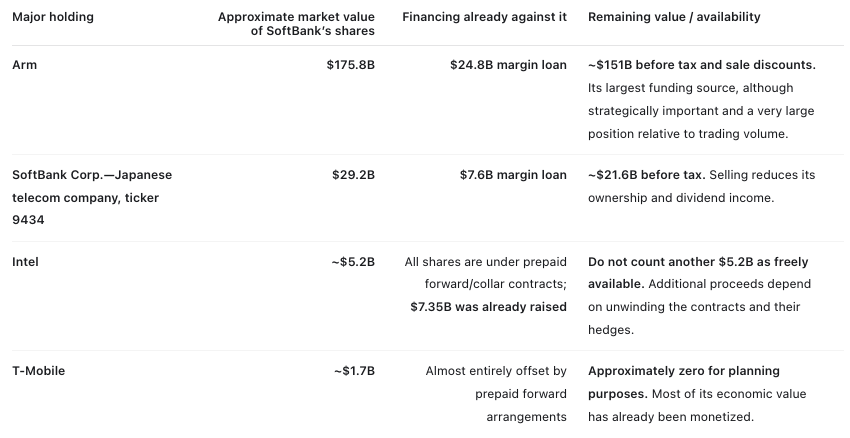
Softbank has only margin loaned $32B of it's 205B worth of assets.
So no doubt, Softbank is a yellow flag but not yet a red flag, OpenAI has other large sources of funding. Let's explore OpenAI's funding, Anthropic's is similar.
OpenAI/Anthropic
In OpenAI recent March $122B funding round, Amazon is actually the biggest funder with Nvidia and Softbank tied for 2rd.
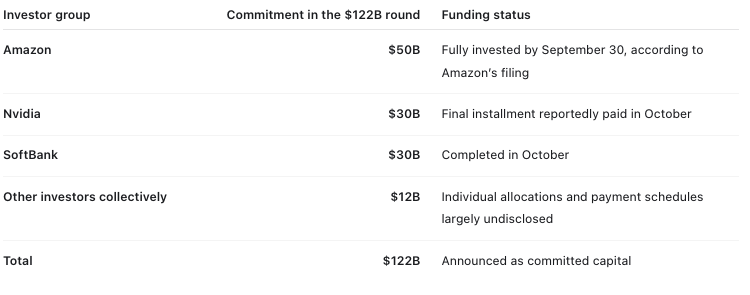
OpenAI's next funding round will have reduced amounts from Softbank, Amazon, Nvidia and sovereign investors such as MGX (8). However the concern with MGX is that it's Dubai's investment firm which because of the Iran War has decreased their funding from $30B to $20B (8). There are some bright spots though with Amazon scrapping it's model building efforts, it will need to double down on both OpenAI and Anthropic.
B) Mag 7 Investments
The concern is that Amazon investments come back as GPU purchases by OpenAI/Anthropic. However, consider if Amazon still had it's internal model development team: Amazon would buy many GPUs for it. So this is not really circular funding as Amazon is just buying it's stake in the the model layer in OpenAI/Anthropic rather than funding it's internal team.
Mag7 funding of the Frontier Labs is actually more stable for the AI buildout. Consider if MSFT, Amazon, Nvidia had gone all in on their own models, there's no guarantee it succeeds because it would still have to complete with OpenAI/Anthropic/Muse/Grok/Gemini. Could you imagine the write off and the all the freed up training GPUs after the project is called quits? Thank god, Amazon's internal model team was an small effort so stopping it doesn't put signfiicant amount of compute on the market.
Now Nvidia is likely to continue to invest because if Amazon does most of the investments, eventually OpenAI/Anthropic rely on Amazon Trainium stack. Thus Nvidia must continue investing to keep Nvidia's share of OpenAI/Anthropic's compute.
Is Nvidia's funding of OpenAI to buy it's own GPUs circular funding? No, because its analogous to Nvidia and Nemotron became a fullstack layer but instead of Nvidia putting all it's eggs on Nemotron, it's diversifying into OpenAI/Anthropic. These large Mag7 companies always have had a large degree of vertical integration, OpenAI/Anthropic are their shared hedges. If you think really hard, you'll understand that OpenAI/Anthropic are the Nash Equilibrium for all these Mag7 to risk optimized their funding so no one fails too badly.
Apple is the Mag7 sitting out but if AI really succeeds, will Apple be able to sit behind it's iPhone just by making it flip screen? Apple may have to triple down after coming in really late or risk becoming IBM.
B) Mag7 Debt Capacity
The big scare is that Mag 7 no longer have free cash flow after max investing into GPUs and is now taking on debt. However, these Mag 7 companies have a combined $584B capacity for debt (9). Not that it will all be used but it's does have room to go.
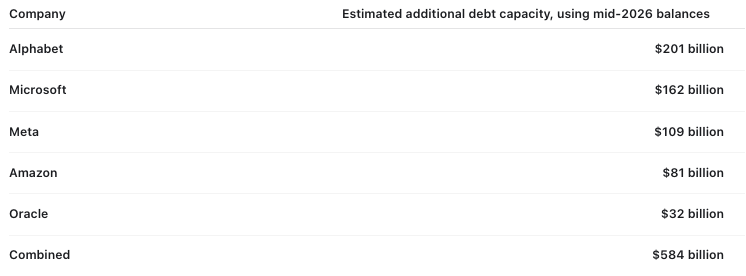
Debt is on top of cashflow that comes in every year for Mag 7 so if Mag 7 decides not take take on any of the debt listed above it's still has considerable operating cash flows.
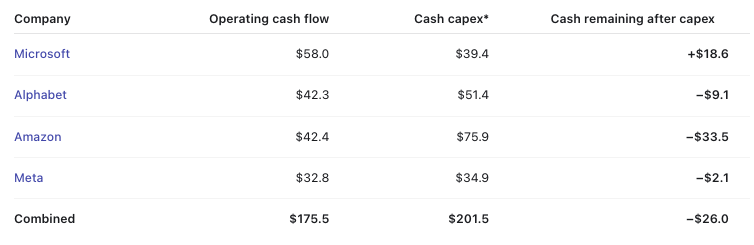
Not listed above is Nvidia with 127B of free cash flow in the trailing twelves months (10). Now Nvidia could return profits to investors instead of re-investing like Apple but that would increase the liquidity in the market which a significant portion will find it's way into AI investments via channels like US VC funding.
A) US VC Funding aka not Softbank
VC funds and their contributors have gotten quite rich after almost two decades of great returns in tech. Most of this money cannot fit into bay area real estate so it has to get put into assets with larger total market cap. Alot of these contributors have made their fortune in tech and aren't going to become gold bugs overnight in the mist of the AI boom.
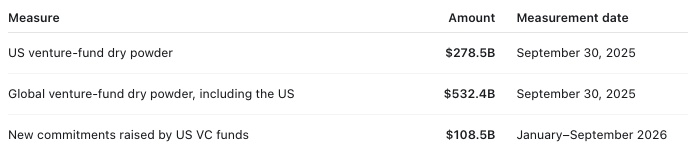
From the funds above, we have to figure out how much of it is already invested and there's actually a healthy amount money that can be invested in AI Natives like FireworksAI, TogetherAI, Baseten, Modal, FigureAI, Fal AI, Cohere, Prometheus. Many AI Natives are Neoclouds customers because their funding is not from Hyperscalers, they don't have to buy over priced Hyperscaler compute and can buy from the Neoclouds!
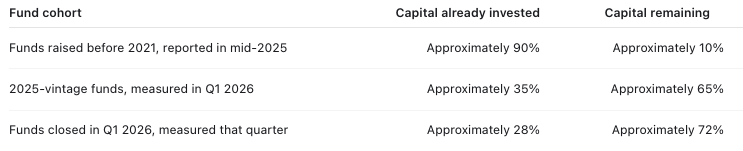
Of course, I'm not going to pretend the numbers are that big. 532B of global venture dry powder sounds like alot but you have to backout sovereign funds like MGX which already counted in OpenAI financing. And even among the 532B, many fund deployment timeframe is 3-10 years. However with 108B coming in each year that also get's deployed in a 3-10 year time frame, there's alot of money to go.
Return on Investment
Capitalism is a system which puts money into investments with fruitful returns. So the concern really should not be AI "running out of money" but rather "does the return on AI justify the investment"?
With any prototypes projects trying to adopt AI, many will fail. A successful project will fail multiple times before it succeeds. The prototype cycle will demand more and more compute because intelligence scales with compute. So the question is are we still in the prototype phase? What do the returns look like?
I'm not going to bore you with another long section, but Anthropic and OpenAI were the first to really make break throughs on the prototyping of coding agents so they are the early example that has gone through the prototype cycle to look at for return on investment. The best metric for return on investment is positive cashflow. While OpenAI is not expected to become cashflow positive until 2029 (11), Anthropic has announced cashflow positive for the first time in Q3 2026 (12).
Yes it's true that not all applications of AI will find the wild success of coding agents but coding agents is not done yet and there's alot more development to be done and alot more TAM within coding agents alone to explore. And with this wildly successful application of AI, you'd bet there's alot of takers on other fields. Fields that come to mind are social media, shows, movies, cyber security, robotics, IOT. I mean, while scrolling through your X feed, have you realize how good AI generated meme videos are recently? You see why the biggest social media companies like Facebook and SPCX need continued investments in AI or potentially lose market share? This applies for most fields I mentioned.
2. Financing gets too expensive.
High interest rates can come from both supply side or demand side and right now we are seeing both. Demand side driven high interest rates is a feature, not a bug. Supply side inflation is unfortunate and L's for everyone.
Supply side inflation is from both the Ukraine War and Iran War. If it was just the Iran War and the Ukraine War ended, the situation wouldn't be this bad. But ending the war wouldn't reverse diesel prices immediately because damage refineries can take years to repair. However, the market is pricing in alot of uncertainty and that premium can be reduced if one or both wars end. With Democrats in congress, Trump will likely have to wind down the Iran War because congress controls war funding. The Ukraine War is harder to estimate a timeline for but it seems to be a type of war where the lines are static but could suddenly collapse due to internal supplies/conflict.
However there are also huge tailwinds to help supply side inflation. During these times of elevated oil prices, China has increased their prioritization of energy independence and made large investments in energy infrastructure. China's the second largest consumer of oil so them reducing their oil consumption expectations will help oil prices. In other words, when China invest heavily in something, subsitute goods price go down.
What an demand driven high interest rate does is raise the bar for which companies gets funded. All these buildouts are all partially debt and partially equity/cashflow/pre-payments. If debt cost goes up, equity investors will reduce funding overall and for terrible companies cut off funding completely thus disabling terrible fundings from accessing debt funding. Only companies who's customers are confident in them to put down significant pre-payments will be able to access debt funding.
If everyone is trying to build out AI gets funded then we would have an overbuild. Higher interest rates may hurt the stock price of IREN, NBIS, CRWV in the short to mid term and slow down their buildouts but it will prevent the NScales and Firmus AIs of the world from IPOing at all. This is good because NScale and Firmus AI would have been zombie companies anyways and a huge waste of capital which would make this buildout cycle. Zombie companies like Nscale and Firmus AI is what would drive down the ROI of AI on a macro level.
Imagine if Nvidia invested or loaned billions in Nscale and the result was idling GPUs because their power wasn't ready or no customers wanted to sign up for 80% uptime. Feature, not a bug.
3. GPU oversupply.
This week, the U.S. Commerce Department is working on a bill to stop China from remote access GPUs (4). From IFP estimates, 60-60% of Chinese compute is Nvidia GPUs! This figure is an accumulation of multiple years worth of capacity additions with pre-ban being 95% Nvidia and H1 2026 being 34% Nvidia (6). With less GPUs being shipped to China, they will need to find powered shells in the US, Canada, Australia, Western Europe.
This is bearish GPU/semiconductor prices but neutral GPU rental prices. All 2027 datacenter capacity and most of 2028 capacity is set in stone! If you plan a datacenter now, it's not coming up until H2 2028. Thus while the GPU supply can increase quickly, the supply of powered GPUs can not be increased quickly.
This is bullish for Neoclouds who have not yet locked in pricing on GPUs. IREN CEO Dan Roberts announced that they "deliberately haven't acquired 100% of the GPUs for next year ... it may well be that GPUs will fall in price, just to reflect the lack of power" (7). So while other Neoclouds have been bragging about securing VR200s, I'm glad IREN makes decision based on economic flexilibity instead of headline pumps.
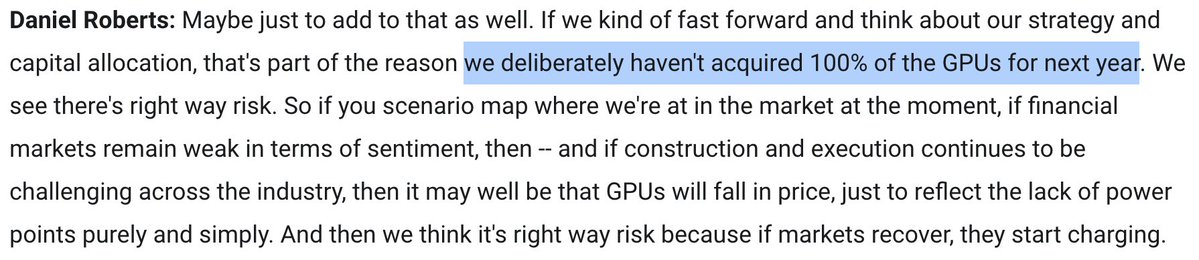
IREN has hedged for GPU oversupply. Thanks to @idearikas for quote.
4. Hyperscalers cut capex.
This is a subcase of the points I explained in section 1.
5. The mkt simply refuses to reward growth.
Public market throws it's tantrums and it's a psychology game within a investing game. Every ~2 years, there's always a short period where the bad news keeps getting worse: Covid, Ukraine War, SVB et al credit crunch of 2023, Trump's Tarriff's Wars and now a creative combo of Iran War + Democrats Regulation + Jensen's Romantic Life.
There's no doubt psychology is part of it and I like to play the game on easy mode which is common shares. If you really can't handle it then check back again in May-June 2027, after all that's essentially what privately owned companies do, they rarely mark down even in bleak macro conditions.
If the team executes, the company becomes valuable and all investors find liquidity at a time when macro and industry conditions are good. There are IPO windows when it's a good time for a private company to IPO. For publicly held companies, when the stock market is in full fear mode, it just means the window is closed for selling if you didn't get out in the last round.