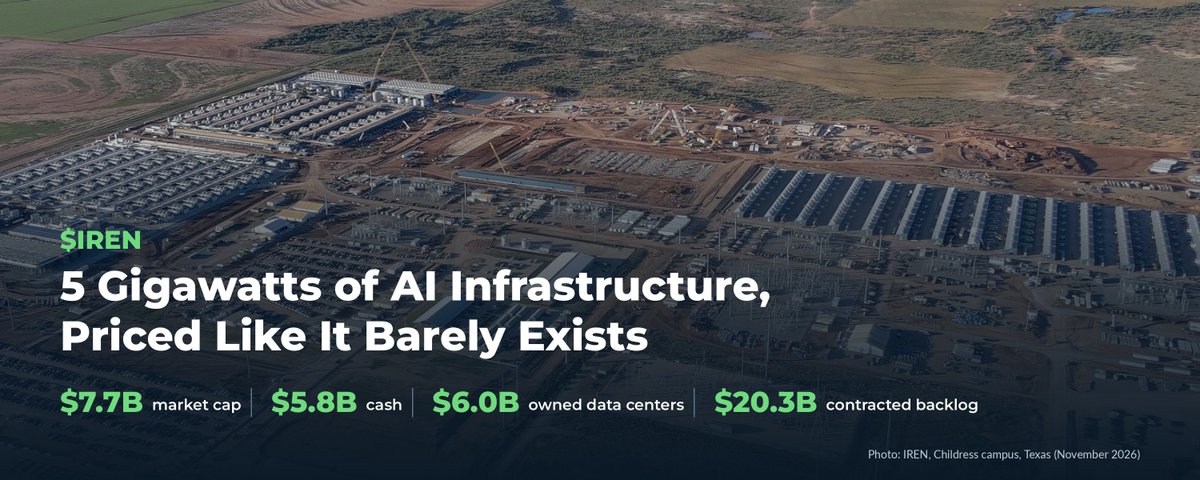
$IREN: 5 Gigawatts of AI Infrastructure, Priced Like It Barely Exists
I just bought 60,000 shares of $IREN in the public markets at $18.72 a share.
The stock closed Friday at $18.17. The 52-week low is $17.16. The 52-week high is $70.71, almost 4X where it trades today. I think the market is handing us one of the most mispriced assets in AI infrastructure, and I want to walk through why.
The market cap vs. what IREN already owns
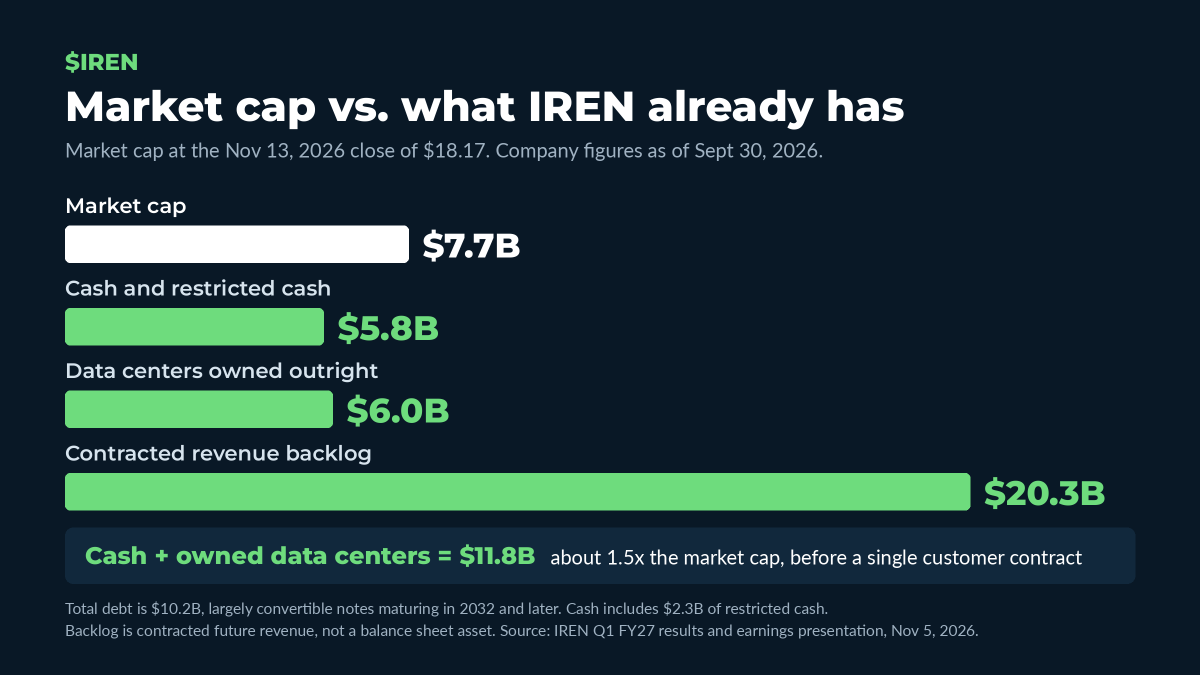
IREN's market cap is roughly $7.7B. Here is what the company reported for the quarter ended September 30:
• $5.8B of cash (including $2.3B of restricted cash set aside mainly for GPU deployments) • $6B of data center assets that it owns outright. Cash-funded, unencumbered, with 20-year useful lives. Management is targeting $10B by June. • About $9B of cash plus committed financing and prepayments, which is more than the entire market cap • $20.6B of total assets
Cash alone is about three quarters of the market cap. The data centers IREN physically owns are worth nearly as much as the whole company trades for. Put the two together and you are well past the market cap before counting a single customer contract.
To be fair, there is debt: $10.2B, largely low-coupon convertible notes with maturities concentrated in 2032 and beyond. It deserves to be tracked. But it is long-dated, and it sits against $20.3B of contracted backlog.
That backlog is part of what the market is ignoring:
• $20.3B revenue backlog, about two-thirds of it with investment-grade counterparties like Microsoft and NVIDIA • AI Cloud revenue of $200M in the quarter, up 182% from the prior quarter • Operating ARR doubled to $1B, with more than $4B contracted and fully funded • 86% AI Cloud gross margin (before depreciation), with adjusted EBITDA margin doubling from 14% to 29% • More than 5GW of secured power across 30,000+ acres
Jensen's math
At GTC Berlin on October 21, Jensen Huang laid out the economics of an AI factory:
"Remember this, each gigawatt data center is $50 billion. The revenue generation you expect is tens of billion dollars per year. If we just said it is $40 billion per year of revenue generation that comes out of that infrastructure."
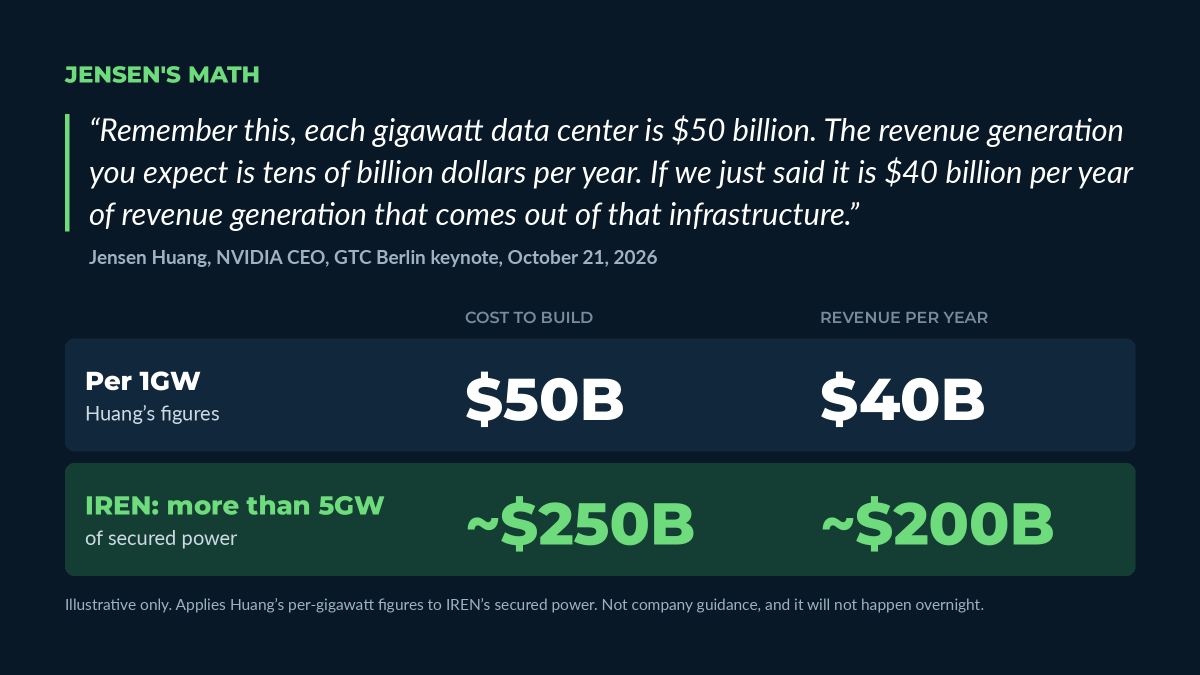
IREN has more than 5GW of secured power.
By Jensen's math, that is a buildout of roughly $250B that could generate around $200B a year in revenue.
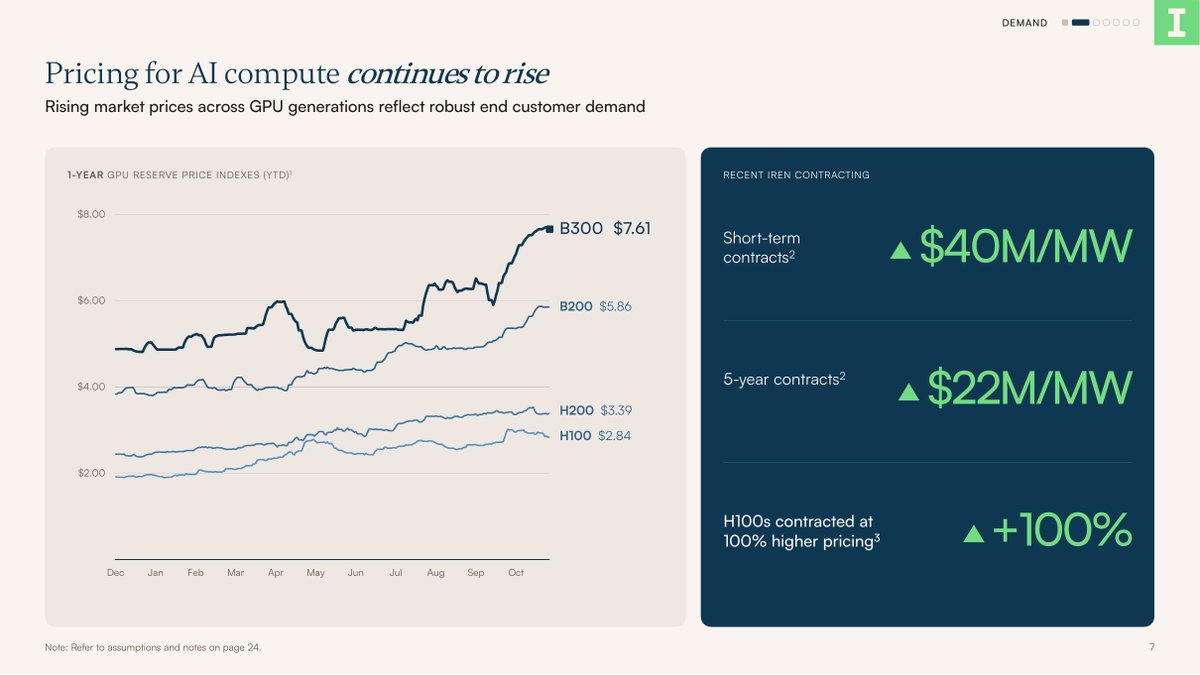
That obviously will not happen overnight. And you can haircut it however you like: for cooling overhead, for time, for the fact that IREN's five-year contracts are pricing closer to $22M per megawatt. But IREN's own numbers rhyme with Jensen's. Its own illustration pegs a liquid-cooled megawatt at around $60M all-in, and it just signed a short-term contract at $40M per megawatt per year, which is exactly Jensen's $40B per gigawatt.
Any reasonable fraction of that number dwarfs a $7.7B market cap.
The two big fears in AI, and why both answers are bullish
Almost every bear case in AI infrastructure comes down to two questions.
1) How can they fund it?
The customers are funding it. Demand is so far ahead of supply that customers are paying up front to lock in compute.
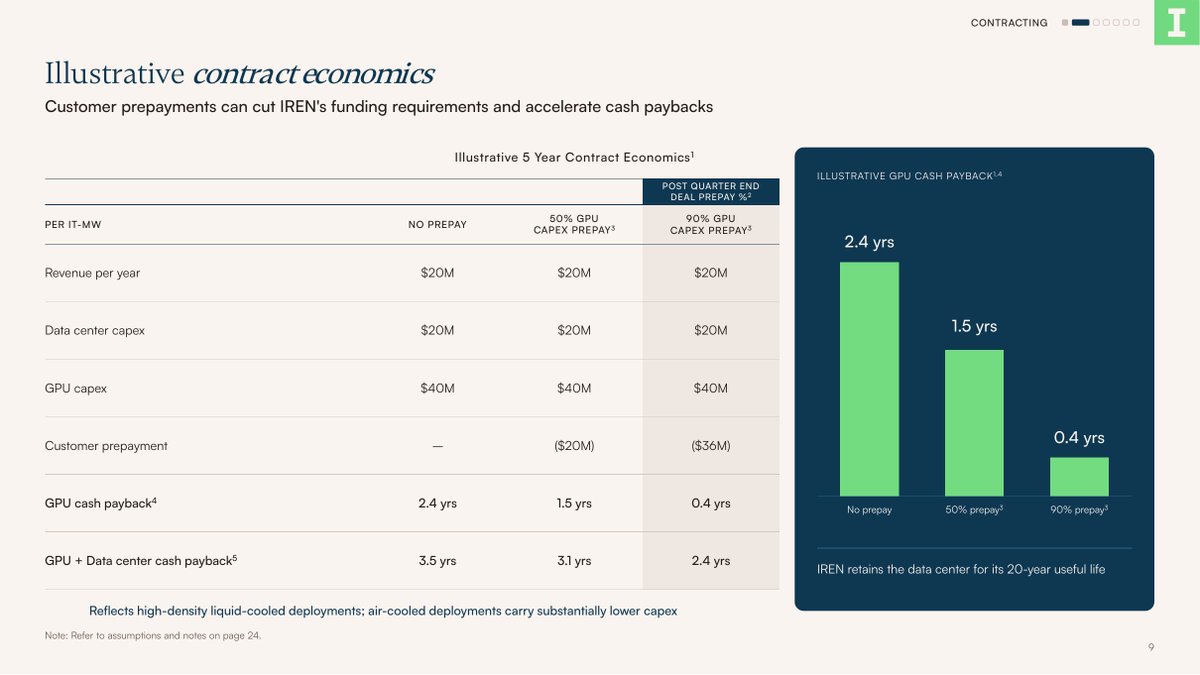
Since quarter end, IREN signed a five-year contract at about $22M per megawatt where the customer is prepaying roughly 90% of the GPU capex. On a five-year deal. At its Mackenzie deployment, customer prepayments plus GPU financing covered more than 100% of the GPU capex. Management says current pricing supports GPU paybacks of around 18 months.
IREN also raised $19B in the 12 months to September, including $6.5B of GPU financing at 6% to 9.5%. When customers will write the check before the chips even arrive, funding is a pacing decision, not an existential one.
2) How fast do the chips depreciate?
This one also comes back to demand. IREN just recontracted older generation H100s, chips that are multiple generations behind the newest hardware, at double the original contract price. And not on a short-term spike. Management confirmed it was locked in on a multi-year term.
Chips that were supposed to be heading toward worthless are renewing at 2X. That is what a supply shortage looks like.
IREN owns what others rent
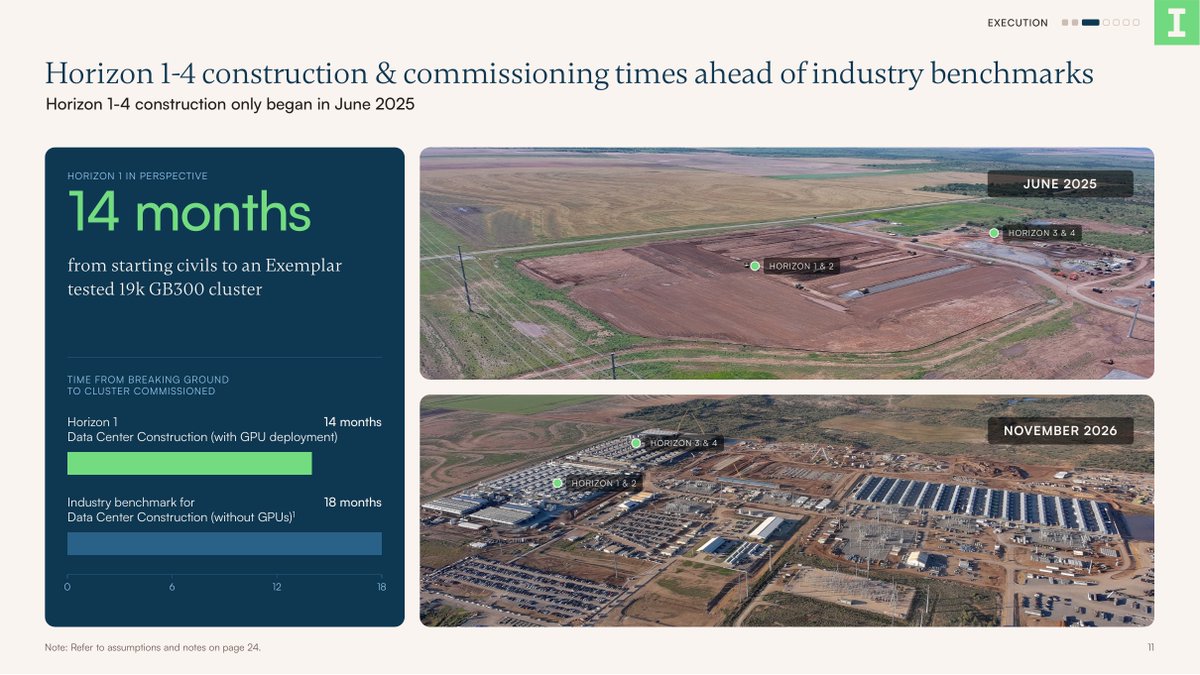
The typical neocloud leases someone else's data center and carries that liability for years. IREN owns the land, the power connection, the data centers and the compute. In Dan Roberts' words: "We don't lease someone else's data center and carry the liability on our balance sheet." That ownership shows up in speed. Horizon 1, IREN's first liquid-cooled build for Microsoft, went from civil works to an NVIDIA Exemplar Cloud-validated GB300 cluster in about 14 months. JLL puts the global average at 18 months for a 50MW data center, and that is the building alone. IREN delivered the building and the cluster inside it four months faster.
It also shows up in flexibility. Part of why the stock has been hit is that the $4B+ ARR milestone moved from year-end to January (possibly February). Microsoft asked for a network upgrade so the full 200MW can serve the latest frontier models, and supplier timing did the rest. IREN could say yes to that request because it controls the whole stack. As of the earnings call, Horizon 2 was built with GPUs racked and in commissioning, Horizon 3 had all of its GPUs on site, and Horizon 4's GPUs were arriving within weeks.
A one or two month slip on a five-year, $9.7B contract is not a thesis change.
5GW is not the finish line
IREN disclosed a development pipeline of more than 35GW on top of the 5GW already secured. It is early stage and management is clear that not all of it will convert. But listen to how Roberts talks about it:
"We are not here for 200 MW of Horizon 1. We are not even here for the 5 GW of secured power."
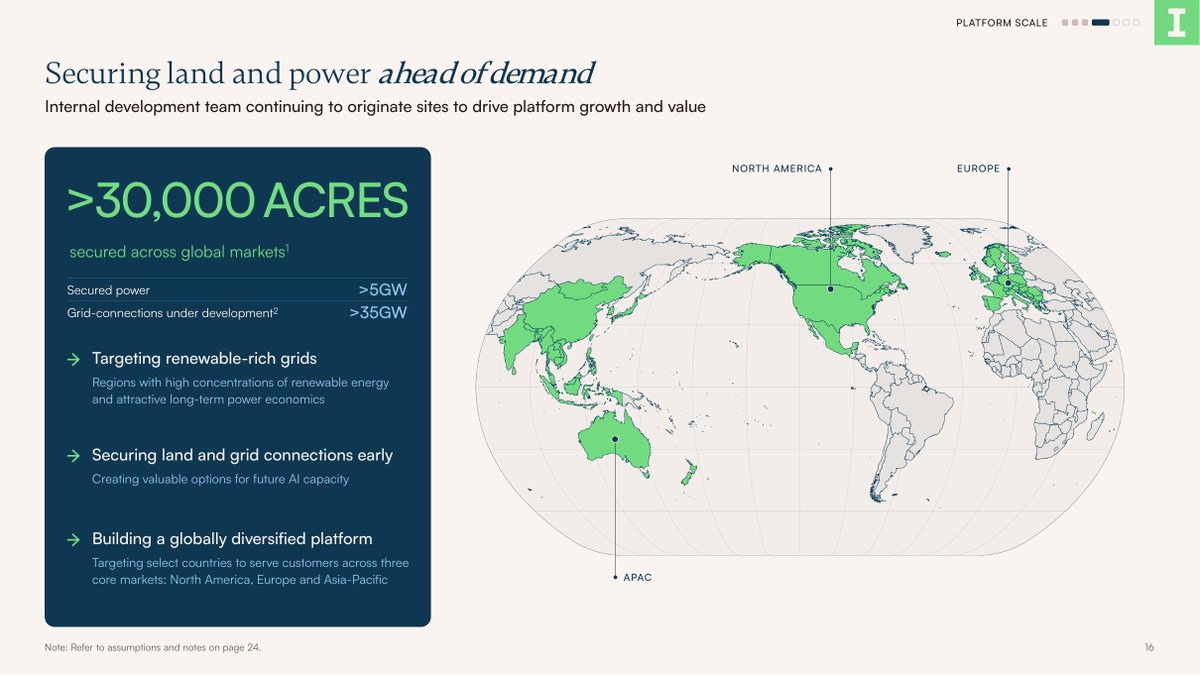
This company intends to be a key infrastructure player of the AI era, and it has spent eight years securing the land and power to do it.
The Cerebras angle
One more thing I am watching. This is speculation on my part, and nothing has been announced.
On its earnings call this week, Cerebras announced a cloud deal with Microsoft, with details coming in the first half of next year. We already knew about the General Compute agreement. Now Cerebras says it has expanded its reach to a variety of neoclouds and is far down the path on negotiations for gigawatts of capacity.
Cerebras is now live with disaggregated inference, where AMD GPUs handle prefill and Cerebras systems handle decode. It says this can deliver up to 5X the tokens from the same data center.
Now connect the dots. IREN still has three more Horizon phases to deliver for Microsoft. IREN already has AMD GPUs alongside NVIDIA in its fleet. And IREN has the one thing everyone in AI is short of: power.
I would not be surprised to hear about a deal where IREN pairs AMD chips with Cerebras systems in a disaggregated solution for Microsoft.
The bottom line
• $7.7B market cap • $5.8B of cash and $6B of owned data centers • $20.3B backlog, mostly investment grade • More than $4B of contracted, funded ARR about to switch on • More than 5GW of secured power and a 35GW+ pipeline behind it • A customer prepaying 90% of GPU capex on a five-year deal • Old chips renewing at double the price
Roberts said on the call that the dislocation between fundamentals and market sentiment "is unlikely to persist very long." I agree.
A single-digit-billion market cap sitting on this much cash, this many owned assets, this much contracted revenue and this much power looks like a 10X+ opportunity to me. That is why I bought 60,000 shares at $18.72.
Disclosure: I own shares of both IREN and Cerebras. I may buy or sell either stock at any time without any obligation to tell anyone. These are my opinions only and not financial advice. Do your own research.