2028 Semis Numbers Look Too High (Unless the Labs Reaccelerate)
文章目录
TLDR: If the labs don't meaningfully reaccelerate to $20B+ of NNARR exiting 2027 (vs. ~$10B per month last quarter), then we will be oversupplied in 2029... And even further, if the labs don't start adding at least $15B of NNARR a month, we will tip into oversupply even sooner (2028).
There is no shortage of opinions on whether the AI buildout is a bubble. I wanted to try and answer a narrower question with the numbers: can the revenue AI generates actually pay for the data centers that sell-side semiconductor consensus implies?
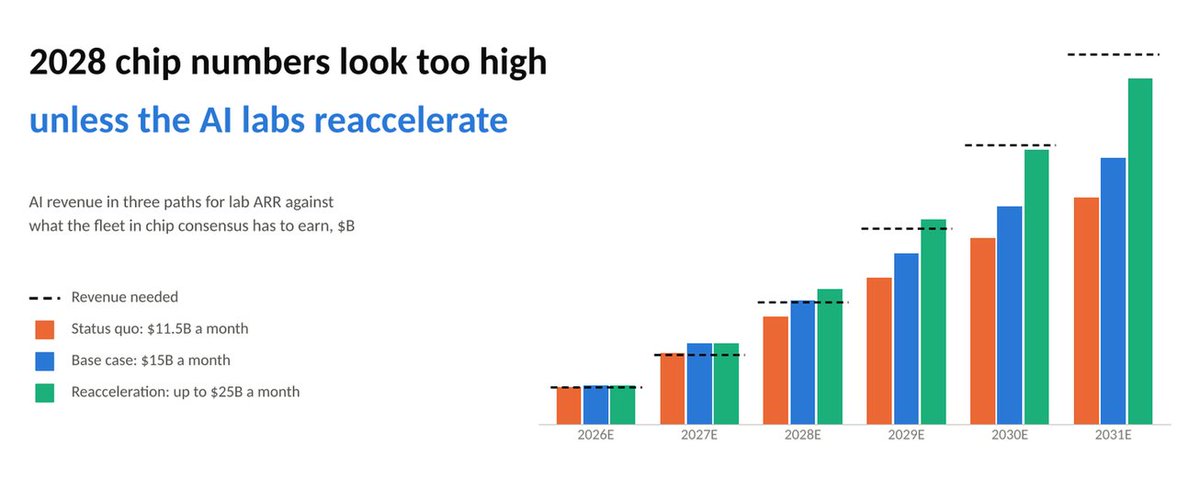
The short answer is yes for the next ~18 months, and no from 2028 unless the frontier labs reaccelerate from here. At this year's pace of lab ARR growth, the fleet that chip consensus builds is oversupplied in 2028. At $15B a month of net new ARR, it tips into oversupply in 2029. Even a reacceleration to $25B a month only gets 2030 to balanced.
Below is how I got there, and where I think I could be wrong.
The Setup
Supply. I start from consensus for AI chip revenue at five vendors: Nvidia (data center), AMD (data center GPUs), Broadcom (custom accelerators), and MediaTek + Marvell. That's ~$450B of revenue this year, ~$840B in 2027 and ~$1.2T in 2028.
From there, I convert dollars into GW using what each vendor collects per GW: ~$25B for Grace Blackwell, ~$40B for Vera Rubin+, ~$18B for Broadcom's XPUs (Hock Tan has put Broadcom's content at $20-30B a GW including networking) and ~$10B for the cheaper custom ASICs. Add the rest of the server and ~$15B of land, power and shell, and a GW costs just under $50B/GW all-in moving forward.
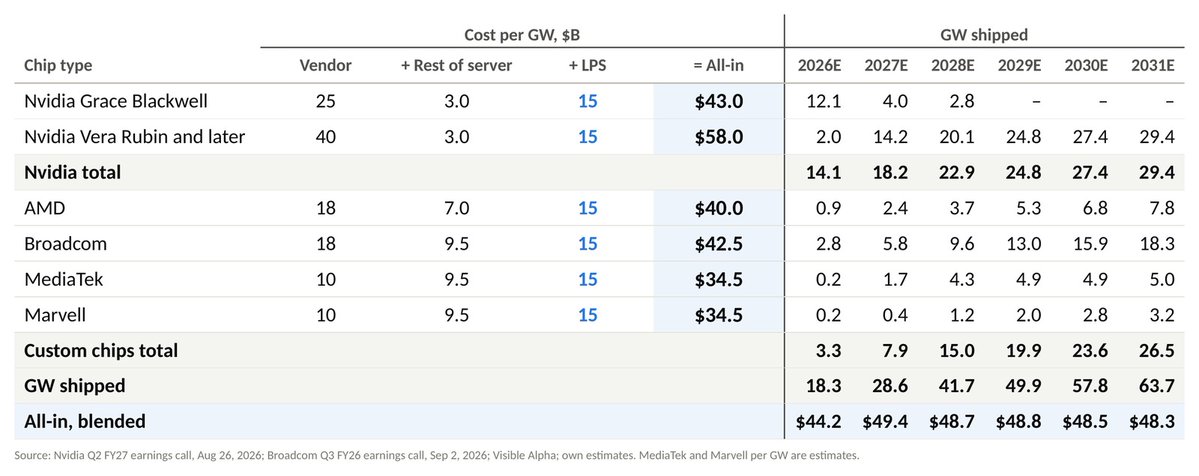
This gets us to ~42 GW shipped in 2028, ~50 GW in 2029 and ~58 GW in 2030 per street numbers.
What a GW has to earn. A GW shipped in 2028 needs ~$10B of revenue a year to cover (i) depreciation (servers over 6 years, the shell over 25), (ii) power, and (iii) a 10% cost of capital on the money still invested.
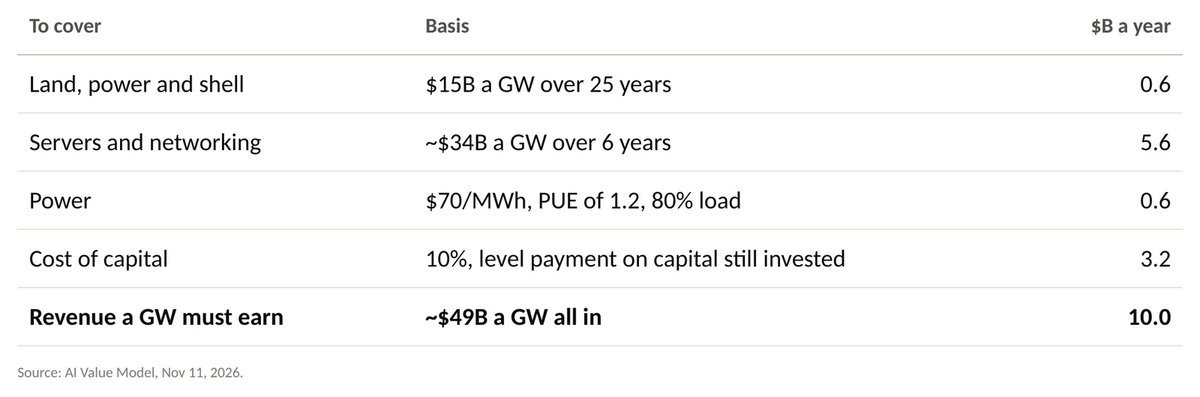
I'd note that this is a very generous bar. It assumes no lab opex (people, sales, R&D), no positive EBIT margin for anyone, and no data center costs beyond power. Six-year server lives are fair, all things considered. I also give capacity nine months after the chip sale before it has to earn anything.
Demand. I count the value AI generates in four ways:
-
Frontier lab ARR (Anthropic and OpenAI). Built quarter by quarter from net new ARR, using the three paths below. Year-end ARR is the run-rate the fleet has to cover.
-
Other model ARR (Gemini, open source, everyone else). Gemini (API tokens, enterprise seats, Workspace and consumer subscriptions) plus open-source model hosts, xAI, Meta, European labs and media models. I build it bottom-up at the end of 2026 and then hold it at that year's share of lab ARR, ~19%.
-
AI-driven advertising and Microsoft 365 uplift above the pre-AI trend. Meta, Google and Amazon ad revenue above each company's pre-AI growth trend, plus Microsoft 365 commercial revenue above its trend (read: Copilot). I credit all of the above-trend growth to AI, which lands a little ahead of consensus.
-
Hyperscaler labor avoided. Megacap headcount (~850k people) growing ~3% a year on average instead of a ~7% trend, at ~$350k of loaded cost per head. It isn't revenue, but it's real value the hyperscalers capture from AI, so I count it.
Total demand is simply the sum of the four. In my base case that's ~$245B at the end of 2026, ~$780B at the end of 2028 and ~$1.37T at the end of 2030. For 2028, that's ~$525B from the labs, ~$97B from other models, ~$122B of advertising and Microsoft 365 uplift, and ~$36B of labor avoided.
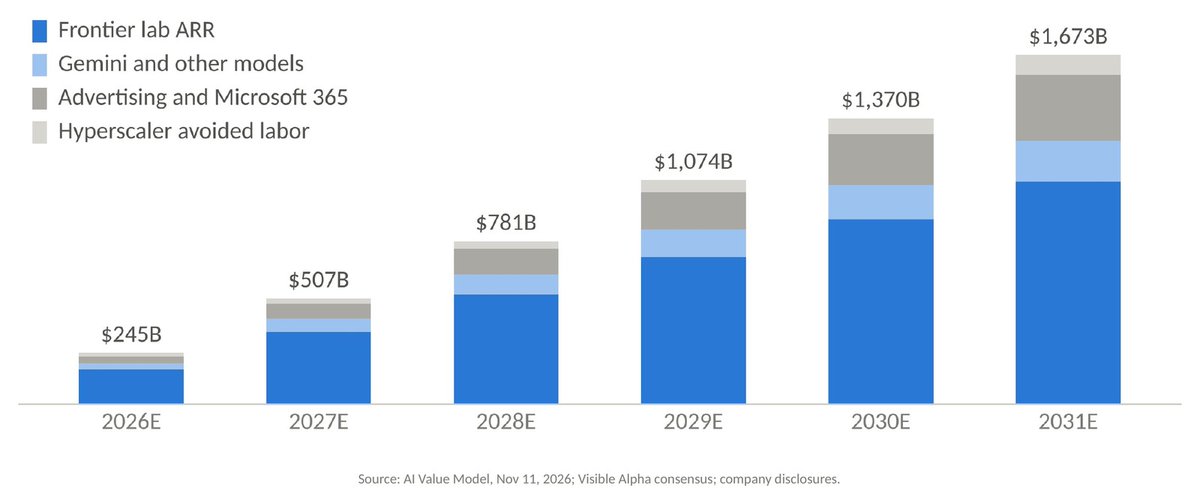
Two notes on the mechanics. ARR is measured at year end, while advertising, Microsoft 365 and labor are full-year amounts, which if anything understates the run-rate. And revenue pays for the oldest capacity first, with servers retiring after six years.
The labs are roughly two-thirds of that revenue, and that's really the crux of the whole exercise. Even if you buy the Jevons paradox argument (cheaper tokens, so AI diffuses faster), the labs specifically need to scale rapidly from here. Anthropic and OpenAI are run-rating ~$85B and ~$60B of ARR today. Anthropic alone has ~$900B of contractual obligations over their full terms, and OpenAI's reported compute contracts with Microsoft, Oracle and AWS add up to ~$690B.
Three Scenarios
The labs added $8-12B of ARR a month across the first three quarters of this year. To finish the year at ~$95B (Anthropic) and ~$70B (OpenAI), they need ~$14.5B a month in Q4.
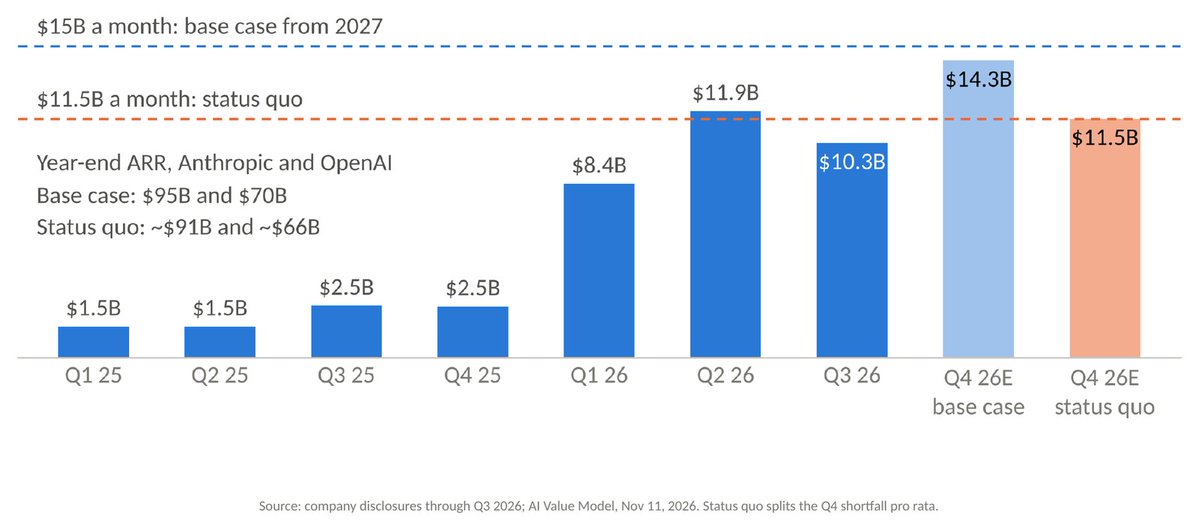
I ran three scenarios for combined net new ARR going forward:
-
Status quo: ~$11.5B a month, roughly this year's pace (assuming a slight miss to Q4 ests.)
-
Base case: $15B a month from 2027
-
Reacceleration: $15B in 2027, $20B in 2028, $25B from 2029 on
The Takeaway
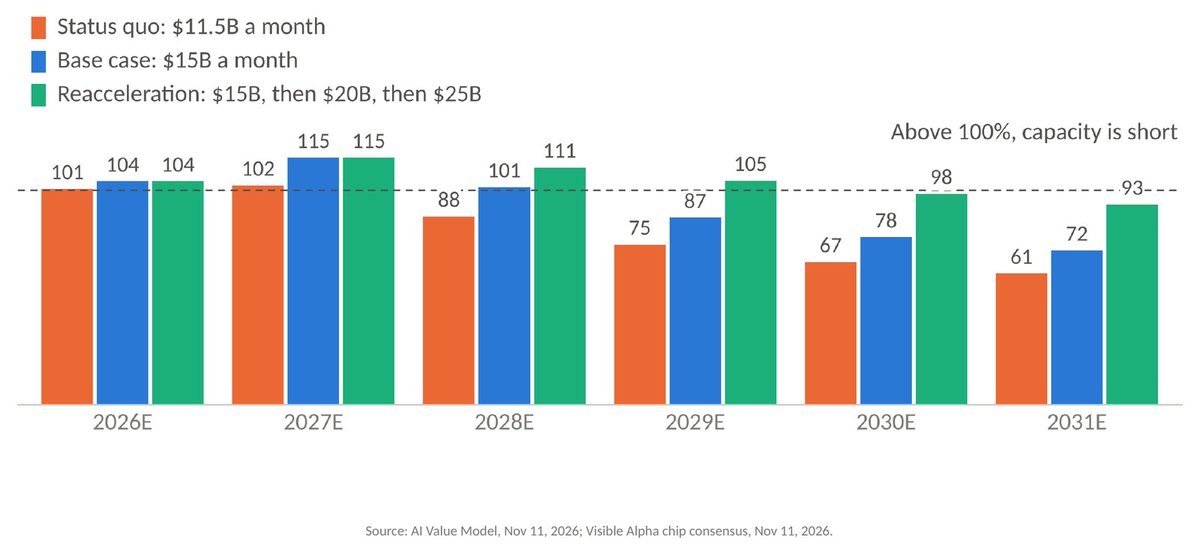
By the end of 2029, the fleet that chip consensus implies needs a ~$1.2T AI revenue run-rate. Of the three paths, only a sustained reacceleration gets there.
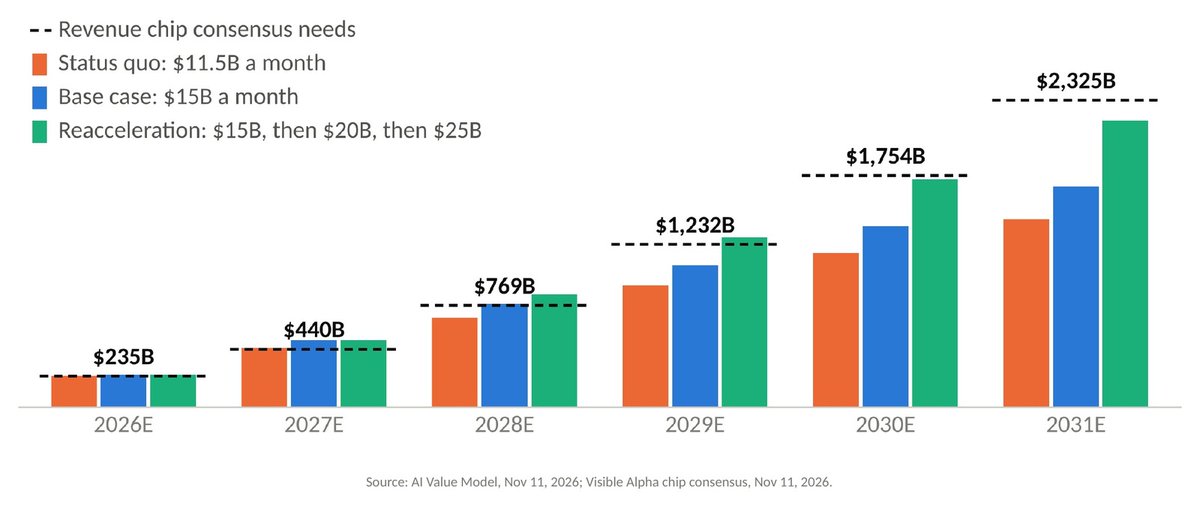
Put in terms of supply and demand:
-
Status quo: oversupplied in 2028
-
Base case: balanced in 2028, oversupplied in 2029
-
Reacceleration: balanced in 2030

Another way to look at it is implied fleet utilization: AI revenue as a share of what the fleet needs to earn at full cost. Below 100%, either capacity sits idle or it earns below its required cost of capital (read: someone is taking a loss on it). Unless the labs substantially reaccelerate, it falls to 75-87% by 2029.
Or we can invert things and ask what the labs need to do for consensus to work. Chip consensus needs the labs adding ~$19B of ARR a month in 2028 and ~$31B a month by 2030. They've averaged ~$11B a month this year.
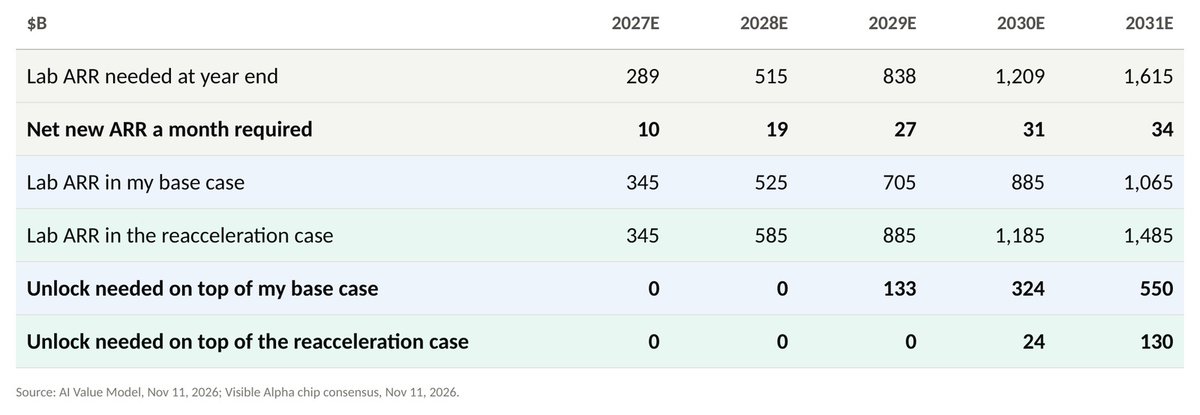
At this year's pace, revenue supports ~25 GW of new capacity a year. At $15B a month, it's ~29 GW. Consensus ships 40-60 GW.
Two Ways Out
A material unlock in AI diffusion or capabilities. I don't think the current pace of diffusion is enough. We need TAM expansion or much faster enterprise adoption. The candidates? Persistent agent swarms (potentially 10-100x the tokens per seat, similar uplift as from chat to reasoning & reasoning to agentic), cybersecurity spend that scales with attacker compute, AI-run R&D, consumer agents taking a cut of commerce, generated video, new form factors, and physical AI. Any one of them could close the gap. The point is that it NEEDS to show up in lab ARR in 2027.
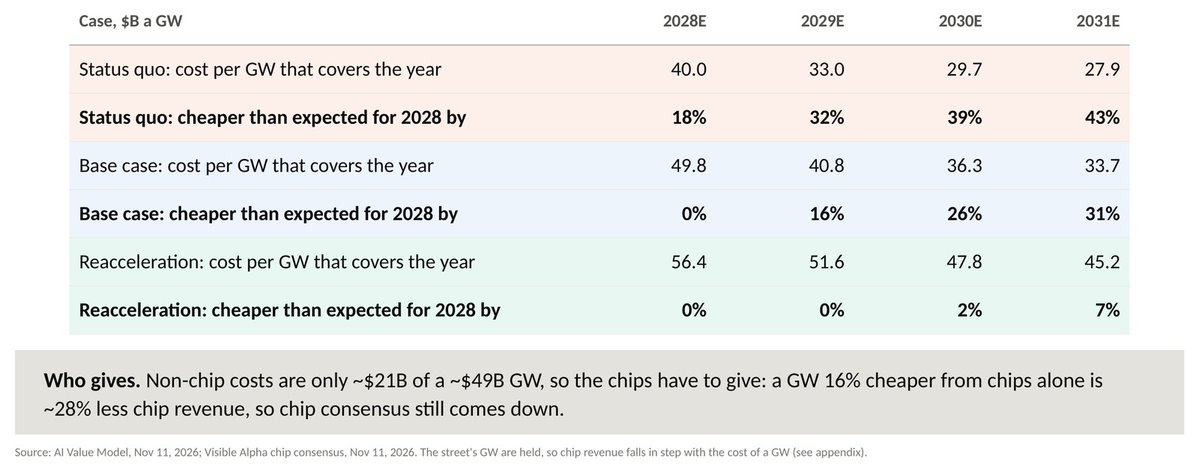
Cheaper GW. In my base case, a GW ~16% cheaper than expected for 2028 covers 2029, and ~26% cheaper covers 2030. However, that saves the GW count, not the chip dollars. Non-chip costs are only ~$21B of a ~$49B GW, so the chips have to give: a GW 16% cheaper from chips alone is ~28% less chip revenue.
What's Priced
On calendar 2028 consensus, Nvidia trades at ~8x earnings. Broadcom is ~12x, TSMC ~14x, semicap 14-20x and memory 2-4x.
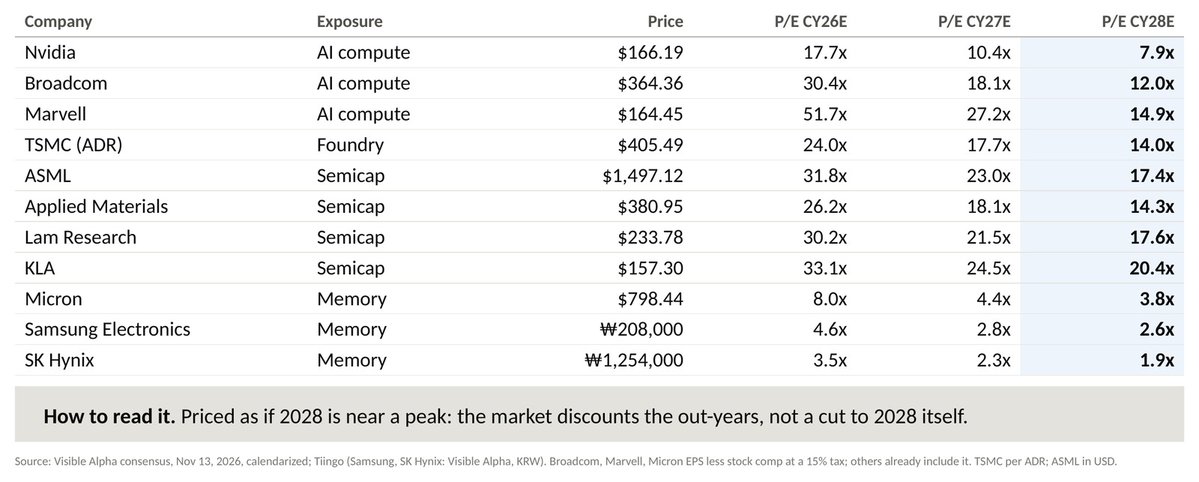
Those are low multiples for businesses growing earnings 30-50%+ a year into 2028. The market is clearly discounting a material haircut to 2030 consensus. With that said, I don't think it's pricing a cut to 2028 itself. That's the year at risk if the labs can't start adding $15B a month, and 2029 is at risk if they don't keep accelerating further.
Why I Think This Is Conservative
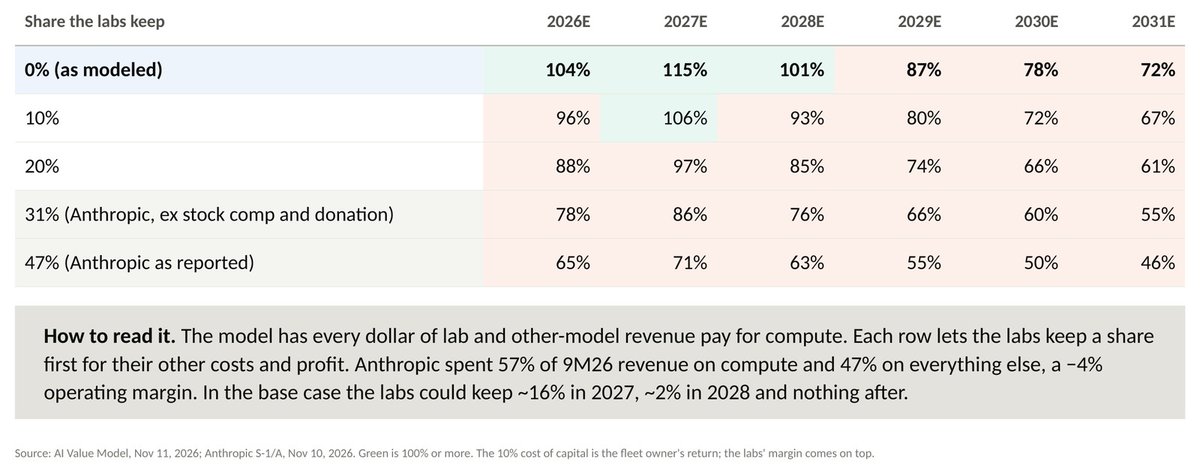
- No margin for anyone. If the labs keep even a modest share of revenue for their own costs and profit, utilization falls further. Anthropic's non-compute costs were 47% of revenue in the nine months to September.
How The Cost of Capital Impacts Things
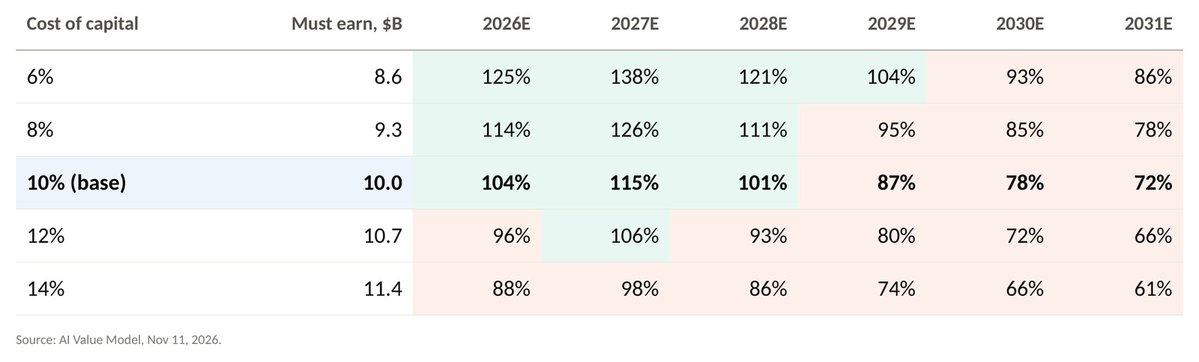
This is a capital-intense process, so changes to the assumed cost of capital have a material impact on the required return of the buildout. At 10%, the return on capital is ~$3.2B of the ~$10B a GW has to earn each year, roughly a third of the bar to clear. Each point of cost of capital moves a GW's annual hurdle by ~$0.35B, which is worth ~4-5 points of utilization in the near years and ~3 points by 2031.
In my base case:
-
At 6%, the fleet is covered through 2029 (104%) and oversupply starts in 2030 (93%).
-
At 8%, oversupply starts in 2029 (95%), though more mildly than at 10%.
-
At 10%, the base case above: balanced in 2028 (101%), oversupplied from 2029 (87%).
-
At 12-14%, 2028 is already oversupplied (86-93%).
I'd note that the 10% is the return to whoever owns the data centers and servers, roughly a cost of capital with no excess return on top. Who funds the buildout matters here. A hyperscaler paying for it out of operating cash flow can probably live with something closer to ~10%. A neocloud or a debt-financed SPV is likely at the high end, and that's exactly the capacity that would feel any oversupply first.
What to watch?
Lab net new ARR. If it doesn't move towards ~$15B a month as we exit the year, I think 2028 chip numbers come down.