Continuous Blood Markers: The Future of AI-Driven Healthcare
文章目录
TLDR: Most of us get our blood checked once a year. Within a few years, a patch on your arm will read your hormones, metabolism, and inflammation every few minutes and stream it to your AI, and the once-a-year checkup will look as dated as a paper road map.
Most people get a once-a-year checkup: one blood draw and a short conversation with a doctor about what it means. At Fountain Life, we do this quarterly (TechCrunch; Longevity.Technology), and that is still only four snapshots a year.
We’re rapidly heading toward a future where wearables, implantables, and ingestibles continuously measure 50+ biomarkers and upload them to your AI. That AI will help you manage which medicines and supplements you take and which foods you eat, adjusting as your body changes. To be clear, that 50+ number is my forward-looking vision. No company measures that many continuously today.
There’s an incredible company called Continuity, run by my friend Zeno Fox, who presented on my Abundance Longevity trip. The company came out of MIT, and its technology is the most advanced I’ve seen.
THE VISION
Your blood chemistry is in constant motion, and a single sample captures one random moment of it. When we spoke on October 28, Zeno described today’s periodic blood tests this way: “You essentially are trying to gauge [a] movie from just a few randomly selected frames.”
In a combined analysis of 509 adults, free cortisol rose about 50% within the first 30 minutes after waking (Wüst et al., Noise & Health, 2000). A classic 24-hour study of men found mean testosterone at 675 ng/dL at 6 to 7 a.m. and 464 ng/dL at 7 to 8 p.m. (Journal of Clinical Endocrinology & Metabolism, 1973). In women, progesterone levels can vary as much as eightfold within just 90 minutes during the luteal phase of the menstrual cycle (Filicori et al., 1984). The same person on the same day can look like two different patients depending on when the needle goes in.
“You essentially are trying to gauge [a] movie from just a few randomly selected frames.” (Zeno Fox, Continuity CEO)
Now layer on a bad night of sleep, a hard workout, a stressful board meeting or a long flight. A yearly panel misses nearly all of it.
Meanwhile, the AI side of this equation has already arrived. OpenAI reports that more than 40 million people turn to ChatGPT every day with healthcare questions (OpenAI, January 2026). Those AIs are brilliant, but they are working from general literature, subjective user input, or thin data.
Continuous sensing changes the math. A sensor that takes one reading every 15 minutes, the cadence of today’s over-the-counter glucose monitors (FDA), produces 35,040 readings a year for every marker it tracks.
WE ALREADY RAN THIS EXPERIMENT WITH GLUCOSE
Glucose is the proof of concept. The first-ever CGM was approved in 1999, depending on which one you want to highlight (first Dexcom vs. first-ever CGM). It was prescription only, lasted up to 72 hours, and needed fingerstick calibration at least every 12 hours (FDA PMA P050012).
On March 5, 2024, the FDA cleared Dexcom Stelo as the first over-the-counter CGM, worn for up to 15 days with readings every 15 minutes on your phone (FDA). Continuous glucose went from a prescription device for people with diabetes to something anyone can order online.
That is the classic exponential curve: deceptive for years, then suddenly everywhere. The limit is that glucose is one molecule. The decisions that matter most for healthspan depend on hormones and inflammation, and so far neither can be tracked continuously outside a research lab.
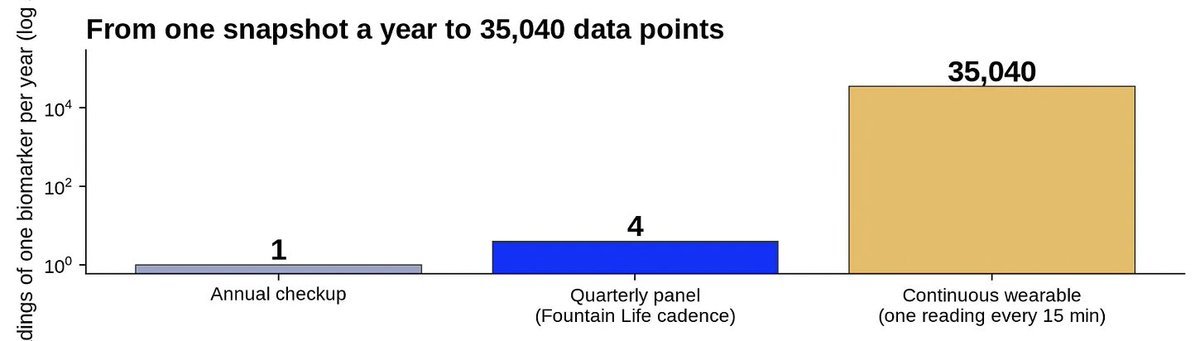
Readings per year of a single biomarker. Continuous cadence of one reading every 15 minutes per FDA, March 5, 2024 (Dexcom Stelo).
WHAT CONTINUITY IS BUILDING
Continuity is an MIT spin-off backed by leading founders and executives in healthcare, venture capital, and DARPA (Continuity). Its co-founder and CTO, Dr. Swathi Manda, did her doctoral work at MIT on programmable DNA-based sensing. An MIT patent naming Swathi and Ashwin Gopinath as inventors describes arrays of individually addressable sensing sites read in real time, with DNA structures programmed to recognize specific target molecules (US Patent 12,578,328; Nature Communications, 2023). Continuity holds an exclusive option on its foundational MIT IP and is finalizing the license.
Swathi describes the chemistry as nanopore-based sensing: combining short strands of DNA engineered to grab one specific molecule with nanopores to generate a signal. On its website, the company says its interface will track “dozens of blood biomarkers in real time, directly from the body, without a blood draw” (Continuity).
Here is how the device works, as the team described it to me (company-reported, not yet peer reviewed):
A wearable on the arm that reads interstitial fluid, the fluid around your cells, through tiny microneedles. Each of its many channels is coated with its own sensing surface.
A modular design. Only the DNA “tag” changes from one biomarker to the next. The signal hardware stays the same, so each new marker only requires designing a new tag to be added on the same device.
A clear roadmap. Hormones like estradiol, testosterone, and cortisol come first, then metabolic markers such as glucose and insulin, then inflammatory markers such as hsCRP and IL-6.
Several days of continuous sensing. That matters because DNA-based sensors have historically degraded fast in the body. In a 2026 human trial in Nature Biotechnology, one of the leading DNA-based sensor patches was worn for 24 hours, and the authors reported mainly the first 12 hours because of sensor degradation (Booth et al., Nature Biotechnology, 2026).
Comparison against the gold standard. The company is validating their wearable against established methods and references, including comparison against blood draws and gold standard lab measurements.
In my view, the platform design is the breakthrough. Zeno told me each new biomarker has taken the team roughly a month to develop by hand. Now they are building machine-learning models to design new sensors faster. As he put it, “the hardware is really only the entry point into the things that we’ll be doing on the foundation model and ML side.”
One patch, many channels, and a chemistry you can reprogram.
Zeno’s own path explains why he is building hardware. By his account, he spent years applying deep learning to healthcare, where models outperformed clinicians yet patient outcomes improved only incrementally. His conclusion was that AI was missing the interface and data stream it needed.
There is still real work ahead. The regulatory path runs through the FDA and involves research studies under IRB oversight, including clinical studies with external partners, like researchers at MIT, with parallel blood draws. This is early, and accuracy over weeks of wear is the test that matters most.
HOW THIS CHANGES YOUR HEALTHCARE STRATEGY
Over the next decade you will choose between two kinds of medicine.
On the first path, you keep doing what most people do today. You wait for symptoms, get a snapshot, and react. Your AI gets better at reading thin data, yet it still misses the cortisol spike after every bad night or the hormone drift that builds for years before anyone names it.
On the second path, your body streams. Your AI learns your personal baseline, sees how your testosterone or inflammation responds to a new supplement, a medication, a change in diet or a new training block, and flags a deviation weeks before it becomes a diagnosis. Your doctor adjusts a dose based on how your body actually responded over the last 72 hours.
Zeno describes Continuity’s stack as one that “closes this loop between sensing, reasoning, and acting that underlies most of health care.” I believe that loop becomes standard for everybody. Medication doses get calibrated to your real-time hormone levels, and your diet gets tuned to your measured inflammatory response.
For longevity, the fundamentals stay the same: sleep, movement, nutrition and a mindset that you can extend your healthy years. What changes is feedback. For the first time, you will see whether the fundamentals are working inside your own chemistry, day by day.
The checkup becomes a conversation with your body that never ends.
WHAT THIS MEANS FOR YOU
If you’re an entrepreneur: the scarce asset in AI medicine is continuous, high-quality biological data. Build the apps and clinical workflows that assume a streaming patient.
If you’re an executive: your employee health benefit is probably a once-a-year physical. Start asking your benefits team what changes when your people can see their stress and metabolic markers in real time.
If you’re an investor: Watch for the teams that turn the second and the twentieth molecule into consumer products, and for the companies that own the data layer above them.
If you’re a student: the intersection of DNA nanotechnology and machine learning is where the next decade of medicine gets written.
If you’re a parent: your children will grow up with a continuous health record. Help them learn what the numbers mean. This piece is not medical advice. Ask your doctor which biomarkers are worth tracking for your family today, and how often.
THE CHALLENGE
Look at your last blood panel and pick the one marker you most wish you could watch every day. Ask your doctor about it at your next visit, then watch for the first continuous sensor that tracks it.
To a future of abundance,
Peter
Disclosure: I’m an advisor to Continuity.bio