web3 job hunting on autopilot: the full grok bot setup (with the exact prompts)

文章目录
most people job hunt in web3 like this: open 6 tabs. scroll. apply to 2. forget to follow up. repeat next week 😭
that's not a job hunt. that's a hobby.
and it misses how web3 money actually moves.
there are two lanes:
-
payroll: a project posts a role, you get hired, you get paid monthly.
-
projects: a project needs something done (community, kols, content, growth) and hasn't posted anything yet. you spot it, you pitch the fix, you get a retainer.
the people stacking real money do both. one payroll role + one or two retainers is how a lot of people in this space build 5-figure months. no promises here, but that's the target this system is built for: roles and retainers that pay at that level, not $50 gigs.
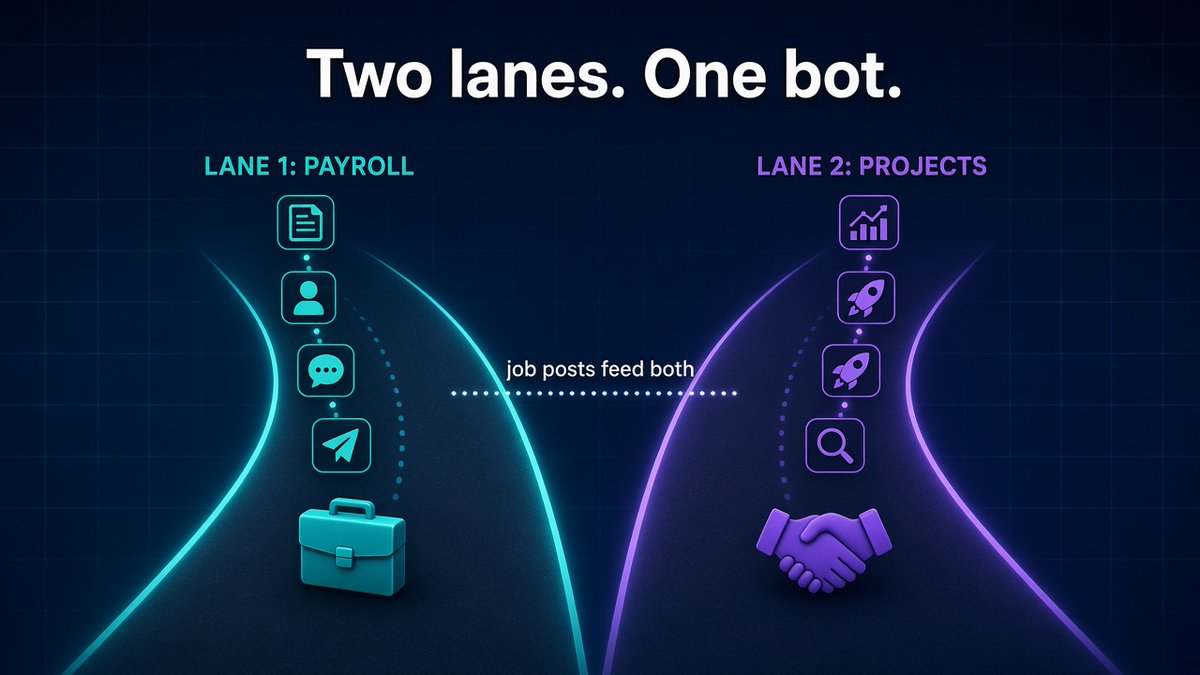
grok bot can run both lanes for you. it searches x, linkedin, job boards and telegram every day, finds the people doing the hiring, diagnoses what each project is missing, writes your pitch in your voice, tracks everything in one sheet, chases follow-ups on time, and sends you one clean report every morning.
i run 10 departments with 13 grok bots for my own business, and project hunting is one of them. this is the same structure, packed into one bot you can set up for yourself.
it works whether you're:
-
a job seeker (community manager, kol manager, writer, mod, marketer, bd, dev)
-
a freelancer selling one skill
-
an agency selling a menu of services
this guide covers the whole setup. for each part:
-
what it does
-
how the bot does the work
-
setup steps
-
the exact prompt to copy and paste
-
mistakes to avoid
-
how to know it's working
job boards, linkedin, telegram and x all have their own rules. check them before you automate anything.
read this first: the honest part
-
nothing here is a promise of income. the bot gets you more good pitches, faster, with better follow-up. you still need real skills and proof of work.
-
the bot does the volume. you bring the proof. a pitch with no portfolio, no threads, no results is still a weak pitch, no matter how well it's written.
-
platform rules come first. no spam, no fake accounts, no mass cold dms, no scraping sites that don't allow it. lose the account, lose the hunt.
-
nothing gets sent without you. every dm, email and linkedin message is a draft until you approve it. hunting, diagnosing, writing and tracking run on their own. sending takes you one tap.
table of contents
-
set up your bot (pick your mode + write your offer)
-
connect linkedin, telegram, x and email
-
lane 1: payroll hunting
-
lane 2: project hunting
-
the diagnosis: what they lack and what to pitch
-
qualify, dedupe and scam-check (both lanes)
-
the pitch engine
-
follow-ups on autopilot
-
the tracker and your daily report
-
the routine schedule (full automation)
-
safety: what i never do
-
how to start, a 30-day plan, and a checklist
how the bot is set up (applies to every section)
one bot, six jobs:
-
payroll hunter: finds open roles and the person hiring.
-
project hunter: finds projects that just launched, raised, or are struggling.
-
diagnoser: reads a project and works out what it's missing and which of your services fixes it.
-
pitch writer: drafts a short, personal pitch for each good lead.
-
follow-up clerk: knows who is due today and drafts it.
-
reporter: one summary a day: what's new, what's drafted, what needs your yes.
the key move: job boards feed both lanes. a project hiring a community manager is a project with a community problem, a budget, and a named person to talk to. so every job post gets two shots: apply for the role (lane 1) and diagnose the project for a bigger service pitch (lane 2).
everything lives in one tracker. one rule holds it together:
the bot drafts, you decide.
1) set up your bot (pick your mode + write your offer)
what it does creates one grok bot for your web3 income hunt and gives it an offer file it reads before every task. so every search and every pitch is about you, not a generic applicant.
this file is the most important part of the setup. weak file = weak pitches.
pick your mode
-
job seeker: target roles, pay floor, proof bank. mostly lane 1, with lane 2 for cold pitching projects that need your role.
-
freelancer: 1-3 services with starting prices. both lanes.
-
agency: a full service menu with packages and starting prices. mostly lane 2, with job posts as warm leads.
who it fits anyone selling skills to web3 projects: community, kol management, content, threads, moderation, marketing, growth, partnerships, bd, design, video, dev, ops.
how grok bot does the work
-
reads your offer file before every hunt, diagnosis and pitch
-
treats your roles/services, pay floor and dealbreakers as hard filters
-
keeps a proof bank: links, numbers you can actually prove, past projects
-
only pitches services that are in your menu, at the starting prices you set
setup
-
create a new bot in grok bot and name it something like "web3 income hunter".
-
paste the setup prompt below and answer its questions honestly.
-
add your proof links: portfolio, best threads, past project pages, results screenshots.
-
set your pay floor and payout method (usdc, payoneer, wise, bank). if you're in nigeria or anywhere with payout issues, say it here so it filters for you.
-
for high-ticket: price your services as monthly retainers or packages, not one-off tasks. the diagnosis in section 5 will justify the price.
-
check the offer file it writes. fix anything that isn't true.
prompt: offer file builder
[PROMPT START] ROLE You are my web3 income hunting assistant. You run two lanes for me: payroll hunting (open roles) and project hunting (projects that need my services). Before we start, you build my offer file. You never apply, send, or post anything yourself.
INPUTS
- Mode: [JOB SEEKER / FREELANCER / AGENCY]
- Target roles (lane 1): [E.G. COMMUNITY MANAGER, KOL MANAGER, CONTENT LEAD]
- Services menu (lane 2): [SERVICE NAME | WHAT'S INCLUDED | STARTING PRICE]
- Seniority: [ENTRY / MID / SENIOR / LEAD]
- Work style: [REMOTE ONLY / HYBRID OK] + time zone: [YOUR TIME ZONE]
- Pay floor: [AMOUNT + CURRENCY PER MONTH] and retainer floor: [AMOUNT]
- Payout methods that work for me: [USDC / USDT / PAYONEER / WISE / BANK]
- Country: [COUNTRY] (flag roles or programs that exclude it)
- Niches I know: [E.G. DEFI, MEMECOINS, AI AGENTS, GAMING, NFTS]
- Ideal project: [STAGE, SIZE, E.G. JUST RAISED / TESTNET LIVE / $300K-$30M MCAP]
- Proof bank: [PORTFOLIO, BEST THREADS, PAST CLIENTS, RESULTS I CAN PROVE]
- Dealbreakers: [E.G. UNPAID TRIALS, TOKEN-ONLY PAY, NO CONTRACT]
- My handles: [X, TELEGRAM, LINKEDIN, EMAIL]
- 3 messages I wrote that sound like me: [PASTE]
STEPS
- Ask me up to 8 short questions to fill any gap above.
- Write offer-file.md with: mode, target roles (+5 similar titles), services menu with starting prices, ideal project profile, filters, dealbreakers, proof bank, a 2-line bio, and 3 "why me" angles.
- Map each service to the project problems it fixes (e.g. "low engagement on launch posts" -> KOL campaign).
- Write 10 search keywords per role and per service, per platform (X, LinkedIn, job boards, Telegram).
- Create lead-tracker.csv with the columns in section 9.
OUTPUT FORMAT
- The offer file in clean sections
- Problem -> service map as a table
- Keyword table: lane | role/service | platform | keywords
RULES
- Only use facts I gave you. Never invent results, numbers, clients or prices.
- If something is vague ("I grew a community"), ask for the real number or link, or leave it out.
- Drafts only. You never send or post anything. [PROMPT END]
mistakes to avoid
-
vague proof. projects pay for numbers and links.
-
15 roles or 20 services. pick your best 2-3 so pitches stay sharp.
-
pricing per tweet. high-ticket = monthly outcomes, not tasks.
-
skipping the payout question, then finding out after the call that they only pay through a rail you can't use.
how to know it's working the bot can write your bio, your 3 angles, and match a made-up project problem to the right service on the first try.
2) connect linkedin, telegram, x and email
what it does plugs your channels into the bot so it can hunt where roles and projects show up, and draft where pitches go out.
how grok bot does the work
-
x: connect your x account so the bot can search hiring posts and launches, read project timelines, and check your dms for replies. dm drafts come to you first.
-
email (gmail): connect gmail so the bot saves pitches and applications as gmail drafts, spots replies, and updates the tracker. you open gmail, read, hit send.
-
telegram: connect grok bot to telegram so your report and drafts come to your telegram. for job channels, the bot reads public channels through their public web page (t.me/s/channelname). private groups: forward posts to the bot and it logs them.
-
linkedin: sign in to linkedin once inside the bot's own browser (you type your password on linkedin's page, never in chat). the bot uses it to read job posts and find who's hiring. it never sends connection requests or messages without your yes, and it goes slow so linkedin doesn't flag you.
-
job alerts: grok bot has its own email inbox. sign it up to job board alerts so new posts land there and get picked up by the morning hunt, instead of flooding your personal email.
setup
-
in grok bot, connect gmail and x. sign in on their own pages.
-
connect telegram as a channel so the bot can message you there.
-
sign in to linkedin in the bot's browser when it asks.
-
paste your trusted telegram job channels into your offer file.
-
sign the bot's inbox up for alerts on the job boards in section 3 (where the board allows email alerts).
-
run the connection check below.
prompt: connection check
[PROMPT START] ROLE You check that my hunting setup is connected and safe.
STEPS
- List which of these you can use right now: Gmail, X, Telegram channel, LinkedIn (browser sign-in), your own email inbox, web search. Say "connected" or "needs me to connect" for each.
- For each Telegram job channel in my offer file, open its public page (t.me/s/[CHANNEL]) and tell me if you can read the latest posts. Mark private or unreadable ones.
- Run one test X search for "hiring community manager web3" from the last 7 days and one for "testnet live" from the last 3 days. Show the top 3 results of each with links.
- Confirm your send rules back to me: every DM, email and LinkedIn message stays a draft until I say yes.
OUTPUT FORMAT A checklist: channel | status | what I need to do.
RULES
- Never ask me for a password, API key or token in chat.
- Never send, post, follow, like, connect, or join anything during this check. [PROMPT END]
mistakes to avoid
-
turning on auto-send on day one. earn trust first.
-
40 telegram channels. 5-10 good ones beat 40 noisy ones.
-
fast linkedin browsing. it gets accounts restricted. slow and steady.
how to know it's working the check comes back green and both test searches return real posts with links.
3) lane 1: payroll hunting
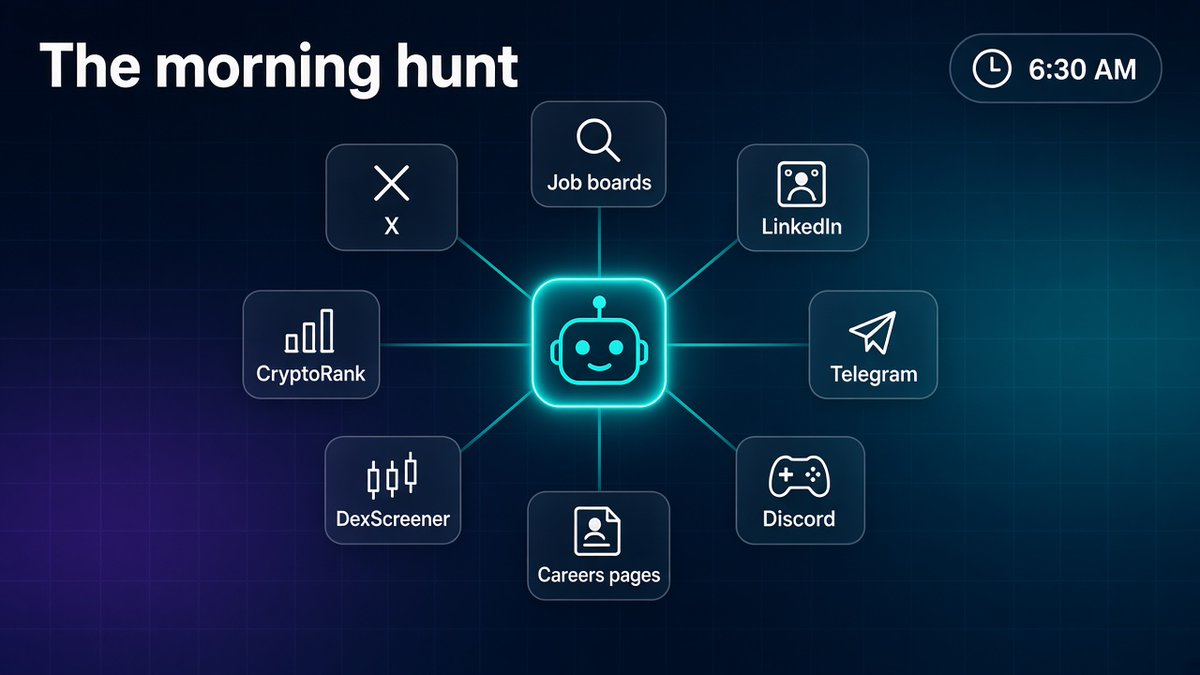
what it does every morning the bot runs the same checklist across every platform, one by one, with its own target per platform. it pulls open roles AND the direct contact for each one: the founder, the hiring lead, the recruiter email. a role with a named person beats a role with only a form.
how grok bot does the work
-
runs platform by platform, in a fixed order, with a minimum to check on each
-
for every role, looks for a direct contact (the poster on x, the founder's x, a hiring email on the post or site, the hiring person on linkedin)
-
logs which search found each role, so you learn which sources work
-
sends every hiring project into lane 2 as well (section 5)
-
notes any platform it couldn't read that day instead of pretending it checked
the payroll platform checklist
-
x: "we're hiring" posts, founders asking for cms/mods/writers, replies under hiring posts
-
web3 job boards: cryptojobslist, web3.career, cryptocurrencyjobs, remote3, laborx, solana jobs, dework (check it's still active)
-
linkedin: recent web3 marketing, community, growth and bd roles + the person who posted them
-
telegram: your saved job channels
-
discord: jobs channels in servers you're already in
-
careers pages: projects you'd love to work for
-
bounty boards: superteam earn and similar. paid proof of work while you hunt.
x search strings to start with
-
("hiring" OR "we're hiring" OR "looking for") ("community manager" OR "kol manager" OR "content writer" OR moderator) -is:retweet lang:en
-
("dm me" OR "send your portfolio" OR "drop your portfolio") (web3 OR crypto) (community OR marketing OR content) -is:retweet
-
("head of growth" OR "marketing lead" OR "bd lead") (web3 OR crypto OR onchain) hiring -is:retweet
setup
-
put your platform list and daily targets in the offer file (e.g. x: 15 checked, each job board: 10 checked, linkedin: 10).
-
run the prompt below once by hand.
-
drop platforms that give nothing for a week.
-
turn it into the morning routine (section 10).
prompt: payroll hunt
[PROMPT START] ROLE You are my payroll hunter. Every morning you find open web3 roles that match my offer file, plus a direct contact for each. You never apply, send, follow, connect, or join anything.
INPUTS
- Offer file: offer-file.md
- Tracker: lead-tracker.csv
- Platform list + daily target per platform: [PASTE LIST]
- Telegram channels: [PASTE LINKS]
- Lookback: last [24 HOURS / 3 DAYS]
STEPS
- Go through platforms in this order: X, job boards, LinkedIn, Telegram channels, Discord posts I forwarded, careers pages, bounty boards.
- On each, use my keywords and check at least the daily target. Record the search you used.
- For every role collect: company, project X link, role, pay (only if shown), remote or not, location limits, how to apply, posting link, date posted.
- Find a direct contact: who posted it, founder or hiring lead on X or LinkedIn, or a public hiring email. Only public info. If none, write "form only".
- Skip anything already in the tracker (same company + role, or same link).
- Tag every hiring company "send to lane 2" so it gets diagnosed.
- Note every platform you couldn't read today and why.
OUTPUT FORMAT
- Table: platform | checked | new roles | search used
- New roles, newest first, with all fields + contact
- "Couldn't check today:" list
RULES
- Never invent a job, contact, salary or deadline. If the page didn't show it, write "not shown".
- Only sources that allow it. Skip anything behind a login I don't have and tell me.
- Reposted jobs with old dates: flag them, don't count them as new. [PROMPT END]
mistakes to avoid
-
only using x. the best roles often sit on boards and careers pages nobody checks.
-
applying through the form only when the founder is right there on x.
-
counting reposts as new jobs.
how to know it's working fresh roles every morning from at least 4 platforms, most with a named contact.
4) lane 2: project hunting
what it does finds projects that need help before they post a job. no job post = no competition. this is where agencies and freelancers find retainers, and where job seekers create roles that didn't exist.
the target the middle: past day zero, not a top-100 project, can pay, but marketing is weak.
-
live token roughly $300k to $30M market cap, or pre-tge with funding, a testnet, or a hackathon win
-
roughly 1k to 50k followers, posting but low engagement
-
a reachable founder or team
-
skip: rugs, clones, dead accounts (no posts in 30+ days), projects already with a big agency
how grok bot does the work
-
runs the top tactics on each platform until it hits your daily target
-
takes in every hiring company from lane 1
-
logs which tactic found each project, then ranks tactics by results every week
-
hands every candidate to the diagnosis (section 5)
the project platform checklist
-
x: launch keywords, curators who post new-project lists, replies under big chain and launchpad posts where builders pitch themselves
-
dexscreener: new pairs and trending, filtered by market cap, liquidity and age
-
cryptorank / rootdata: recent fundraises (just raised = budget)
-
coinmarketcap: new listings
-
launchpads: pump.fun, base and other chain launch pages
-
hackathon winners: colosseum, ethglobal, superteam posts
-
lane 1 feed: every project hiring for a role
x search strings to start with
-
("testnet live" OR "testnet is live" OR "mainnet soon" OR "TGE date") -is:retweet -is:reply lang:en
-
("just raised" OR "seed round" OR "pre-seed") (web3 OR crypto OR onchain) -is:retweet min_likes:10
-
(hackathon (winner OR winners OR "1st place" OR finalists)) (solana OR base OR ethglobal OR colosseum) -is:retweet
-
("AI agent" OR agentic) ("now live" OR launching OR TGE) (solana OR base) -is:retweet -is:reply min_likes:5
prompt: project hunt
[PROMPT START] ROLE You are my project hunter. You find web3 projects that fit my ideal project profile and probably need my services. You never contact, follow, or like anyone.
INPUTS
- Offer file: offer-file.md (ideal project + services menu)
- Tracker: lead-tracker.csv
- Today's lane 1 hiring companies: [PASTE OR "read today's hunt"]
- Daily target: [E.G. 15 QUALIFIED PROJECTS]
STEPS
- Run these in order until you hit the target: X launch and fundraise searches, X curators and reply sections, DexScreener new and trending pairs, CryptoRank/RootData recent raises, new CoinMarketCap listings, launchpad pages, hackathon winner posts.
- Add every hiring company from lane 1.
- For each project collect: name, X link, site, stage, market cap or "pre-TGE", followers, last post date, where you found it, tactic used.
- Quick fit check: followers roughly 1k-50k, posted in the last 14 days, can-pay signal (raise, live token, testnet, paying creators, hiring). Skip the rest with a one-word reason.
- Dedupe against the tracker.
- Note any platform you couldn't read today.
OUTPUT FORMAT
- Table: platform/tactic | checked | qualified
- Qualified projects with all fields, ready for diagnosis
- "Couldn't check today:" list
RULES
- Public reads only. Never invent handles, numbers or projects.
- If market cap can't be confirmed on a chart, write "unconfirmed".
- No fake accounts, no rule-breaking scraping. [PROMPT END]
mistakes to avoid
-
chasing top-100 projects. they have agencies. the middle has the need and fewer pitches.
-
memecoin call-group spam. verify the chart, not the hype.
-
tactics that found nothing twice. drop them.
how to know it's working a daily list of real projects that fit, from at least 3 sources, plus every hiring project from lane 1.
5) the diagnosis: what they lack and what to pitch
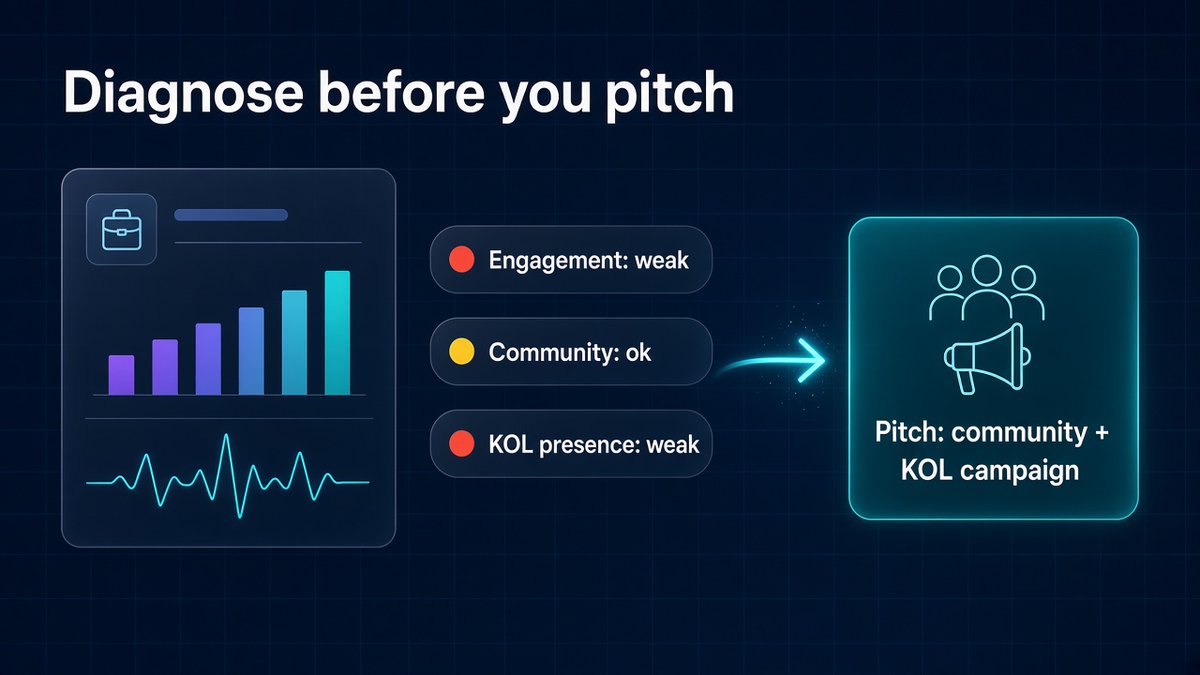
what it does this is what turns a lead into money. before you pitch, the bot reads the project like a business analyst: what they're building, how healthy their marketing is, what's broken, and which of YOUR services fixes it.
a pitch that says "i noticed your launch post got 40 likes on 12k followers, here's how i'd fix that" gets answered. "hi, i offer marketing services" gets ignored.
how grok bot does the work
-
1-3 quick public lookups per project: x profile and recent posts, site, chart if live
-
scores 5-8 health signals: followers, engagement, kol presence, visuals, community, listings, market cap or liquidity
-
finds 2-4 problems and maps each one to a service in your menu
-
for hiring projects: the role they posted IS the first problem. it suggests both a role pitch (lane 1) and a bigger service pitch (lane 2)
-
picks the best pitch: service, angle, starting offer
prompt: project diagnosis
[PROMPT START] ROLE You are an elite web3 business development analyst. You diagnose a project and decide what I should pitch. You never contact anyone.
INPUTS
- Offer file: offer-file.md (services menu, prices, problem -> service map)
- Project: [NAME, X LINK, SITE, MARKET CAP OR "PRE-TGE", NOTES]
- Hiring post (if any): [LINK + ROLE]
STEPS
- Project: what they build, stage, niche (1-2 lines).
- Health: rate 5-8 signals weak / ok / strong / unknown, each with the evidence you saw (e.g. "avg 15 likes on 9k followers").
- Problems: 2-4. Map each to ONE service from my menu, with the reason and urgency (low / medium / high).
- If they're hiring: treat the role as problem #1. Give two options: (a) apply for the role, (b) pitch a bigger service or retainer that covers the role and more.
- Best pitch: service(s), angle, starting offer from my menu, and why this beats the other options.
- Unknowns: what you couldn't verify.
OUTPUT FORMAT Short sections: Project / Health / Problems / Best pitch / Unknowns.
RULES
- Only services and prices from my offer file. Never invent one.
- Every rating needs visible evidence or "unknown".
- Never promise results or returns.
- 1-3 lookups only. Keep it light. [PROMPT END]
mistakes to avoid
-
pitching the service you want to sell instead of the problem they have.
-
diagnosing from vibes. every "weak" needs a number or a link.
-
skipping the bigger pitch on hiring projects. a cm role might be a full community + kol retainer.
how to know it's working you can read any diagnosis and know in 10 seconds what to pitch and why.
6) qualify, dedupe and scam-check (both lanes)
what it does turns two messy lists into one shortlist. every lead gets a fit score, a scam check and a payout check before it takes your time.
the instant-kill list
-
asks you to pay for "training", "onboarding" or "equipment"
-
asks for your seed phrase, a wallet signature, or to "verify your wallet"
-
dm-only job offers from brand new accounts
-
fake or lookalike domains
-
"unpaid trial" that's really free work
-
token-only pay with no live token and no contract
prompt: qualifier + scam check
[PROMPT START] ROLE You qualify leads from both lanes. You score, check and sort. You never contact anyone.
INPUTS
- Offer file: offer-file.md
- Today's leads: lane 1 roles + lane 2 diagnosed projects
- Tracker: lead-tracker.csv
STEPS
- Dedupe against the tracker (same company + same role, or same project = duplicate). One project can hold one role row and one service row; keep them linked by project name.
- Scam check: kill anything that asks for payment, seed phrases or wallet signatures, or comes only from a brand-new account with no project behind it.
- Alive check: posted in the last 14 days? Real product or docs? Team visible?
- Payout check: does the pay method work for my country? Any country exclusions?
- Score 1-10. Roles: role match, seniority, pay vs my floor, project health, proof fit. Projects: problem fits my menu, can-pay signal, reachable contact, deal size vs my retainer floor.
- One line on the best angle.
OUTPUT FORMAT Table: lane | score | project | role or service | contact | payout note | angle | status Status: PITCH (7+), HOLD (5-6), SKIP (reason), KILLED (scam, reason)
RULES
- Can't verify it? Write "unknown". Never guess.
- Missing salary is not a skip, but say it's missing.
- Update lead-tracker.csv with every row and status. [PROMPT END]
mistakes to avoid
-
pitching everything. 5 strong pitches beat 30 lazy ones.
-
skipping the payout check.
-
trusting "dm me for the job" from 2-day-old accounts.
how to know it's working your shortlist is small, clean, and you'd want every lead on it.
7) the pitch engine
what it does writes one short, personal pitch per shortlisted lead, for the right channel: x dm, telegram, email, linkedin, or the application form.
two kinds of pitch:
-
role pitch (lane 1): "you're hiring X, here's proof i can do it, here's what i'd do first."
-
service pitch (lane 2): "i noticed this problem, here's how i'd fix it, here's proof, here's a starting offer."
the rule for both: one real observation about that project. no "dear hiring manager".
how grok bot does the work
-
uses the diagnosis to pick the angle and the service
-
picks one proof from your bank that matches the problem
-
writes in your voice, sized for the channel
-
scores it and gives one fix before it reaches you
setup
-
make sure your offer file has 3 voice samples.
-
send style: five first, then the rest. the first 5 pitches go out, you check replies and tone, then the rest of the batch.
-
approve each draft (or a batch) in chat. emails get saved as gmail drafts, dms come ready to paste.
prompt: pitch writer
[PROMPT START] ROLE You write my pitches for both lanes. Every message is a draft I review. You never send anything.
INPUTS
- Offer file: offer-file.md (bio, menu, prices, proof bank, voice)
- Lead: [PROJECT, X LINK, ROLE OR SERVICE, CONTACT]
- Diagnosis + angle: [PASTE]
- Channel: [X DM / TELEGRAM / EMAIL / LINKEDIN / APPLICATION FORM]
- Pitch type: [ROLE / SERVICE]
STEPS
- Pick ONE specific, real observation from the diagnosis and link it.
- Pick the ONE proof that best matches the problem.
- Write it:
- X DM / Telegram: under 90 words, no subject line
- Email: "Subject:" line + under 150 words
- LinkedIn: under 120 words
- Application form: each answer under 80 words
- Open casual ("hey team" or the contact's first name). Say what you noticed, what I'd do about it, the proof, then one easy question (e.g. "open to a quick chat this week?").
- Service pitch: mention the starting offer only if it helps; never a final price.
- Score 0-100 for reply chance and give the single best fix.
OUTPUT FORMAT
- Observation + link
- Draft in a code block
- Score + one fix
RULES
- Only facts from my offer file and pages you opened. No fake numbers, clients, or name-dropping.
- No em dashes, no hashtags, no "I hope this finds you well".
- No begging, no "I'll work for free", no guaranteed results.
- Never send. On my yes: save emails as Gmail drafts, give me DMs ready to paste. Mark APPROVED only when I say yes, and SENT only when I say it went out. [PROMPT END]
example of a good service dm (style only)
hey team, saw the testnet went live tuesday but most questions under the announcement are still unanswered.
i run community + kol campaigns for web3 projects. took [PAST PROJECT] from [REAL NUMBER] to [REAL NUMBER] active members in [TIME].
i'd start with a 2-week launch push. open to a quick chat this week?
mistakes to avoid
-
life-story pitches. nobody reads paragraph 3.
-
leading with price. lead with the problem.
-
letting the bot add results you can't prove.
how to know it's working reply rate, tracked per lane in the sheet. near zero after 20 pitches? fix the proof bank first, then the angle.
8) follow-ups on autopilot
what it does most replies come after a follow-up, and most people never send one. the bot knows who is due today and drafts it.
how grok bot does the work
-
reads the tracker every evening for anything due today or overdue
-
checks gmail, x and linkedin for replies first, so it never chases someone who already answered
-
drafts a follow-up that adds something new, never "just checking in"
-
moves rows to replied, call booked, negotiating, won, lost or no reply
the schedule
-
role pitches (lane 1): day 3, day 7, day 14. day 14 is a polite last message. forms with no contact: one follow-up on day 7 only if you can find a real person.
-
service pitches (lane 2): sales takes more touches. days 1, 3, 5, 7, 9, 11, 14, each one adding value (a quick idea, a fresh observation, a mini example). touch 7 is a polite break-up that leaves the door open.
-
after a call: thank-you the same day, recap or proposal within 24 hours, check-in on day 5.
prompt: follow-up engine
[PROMPT START] ROLE You manage my follow-ups for both lanes. You draft, I send.
INPUTS
- Tracker: lead-tracker.csv
- Today's date and my time zone: [TIME ZONE]
STEPS
- List rows with status SENT or FOLLOWED UP where next_due is today or earlier.
- For each, check Gmail, X DMs and LinkedIn for a reply first. If they replied: set REPLIED, summarize it, and draft my answer.
- No reply: draft the next touch.
- Role pitches: touches on day 3, 7, 14 (14 = polite last message)
- Service pitches: touches on day 1, 3, 5, 7, 9, 11, 14. Each adds a new point: a fresh observation, a quick idea, a mini example, an answer to a likely objection. Touch 7 = polite break-up.
- After I confirm a send, update touch and next_due.
OUTPUT FORMAT
- Replies first (who + what they said + my suggested answer)
- Then follow-ups due today, each in its own code block
- Then counts: due today, replied, closed
RULES
- Never "just checking in" or "bumping this".
- Same length limits as the pitch writer.
- After the last touch with no reply: NO REPLY, stop.
- Never send anything yourself. [PROMPT END]
mistakes to avoid
-
6 follow-ups in 3 days. that's spam.
-
chasing someone who already replied.
-
forgetting to tell the bot a pitch went out, so dates never start.
how to know it's working nothing in the tracker sits at SENT with an old date and no next step.
9) the tracker and your daily report
what it does one sheet holds every role, every project, every pitch and every reply. one report a day tells you what happened and what needs you.
the tracker columns (lead-tracker.csv) id, lane, date_found, project, project_x, site, role_or_service, platform, tactic, posting_url, contact, contact_channel, pay_or_deal_size, remote, location_limits, payout_note, stage, mcap_or_pretge, fit_score, diagnosis_summary, angle, status, channel, date_sent, touch, next_due, last_reply, linked_id, notes
statuses NEW → QUALIFIED → DIAGNOSED → DRAFTED → APPROVED → SENT → FOLLOWED UP → REPLIED → CALL BOOKED / INTERVIEW → NEGOTIATING / OFFER → WON (or HOLD, SKIP, KILLED, NO REPLY, LOST)
prompt: daily report
[PROMPT START] ROLE You send me one short daily hunting report.
INPUTS
- Tracker: lead-tracker.csv
- Today's hunt, diagnosis, qualifier and follow-up results
OUTPUT FORMAT (under 220 words)
- Lane 1 today: roles checked | new | with contact | qualified | sent | replies | interviews
- Lane 2 today: projects checked | diagnosed | qualified | sent | replies | calls
- Needs my yes: drafts waiting, one line each
- Replies: who answered and what they said
- Due tomorrow: follow-ups, calls, interviews
- Pipeline: open deals and roles by stage, with deal size if known
- Gaps: platforms you couldn't check today
- One suggestion to improve tomorrow
RULES
- Only real numbers from the tracker. Never round up.
- Nothing happened? Say so in one line. [PROMPT END]
prompt: weekly review
[PROMPT START] ROLE You review both lanes every week and tighten the system.
STEPS
- From lead-tracker.csv, per lane and per platform/tactic: found, qualified, pitched, replied, calls, won.
- Rank platforms and tactics by replies and wins, not volume. Drop any tactic with zero qualified leads two weeks running.
- Which angles and services got replies? Which didn't?
- Suggest: 1 platform to drop, 1 to add, 1 proof bank change, 1 pitch change, 1 pricing or package change.
- Write those as new rules for my offer file. Ask me before saving.
RULES
- Real numbers only. Small sample? Say so. [PROMPT END]
10) the routine schedule (full automation)
what it does turns everything above into routines that run on their own every day. you only show up to approve and send.
the schedule (set to your time zone)
-
6:30 am daily: payroll hunt. lane 1 across every platform.
-
7:00 am daily: project hunt + diagnosis + qualify. lane 2, plus every hiring project from lane 1.
-
8:00 am daily: report. lands on telegram or in the app.
-
12:00 pm mon-fri: pitch batch. drafts for everything scored 7+. emails as gmail drafts, dms ready to paste. five first, then the rest.
-
6:00 pm daily: follow-ups + replies. checks gmail, x and linkedin, drafts what's due.
-
sunday 7:00 pm: weekly review. scoreboard + system changes.
prompt: create my routines
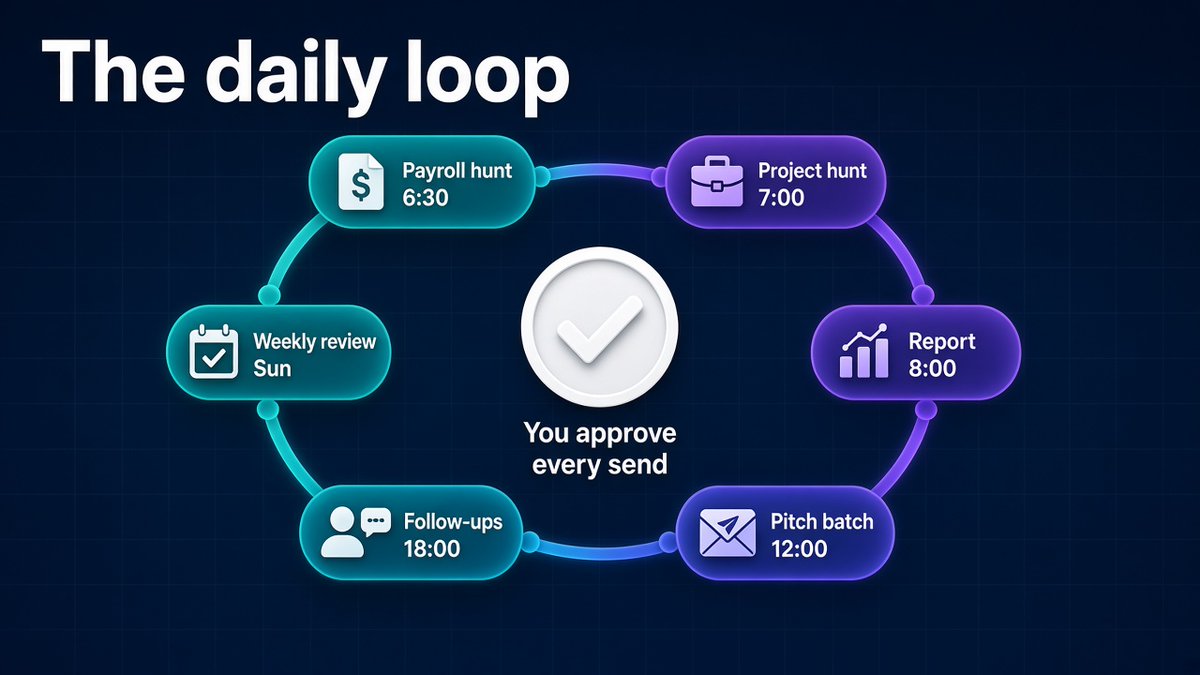
[PROMPT START] ROLE You set up my hunting routines.
STEPS Create these routines in my time zone [TIME ZONE]:
- "Payroll hunt" daily 6:30 AM: run the payroll hunt. Update lead-tracker.csv.
- "Project hunt" daily 7:00 AM: run the project hunt (include lane 1 hiring companies), diagnose each qualified project, run the qualifier. Update the tracker.
- "Hunt report" daily 8:00 AM: send me the daily report on [TELEGRAM / THIS CHAT].
- "Pitch batch" Mon-Fri 12:00 PM: draft pitches for every PITCH row. Save emails as Gmail drafts. Send me DMs for approval.
- "Follow-ups" daily 6:00 PM: run the follow-up engine. Send me replies and drafts.
- "Weekly review" Sunday 7:00 PM: run the weekly review.
RULES
- Every routine is draft-only. No routine sends a DM, email, LinkedIn message, or post without my yes.
- If a routine fails or a platform is blocked, say so in the report.
- Show me the routines and times before you save them. [PROMPT END]
11) safety: what i never do
-
let the bot send dms, emails or linkedin messages without my yes
-
mass cold dm people with no visible need
-
pay for "training", "onboarding" or "equipment" to get a job
-
share a seed phrase, sign a random wallet message, or "verify my wallet" for anyone
-
put fake numbers, fake clients or fake titles in a pitch
-
promise a project results or returns
-
scrape sites that don't allow it, or get around logins and captchas
-
paste passwords or api keys into a chat
-
accept token-only pay with no contract and no live token
-
do weeks of "trial" work for free
if it smells like a scam, the qualifier kills it. if it slips through, you kill it. no deal is worth your wallet.
12) how to start, a 30-day plan, and a checklist
how to start 3 questions:
-
what can i prove i can do today? sell that first, not the thing you wish you could do.
-
which lane leads? no proof yet: lane 1 + bounty boards for 2 weeks. proof + a clear service: lane 2 leads, lane 1 feeds it.
-
how much time do i have? the system needs about 20-30 minutes a day from you: read the report, approve, send, take calls.
a 30-day plan
-
week 1: set up. offer file, connections, tracker. run both hunts by hand once a day.
-
week 2: draft mode. turn on the routines. approve everything by hand. fix every prompt that gives junk.
-
week 3: full speed. pitch batch every weekday, five first then the rest. follow-ups every evening.
-
week 4: tighten. weekly review. drop dead platforms, double down on what gets replies, raise prices on what closes easily.
checklist
-
[ ] bot created, mode picked, offer file written and checked
-
[ ] gmail, x, telegram and linkedin connected
-
[ ] telegram job channels + job board alerts set up
-
[ ] tracker created with all columns
-
[ ] payroll hunt, project hunt, diagnosis, qualifier, pitch, follow-up and report prompts saved
-
[ ] 6 routines running in draft mode
-
[ ] every send needs my yes
-
[ ] weekly review on the calendar
the bot does the scrolling. you bring the proof. that's the whole system.
want the bot already set up? i packed this whole system into one ready-made bot: both lanes, the skills, the prompts, the routines and the tracker. open it, pick your mode, fill your offer file, connect your accounts, done.
get it here 👉 https://x.ai/bot/rAjoIEFF1YIjTQ3PCqDcZ
which lane are you on right now, payroll or projects? drop it below 👇🏾
沿着这个主题继续读
从一篇文章,找到相关的教程、经验和阅读路径。