How to Learn Anything in 30 Minutes a Day (Stop Studying, Start Playing)
文章目录
Don’t save this.
If you do, I guarantee you will never read this again.
It will go where the others went. Somewhere on your phone is a folder full of the person you want to become. It holds the thread you saved at midnight, the video waiting in your watch-later list and the course you bought but never opened.
You’ve already saved more good ideas than you will ever use. And most of what you know, you can’t do.
You know how to get in shape. You how to learn a new language, how to write a book, and how to start a business. You could explain all the little intricacies of it all over dinner, and rather well. Then the moment comes to do it, and your hands have absolutely nothing to say.
I found this out by putting one question to my own saved folder, which currently holds 2,271 items.
How many of these have I ever done?
One of them was Dan Koe’s “You can learn anything in 2 weeks”. I had saved it three times. (Agreeing with it was much easier that actually doing it.)
📷
DAN KOE@thedankoe
You can learn anything in 2 weeks. You can't master it, obviously, but if you obsess over it, you can become better at it than most people ever will. You'd be surprised how fast your life can change when you understand this.
11:03 AM · Mar 30, 2026 · 738K Views
616 Replies · 2.53K Reposts · 18.9K Likes
Those 2,271 ideas were maps, and I had never once left the hourse.
If your own answer makes you wince, you can drop the usual charges of laziness or lack of discipline. What happened to you is much stranger than that, and actually kinder to hear.
You were *taught *to wait.
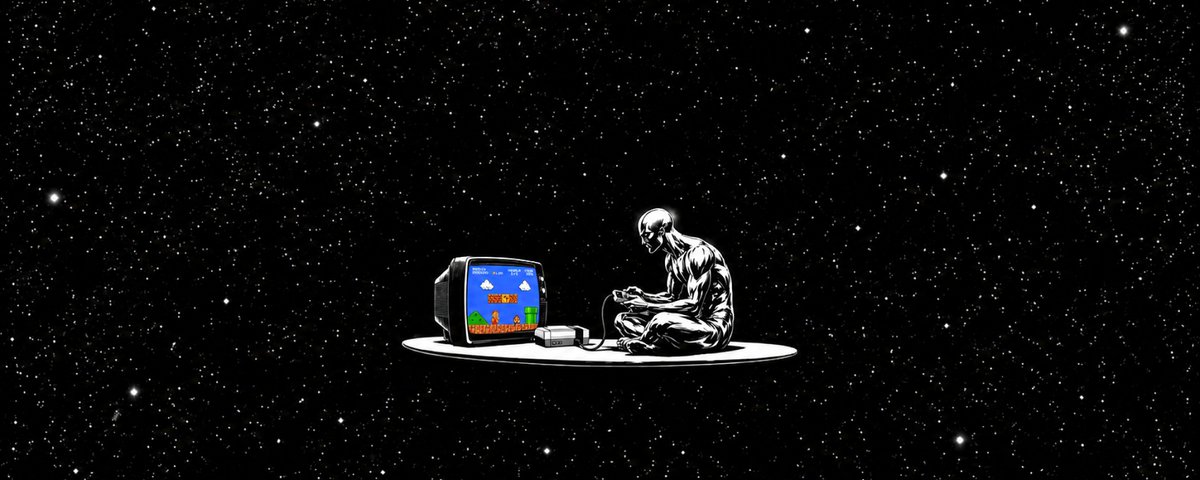
I found the other way to learn in an odd place for a grown man to be looking. I sat down and playedthe first level of Super Mario Bros. again.
There is no tutorial in that level, and nothing on the screen that tells you what to do. Yet, a few seconds in playing you can jump, stomp on an enemy, grab a power-up and clear a pit, and nobody, so far you can tell, has taught you any of it.
The level, of course, had been teaching me all along, and by the one means my saved folder had never offered.
It was letting me lose.
This letter is going to show you where the waiting came from and why it pays so well, and how to build a small level of your own out of one thing you have already saved. The building takes about forty minutes and a sheet of paper. The playing takes thirty.
You may save this letter after that.
So, let’s play.
I. The Collector’s Bargain
“We learn not for life, but for school.” —Seneca
Seneca meant it as a complaint. Almost two thousand years have passed, and the complain now explains your swipe file.
School graded what you could carry in your head
For most of our history, we humans learned a things at somebody’s elbow. A child watched the adults at work, picked up their tool, got it wrong, and was shown again. The doing came fist, and the understanding grew out of it.
School turned that entire order completely around. An authority figure at the front explained the “truth,” you wrote it down for a grade, and for twelve years or more, the reward went to a child who could repeat the thing back. Nobody graded you on what you could do with it.
Out of this you drew a rule that nobody ever said aloud, which is why you never examined it.
Understanding comes first. Doing comes later.
You can watch the rule at work in any ordinary week. That’s why you sit through four tutorials before you even open the program, and why the instrument you want to learn sits in in the closet until you finished a course on how to play it.
And by that, you became good at collecting, and the doing was handed off to a future you who would always, somehow, have it under control. Then came a button that performs the collecting in a single tap, without even asking you to read the thing first.
I ought to have known better than anyone. School bored the shit out of me; I was a poor student, better with my hands, and I spent seven years coaching athletes in a weight room, where nobody learns anything in isolation. Yet when I began writing online in June 2025, I walked straight back to the classroom. I copied the popular formats to writing a newsletter, and it took me more than a year to write anything that sounded like me.
I got there, in the end, all by messing around like a kid.
Your brain files the location and drops the lesson
Now, the habit persists because it pays, and it pays twice.
The first payment is the feeling of knowing. Psychologists at Yale ran nine experiments on people who had searched the internet, and concluded that they mistake “access to information for their own personal understanding.” A 2011 study also found the same split in memory: people who expected to look up a fact later remembered where to find it better than they remembered what it said.
You can try it yourself. Call to mind the last thing you saved, and see where you can name a single idea from it.
The writer Alan Watts had a line for this confusion. We mixed up the menu with the dinner, he said, and we go hungry on a diet of menus.
A saved post is a very good menu. I say so as a recovering Collector; I can tell you where every one of my 2,271 items lives, and if you ask me what they have built, I go quiet.
The second payment is much larger
A save cannot fail.
To try an idea is to risk something. You write the paragraph and dislike it; you play a chord and it buzzes; you try your Spanish on the waiter and he answers in English. A save risks nothing at all, and yet, it feels like a step forward the instant you tap it.
The pull is older than the save button. In a 2009 study, thirsty monkeys chose to find out early how large their next drink would be, though knowing changed nothing about the drink, and the same dopamine cells that tracked the water tracked the news. A save, I suspect, is that kind of news: word of a reward with no reward attached.
So there is no need to scold yourself for the habit. Saving is the most sensible move in a horribly built game; it costs nothing, it cannot fail, and it pays on the spot.
Almost ready is a place you can live for years
The bargain feels so good that you never notice the bill. It arrives later, and it arrives in years.
Every save makes the pile taller. A taller pile make you feel further behind, and feeling behind sending you immediately looking for the one missing piece, which means another save. This is why reading has never cured too much reading. You wouldn’t rescue a drowning man by handing him more water right?
Watts called the pattern the *backwards law. *Fight to stay on top of the water and you go under; stop fighting and the water carries you. I’ve seen the same thing in everything i ever chased: the harder I work, the further away the endgame moves.
Let’s try a small experiment.
Scroll to the oldest thing in your saved folder, your bookmarks or your watch-later list, and look at the date.
That is how long you have been almost ready.
The date carries a kinder message too. You already know enough to start, and you crossed that line a great many saves ago.
Meanwhile nobody can see a folder; people see only what they can do. I learned this as a coach. My athletes kept growing stronger in the weight room, and on game day some of them still played poorly.
A barbell never agues. It goes where you send it, while a game sends somebody to stand exactly where you meant to go.
Your saved folder is a room full of barbells. Nothing in it argues with you.
So what will?
Before I answer that, I have something to share. I built it for this exact problem.
Sum of One
I made a two-week course called Sum of One.
It’s ten weekday emails. Each one is a 30-minute game you play with one skill you care about. There’s no syllabus and no video library to fall behind on.
How?
First, by playing with one skill for a week. You start with the hardest part you can reach. You steal one move from someone better than you, draw a card that changes the rules, and finish Friday by showing one small thing to one person.
Second, by adding the skills you already have. You count them up, borrow a rule from one of them, teach your skill to someone, and make one small thing only your mix of interests could make.
You save a 60-second sample on Day 1 and another on Day 10, so you can judge the change for yourself.
It’s $149. If it isn’t for you, reply before Day 3 lands and I’ll refund every dollar. You can learn more and join here.
Now, back to the letter.
II. The Level is the Teacher
So what argues back when a saved folder will not?
A level does, and the most famous one ever built is World 1-1, the first level of Super Mario Bros.
In 1985, Shigeru Miyamoto and his team at Nintendo faced a peculiar task. They had to make a new kind of game, and they had to teach it to people who had never seen one like it. The classroom answere would have been a tutorial, a screen full of tect explaining which button jumps. They hid the lessons inside the level instead, and Miyamoto later said it was built so that a player would “gradually and naturally understand what they’re doing.”
From the couch, it goes like this.
You begin small, at the left edge of an empty stretch of ground, and the only way to go is right. A Goomba, a small frowning creature, walks toward you. Touch it and you lose a life; you start again a few steps back, and now , without a word from anyone, you know how to jump.
Next comes a block. Bump it from below and a coin pops out. Bump the next one and a mushroom slides out, and here the level plays its best trick. The last thing shaped like that killed you, so you quite sensibly try to get away, and you cannot. The mushroom strikes a pipe and comes back, the bricks overhead cut your jump short, and it catches you. But Mario grows.
The level had forced a gift on you that you would’ve run from.
Then come two gaps. The first has a floor, so that when you miss the jump, as you will, you can climb back out. The second is the same jump over a real pit.
By then you can jump, stomp, power up and run, and no one told you a damn thing. Each of those moments was a rule folded into a situation, and the lesson came in through your hands, which is why it stays. It is the reason nobody forgets how to ride a bike.
Nintendo arranged a few objects in a carful order and let you lose your way into the lesson.
Notice, too, that the game never asks whether you’re ready. Ready is a word from the classroom. The game hands you a controller and sends something walking toward you, which is how the world taught us before there were classrooms.
We might call it the Law of the First Level
We learn a thing by being places in a small situation where we are allowed to lose, and then given a moment to notice what happened.
A room small enough to lose it
My pile of 2,271 ideas gave me nowhere to begin, but a level is one room. Saving cannot fail. Playing can, and the failure costs a few seconds and leaves you knowing more that you did before.
Every idea you’ve saved is a map of a level somebody else already played. It becomes useful the moment you are standing in the room.
And in that room, you stop borrowing the answers and begin to own skills. A saved thread belongs to whoever wrote it. The chord you finally got to ring out and the clumsy sentence you finally sent out belong to you.
Every idea you use is one less ghost in the folder. The pile stops growing, adn so does the guilt.
You already learned this way once
I have watched this work at a playground. My daughter grew frightened partway up a rope jungle gym. “I can’t do it",” she said. I told her, “You got it,” and I stayed close and let her find her own way.
Children run on this. Alison Gopnik, a psychologist at Berkley, argues that our childhood exists for it: we are given years of protected time to explore before life asks us to produce. In his latest book, The Law of the Sublime, Robert Greene describes those years as a time when “your mind was supremely fluid and expansive.”
You had those years. You learned to walk in them, by falling down a great many times, and perhaps you learned to play Mario in them too. That mind is still in you, just a little out of practice.
It still works on grown-ups. I shot 100 in my first round of golf in 2020, and I shoot around 90 not. *(If you don’t know golf, lower is better.) *Ten strokes in six years is slow, and it counts.
It is also how I learned to write. I quit collecting advice about sentences and just began copying great sales letters, newsletters, and posts by hand, an hour every morning, with a cheap ballpoint pen.
After a few levels, the question in your head changes. You stop asking whether you are ready, and catch yourself asking what yesterday’s attempt showed you.
*“Genius is nothing more nor less than childhood recovered at will.” —*Charles Baudelaire
So build one.
III. Build Your First Level in Forty Minutes.
Think of a skill you want as a long game, and of your saved folder as a shelf of maps to it. You can know every world by name without ever having stood on the first screen, which is the position most of us are in.
Any simpleton can build that screen. Miyamoto had a team; all you need is a timer, one sheet of paper and your saved folder.
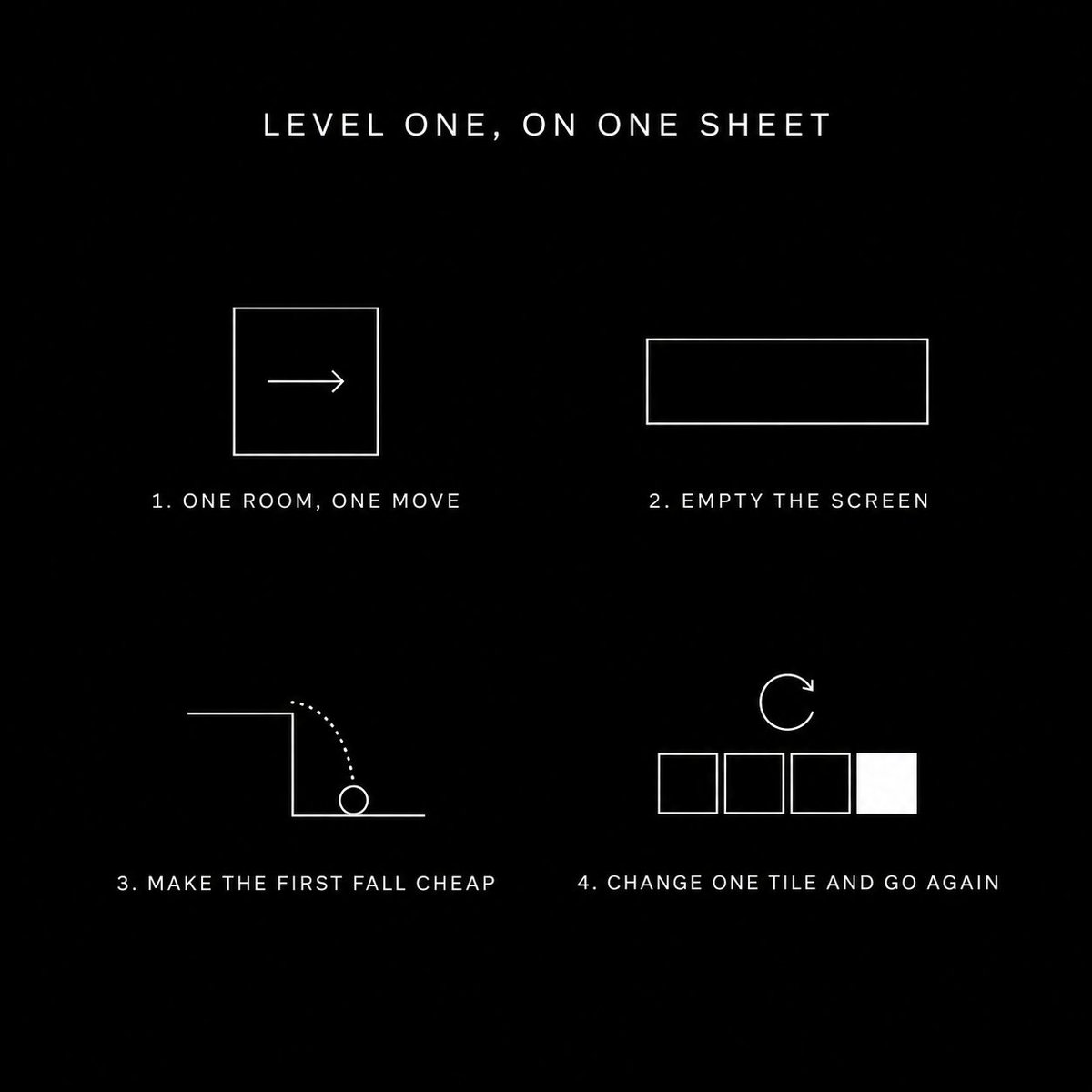
It takes four steps, and each one takes about ten minutes.
- Make is one room and one move.
Pick a single saved idea and look for the move inside it, the thing you would do with your hands or your voice.
“Open with a question” is a move. “Hold one chord for four bars” is a move. “Get better at guitar” is a folder.
Now write the level as one sentence.
I will [one move], on [one real thing], and [one person] will see it.
World 1-1 ends at a flagpole. In your level, the flagpole is the person who will see what you made.
The internet, for once, makes this easy. You can simply post what you made. Or you can tell me what you played in the comments below, and I will be your flagpole.
Nintendo had to cut their own opening down in just this way. The first enemy was going to be a Koopa Troopa, which takes a jump and then a kick to beat. That was a great deal to ask of a beginner, and so the team made the Goomba, which takes one jump.
They also worked from the endgame. Miyamoto has said the team usual make the later levels first and came back to build 1-1 afterward, once they knew what a player would need. You can do the same. Ask what you want to be able to doo three months from now, then find the smallest piece of it you could try tonight.
A level that will not fit in one sentence is too large to learn from, because when it goes wrong you cannot tell which part broke.
- Draw the empty screen
Mario begins on bare ground with one direction to go. Give yourself the same beginning: take away everything that is not the move, close the tabs, return the other ideas to the folder, where they will keep, and work with one tool.
When a friend asked me to teach him guitar, I began with what he already knew, which was the musical alphabet. The I gave him a single rule: he could play the scale on one string only, and the choice of string was his.
One string was small enough to play with.
After that I turned it into a game.
“Find 1, 4 and 5 on the G string.” Then, “Make a rhythm out of it.”
I was slow and messy, and I told him that was fine. String by string, he began to find his way around the neck. And he has only been playing for three months.
If you are building a level for somebody else, give one example, name the one thing to do, and then stop talking. (This is the hard part.)
- Let yourself touch the fire once
A level in which nothing can go wrong teaches nothing.
So decide in advance what it allowed to go wrong, and make the first fall a cheap one. Nintendo put a floor in the first gap, so that you may miss that jump once before a miss costs you a life. A failure you survive teaches what a fatal one cannot.
Your floor is a small audience. Show the paragraph to one friend before you publish it. Play the chord in an empty room. Say the hard sentence aloud in the car before you say it your boss.
Then let it go wrong, and keep your face still. Nobody is grading this one.
When my daughter froze on that rope gym, the level was doing its work. The worst thing I could’ve done was climb up and place her feet for her.
The first version always fails, and that is its job. It shows you where the level breaks. (It is a relief to know this in advance.)
- What the failure, then move one tile
When it goes sideways, you will want to explain it to yourself at once. Hold off and write three lines first.
What I tried. What surprised me. What I’ll change tomorrow.
Then change one thing and run the level again.
Nintnedo worked the same way. They watched people play with no explanation, and whenever a player did that the team had not planned for went down as a note on the level.
A bad session is a note on yours. Change a tile and play again.
Now you have earned the map. Go back to the thing you saved with one real question in your hand, and see how differently it reads.
What thirty minutes looks like
Suppose the thing you saved is Dan Koe’s “How to fix your entire life in 1 day.” It has been viewed more than 200 million times, and it asks for a full day; hard questions in the morning, reminders through the afternoon, a plan by night. *(It even tells you to bookmark it.) *That is the whole world, which is why it is still in your folder.
So take one room of it. Among the morning questions is this one.
“If absolutely nothing changes for the next five years, describe an average Tuesday.”
That is your move, and this is your level.
I will describe that Tuesday, on one sheet of paper, and one person will read it.
You can close the article now, for you have already taken the only line you need for tonight. Set a timer for thirty minutes and write by hand: where you wake up, what fills the hours from nine to six, how you feel by ten at night.
The first attempt will come out thing, a few polite sentences that could describe anybody. Good. Now write your three lines.
What I tried: the whole Tuesday. What surprised me: I could not say what I do between nine and six. What I’ll change tomorrow: write only three hours.
Then hand the page to your friend. That part stings, and it is what makes this a level.
You now have done more with that article than in all the months is sat saved. Tomorrow, move one tile: the same Tuesday, ten years out, or the first of his reminders. (He ends the article, as it happens, by telling you to turn your life into a video game.)
Benjamin Franklin ran this same loop as a teenager, about 260 years before Mario. He rebuilt essays from The Spectator out in his own short notes, laid each version beside the original and, in his words, “discovered some of my faults, and corrected them.”
Books and teachers hand you moves to try. The attempt is what makes them yours.
Play One Room Tonight
Do this once and you will hold three things: something you made that you can point at, proof that being terrible for thirty minutes is survivable, and three lines telling you what to try tomorrow.
Ten of these make two weeks of weekdays, and you don’t have to buy anything to play them; the four steps above are the whole method. If you would like ten levels laid out for you, with a card to draw when you get stuck, that is Sum of One. If two weeks is more thatn you can promise yourself, Carry the One is five days and free.
So you might as well start tonight. Take the last thing you saved and read it once, then answer two questions.
What is the one move it is teaching me? Who will see me try it tomorrow?
From then on, give every save one of two fates: it becomes a level within forty-eight hours, or it goes. (Most will go, and you will not miss them.)
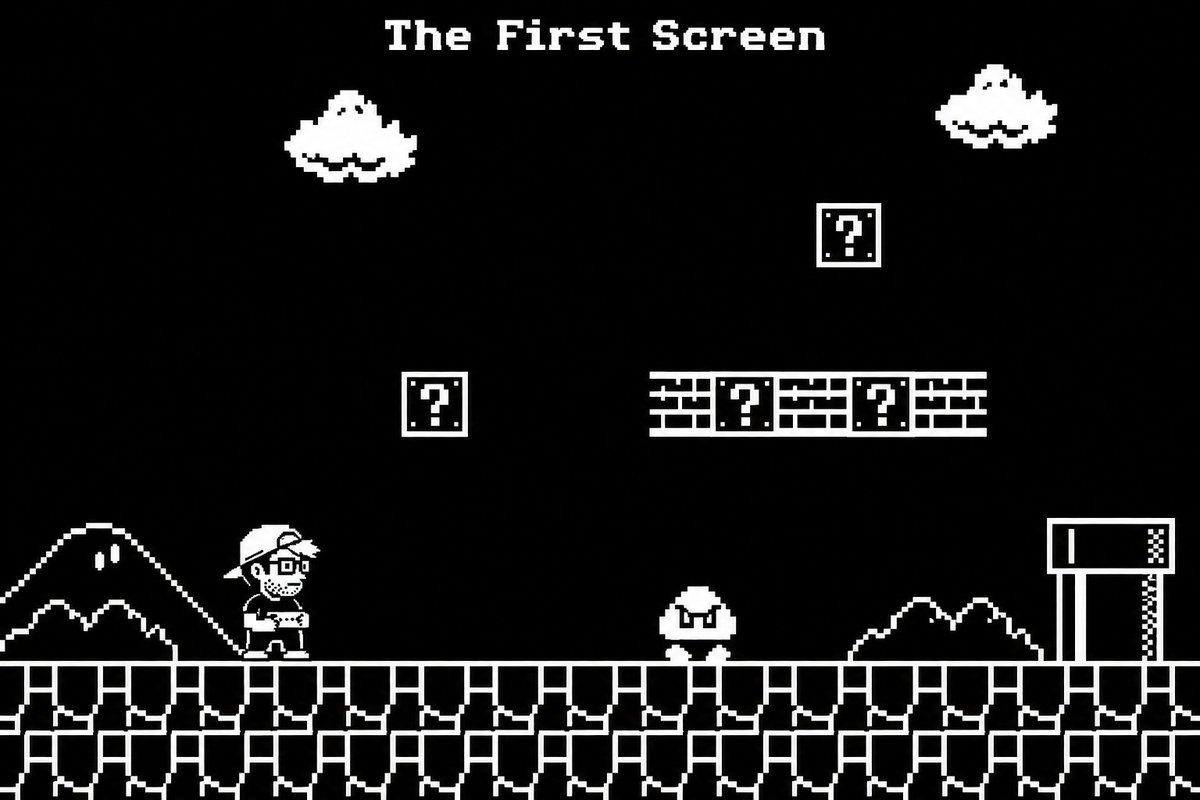
Walk toward it. Make your first mistake. Start again a few steps back, knowing something you didn’t before.
Alan Watts held that the secret to life is to be wholly taken up with whatever is in front of you. Then he added the part I care about…
“Instead of calling it work, realize it is play”
At the top, I asked you to not save this letter. You may do so now, once you have played one level.
All this while, the level has been saving your place. You can give up getting ready now. The person you meant to become is simply the one who walks in and plays.
—Sam