How to be a Creative Genius (art of great ideas)

文章目录
Every startup, company, and business worldwide is looking for a cracked marketer, storyteller, or content person. What they're actually hiring for is a creative genius.
Someone who looks at the same market and data as everyone else and spots something completely novel. Someone with brilliant ideas, curated taste, and the ability to create.
In today's article, I want to show you that creativity isn't something you're born with. You can build it, and I'll show you exactly how.
By the end, you'll understand one of the most in-demand skills in business, and you'll literally start seeing things 99% of people miss. As if you've been handed a pair of glasses only you can wear.
Contents
I: The Anatomy of a Creative Genius (high-level)
II: Inputs
III: Capturing Data
IV: Where Great Ideas are Born
V: Taste: The Unfair Advantage
VI: Final Advice
If you enjoy this content, all I ask is that you Like, Repost & Follow me @ryangrowthh. It helps ensure I can keep bringing free content to you guys :)
I: The Anatomy of a Creative Genius (high-level)
Firstly, I don't consider myself a creative genius. I'm only writing this because I've spent a lot of time studying and working with them.
Elon Musk, Steve Jobs, Steven Bartlett, and my own circle of entrepreneurs.
Most people think creativity is a lightning bolt. A moment of divine inspiration that only certain people are lucky enough to get. I don't think that's true.
Steve Jobs once said that creativity is just connecting things. The more time I spend making things, the more I think that to be true.
Almost every "original" idea is really a combination of existing ideas and data that nobody had put together before.
A cool way to visualize this is as an informational graph of new connections.
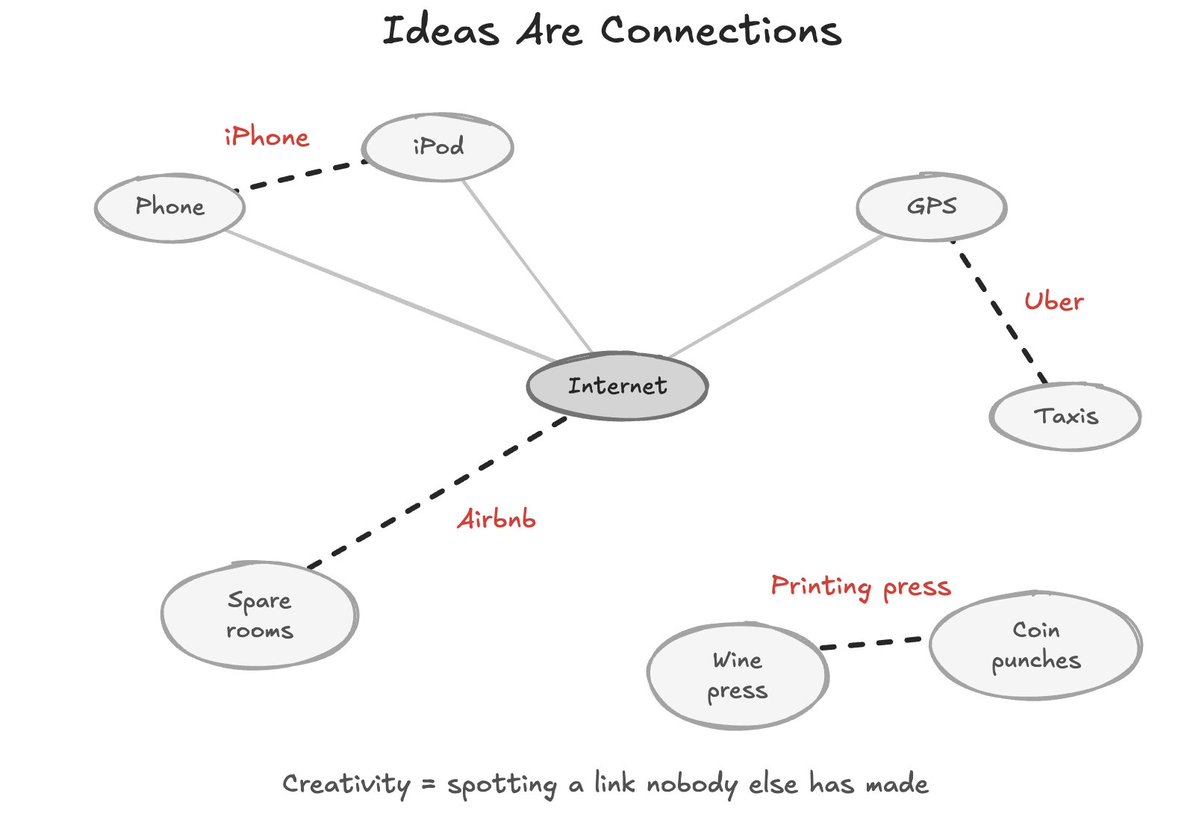
Informational Graph
At its core, idea generation is the art of finding something new in something old.
In marketing (my area of expertise and the focus of this article), it works the same way. Great ideas come from connecting data, formats, and insights that nobody else thought to connect.
From everyone I've studied and worked with, I've noticed a few key things:
1. Better inputs
They consume more, and more widely, than everyone else. They have more dots (data) than 99% of people.
2. They log data
Creative people have a system for logging information. Writing, visual art, digital storage, and so on.
A database where they can express their ideas.
3. Wide connections
They constantly link ideas across different fields that seem almost unrelated.
For example, someone I know created a trending YouTube video on Habit Creation with millions of views after watching a random dog-training ad on Instagram.
4. Reps
They think...a LOT. They analyze everything in their life in extreme detail and go beyond the surface.
They're extremely curious about the underlying mechanics of why and how things work. Once they understand the fundamentals, they can extrapolate them into something new.
II: Inputs** **
Creative geniuses are obsessive about their inputs. The specific data they let into their brains that ultimately leads them to make connections.
In this section, I want to get practical and apply this to marketing and content since that's my audience, but these principles apply to anything: business, relationships, etc.
One principle to remember: garbage in = garbage out.
Every piece of content you create is a reflection of what you've consumed.
Your hooks, your angles, your formats, your takes. All of it is built from the dots you've collected up until that particular point in time.
To create better content, you need to consume better content.
Tips
1. Feed curation
-
Unfollow accounts that only post noise, rage bait, or recycled BS
-
Follow people who are genuinely ahead of you in your niche
-
Follow people who are experts in things you're curious about but a beginner at
-
Follow people who post original thought & strong opinions
-
Follow people who make you think and take new actions in real life
2. Go wide
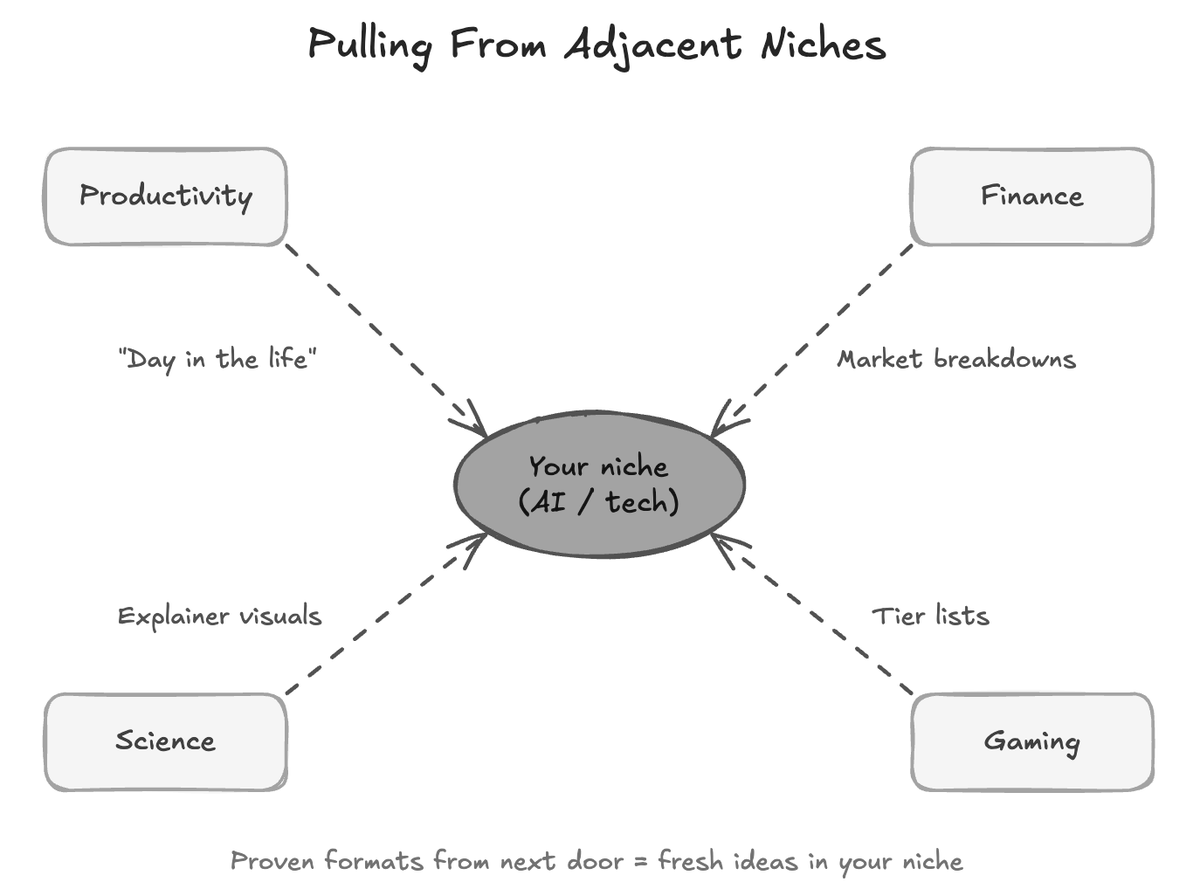
The best ideas come from the edges. If you only consume content from your bubble, you'll only ever remix your own niche.
Expand your interests and become curious about new fields.
In marketing, this is often called pulling from "adjacent niches": spaces next to yours that share an audience, a format, or a way of thinking, but haven't been mined for ideas in your niche yet.
3. Go deep
Going deep uncovers novel insights.
I like to think about it this way: "Why does [x] work?"
In content, that means analyzing why a specific piece of content succeeded.
When you understand principles, you can test further.
4. Consume like a creator
When something stops you mid-scroll, ask:
-
Why did this grab me?
-
Why does this format work?
-
How could I apply this to my niche?
Extrapolating this to business, creative geniuses analyze why they like [X] product and pull specific fundamentals into their own.
5. Talk to real people
Go out and talk to real people with different interests, backgrounds, and insights. ** 6. Balance inputs with outputs**
In the context of marketing, this could literally mean that for every 5 articles you consume, you write one.
In my personal life, I have rules like this.
For every 3 hours of content I consume, I spend 6 hours creating (daily).
III: Capturing Data
Humans have 6,000+ thoughts/day. It's impossible to remember and store all that data.
You need a system for capturing your ideas. Every creative genius does.
This could be:
-
An Obsidian knowledge base (shown below)
-
A simple journal and pen
-
Notion database
-
Simple Apple Notes
-
A vibe-coded custom dashboard with Claude
-
Markdown file system on your desktop
It doesn't matter. The point is, you need to log your ideas so you can think deeply about them later.
Most people have an idea pop into their head and instantly forget it. This eliminates that.
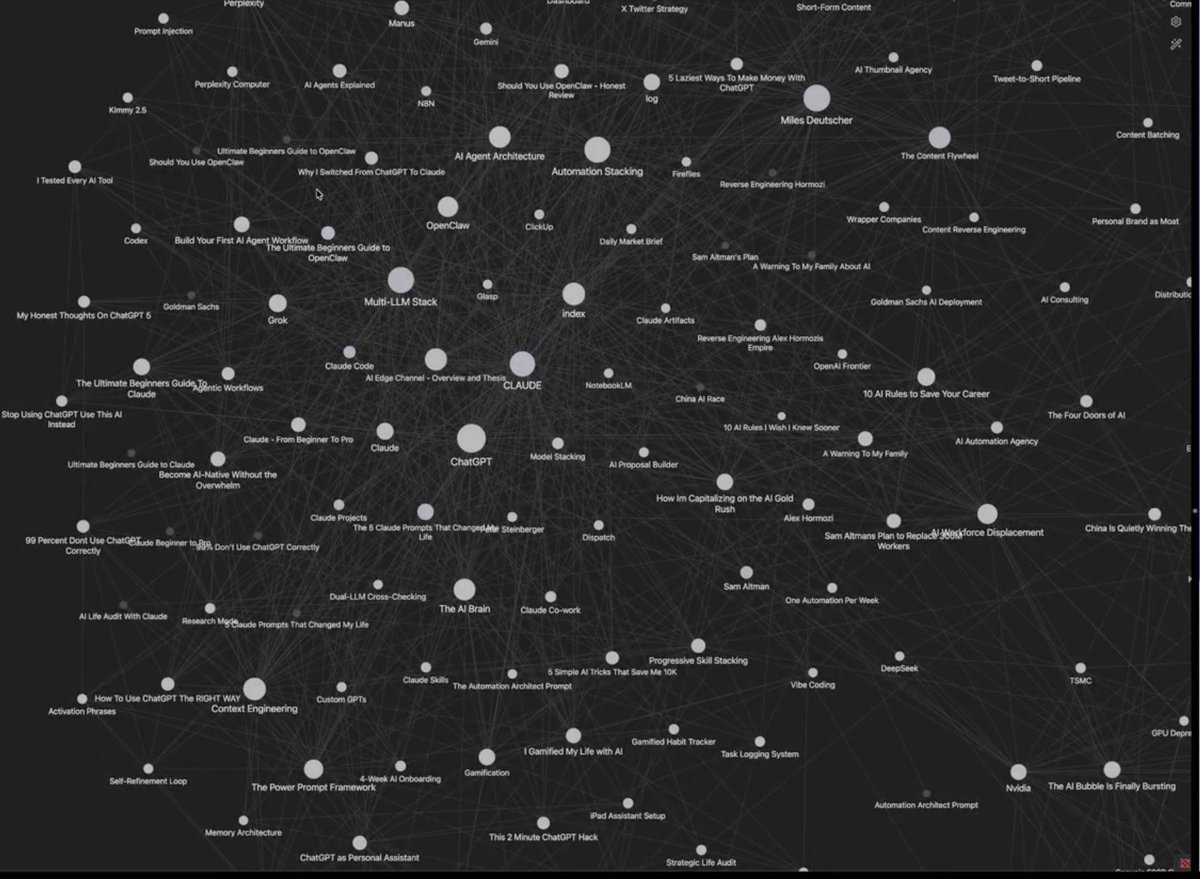
Informational Graph w/ Obsidian
Your system only needs to follow two rules:
-
Be frictionless: you need to jot ideas down quickly, from anywhere. Use voice-dictation tools, smartwatches, AI agents, etc., if they help.
-
Regular review: you need a cadence for reviewing and thinking creatively.
My personal system:
-
For big ideas and reflections, I use the classic journal-and-pen method (I've been doing this for 5 years). At a minimum, I reflect on ideas and goals every month. This is cool because I can literally see my thoughts from when I was a teenager.
-
For quick ideas, I'll just text my Grok Bot to keep a running log, and every Thursday at 3 pm I time-block to review the last 7 days of ideas.
-
Public reflection. Lastly, posting here on 𝕏 is a huge creative outlet for me. Even writing this article forces me to think deeply about my frameworks and stress-test my thoughts before publishing.
IV: Where Great Ideas are Born
Obviously, everyone has different preferences for where their best thoughts are born.
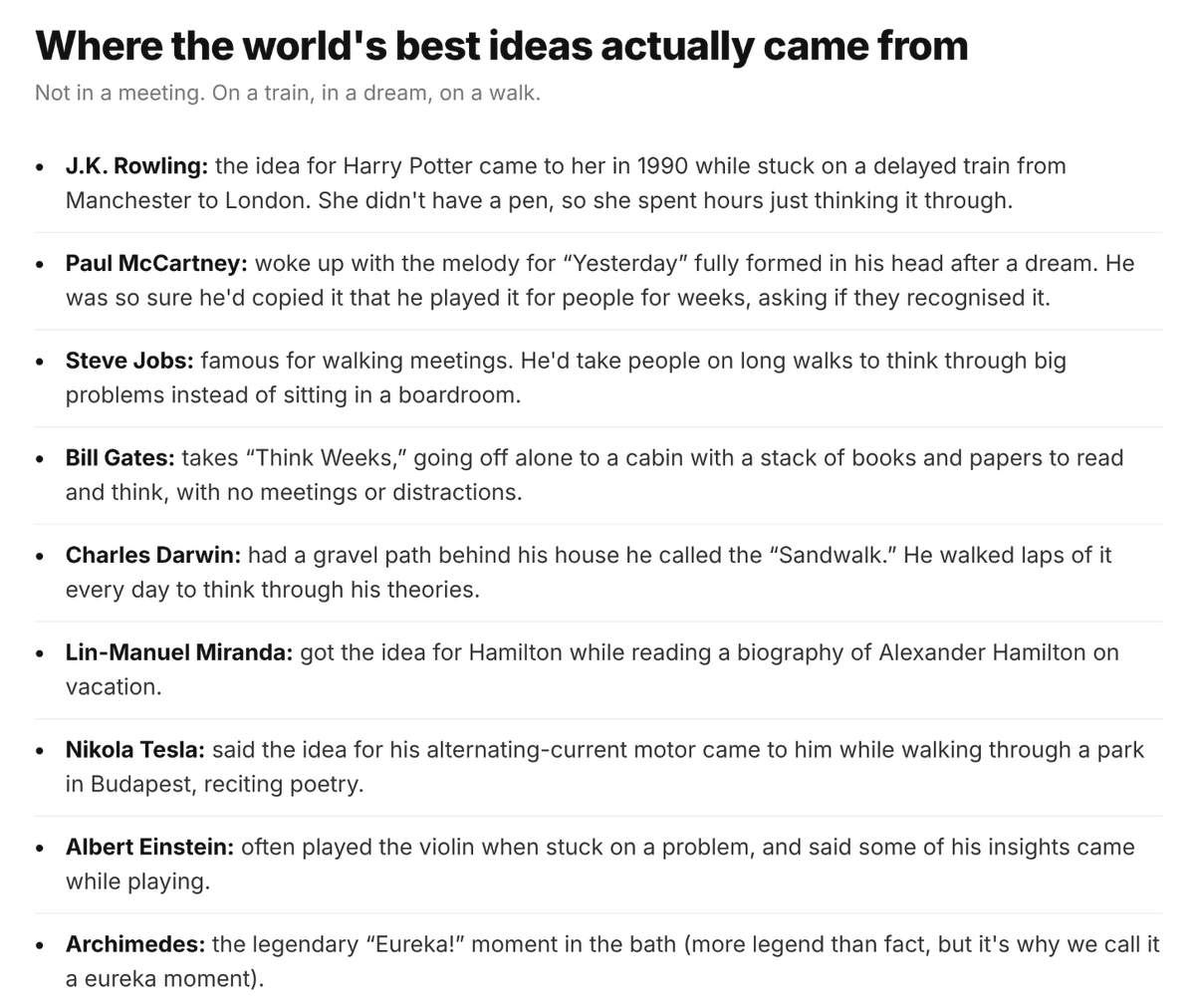
real examples
Some creative geniuses like complete silence; others like going for walks; some prefer the gym.
But one thing holds true for most: exceptional ideas come from curating the right environment.
Most great ideas don't come when you're trying your hardest.
When you're deeply focused, your brain locks onto one problem. When you relax, it wanders, pulling from everything you've stored and linking ideas. Neuroscientists associate this wandering state with the brain's default mode network, which plays a big role in creative thinking.
The creative cycle:
-
Load up → Consume (collect dots)
-
Wrestle → Think hard about the problem
-
Let go → Walk away and do something else
-
Spark → A new thought appears
-
Capture → Log the connection before it disappears
Repeat with your new information.
V: Taste: The Unfair Advantage
Taste isn't something you're born with either. It's pattern recognition, built from thousands of reps of judging things as good or bad and understanding why.
Practical Tips:
1. Study the best (in and outside your niche)
You can't recognize great work if you've only ever seen average work. Study the top 1% in your field and in fields you admire: the best writers, designers, filmmakers, and brands. Raise your reference points, and your standards will follow.
2. Have an opinion on everything
Don't just consume, judge. Every time something crosses your feed, ask: Is this good or bad? Why? What would I change?
Have REAL opinions. Don't be afraid of other people disagreeing.
3. Build a swipe file
This is one of the best practical tools every creative should build.
When something is exceptional, save it. Then break it down: the hook, the format, the pacing, the visuals, the emotion it made you feel.
Over time, you'll have a personal library of what "great" looks like, and you'll start noticing the same principles show up again and again (pattern recognition).
4. Create a lot, keep a little
Taste is mostly editing. It's way easier to know what's bad than to know what's good.
For example, in the context of content, you can write ten hooks and trim until you're left with one.
Great creatives create a bunch, then delete most of it.
5. Network
One thing that really helped me build taste was paying mentors to teach me why certain formats landed on social media.
If you look at every creative genius, regardless of their domain, they almost all had mentors.
Final Advice
If you want to be a better creative tomorrow, I think it primarily boils down to:
Start curating your inputs → start logging your ideas → give yourself space to think on those ideas.
In today's article, I focused mainly on marketing/content examples, but these principles apply to being more creative in any aspect of your life.
If you found even one valuable point from this piece, a Like, Repost, and Follow go a long way.
Every week, I write 1-2 articles covering: GTM strategy, content, marketing, creative work & related topics. If that interests you, I'd love to connect with other like-minded folks.
I also post whiteboard-style videos that people enjoy.
Here's my latest one breaking down how I recently gained 10,000 𝕏 followers in 35 days: