How to Build a One-Person Million Dollar Agency with AI Agents

文章目录
Sam Altman says tech CEOs have a betting pool on the first year one person builds a billion dollar company. Maybe. A one-person million dollar agency is a much smaller bet, and it's the one I'd make.
A million dollar marketing agency usually means about six people. Agencies brought in $163,000 per full-time employee in 2025 (Promethean Research, 2026 State of Digital Services). Some of those people win clients. The rest run the accounts: the website, the ads, the Google listing, the reports and the calls. Agents can now do most of that work, and bring you only the decisions.
So here's one, built on paper: one niche, three productized tiers, a sales team of agents, a delivery team of agents that asks before it acts, and the math at every step. It's a hypothetical, and every number in it is a sketch you'd replace with your own.
It picks up where my last two articles left off. The masterplan covered what to sell to boring businesses, and the October piece covered who to go after and how to get in the door. This one runs the whole agency to a number. It's long (about a 20 minute read).
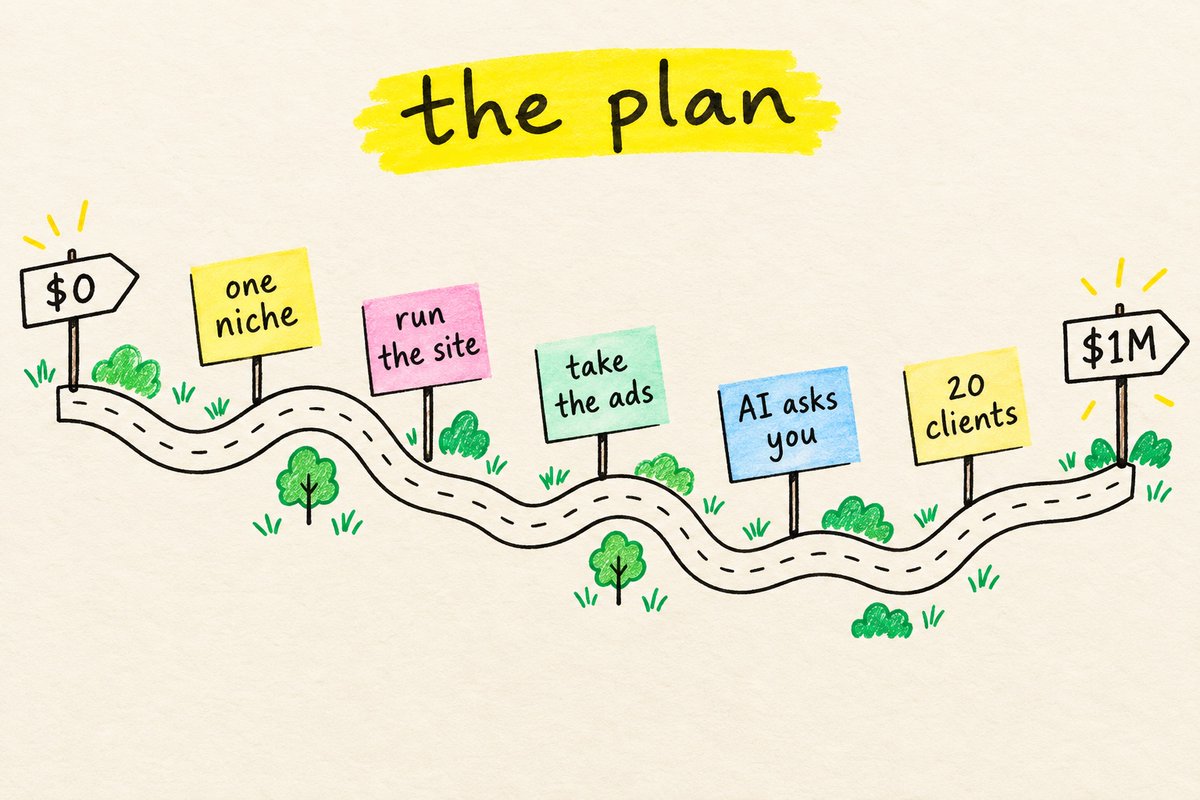
Here's the whole plan:
-
One trade, several metros. Plumbing and HVAC companies with ten or more people, starting in Dallas-Fort Worth.
-
Get in through the website. Take it over and turn more of the traffic they already get into calls.
-
Grow the account. Take over their ads and their Google Maps listing next.
-
Agents do the work and ask you first. Every change a customer or the owner would notice comes to your phone as an approval.
-
20 clients across three tiers. That's about $85,000 a month, or $1,020,000 a year.
You're the one person. You approve, you decide, and you get on a call only when it matters.
Why an agency, and why now
Main Street owners don't want more software. Plumbers and HVAC shops have been sold website builders, review apps and ad dashboards, and running them is a job they don't have time for. What they'll pay for is more booked jobs. That's why agencies exist.
The problem with agencies was always people. An agency sells work done by hand, so revenue grows only as fast as you hire, and most of the money goes to payroll. Software had the opposite problem. The margins were great, but the owner still had to do the work.
Agents do the work at close to software costs. Investors call this service as software, and Foundation Capital puts it at a $4.6 trillion opportunity, because AI starts doing work companies now pay salaries and outside firms for (Foundation Capital, 2024). A local marketing agency is about the plainest version of it. The client buys a result, and agents do most of the labor.
Three things make it work for one person now:
-
Agents can work inside real accounts. Claude Code and Codex build and change websites, and connectors sign them into a client's Google Ads, Business Profile and email.
-
Agents keep working when you stop. Scheduled cloud tasks and always-on personal agents like Hermes and Grok Bot run overnight and message you when they need a yes.
-
Owners can see proof before they pay. An agent can check every business in a city on a phone and build the fix before the first call.
Part 1: The math to a million
A million a year is $83,333 a month. With three tiers, you don't need many clients to get there:
-
5 on the site tier at $1,500 a month is $7,500.
-
10 on the site, ads and Maps tier at $4,000 is $40,000.
-
5 on the top tier at $7,500 is $37,500.
That's 20 clients and $85,000 a month. Ad spend is on top, and the client pays it straight to Google and Meta.
Some clients will leave. Agencies on retainers lose about a quarter of their clients a year, and agencies with one to ten people lose 44.3% (Focus Digital, 2026, vendor data). So to have 20 at the end of two years, plan on signing about 28, and more if you lose clients the way small shops do.
Now work backwards. These are guesses you'll replace after your first 100 businesses:
-
1 in 20 businesses that get a full two-week sequence takes a call.
-
1 in 4 calls signs up for the site.
-
So one client takes about 80 businesses, and 28 clients take about 2,240.
That's about 22 businesses a week for two years, each one found, checked on a phone, written to with its own proof, and followed up. And once they sign, every account needs a site, ads, a listing and a report kept up every week. That's why both teams in this piece are agents.
Then check the market. Bigger tickets need bigger businesses, so this agency only goes after plumbing and HVAC companies with ten or more people. Dallas-Fort Worth has 613 of them. That isn't enough for a million on its own, so the agency stays in one trade and adds metros: Houston has 460, San Antonio 192 and Austin 181, for 1,446 across the four big Texas metros (Census, County Business Patterns 2023). At 1 in 80, that's about 18 clients. The "not now" owners you work again after six months and the ones who find you through your own marketing have to cover the other ten, or Phoenix (418) and Atlanta (394) come in sooner.
Nothing in this agency needs you in the same city as the client. What carries over is the trade: the same menu, the same tested pages, the same prompts and the same proof. A new metro is a new list.
That's arithmetic, not a promise. (The October piece has the full case for going after bigger shops, and how to size one from the outside.)
Part 2: Three tiers, one menu
Every client buys from the same short menu. Nothing gets made to order.
-
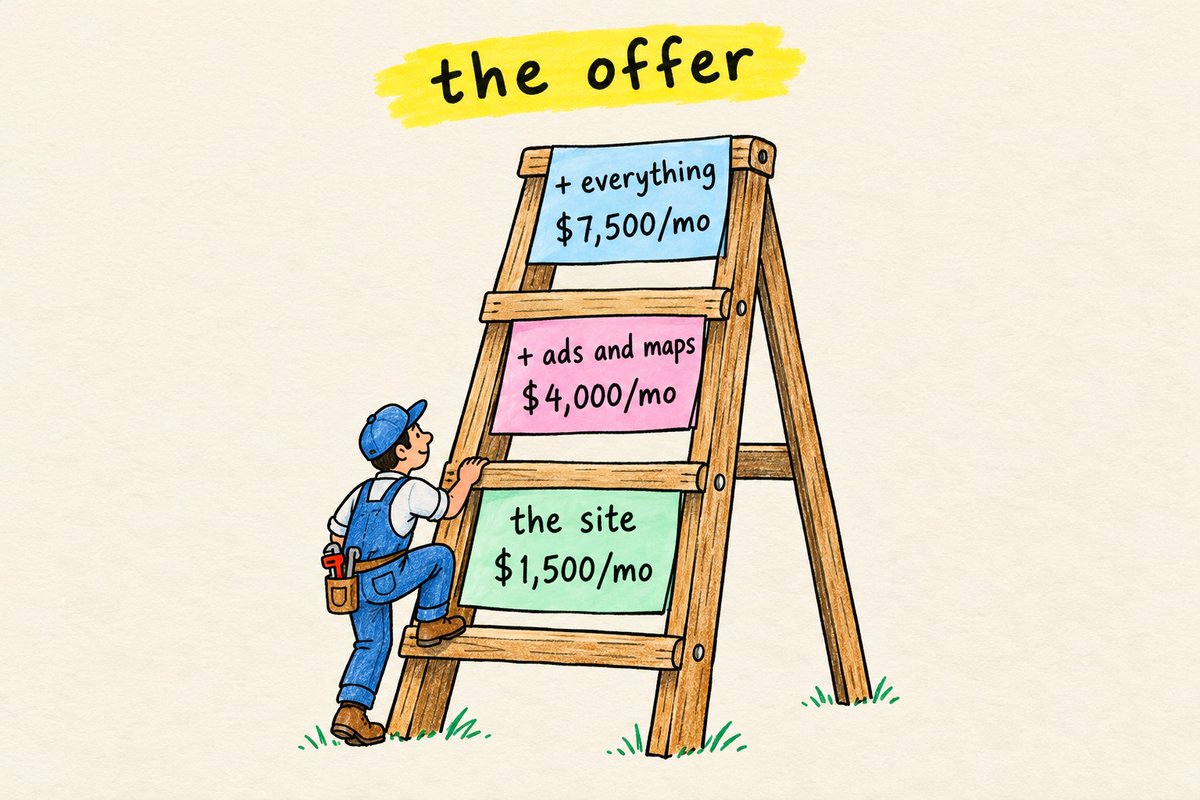
The site: $1,500 a month, after a $2,500 setup. You take over their website, move it onto your stack, and turn more of the traffic they already get into calls. Their number on the first screen, a page for every service they run ads on, a text back to every missed call, and one new test a week. They get a short report every week, and it sends itself.
-
Site, ads and Maps: $4,000 a month. Everything above, plus their Google Ads and Local Services Ads and their Google Business Profile: posts, photos, review requests after every job, and review replies.
-
Everything: $7,500 a month. Everything above, plus Meta ads, local search pages, and a monthly call with you. This is the only tier with a standing call.
The website is the way in. It's where the traffic they already pay for lands, and once it's on your stack you can change it without waiting on their web guy. Keep the domain in their name, and if they ever leave, hand the site back the same week.
The upgrade sells on numbers. If the weekly reports show more calls from the same traffic after 60 to 90 days on the site tier, that's when you show them what their ads and their Maps listing are leaving on the table.
Why these prices? A plumbing shop on LocaliQ already spends about $2,500 a month on search ads alone (LocaliQ, 2026, vendor data), and a ten-person company spends more. If the site books more jobs from those clicks, $1,500 is easy to defend with the owner's own numbers. The setup fees cover the months when a client leaves.
Part 3: The sales team
22 businesses a week, every week, is a team's worth of work. Here's the team:
-
The researcher finds businesses that are losing customers and already paying to get them.
-
The auditor shows each one its own problem, on its own phone.
-
The writer turns that proof into an email, a video or a postcard.
-
The caller handles the phone, the one channel where AI can get you sued.
-
The marketer gets owners to come to you.
-
The follow-up rep chases every lead and sorts every reply.
A manager sits above them: a personal agent like Hermes, Grok Bot, OpenAI's Dots or Claude Duet that runs both teams on a schedule and messages you when something needs a yes. You're the closer.
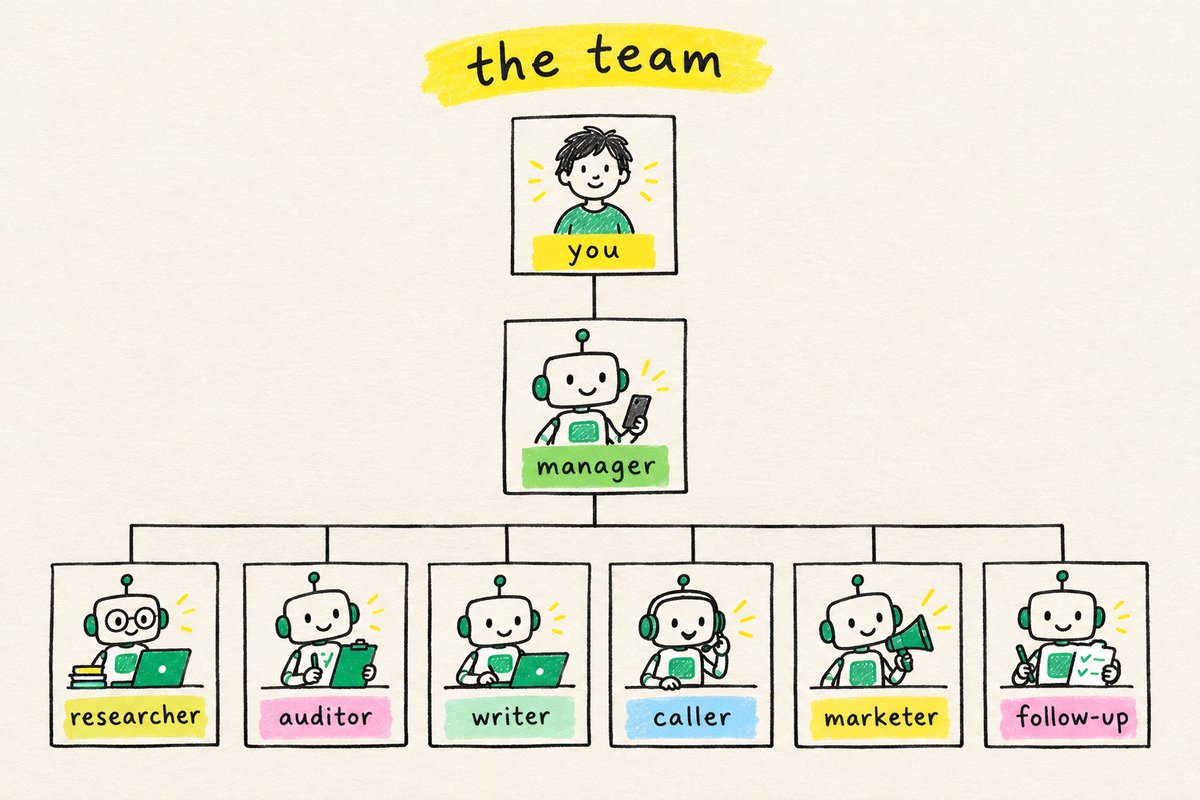
Six seats, one manager, one closer.
Every seat works from proof. It takes about 19 cold dials to get one conversation (Gong, vendor data), inboxes got stricter about cold email, and owners can spot an AI-written "personalized" first line from the subject. What still gets a reply is the business's own website, measured on a phone, next to the best in their town. That used to take an afternoon per business. Agents make it cheap enough to do for all 22.
Seat 1: The researcher
Skip the list of every plumber in town. The researcher looks for signals that a business is paying for customers and losing some:
-
Running ads. They already pay for customers, so a leak costs them money they can see.
-
Still getting reviews. New reviews every week mean real job volume.
-
Pulling permits. Many cities publish building permits with the contractor on each one.
-
Hiring. Open jobs for techs mean more work than people.
-
Missing calls. You can't see this from outside, but the auditor can test it.
boringfunnels reads the first two for you. I typed "plumbers in Dallas" into it and got 20 local plumbers, ranked by what's losing them customers, with their estimated size and their ads. Pro checked all 20 on a phone, and 18 had something I could fix. The #1 runs 40 Google ads promising 24/7, and its website never says it.
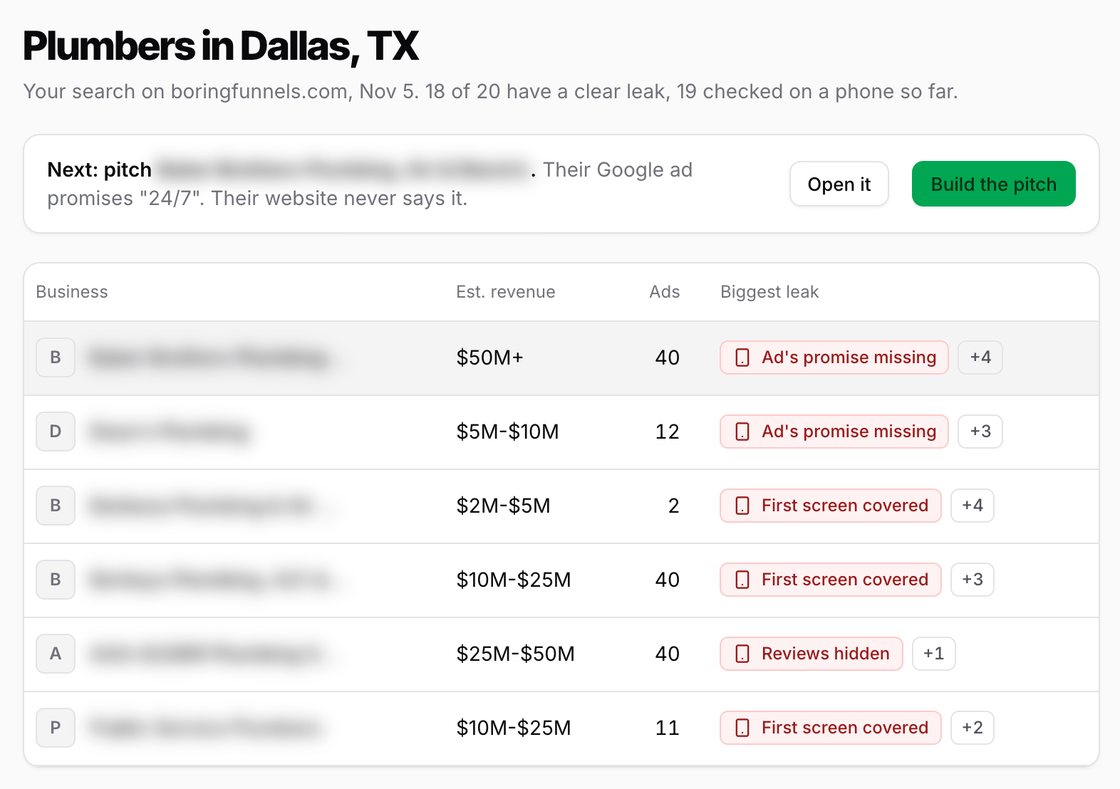
My real search. Names blurred.
Run it on your own town. Type a trade and a city into boringfunnels.com. Three searches a month are free, and each one checks the top five businesses on a phone.
Then hand it to your agent. With boringfunnels Pro connected, your agent can run the search itself or read the ones you ran on the site, then pull each business's Google rating, newest reviews and the ads it runs:
You're the researcher for an agency that runs websites, ads and Google
listings for [trade] businesses in [metro]. Read my latest boringfunnels
search (the searches tool). For the top 10, use the prospect tool to read
each one's Google rating, newest reviews and the Google ads it runs, and
check their own site for growth signs, like job posts or a new location.
Mark every guess as a guess. Save name, site, biggest gap and ad promise
to prospects/[metro]-[trade].csv. Don't save the reviews.
Seat 2: The auditor
The auditor finds the one thing on each website costing them customers and shows it the way their customer sees it. boringfunnels does this part. The free search checks the top five businesses on a phone, and Pro checks every one: each gap biggest first, why it costs them, and how the rest of the town does.
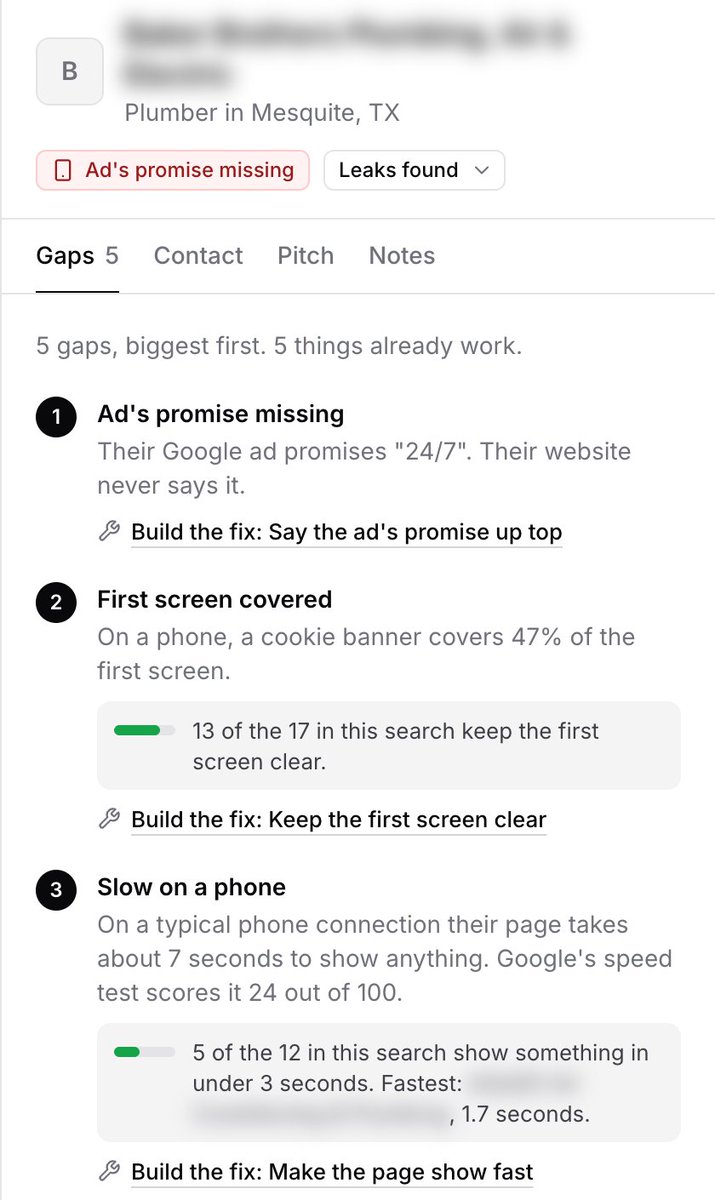
The #1 plumber from my search. Five gaps, each next to the rest of the search. Names blurred.
Before any proof goes out, check it has four parts:
-
The gap, on their phone. "On a phone, your number doesn't show until the sixth screen."
-
Why it costs them, in their customer's words. "Someone with water on the floor calls the next plumber."
-
The best in their town. "13 of the 17 plumbers near you keep the first screen clear." Owners care more about the shop down the road than any best practice.
-
The fix, in one sentence, ideally already built.
The strongest proof is a test. Fill in their contact form after hours, the way a customer would, and time the reply. The first line writes itself: "I filled in your form Tuesday at 7pm. Nobody had replied by Thursday." Use the form or a real person's call, never an AI voice (Seat 4 says why), and tell them exactly what you did.
Seat 3: The writer
The writer turns the proof into the pitch, and boringfunnels writes the first draft. Here's how the email it wrote for that #1 plumber opens:
Subject: Your "24/7" ad

Hi there,

Your Google ad promises "24/7". On a phone, your website never mentions
it, so someone who tapped for it has to go looking, or goes back to Google.
Then show them the fix before they pay. In boringfunnels Pro, your AI builds the pitch from the business's card: a page in their brand that fixes the gap, a one-page proposal with your offer, and the emails. Pro also finds who to send it to, the owner and the managers who might decide on marketing, with work emails at the business's own domain. You send everything from your own inbox, and nobody gets contacted for you.
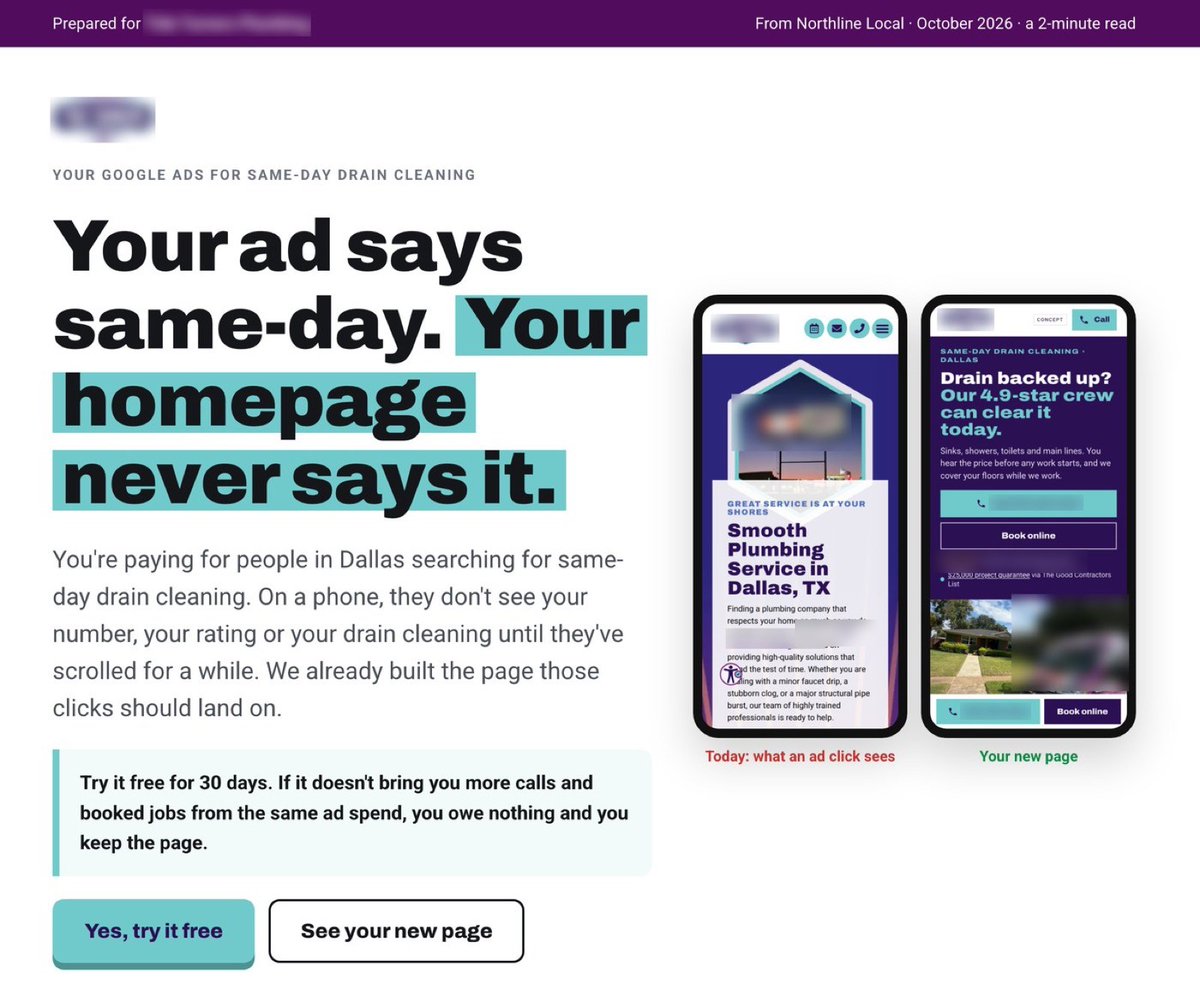
A pitch built this way for a Dallas drain-cleaning company: their page today, the new page, and the offer. Names and numbers blurred.
Home service owners get more customers from referrals than anywhere else (Jobber, vendor data). They trust people they know, so the writer keeps every message personal and small.
-
Email. One gap, one ask, under 80 words, in plain text with no link. Send it from a warmed-up domain that isn't your main one, with an honest subject line and an easy way to opt out.
-
Video. Record your face once and let AI personalize it (Sendspark does this), use an avatar of you, or send a Loom after they say yes. Sendspark says personalized video gets 6% to 15% replies against 1% to 3% for text. That's their number, so test it. Never let an avatar pretend to be live.
-
Mail. A postcard with a screenshot of their own page, the gap circled, and a QR code to the fix. Lob prints a different card for each business for under a dollar. Cold mail gets about 1% back, so save it for your top 50.
In every channel, say what your AI did. "I had my AI check your site on a phone" is true, and it's a better hook than pretending you were browsing.
Seat 4: The caller
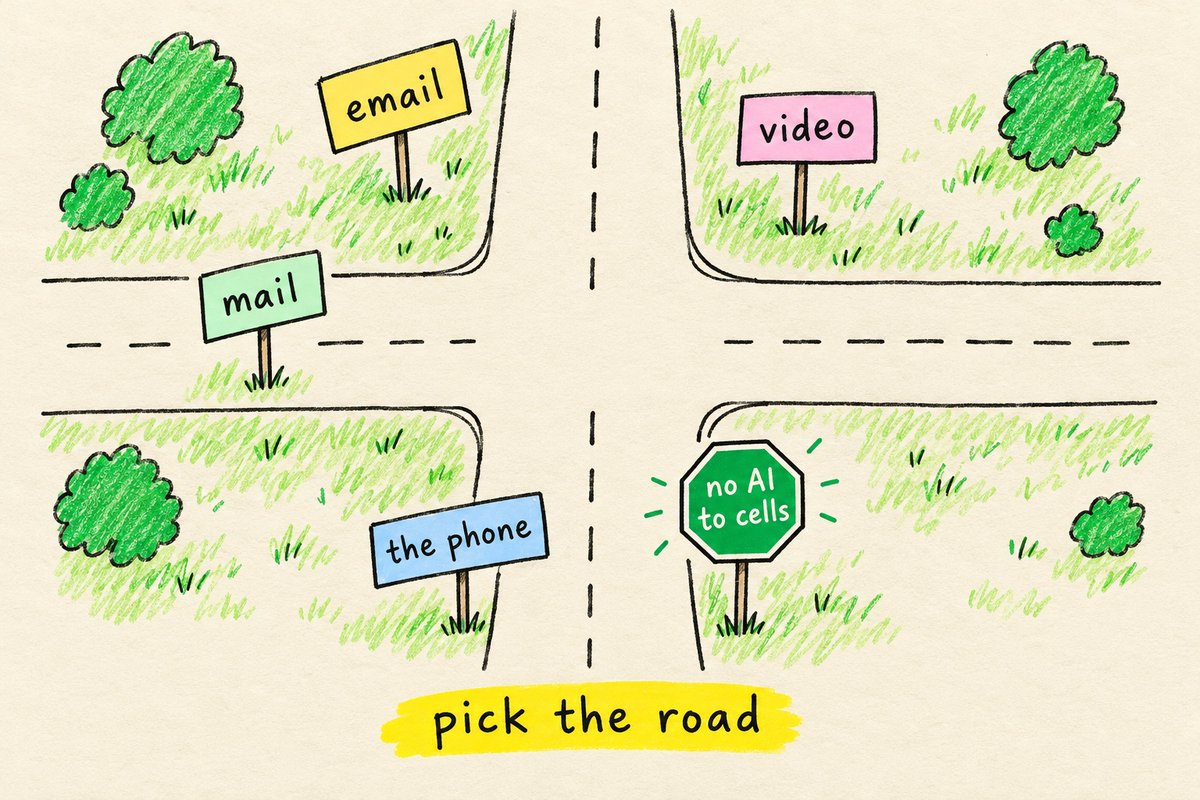
This is the seat where AI gets you sued. An AI voice can't cold call a cell phone, and most trade owners answer their business line on a cell. Each call can cost you $500 to $1,500.
So use AI everywhere except the dialing:
-
The demo line. A number each prospect can call to hear an AI receptionist answer as their own business, with their name, services and hours.
-
The consented callback. A form on your page with clear consent language, and your AI calls back within a minute.
-
Human calls, prepped by AI. The caller builds the call sheet from their site and their gap. You dial.
Skip ringless voicemail and cold texts too. The law counts both as calls.
Build a demo line for [business]. From prospects/[business]/, write the
receptionist's instructions: open with "Thanks for calling [business name],
this is their AI assistant", use only their real services, hours and
service area, take a name and number for a callback, and never quote a
price. Create the assistant and a phone number with the [Vapi or Retell]
MCP. Add one line to their proposal: "Call [number] to hear how your
calls would be answered."
Seat 5: The marketer
Outbound is you knocking on doors. The marketer gets owners knocking on yours, which matters more as referrals dry up. 76% of agencies called referrals a top source of new business in 2025, and only 44% did in 2026 (RSW/US).
-
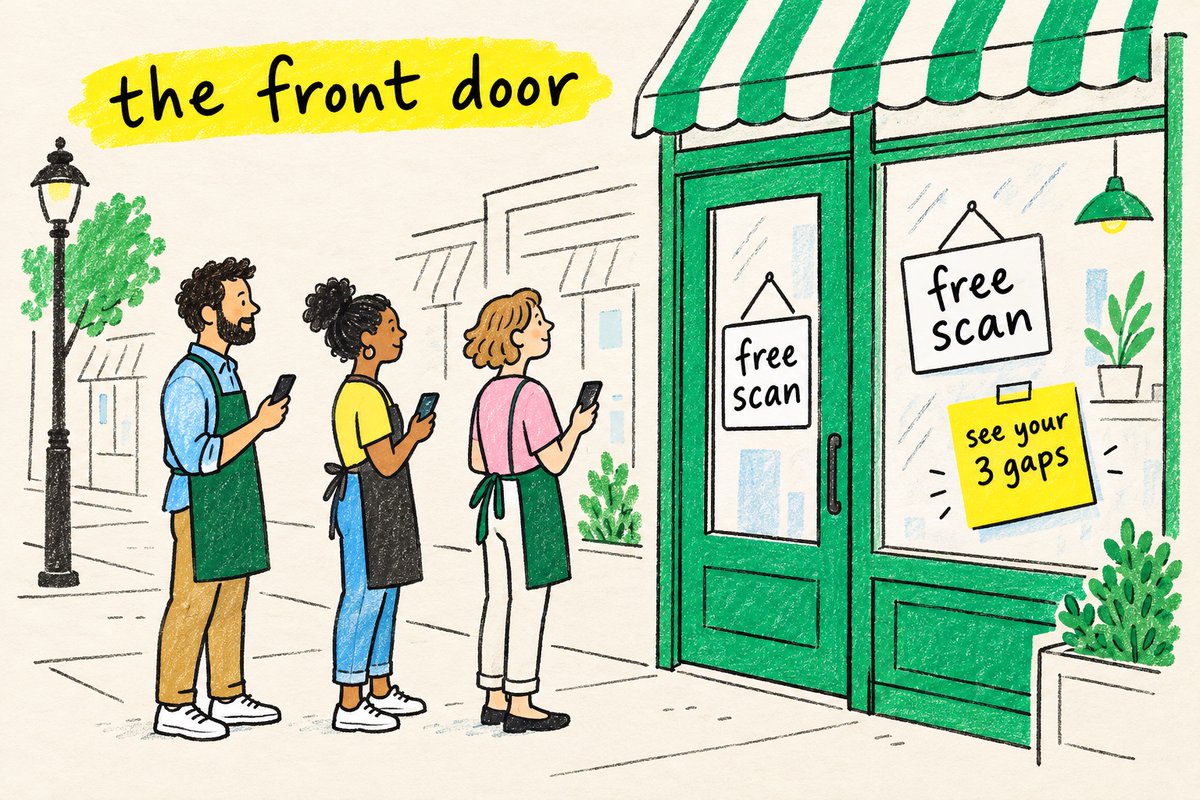
A free scan. An owner types in their business name and website. Your agent runs the boringfunnels pitch skill on it, and you send back their three biggest gaps, worst first, with their first screen fixed in their own brand. Ask for the email before you send it.
-
Retarget the click. Skip uploading your cold list to Meta. Put the pixel on your scan page and on each prospect's proposal page, and everyone who clicks joins an audience. Personalize the page, never the ad.
-
ChatGPT ads. You can now buy ads in ChatGPT yourself and pay by the click. An owner asking ChatGPT for "someone to fix my plumbing company's website" is about as ready as a buyer gets. It's new, so test it small.
-
Your own local data. Publish what your boringfunnels searches found across the metro: how many HVAC companies run ads their page never backs up, and how many cover their own first screen. Other sites and AI answers cite pages like that. One real page beats fifty copies with the city swapped.
Seat 6: The follow-up rep
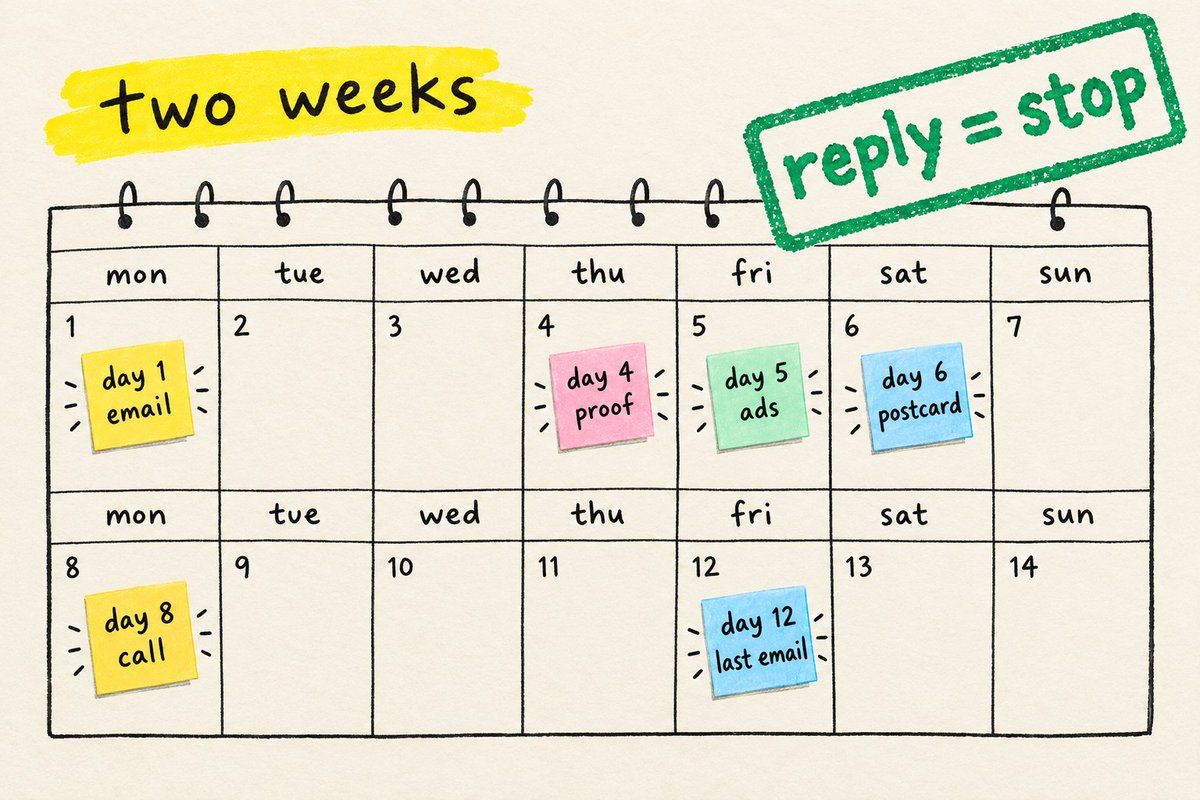
Most deals come on the second, third or fourth touch. 42% of cold email replies come from follow-ups (Instantly, 2026, vendor data). With agents, each follow-up can carry new proof. A two-week rhythm for one business:
-
Day 1: the email with their gap.
-
Day 4: a follow-up with the proof attached, or the demo line.
-
Day 5: if they opened the proof, your ads start showing.
-
Day 6: for top accounts, the postcard lands.
-
Day 8: you call their business line. "I sent you something about your website. Did it reach you?"
-
Day 12: the last email. "Should I close the file on this?"
The moment they reply, everything else stops. That rule lives in code, where the agent can't skip it.
The follow-up rep also sorts the inbox:
Read new replies in the outreach inbox. Sort each one: interested, asked a
question, not now, no, or unsubscribe. Unsubscribes and no's go into
suppression.csv first, then stop their sequence. For interested and
questions, draft a reply into outbox/pending/ using only facts from their
prospects/[business]/ folder, and offer two times for a 15-minute call.
For not now, set a reminder for 60 days. Send nothing. Summarize in three
lines.
On the call, sell the site tier and nothing else. It fixes the problem they just saw, and the upgrade comes later, on their own numbers.
Part 4: Run 20 accounts without living on calls
I've built multiple seven figure agencies and worked with hundreds of clients, and delivery is the part I'd plan hardest if I did it alone.
The rule for this agency: agents do the work, and anything a customer or the owner would notice comes to you as an approval first. Four more seats run the accounts:
-
The site seat runs every client's website on your stack. It fixes what the proof found, ships one test a week, and checks every change on a phone.
-
The ads seat manages Google Ads and Local Services Ads inside the budget the owner signed, and Meta ads on the top tier. It proposes every change and makes none on its own, except pausing an ad that spends with no leads.
-
The Maps seat runs the Google Business Profile: weekly posts, new photos, a review request after every job, and draft replies to every review.
-
The reporter reads each client's calls, forms, bookings and ad spend, and writes a five-line weekly note: what came in, what booked, what changed, and what's next.
The site seat starts where the pitch left off. When an owner says yes, press Build the fix on their card in boringfunnels, and your AI builds it in their own logo, colors and photos, from pages that already sell, then checks that it worked. Here's another Dallas plumber's first screen, today and after:
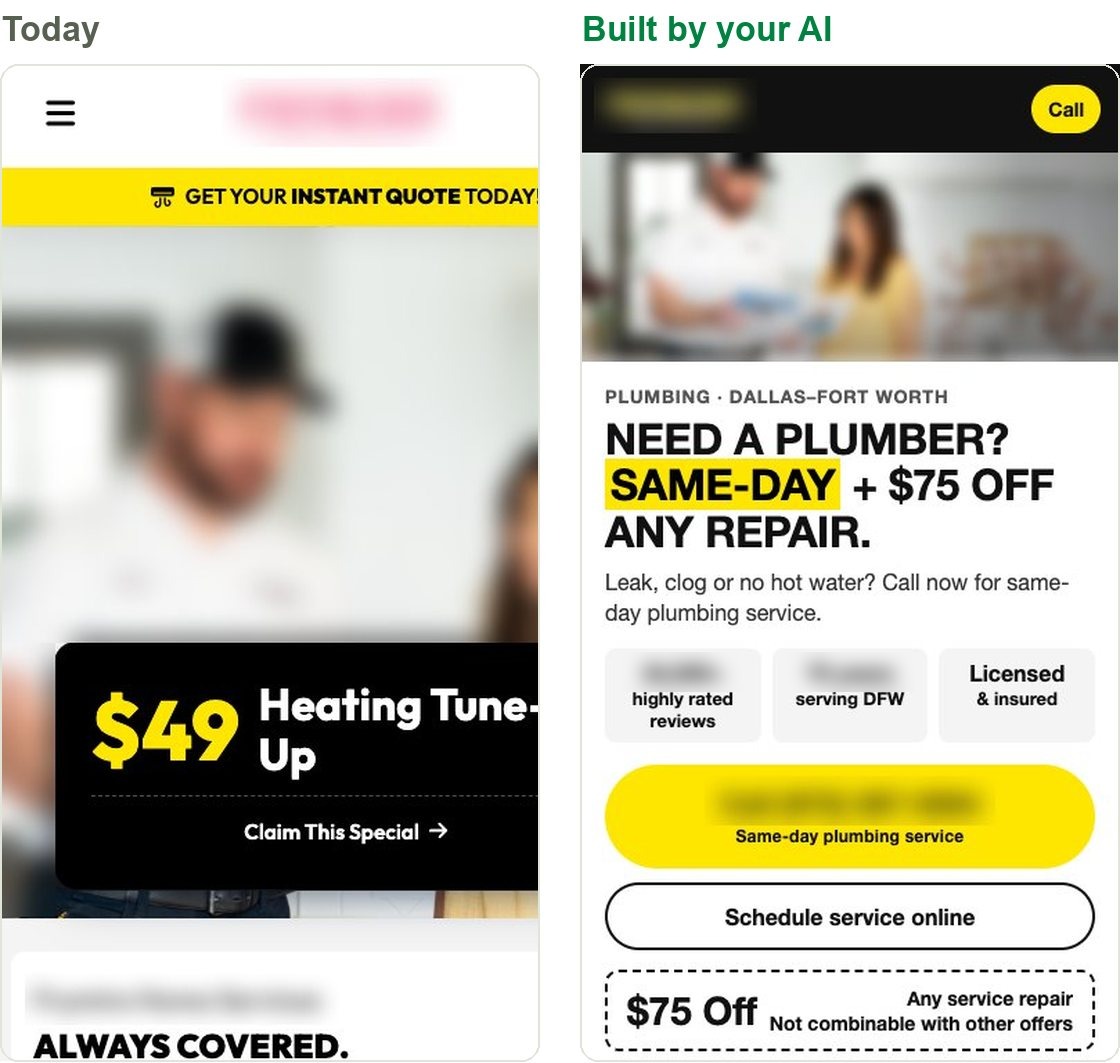
Today, and the first screen their AI built. Names and numbers blurred.
Each seat proposes, and the manager brings it to you one client at a time. Here's what lands on your phone:
Fort Worth HVAC client: 3 changes waiting
1. Site: test a new first screen, "Same-day AC repair". Calls from the
   page fell two weeks in a row.
2. Ads: move $300 from "furnace repair" to "AC repair". Furnace leads
   cost twice as much this month.
3. Maps: reply to a 2-star review (draft below).
Reply 1, 2, 3 to approve, "skip", or "call" if this needs the owner.
Every client folder has an approvals.md with three lists, so the queue stays short:
-
Runs on its own. The weekly report (after you've read the first month of them), posts from the approved calendar, thank-yous to 4- and 5-star reviews, review requests, and pausing an ad that spends with no leads.
-
Asks you first. Any change a customer can see on the site, new ads or ad copy, any budget change, replies to reviews under 4 stars, and anything that goes to the owner outside the report.
-
Never. Spending above the cap the owner signed, touching billing or their domain, or publishing a price, guarantee or license claim that isn't in their brief.

Reporting stays automatic. The reporter sends the weekly note on its own and flags the exceptions to you: leads down two weeks running, a cost per lead that jumps, a bad review. Those exceptions are the only times a call should come up outside the top tier. Everyone else gets the note and a reply-to-this-email line, and most owners prefer it.
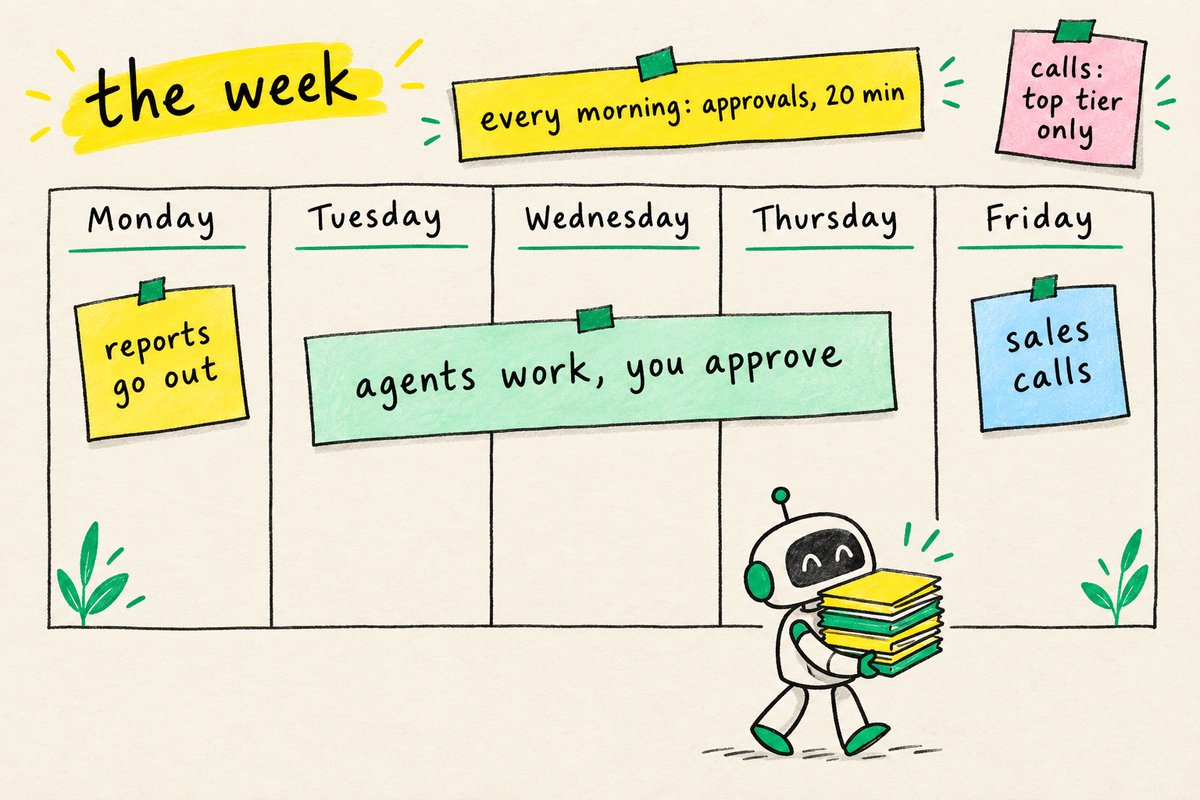
Here's the week:
-
Every morning: 20 minutes on the approval queue, client by client, on your phone.
-
Monday: the reports go out on their own. You read the exceptions.
-
Tuesday to Thursday: the seats work through each client's plan and bring you what needs a yes.
-
Calls: the five top-tier clients get one a month, plus any call the manager says is needed.
-
Friday: sales calls and new setups.
On paper that's 15 to 20 hours a week. In practice something always breaks, and the slack in that week is for it.
No agent fixes the owner's side. If the shop doesn't answer the calls you send, the numbers look bad whatever you build. So every site setup starts with a text back to every missed call.
If you ever hire, hire for delivery, never sales. Your first person reviews the approval queue with you, and the math still works with one person and a part-timer.
Part 5: The setup, kept simple
This sounds like a lot of software. It isn't. It's one folder in Claude Code, one place to connect each client's tools, one text thread per client, and you checking the work.
-
Claude Code on the Ultra plan. Ultra is $200 a month, with ten times the usage of Claude's Pro plan and $200 a month in API credits. It's the plan I'd run this on.
-
Composio for the connections. One sign-in per client account, and your agent can work in their Google Ads, Business Profile, Gmail, calendar, CRM and phone line. It covers over 1,000 apps, so you never build an integration yourself.
-
The boringfunnels MCP, for finding businesses, checking their sites on a phone, and building the pitches and the fixes. Add a browser so your agent can check its own changes on a phone.
-
A sender for cold email (Instantly or Smartlead), so outreach never goes out from an agent directly.
agency/
  CLAUDE.md                  who we sell to, our voice, the hard rules
  menu.md                    the three tiers, and exactly what each includes
  .claude/agents/
    researcher.md  auditor.md  writer.md
    caller.md  marketer.md  follow-up.md
    site.md  ads.md  maps.md  reporter.md
  prospects/
    dfw-plumbing.csv         one row per business, a source for every fact
    [business]/              the proof and the pitch for each one
  clients/
    [client]/
      brief.md               their services, area, prices, budget cap
      approvals.md           runs on its own, asks you, never
      queue/                 changes waiting for your yes
      reports/               every weekly note
  suppression.csv            opted out or bounced, checked before every send
Each seat is a subagent: a short file with its job and what it must never do. The agents prepare everything. You press go on anything that spends money, changes what a customer sees, or goes to the owner.
# connections: Google Ads, Business Profile, Gmail, your texting line and the rest
curl -fsSL https://composio.dev/install | sh
composio login

# boringfunnels: finding businesses, checking them on a phone, the pitch and the fix
claude mcp add --transport http --scope user boringfunnels https://boringfunnels.com/mcp

# a browser, for checking your own changes on a phone
claude mcp add playwright npx @playwright/mcp@latest
The client's side: one text thread
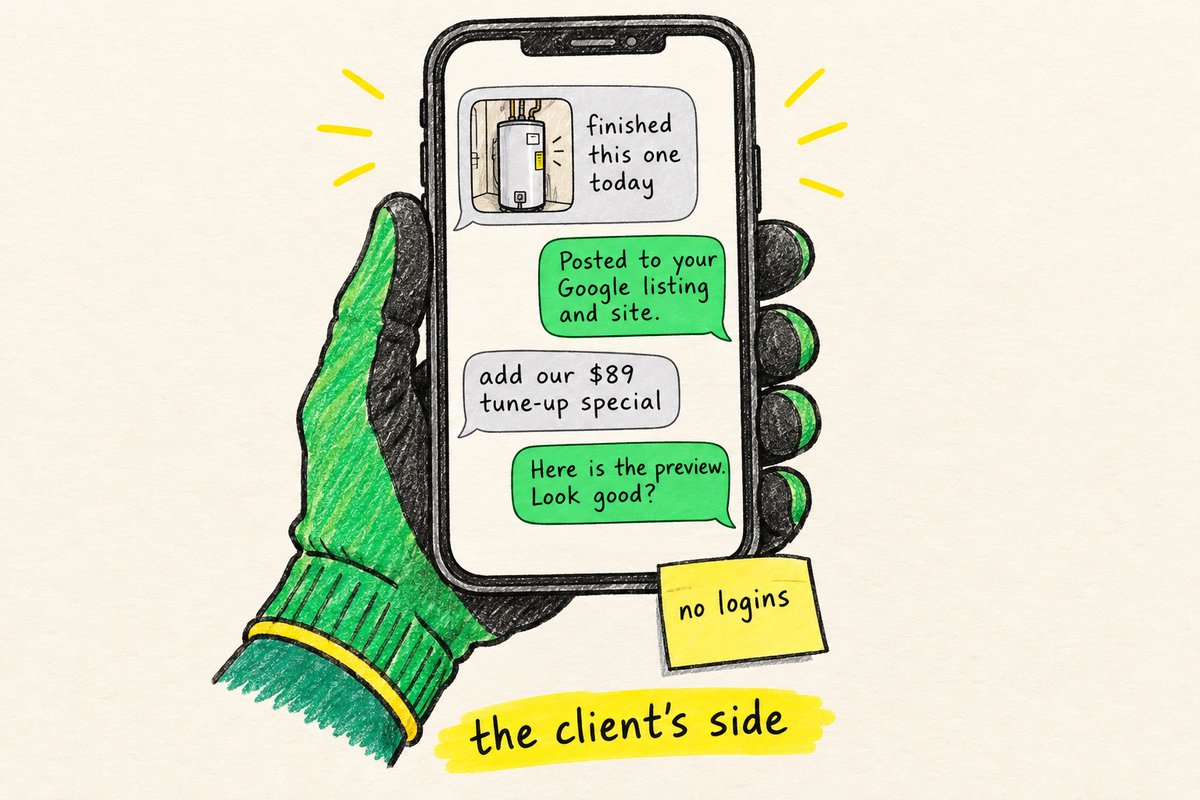
Each client's whole relationship with you lives in one text thread: the owner, the office manager, your assistant and you. A shared business number works (Quo connects through Composio). There are no logins, no dashboard and no app. The assistant says it's AI, and you're one reply away.
-
The owner texts a photo of a finished job, and it's on their Google listing and their site that afternoon.
-
The owner texts "add our $89 tune-up special". A preview link comes back in the thread, they reply "looks good", and it goes live.
-
A customer's call goes unanswered, and the customer gets a text back within a couple of minutes.
-
On Monday morning, the weekly note lands in their inbox.
It feels like having a person on the account. Most of it is software, and you still read every thread.
Your side: one queue
Every morning, the agents go through each client and bring you what needs a yes. In Claude Code, /schedule runs a prompt in the cloud on a schedule, or run claude -p from cron on your own machine.
Every weekday at 6am, for each folder in clients/: read brief.md and
approvals.md. Have the site, ads and Maps seats check yesterday's numbers
and propose this week's changes. Do everything on the "runs on its own"
list. Put everything on the "asks you" list into queue/ with one line on
why. Never do anything on the "never" list. Then send me one message per
client with changes waiting, numbered, so I can approve by replying.
To get that queue on your phone, add a personal agent. Grok Bot, OpenAI's Dots and Claude Duet are all options. Whichever you pick, make sure it hands the building to Claude Code or Codex instead of doing it itself. When Claire Vo ran four personal agents through nine real tasks (Lenny's Newsletter, Oct 28, 2026), her advice was to skip them for code. I'd use Hermes here (open source, on a small server, over Telegram). It listens around the clock, you approve by replying, and it comes with skills that hand coding to Claude Code or Codex.
The same agent can line up tomorrow's prospects overnight:
Every weeknight at 11pm: open my latest boringfunnels search (the
searches tool) and take the next 5 businesses I haven't pitched. For
each, build the pitch from its card: their page fixed in their brand,
the proposal and the first email, with my sender details from CLAUDE.md.
In the morning, send me one Telegram message: the 5 names, their gap in
one line, and the draft. Wait for my approval on each. Never send
anything yourself.
Keeping it on when your laptop is closed
Three things have to run without you sitting there:
-
The schedule. /schedule tasks run in Anthropic's cloud, not on your laptop. The 6am queue, the nightly prospect list and the Monday reports all go out with your laptop shut.
-
The listener. Client texts and your approval replies come in all day. Hermes runs around the clock on a small server or a spare Mac mini, watches the threads, handles what's on each client's "runs on its own" list, and pings you for the rest. Grok Bot runs around the clock too, on its own cloud computer. Claude Duet runs in its own cloud, but it checks in every few hours rather than live, and it doesn't text people.
-
The phone system. Let it send the missed-call text back by itself (Quo has auto-replies). Anything that has to happen within two minutes shouldn't wait on an agent.
Part 6: The agents get better every week
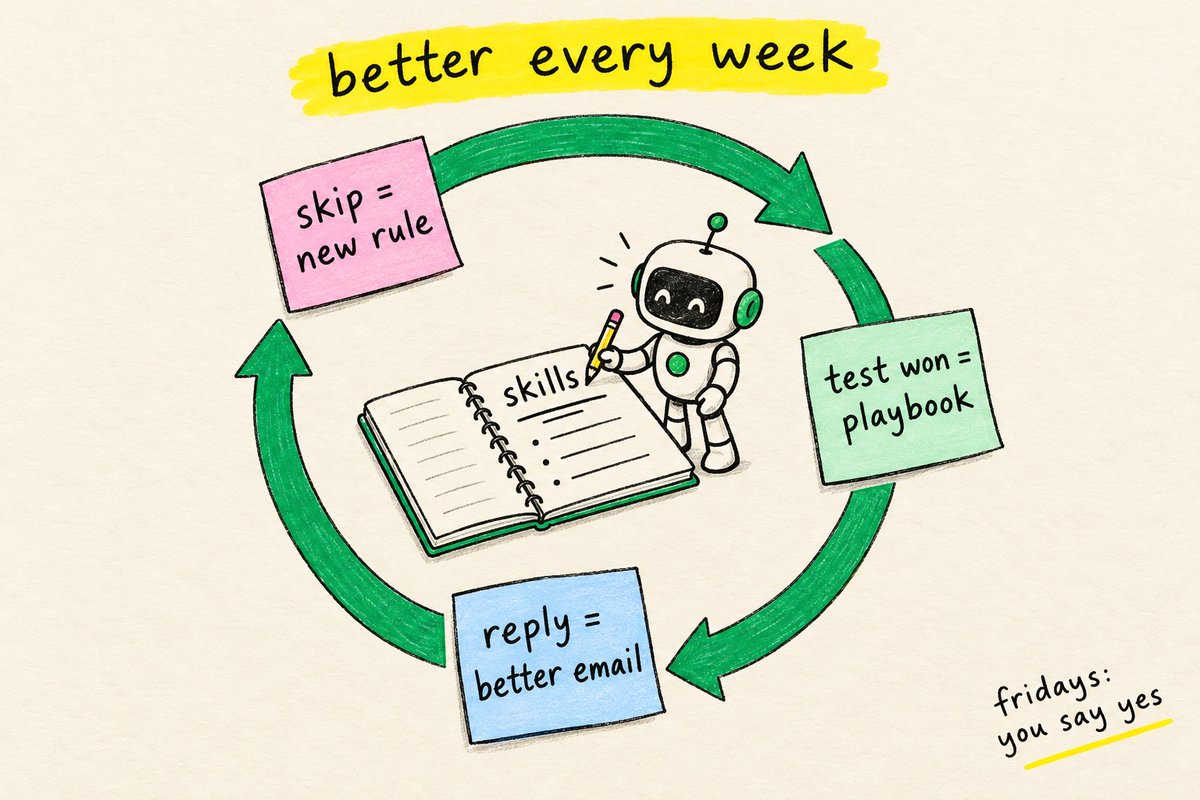
An agent does the same thing every run unless something writes down what it learned. In Claude Code and Codex, that's what skills are for. A skill is a short file of instructions an agent loads when a job calls for it. Give every seat one, add a playbook.md next to menu.md, and run three loops:
-
Every "no" becomes a rule. When you skip a change in the queue, add one line on why. The manager writes it into that seat's skill, so the same idea doesn't come back next week.
-
Every test feeds the next client. Each site and ad test gets a line in the playbook: what changed, for which client, and what happened to calls. A new HVAC client starts with the tests that won for the last five. This is the real payoff of staying in one trade.
-
Every reply teaches the writer. The follow-up rep logs which gap and which subject line got a reply, and which got nothing. The writer's skill moves toward what owners answer.
Once a week, the manager turns all of that into edits you approve:
Every Friday at 4pm: read the changes I skipped this week and why, every
test result in clients/*/reports/, and which emails got replies. Propose
up to five edits to the skills in .claude/skills/ and to playbook.md, one
line each, with the evidence behind it. Suggest removing any rule that
hasn't mattered in a month. Change nothing until I reply yes to each.
Keep every skill short enough to read in a minute. Long skills cost more to run and get followed worse.
What it costs to run
A million dollar agency usually means six salaries. This one runs on software, at list prices as of November 2026:
-
Your agent: Claude Ultra is $200 a month, with Claude Code and $200 a month of API credits.
-
Finding, pitching and building: boringfunnels is free for three searches a month. Pro is $79 a month or $299 a year. The free searches check 15 businesses a month on a phone, so at 22 a week you'll want Pro.
-
Connections: Composio, plus a business texting line for each client.
-
The sender: Instantly from $47 a month, plus a few domains and mailboxes.
-
Video: HeyGen from $29 a month, Sendspark from $49.
-
A demo line: Vapi charges $0.05 a minute plus the models.
-
Mail: under $1 a postcard through Lob.
-
The manager: Hermes is free. You pay for the model and a small server.
Add hosting, call tracking and model bills on top. At 20 clients that's still a rounding error next to $85,000 a month, and the clients pay their own ad spend. The average marketing agency brings in $1.96 million a year at a 13% net margin, mostly because the money goes to payroll (Promethean Research, vendor data). A one-person agency's math is very different, and your first client still takes the longest.
What breaks
-
Proof that's wrong. A gap they already fixed, a number your agent made up, a rival that isn't one. One wrong fact and the owner stops reading. Every claim needs a source, and you open their site on your own phone before anything goes out.
-
The wrong phone number. One AI cold call to a cell can cost $500 to $1,500. If you can't tell a cell from a landline, don't let AI dial.
-
An agent that can spend. The ads seat proposes and you approve. Budget caps live in the ad account's own rules, where a bad prompt can't reach them.
-
Approval fatigue. If the queue asks about everything, you'll start approving without reading. Let the safe things run on their own, and keep the queue for changes that matter.
-
Holding their site hostage. Keep the domain in their name and the site exportable. Owners have heard the horror stories, and a clean exit is part of the pitch.
-
Clients outside the menu. A dentist, a friend's restaurant, a custom app. Each one breaks the menu, and the menu is the only reason one person can run 20 accounts. Say no, or pass it on.
-
Turning on every seat at once. Ten seats on a bad list burn a domain faster. Get the researcher and the auditor right on 20 businesses, then add the next seat.
-
Believing the headline numbers. Most stats in this space come from vendors, including several here. I haven't seen anyone prove a one-person agency this size with a team of agents yet, and the million here is a sketch. Trust your own first 100 businesses over any of it.
How it adds up
-
Month 1: run a boringfunnels search for plumbers in Dallas-Fort Worth, pitch the best pick with the pitch skill, do the form test on the top five, and send from your own inbox. Then turn on one more seat a week.
-
Months 2 to 6: the first site clients, and the first few move up to ads and Maps. About 8 clients, $19,500 a month.
-
Months 7 to 12: add Houston. About 14 clients, $50,500 a month.
-
Year 2: add Austin and San Antonio. 20 clients, $85,000 a month.
In this sketch, month 24 bills about $85,000, which is a million a year, with one person approving a morning queue over coffee. Swap in your own numbers as soon as you have them.
Want to start with the sales team? boringfunnels finds local clients, shows them what's broken, and has your AI build the fix.
Type a trade and a city into boringfunnels.com. It ranks every business by what's losing them customers, checks the top five on a phone, and writes the email for the best one. Three searches a month are free.
boringfunnels Pro checks every business, writes every email, finds the owner and the managers with work emails, and connects to Claude Code or Codex so your AI builds the pitch and the fix.