
How to build a robotic wet lab: the whole problem map
文章目录
This is first-hand work. Over the past months I walked through manual and automated labs and CRO sites in person, built the cost models in this post myself (a technician against a robot cell, a workcell break-even, a per-step success table from the robot-lab papers), and counted the vendors, prices and startups myself. Where a figure is my own derivation rather than a published statistic, I say so.
Founders ask how to build a robotic wet lab as if it were one problem. It is eight, stacked, and the order matters: what the thing is (1), whether each step works (2), what it costs to wire the steps together (3), who runs it (4), at what volume it pays (5), whether the data it produces is worth anything (6), who has actually made money (7), and the order to build in (8). The first four are engineering and staffing, some solved and some open. The ones that decide whether you make money are the economics in the middle, and two variables run through all eight: what it costs to change the experiment, and how often a whole run succeeds.
1. What "robotic wet lab" means in 2026
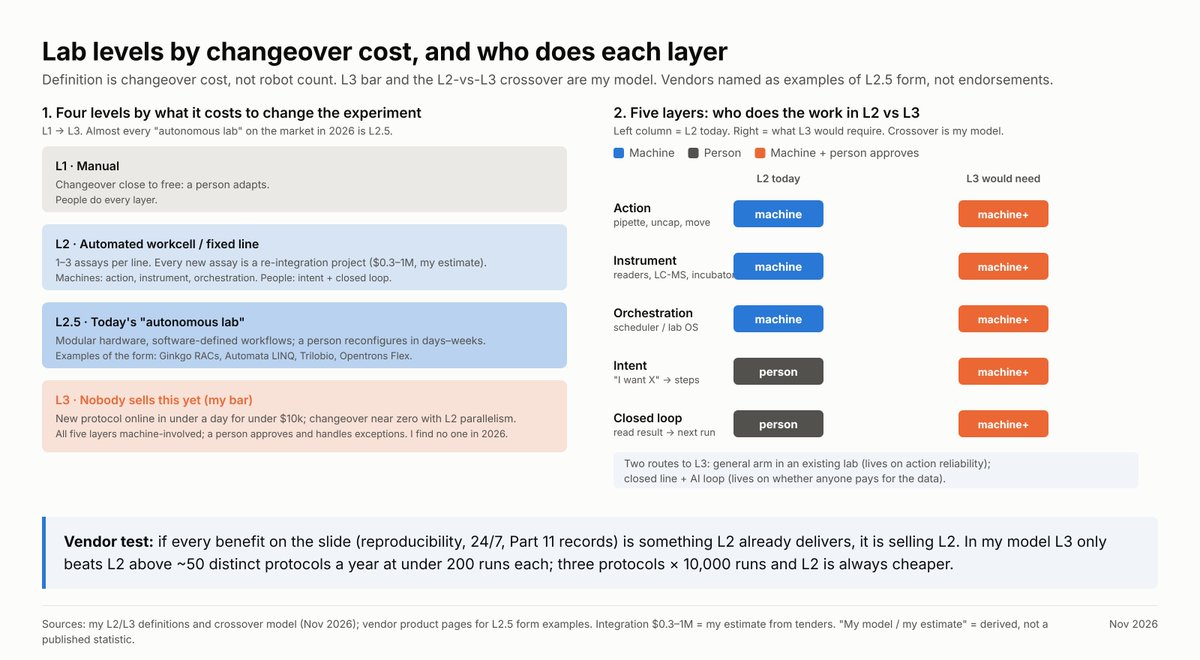
The useful definition is not robot count but what it costs to change the experiment. L1, manual: changeover is close to free, because a person adapts. L2, automated: a fixed workflow on a workcell or line, one to three assays per line, and every new assay is a re-integration project. L3 would bring changeover back near zero while keeping L2's parallelism. My bar is a new protocol online in under a day for under $10k. By that bar I cannot find anyone in 2026. Almost every "autonomous lab" on the market is what I call L2.5: modular hardware and software-defined workflows (Ginkgo's RACs, Automata LINQ, Trilobio, Opentrons Flex), reconfigurable by a person in days to weeks, not self-reconfiguring.
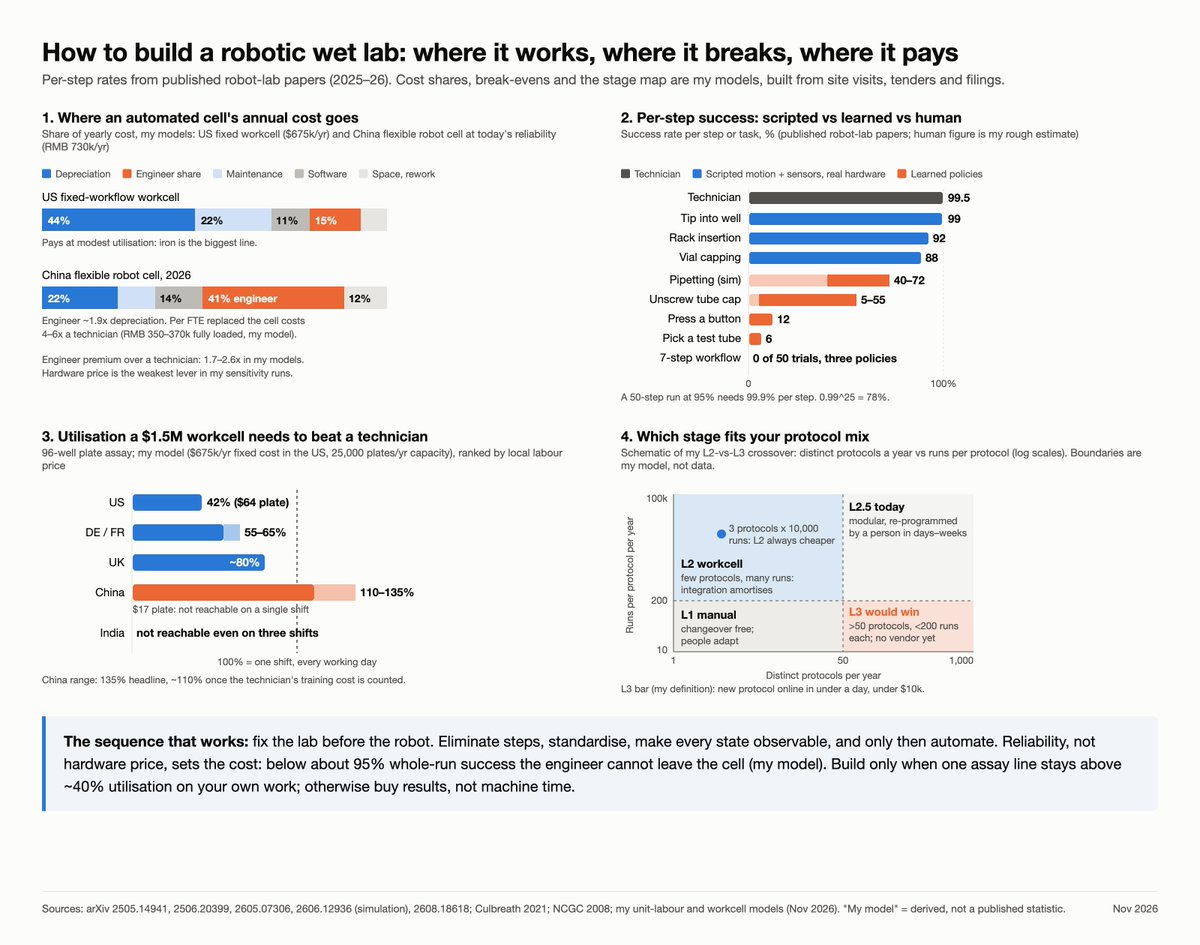
Split the lab into five layers: action (pipette, uncap, move a plate), instrument, orchestration, intent (turning "I want X" into steps) and closed loop (read the result, choose the next experiment). In L2 machines do the first three and people the last two. L3 needs all five machine-involved, a person approving and handling exceptions. The routes there differ: a general arm dropped into an existing lab (Medra) lives or dies on action-level reliability; a closed line with an AI loop (Lila, Periodic) on whether anyone pays for the data. Sections 2 and 6 take them in turn. In my model L3 only beats L2 above roughly 50 distinct protocols a year at under 200 runs each. If you run three protocols ten thousand times, L2 is always cheaper.
A vendor test follows from the definition: if every benefit on the slide (reproducibility, 24/7 running, Part 11 records) is something L2 already delivers, it is selling L2.
2. The physical layer: what works, step by step
Hardware is not the hard part. By my estimate from tenders and vendor prices, a full in-vitro line runs from about $4M (a US protein-binder line of Adaptyv's shape) to RMB 40–70M (a Chinese small-molecule line with liquid handlers, readers, incubators, an arm or track, a compound store and LC-MS/MS); the two are different lines, and the point is that neither figure is the problem. The question to ask about any step is not whether a robot can do it but how often. From the recent robot-lab papers:
-
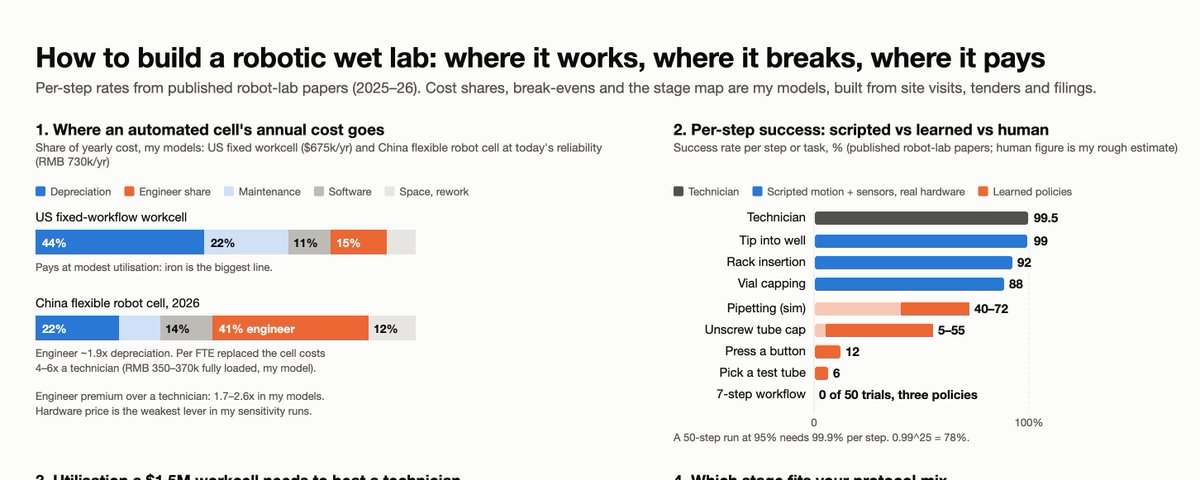
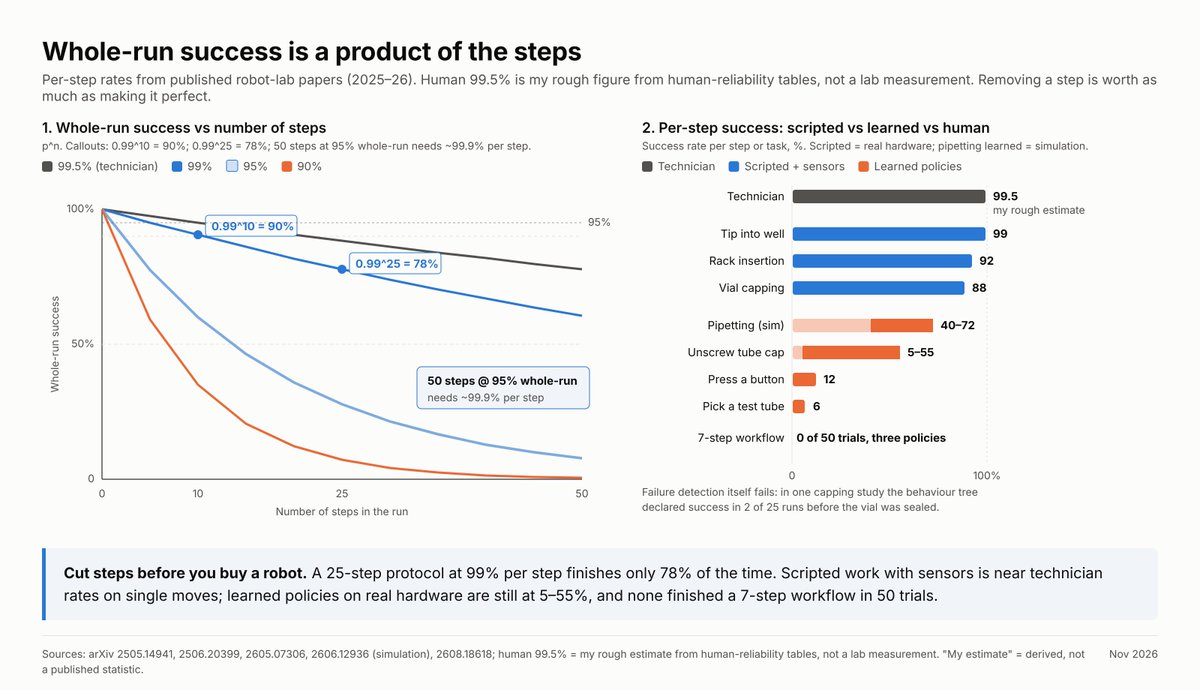
Scripted motion with sensor checks and retries, real hardware: rack insertion 92%, vial capping 88% end to end, tip-into-well 99% with up to three retries.
-
Learned policies: 40–72% on a pipetting benchmark in simulation; on real hardware 5–55% unscrewing tube caps, 6% picking a test tube, 12% pressing a button, and none of three policies finished a seven-step workflow in 50 trials each.
-
A trained technician: about 99.5% per step, my rough figure from human-reliability tables, not a lab measurement.
Whole-run success is the product of the steps, and it is the number every later section hangs on. A 50-step protocol at 95% whole-run needs about 99.9% per step; 0.99 to the 25th is 78%, to the 10th 90%. Removing a step is worth as much as making it perfect. And failure detection itself fails: in one capping study the behaviour tree declared success in 2 of 25 runs before the vial was sealed.
Two blind spots matter more than the headline rates. Sterile cell work in a biosafety cabinet is 25–35% of a biology technician's execution time by my estimate, and I could not find a general-arm benchmark for it; closed culture units do it today and none I checked publishes a contamination rate. And robots compress human waiting, not biology. Hands-on time is 10–40% of a typical protocol's duration (a vendor sandwich ELISA: 25–30 minutes hands-on in about four hours). By my estimate automation takes ADME turnaround from 7–10 working days to 3–5; incubation sets the floor. Of the ten in-vitro bottlenecks on my list, robots do not touch half: cell supply and state consistency, LC-MS method development, compound solubility, compliance sign-off, reagent lead times.
So the physical layer is further along than the demos suggest for scripted work and further behind for learned work, and either way the step count is yours to cut before any robot arrives.
3. The integration layer: where the hidden cost sits
Once the steps work, wiring them together is the line nobody budgets. Integration runs $0.3–1M and takes weeks to months per new assay; add 8–12% of equipment price a year in service and a scheduler licence (my estimates from tenders and quotes). The problems underneath are unglamorous:
-
Connectivity. By my estimate under 30% of installed instruments can be called through an API. SiLA 2 and OPC UA LADS exist; I found almost no vendor shipping a server by default.
-
Physical standards. ANSI/SLAS covers microplates. I could not find a tube-rack or instrument-docking standard, and consumables are the slow fix: screw-cap-free formats exist (Greiner's AutoFlask, launched in 2006, still sold) and stayed niche, because people did not need them and too few robots existed to create demand.
-
Safe state. No common spec for pause-and-resume or "move samples to 4 °C on a crash". NIH's screening centre reported in 2008 that one overnight software crash on an otherwise reliable line lost several hundred cell plates.
-
Evidence. Hand-off cameras proving the plate went where the log says: for CRO work, essentially blank.
Incumbents are absorbing the orchestration layer: Danaher invested in Automata in January 2026 and in October announced an autonomous lab at Abcam built on it, due to run at scale in early 2027 per Danaher's release. And no company I checked publishes an end-to-end success rate from "one sentence in" to "data returned". That missing number is why the next two layers, people and money, look the way they do.
4. The people layer: hands are not the constraint
By my estimate about 200k graduates a year enter industry wet-lab jobs worldwide against 40–70k of net demand. What is scarce is the same three profiles everywhere: LC-MS/MS method developers with real years, automation and scheduling engineers (a global pool I put under 10,000), and people who can do both the model and the bench.
Staffing follows the exception rate, which is the whole-run number from section 2 turned into a payroll. In my roadmap model, island automation needs about one engineer per two workstations; a chained line, one per four, and only then does it run overnight. L3's target would be one scientist supervising ten or more different lines; no vendor publishes the ratio.
The engineer costs more than the person the robot replaces: 1.7–2.6x a technician in my models (lower in the US, higher in China, where technicians are cheap). In my model half a technician's year is not bench work, so "one robot replaces two people" usually counts only hands-on hours. And one thing does not move: tasks can be delegated, accountability cannot. An IND names the individuals who evaluated the nonclinical results; a GLP study director is the single point of study control. Someone on your payroll signs.
5. The economics: break-even is a utilisation number
Put the engineer and the success rate into a cost model and the decision becomes a utilisation number. My US workcell model: $1.5M installed, about $675k a year of fixed cost (depreciation $300k, maintenance $150k, software $75k, half an engineer $100k, space $50k), capacity 25,000 plates a year. A US technician produces a 96-well plate at about $64 fully loaded, so the cell wins at about 10,500 plates, 42% utilisation (54% if the technician costs $110k rather than my $140k input). Ranked by labour price: US about 42%, Germany and France 55–65%, UK about 80%. In China, against a $17 plate and with the same cell priced for China ($575k a year in my model), it needs 110–135% (110% once the human's training cost is counted): not reachable on one shift. India, not on three. Labour price, not labour supply, draws the map.
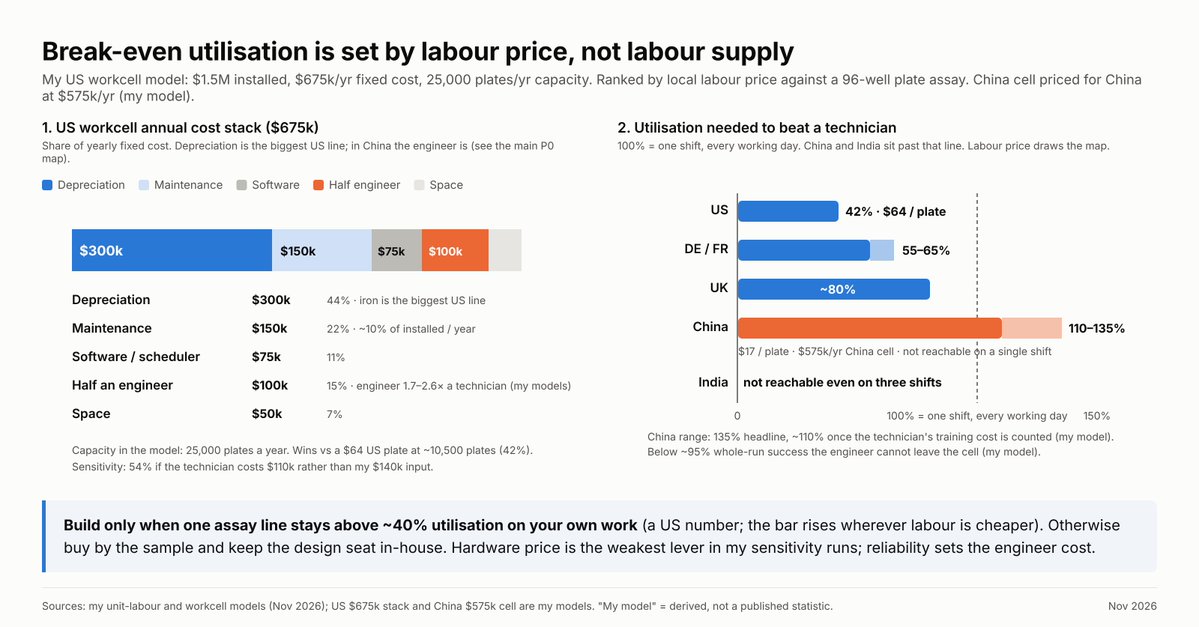
The reason the bar sits so high outside the US is that a flexible robot cell is mostly someone watching it. In my separate 2026 China build, with a fully loaded MSc technician at RMB 350–370k, the engineer is about 40% of the cell's annual cost, about 1.9x its depreciation, and at today's success rates the cell costs 4–6x a technician per FTE replaced. In my sensitivity runs hardware price is the weakest lever; engineer ratio, utilisation and success rate all hang on reliability. Below about 95% whole-run success the engineer cannot leave and the cell idles waiting.
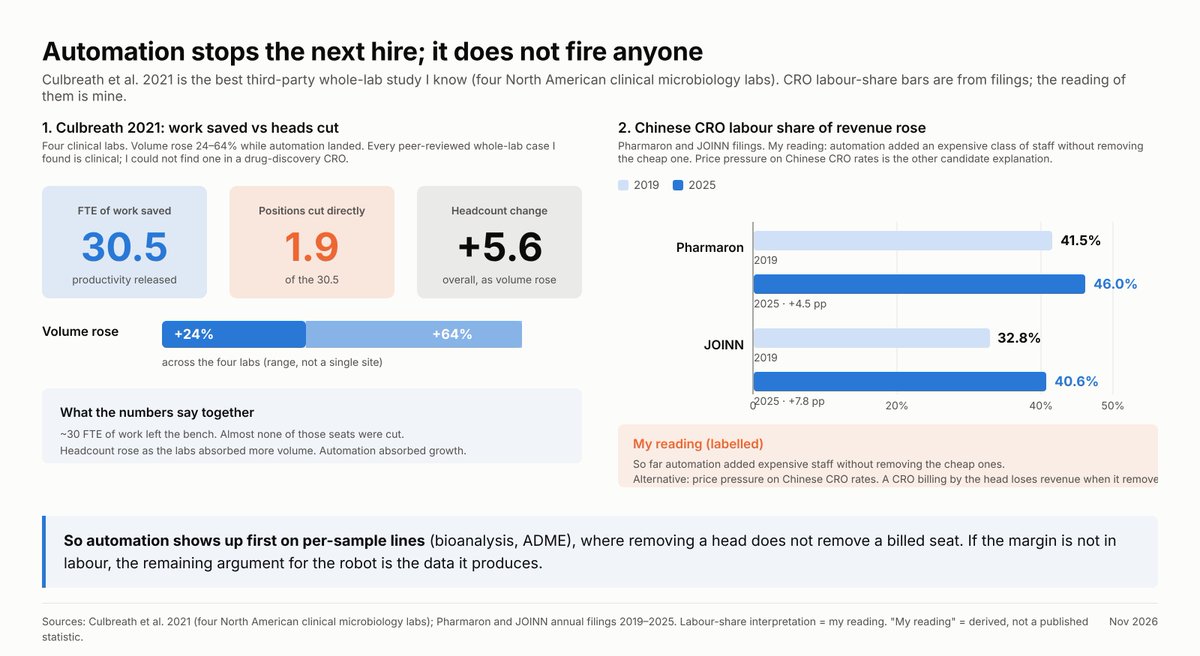
So automation does not fire anyone; it stops the next hire. The best third-party study I know (Culbreath et al. 2021, four North American clinical microbiology labs) found 30.5 FTE of work saved, a direct cut of 1.9 positions, and headcount up 5.6 overall as volume rose 24–64%. Every peer-reviewed whole-lab case I found is a clinical lab; I could not find one in a drug-discovery CRO.
CRO accounts agree. Pharmaron's labour cost went from 41.5% of revenue in 2019 to 46.0% in 2025; JOINN's from 32.8% to 40.6%. My reading: so far automation added an expensive class of staff without removing the cheap one, with price pressure on Chinese CRO rates as the other candidate explanation. Part of this is incentive: a CRO billing by the head loses revenue when it removes one, so automation shows up first on per-sample lines like bioanalysis and ADME. (The contract side is its own post.) If the margin is not in labour, the remaining argument for the robot is the data it produces, which is the next question.
6. The data and AI layer: information first, physics later
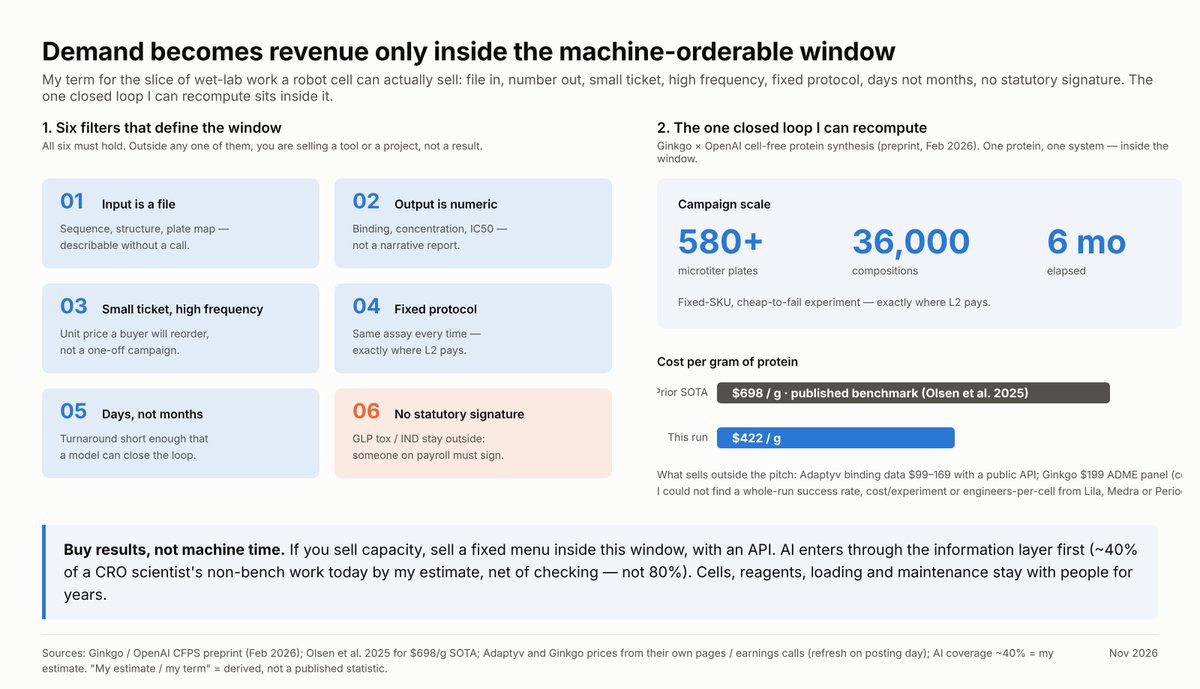
AI enters the lab through the information layer: protocols, data QC, reports, anomaly flags. Cells, reagents, loading and maintenance stay with people for years. Even there the ceiling is lower than the pitch. By my estimate AI covers about 40% of a CRO scientist's non-bench work today, net of checking, not 80%: GLP reports need a signed study director, and troubleshooting needs physical context only sensors give. In a 2026 survey of 637 US and UK scientists, 89% of those saving time with AI spent over 10% of the saved time checking it.
Demand becomes revenue only inside what I call the machine-orderable window: input describable as a file, numeric output, small ticket and high frequency, fixed protocol, days not months, no statutory signature. The one closed loop I can actually recompute sits squarely inside it. Ginkgo and OpenAI's cell-free protein synthesis campaign (preprint, February 2026) ran over 580 microtiter plates and 36,000 compositions in six months and reached $422 per gram of protein against a published $698/g state of the art. One protein, one system. It worked because it is a fixed-SKU, cheap-to-fail experiment, exactly where L2 pays.
Data is worth something only if a model consumes it and you own it. CRO data belongs to the client, so a CRO's archive is not a moat. The clearest buyers of fresh, measured answers are a handful of frontier AI labs, 5–10 by my count. I could not find OpenAI, Anthropic or Google DeepMind saying publicly that they use wet-lab results as a training reward; the wet lab is still the final check, not the gradient. And there is no metrology layer (shared reference materials, standard human-cell systems), so cross-lab data does not merge. Without it every data flywheel is a single-lab flywheel. That is the second L3 route from section 1, and it has no paying customer yet.
7. Who has made money: results, not machine time. And what China is doing
Lab automation is three businesses: instrument makers (Hamilton, Tecan, Beckman), orchestration software or "lab OS" (Cellario, Green Button Go, Synthace and about a dozen others), and AI-native robotics (Automata, Medra, Lila). Capital went to the third; the CROs whose accounts appear in section 5 buy the first two. The accounts of the third tell the story. Emerald Cloud Lab has sold remote lab time since 2014 and built a $40M cloud lab with Carnegie Mellon; it cut 30 jobs in South San Francisco in 2023 and moved operations to Austin. Strateos shifted in April 2023 from a public cloud lab to designing on-site labs for customers. Automata and Chemify are automation companies, not cloud labs, and their UK statutory accounts show losses of about 4.7x and 12.6x revenue (Automata's year to March 2025, Chemify's 2025). My diagnosis goes back to the five layers: the customer had to do the intent layer, translating what they wanted into machine instructions; the vendor sold a tool, not an answer.
What sells is results inside the window. Adaptyv sells binding data per protein ($99–169 on its own pages) with a public ordering API, and raised a $40M Series A in August 2026. Ginkgo says its $199 ADME panel undercuts Chinese quotes: $1,000–2,500 on its Q2 call, "like $1,000 or more" from WuXi on its Q3 call. The well-funded L3 bets have not published unit numbers yet: Lila closed a $350M Series A in October 2025 at a valuation above $1.3B (Reuters); Medra raised a $52M Series A in December 2025 and says its San Francisco lab, opened in April 2026, runs about 100 robots; Periodic Labs raised a $300M seed in September 2025. Lila and Periodic have since been reported raising at multi-billion valuations; I left out rounds I could not confirm from the companies. I could not find a whole-run success rate, cost per experiment or engineers-per-cell figure from any of them.
China has the same three businesses under one label, with the weight in a different place and the middle one missing. The first is standard machines (liquid handlers, transfer robots) at roughly half the import price, by my estimate; the evidence for it is strong. The third is "AI plus automated lab" platforms, where the money went. MegaRobo, the one company I found with verifiable revenue near RMB 1B (RMB 930M in 2024, per media coverage of its since-lapsed Hong Kong filing), earned about two-thirds of it from industrial inspection and cutting equipment. Of five Chinese AI-lab startups I reviewed, one has published a named-customer result: C12.ai's BeiGene pilot, 15 intermediates in 50 days, company-reported. The others have not published named-customer numbers. The orchestration layer is the largest gap against the US: I could not find an independent Chinese lab OS; it comes bundled with each vendor's own hardware. And of about 60 Chinese experiment vendors I surveyed, I found none publishing a per-sample price or a public ordering API. The capacity is real; it is not machine-readable.
8. The sequence that works, and the founder's rules
The labs that got it right fixed the lab before buying the robot, which is section 2's arithmetic applied in order. Eliminate steps (screw caps, feeder culture, washes), then standardise (SBS racks, fixtures, 2D barcodes), then make every state observable (telemetry, cameras at hand-offs, pressure-monitored pipetting), and only then teach a machine to imitate hands. Each rung you skip raises the demand on the robot about tenfold, so money on the environment goes further than money on the arm. If you do only three things, do these: make failures cheap and detectable (per-plate isolation, mid-run checkpoints, a safe state); put a robot-ready layer on your ten busiest instruments; and move screening to assay-ready frozen cells, which by my estimate removes 40–60% of hood time. Then stage it: standardise inputs, automate islands, chain the middle, touch upstream samples last. Measure exception rate and output per head, never machine count.
The open problems I watch, because I could not find anyone who has published an answer: whole-run success and engineers per cell for any L3 lab; a benchmark for sterile cell work; failure detection that does not itself fail; connectivity across the installed base; a third-party FTE study in a discovery CRO; a metrology layer that lets data merge; and the signature ceiling that keeps GLP tox outside any per-run window.
Rules for a founder:
-
Pick the stage from your protocol mix. A few protocols run thousands of times: buy L2. Over ~50 protocols a year at under 200 runs each: buy L2.5 and watch L3, which nobody sells yet.
-
Build when one assay line stays above ~40% utilisation on your own work (a US number; the bar rises wherever labour is cheaper, section 5), sits on your critical path every week, and you can hire the engineer. Otherwise buy by the sample and keep the design seat in-house.
-
Budget people, not iron. The engineer is the biggest line and costs 1.7–2.6x a technician (my models).
-
Ask every vendor for whole-run success on your protocol, exceptions per run and engineers per cell. Per-step hands-on savings are not the number.
-
Spend on the environment before the arm. Do not start with an arm holding a pipette, a learned policy on caps or buttons, or open-arm cell passaging.
-
Buy results, not machine time. If you sell capacity, sell a fixed menu inside the machine-orderable window, with an API.
-
Own your data and know who would pay for it. If no model consumes it, data return is a feature, not a business.
-
In China, automate for 24/7 running and per-run lines, not to save heads.


