
The State of Robotics Data In 2027
文章目录
部分视频或图片暂未收录,已在正文保留提示;需要时可查看原文。查看原文 ↗
What labs are buying, what they pay, and where robot data goes in 2027.
I had 180 meetings in the last 46 days. Since posting my @Eidon_AI post-mortem, I have spoken with dozens of investors, researchers, and founders across robotics.
And since posting @ByCrux's intro form, we vetted 47 data producers and collected their detailed data specs.
All this, alongside the hours of research @_varunnair and I put into mapping out the industry, gave me a really good understanding of the state of the market.
Demand is not slowing down, but what is in demand is changing, and fast. There are also larger, well-established industry players moving in. The industry is maturing, and competition is getting fiercer.
This is a snapshot of the Robotics Data Industry in November 2026, and where things go next year.
How Much is 1 Hour Worth?
I mention prices per hour throughout the rest of this essay. These are all best estimates from conversations and research. This market is famously opaque with prices, so take estimates below with a grain of salt.
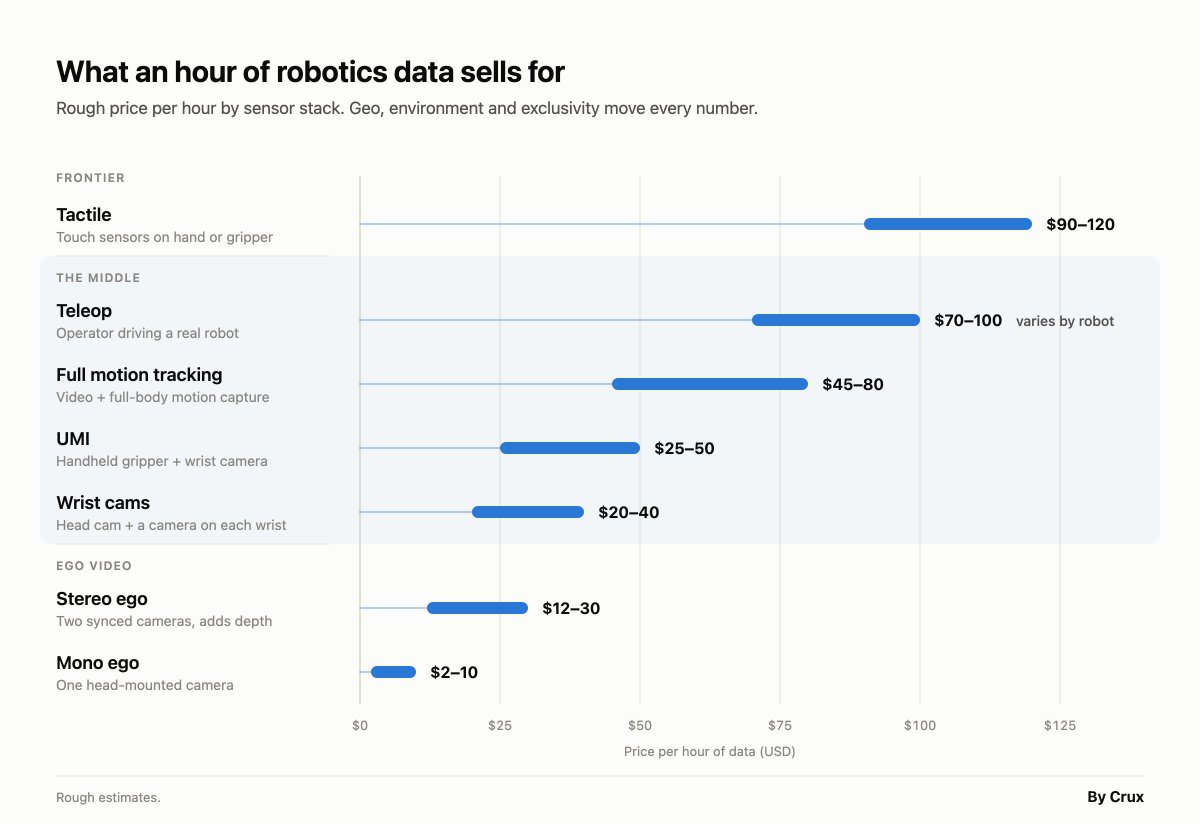
The value of one hour of robotics data varies based on five primary factors: Modality, Geos, Environment, Exclusivity, and Annotations.
Modality / Sensor Stack
The fundamental goal of robotics data capture is to record motion. But no two labs want the same motions, and no two collectors capture them the same way.
This variation is the single biggest price-defining factor in an hour of training data. It makes the price range from ~$5 all the way to ~$120.
I place different modalities in a rough complexity scale.
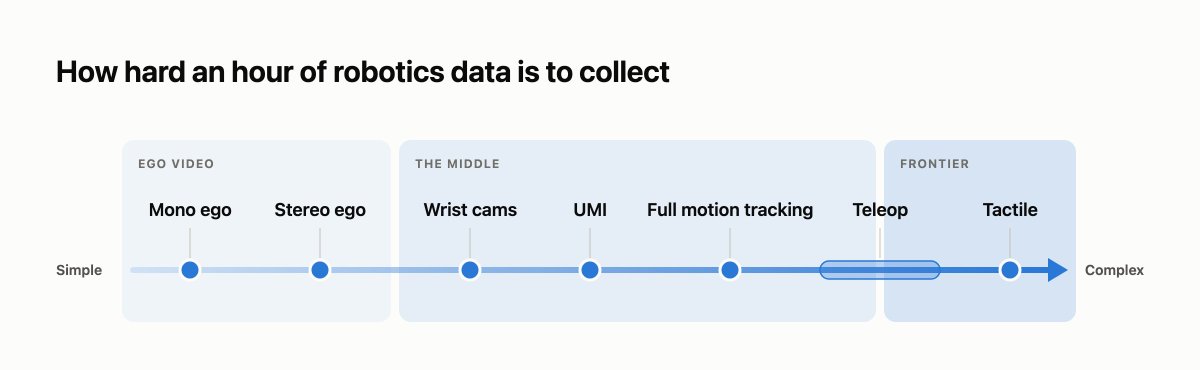
On one end you have egocentric video. It comes in two kinds: mono (monoscopic), the simplest, and stereo (stereoscopic).
Mono is a single camera capturing the scene; this is what a phone attached to a head mount gives you. Stereo requires special cameras that record the scene from two different lenses and image sensors. This dual-perspective lets you derive object depth from the footage.
On the other end, there is tactile data - touch. Several sensorial approaches are emerging to collect this data. There are a lot of questions around transferability, usability, and durability, and there is no clear winner for tactile sensors.
But there is broad agreement across the industry that this is the frontier of robotics data.
The middle is an amalgamation of video perspectives, sensors, and data points that add context to what pure ego video gets. Wrist cameras, UMI (handheld parallel grippers), full-body kinematics (this is what we collected at Eidon), and even teleop live in this middle.
Geos, Environments, Exclusivity and Annotation
Modality sets the price range, while these four move the price up or down within it.
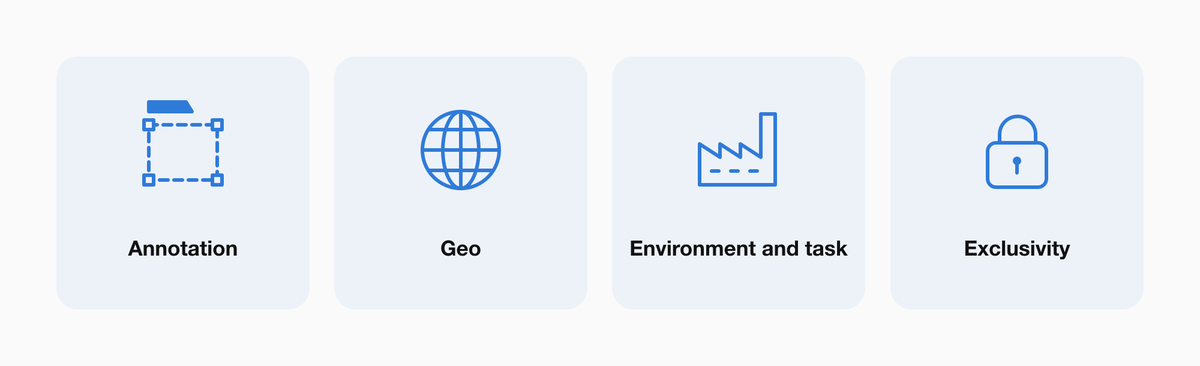
Geographic Origin** **US data sits at the top of every range. It is the most sought-after geo, as these are the environments most American robotics companies are targeting for deployment.
At the bottom, ego from India and Southeast Asia is saturated. Buyers already have more than they need, so it carries the lowest price, and several have stopped buying it altogether.
*Environment and task *Commercial beats residential. Homes are where most capture has happened. Businesses are harder to get into, so footage of real work, like an HVAC technician or an electrician, is scarcer and worth more.
*Exclusivity *Exclusive data sells at a premium. The buyer is also paying for competitors to not have it. And a surprisingly large number of current data collection operations are being deployed under exclusive agreements.
*Annotation *Labeled data obviously sells for more than raw. But I see several companies and founders over-indexing on this. In my experience, annotations move the price per hour far less than most think.
If you understand how these factors interact and change over time, you can deduce from first principles where the industry is going next year, how demand will change, which bets are not worth making, and where to invest next.
Mono is Dead, Stereo is Sold Out
Humyn Labs, CC BY 4.0
Humyn Labs, CC BY 4.0
When we started @Eidon_AI in 2024, the idea of paying people to strap their phones to their heads and record their tasks was... peculiar.
There was a huge void for egocentric video in robotics, independent of where the data came from or what it was collected with.
So it is telling that, just 2 years later, several labs have** stopped buying egocentric mono data**, particularly from certain geos like India, China, and SE Asia. The market is saturated, and research interest has moved past what monoscopic gives you.
In our submissions, ego mono video is the most common supply by far. And it clusters exactly in India, the Philippines, Pakistan, and Southeast Asia.
Except for a handful of US-focused, large-scale exclusive mono operations, virtually every ego collector we have spoken to has moved to or is actively trying to move to stereo.
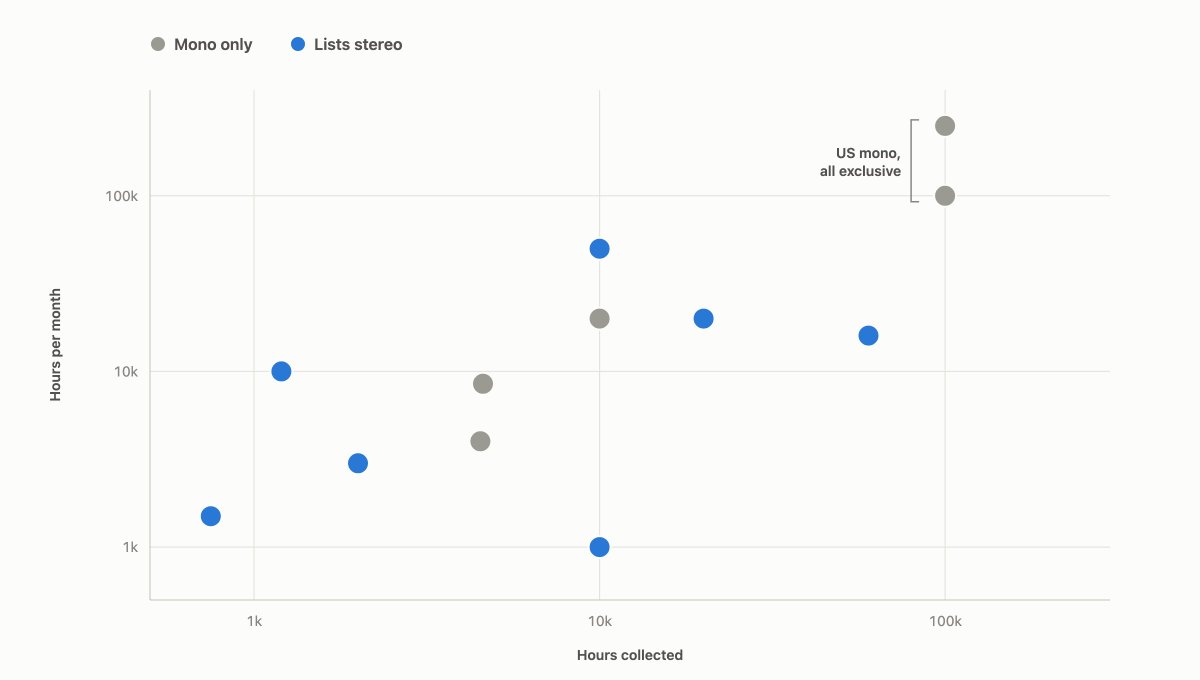
This is a new baseline for what kind of data is useful in the industry. And one that significantly raises the barrier to entry. Stereo cameras go for $200 BOM-only on the low end, up to over $1,000 for high-quality off-the-shelf stereo cams.
Deploying stereo operations to 100 collectors can now represent a $50k hardware investment. It is no longer just "build an app and put it on the App Store". And it is precisely because of this new barrier to entry that an overwhelming majority of the stereo supply I have come across is accounted for. Many data collectors have entered rev-share or exclusive agreements with buyers or partners to finance the rollout of stereo ego collection.
About a quarter of the producers we vetted list stereo. And only two had any stereo off the shelf, roughly 1,750 hours between them. Most of the others work under exclusive deals or collect to order.
And that in and of itself is a great opportunity. There is high demand for stereo camera manufacturers who understand the economics of data collection and are willing to make a bet in the industry.
In short, stereo is the new standard, almost nobody has it off-the-shelf, and people are struggling to find good suppliers of cameras who can work around the needs of the industry.
Tactile, the Next Frontier
Tactile is what everyone is looking for and what will dominate data collection for the next couple of years. Earlier this year, when we were considering a build-out of our Eidon Gloves, we received quotes for up to $120/h of tactile data.
The demand is very high. But there isn’t much supply to meet it yet.
Today’s tactile datasets are small, research-oriented, and scattered across different sensors. That’s enough to fine-tune an existing model (see T-Rex: Tactile-Reactive Dexterous Manipulation https://arxiv.org/abs/2606.17055) or train specific policies.
It is nowhere near enough to pretrain on. It is worth noting that egocentric video data was in a similar place just a couple of years ago. The thought of having enough ego data to pretrain on was equally absurd.
And now we have open-source datasets with 100K hours.
Collecting tactile data is orders of magnitude more complex than ego video, but the race is on to build the first tactile corpus big enough to pretrain on, alongside ego video.
But the field is very, very new. There’s no standard sensor, and tactile signals are tied to the hardware that recorded them. It is an open research problem how well tactile data transfers or how well what a model learns from one sensor carries over to another.
And beyond the open engineering and research questions, there are practical ones.
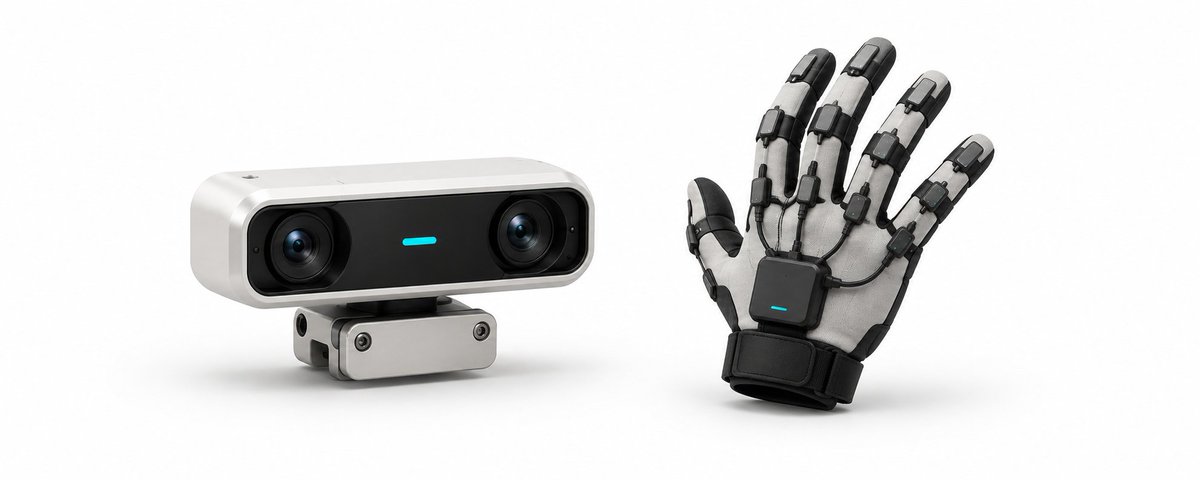
Gloves on human hands are often bulky and hurt dexterity. The durability of most gloves has not been independently tested. At $4,500 to $8,000 a pair, deploying 100 collectors costs you $450k to $800k, roughly ten times the stereo bill. At $100 an hour, 45–80 hours of sales would cover the glove hardware alone. Not withstanding labor, rejected recordings, processing, and maintenance.
Every collector wants to claim they are collecting "tactile", but doing this well, let alone at scale, is very much non-trivial.
It has also been interesting to observe an entire sub-industry emerge focused primarily on data capture hardware. This is, in my opinion, one of the most exciting areas to pay attention to looking into 2027.
Prices will go down as manufacturing scales, but right now the economics of capture hardware are insanely attractive if the demand is willing to pay.
[未转换内容,参见原始 JSON]
There’s a lot more to say here. I’ll go deep on tactile in a separate piece.
The Market is Maturing
In January, Defined.ai expanded into physical AI data at CES. We worked with them shortly after this announcement to sell our body motion dataset. In March, DoorDash launched Tasks, an app that pays its couriers to film chores like folding laundry to train AI and robotics models. And several other non-robotics companies across the stack have looked at the space and started moving in.
The later-stage funding numbers are also off the charts. XDOF raised $70M in June, and was supposedly in talks to raise another round at a $1.2B valuation. Mecka raised a $60M Series B in October, and Micro1, one of the biggest LLM data vendors, says robotics alone is already over $100M of its run rate.
The "Data services" category in our industry map is the third largest, behind only robot builders and deployers. And it is getting more participants basically every week. Companies that already sell to AI labs are moving in. Polyshares is a good example. It is known for selling operational data and CAD to AI labs, but it just pointed its broker network at robotics through a partnership announcement with Amelia Robotics.
This trend keeps pointing back to a core realization of these 180 meetings: The two remaining moats of robotics data are hardware and relationships.
Everything in between, like processing, QC, ops, annotation, data visualization, and even sim tooling, is valuable but table stakes. And I’m less convinced they are enough to defend a business on their own as we look into the new year.
This is why everyone with lab relationships is trying to monetize them, and why the aggregator side - the relationships side - is getting crowded fast.
Parting thoughts
There is chatter that "the data problem of robotics" is close to being solved. This argument has merit; millions of egocentric video hours have been created in the last 2 years.
Today, mono is a commodity, stereo is the baseline, but tactile is at an even worse place than egocentric video in 2024 in terms of available data. If every modality follows a similar curve, I don’t expect stereo or tactile demand to slow down anytime soon.
But the choice of where to invest time and money in robotics data is not obvious. Take the amount of hours needed to reach $1M in revenue.
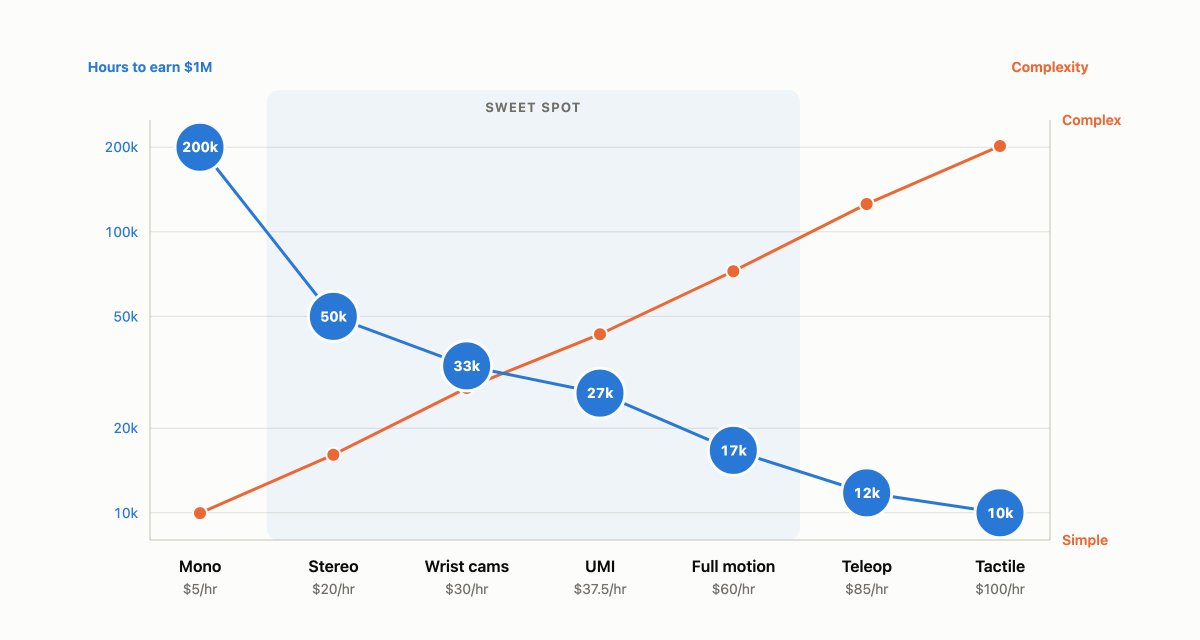
At $5 an hour, $1M of mono takes 200,000 hours. That’s a volume game on extremely thin and dwindling margins. At $100 an hour, tactile takes only 10,000 hours, but the hardware isn’t solved, is expensive, and data usage is still an open research question.
But the middle is an economically sensible bet today. Stereo, wrist cams, UMI, and full motion tracking need roughly 4 to 12 times fewer hours than mono to reach the same revenue, with hardware that exists and ships now relatively inexpensively.
Demand isn’t slowing down. But the bar is rising, demand is changing, and the market keeps getting ever more crowded. The window to build a strong data business is open and will likely remain open into next year.
But I don’t think it stays open that much longer than that.
If you’re collecting, buying, or researching robotics data, I want to hear from you.
[未转换内容,参见原始 JSON]
And if you're in Austin for CoRL this week and want to riff on any of this, ping me. DMs are open 🤠🤘


