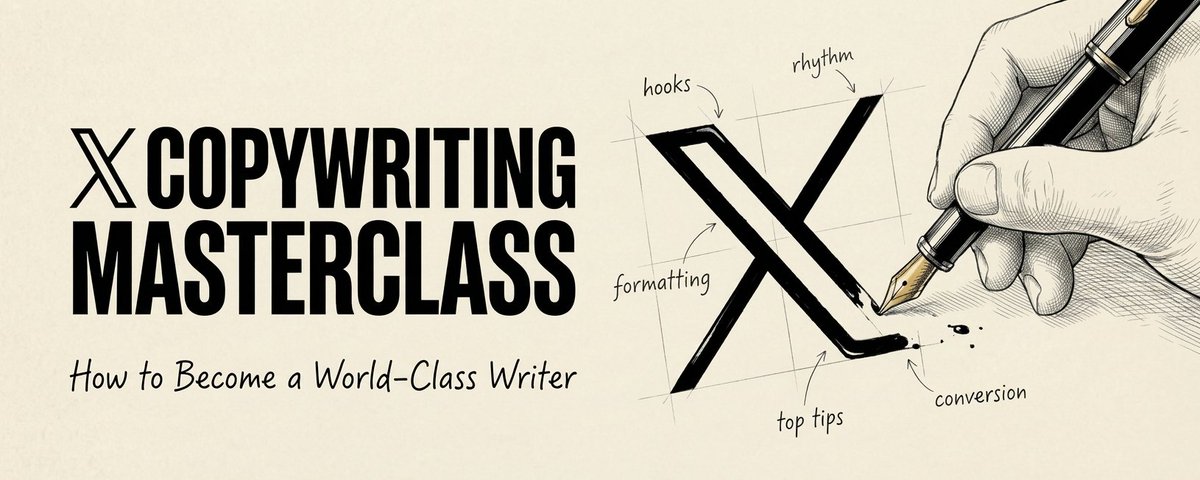
𝕏 Copywriting Masterclass (Dense Guide)
文章目录
Nail this, and you'll never struggle with 𝕏 growth ever again.
The brutal reality is, most brands on 𝕏 are doomed from the start. Not because of their ideas, but because they're missing one key skill:
The art of turning brilliant ideas into words people actually want to read.
For the past 6 years, I've obsessed over mastering this skill.
It's what took me to 1B+ lifetime impressions on 𝕏 and helped me build some of the world's biggest brands across a wide range of niches.
And it's exactly what I used to grow my own account from zero. In my first month of posting, I gained +9,000 followers and ~6M impressions.
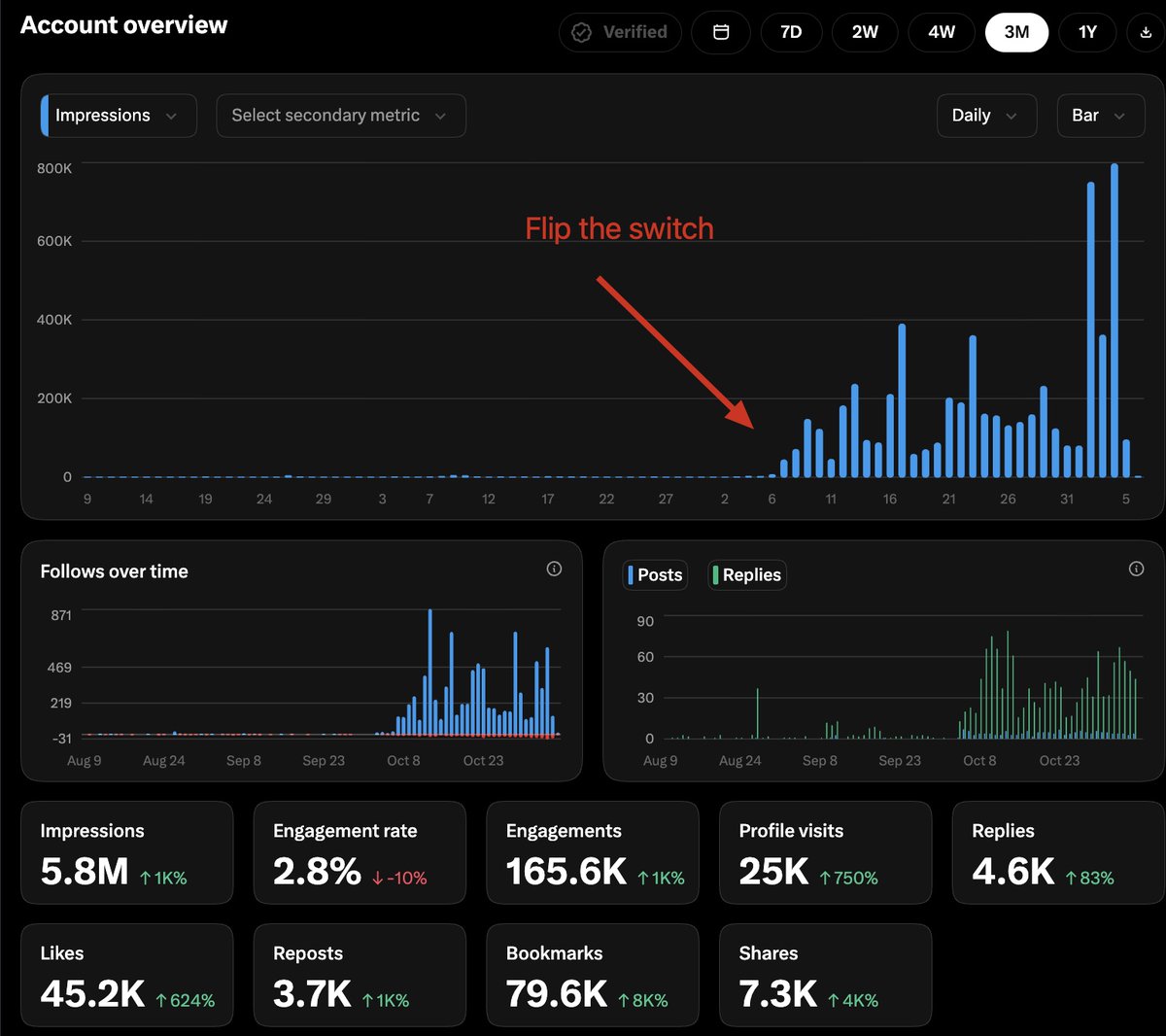
deciding to go viral
Once you understand the principles I discuss today, you can literally "flip a switch" and go viral on *any* social media platform, anytime you want.
All I ask for in revealing this information is two things:
-
If you find this valuable at the end, follow me
-
Repost/Like this article so others can see it
By doing these two things, you help me keep creating free, original content. Thanks guys.
Today's masterclass:
-
Fundamentals
-
Hooks 101
-
Structure & Formats
-
Rhythm & Readability
-
Word Choice
-
Voice
-
CTAs & Closers
** **Fundamentals
Before we get into the fun stuff, you need to understand a few core principles.
Remember: good copywriting is getting the right person to take the right action.
That action might be reading, replying, sharing, following, or buying. But every post should be engineered to make someone do something.
Foundational principles you need to understand:
-
**Write for a specific audience**
Picture your ideal reader before you post. Get as detailed as possible:
-
What are they (currently) struggling with
-
Where do they consume content? Is 𝕏 even the place your ideal reader is?
-
What value do they want?
-
What are they feeling right now?
And so on.
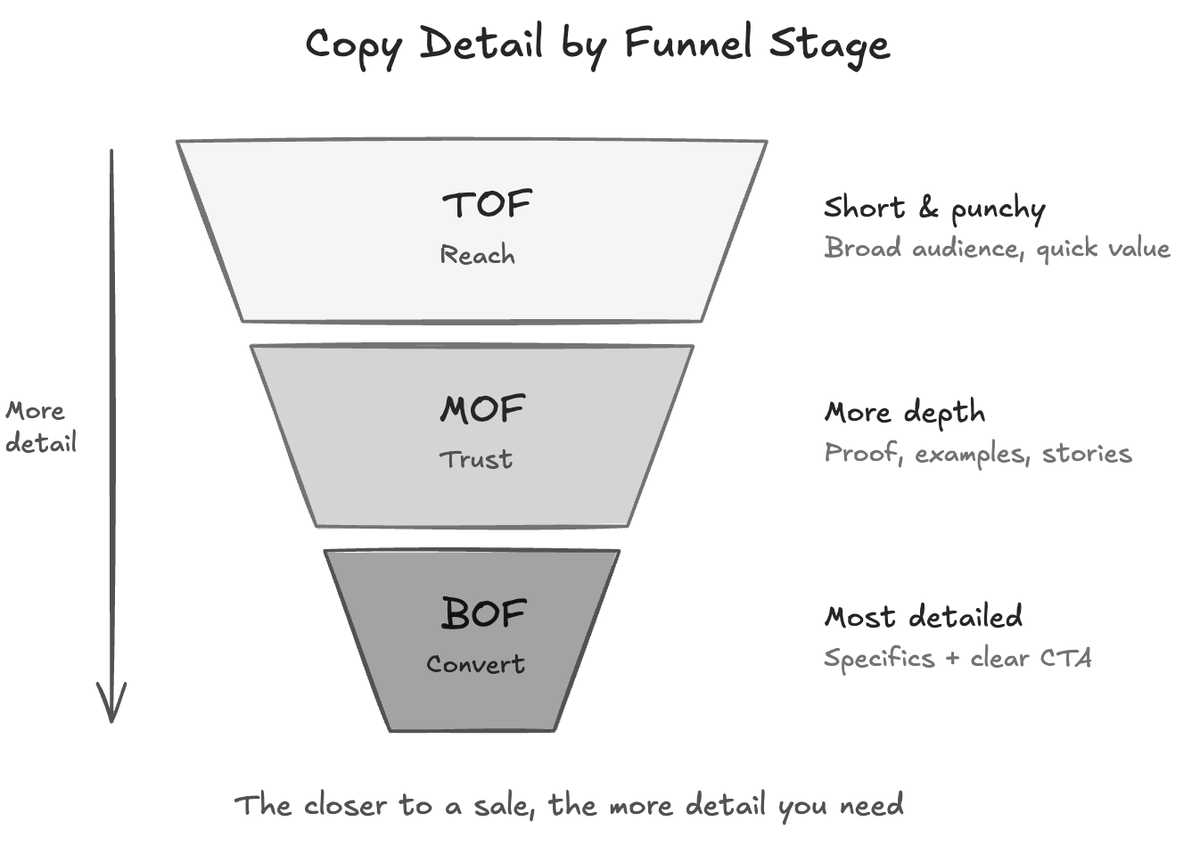
Depending on your post (top, middle, or bottom of the funnel), you'll want to get increasingly detailed.
-
**One idea per post**
If you have three ideas, you have three posts. Multiple ideas generally confuse the reader and the algorithm.
- Every post needs a takeaway
Ask yourself: "What does someone walk away with?"
Every post needs a concrete point and takeaway.
- Clarity > clever
Good writing reduces friction for your reader.
Make it as easy as possible to understand your point.
My rule: If a 12 y/o can't read it, I'm not publishing. This doesn't mean your concepts intellectually need to be dumbed down to this level, but it does mean your vocabulary, formatting, and word choice do.
Nail these four things, and you're already ahead of most people who post on 𝕏.
Hooks 101
The most important part of any written media is the hook.
Think about it, if you made it this far, it's because my hook intrigued you.
The only job of your first line is to get someone to read your second line.
Your main goal is to create a curiosity gap for your reader. You want people to feel like you're speaking to them.
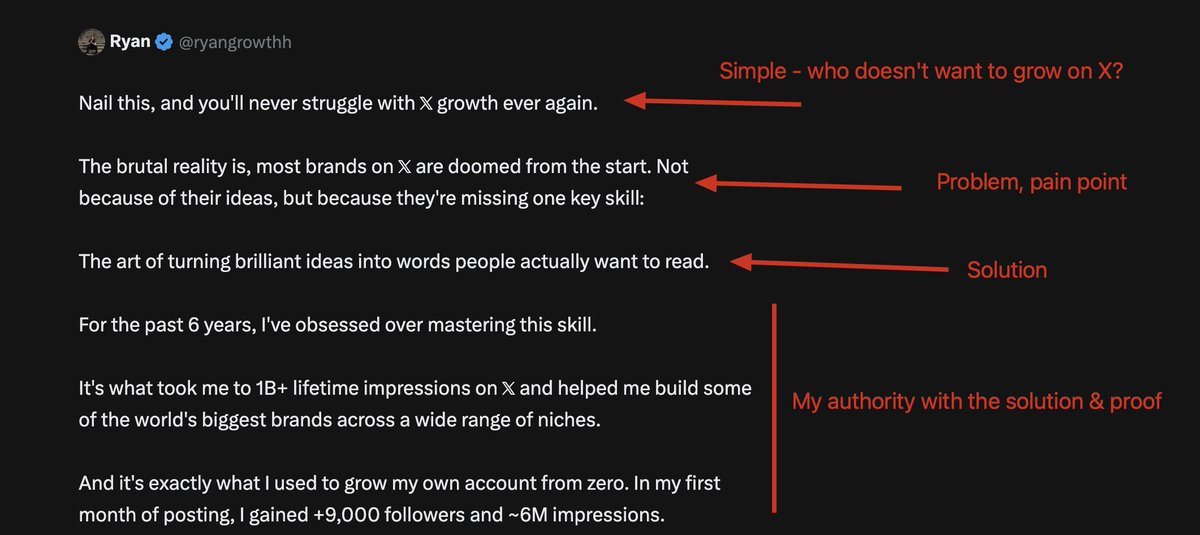
analyzing the exact hook I used for this article
There are eight types of hooks worth mastering:
-
Bold claim:** **"Copywriting is the most underrated skill on 𝕏."
-
Callout: "If you're a founder with under 1K followers, read this."
-
Curiosity gap: "I just realized something 99% of founders miss."
-
Clear outcome: "How to write posts like the top 1%."
-
Contrarian: "F*ck posting volume. You NEED to post less."
-
Story: "It took me 8 years to realize this..."
-
Number / list: "7 copywriting rules I wish I knew 6 years ago."
-
Proof: "This post got 2M views. I analyzed why (takeaways)."
The best writing is usually a combination of multiple of these puzzle pieces.
Rules for writing better hooks:
-
Lead with the most interesting thing. Cut the warm-up.
-
Be specific: "I grew fast" is crap. "I hit 5.8M impressions in my first month" is better. Numbers, names, and timeframes always beat vague promises.
-
Make it about them. The reader is always asking, "What's in it for me?"
-
Keep it short
-
Create tension. A good hook opens a loop the reader needs closed. A question, a surprise, a contradiction, the need for value.
-
If your best line is at the bottom, move it to the top.
Every great hook taps into at least one of these:
-
Self-interest: "What's in it for me?" (outcomes, money, time saved)
-
Curiosity: an open loop the brain wants closed
-
Novelty: something they haven't heard before
-
Emotion: surprise, fear, FOMO, excitement
-
Identity: "This is about people like me"
Again, the strongest hooks stack two or three of these frameworks.
Example: "If you're a founder under 1K followers (identity), this one change doubled my reach (self-interest + curiosity)."
Hooks by format

Short posts   → The hook IS the post. Make line one strong enough to stand alone.
Threads       → Hook + promise of what's coming ("Here are 7 lessons:")
Articles      → Title + subtitle + first paragraph all need to hook. Treat each as its own hook.
Video         → The first 1 to 2 seconds. Visual movement + text on screen + spoken hook.
Quote posts   → Your take needs to add tension or value to the original, not just "this."
Images        → The headline on the image is the hook. One idea, readable at phone size.
How I write hooks (my process)
-
Write the post first, hook last. Once you know what the post actually says, the hook is easier
-
Write 5-10 versions using different hook types
-
Cut the weakest options immediately
-
Refine each line several times until each hook line rolls smoothly into the next
-
Cut any unnecessary words *(things that say the same thing twice or add no value/point) *
Hook Resources:
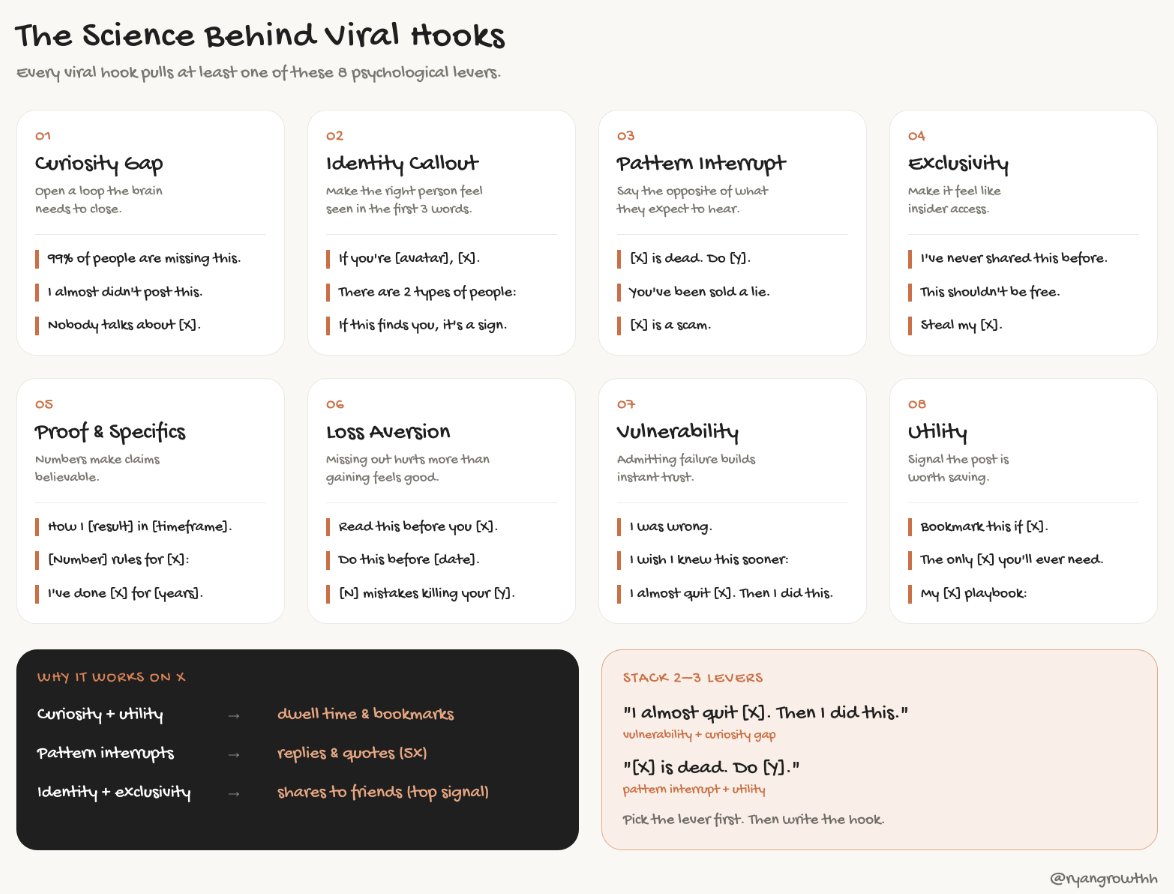
@ryangrowthh
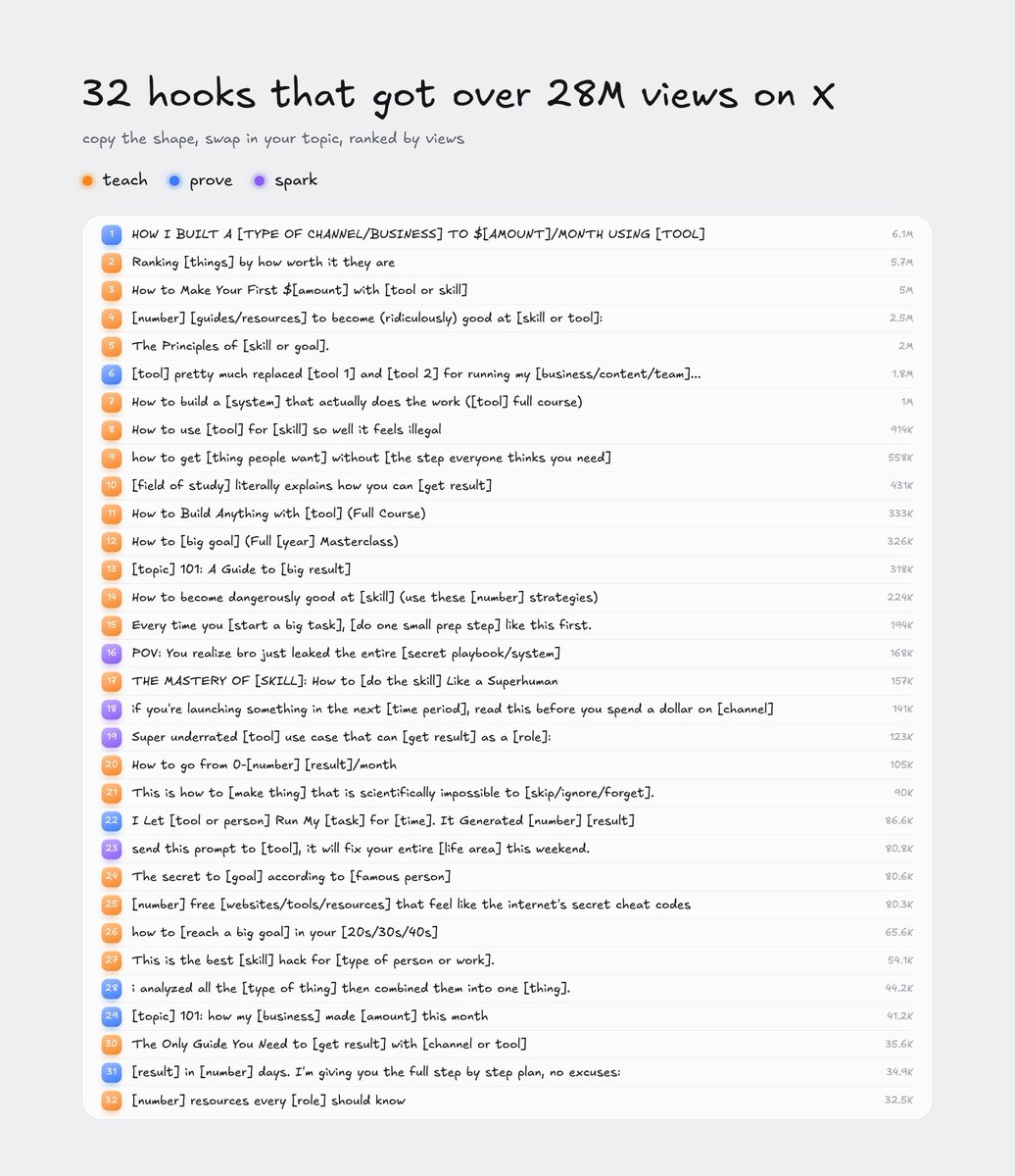
@BuzzMalx
Structure & Formats
In a way, formatting and structure are also part of the hook too. If a post looks too daunting, people will scroll away. Again, it's about reducing friction.
Every post needs a shape. Without one, even great ideas read like a ramble.
The 6 structures I use most:
1. Problem → Insight → Takeaway (written post)
Name a problem, share what most people miss, give them something to do.
2. The list
Hook + numbered points + closer. Easy to digest, save and share.
3. The graphic
Packaging a point into an easy-to-digest visual
4. Video
5. Article
6. Quote Tweet
These are just some of my personal favorite formats, but 𝕏 offers many options.
-
Short posts
-
Long posts
-
Threads
-
Replies
How to open posts
-
Cut filler
-
Get to the point as quickly as possible
-
Show proof ASAP
-
Establish credibility ASAP
How to close any post
-
Takeaway in 1-2 lines
-
Ask a question
-
Tease what's next
-
Never trail off. The last line is the second most important line in your post. It tells your reader what to think or act on next.
Rhythm & Readability
Understand this: Most of the time, people don't read posts. They scan them.
Your job is to make your post feel effortless so readers can commit to spending time on it.
Use line breaks. Walls of text get skipped.
Vary your sentence length. Short sentences hit hard. Longer sentences carry detail and build momentum. Mix them.
Each line flows to the next. Each line should carry one thought. If a sentence has two "and"s and a comma, it's probably two sentences.
Keep paragraphs to 1 to 3 lines. On mobile, a 4-line paragraph looks like an essay.
Make it scannable. Numbers, lists, bullet points, arrows
Use transitions that pull people down. These are short connector lines keep people reading. Examples:
"Let me explain..." "But here's what nobody tells you:"
Write for the phone screen. Most of your readers are on mobile. Before posting, preview it on your phone.
Word Choice
Every word needs to earn its place in your copy.
• Cut filler: really, very, just, actually, etc.
• Use simple words: utilise → use, facilitate → help, commence → start
• Use strong verbs: "grew really quickly" → "exploded"
• Write in active voice: "Mistakes were made" → "Most creators make this mistake"
• Use "you" more than "I": always make it about the reader.
• Avoid AI slop (em dashes, it's not [X], it's [Y], etc.)
• Delete. If deleting a word doesn't change the meaning, delete.
Voice
Anyone can copy your format and hooks, but copying your voice is much harder.
• Write like you talk
• Have opinions
• Be consistent with the tones and styles you pick.
• Show personality
• Share your experiences: "here's what happened..."
• Pick your perception: smart, funny, blunt? Your voice should match how you want to be perceived.
• Don't copy someone else's voice
• Keep your quirks
CTAs & Closers
The biggest takeaway here: you need to DIRECT people on what to do next.
Want a follow? Ask for it.
Want people on your website? Give them easy access to the link.
Want comments? Ask a question or spark conversation.
Tell people what to do.
Reply   → "Which one do you disagree with?"
Share   → "Send this to a friend who's building a brand."
Follow  → "Follow for daily posts on copywriting."
Save    → "Bookmark this for your next post."
Click   → "Full breakdown in the article below."
Buy     → "DM me 'system' and I'll send you the details."
Match the CTA to the funnel
TOF  → Ask for a follow or share (they don't know you yet)
MOF  → Ask for a reply, save or click (they trust you a bit)
BOF  → Ask for the sale, DM or sign-up (they're ready)
Tips:
-
In the replies to your best post, comment your CTA
-
Sprinkle CTAs throughout your posts (at the beginning, when retention is highest)
-
Be specific and keep your CTAs low-effort to execute
-
Tease what's next
-
Ask the readers for something (advice, what they want to see next, etc.)
Closing
So, there you have it: my 2026 𝕏 copywriting masterclass.
If you found even one valuable point from this piece, a like, repost, and follow go a long way.
Every week, I write 1-2 articles covering: GTM strategy, content, marketing, AI & related topics. If that interests you, I'd love to connect with other like-minded folks.
I also post whiteboard-style videos that people have really enjoyed recently.
Here's my latest one breaking down the 𝕏 algorithm in depth:
Thanks for reading!
沿着这个主题继续读
从一篇文章,找到相关的教程、经验和阅读路径。