How Martin Luk Made Over $4 Million (+150.64%) in October 2026
文章目录
部分视频或图片暂未收录,已在正文保留提示;需要时可查看原文。查看原文 ↗
It was not luck. In his first week he was down 1%.
Almost everything came in five trading days.
He only had one long the entire month.
Most of it came from shorting chips, memory and crypto.
This is a detailed breakdown on how he could achieve such massive returns.
Behind The Scenes Of Outsized Returns
Going into October this year, he had already made 785.8%. On the last trading day of October 2026 he posted a screenshot from his broker: up 150.64% for the month. One month.
It was both his largest single-day gain and his largest monthly gain. He said he'd been lucky.
And signed off: Good night. 🤣
I wanted to see how he can pull of such a month without excessive leverage, using options or yolo'ing. So I went through all the data we have available.
It doesn't look like what I expected. If he hadn't documented it live I don't think I would've believed him.
Almost all of it came on five days. He was mostly short - mainly chips and memory stocks, a lot of it through inverse ETFs. Three of the five big days happened when he wasn't streaming. And going into the last two days, he fat fingered one of his short and doubled it instead of closing it.
Here's complete breakdown of Martin Luks Epic Shortober:
-
What he traded, and why he flipped from long to short at the end of September
-
How he got into his shorts, and how he got out of them
-
How big he went
-
Breakdown of his main trades
I've journaled every trade since my day one. I think that is the best decision that I've ever made.
Martin Luk on stream, 2026-10-22
Martin says that revisting old trades and charts is where most of his learning comes from. That's why I've built the Deep Dive Study App. It has 1700+ of Martin Luk's and Qullamaggie's actual trades.
[未转换内容,参见原始 JSON]
NOTE: This is reconstructed from his 𝕏-posts, streams and Discord journal. We don't have perfect info, and where I have made assumptions it is clearly stated.
Silent Before The Storm: Flat For A Week Before Going Parabolic
Let's break down his 150% returns day by day. I went through all 22 days.
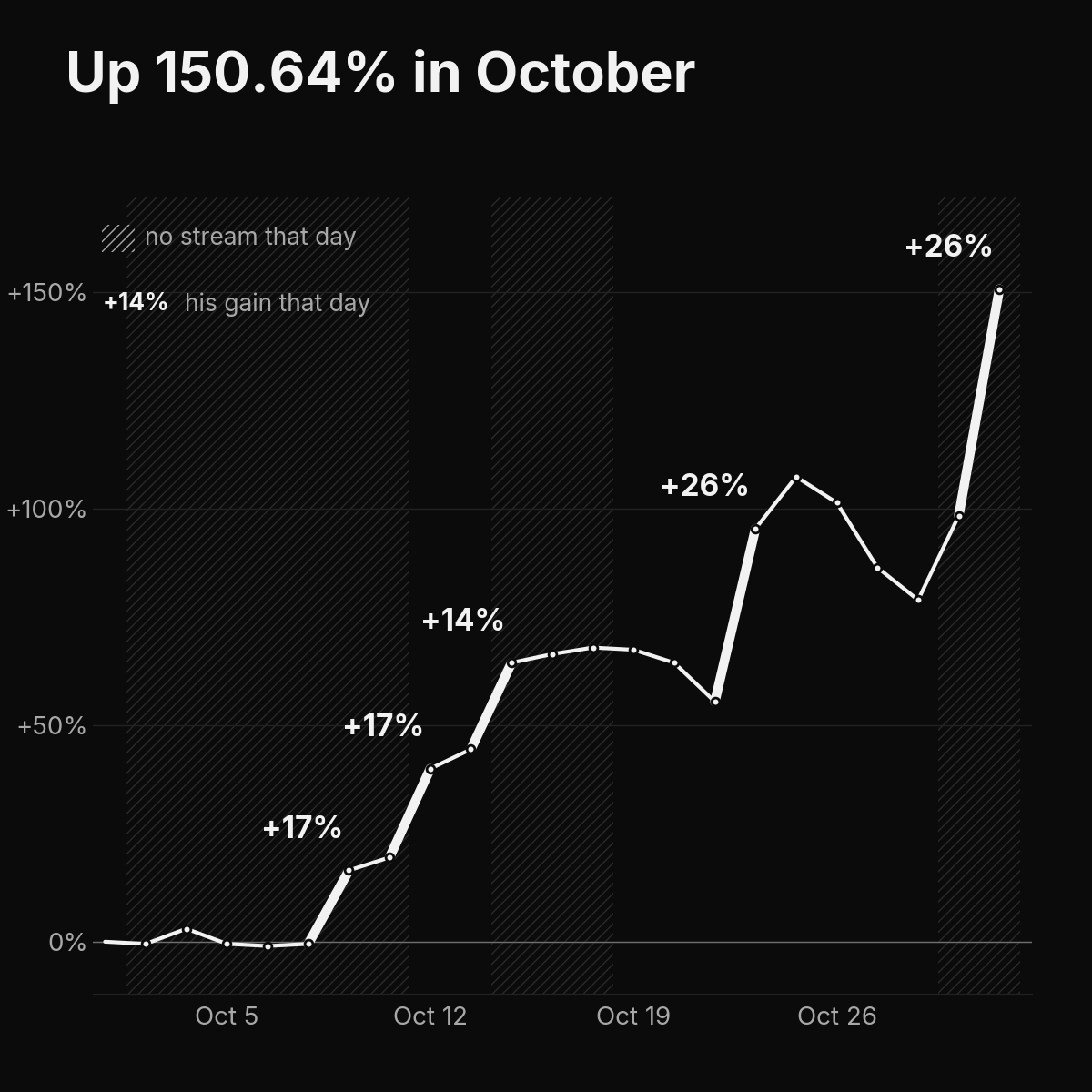
His own account chart for October, per trading day. Hatched days are days he didn't stream.
For the first week he went nowhere. At the low he was down about 1 percent for the month. Then the account went almost straight up for a week and a half, flattened out, jumped again on the 22nd and peaked at plus 107 percent on the 23rd. He then gave back about 14 percent of his account in a few days - even in his best month ever! Then two massive last days took him to +150%.
First thing to notice is the shape of it. It wasn't a steady climb. But nor was it very volatile.. It was a lot of waiting and a few big jumps.
Five Days Made The Month
Sorting the days by best to worst, they sort into two piles.
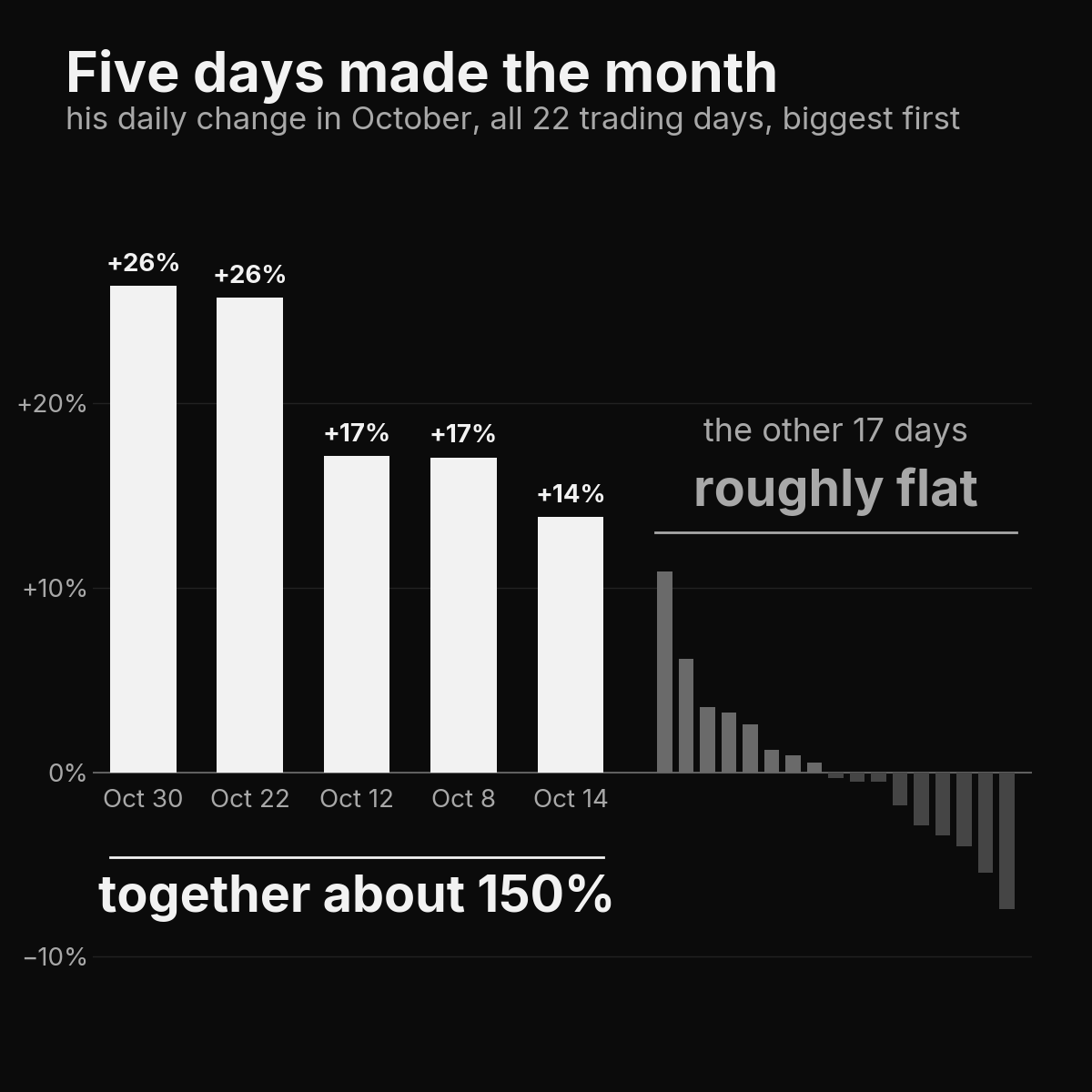
His daily change for every trading day in October, biggest first.
The five best days, compounded, come to about 150 percent. The other 17 days, taken together, were roughly flat.
Those 17 days weren't flat or non-volatile. They include his worst day of the month (-7% on the 27th) and a two-day losing stretch in the middle of the month. They just cancelled out. The five big days were the 30th and the 22nd (about 26% each) then the 12th and the 8th (about 17% each), and the 14th, about 14%. They have one thing in common: the chip ETF SOXX fell on every one of them.
As for which positions made the money: rebuilding his positions day by day, I get a bit more than half of the gain from shorting chips, memory and other AI names, about a fifth from shorting gold and silver, and about a tenth from the quantum shorts.
Three of those five days were days he didn't stream.
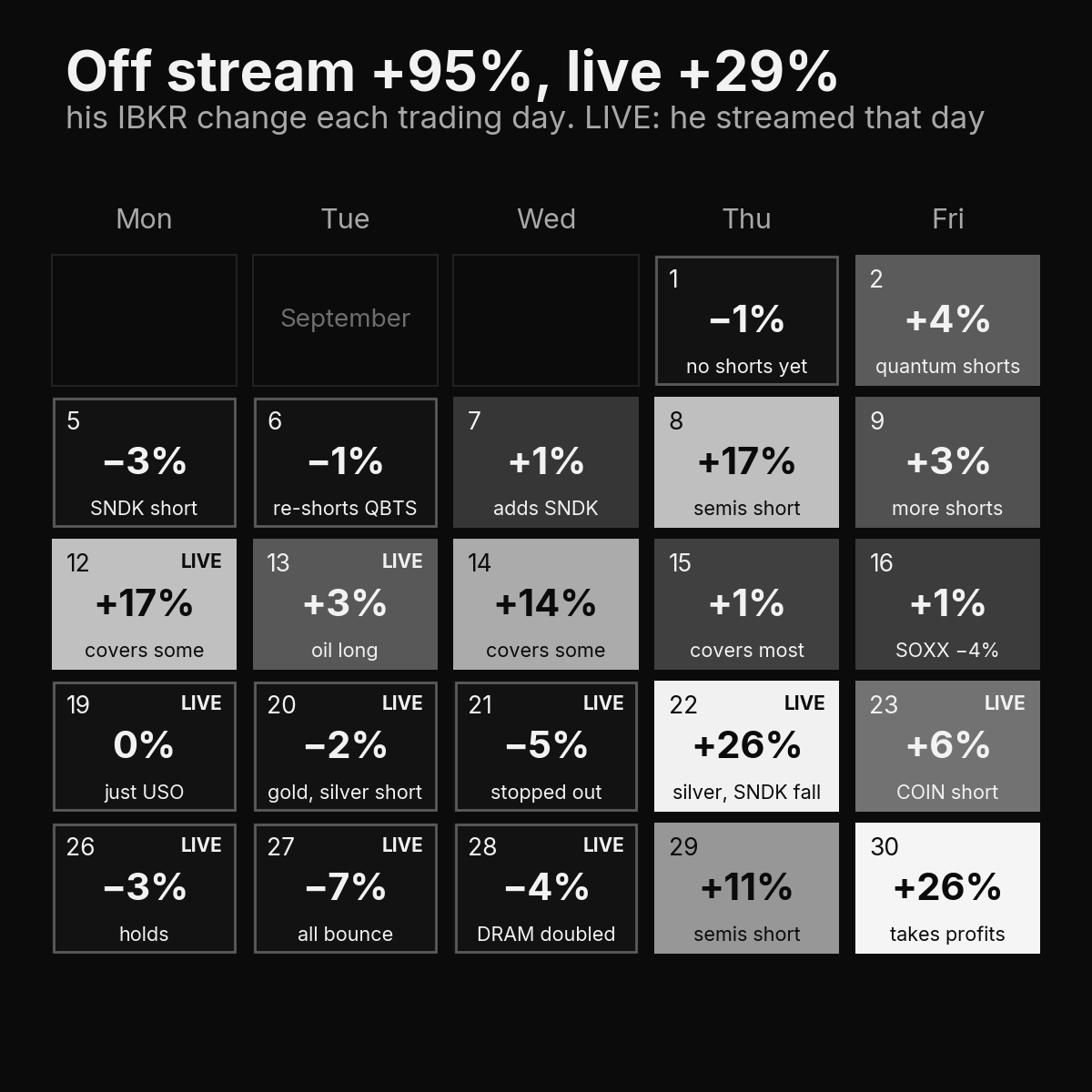
October as a calendar. LIVE marks the days he streamed.
On the 10 days he streamed, his curve rose about 29%. On the 12 days he didn't, about 95%. This doesn't mean he trades a lot off-stream. It says more about when he streams. He's says he tends to stream more when the market is choppy, and the day a big short finally pays (trending) isn't always a day he would stream. For anyone viewing and learning from his streams that's worth knowing: we see more of the grind than of the payday.
How September Set Him Up for A Massive October
October makes more sense once you know how September went. Even with a massive YTD 785%, he was actually down 6% in September. He went silent. No streams for three weeks, from the 22nd of September until the 12th of October.
Then:
When he was back to streaming all his longs were gone, and he had gone full bear. Probably drawing from his December 2025 experience he said:
I can't handle going longs and shorts at the same time
Martin Luk on stream, 2026-10-12
So he picked short. But he wasn't sure. Not confident that they would work. His shorts hadn't really worked since June: little follow-through, sharp snapbacks, stops. On the same stream he said he still wasn't convinced of his own short bias.
But his thesis and thought process was clear:
Comparing memory and chip stocks with Cisco and Qualcomm at the 2000 top. Same idea with SanDisk later in the month.
Flying Blind - Pilot's Report
Everything he did in the first week and a half of October happened off stream. But luckily for us, he walked through a lot of it, chart by chart, when he came back on the 12th.
Martin breaking down his trades in the beginning of October
To quickly recap: In the last days of September the longs went out and a handful of shorts came in: the quantum names QBTS and IONQ, SanDisk, SpaceX and Western Digital. All together they were a bit bigger than his whole account. The first days of October he cleaned up. SanDisk and SpaceX were gone after the 1st, a Coinbase and Tesla short was stopped out quickly, and Western Digital was gone by the 5th, and he doubled IonQ.
Then he retried SanDisk. It closed weak under its daily 9 EMA, bounced back up into it the next day, and on the 5th he shorted the bounce through SNDQ, a 2x inverse ETF on SanDisk. He doubled it on the next bounce, on the 7th, with more risk than he normally takes (and responsibly told viewers not to do that).
But it wasn't all easy and straightforward. On the Tuesday he covered QBTS near the high of the day, in what he called a panic:
And then I kind of immediately realized that it's a mistake.
Martin Luk on stream, 2026-10-12, on covering into strength
He shorted it again shortly after. All in all his account didn't move much. Down 1%. But his conviction grew.
On the 7th, the Wednesday, he went big. DRAM, SK Hynix, Oracle, AXT and Reddit all went on that day, and by the close his shorts added up to about 250% exposure. That was the day before chips broke down.
Then Thursday the 8th. Chips gapped down below the prior day's low and under the daily 9 EMA. He didn't short the gap. He waited for the bounce into resistance during the day, then shorted a 5-minute break through SOXS, (3x inverse ETF) in what he described as a very large position.
I really don't like shorting into the weakness
Martin Luk on stream, 2026-10-12
The account made ~17% that day. By the close on the 9th he was up almost 20 percent for the month, and he hadn't streamed a minute of it.
When he went live on the 12th, his screen already listed his shorts: QBTS, IonQ, DRAM, SK Hynix, Oracle, AXT, CoreWeave and Corning.
For a full overview of his 150% Shortober I made this chart: this is the whole month in one visual.
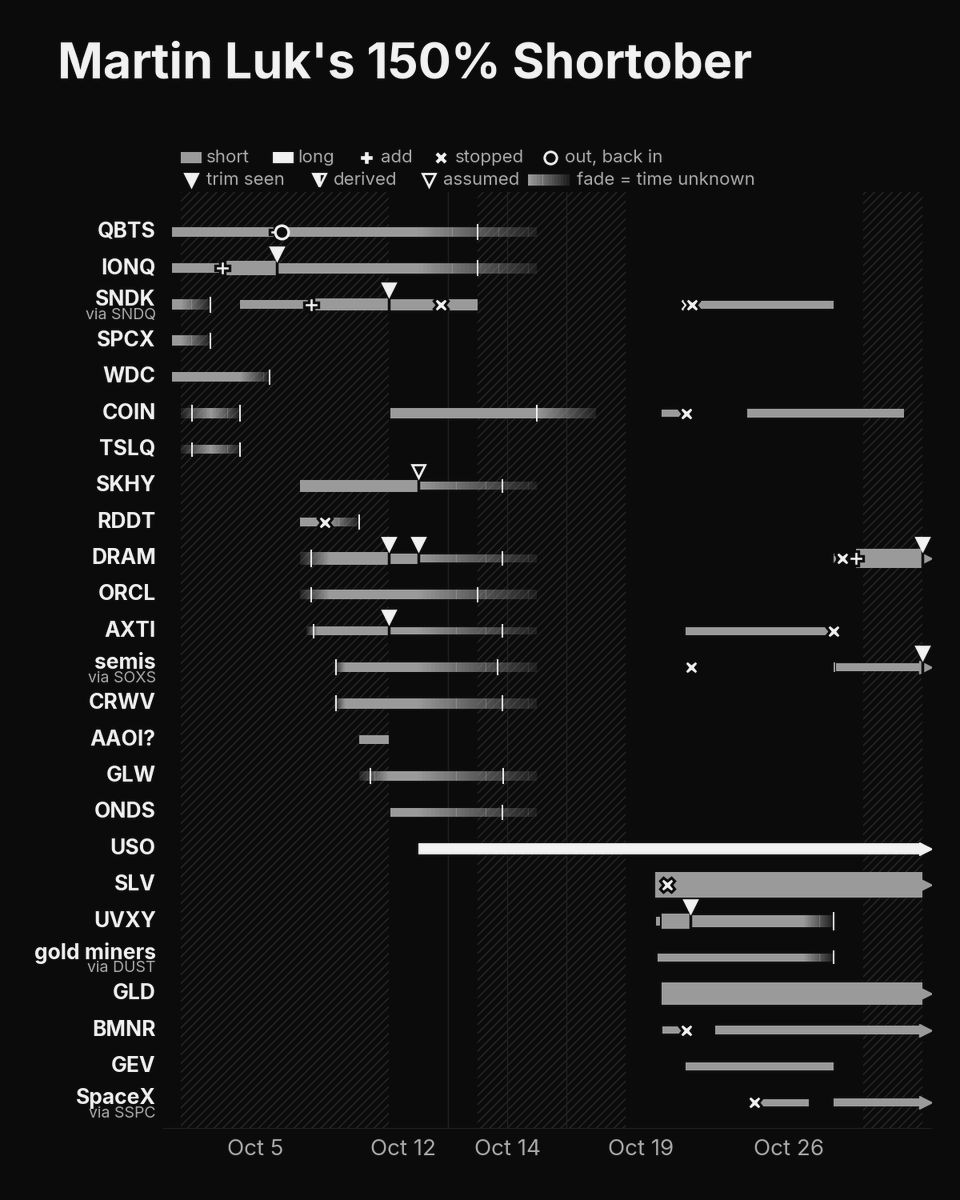
Every position I could document in October. Where a bar fades out, I only know roughly when he got in or out.
He Missed Out On Massive Gains in SOXS
When he finally went live on the 12th he said he was heavily short, and at some point he held over 13 short positions. The 12th was a big day: his account rose about 17%. He covered a little at the open, mostly to free up buying power. On the 13th he added the only real long of the month, oil through USO, and he started covering his shorts. He said he was closing half of his memory shorts, DRAM and SK Hynix, and about his quantum shorts, QBTS and IonQ:
I'm going to cover them into weakness today.
Martin Luk on stream, 2026-10-13
Then he hit the road again, and the next two days happened off stream.
On the Wednesday his account rose about 14%, and by that evening every short except Coinbase was gone. Coinbase went on the Thursday, a day the account added about 1 percent. The following Monday he said where he'd covered: at the weekly moving averages. He was traveling and didn't want to watch the market, so he took the money when the levels came.
On the Friday, chips fell again. SOXX was down about 4 percent, and his account was up less than 1 percent, because he'd already closed his shorts.
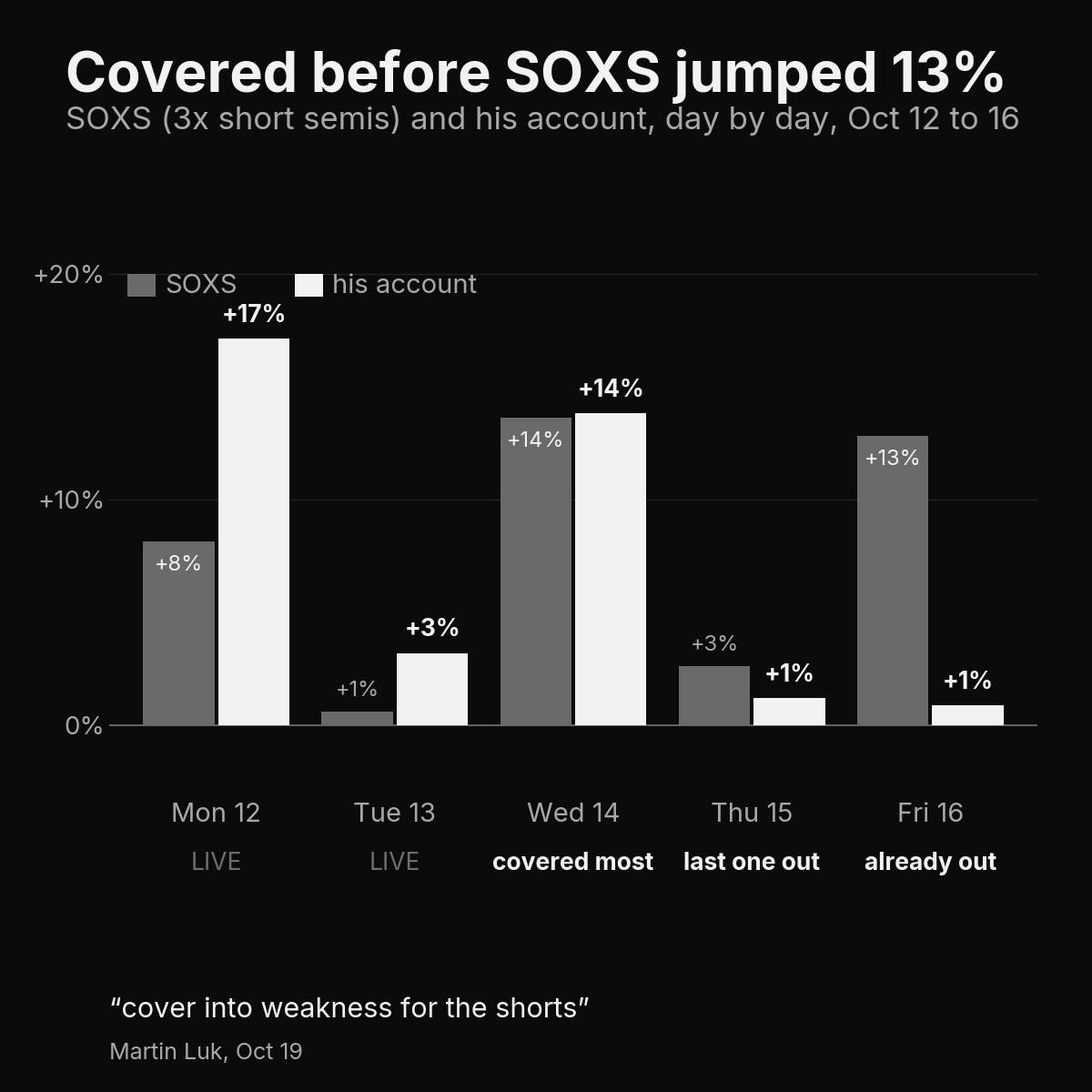
SOXS, an ETF that rises three times as much as chips fall, against his account in the week he covered.
He knows what it cost him. He said he "actually missed quite a lot" of the further drop from the Wednesday. And he says he still treats shorts as short swings, not trades to ride all the way down. Same stream, talking about a viewer's short, he said it's never wrong to:
cover into weakness for the shorts
Martin Luk on stream, 2026-10-19
So he prefers to cover into weakness, rather than to wait for that bounce. Locking in gains before the snapback.
For the week his account rose about 40 percent. It was his best week of the month. And most of it happened while he was travelling.
Some Trade Breakdowns
Selling into strength or covering into weakness is how he prefers to get out. Besides picking the right stocks and entries, how he gets out is one of the main drivers for his massive gains this month.
I like shorting when the market is bouncing and also the stock is also bouncing into the resistance levels.
Martin Luk on stream, 2026-10-26
Here's his entries, re-entries and exits for some of his trades.
SanDisk, mostly through SNDQ, an inverse 2x ETF. A short from September came off on the 1st. Short again from the 5th, doubled on the 7th, took some off, stopped out and back in the same day on the 13th, and covered the rest at the open on the 14th. Back in on the 21st, where his fourth try that morning was the one that stuck, and out on the 27th.
Silver. Short in the premarket on the 20th, stopped and back in the same morning, and still short when the month ended.
Gold. Short from the 20th and still short when the month ended.
Coinbase. One night on the 1st, then short from the 12th to the 15th, again on the 20th until he got stopped the next morning, a quick try that same day, and a last one from the 23rd that he covered on the 30th after the stock gapped down.
Oil, his only long. Bought on the 13th and still held when the month ended.
DRAM, a memory stock ETF. Short from the 7th, covered into weakness and out by the 14th. Back in on the 28th after two quick tries earlier that day, doubled the same afternoon, and a quarter taken off on the 30th.
Note how most of his trades played out. They got stopped out quickly. Then some of his big winners were held for almost two weeks!
The 2nd Half of The Month
Going into the 2nd half of the month, he only held the oil long and said he was waiting for the indexes to bounce into resistance before he'd short again. A viewer asked what happens if his 2000 comparison turns out to be wrong. He simply said:
never trying to be right.
Martin Luk on stream, 2026-10-19
On the same stream he talked about how he focused on not overtrading, expecially "try not to to over trade after a good period." His account was up about 67% at that point.
Over the next two days I found 18 entries. On Tuesday he shorted silver in premarket and said afterwards it was a bit too aggressive. Gold, COIN and BMNR followed. On Wednesday the market gapped up, the crypto shorts got stopped, and he went after SanDisk four times. Two days later he used it as an example of what not to do:
getting too aggressive in the early morning then I got stopped out twice and then I took two more attempts
Martin Luk on stream, 2026-10-23, on SanDisk
And on the day itself, at the end of the stream:
Not getting patient enough again.
Martin Luk on stream, 2026-10-21
The account lost about 2% on the Tuesday and 5.5% on the Wednesday. What he had said he wanted to avoid happened. That's not a knock on him. It's the most useful thing in the month for me. Trading is super hard, even when things are working!!
Tiny Risk, GIANT Positions
The 22nd was one of his two biggest days of the month, about 26%. Silver and SanDisk fell hard that day, gold too, and he was short gold and silver.
Two days earlier a viewer had asked how big his positions were. His crypto shorts were normal size: COIN about 20 percent of his account, he said, and BMNR 18 or 19. Gold and silver were something else. He didn't give exact numbers, only that each of them was "more than 100% of my accounts".
By my estimate, gold was about the size of his whole account and silver about 1.3 times it. On top of that he bought DUST, an inverse fund on gold miners, one more bet on gold falling. And here's what he was risking on them:
I think it's slightly higher than 0.5% and gold is slightly less than 0.5%.
Martin Luk on stream, 2026-10-20, on silver, then gold
That's about half a percent of his account at risk on each, on a position as big as the account or bigger. So his stop was just above his entry, less than half a percent away. And that's how you can risk a fraction of your acction per trade, and still make 26% in a day.
His normal position, he says, is 20-25% of the account, and he usually risks 0.3 percent, less when the stop is tight. The risk is small. The positions aren't.
He doesn't treat margin as a risk of its own. He sizes from his equity, caps the risk per trade rather than the margin, and the only brake is running out of buying power. Which he did on the 28th. Once the stops are in, as he put it that day, "the risk is already defined."
But that's a simplification. What about gap risk? A stop only fills where the price trades, and gold and silver keep trading all night while GLD and SLV are shut. Asked on the 19th how he handles overnight risk, he said he can't: "it's just part of the game." When a position opens past his stop, "I just sell immediately at the open." The one adjustment he describes is smaller size in small caps. Gold and silver got the opposite treatment, because they move slowly.
I put his gold and silver sizes from the 20th, about 2.4 times his account, on every morning since 2006. On in three days would take more than the 1% he risked on them. 1/20 took about 4 percent. His own estimate on the 22nd, then it gapped up, was "more than 5% drawdown on the gap up".
And historically it has happened to him. On September 15 he said he was "not really worried a lot on a overnight gap risk" in gold and silver. Two days later silver opened 3.5% higher and stopped him out at the open. In October most of the overnight moves went in his favor. The Monday after his record day, everything he held opened against him, down almost 7%. He kept his shorts: "I don't think we are out of the woods yet."
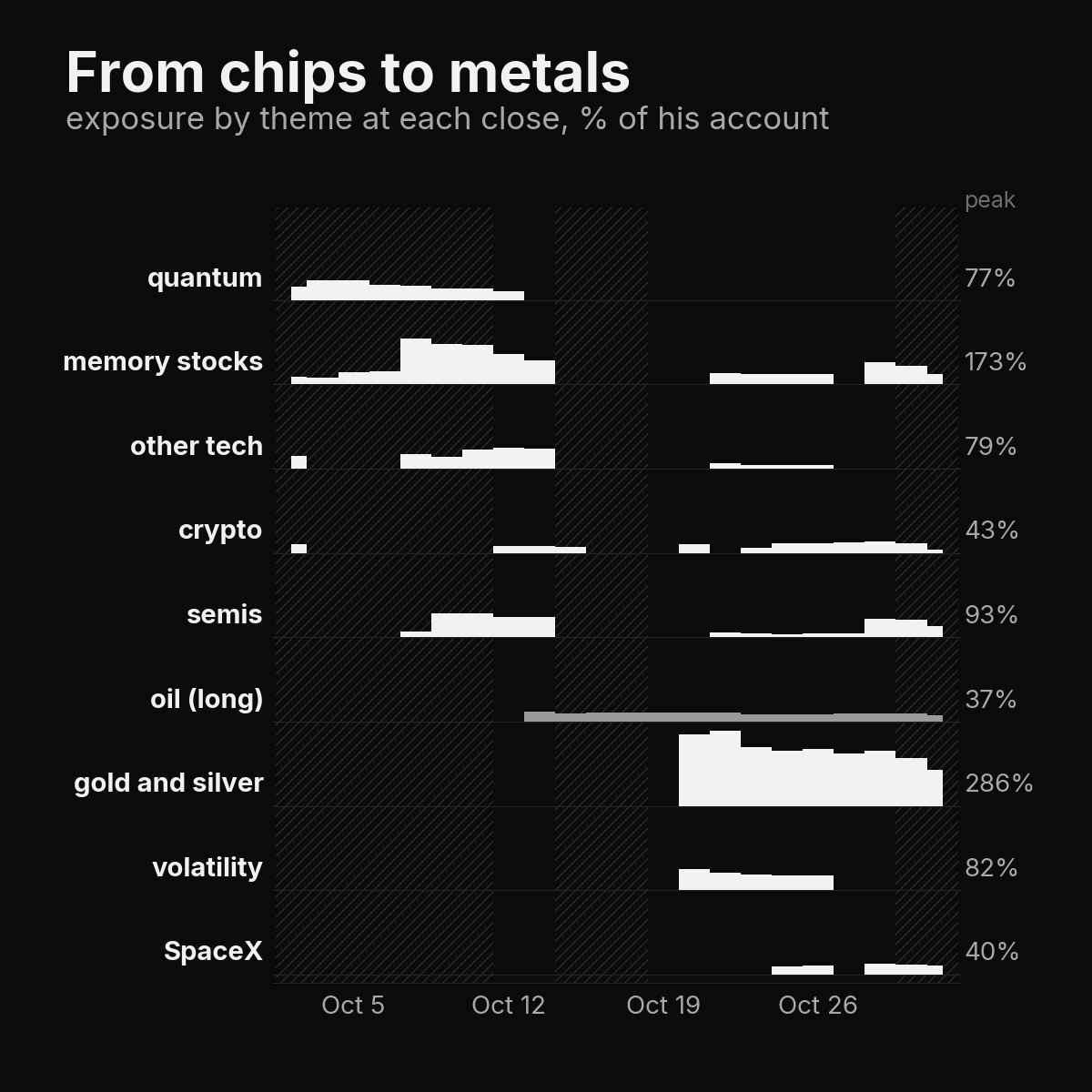
Best estimates on what he held throughout the month.
His Account Equity = Levered Short Chips
Put his daily account next to SOXX and the relationship is hard to miss.
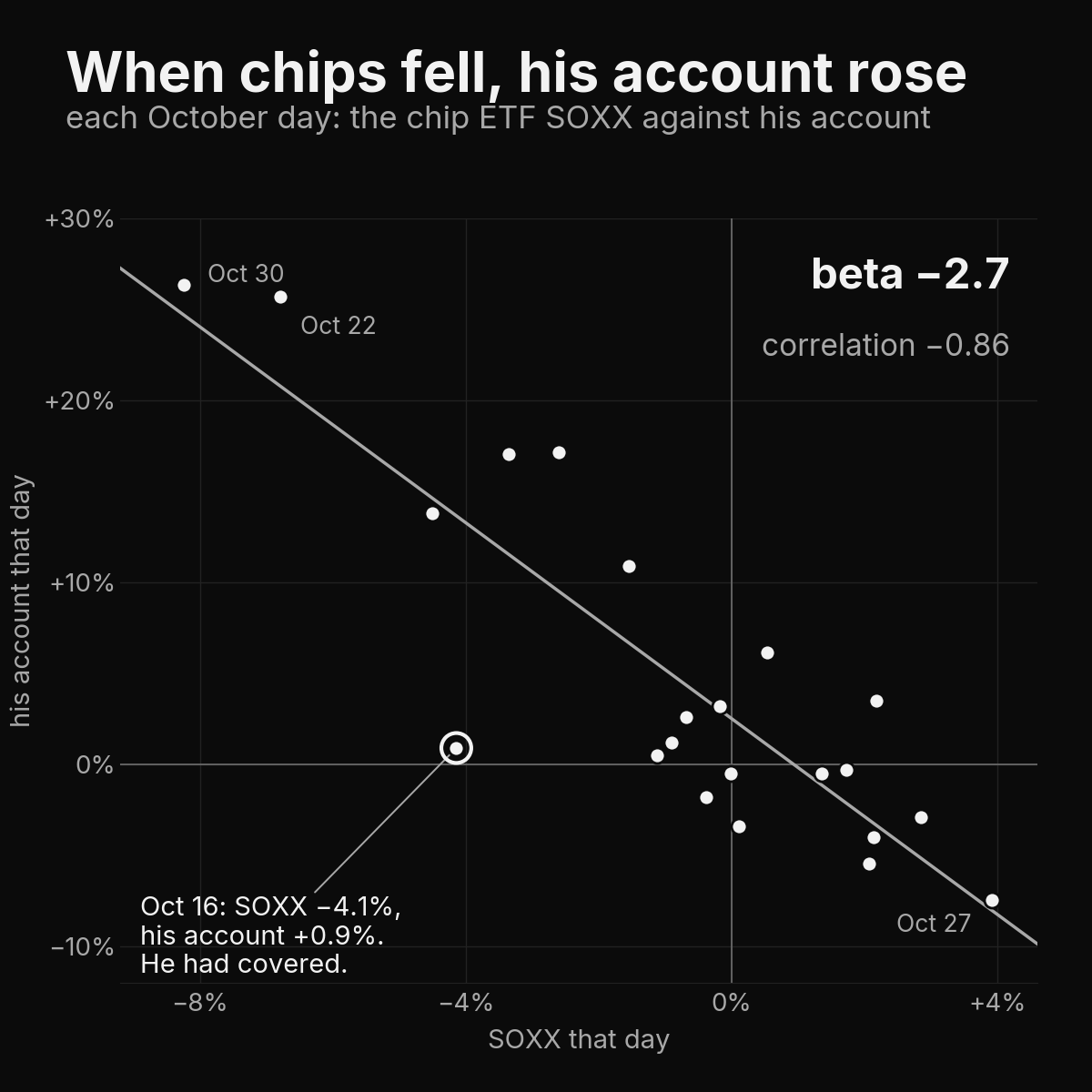
Each dot is one October day: SOXX across the bottom, his account up the side.
In my reconstruction he held 49 positions in 26 tickers in October, and all but one had short exposure. The exception was the oil long. Fourteen of the 49 were inverse ETFs: SNDQ for SanDisk, SOXS for chips, SSPC for SpaceX, DUST for gold miners, TSLQ for Tesla.
Put all together they look like this. At the peak, on the 28th, his shorts came to about 379% of his account, and he went into each of his five best days already heavily short.
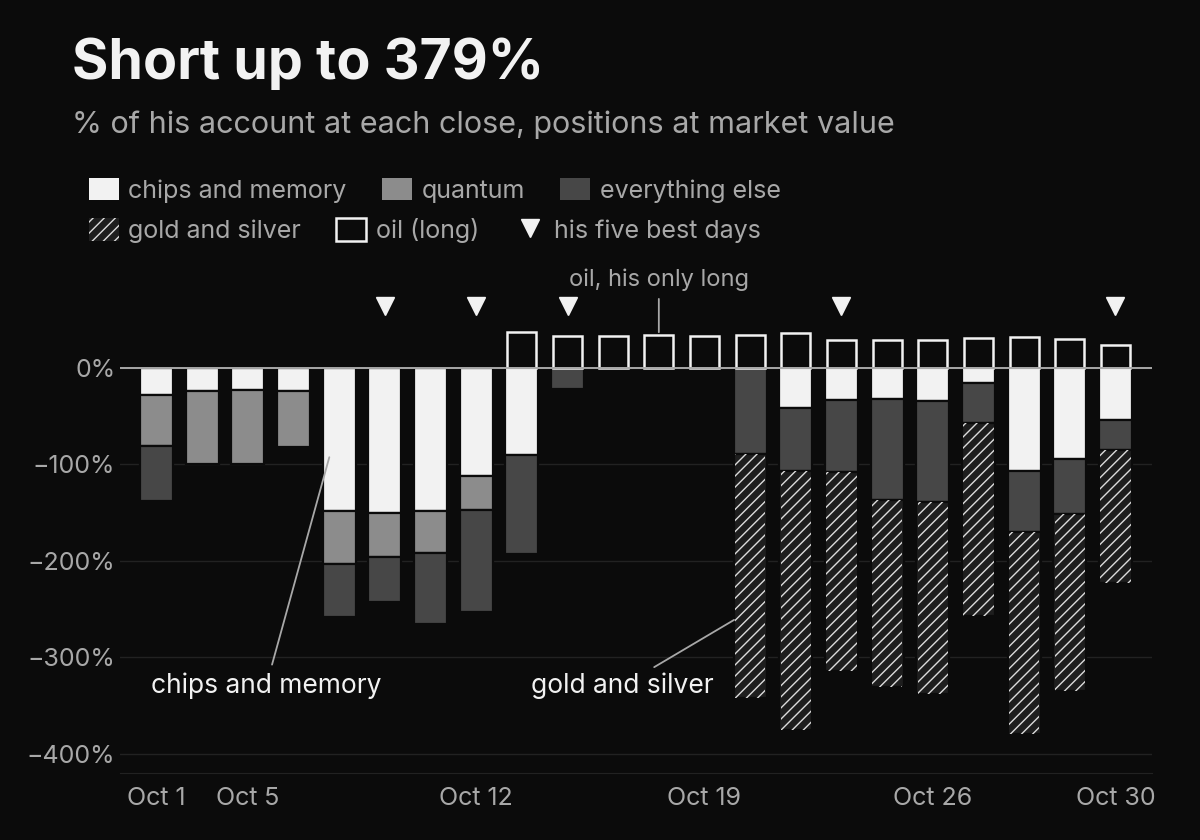
What he held at each close, by theme, as a share of his account. The markers sit over his five best days.
He uses both the stock and the ETF. On the 23rd he said a leveraged ETF is mathematically better for a short because of the way it compounds, but that liquidity and price matter too, so he goes with whichever fits.
One thing to watch if we ever do this ourselves: a 3x ETF triples the exposure. A quarter of the account in SOXS is three quarters of the account short chips.
Three Red Days
His account peaked on the 23rd. Then three losing days in a row. His worst day was the 27th: almost everything he was short bounced at once, chips by almost 4%, gold, silver and the crypto names too, and his account fell 7%. By the 28th he was down about 14% from his high.
He'd described this habit himself on the 23rd: after a good run he overtrades and gives some of it back, every time. On the 28th he looked at the damage. He said he "was too aggressive" on the short side over the last few days, and "lost a lot of them now". He also said he'd run out of buying power, and that running out had saved him again: it stopped him from addding even more.
A day earlier he'd also sold UVXY. He described it as a bet on a fast sell-off, and holding it was one more way of being short the market:
So yesterday I sold my UVXY as the market is just not showing any sign of weakness or reversal.
Martin Luk on stream, 2026-10-28
Fat-Fingering For The Win
This one only came out afterwards, on his first stream in November.
On the 28th, right after the Fed decision, he shorted DRAM, memory ETF, with his stop above the high. The stop should have been a buy stop. He entered a sell stop instead, so when it filled about half an hour later it sold more DRAM instead of buying it back. He thought he'd been stopped out, and only found the doubled position when he opened IBKR on Thursday morning. By then DRAM alone was 80% of his account.
80% of your account on a fat fingered trade!
The market gapped down. By his own estimate a gap up would have cost him a 4-5% He didn't hide it.
really dangerous and really scary
Martin Luk on stream, 2026-11-02
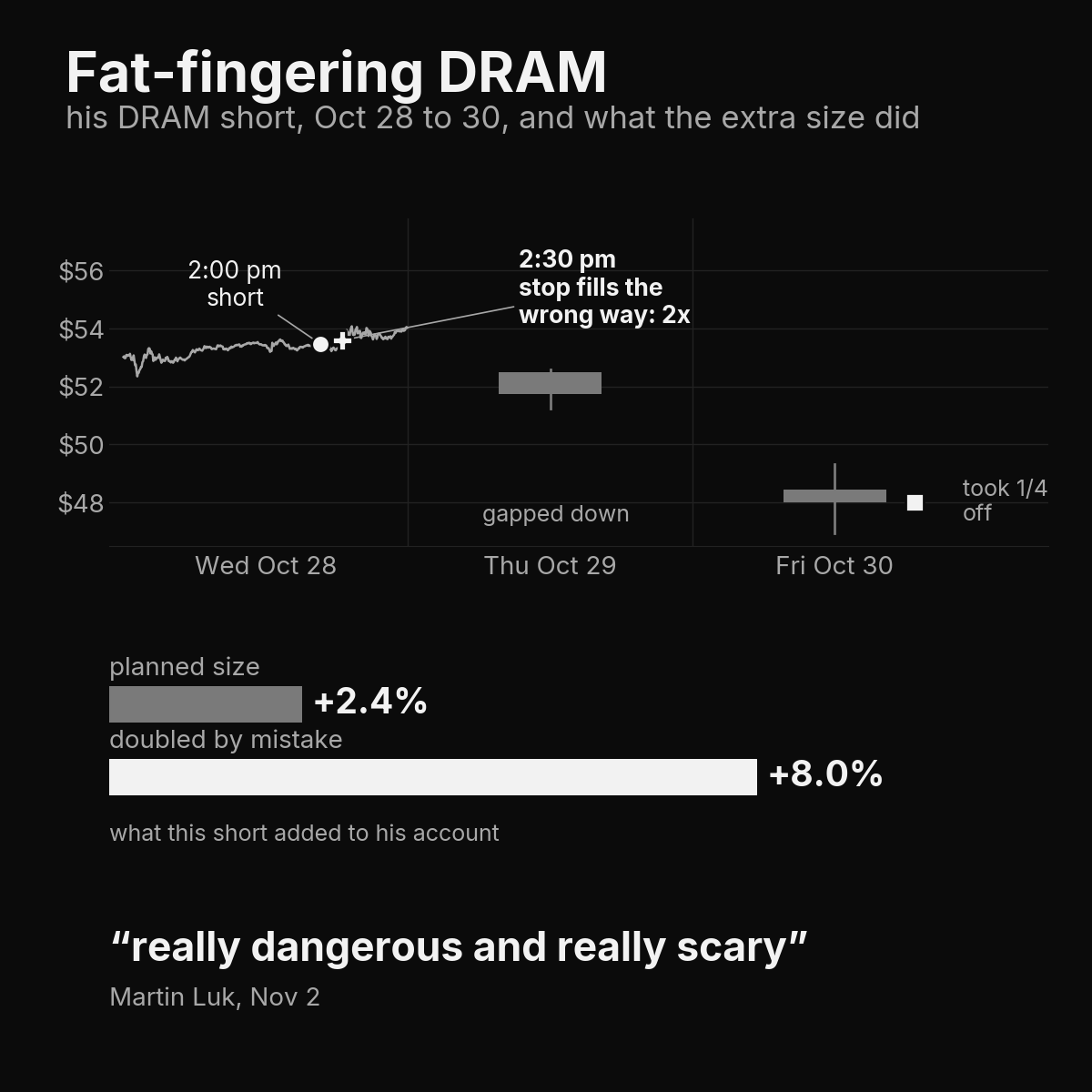
The DRAM short from the 28th to the 30th, and what the extra size added to his account.
DRAM fell about 4% on the Thursday and another 7% on Friday, and the account made about 11% on the Thursday. He also said how it could happen: he doesn't use hotkeys, so the entry and the stop go in as two separate orders, and the second one is where the mistake slipped in.
That Thursday he also sat out the first hour, and said afterwards he was glad he had.
The Grand Finale - When Everything Aligned
Then the grand finale. On the last day of the month, chips fell 8%. His account made about 26%. He bought back all of his COIN short, a third of his chip short and a quarter of his memory short. He kept the rest into November, gold and silver included.
That evening he posted the screenshot:
The last two days added about 40% to his account. For that, his positions had to add up to roughly four times his account, the biggest he had been all month. On the 28th he said he'd run out of buying power, which fits.
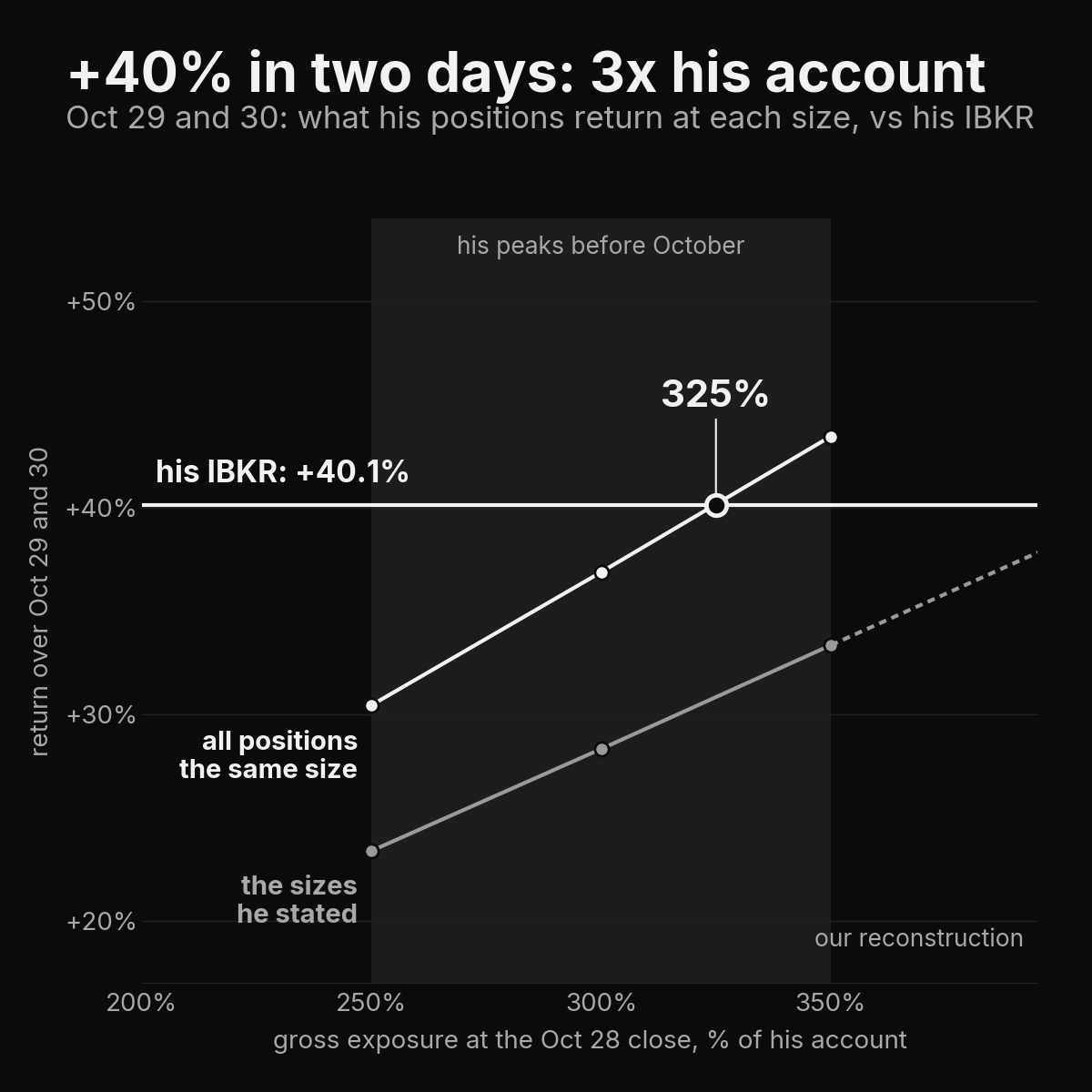
How his positions from the 28th would have done at different sizes, against what his account actually made on the last two days.
Preperation Meets Opportunity
He says luck a lot. In the post. About DRAM, which he called an accident. And on the 22nd, in a longer answer about the risk he takes, he said that when a setup looks too good, "I just can't hold myself back", and that "maybe I'm just the lucky guy".
I believe him about the luck. A gap down instead of a gap up the morning after DRAM got doubled by mistake is luck. Chips falling 17% in the month he went heavily short is at least partly luck.
But what he did around the luck wasn't luck. He built conviction. He didn't gamble. He probed with a handful of shorts for a week and went big on a bounce. He shorted bounces, not gaps. He covered into weakness, and the Friday flush went without him. He cut the losers the same day, and there were a lot of them. Those are things we can actually practise.
And the first thing he did in November was slow down. On the 3rd he kept every short under 20% of the account and said he's now growing his size much slower than his account grows. The reason:
Part of it is because I got a really good run
Martin Luk on stream, 2026-11-03
Eight Things We Can Take Away From His Epic Run
-
One thesis, one side. We are either long or short. We are not playing the rotation on both sides.
-
He probed for a week, then sized up on a bounce. The first week he didn't use leverage. But when his setups improved and he built conviction, he sized up.
-
He shorted the bounce, not the gap. His big entries came on bounces into falling moving averages.
-
He covered into weakness, and accepted missing some of the move. He bought back his shorts at his weekly levels while chips were still falling, and missed the Friday drop. The week still made about 40 percent. Locked in gains > giving back unrealized gains
-
Losers went fast, winners ran one to two weeks. About half his positions were over within a trading day, and the biggest winners lasted four to ten.
-
Rethinking levered ETFS: I've sized down on levered ETFs, but I will now be treating them as isolated trades.
-
Spend our time on charts, not hotkeys: One of the best traders of our times uses manual orders. So can we.
-
Everyone has flaws. He talked about his overtrading habit on Monday and took 18 entries over the next two days anyway. If he can't skip that trap in his best month, we should plan for it in ours.
Study every Martin Luk trade in Deep Dive App
I mapped 445 of Martin Luk's trades across 112 livestreams (307 hours of video), complete with exact entries, stops, exits, and timestamped stream transcripts on interactive charts, plus an AI assistant trained on his streams. Sign up for a free account to explore the Martin Luk playbook
[未转换内容,参见原始 JSON]