How to Grow on X (Full Playbook)
文章目录
I have 100,000 followers on X.
I've tweeted over 60,000 times for myself. I've written hundreds of thousands of tweets for clients, and they've generated hundreds of millions of impressions across many different industries for many different people.
Some may argue I'm the best X ghostwriter in the space.
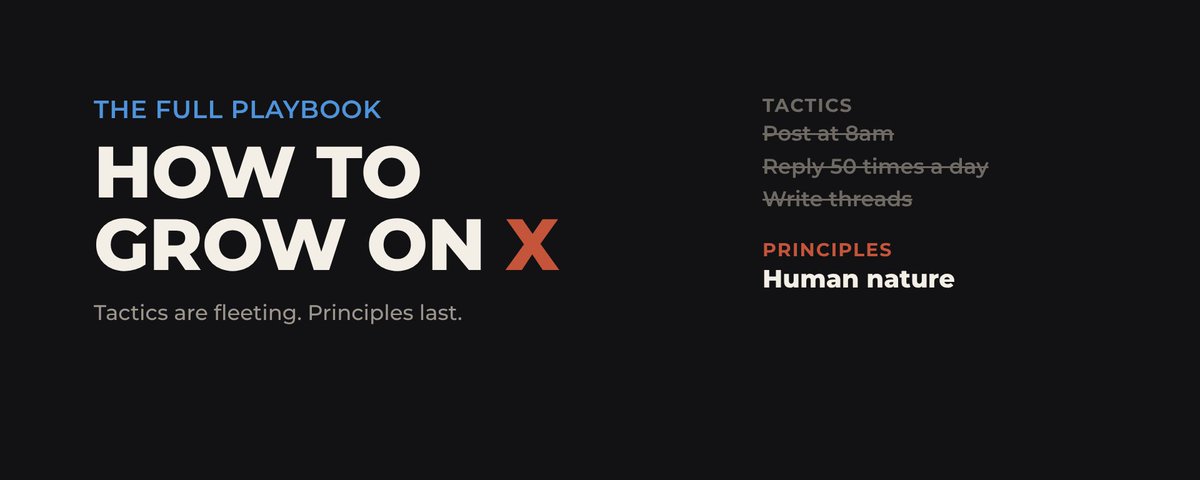
So I get asked how to grow on X a lot. And most of the answers people get are tactics: comment this many times a day, quote tweet bigger accounts, post at 8am, write X articles.
Those tactics work for a while. When I started, deep-dive twitter threads drove 90% of my growth. Now, obviously those are dead.
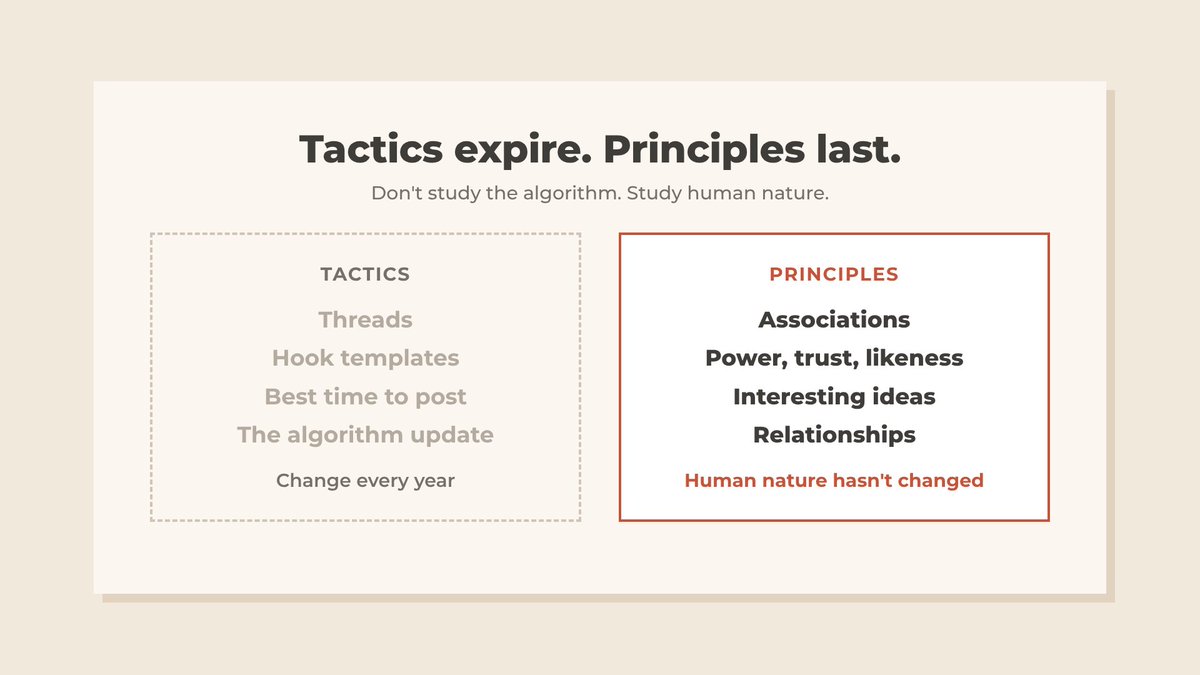
Tactics are fleeting, but principles last.
So in this article, I want to chunk up and share the principles behind growing on X (and on any platform, for any brand). At the end of each section, I'll give you reflection questions to work through, because a principle is useless until you apply it to your own account.
Here's what we'll cover:
-
What are you growing for?
-
Your brand is what people associate you with
-
Influence = power, trust, and likeness
-
Pick a premise, not a niche
-
Authority, reach, and resonance
-
Become someone worth following
-
Say true things in non-obvious ways
-
Test, then invest
-
Relationships are the compounding asset
-
Leverage beats consistency
-
What changes at each stage
-
How my account grew (the honest version)
Grab a pen. Let's get going :)
What are you growing for?
Lots of followers isn't the goal.
I learned this the hard way. In 2022 I documented my entrepreneurship journey on Twitter, and the audience grew. But even though I had a sizable audience, I couldn't find a sustainable way to build a durable income.
Now, I'm not going to tell you followers don't matter. That's a common line in the personal branding space, and it's complete BS. Followers matter for two reasons:
-
Followers show power. A big following signals you have what other people want.
-
Followers are a filter. You've probably heard that you only need 1,000 true fans to make a living online. But your 1,000 true fans are probably not going to be your first 1,000 followers. You'll probably have to get 10,000 followers, or maybe 100,000, and nurture them and educate them into being fans.
So followers matter, but they're a byproduct.
The goal is influence, which I define as the ability to change other people's behaviors. Can you get someone to read the book you recommend, try the framework you teach, reply to your DM, book a call, or buy?
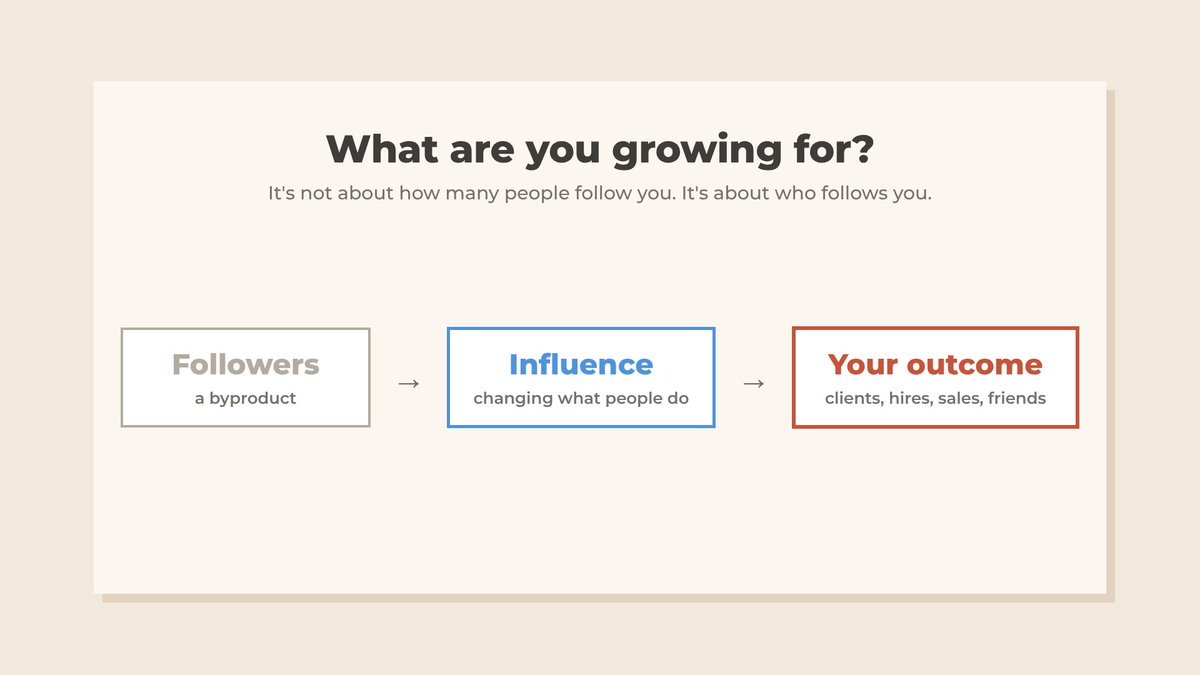
It's not about how many people follow you. It's about who follows you.
A post with 40 likes that got a reply from the one buyer you wanted is a better post than a meme with 4,000.
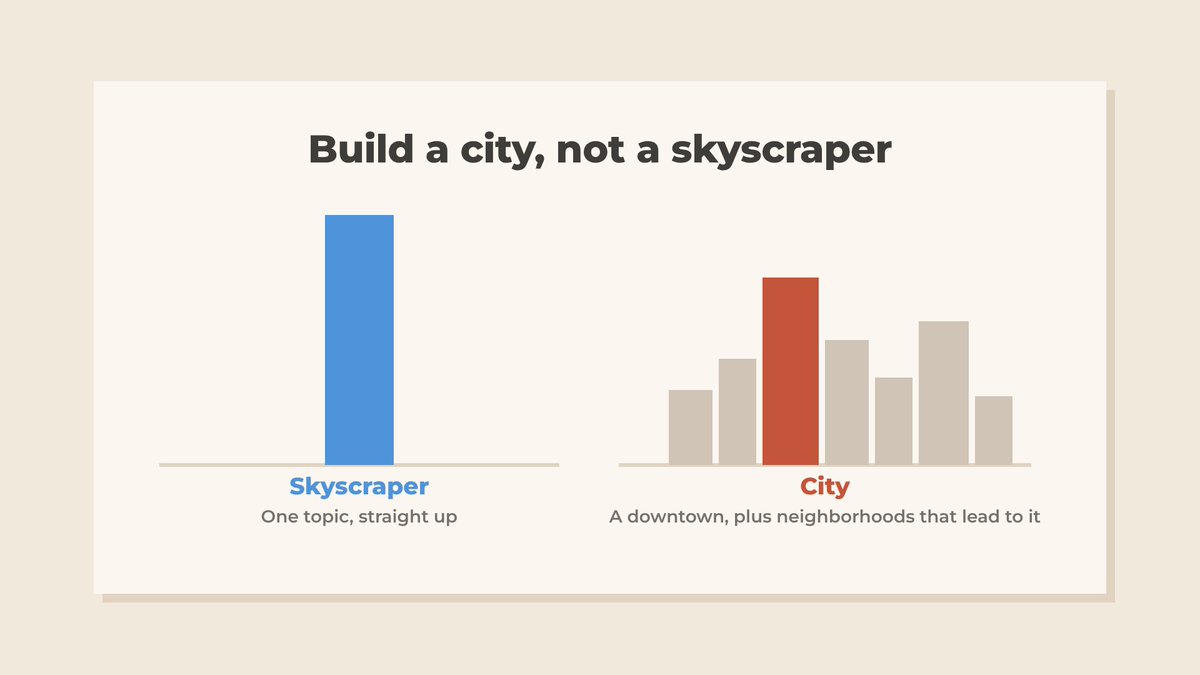
City vs. skyscraper
On one side, you have people building a skyscraper. They pick one topic and go straight up. On the other side, you have people posting about anything, trying to go viral. They're great at getting impressions and not great at business.
A city sits in between, and I would rather build a city than a skyscraper.
A city has a downtown (the core topic you want to be known for) and neighborhoods around it (your life, your story, the adjacent ideas you care about). People come in through the neighborhoods and end up downtown.
Fundamentally, you grow on X so the right people know, like, and trust you, and think of you when they have a problem you can solve.
X has done that for me. My knowledge and network in my little corner of Twitter added up, and I started seeing opportunities I was uniquely capable of seizing. I got several job offers from ghostwriting agencies. I met friends who later became collaborators. And when I started Revenue Media Lab, our first 5 clients came from my own brand on X.
Why a brand is worth building
A business survives because of one equation: LTV to CAC (how much a customer is worth vs. how much it costs to get one).
You know what increases that ratio? Building a brand.
When leads come in through your content, they feel like they know, like, and trust you. They're already pre-sold.
If you cannot compete on pedigree, you compete on trust. And X is one of the best places on the internet to build it.
Reflection questions:
-
What outcome do I want from X in the next 12 months? (Clients, a job, investors, hires, book sales, friends?)
-
Who are the 1,000 people who, if they followed me, would make that outcome inevitable?
-
If my follower count doubled tomorrow but none of those 1,000 people were in it, would my life change?
Your brand is what people associate you with
Ask 10 people what a brand is and you'll get 10 answers. A logo. A feeling. A promise.
I subscribe to the definition Caleb Ralston talks about: a brand is the result of branding, and branding is teaching.
I like it because it's the most actionable and implementable way to build a brand. If a brand is a feeling, what do you do with that information? But if branding is teaching, you can do something with that today.
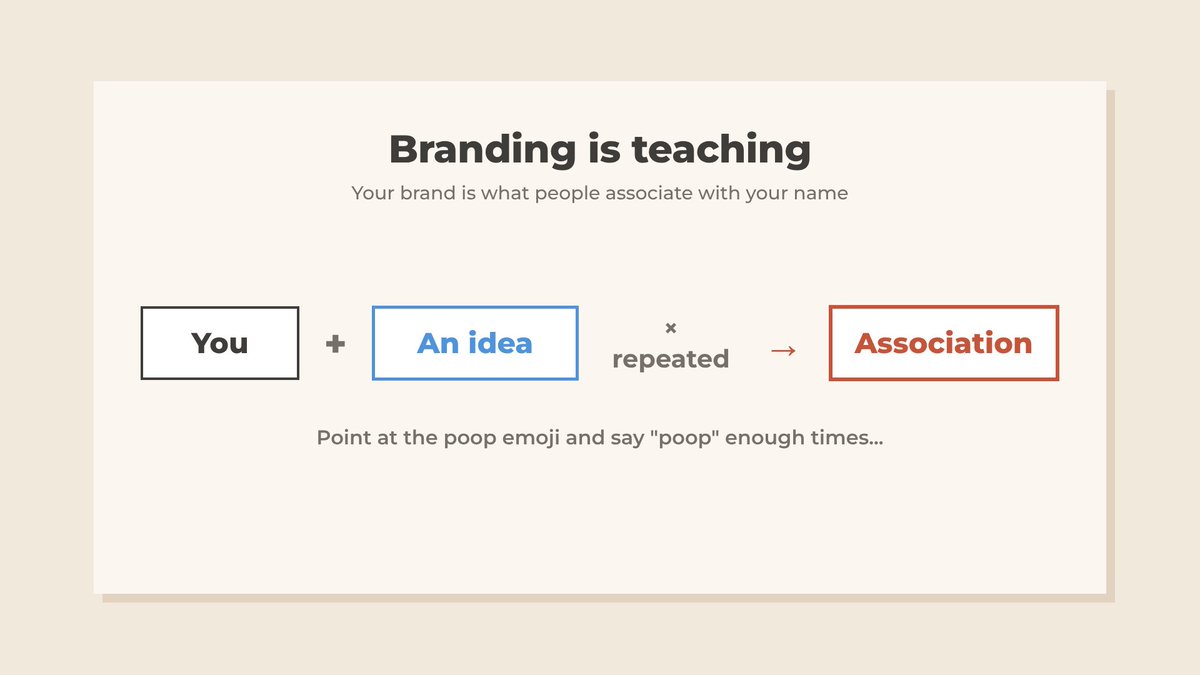
Here's how teaching works. If I point at the poop emoji and say "poop," then the next time I say "poop," kids will think of that emoji.
That's an association. You pair a word and an image together, consistently, until one brings up the other.
Your brand is the set of associations people have with your name. And good branding means you choose those associations on purpose instead of letting them happen by default.
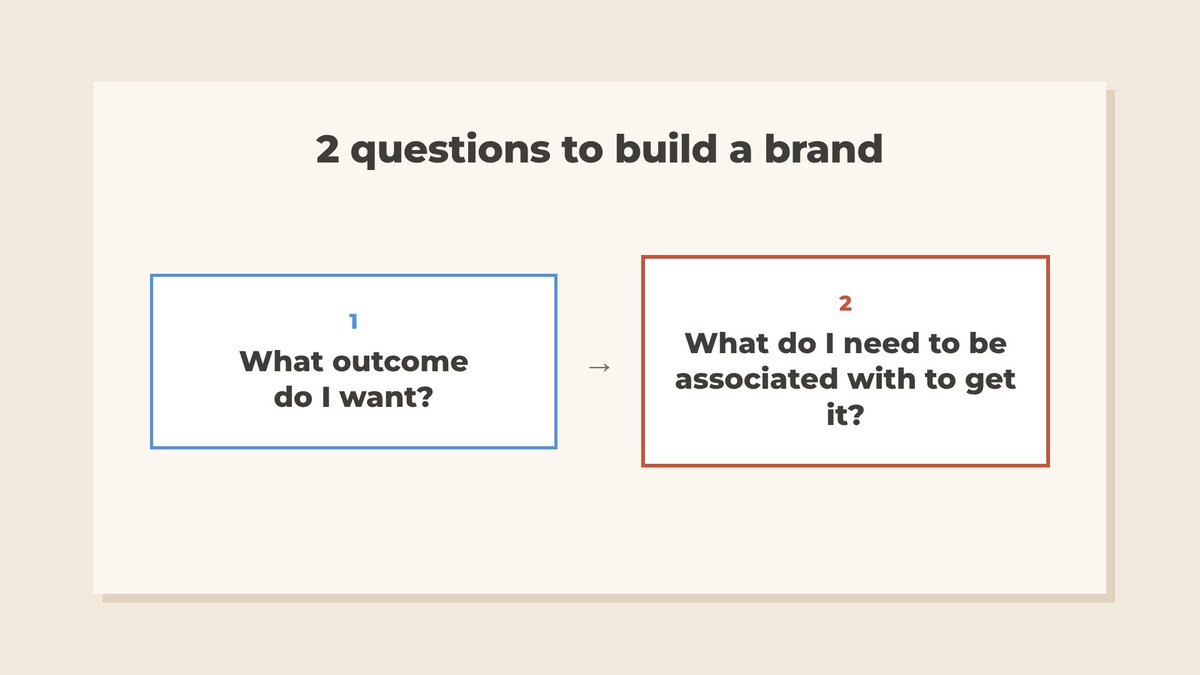
So to build a brand, there are two questions I want you to ask yourself:
-
What outcome do I want? Why am I showing up on X in the first place?
-
What do I need to be associated with to get that outcome?
For me, I want people to know that I'm the best damn social media copywriter in the space, that I'm a marketing strategist, and that I have a lot of proof at a young age.
So I talk about my proof. I teach what I know about copywriting and marketing. And I help other people get results in public, so you can see it work.
Lean on one credibility until you get the next
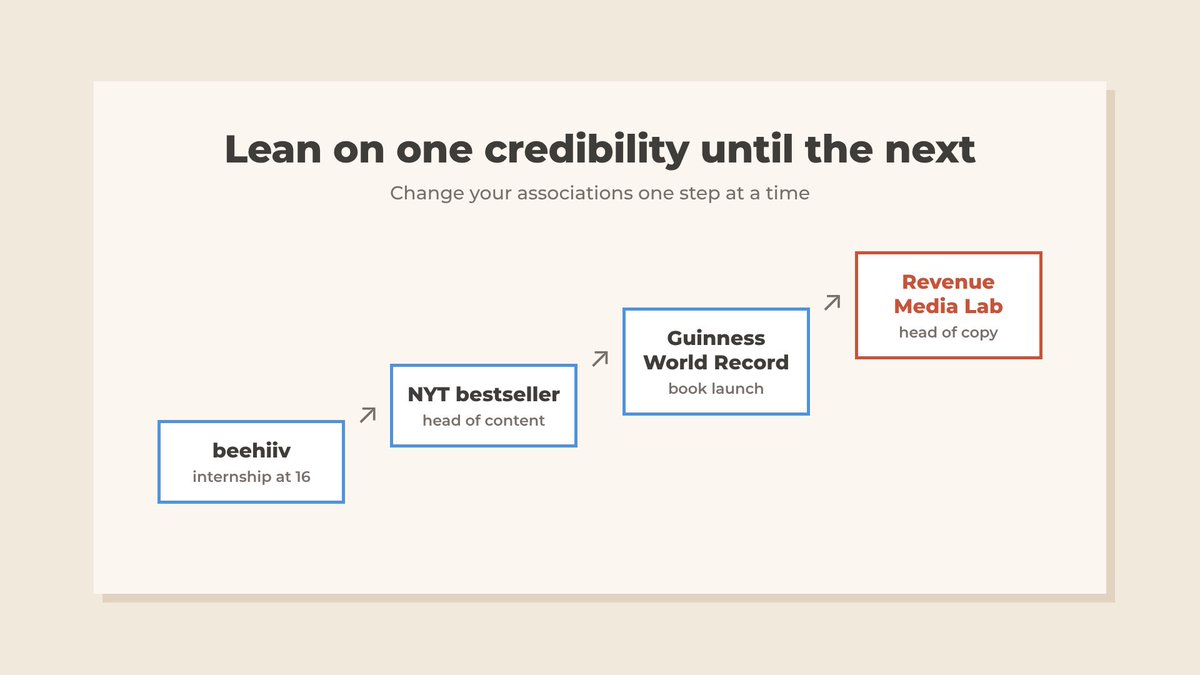
When I started, I leaned on my internship at beehiiv. Then on being head of content for a New York Times bestseller. Then on helping run the launch of a book that broke a Guinness World Record.
You lean on one credibility until you get the next.
It doesn't have to be a hard pivot. You slowly change the associations people have with your brand by adding new proof and talking about it until the new association sticks.
Reflection questions:
-
If someone described me to a friend in one sentence right now, what would they say?
-
What do I want them to say instead?
-
What do I need to be associated with, so that when my audience has a problem, they think of me first?
-
What's the one piece of credibility I can lean on today, and what's the next one I'm working toward?
Influence = power, trust, and likeness
Have you ever wondered why the same advice from one person makes you act, but from another person makes you roll your eyes?
A coworker recommends a book. You smile, nod, then forget about it a few minutes later. A friend tells you to read the same book a week later. You buy it that night.
Or your boss tells you to try a new haircut. You laugh it off. Your girlfriend says the same thing. You schedule the appointment.
The messages are the same in both cases. What's different is the person saying them.
I think about this a lot because my career hinges on my ability to influence people. I'm a writer. Writers can't fire their readers, promote them, or pay them. Influence is the only tool we have.
So I came up with a framework for it, which I call PTL (power, trust, and likeness). I spent an entire 2.5-hour car ride trying to poke holes in it and prove it wrong (I couldn't).
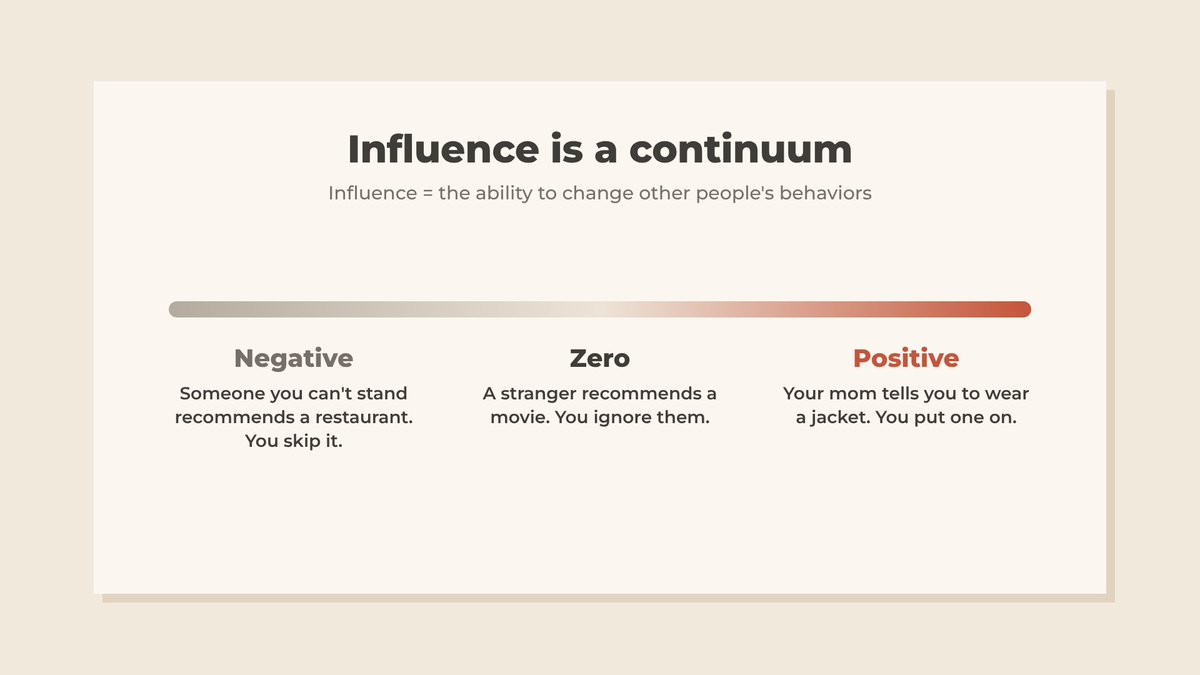
Influence is a continuum
Influence is not "do you have it or not." It's "how much do you have."
Positive influence is when someone tells you to do something and you're compelled to do it. Your mom tells you to wear a jacket and you put one on.
Zero influence is when someone tells you to do something and you don't react in either direction. A stranger on the street recommends a movie. You ignore them.
Negative influence is when someone tells you to do something and you're compelled to do the opposite. A person you can't stand recommends a restaurant and you decide not to go, even if it's a good restaurant.
Take Kim Kardashian. To one segment of the population, Kim has high positive influence. They follow her, buy what she promotes, and listen to what she says about beauty and business. To another segment, Kim has high negative influence. If she recommends a product, they actively avoid it.
So why does someone like Kim move one audience and repel another? It comes down to 3 factors: power, trust, and likeness.
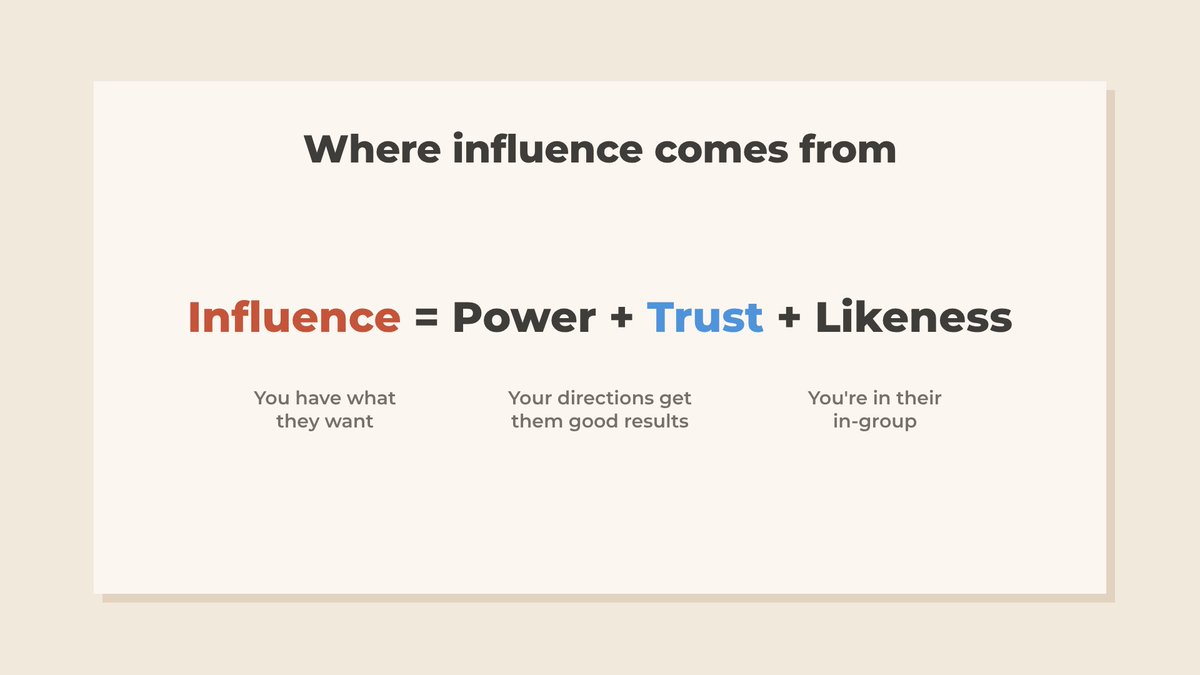
1/ Power
Power is when you have what someone else wants. It's signaling resources: money, status, access, knowledge, or longevity in your field.
Power is relative. It depends on what the other person wants.
A bartender has power in the bar because they control who gets a drink and how fast. Once they step outside the bar, that power is gone. A famous investor has power in a meeting with founders because the founders want their money. The same investor has low power compared to the coach at a kid's soccer game.
On X, power doesn't mean recording flashy cars and mansions. It means showing you have the expertise and knowledge your audience wants. A great way to show power is to show that you have proof, a network, an audience, and a skill set.
This is why I like to signal power in the hook. You want to show that you have what other people want.
2/ Trust
Trust is the belief that following your direction will produce a good result.
Trust comes from evidence (belief without evidence is faith). Trust is built when I tell you to do something, you do it, and a good thing happens. Each time that happens, the likelihood you comply with me in the future goes up.
Parents have high trust with their kids because they've spent years giving directions that produced good results. Eat your vegetables and you'll grow. Wear sunscreen and you won't burn.
Martha Stewart has high trust with her audience because for decades she's been giving step-by-step directions (recipes) that produced good results in their kitchens. If you follow her cake recipe and it comes out right, you get compliments from your spouse, neighbors, and kids. And you associate that good feeling with Martha. So the next time she shares a recipe (or tells you to buy her cookbook), you go grab your flour.
On X, trust comes from content people can act on. If I say, "You should be authentic when you show up online," what does that mean? There's nothing to do with it. But if I say, "Make educational content that teaches your audience something they can implement right away," you can do that this afternoon.
When I give feedback on posts, I'll often tell people to break their post into more tactical pieces, so that even if I'm skimming, I take one idea, implement it, and now I associate that value with you.
3/ Likeness
Likeness is how similar you are to the person you're trying to influence.
In psychology this is called the in-group effect. People show favoritism, trust, and empathy toward members of their in-group, and skepticism toward people outside it.
If I had an audience of lumberjacks and put a lumberjack on stage in front of them, they'd probably listen to the lumberjack more than a buttoned-up corporate type, even if both said the same words.
Likeness comes from two places:
-
External: your looks, clothes, age, and how you talk.
-
Internal: what you believe, where you're from, what you care about.
Some external attributes you can change, but most of the time I focus on the internal ones.
The further outside someone's in-group you are, the harder your advice has to work to land, even if it's good advice.
On X, likeness comes from your story and your writing style. For me, I position as: I'm not a guru. I'm a student learning with you, and I'm going to build in public and take you with me.
It also shows up in your sentences. Match your writing to your reader's in-group. "Please don't hesitate to reach out" becomes "text me if you need anything."
How they combine
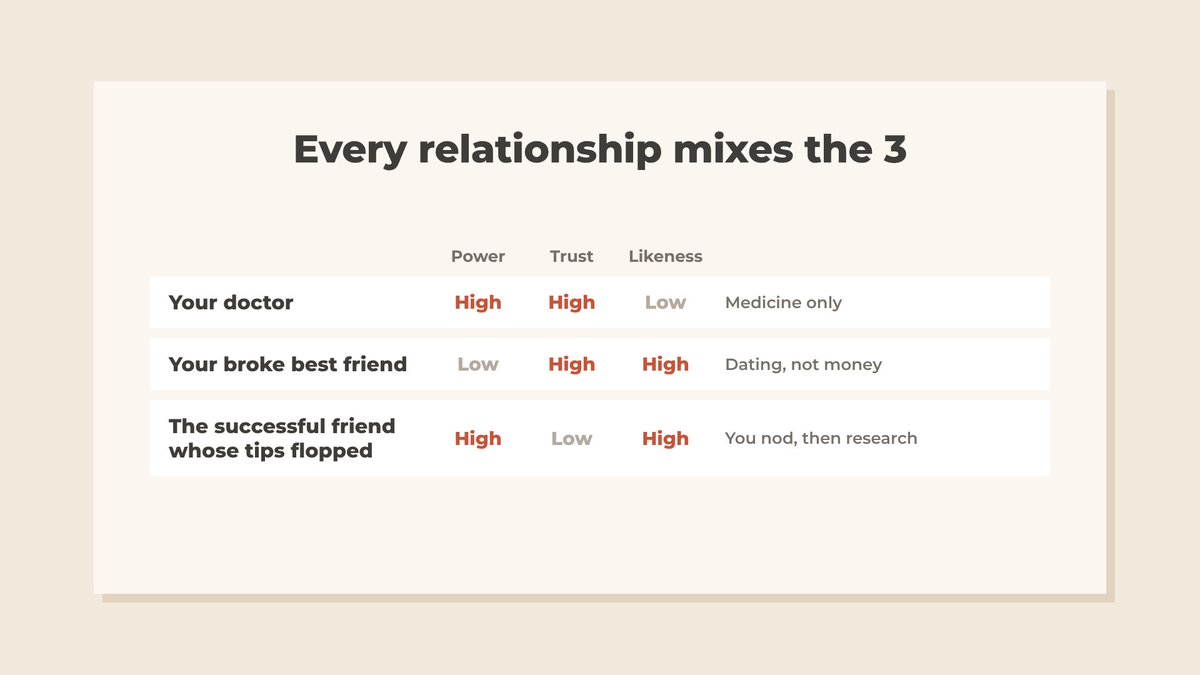
The three factors combine differently in every relationship you have.
High power, high trust, low likeness: Your doctor went to school for 10 years and has been right about your health for as long as you've known them. But you don't have anything in common. You take their advice on medicine and ignore it on everything else.
Low power, high trust, high likeness: Your best friend who's broke. They've been right about every relationship in your life and they understand you better than anyone. You'd take their dating advice in a heartbeat. You wouldn't ask them about money.
High power, low trust, high likeness: A close friend who's built a successful business and shares your values. You'd grab dinner with them anytime. But the last 3 pieces of advice they gave you didn't pan out. So when they tell you something now, you nod and do your own research.
Isn't this manipulative?
Some people who hear this framework say it sounds manipulative.
But we're all playing the influence game whether we realize it or not. Every time you put on a nice watch for a job interview, you're working on power. Every time you remind a colleague of a project that went well, you're working on trust. Every time you find common ground with someone in a conversation, you're working on likeness.
If you're worried about being manipulative, the question is what you're influencing people to do. If it helps them, it's influence. If it hurts them, it's manipulation.
Reflection questions:
-
Power: What do my readers want, both internally (their beliefs and values) and externally? What proof do I have that I've got it?
-
Trust: What step-by-step directions can I give my audience to get positive results this week?
-
Likeness: What are the core beliefs or values my audience has, that I can signal to show we value the same things?
-
Look at my last 20 posts. Which of the three factors is missing?
Pick a premise, not a niche
Conventional wisdom will tell you to "pick a niche." But a niche is saturated. A premise, on the other hand, is memorable.
-
Niche: "I help entrepreneurs." (Who)
-
Premise: "I show entrepreneurs how to build a brand without selling their soul to the algorithm." (What + how + why)
People will ask, "What's this person about?" And if you aren't intentional with what you want people to say, you'll build a brand by default rather than by design.
The Premise Test: Can someone explain what you're about in one sentence after meeting you?
-
James Clear: "The Atomic Habits guy."
-
Ryan Holiday: "Ancient stoicism for modern times."
The goal is to be easy to summarize but hard to compete with.
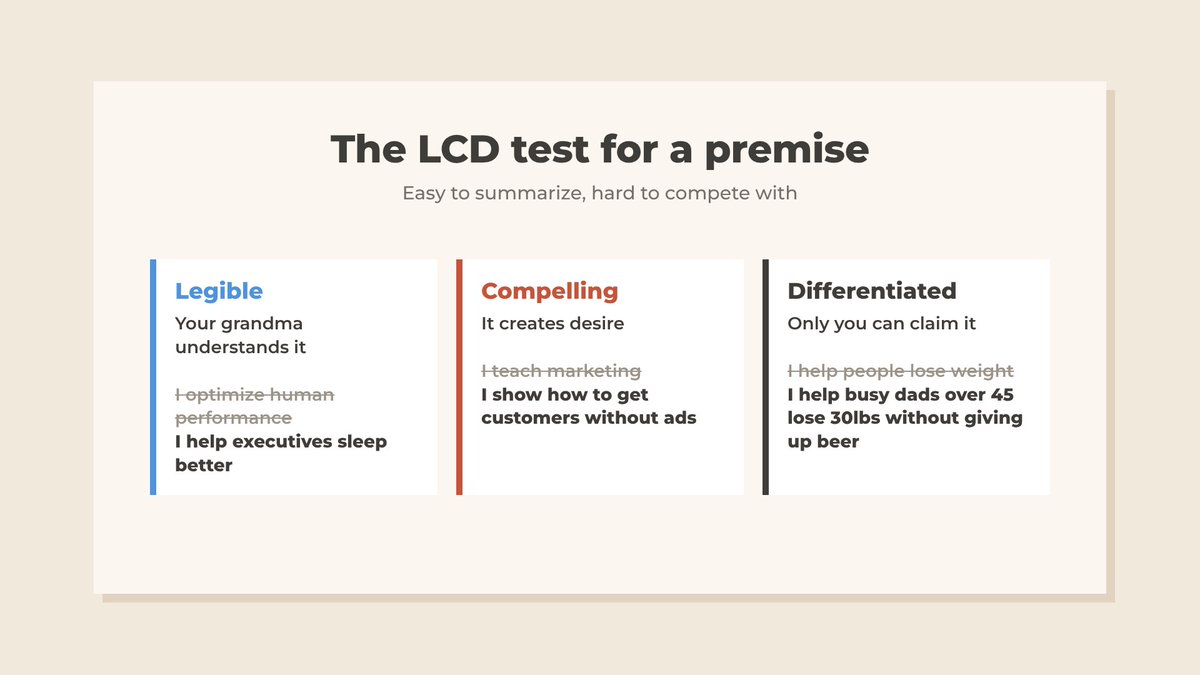
The LCD test
So how do you design a premise? Run it through 3 checks:
1. Legible (your grandma can understand it)
❌ "I optimize human performance"
✅ "I help executives sleep better"
2. Compelling (it creates desire)
❌ "I teach marketing"
✅ "I show how to get customers without ads"
3. Differentiated (only you can claim it)
❌ "I help people lose weight"
✅ "I help busy dads over 45 lose 30lbs without giving up beer"
Niche by transformation, not topic
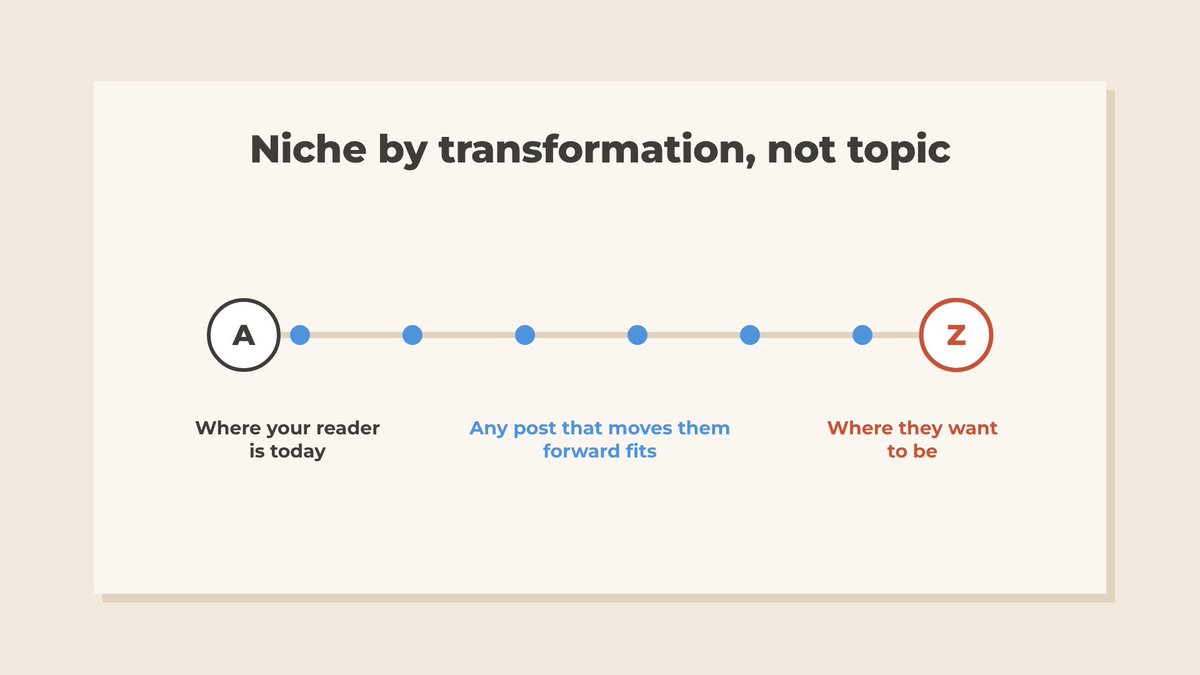
I don't like to niche by topic. I like to niche by transformation.
If you niche by topic, you box yourself in. "I write about productivity" means your workout, your trip, and your failed launch are all off-limits.
If you niche by transformation, you ask: Where are my readers today (A), and where do they want to be (Z)? Every post that helps someone move from A to Z fits, whatever the topic.
If you're early, the transformation can be your own. Ask yourself: Where am I at today? Where do I want to be in the future? What's the gap? What skills do I need to learn to close it? And then document that journey.
Values hold up the premise
The next piece of advice the content gurus will give you is to pick your topics. But topics are too broad, and even more important, they're impersonal.
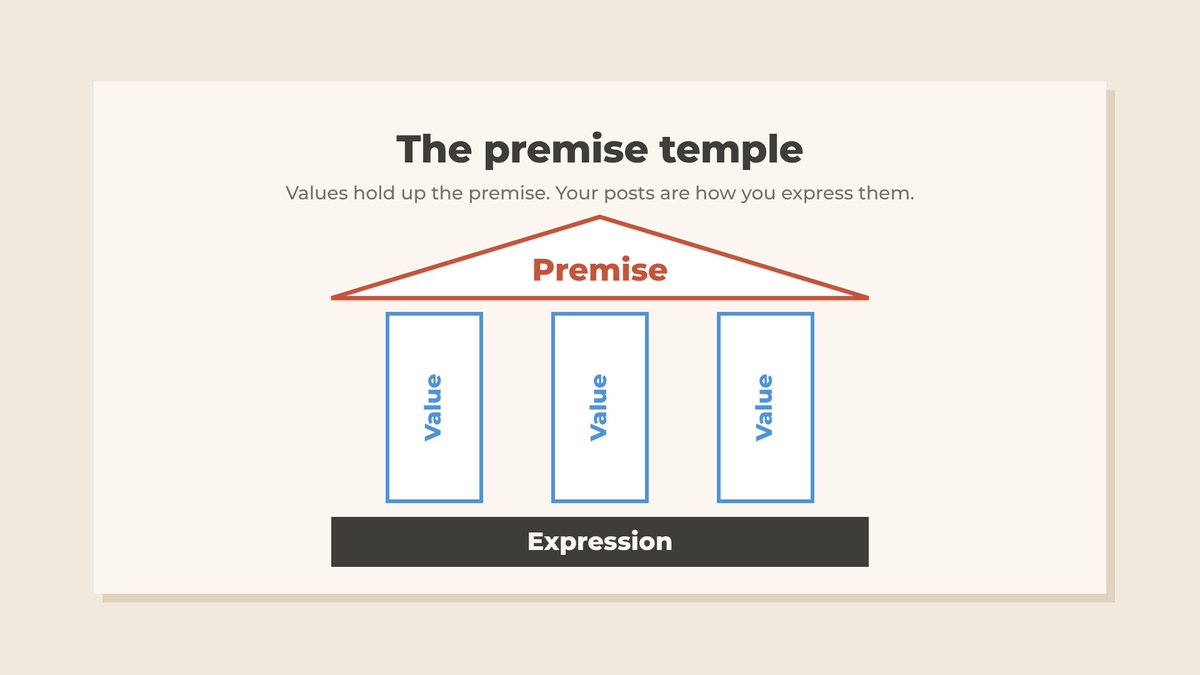
Instead, focus on values (the beliefs that support your premise).
I think of it like a temple. Your premise is the roof. Your values are the pillars holding it up. And your expression (your posts, your stories, your style) is the foundation everything stands on.
Values matter because they're magnets. Your values attract people who believe in the same things.
They're also repeatable. They make it easy to say the same idea in 1,000 different ways. Look at the biggest creators you follow and you'll see them tweet about the same few values over and over, expressed differently each time.
And sharing what you stand against matters even more than sharing what you stand for.
Story, values, and mission
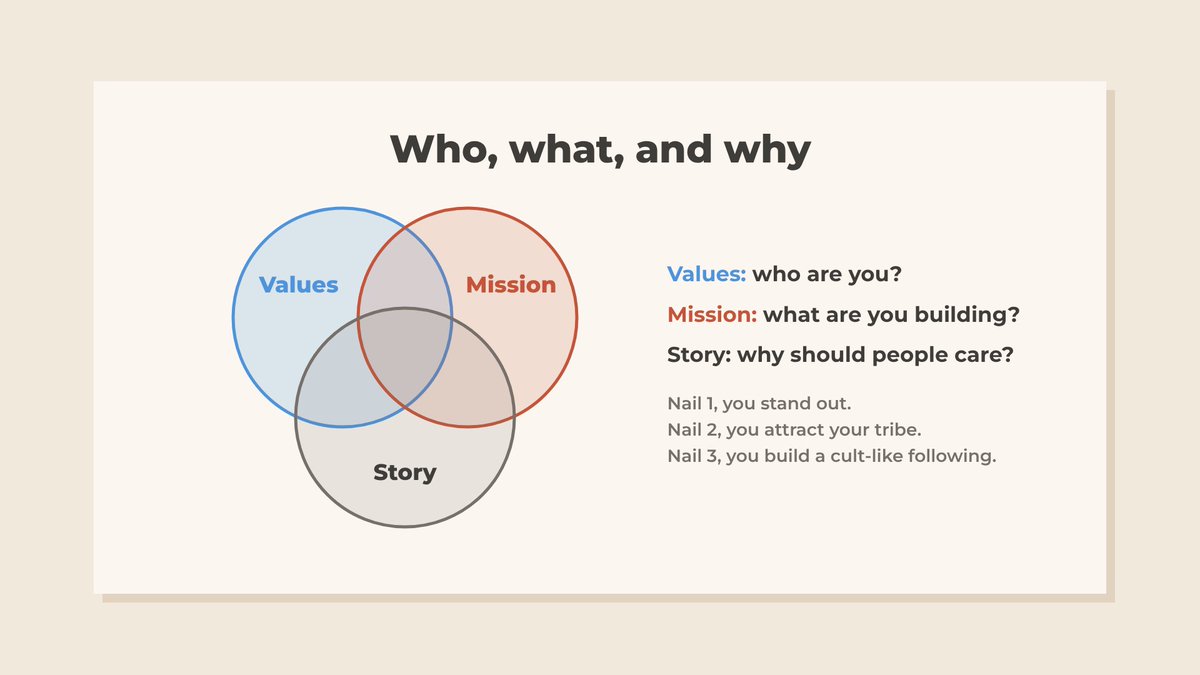
Back in 2023, I wrote about the 3 questions every account has to answer:
-
Who are you? That's your values.
-
What are you building? That's your mission.
-
Why should people care? That's your story.
If you nail one, you'll stand out. If you nail two, you'll attract your tribe. If you nail all three, you'll build a cult-like following.
Your story is the most powerful asset you have as a creator. If you have a compelling story from the past, share it. If you don't, build it in public.
Reflection questions:
-
Finish this sentence the way I'd want a stranger to: "Oh, [my name]? That's the person who ______."
-
Does my premise pass the LCD test? Would my grandma understand it?
-
Where is my reader today (A), and where do they want to be (Z)?
-
What's my personal quest? What do I believe strongly that most people don't?
-
What makes me angry? What do I stand against?
Authority, reach, and resonance
Power, trust, and likeness tell you what you need to signal. But how do you turn that into posts?
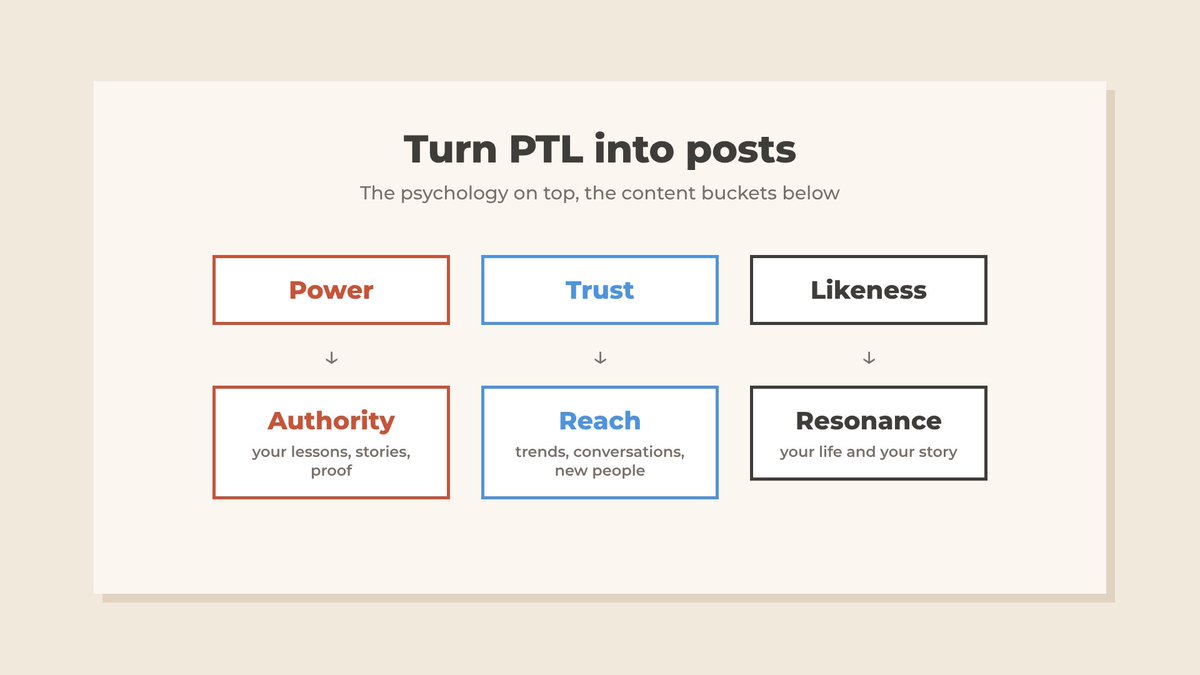
I reverse engineer PTL into 3 content buckets I call ARR: authority, reach, and resonance.
Authority
Authority content demonstrates that you know what you're talking about.
This is why I'm not a big fan of the posts that go, "This is Elon Musk, he did X, Y, and Z, and here are 7 lessons." When you write about others, you build an audience. When you write about yourself, your stories, and your learnings, you build authority.
Ask yourself: What educational content, personal lessons, or client stories can I share to demonstrate my expertise?
Reach
Reach content gets you in front of people who've never heard of you.
What trends are happening out in the world? What conversations is my audience having that I can tap into? What viral quotes or tweets can I screenshot and add my commentary to?
At a past job, we used to film workplace skits. Did those skits drive any meaningful revenue directly? Absolutely not. They had nothing to do with business. But more and more people shared them with their friends, and months down the road, more business owners found us and came to our workshops.
So it's not "should I go viral or should I make authority content?" You want both.
Resonance
People like to listen to people they know, like, and trust. If you're a robot spitting out educational information, you'll sound like AI. People don't only want to learn information. They want to connect with the messenger.
This is why the market for content can't be saturated. The messenger changes the message. Hearing an idea from me is different from hearing the same idea from someone else.
Reach gets you well known. Resonance gets you known well (as Shaan Puri puts it, you want to be known well, not only well known).
So for your resonance content, share your life and your story online. I like to build a binge bank: a set of posts (your story, best guides, and biggest lessons) a new follower can binge in one sitting to get to know you fast. Founders tend to skip these posts, so make a point of writing them. In our client work, resonance posts booked the most calls, because prospects showed up already knowing, liking, and trusting the founder.
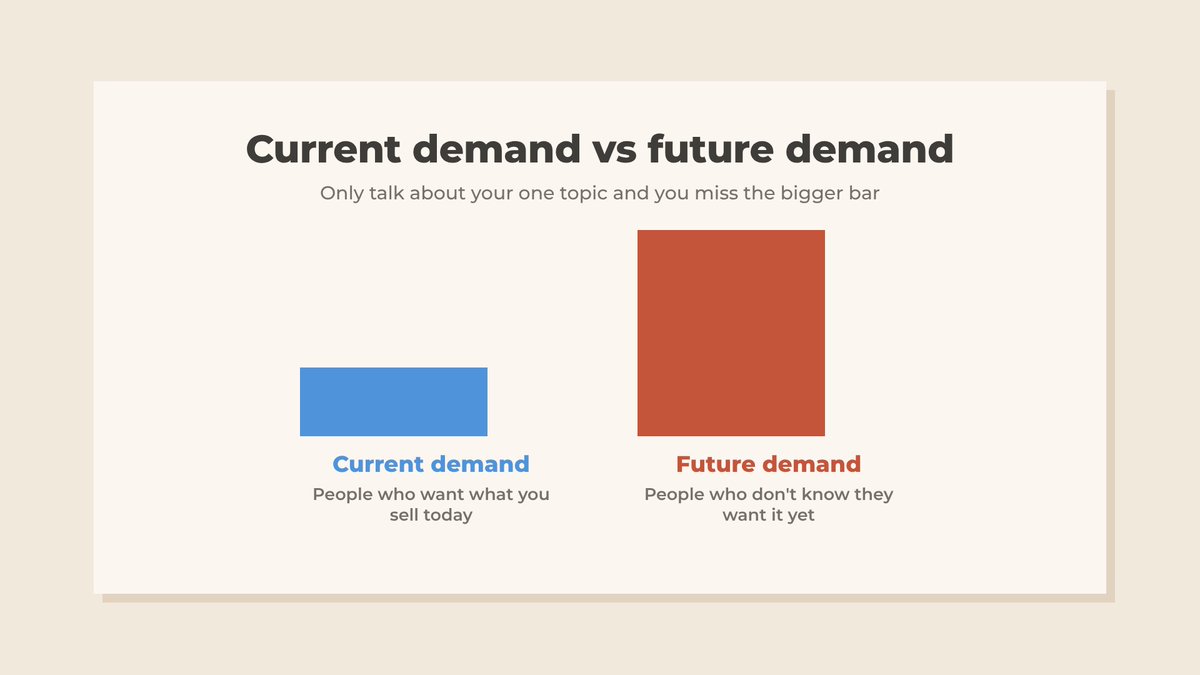
Current demand vs. future demand
There's one more reason you need reach content.
If you only talk about your one topic, you capture current demand: the people who already want what you sell. But you miss out on all the future demand, because you're not speaking to new people.
So I ask: How do I get my grandma to be interested in what I'm talking about? If you operate from that lens, that's how you get new people into your world.
Reflection questions:
-
Sort my last 20 posts into authority, reach, and resonance. Which bucket is empty?
-
What's one story from my life this month that I haven't shared?
-
How would I explain my core topic so my grandma would care?
Become someone worth following
Chase mastery, but do it in public.
People follow interesting people. To write interesting tweets, I need to do interesting things.
Back in 2023, I shifted my content to 3 kinds of posts:
-
Things I've personally done
-
Things I've personally learned
-
Not things you can Google
Show, don't tell
Instead of relying on a resume to tell people what you can do, you can point to your portfolio and show them.
When you do great work in public, each opportunity opens up the next.
This is why my favorite growth strategy has nothing to do with X. Go do something interesting (run a marathon, ship a product, help a client get a result, write a book), then write about what you learned.
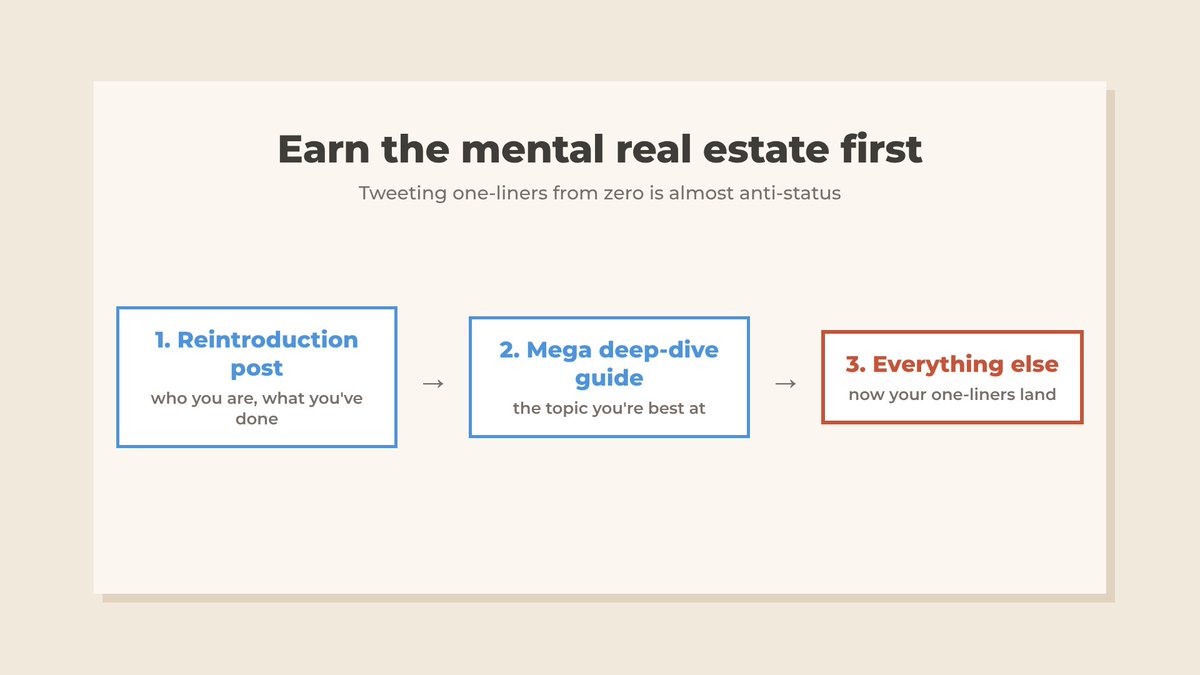
Earn the mental real estate first
A mistake I see all the time, especially from founders and experts joining X, is tweeting one-liners out of the gate. Everyone goes, "Who the f*ck are you?" It's almost anti-status.
The reason James Clear can tweet about habits and go viral is because people have read Atomic Habits. He already owns the mental real estate.
So the first 2 posts I have everyone do when they start on X:
-
A reintroduction post. Who you are, what you've done, and what you'll be posting about. This is where you're allowed to subtly flex.
-
A mega deep-dive guide on a specific topic you're the best at. Something people save and send.
Then you start with everything else.
Fix the profile before you chase more posts
When I started, I'd tweet 10 times a day, engage like a madman with other accounts, and consistently get tons of likes and replies. But few would convert to followers.
Then I stumbled across a large account and noticed what they did differently: their profile. It told you who they were, what they wrote about, and why you should listen.
Your posts send people to your profile, and your profile is where they decide whether to follow you.
Run your bio through 3 questions:
-
Who are you?
-
What do you write about?
-
Why should people listen to you?
Reflection questions:
-
What's the most interesting project I've taken on in the last 90 days? Have I written about it?
-
What do I know from experience that someone can't Google?
-
If a stranger landed on my profile, would they know who I am, what I write about, and why to listen in 3 seconds?
-
Have I written my reintroduction post and my mega deep-dive guide?
Say true things in non-obvious ways
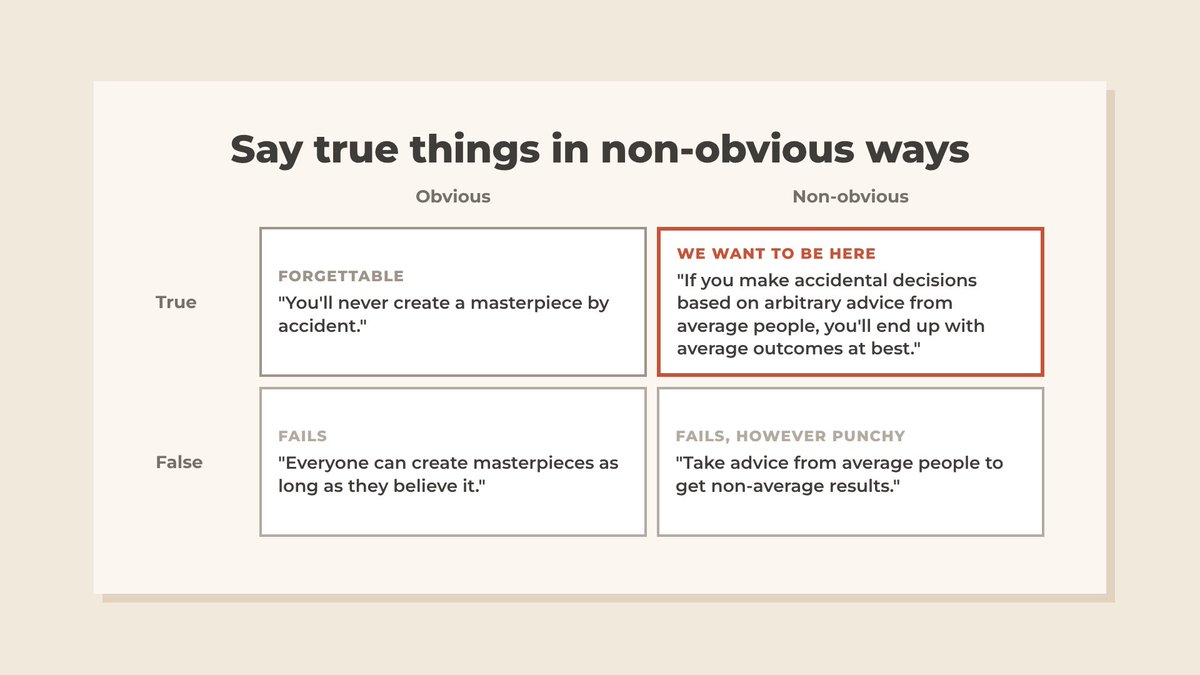
I think of sentences in a 2x2: true or false, and obvious or non-obvious.
-
True and obvious: "You'll never create a masterpiece by accident."
-
True and non-obvious: "If you make accidental decisions based on arbitrary advice from average people, you will end up with average outcomes at best."
A lot of tweets are true but obvious. And when something feels like "yeah, I've heard that before," it doesn't trigger much emotion or engagement.
We want to say true things in non-obvious ways.
A few rules I follow on every post:
One idea per post.
❌ Saying the same idea 3 different ways in one post (it dilutes the message)
✅ One idea, said once, said well
Frame it as an observation, not a command.
❌ "You need to stop chasing followers."
✅ "The best accounts I know stopped chasing followers years ago."
People don't like being told what to do. It's too direct.
Earn the aphorism.
❌ A vague one-liner with no story or proof behind it
✅ The same line after you've built the mental real estate to say it
You're not Naval. Don't use juxtaposition and contrast for the sake of it. The tweet still has to make sense.
And one more on AI: the easier it is to use AI to write something, the more alpha there is in not using AI to write it, especially on Twitter.
Fundamentally, it was never about the writing in the first place. It was about the thinking.
(I'm publishing a full article tomorrow on how to write a great sentence. This is the short version.)
Reflection questions:
-
What am I trying to say in my next post, in one sentence?
-
Which of my last 5 posts was true but obvious, and how would I rewrite it?
Test, then invest
X is one of the fastest feedback loops on the internet.
When a text tweet does well, I know it's the idea behind it, because there's no fancy visual, graphic, or video carrying it.
That makes X an idea lab. And there's a pocket of Twitter I call money Twitter: entrepreneurs, operators, and builders. When Elon Musk takes a bathroom break and opens his phone, he's not scrolling Instagram.
So I use X to test ideas cheaply, then put more behind the ones that win.
The weekly review
Writing consistently is one part of growing online. The 2nd part is reflecting on and analyzing your performance.
Every week, ask:
-
What worked? Why?
-
What didn't work? Why?
-
How can I do more of what worked?
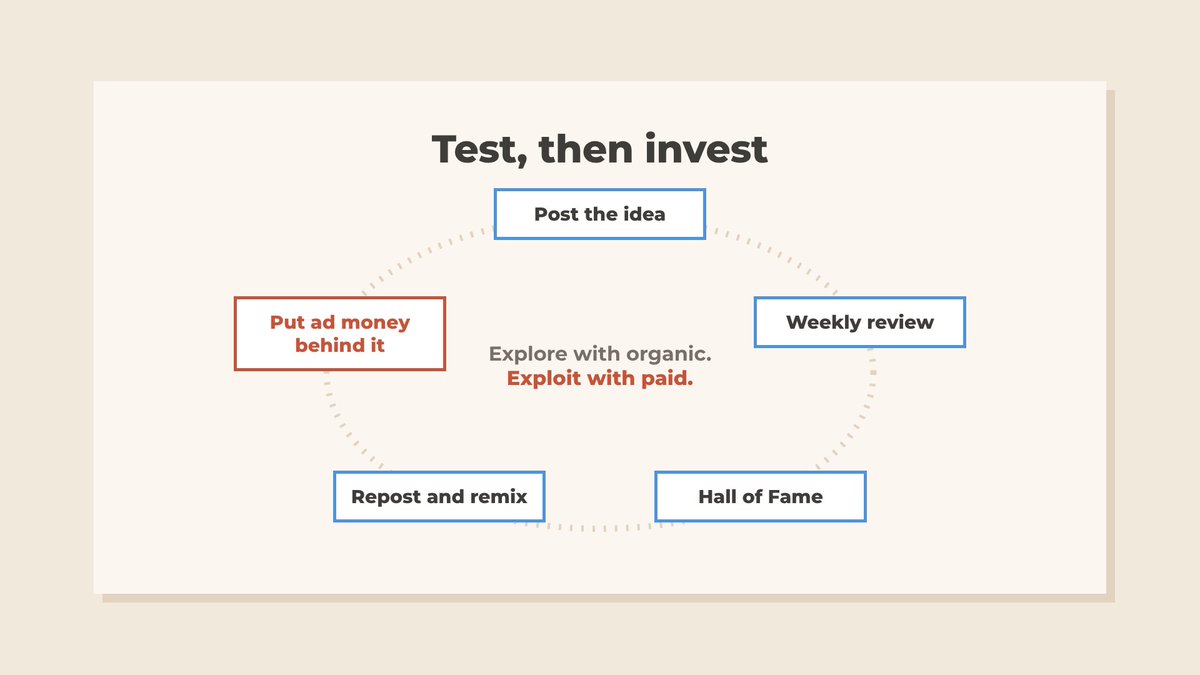
Repost your winners
When a post outperforms, save it to a Hall of Fame. Then reuse it.
If you're thinking your audience is going to get tired of you, they won't. We need to be reminded about the core few ideas more than we need to be taught new ones.
There are 2 ways to remix a winner:
-
Same structure, different topic.
-
Same topic, different structure.
To find more, use the 5S method on accounts you admire: scroll, study, save, scribe, and steal (the structure, not the words).
Explore with organic, exploit with paid
My rule is to explore with organic and exploit with paid.
Organic is free to post, so you test angles there. But the results vary. Once a post proves an idea works, you can put money behind it. One client tweet that did 400,000 views became the hook for one of their ads.
Reflection questions:
-
What are my top 10 posts of all time? What do they have in common?
-
When did I last repost or remix a winner?
-
Which of my winning ideas could I turn into an ad, a newsletter, or a video?
Relationships are the compounding asset
Twitter is SOCIAL media. My goal is to make lifelong friends.
Some of my greatest friendships have been forged through interacting on Twitter and then meeting in person. If you think someone is working on something cool, DM them. That's how I met Mike and started working with him on the Startup Archive.
I used to take pride in being a lone wolf. Now I realize relationships are everything.
Givers get
Givers get. That's life.
Nothing brings more goodwill and reciprocity than shouting out a smaller creator. How do I know? Because I was once a smaller creator.
Early on, I formed a mastermind with 4 friends. We gave each other feedback and shared each other's work. Today, I run a group chat for Publish30 that does the same for its members.
Your reputation is an asset
The biggest thing I've learned on Twitter is that your reputation is an asset. Being known as "the guy who gives tons of value" is priceless.
At one point, the inbound requests got so overwhelming that I doubled my prices to filter through the noise. Ironically, that only increased the number of inbound requests I received.
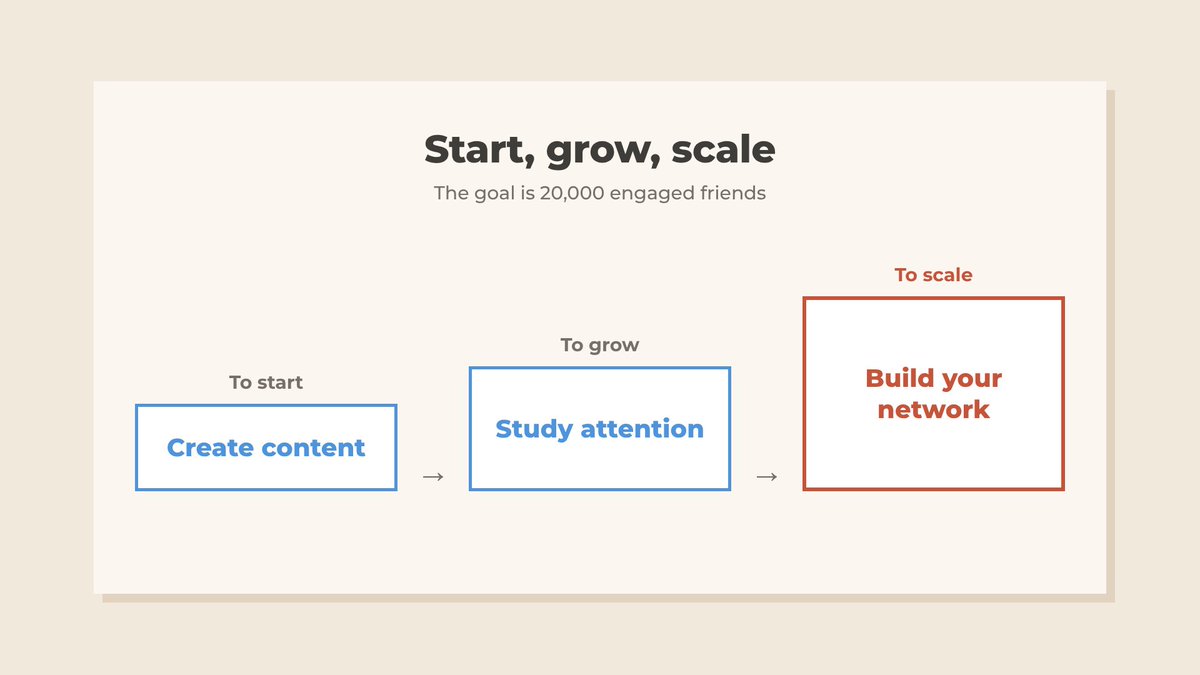
The goal isn't to have 100,000 disengaged followers. The goal is to have 20,000 engaged friends.
I summed up the progression like this back in 2023:
To start, create content. To grow, study attention. To scale, build your network.
Reflection questions:
-
Who are 10 people on X I admire and want to know in a year? Have I added value to any of them this week?
-
Who's a smaller creator I can shout out today?
-
Who's in my feedback group? If nobody, who are 3 friends I could start one with?
Leverage beats consistency
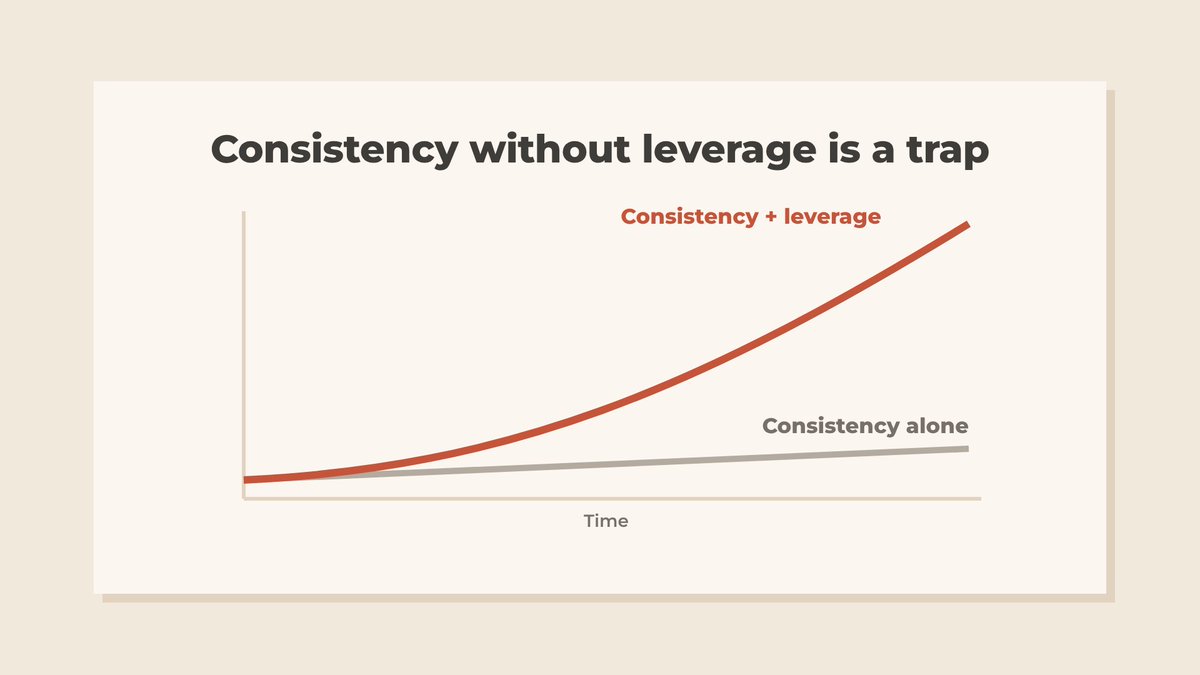
A lot of people will tell you consistency matters most.
I once wrote a parable about a guy named Consistent Chris, and the lesson stuck with me: the world doesn't reward the man who swings hardest, or longest, or most consistently. It rewards the one who finds leverage.
Leverage on X looks like:
-
A premise people can remember
-
A Hall of Fame you can repost from
-
A skill (writing) that makes every post better
-
Relationships that share your work
-
Proof that does the convincing for you
Focus
The hardest part of building a business on the internet is not getting distracted by the internet.
When I started, I was writing on Twitter, starting a newsletter, making Instagram videos, and taking random freelancing gigs all at once. Those distractions ended up costing me two years.
The mistake? Trying to skip steps.
All the benefits of having an audience (the opportunities, the clients, the friends) happen after you get good at writing. At the start of my career, I wrote 10+ tweets a day for 6 months straight, and I copied my favorite writing by hand, pen and paper. It took 6 months before I felt somewhat decent.
Reflection questions:
-
Which of my daily habits on X would I still be glad I did in 2 years?
-
What's one platform or project I need to drop so I can get great at X first?
-
Where's my leverage? If I stopped posting for 30 days, what would keep working for me?
What changes at each stage
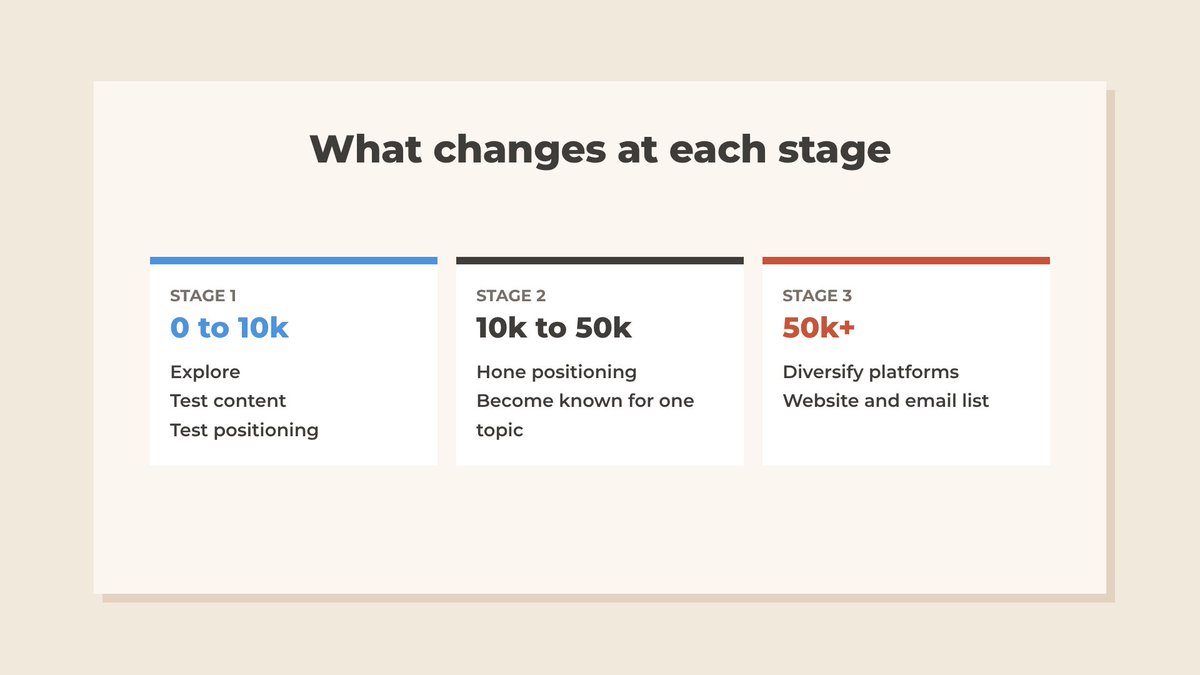
The right moves at 500 followers are the wrong moves at 50,000.
Stage 1: Beginner (0 to 10k)
Explore. Test content. Test positioning. Post a lot, reply a lot, and find out what people respond to. Fix your profile. Write your reintroduction post and your deep-dive guide.
Stage 2: Intermediate (10k to 50k)
Hone your positioning. Become known for one topic. Double down on what worked in stage 1 and cut what didn't. Build your Hall of Fame and repost from it.
Stage 3: Advanced (50k+)
Diversify platforms. Focus on your website and email list.
Reflection questions:
-
Which stage am I in?
-
Am I doing the work of that stage, or the work of a stage I haven't earned yet?
How my account grew (the honest version)
People expect a growth story to have one viral tweet that changed everything. Mine doesn't.
I started posting content online the summer before my freshman year of high school. I grew an Instagram theme page to 120,000 followers and sold it for $1,250. That's where I learned how to use social media to attract and funnel attention to an offer.
Then I got on Twitter and documented my journey in real time.
After growing to around 1,000 followers in under 30 days, someone asked if I'd get on a call to teach him Twitter growth. We had a nice 1-hour coaching call and he paid me $27. That was my first dollar from X.
Then came the 10+ tweets a day, profile fix, deep dives, mastermind, and a lot of posts that did nothing.
The following grew as I grew. The more cool stuff I did, the more my following grew. It wasn't slow or explosive. It was kind of linear. There wasn't a specific post or moment that accelerated things.
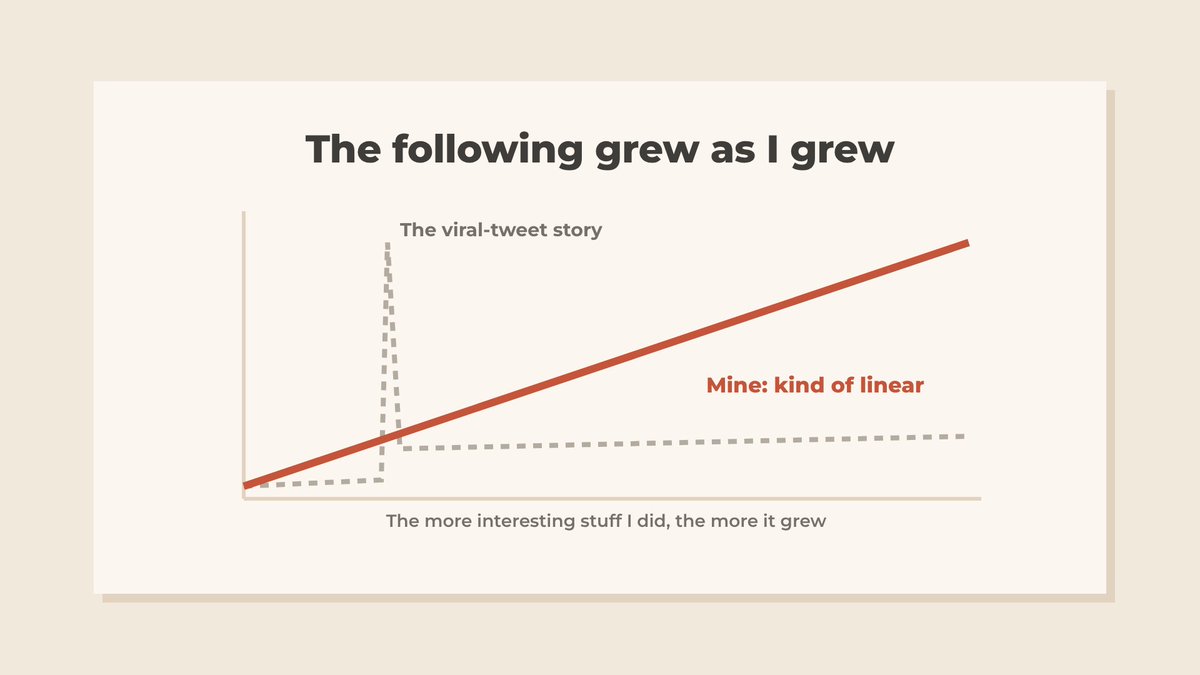
I got better at writing, did more interesting stuff to write about, built more proof, and made friends who shared my work, and the account grew with me.
Reflection questions:
-
What will I have done in 12 months that makes me more worth following than I am today?
-
Am I waiting for a viral moment, or building a line that goes up?
The system
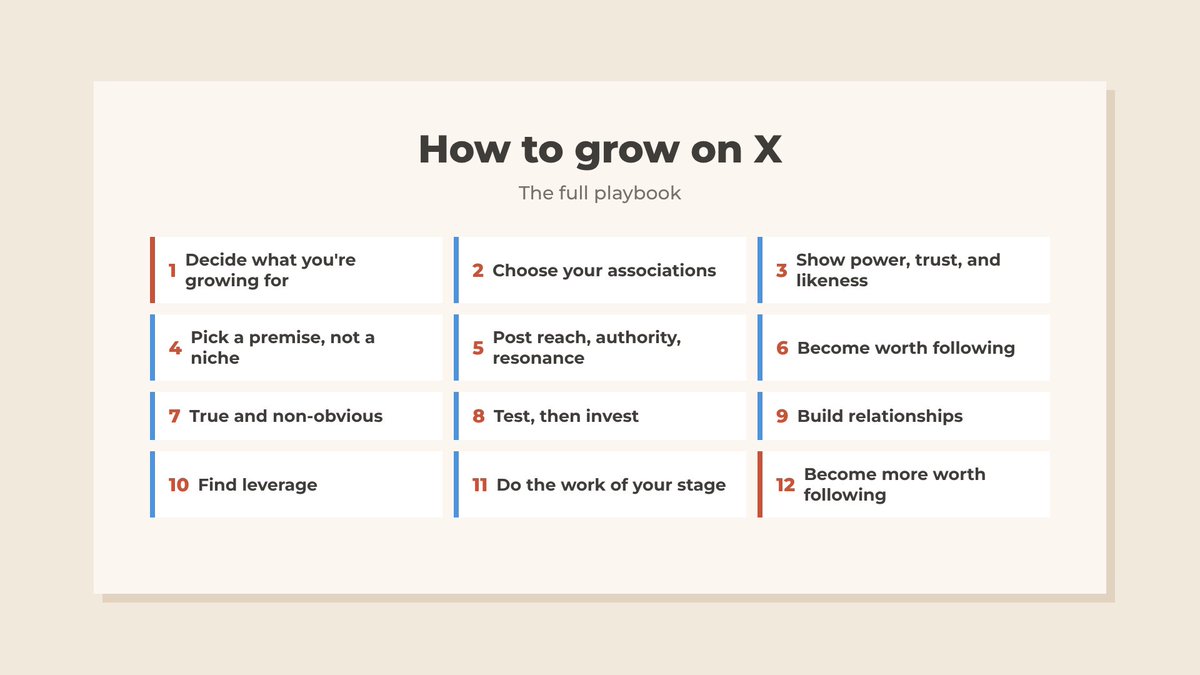
Here's the full playbook:
-
Decide what you're growing for. Influence with the right people, not a follower count.
-
Choose your associations. Branding is teaching. Ask what outcome you want and what you need to be associated with to get it.
-
Show power, trust, and likeness. Show you have what they want, give directions that get results, and show you're in their in-group.
-
Pick a premise, not a niche. Make it legible, compelling, and differentiated. Niche by transformation. Hold it up with your values.
-
Post across authority, reach, and resonance. Capture current demand and build future demand.
-
Become someone worth following. Do interesting things, earn the mental real estate, and fix your profile.
-
Say true things in non-obvious ways. One idea per post.
-
Test, then invest. Review weekly, repost winners, explore with organic, and exploit with paid.
-
Build relationships. Givers get. Your reputation is an asset.
-
Find leverage. Focus on one platform until you're great at it.
-
Do the work of your stage.
-
Become more worth following every year.
Don't study the algorithm. Study human nature.
Until next time,
Jay "Known Well" Yang
Ps. If you're a founder who wants to build a brand on X without spending 20 hours a week writing, this is what we do at Revenue Media Lab. We become your head of copy and run your content department. You can learn more at revenuemedialab.com.
沿着这个主题继续读
从一篇文章,找到相关的教程、经验和阅读路径。