The Google Algorithm Explained, In Depth (Opus 5.5 read the whole leak)
文章目录
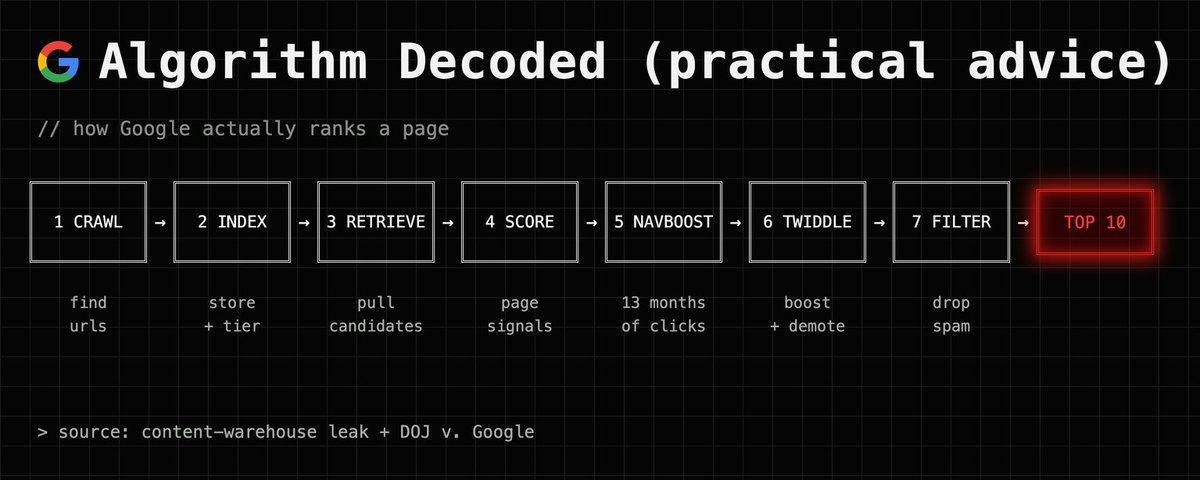
How the search engine decides who wins a query, what it rewards, and the best practices to land on the first results page. Tag your @bot to digest this entire breakdown
Everything here comes from Google's own leaked ranking docs, the DOJ trial testimony and my own SEO, so it's practical
Why listen to me?
My job is to rank pages. The ChatSEO blog went from 0 to 3,000 visits a month with 2 articles a week, and my consultant site brings me leads for about 20 minutes of work a week
I had Opus 5.5 read all 2,596 leaked modules so you don't have to
I am NOT from Google. This is my interpretation of the docs
Here is an example of the results you could achieve with this method:
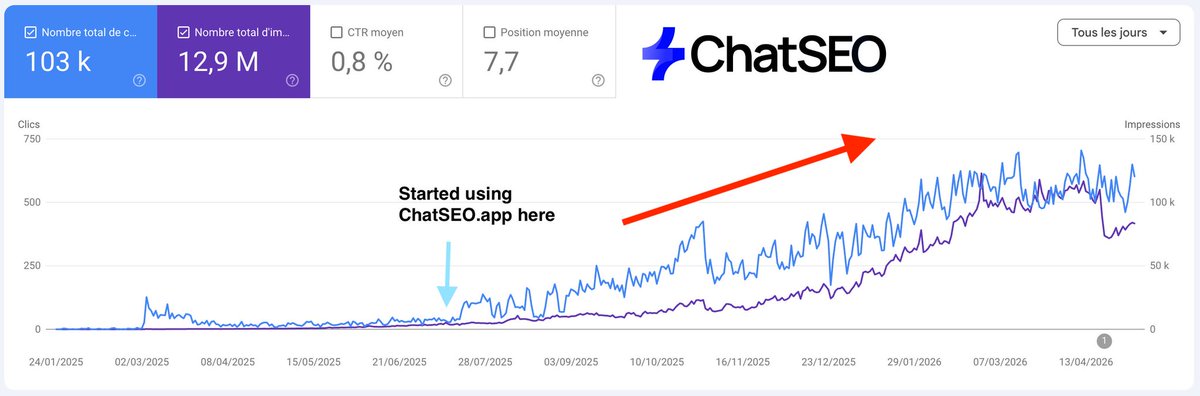
To get similar results for your business: try ChatSEO free for 7 days
Little tip: bookmark this. It is long on purpose, and you will want it open the next time a page of yours drops for no reason
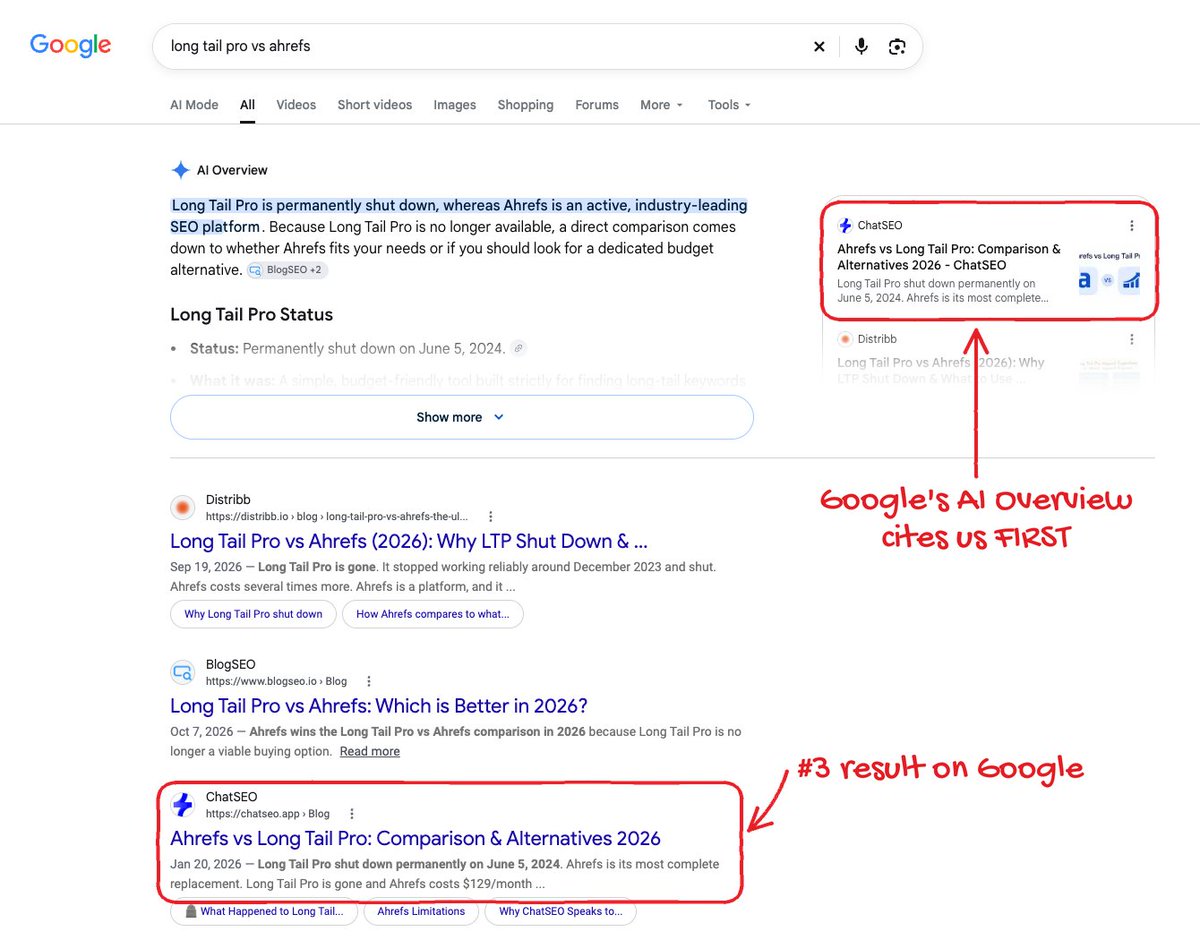
The first screenshot above is a live Google search for "long tail pro vs ahrefs". Our page is the first source Google's AI Overview cites, and the third blue link under it. Nothing in that page is a trick. It is built on the same rules you are about to read
Where this comes from
In March 2024, a set of internal Google documents was pushed by mistake to a public code repository. They describe the "Content Warehouse": the data Google stores about every page, every site and every link it knows. Two people in the SEO world, Rand Fishkin and Mike King, were the first to write about it in May 2024, and Google confirmed the documents were real
What leaked is not the code. It is the list of what Google measures: 2,596 modules and 14,014 attributes, each with a name, a type and very often a short comment written by a Google engineer for other Google engineers. Those comments are the gold. They say things like "applied in Qstar", "used in twiddler to sandbox fresh spam" or "LLM-based effort estimation for article pages"
The second source is the US Department of Justice trial against Google (2023 and 2024). Under oath, Google's own people described how ranking works, NavBoost and its 13 months of click data included. When the leak and the testimony say the same thing, I treat it as solid
The third source is my own sites. I only kept what I have watched move a real page in Search Console
What the leak does NOT give you: the weights. Nobody outside Google knows if a signal counts for 0.1% or 30% of a ranking. Anyone who sells you "the 200 factors with their weights" is guessing. So I will tell you what exists, what it is for, and what I do about it. You decide how hard to push
How I read 2,596 modules without losing a month:
-
I pulled the whole public mirror of the docs (every module, every attribute, every comment) into one plain text file
-
I cut it into 6 parts so each one fits comfortably in Opus 5.5's context
-
I gave each part the same job, the prompt below, and asked for quotes, never summaries
-
then I checked every quote I use in this article against the live docs page, and captured that page. Every red box below is on Google's own text
Here is the prompt, if you want to do your own reading:
You are reading part {N} of 6 of Google's leaked Content Warehouse API docs
(2024 leak). Each module lists attributes with a type and, often, a comment
written by a Google engineer.

Your job: find every attribute that tells us how Google judges a PAGE, a SITE,
a LINK or a CLICK for ranking in web search.

For each one, give me:
1. the module name and the attribute name, exactly as written
2. the engineer's comment, quoted word for word (no paraphrase)
3. what it measures, in one plain sentence a site owner understands
4. what a site owner could actually do about it, or "nothing" if nothing
5. your confidence that it is used for ranking today: high, medium, low,
   with the words in the comment that justify it

Rules:
- Quote, never invent. If the comment is empty, say "no comment" and give
  low confidence.
- A field that exists is not proof it is used. Say so when that is the case.
- Ignore anything about Ads, YouTube internals, Maps internals or storage
  formats, unless it says it feeds web ranking.
- Group the results by: crawl and index, page quality, site quality, topic,
  links and anchors, clicks and user behaviour, demotions and spam, freshness.
One field kept me honest the whole time. In the leak there is a module called Kaltix, with a comment that reads "empty for now". A field name is a plan, not a proof. Keep that in mind every time someone screams "Google uses X!" because they found X in a list
Part 1: How to think about Google
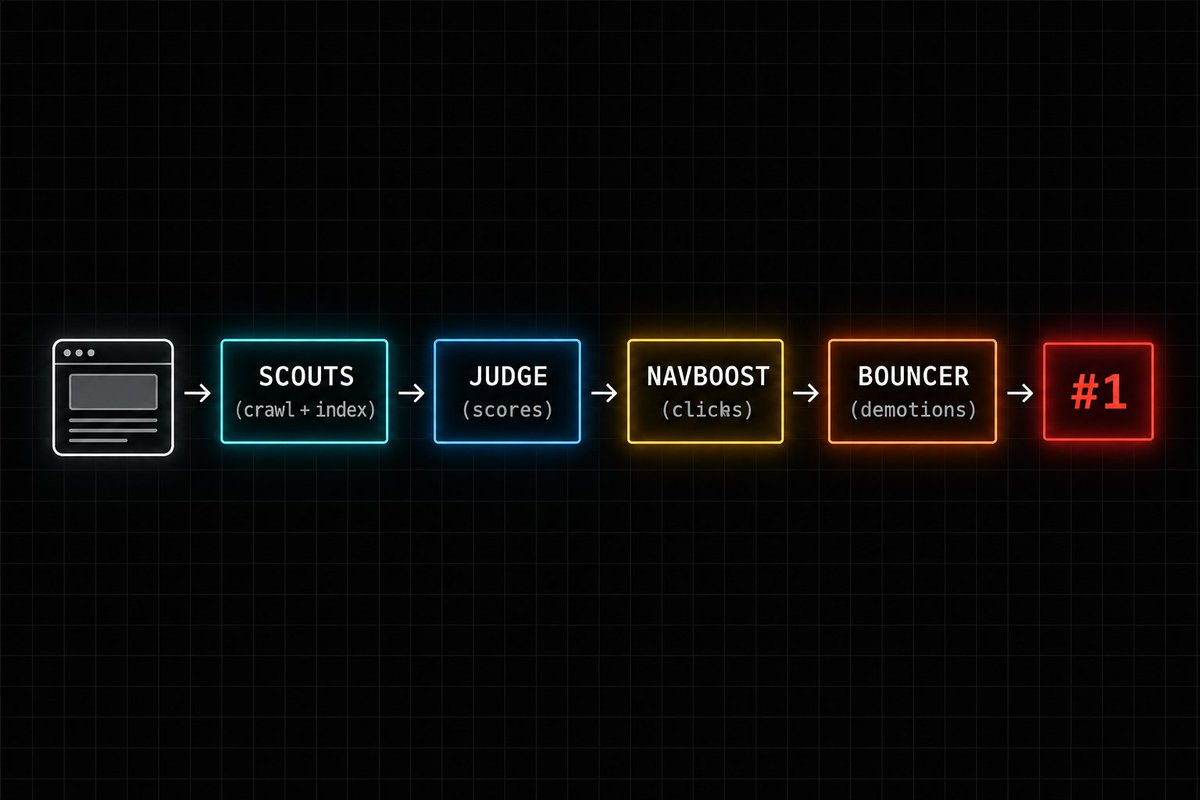
Most people imagine Google as one giant brain that reads your page and gives it a grade. It is not one brain. It is a chain of separate systems, built by different teams over 25 years, each one passing a shortlist to the next
The simplest way to hold it in your head is four characters:
-
the Scouts find your page, read it and file it (crawl, render, index, retrieve)
-
the Judge scores it, on its own and as part of your site (quality, authority, topic, links)
-
NavBoost watches what real people do with it once it is shown (clicks, and which click ended the search)
-
the Bouncer, at the very end, can push it down or throw it out (demotions, spam, "twiddlers")
Each step works on a smaller list than the one before. The Scouts deal with hundreds of billions of pages. The Judge deals with the thousands that could match your query. NavBoost and the Bouncer reorder the few hundred that are left, and you see ten
Why does that matter to you? Because each step fails for a different reason, and each fix is different
-
if you are not indexed, no amount of "quality" helps you. That is a Scout problem
-
if you are indexed but stuck on page 3, it is usually the Judge: topic, authority, links
-
if you hit page 1 and slide back to page 2 a few weeks later, it is very often NavBoost: people clicked and did not stay
-
if you drop off a cliff overnight, look at the Bouncer: a demotion or a spam signal
One more thing the leak makes very clear. A lot of the scoring happens BEFORE anyone searches. Look at this one:
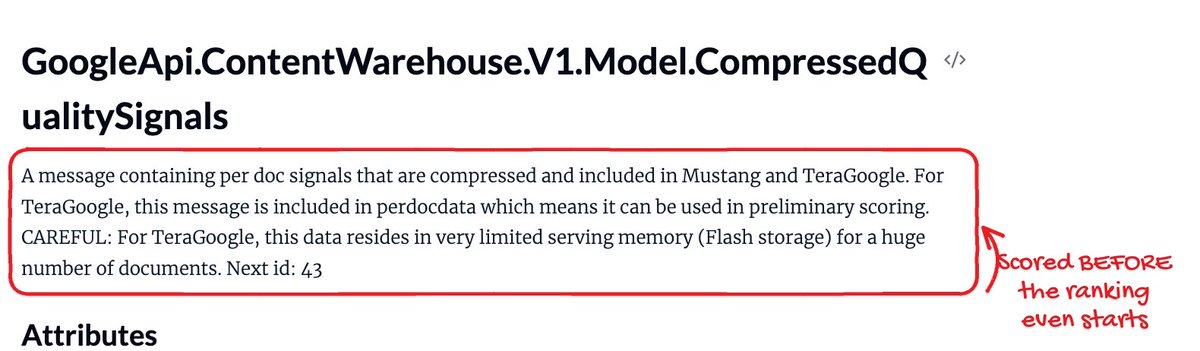
CompressedQualitySignals is a small block of scores stored with every document, "compressed and included in Mustang and TeraGoogle". Mustang is the main ranking system. TeraGoogle is the huge, slower tier of the index. And the line that matters: "it can be used in preliminary scoring"
In plain words: Google has already formed an opinion of your page and your site before the query arrives. The query decides which pages compete. Those pre-computed scores decide who starts the race in front
That is why two pages with the same words can sit 40 places apart. The text is only the ticket in. The stored reputation does the rest
-> Think of Google as a pipeline, find the step where your page fails, and fix that step. Not "SEO" in general
Part 2: The Scouts (crawl, render, index, retrieve)
The Scouts' job is boring and decisive: find the URL, fetch it, render it like a browser would, store what they find, and later pull it back out when a query matches
Three things in the leak are worth your time here
First, rendering. Google does not only read the HTML your server sends. It runs the page, and it notices what changed after the JavaScript ran:
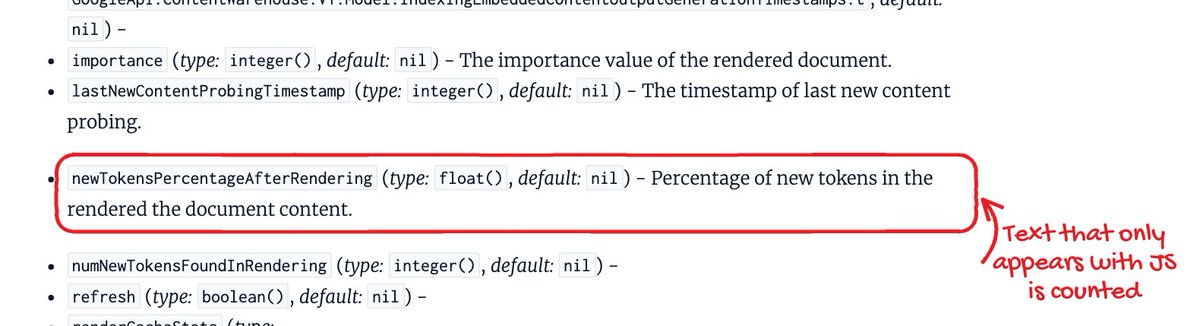
newTokensPercentageAfterRendering and numNewTokensFoundInRendering count the words that only appear once the JavaScript has run. Google measures how much of your page depends on that step
I read it as a warning more than a penalty. Rendering costs Google money, it happens later than the first crawl, and sometimes it does not happen well. If the text that answers the query only shows up after JavaScript, you are betting your ranking on the most fragile step of the pipeline
What I do:
-
the main answer of the page is in the HTML the server sends. Always. Open "view source" (not "inspect") and search for your first paragraph. If it is not there, fix that first
-
tabs, accordions and "read more" are fine, as long as the text is in the source
-
prices, stock and reviews loaded by a script are fine for users, but do not count on Google reading them on the first pass
Second, the index is tiered. The leak keeps naming different storage tiers, and the one comment above already told you the quality block lives in TeraGoogle's "very limited serving memory (Flash storage)". Not every page gets the same seat. Pages Google considers important are kept closer and refreshed faster
You see this in Search Console as "Crawled, currently not indexed" and "Discovered, currently not indexed". Those are not bugs. They are Google deciding a page is not worth a seat yet
Third, retrieval is mostly about words and meaning, still. Before any fancy scoring, Google has to pull a candidate list for the query. The leak is full of fields about titles, anchors, body text and "salient terms". If the words people search are not on your page (title, heading, first paragraph), you are not on the list the Judge looks at
Two cheap things help the Scouts more than people think:
-
a clean sitemap with only the pages you want indexed. Not the tag pages, not the filters, not the 300 empty author archives. Every useless URL you hand Google is one more thing it has to judge, and a lot of judged-and-rejected pages is a signal about the site
-
internal links to every page that matters. A page with no internal link pointing to it is an orphan: Google finds it late, revisits it rarely and gives it little weight. Your own links are the map the Scouts follow
Here is the prompt I use to check the Scout step on any page:
Here is the raw HTML my server returns for {URL} (view-source, not the
rendered DOM), and here are the 5 searches I want this page to rank for.

Tell me:
1. Is the main answer to each search present in the raw HTML? Quote the
   sentence where it is, or say MISSING.
2. Which important text only appears after JavaScript (compare with the
   rendered text I pasted below)? List it.
3. Is the exact wording of each search, or a close variant, in the <title>,
   the H1 and the first 100 words? Answer YES or NO per search, per place.
4. The 3 smallest changes that would make this page easier to find and
   index. No rewrite of the whole page.

Raw HTML:
{paste}

Rendered text:
{paste}
-> Put the answer in the HTML, put the searcher's words where Google looks first, and treat "not indexed" as a verdict on value, not a technical bug
Part 3: The Judge, page quality and site authority
Once your page is a candidate, the Judge scores it. And this is the part SEO Twitter fought about for 10 years, because Google always said one thing in public, and the leak shows another
Start with this one:
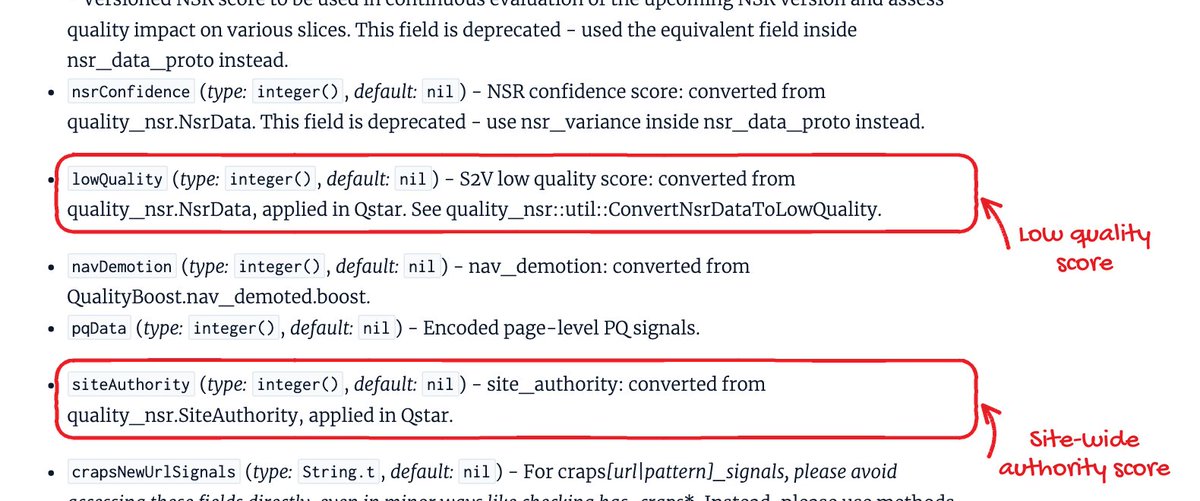
siteAuthority: "converted from quality_nsr.SiteAuthority, applied in Qstar"
For years, Google's public line was "we don't have a domain authority score". There it is, in their own words, stored for every page, and "applied in Qstar", which is one of the quality systems of the ranking. It is not Moz's DA or Ahrefs' DR. Those are third-party guesses based on links. Google's is its own, and nobody outside knows the recipe. But a site-level authority score exists and is used
Right above it, lowQuality: "S2V low quality score: converted from quality_nsr.NsrData, applied in Qstar". NSR shows up everywhere in the leak. It is a site-level quality rating, and your pages inherit it
That is the most important idea in this whole article, so I will say it twice. Your page is judged with your site. A great page on a site full of thin pages starts behind. A decent page on a site Google trusts starts in front
What raises a site's standing, from what I see in the leak and in my own Search Console:
-
a clear focus (more on that in Part 4)
-
pages that people search for by name, and come back to
-
links from pages that themselves get traffic
-
very few pages that nobody reads
And the one that changed how I write in 2026:
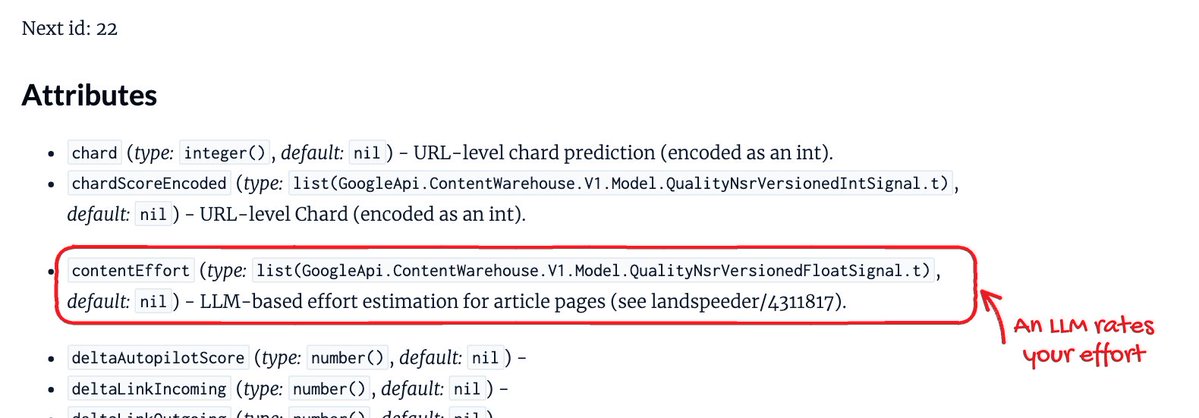
contentEffort: "LLM-based effort estimation for article pages"
Google runs a language model over article pages to estimate how much effort went into them. It does not say what the model looks for, and I will not pretend to know. But think about what "effort" means for a machine that has read the whole web: things it cannot find anywhere else. Your numbers. Your screenshots. Your test. Your mistake and what it cost you. A sentence that could only come from someone who did the thing
What it cannot be: length. A 4,000-word article that rephrases the top 5 results is low effort, whatever its word count. A model that has read those 5 results sees that in one pass
The fields next to it in the same module, "chard" and "deltaAutopilotScore", have thin or no comments, so I will not build anything on them. But the direction is clear: Google built a machine estimate of "did someone actually work on this"
Here is the prompt I run on every article before it goes live. It is the most useful one in this article, and it is the one I would keep if I could only keep one:
You are a strict editor who has read every page that ranks for "{QUERY}".
Here are the top 5 ranking pages (text pasted below) and my draft.

1. List every claim, number, example or step in my draft that ALSO appears
   in at least one of the top 5. Those are table stakes, not effort.
2. List everything in my draft that appears in NONE of them: my own data,
   screenshots, tests, results, opinions with a reason, mistakes. Those are
   the effort.
3. If list 2 has fewer than 5 items, tell me exactly what first-hand
   material I should add (a number I could measure this week, a test I could
   run, a screenshot I could take), and where in the draft it goes.
4. Point out every sentence that a reader could have written without ever
   doing the thing. Rewrite none of them, just quote them.

Top 5 pages:
{paste}

My draft:
{paste}
-> Google scores your page and your site, before and during the search. Make the site focused and the page impossible to write without having done the work
Part 4: The Judge, topic (what your site is "about")
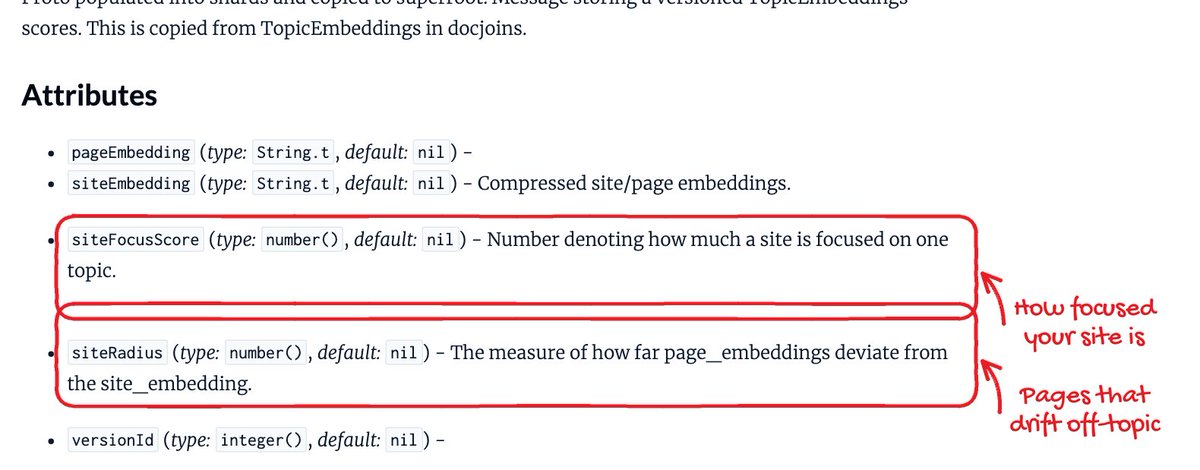
Google does not only ask "is this page good?". It asks "is this the kind of site that should answer this?". The leak has a whole family of fields for that, and they are the clearest signals in the dump:
-
pageEmbedding and siteEmbedding: a page and a whole site, each turned into a vector, a point in "meaning space"
-
siteFocusScore: "how much a site is focused on one topic"
-
siteRadius: "how far page_embeddings deviate from the site_embedding"
Read siteRadius again. Google computes the average meaning of your whole site, then measures how far each page drifts from it. A page about mortgage rates on a site about running shoes is far from the center. It is not banned. It just carries less of the site's weight
I see this all the time with clients. The "we also wrote about X because it has volume" pages are the ones that never rank, and worse, they pull the average away from what the site is actually good at
What I do:
-
list every page and tag it "core", "close" or "off-topic"
-
off-topic pages with no traffic: merge them, or delete them and redirect
-
before writing a new page, ask "would my best customer expect this on my site?". If not, it goes on another site or nowhere
Then links. People love to argue that links are dead. The leak says they are very much alive, but not in the way most people buy them:

topPrOnsiteAnchorCount: "According to anchor quality bucket, anchor with pagerank > 51000 is the best anchor. anchors with pagerank < 47000 are all same"
That is a Google engineer telling you, in a comment, that links are sorted into quality buckets by the strength of the page they come from, and that below a threshold, they are all worth the same. Which is to say, close to nothing
The same module counts these for on-site links, off-domain links and on-domain links, separately (topPrOffdomainAnchorCount, topPrOndomainAnchorCount). It also keeps a spam probability for the whole set of anchors pointing to a page (spamLog10Odds), and flags spikes of spammy anchor phrases created in a short window (LINK_SPAM_PHRASE_SPIKE)
My reading, and it matches 10 years of practice:
-
1 link from a page that gets real traffic beats 100 links from pages nobody visits
-
bad links are mostly ignored, not punished. They land in the bucket where "all are the same", or they get dropped as redundant. You do not need to "clean" them. Spend that time getting one good link instead
-
your own internal links count, and they are the only ones you control 100%. Link from your strongest pages to the page you want to push, with words that describe it
The leak also shows Google remembers anchor text per domain and drops redundant anchors from the same site. Ten links from the same blog with the same words are not ten votes
Here is the prompt for the internal link part, the cheapest win in SEO:
Here is my site's page list with, for each page: URL, title, monthly
clicks from Search Console, and its main topic.

Target page: {URL} (I want it to rank for "{QUERY}").

1. Pick the 5 pages on my site that are closest in topic to the target AND
   get the most clicks. Those are my link sources.
2. For each one, find the paragraph where a link to the target would be
   natural for a reader. Quote the sentence and propose the anchor text
   (3 to 6 words, describing the target, never "click here", never the
   exact query 5 times in a row: vary it).
3. Flag any page in the list that seems off-topic for this site (far from
   what most pages are about). Just list them, with one line on why.

Page list:
{paste}
-> Be one thing, link from pages that people actually visit, and stop worrying about the bad links you never asked for
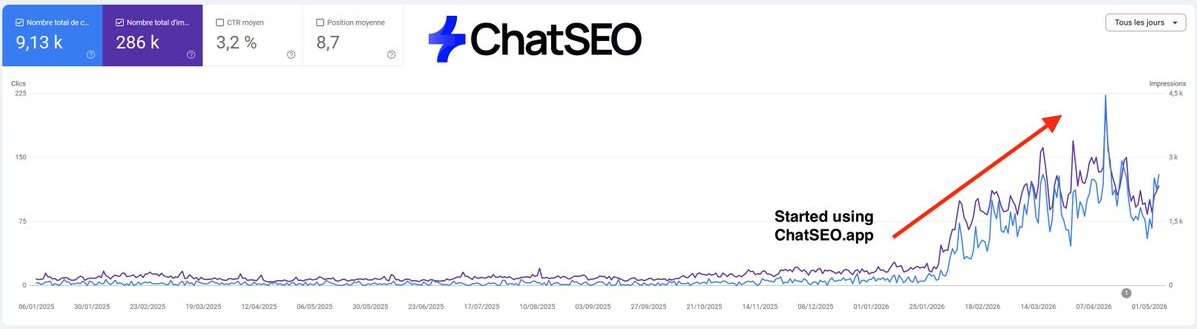
To get similar results for your business: try ChatSEO free for 7 days
Part 5: NavBoost (13 months of clicks)
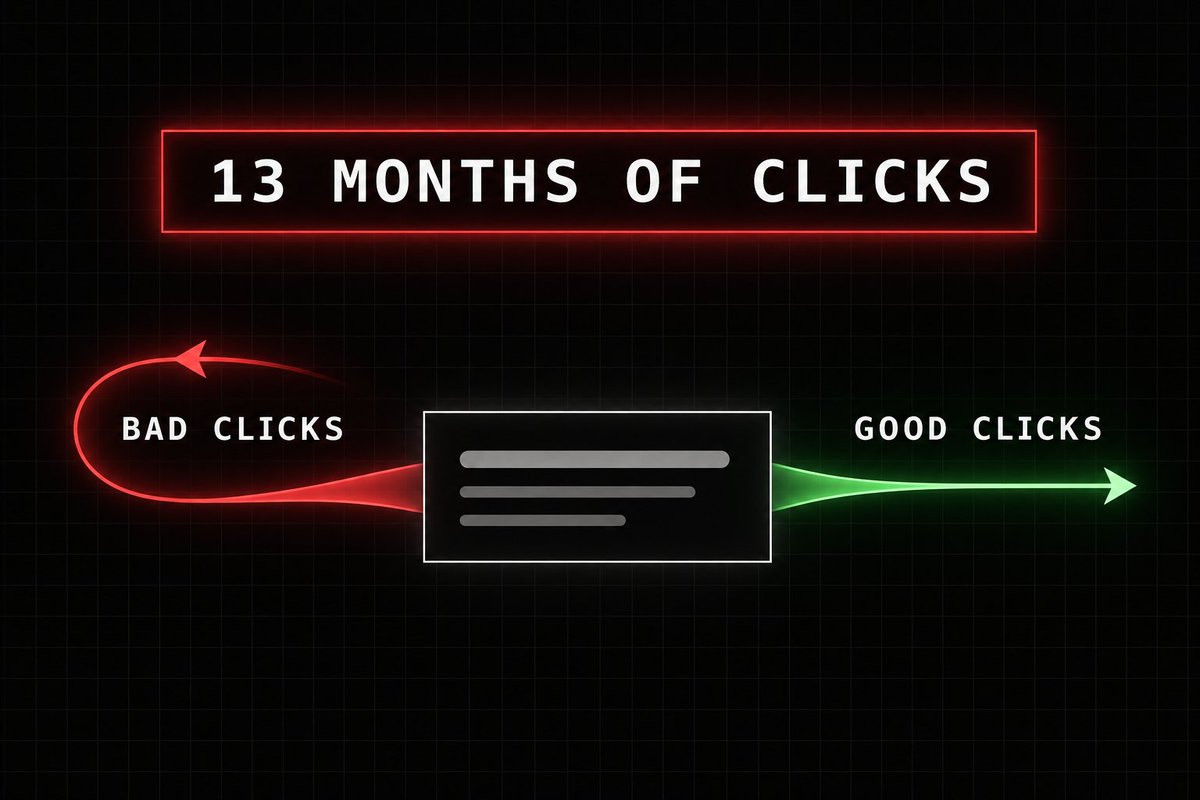
This is the big one. For 15 years Google said clicks were "too noisy" to be a ranking factor. Then, in the DOJ trial, Google's own Pandu Nayak (VP of Search) described NavBoost under oath: a system that remembers how people clicked on results, over the last 13 months, and uses it to rank. The leak shows the data it stores:
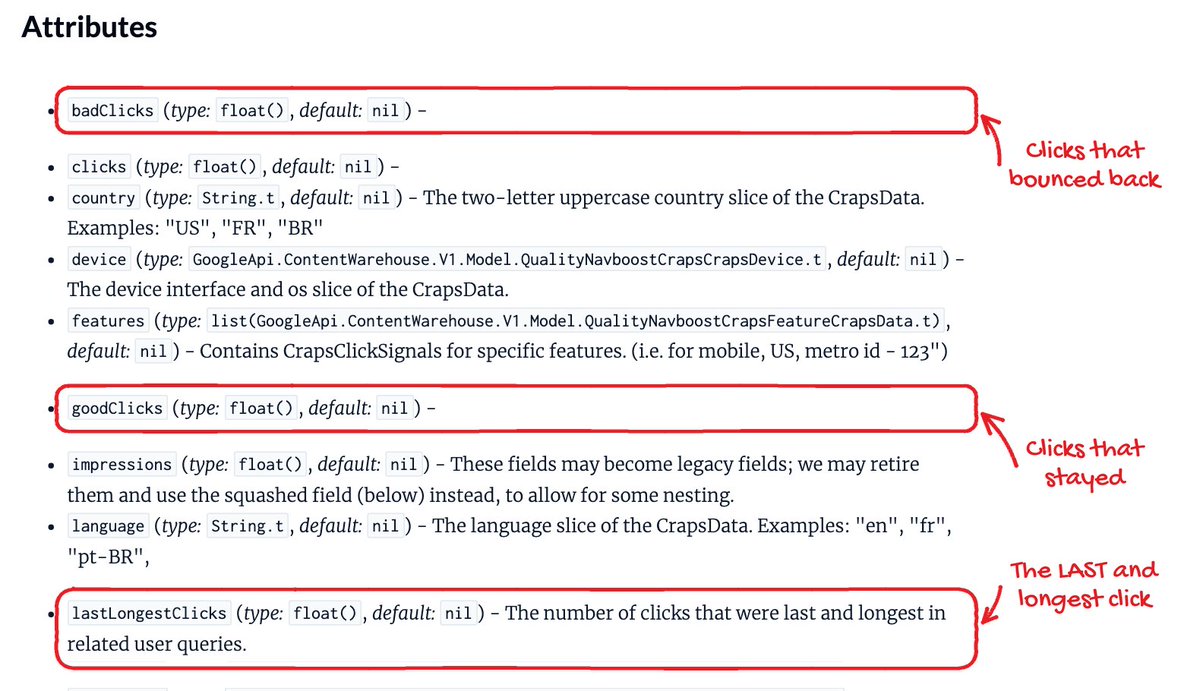
QualityNavboostCrapsCrapsData. "Craps" is the internal name for click and impression signals, and look at what it keeps for a result:
-
badClicks
-
goodClicks
-
lastLongestClicks: "the number of clicks that were last and longest in related user queries"
-
clicks and impressions
-
sliced by country, by device, by language, even by metro area
Read lastLongestClicks one more time, because it is the whole game. Google does not just count that someone clicked you. It wants to know if yours was the LAST click of the search, and the LONGEST one. In plain words: did the person stop searching after your page?
A bad click is someone who lands on you, sees a cookie wall, a pop-up and an intro about "in today's fast-paced world", and goes back to Google in 5 seconds to click the next result. A good click is someone who stays. The best click is the one after which they do not come back to Google at all for that need
There is a second family of fields that worried a lot of people:
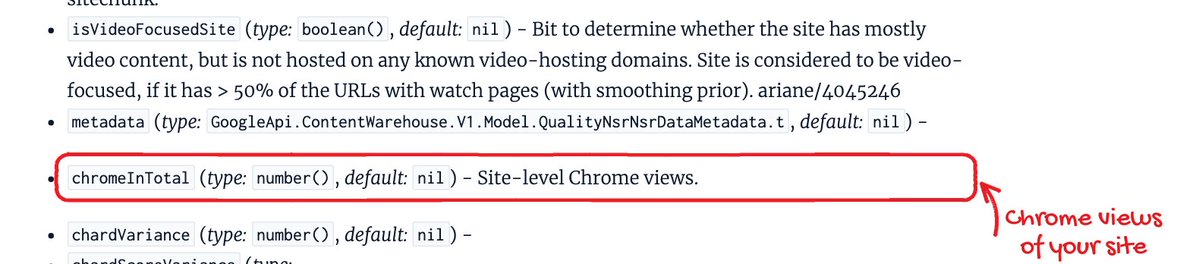
chromeInTotal: "Site-level Chrome views". Google publicly said for years that Chrome data was not used for ranking. This field sits in the site quality module, next to the authority scores. I do not know how much it weighs. I do know that a site real people visit outside of Google (typed in, bookmarked, coming from newsletters or social) looks different in that data from a site that only lives on Google traffic
There is also lastGoodClickDateInDays elsewhere in the leak: Google remembers when the last good click on a document happened. A page that used to satisfy people and stopped doing so does not keep its rank forever
What this means in practice:
-
a page can win page 1 with good relevance, then lose it in a few weeks because people do not stay. That is the "rank, then slide" pattern almost everyone has seen
-
NavBoost looks back 13 months, so one good week does not save you and one bad week does not kill you
-
because it is sliced by device and country, your page can win on desktop in the US and lose on mobile in the UK. Check Search Console with those filters before you "fix" anything
A quick way to see NavBoost at work on your own site: in Search Console, compare a page's position on mobile and on desktop over 3 months. When one device holds and the other slides, look at the page on that device. Nine times out of ten, something on that screen is sending people back to Google: a pop-up, a slow load, an answer pushed below an image
And no, you cannot fake it. People have tried click farms since 2010. NavBoost has had 13 years of people trying, filters for it, and a comparison with what real users do across millions of queries. The only way to get good clicks is to deserve them. Part 8 is about how
-> Google remembers, for 13 months, whether people who clicked you stopped searching. Build the page that ends the search
Part 6: The Bouncer (twiddlers, demotions, spam)
After the main ranking, Google runs "twiddlers": small, late systems that reorder the final list. The leak mentions them often. Some boost (freshness for news, diversity so one site does not take all 10 spots). Many demote
Here are some of the demotions, with their own names:
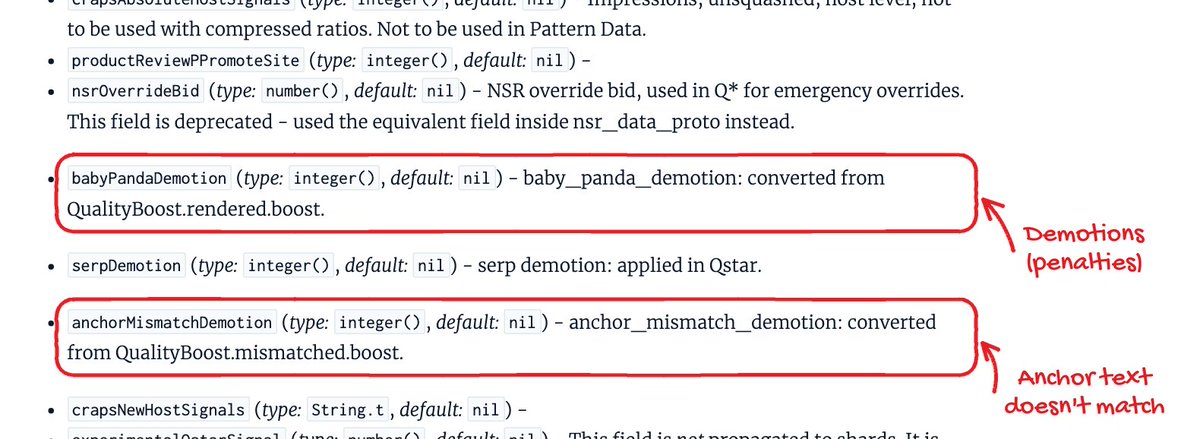
-
babyPandaDemotion and pandaDemotion: Panda was the 2011 update against thin, low-value content. It did not go away, it became part of the system
-
serpDemotion: a demotion computed from how the page performs on the results page. My reading: when NavBoost data says people do not want this result, it gets pushed down
-
anchorMismatchDemotion: the words in the links pointing to you do not match what your page is about. Classic sign of bought links with exact-match anchors on an unrelated page
Others in the same family: exactMatchDomainDemotion (the "best-cheap-shoes-online.com" trick, demoted), navDemotion (a navigation and usability penalty), and a "scamness" score from 0 to 1023 in the spam modules
What I find useful about this list is not fear. It is precision. Each demotion targets a specific shortcut people took:
-
a domain name made of the keyword: demoted
-
links with the exact keyword as anchor from pages about something else: demoted
-
thin pages made to catch long-tail traffic: demoted
-
results people reject on the page: demoted
If your traffic fell off a cliff on one date, check the date against Google's update history first, then ask which shortcut you took. It is almost always one of those
How to come back from a demotion, from what I have seen on client sites:
-
remove the shortcut, do not hide it. Bought links with exact anchors: stop buying, and replace them over time with links you earned. Thin pages: merge them into fewer, better pages, or delete them and redirect to the closest good page
-
fix the pages that people reject first. If NavBoost data is part of serpDemotion (my interpretation), the pages with the most bad clicks are the ones dragging you
-
then wait. Most demotions are recomputed when the system runs again, and for site-wide quality that is often the next core update, months later. Sites I have watched recover did it on an update date, not the week after the fix
-
do not chase it with 20 changes a week. You will never know which one worked, and every change resets what Google has learned about the page
SpamBrain sits on top of all this. It is Google's AI spam system, and from the leak and Google's own reports it focuses on two things: link schemes and scaled content (thousands of pages made by a template or a model, with nothing new in them). If you publish AI content at scale with no human value added, this is the system you are betting against
Here is the prompt I use when a client's traffic drops overnight:
My site {DOMAIN} lost {X}% of its Google clicks starting on {DATE}.
Here is my Search Console export: pages and queries, the 28 days before
and the 28 days after that date.

1. Did the loss hit all pages evenly, a group of pages (same template,
   same folder, same topic), or a few big pages? Show the numbers.
2. Did we lose positions, or keep positions and lose clicks (the
   results page changed: AI Overview, new features)? Show per page.
3. Match the date against Google's confirmed updates (core, spam,
   helpful content, reviews) in a window of plus or minus 5 days. Say
   which one, or "none confirmed".
4. For the group that lost the most, list what those pages have in
   common (thin, templated, off-topic, old, same author, same link
   profile). Do not guess beyond the data. Say "unknown" if unknown.
5. Give me the 3 checks I should do by hand next, in order.

Data:
{paste}
-> The Bouncer punishes shortcuts, by name. Find the shortcut, remove it, then wait for the next update
Part 7: Myths busted (and two that survive)
The leak settles some fights for good. Here are the ones I get asked about the most
Myth 1: "Google has no domain authority". False. siteAuthority exists and is applied in a quality system (Part 3). It is not DR or DA, but your site has a reputation score that your pages inherit
Myth 2: "Clicks are not a ranking factor". False. NavBoost uses 13 months of click data, by Google's own testimony, and the leak shows good clicks, bad clicks and last longest clicks stored per result (Part 5)
Myth 3: "There is no sandbox for new sites". Mostly false:
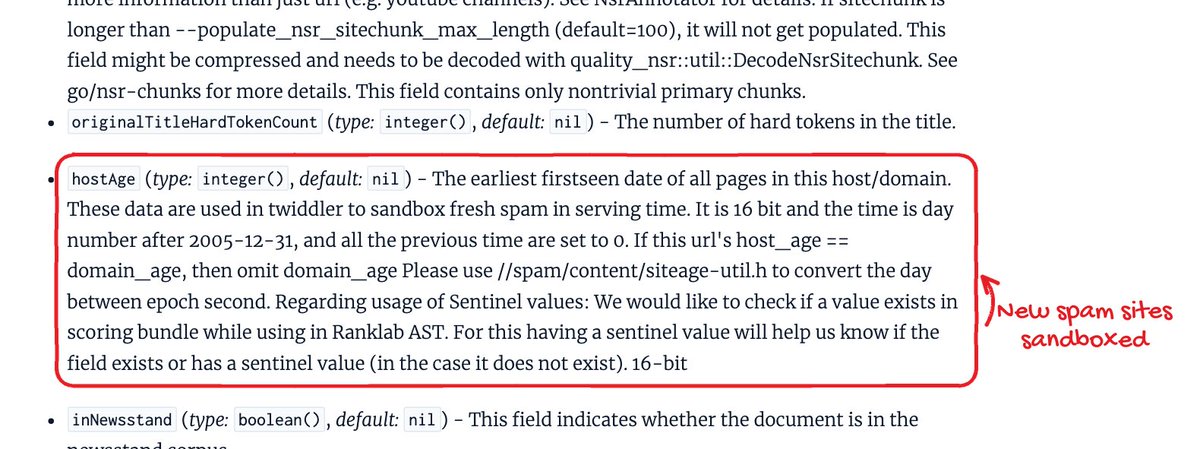
hostAge: "used in twiddler to sandbox fresh spam in serving time"
Read it carefully. It does not say all new sites are sandboxed. It says the age of a host is used to sandbox fresh SPAM. A brand new site with clean content is not the target. But if your new site looks like a spam pattern (lots of pages fast, thin, links bought on day 1), age is one of the things that holds you back
That matches what I see. A new site that publishes 20 solid pages and earns a few real links ranks within months. A new site that publishes 2,000 AI pages in a week does not, and the same 2,000 pages on an old trusted site do a bit better, for a while
Myth 4: "Google reads your content like a human would". Half true. The leak shows a lot of text understanding (embeddings, salient terms, the LLM effort estimate). But it also shows that much of the ranking is about what happens AROUND the content: links, clicks, site reputation. A perfect page on a site nobody knows will not beat a good page that people already trust
Myth 5: "Small sites can't win anymore". The leak has a field for exactly that, smallPersonalSite: "Score of small personal site promotion", with a link to an internal page called promoting-personal-blogs. Google built a boost for small personal sites. I will come back to it in Part 8
Myth 6: "Google penalizes AI content". Not as such. I found no field that says "written by AI". What the leak does have is everything that catches BAD content, whoever wrote it: the effort estimate, the Panda demotions, the site quality scores, and SpamBrain against scaled content. AI makes it very cheap to publish thousands of pages with nothing new in them, so AI content trips these systems more often. A page written with AI that carries your own data, your screenshots and your test is not the target. I write with AI every week, and the ChatSEO blog grew from 0 to 3,000 visits a month that way
Now two that survive:
-
"Content is king". Still true, but only content nobody else has. The rest is table stakes (see contentEffort)
-
"Links still matter". True, but only links from pages with real weight. Below the threshold, "all are the same"
And one honest caveat on all of this: the leak is from 2024, and Google changes things every week. The structure (site scores, topic focus, clicks, demotions) has been stable for 10+ years, so I trust it. The details may have moved
-> Domain authority, clicks and a spam sandbox are real. Bad links punishing you is not
Part 8: Win the click
Everything above comes down to five moves, Parts 8 to 12. I do them in this order on every site, mine and my clients'. The first one: you do not get NavBoost data if nobody clicks you. The leak has a field for exactly this step:
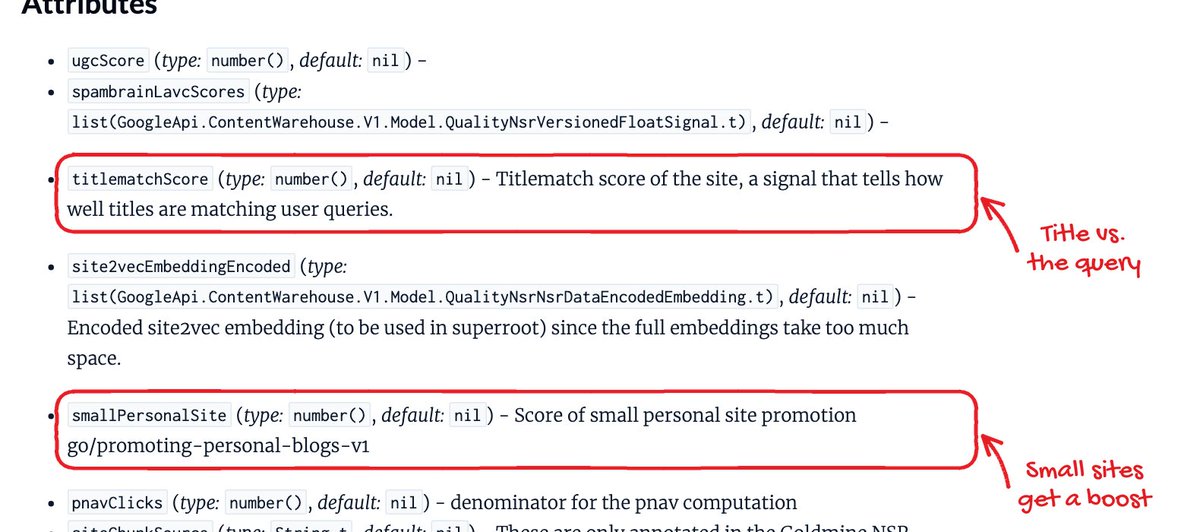
titlematchScore: "Titlematch score of the site, a signal that tells how well titles are matching user queries". At the SITE level. So it is not just one page's title. Google rates how well your titles, across the site, match what people search
Next to it, smallPersonalSite, the boost for small personal blogs. If you are a solo creator, a consultant or a small shop, write like a person: your name, your face, your own opinions. It is a feature, not a weakness
How I write titles now:
-
the words people search, near the start
-
a promise the page keeps in the first screen
-
a reason to click us rather than the 9 others: a number, a year, a format ("with screenshots", "tested"), a name
Here is the prompt:
Here are the 20 queries that bring the most impressions to {URL} (from
Search Console, last 3 months: query, impressions, clicks, position),
and the current title and meta description.

1. Which 3 queries should the title target? Pick for impressions AND
   for intent that this page actually serves.
2. Write 5 title options, 60 characters max, the main query in the
   first 5 words, each with a different reason to click (a number, a
   result, a format, a year, a promise).
3. Write 2 meta descriptions, 150 characters max, that say what the
   reader gets in the first screen.
4. Tell me which promise the page must keep in its first screen for
   each title to be honest. If the page does not keep it today, say so.

Data:
{paste}
Part 9: Win the stay
A good click is a stay. Here is the first screen of the page you saw in the results at the top of this article, the one Google's AI Overview cites first:
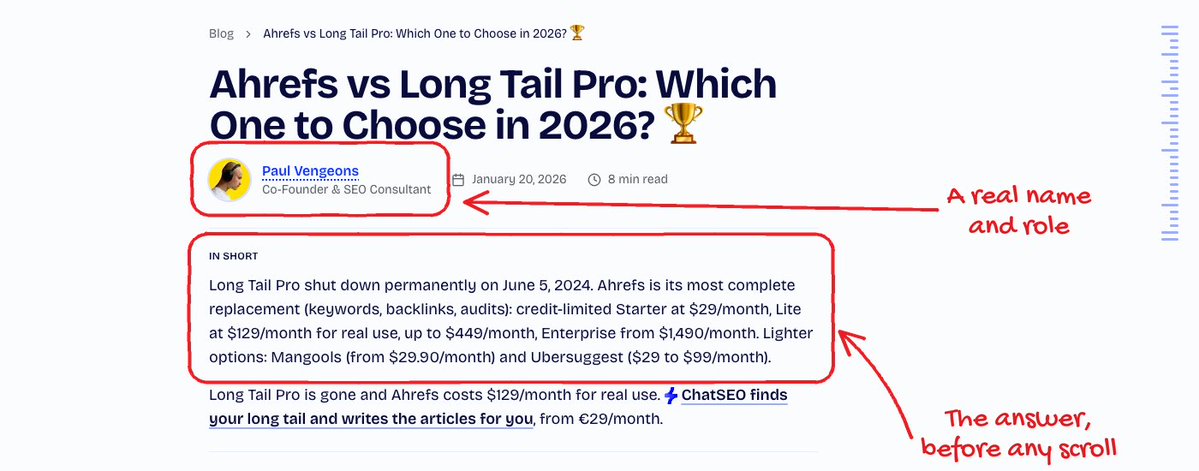
Nothing clever. The reader typed "long tail pro vs ahrefs" and the answer is in the box under the title: Long Tail Pro shut down, Ahrefs replaces it, here are the prices, here are the cheaper options. Someone who only needed that leaves satisfied, and that is a good click. Someone who needs more scrolls, and that is a long click. Both are wins for NavBoost
The fastest wins:
-
the answer in the first screen, not after 3 paragraphs of intro
-
no pop-up before the person read anything
-
a table, a list or a screenshot when the question is "which", "how much" or "how to"
-
the next question answered right after the first, so they do not go back to Google to ask it
The test I use: open your page on your phone, read only what fits on the first screen, and ask "would I go back to Google now?". If yes, rewrite that screen first
Part 10: Earn the brand return
This is the part people skip because it does not feel like SEO. Here is ChatSEO's Search Console, filtered to the searches that contain our name, last 3 months:

11.9K clicks from people who typed "chatseo" into Google. Nobody had to rank for anything. They knew the name from a post, a podcast, a friend, and they went looking. In the NavBoost data, those are clicks that end the search on our site, every time. In the Chrome data, they are visits that do not depend on any ranking
Remember chromeInTotal and the "last longest click". Google likes sites that people come back to on their own
-
get people to search your name: a newsletter, a podcast, a tool, social posts that end with your brand
-
make pages worth bookmarking: checklists, calculators, comparisons kept up to date
-
a branded search ("chatseo blog", "your-name pricing") is one of the strongest signals you can send, and you can watch it grow in Search Console
Part 11: Prove a human did it
contentEffort is a machine reading for a human signature. And one more field to know about:
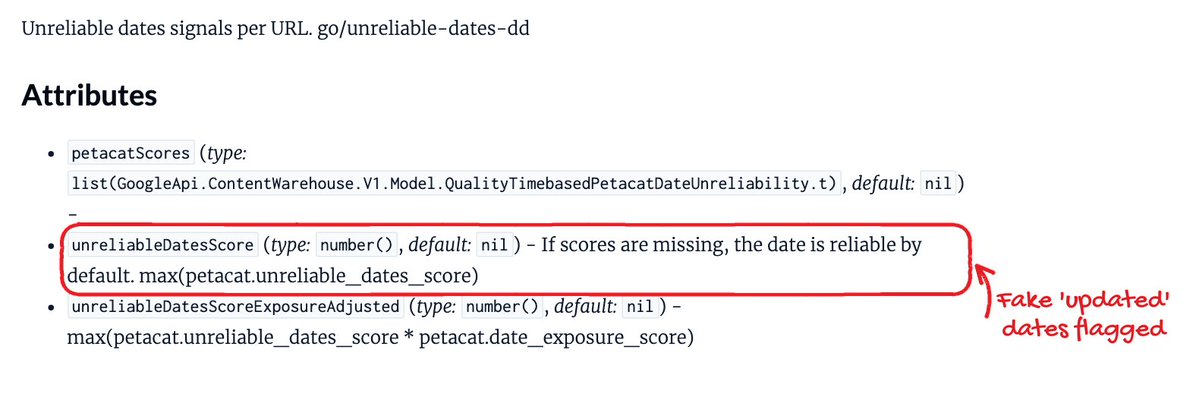
unreliableDatesScore. Google scores how much it can trust the dates on your page. Changing "updated on" every month without changing the page is a known trick, and Google flags it. The leak also has lastSignificantUpdate: it knows the difference between a real update and a new date stamp
So:
-
update a page when something actually changed, and then change the date
-
add what only you have: your numbers, screenshots of your own tools, the test you ran, the client case
-
sign it with a real name and a real "about" page. Google keeps author fields too (I count several in the leak), and on health and money topics (YMYL, with its own scores, ymylHealthScore and ymylNewsScore) it matters even more
Here is the prompt I use to plan a real update instead of a fake one:
Here is my article {URL}, published {DATE}, and the top 5 pages that
rank above it today for "{QUERY}" (text pasted below).

1. What do the top 5 cover that my article does not? Only real gaps:
   a step, a number, a tool, a question. List them.
2. What in my article is now outdated (prices, tool names, screenshots,
   numbers older than 12 months)? Quote each line.
3. What first-hand material could I add that none of them have? Suggest
   3 things I could produce in under 2 hours (a test, a screenshot, a
   measure, a short case).
4. Is this update big enough to change the "updated on" date? Answer YES
   only if at least 20% of the useful content changes.

My article:
{paste}

Top 5:
{paste}
Part 12: Pick the right battle
The last move is the one most people skip. Here are ChatSEO's top searches in Search Console once you take our own name out:
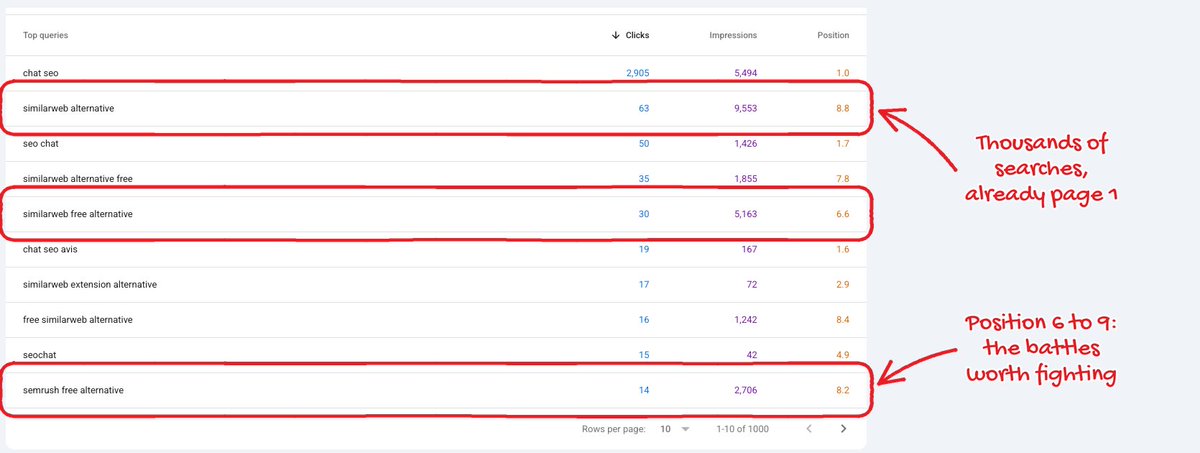
Look at "similarweb alternative": 9,553 impressions, position 8.8. "similarweb free alternative": 5,163 impressions, position 6.6. "semrush free alternative": 2,706, position 8.2. Google already decided we belong on page 1 for these. We get a handful of clicks because we sit at the bottom of it. Moving from 8 to 3 on a query we already rank for is far easier than starting a new page on a query where we are nowhere, and the clicks go up by a multiple, not a percent
The full system I run with Claude to find these queries and move them up is in my most-read article:
That is the battle worth fighting this month. Not the big generic keyword with 50,000 searches where the top 10 is Ahrefs, Semrush and Wikipedia siteFocusScore and siteRadius (Part 4) mean that the same article ranks differently depending on WHERE it lives. Before writing, ask:
-
is this query close to what my site is already trusted for?
-
do the pages on page 1 come from sites like mine (size, type), or only from giants?
-
can I bring something they do not have (Part 3)?
If two answers are no, pick another query. There are always easier ones next to it. A page that ranks #3 on a small query brings more than a page that ranks #40 on a big one
Here is the prompt I use to choose:
My site: {DOMAIN}, about {TOPIC}. Here are 30 candidate queries with
monthly volume and keyword difficulty, and the top 10 results for each
(domain + title).

For each query:
1. Is it close to what my site is about? CORE / CLOSE / FAR
2. Are there at least 2 results in the top 10 from sites of my size or
   type (not Wikipedia, Amazon, Reddit, big media)? YES / NO
3. What could I bring that the top 3 do not have? One line, or NOTHING.

Then rank the queries I should write first: CORE or CLOSE, at least one
YES on question 2, something real on question 3. Volume breaks ties, it
never decides alone.

Data:
{paste}
-> Win the click, win the stay, earn the return, prove a human did it, and fight where your site already belongs
The leak glossary (keep it next to the docs)
If you open the docs yourself, or ask your own bot to read them, these are the names you will meet everywhere. Here is what each one means, in plain words, as far as the comments let anyone tell
-
Mustang: the main ranking system for web results. When a comment says a signal is "used in Mustang", it is part of the core scoring
-
TeraGoogle: the very large, slower tier of the index. Pages there are kept with compressed signals, not the full detail
-
Qstar: one of the quality systems that apply site and page quality scores. siteAuthority and lowQuality are "applied in Qstar"
-
NSR: a site-level quality rating that keeps coming back (quality_nsr). Your pages inherit it. My best one-line translation: "how much Google trusts this site in general"
-
Twiddler: a small system that runs after the main ranking and reorders the final list. Boosts (freshness, diversity) and demotions (spam, sandbox) mostly live there
-
NavBoost: the system that remembers how people clicked on results for 13 months and uses it to rank. Confirmed under oath at the DOJ trial
-
Craps: the internal name for the click and impression data behind NavBoost (good clicks, bad clicks, last longest clicks)
-
Panda and Baby Panda: the 2011 quality update and its smaller sibling, now stored as demotions on pages
-
SpamBrain: Google's AI system against spam, focused on link schemes and scaled content
-
Superroot: the layer that receives a query and coordinates all the systems that answer it
-
Kaltix: a module whose comment says "empty for now". The reminder that a field name proves nothing on its own
-
Salient terms: the words Google considers central to a page, kept so it can match queries without reading the whole page again
Two warnings before you play with these names. First, a comment is written by one engineer at one point in time, for colleagues who know the context. It is not documentation for us. Second, everything above is "what exists", not "what weighs". If someone tells you "siteAuthority is 30% of the ranking", ask where the 30 comes from. The leak has no such number
The 20-minute check of your own site
If you only have 20 minutes after reading this, here is the check I would run, in this order, with the step of the pipeline each one tests
-
2 minutes, Scouts: Search Console, Pages report. How many pages are "Crawled, currently not indexed"? If it is more than a third of your site, Google is telling you those pages are not worth a seat. That is your first project
-
3 minutes, Scouts: open your 3 most important pages with "view source". Is the answer to the main question in the HTML, or only after JavaScript runs?
-
3 minutes, Judge: list your last 20 pages. How many would your best customer expect to find on your site? The ones they would not are pulling your topic focus apart
-
4 minutes, NavBoost: Search Console, Performance, sort by impressions. Find the pages with lots of impressions, a position between 3 and 10 and a click rate under 2%. Those titles are losing the click
-
4 minutes, NavBoost: open those same pages on your phone. Is the answer on the first screen? If not, people come back to Google, and Google remembers it for 13 months
-
2 minutes, Bouncer: does your domain name contain your main keyword? Do the links you bought say your main keyword word for word? Any "yes" is a known demotion
-
2 minutes, brand: Search Console, filter queries that contain your name. Is the line going up over 12 months? If it is flat, the brand return (Part 10) is your slow lever
Write the answers down. The step with the worst answer is the step you fix first, and almost always it is not the one you were planning to work on
What this does not prove
I want to be straight about the limits, because most "leak" content is not
-
the docs show what Google STORES, not how much each thing WEIGHS. I told you what exists and what I do about it. The order of importance is my experience, not the docs
-
the leak is from 2024. The big structure has not moved in 10 years, but names, thresholds and details may have
-
some fields are deprecated, experimental or "empty for now" (Kaltix). I only used fields with a clear comment, and I said so when the comment was thin
-
the testimony at the DOJ trial was about how Google worked at the time of the case. NavBoost is real, the 13 months were said under oath, the details of today's version are not public
-
Opus 5.5 read the docs for me, and I checked every quote in this article on the live docs page before using it (every red box is on a real capture). But an AI reading 14,014 attributes will miss some. If you find a field that changes one of these conclusions, tell me and I will update the article
-
my own results (the screenshots at the top and in the CTAs) come from sites where I applied all of this at once. I cannot isolate which signal did what
What I would do this week
If I took over your site on Monday, here is the order:
-
Monday: open Search Console, Pages report. List what is "not indexed" and decide: improve, merge or delete. Check that every important page has its answer in the raw HTML (Part 2)
-
Tuesday: tag every page core, close or off-topic. Merge or remove the off-topic pages with no traffic (Part 4)
-
Wednesday: take your 10 pages with the most impressions and the lowest click rate. Rewrite their titles with the prompt in Part 8 (win the click)
-
Thursday: open those same 10 pages on your phone. Fix the first screen of each so the answer is visible without scrolling (win the stay)
-
Friday: run the effort prompt (Part 3) on your 3 most important articles. Add one thing only you have to each
-
next week: 5 internal links per important page, from your pages that already get clicks (Part 4)
-
every month: one real update on your best page, with the date changed only when 20% of the useful content changed
Do not touch your backlinks this week. Do not disavow anything. Do not change 50 dates
If you are starting a site from zero instead, I broke down the 7 mistakes I would never make here:
Questions people ask me
Is the leak real? Yes. Google confirmed the documents were authentic, while warning that they could be "out of context, outdated or incomplete". Both are true
Does Google use AI to rank now? It has for years (RankBrain from 2015, then BERT and MUM). The leak adds embeddings for pages and sites, and an LLM estimate of article effort. AI is part of the Judge, not the whole Judge
Should I block AI tools from my site? Different question from Google ranking. But careful: some AI crawlers are tied to how AI products cite you. Blocking them to "protect" content can also remove you from AI answers, like the one in the first screenshot
Can I buy my way in with links? You can buy links. The ones that work come from pages with real traffic, and those are expensive and rare. The cheap ones fall in the bucket where "all are the same", or trigger anchor demotions. Spend the money on content only you can make
How long until I see results? Indexing: days. Topic and authority: months. NavBoost: it looks back 13 months. Plan in quarters, measure in Search Console every week
Do word count and keyword density matter? Not in the way people think. I found no field that rewards length, and contentEffort is about effort, not length. Keyword density is a 2008 idea. What the leak does show is that the words of the query matter in specific places: the title (titlematchScore), the anchors pointing to you, and the salient terms of the page. Put the words where they count, then write as long as the answer needs
Does Google use E-E-A-T as a score? There is no field called E-E-A-T. It is a guideline for the human raters who test Google's changes. But a lot of fields measure pieces of it: author information, site authority, YMYL scores for health and money topics, the effort estimate. So the idea is real, the single score is not
Is it worth updating old articles? Yes, when the update is real (Part 11). Google keeps lastSignificantUpdate and scores the reliability of your dates. A real update on a page that already has links and clicks is often the cheapest ranking gain on a site. A new date on an unchanged page is a known trick, and a known trick is a signal
Running an online store? Read How to run your Shopify store's SEO with 50 Claude agents. Running a local business? Read How to make your Google Business Profile citable by AI (the 5 checks).
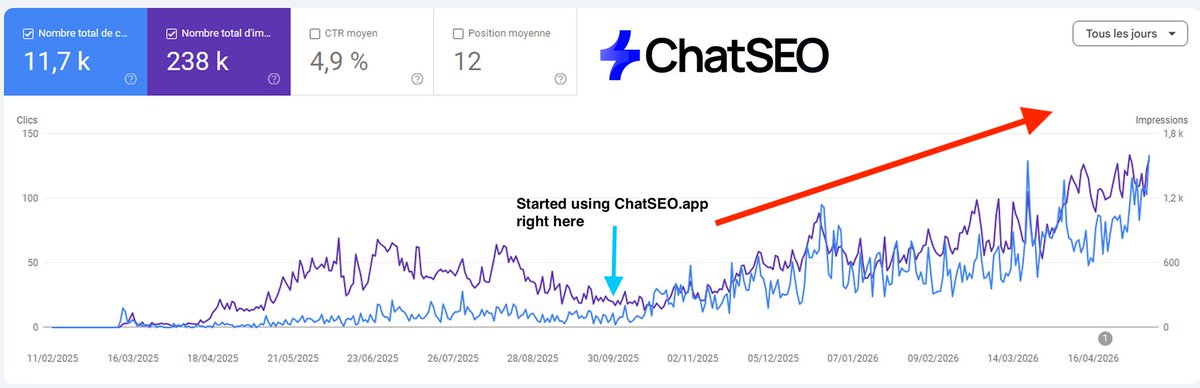
To get similar results for your business: try ChatSEO free for 7 days
Thanks for reading!
🎁 If you want to hire your first AI SEO employee (for free), click here
沿着这个主题继续读
从一篇文章,找到相关的教程、经验和阅读路径。