If You've Wasted 2026, Here's How to Make a Comeback Before 2027
文章目录
We're November 4th, 2026. There are exactly 57 days left before 2027. That's around 8 weeks. But if we're being totally honest, it's not really 8 weeks. We can easily remove the last 2 weeks of December, since they're usually spent with family and friends. And if we take into account the time between when I finish this article and when it lands in front of your eyes...
We can confidently say that you have 6 to 8 weeks left before 2027.
So let's not waste any more time.
This article's goal is stupidly simple:
Give you the most effective, no-bullshit action plan and ideas to turn these 8 weeks into a sprint that will let you make the greatest comeback of your year. Whether it's physically, mentally, financially or spiritually.
If you feel like you haven't made enough progress toward your goals in 2026 (as we all do), applying this action plan will definitely alleviate that feeling, and surprise you with how quickly you can get results when you put in the intensity.
Let's begin.
Prefer to watch? I recorded the whole plan as a video, from the dopamine reset to the daily execution: https://youtu.be/AUdNYtOiwW0
Run this sprint with an AI coach: The 8-Week Sprint Coach is a free AI coach that builds your sprint plan with you, checks in with you every day and runs your weekly review. Get it for free on my Eden store: https://noahsark.eden.so/8-week-sprint-coach
Step 1: The Foundation
Everything starts with resetting your dopamine baseline. You can't expect to turn your life around in 6 to 8 weeks if your brain and body are constantly being hijacked by all the crap society throws at you to keep you weak, addicted and spiritually enslaved.
If you've been living in a cave these past few years and have never heard the term "dopamine detox", or don't even understand what dopamine is, here is an absolutely non-scientific explanation for you:
Dopamine is basically one of the chemicals linked to the reward system in your brain. It's released every time you do something (or plan to do something) to keep you motivated. The problem is, modern society and evil corporations are well aware of this weakness in our brains, so they made everything as addictive as possible to keep you hooked on their products.
That's why entertainment keeps getting more and more addictive, food is specifically engineered to trigger as much pleasure as possible, and the infinite scrolling feeds of social media work like slot machines that hijack your brain to keep you swiping like a monkey.
The answer to that?
Ruthlessly. Cut. Everything.
-
Uninstall all video games from your computer. You can always play again as a personal reward after the 8 weeks. But don't play during this sprint, because video games are a literal simulation of real-life accomplishment: they steal the dopamine from IRL tasks and leave you with no motivation left. I fucking love video games, but I also know that if I play them every day, I'll just play more and more until I'm literally doing the bare minimum of work so I can spend the rest of the day playing. (Which is a terrible idea for a solopreneur whose whole income depends on his actions lol.)
-
Delete all social media apps from your phone, no exceptions. (Yes, even Substack.) Install blockers and extensions like News Feed Eradicator on your computer to block access to these websites from morning to evening. Add as much friction as you can between you and hours of scrolling, and reclaim your attention. Even if you're a content creator on these platforms, use an online scheduler like Eden instead of your phone.
-
Stop all junk food. Delete Uber Eats from your phone. Replace it with unprocessed food. Grass-fed meat. Sweet potatoes. Raw vegetables. Eggs. Raw honey. Even more eggs. Keep it simple and natural. If the ingredient list is as long as a black magic formula, don't buy it.
-
Try to keep your drug consumption as low as possible. Ideally, only coffee. Cut weed, of course. But if you're addicted to nicotine, it might be hard to stop, depending on how psychologically addicted you are. Read Allen Carr's Easy Way to Stop Smoking: it will help you a lot when it comes to cutting nicotine out of your life. I'm not gonna lecture you on why quitting nicotine is good for you. I've been a smoker too, and I know how hard it can be sometimes. But I also experienced how easy it can be to stop once you're truly fed up with that shit destroying your self-confidence and making you a slave. Anyway, do your best. Worst case, switch to a healthier nicotine product and reduce your consumption.
You might need to dedicate 1 to 2 weeks solely to resetting your dopamine baseline, depending on how deeply you're poisoned. If you've been over-indulging in all of the above for years with no moderation at all, just doing this might already be a huge challenge, but honestly, it's worth it. A true dopamine detox is the closest thing to a spiritual awakening you'll ever feel. If you're not too addicted and have only been over-indulging in one or two bad habits, 7 to 14 days are usually enough to cut and reset your baseline.
Now keep in mind that the human mind hates a void. So we can't just cut everything and expect our brain to accept it without putting up a fight. That's why we need to give it alternatives to focus on. Otherwise, it will keep seeking dopamine from these easy sources because it has nothing better to do.
That's why the next step of this protocol is the following:
Step 2: Clarity Maxxxxxing (yes, with a lot of X's)
"If a man knows not to which port he sails, no wind is favorable." - Seneca
If you want to achieve something meaningful in these 6 to 8 weeks, you first need to know what you want to achieve, and have a profound personal why attached to it. Otherwise, there's no point in creating intensity in your life if your heart doesn't truly desire it. That's why we'll focus on generating as much clarity as possible on the goals you want to accomplish during that timeframe, and on how good you'll feel afterward.
So grab a pen and a piece of paper: it's time for a deep, handwritten journaling session babyyy.
First, start with a quick audit of where you are in your life. What are the key areas you need and want to improve? The most common ones for men are their physique and their finances. Try to keep it to 1 to 3 life areas maximum. We can achieve a lot in 6 to 8 weeks, but let's not delude ourselves: it's still not that much time, so let's stay focused, shall we?
Then we'll create OKRs to reach over the next weeks. OKR is a corporate goal-setting method that's pretty cool for creating inspiring and effective goals for yourself.
You start by defining your Objective, which is a badass-sounding sentence describing the goal you want to achieve.
For example:
Make a physical transformation so insane in 6 weeks that my friends and family can't help but be shocked at how fucking good I look.
Of course, be realistic about your starting point, but this Objective sentence must already light a fire in your heart.
Then we set up Key Results, which are measurable KPIs we'll track and update every week to make sure we're reaching that goal.
For the sentence above, it could be something like:
-
Go from 60 kg to 67 kg
-
Reach 15 pull-ups at my bodyweight
-
Receive 3 compliments from friends and family about my physique
KRs must be measurable. Aim for 3 to 5 Key Results per OKR, but stay concise: don't put in too many, or it's going to be a pain in the ass to track.
Here are a few examples cooked up by my AI agent to inspire you when writing your OKRs:
Business: escape the 9-5
Objective: Sign my first paying clients and prove to myself, once and for all, that I can make money without a boss.
-
Sign 3 paying clients at $500 or more each
-
Book 15 sales calls
-
Grow my email list from 0 to 300 subscribers
Body: the Christmas glow-up
Objective: Lose the gut and walk into the family Christmas dinner as a different man.
-
Go from 92 kg to 86 kg
-
Bring my waist from 98 cm down to 92 cm
-
Run 5 km in under 28 minutes
Mind: the attention comeback
Objective: Take back control of my attention and become a man who can sit alone with his thoughts again.
-
Bring my phone's daily screen time from 4 hours down to under 1 hour
-
Stay 100% nicotine-free for the last 30 days of the sprint
-
Rate my focus 8/10 or higher in 6 of my 8 weekly reviews
Okay so those were just random examples cooked by my AI but you get the idea.
I recommend having 1 to 2 OKRs maximum. Once again, remember we only have 6 to 8 weeks. So the more focused you are, the better your results. Also, make your Key Results ambitious. Usually, a 70% completion rate on OKRs is considered excellent. If you can reach your KRs in two weeks, they were too weak. Raise the bar, shoot for the moon, and you'll land among the stars. (Cliché af, yes, I know.) The idea is: don't be a pussy, aim for high goals that keep you excited and on edge, but not so delusional that they totally destroy your motivation.
Another important thing about Key Results: make sure they're results, not activities. For example, you don't want a Key Result like "Post 10 newsletters", because that's not a result, that's a task. It's great to have task goals, don't get me wrong, but to get the most psychological benefit for your brain, we want to aim for concrete results.
In the OKR method, those tasks are called Initiatives. So if your objective is to become a famous writer on Substack, one of your Key Results could be reaching 500 email subscribers or reaching the leaderboard in your category, and your initiatives to achieve those Key Results would be publishing 3 to 5 notes a day, engaging with other people's accounts for 30 minutes to 1 hour a day, and publishing one long-form newsletter a week.
Step 3: Weekly Planning
Okay, at this point your dopamine baseline is reset and you know in great detail what you want to achieve. Now it's time to get into the logistics of how you're going to progress each week.
For that, we're going to do a very cool exercise that I like to do every once in a while:
Time budgeting in Google Calendar.
It's pretty simple. Open Google Calendar and start by blocking out every moment of your day that's taken by external obligations. Work, meals, sleep, groceries, etc. Be precise, because what's left is your limited time budget. How we allocate that time budget is the key to making these 6 to 8 weeks the greatest comeback of your life.
It's normal to get some kind of reality check at this point. If you have a 9-5, you risk being deeply pained by how much time this shi is stealing from your days. But hey, you've gotta figure it out anyway, or you're gonna stay a slave your whole life. So embrace it and conquer. The less time you have, the more strategic you must be with it.
Here's what mine looks like for reference:
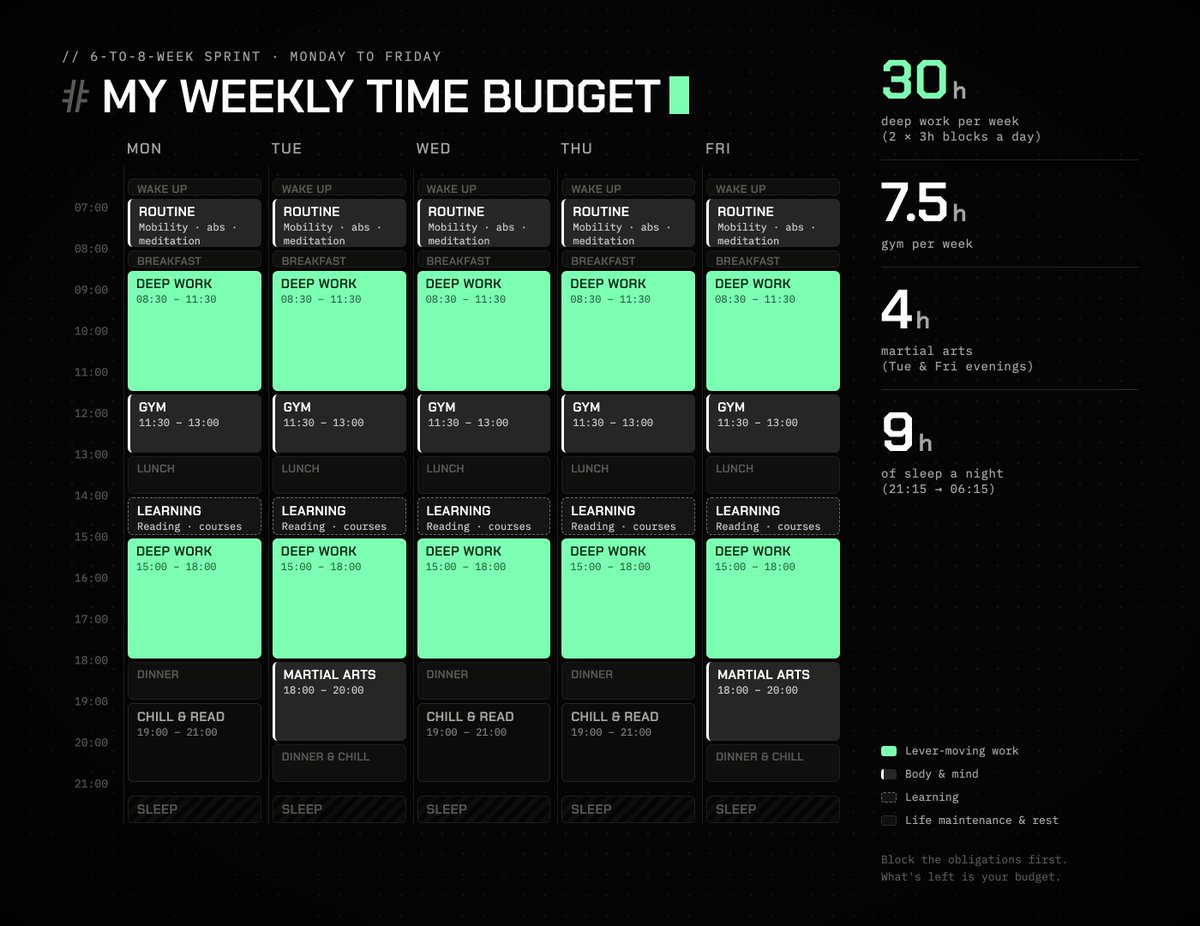
After that exercise, you should have a pretty realistic idea of how much time you have available each day and each week to dedicate to your OKRs.
The next step is to create a review system that keeps you accountable for the duration of the sprint. Keep in mind that to get insane results in a short time frame, you need high intensity. And to have high intensity, you need a deep sense of urgency about how much time (or should I say, how little time) you have before the end of the sprint.
The best way to keep yourself accountable is a weekly review habit that lets you see what worked, what didn't, how much progress you made on your Key Results, and how many weeks are left.
Here is a weekly review journaling template you can steal:
The Sprint Weekly Review (every Sunday, 30 minutes, pen and paper)
1. Where am I?
-
How many weeks do I have left in my sprint?
-
For each of my Key Results: where did I start, where am I today, and where do I want to be at the end?
-
Am I on track? If not, how far behind am I, and why?
2. Look back
-
What were the big wins of the week?
-
What were the biggest challenges?
-
What got in my way?
-
What did I learn?
-
Did I respect my time budget? How many hours did I actually put into my lever-moving tasks vs. what I planned?
-
Did I relapse into any of my old dopamine traps? What triggered it?
3. Look ahead
-
What are my 1 to 3 lever-moving tasks for next week?
-
What am I cutting next week?
-
What's one thing I'll do differently?
4. One last question
- On a scale of 1 to 10, how proud of this week would my future self be?
Step 4: Daily Execution
Now that your goals are set and your time is budgeted, it's time to figure out what you're going to do each day.
That's why we're going to define your 1 to 3 Lever-Moving Tasks.
As Brian Tracy said:
"No matter how many different things you do in a week or a month, there are only three tasks and activities that account for 90% of the value of the contribution you make to your business." This is known as the "Rule of Three".
This exercise is wonderful in its simplicity and in how much clarity it brings. Because once you've done it? You can't lie to yourself anymore. You can't spend a day tweaking Notion templates or watching YouTube videos and trick yourself into feeling like you've made "some progress". No, you didn't. That was disguised procrastination, sorry.
So here is the 4-Step Process to Identify Your 3 Lever-Moving Tasks:
-
Make a list of all your tasks and responsibilities.
-
If I could only do one task on this list all day, which one would bring the most value to my business?
-
If I could only do one more task on this list all day, which one would bring the most value to my business?
-
If I could only do one more task on this list all day, which one would bring the most value to my business?
The less time you have, the more ruthless you need to be: focus on your #1 or #2 lever-moving task. Of course, we're talking about business in this example, but it works for any activity and goal.
Let's get back to our imaginary goal of becoming a Substack writer, shall we? If someone wants to reach the leaderboard in 6 weeks, there are multiple tasks they can do:
-
Write weekly newsletters
-
Write daily notes
-
Engage with other people's content
-
DM other creators to build partnerships, network and make cool friends
-
Optimize their bio
-
Optimize their Substack publication settings
-
etc.
All of these things are great, but if you only have one hour a day, the best way to invest that hour is simply writing your weekly newsletter. The second best is writing daily notes. The third is engaging with other people's content. In that order. If you don't have time to engage, focus only on newsletters and notes.
You need to dumb down your to-do list. Simplicity is powerful. Doing one task with deep focus toward one goal for one hour every day will take you further than spreading yourself thin over 8 hours every day.
That's the bare minimum. Everything else is optional. Your morning routine is optional too. Don't spend 2 hours every morning working out and meditating if your number one goal is to sign clients and you should be sending DMs or calling people instead. You have to prioritize your time right, so you invest at least one to two hours a day in your 3 lever-moving tasks. The rest is optional.
But optional doesn't mean useless. If you want to take your sprint to a higher level and make it more of a holistic growth, which I recommend since we are systems, having one quality daily habit per growth area is great. Here's a simple list you can implement on top of your 3 lever-moving tasks:
-
Mental practice: breathwork, cardiac coherence, mindfulness meditation. Reading books.
-
Physical practice: daily push-ups. Gym training 3x per week. Street workouts. 10-min jump rope.
-
Spiritual practice: writing down 5 things you're grateful for every day. Long walks with no phone. Time alone in nature. Daily journaling.
-
Financial practice: 1 to 3 hours of deep work a day on your 1 to 3 lever-moving tasks. Everything else is just noise: cut it ruthlessly.
That's it. No need to make it more complicated. Keep in mind we only have 6 to 8 weeks, so creating complex systems and routines isn't going to help. Instead of thinking about what you can add to your sprint, think in subtraction. List everything you planned and ruthlessly cut what isn't absolutely crucial to reaching your OKRs. The more focused you are, the better the results. Like a magnifying glass that turns the sun's harmless rays into a beam that can start a fire.
Summary & Implementation Resources
So that's it. This is how you can turn the last 6 to 8 weeks of the year into the greatest comeback of your life. In summary:
-
Ruthlessly cut distractions to reset your dopamine baseline
-
Set 1 to 2 OKRs to achieve over the next 6 to 8 weeks
-
Budget the time you have available each week
-
Define your 3 lever-moving tasks
-
Execute them every day to the best of your ability
-
Review your progress every week and adjust based on the data
If you want an AI coach to run this sprint with you, I've created one for free: The 8-Week Sprint Coach.
Here's what it does for you:
-
It builds your sprint plan with you. In one 30-minute session, it interviews you and writes your OKRs, your time budget, your lever-moving tasks and your dopamine reset into one document.
-
It checks in with you every day. Two minutes in the morning to lock in your #1 task, two minutes at night to log what you did. And it calls out your disguised procrastination.
-
It runs your weekly review. It updates your scoreboard, tells you if you're on track, and shows you the pace you need to hit your targets.
-
It helps you restart when you slip. No guilt trip. It finds what triggered it and gets you back on your #1 task within 24 hours.
-
It remembers everything. Your plan, your numbers, which week you're in. You never start from zero.
You also get the full playbook, the planning worksheet, the weekly review template, the dopamine reset checklist, 12 example OKRs, and copy-paste prompts if you prefer Claude or ChatGPT.
It's 100% free. Just create a free Eden account and you'll get access to my 8-Week Sprint Coach right away:
https://noahsark.eden.so/8-week-sprint-coach
And don't forget: focus is king. Simplicity is king. Subtraction over addition. Intensity > time spent. 4 hours of deep work > 12 hours of scattered work.
Enough consumption now. Go make that comeback, king. Your ancestors are watching you. Your future self is watching. Don't disappoint them.
Thanks for reading... And as always, Welcome back to Noah's Ark.