HOW I TURNED 30 SOL INTO 567 SOL ($53,500+) ON METEORA LP: A FULL BREAKDOWN OF MY SYSTEM
文章目录
This article is a full breakdown of my 5-part system: from reading the memecoin cycle and 4 working setups to our server infrastructure and rules for getting out of losses.
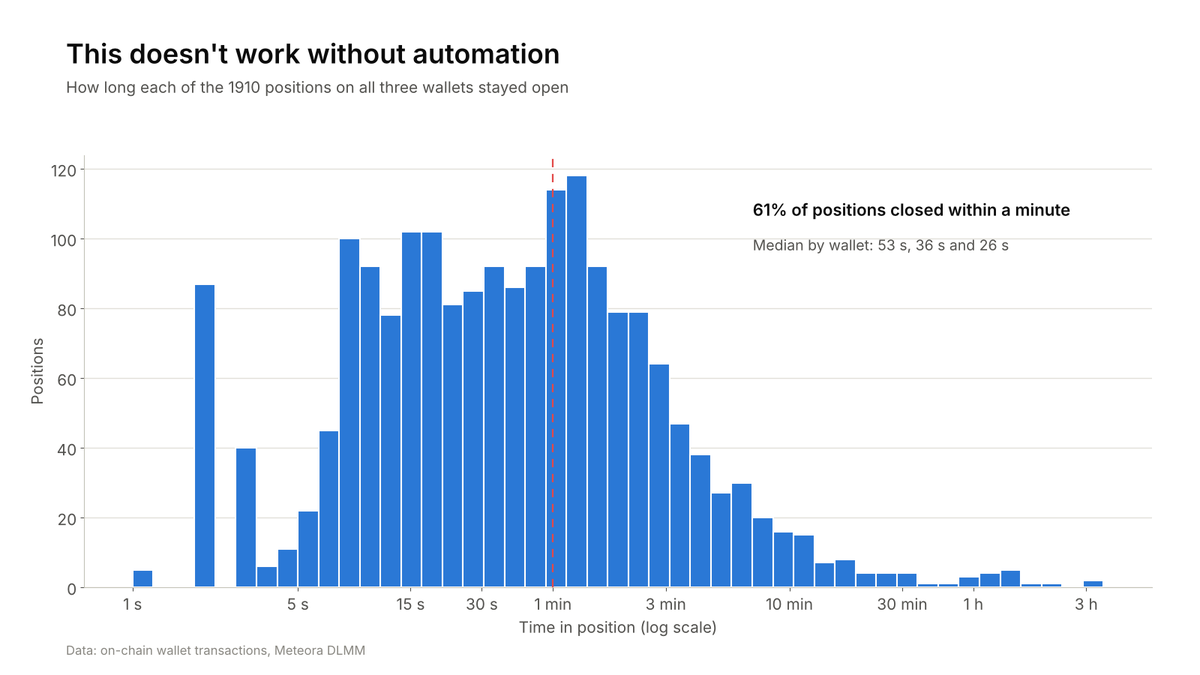
The first two breakdowns of my wallets brought a ton of questions in my DMs: how I pick pools, why I hold positions for 26–53 seconds, etc.
The main dilemma for people coming into LP: can you make money with a small balance, and what percentage can you realistically squeeze out once you already have a decent deposit. I split the whole process into 5 parts:
-
Understanding the market stage
-
Strategy and risk/reward
-
Automated monitoring and management tools
-
Personal psychology
-
Community
Understanding the market stage
This covers the big picture: what’s happening with BTC and SOL, where liquidity is flowing, and what the market sentiment is.
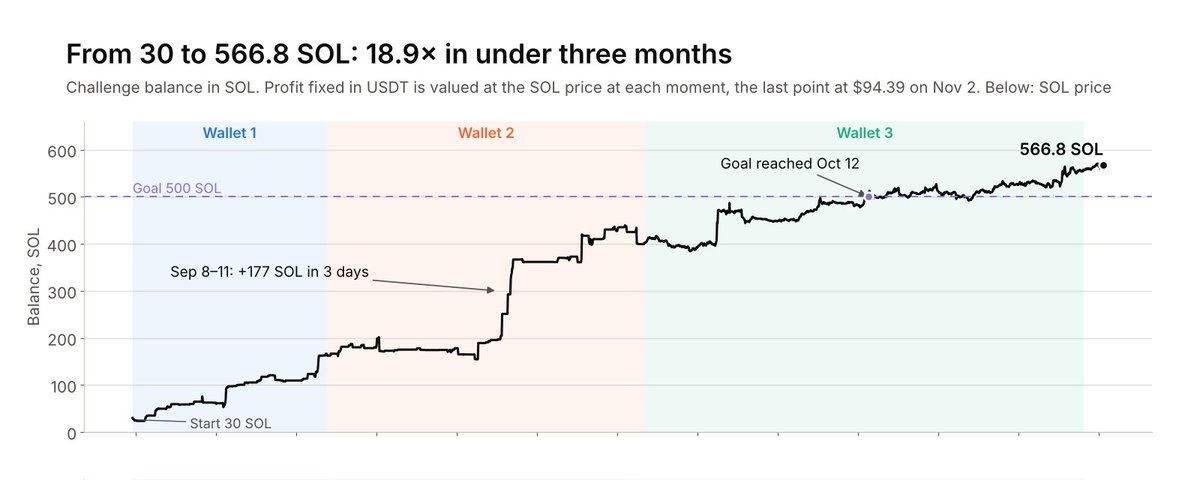
As you can see on the main challenge chart above, while SOL itself first rose from $76 to $120 over these three months and then fell to $94.39, the balance in SOL grew 18.9x (from 30 to 567 SOL). Attention to memecoins usually comes during quiet periods in the main market. When there’s too much movement in the main market, focus gets diluted and moves to other sectors.
A meme bull run always develops along the same spiral: first tokens rise without strong volume, then liquidity comes in, and at the end comes the euphoria stage — that’s exactly where I make the main money. For example, in just 3 days (September 8 to 11), at peak activity, I managed to pull out +177 SOL.
As soon as the euphoria ends, rugs start pouring in and the main tokens deflate. At the highs, it’s psychologically hard for people to admit a mistake, so they hold until the very end — the whole cycle is built on that. There are also prolonged seasons, like in 2024 and early 2025 (a long SOL rally + the distribution on TRUMP and MELANIA followed by the dump on LIBRA). I’m confident a big season is still ahead: no one is going to close the casino, it’s the perfect mechanism for extracting money from the crowd.
Strategy, setups and risk/reward
The bigger my deposit gets, the lower the risk per trade I allow myself. I chose an aggressive approach through ultra-short positions, but with a cap on working size (from 10 to 100 SOL, currently my main working size is around 20–40 SOL).
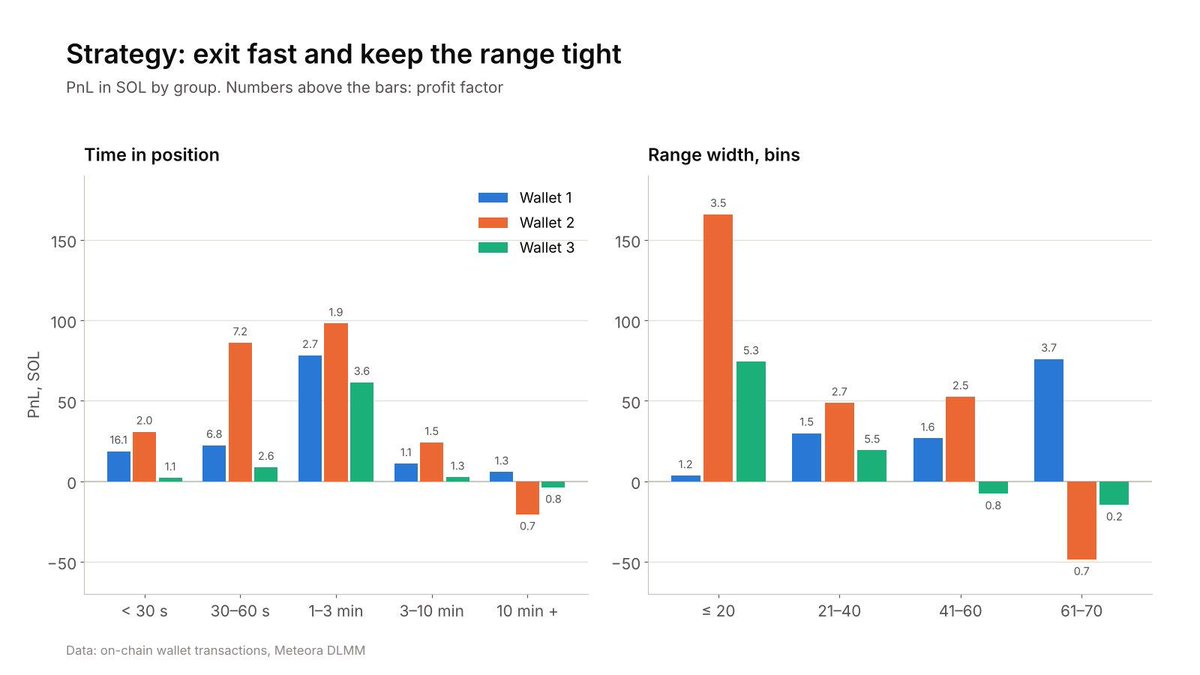
If you look at the on-chain stats of all three wallets, the sweet spot for holding time is up to 3 minutes, and for width on the scaled-up wallets it’s narrow ranges of ≤20 bins (profit factor 3.5–5.3). At the same time, positions held longer than 10 minutes and wide ranges of 61–70 bins on the second and third wallets produced a net loss.
My main strategies (from riskier and shorter to calmer):
-
Narrow one-sided Spot at ATH The riskiest one. A narrow spot on 10–5–1 bins (depending on the pool’s bin step). I use it when a token is rising and when it’s trading around the highs. Profit depends heavily on skill and closing speed. One wrong move and you’re already in a solid loss. You can’t sit it out — you need to exit immediately as soon as the price breaks out to the left.
-
Two-sided Spot with auto-rebalancing + auto-claiming fees I like working with new tokens and entering on both sides. The ratio ranges from 30/70 (token/SOL) to 50/50, depending on the market stage and the token itself. I automatically claim fees every 10–15 seconds and add them back into the position. The key is to exit before a strong correction starts, because it eats a significant part of the initial profit. Knowing when to exit comes with experience. Better to underearn than to lose.
-
Short one-sided Bid-Ask (rarely) I use it when the price is in a downtrend with periodic bounces. If tokens on Spot don’t outpace IL, I go with Bid-Ask. I don’t like working on the way down.
-
One-sided wide Spot (from 0 to -30/-50%) A safer strategy for when a token is rising steadily on moderate volume and I want to hold the position longer, counting on a new ATH or a good bounce.
Automated monitoring and management tools
I can’t imagine working without them anymore.
Back in 2024 we built our first pool monitoring bot — Meteora Navigator (at its peak, around 12k people used it). Then we built a web version of the monitor based on on-chain transactions, but we didn’t actively develop it and moved into on-chain automation.
Right now I only use the web version of Meteora Navigator + my own automation software. During the current market lull, the team and I are building v2 of the service — it will combine the best of what’s on the market, with a focus on speed. The infrastructure is already ready: 6 servers in different locations around the world with fast data sources (gRPC, shreds) on each, with redundant backup.
Personal psychology
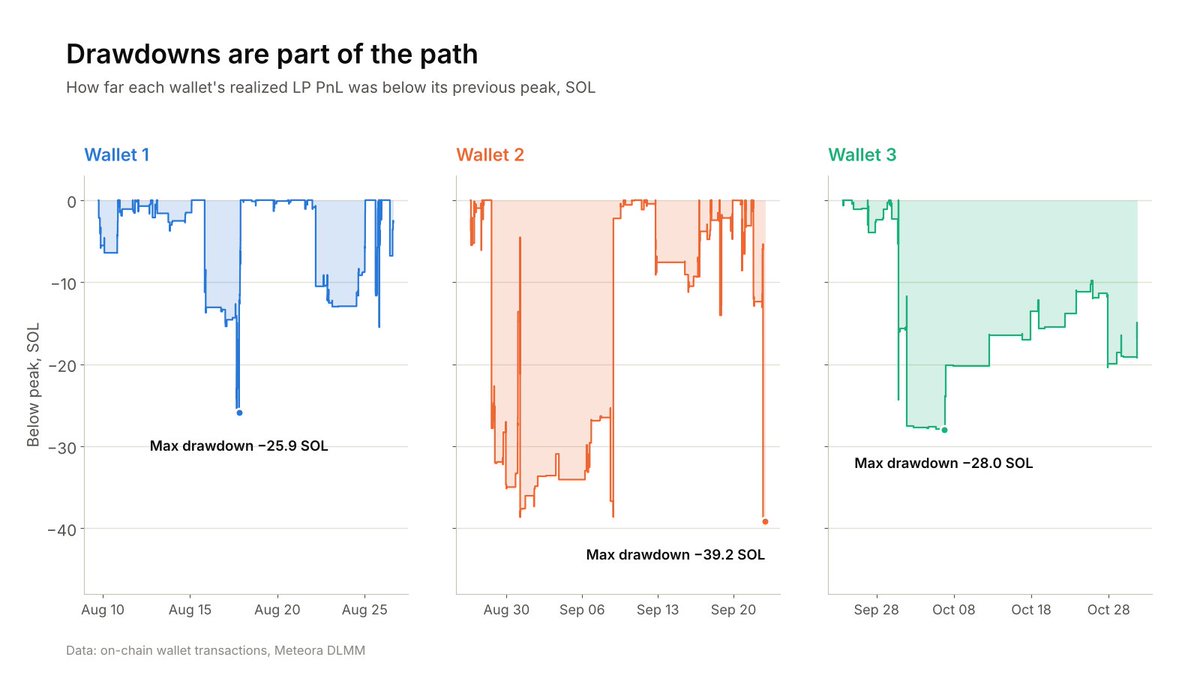
You need to find a strategy that’s comfortable for you. I’ve always been a proponent of high risk and high reward, so I’ve always found or built tools for opening and managing positions as fast as possible.
Community
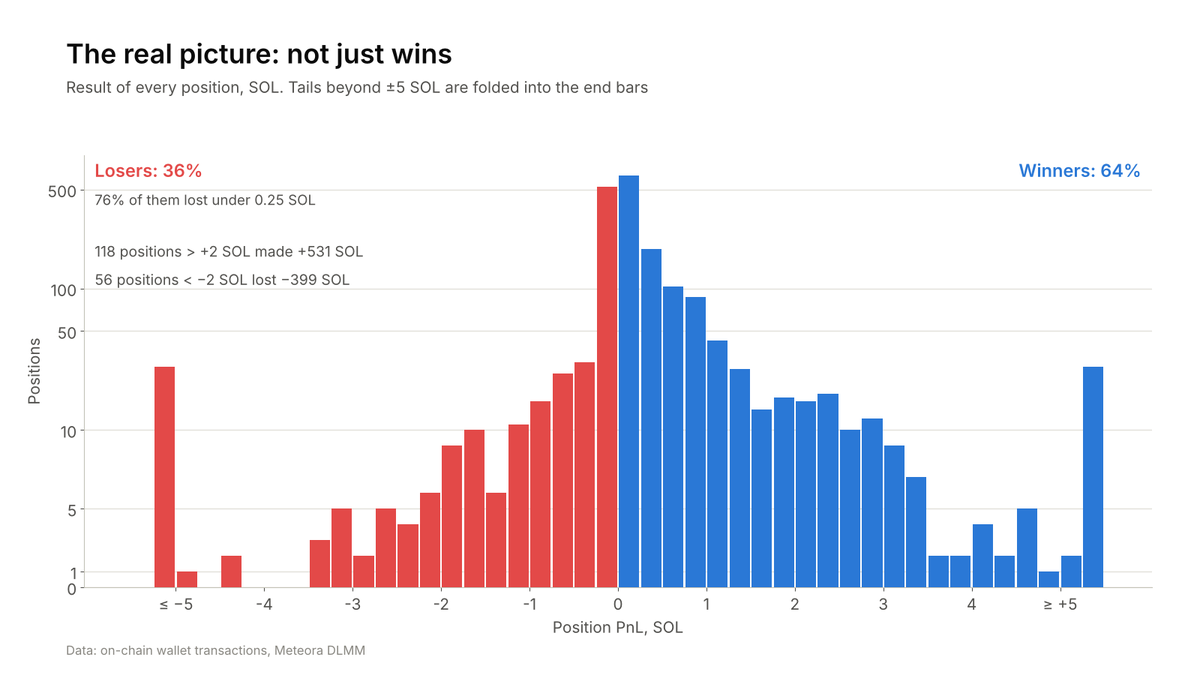
We’re all different, and each of us has our own strengths. By talking to each other, you can pick up experience that would otherwise take years to earn. In communities, people share both their wins and their failures — that gives you the real picture of the market, not just nonstop profits on Twitter.
If you have any questions about the strategy or the software, drop them in the comments.