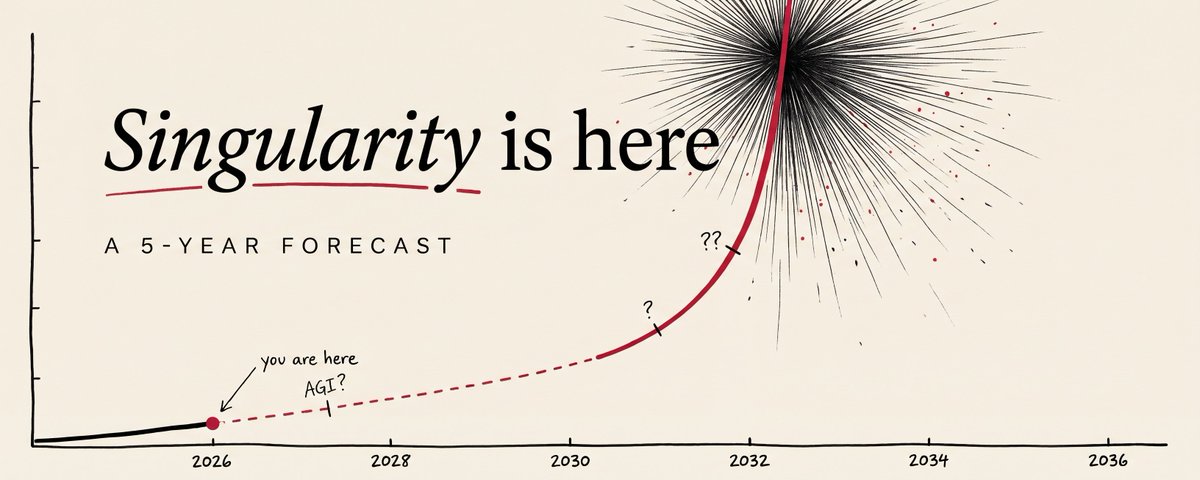
We’ve Entered the Singularity (Realistic 5-Year Forecast)
文章目录
In 2026, the CEOs of xAI, OpenAI, and Google DeepMind have all said something similar: the Singularity has started.
Elon Musk, January: “We have entered the singularity.”
Sam Altman, July: “We are now, like, in the singularity.”
Demis Hassabis, May: We’re in the “foothills of the singularity.”
Something dramatic has shifted in Q3-Q4 of this year. We’ve all felt the exponential leaps in AI capability over the past few months. Only now does the public have access to what these leaders were referring to earlier this year.
For me personally, it feels like the past year has really been 10. I've never seen technology advance so quickly.
This got me thinking about a few questions. Are we really in the singularity, or is this just hype? And if it’s real, what realistically happens next?
I've been writing this article for 2+ days. I wanted to do the deepest research possible on this subject. I'm finally ready to publish.
Nobody is ready for what happens next in this timeline.
Today I present:
I: Proof We’ve Entered the Singularity (bull case) II: Bear Case, Nuances, Caveats III: The 5-Year Forecast (2027 to 2031) IV: What (realistically) Happens Next
Section I: Proof We’ve Entered the Singularity (bull case)
First, let’s define it properly, because there doesn't seem to be a universal understanding of what the singularity means.
The singularity isn’t a robot uprising or a single moment where everything changes overnight. At its core, it’s much simpler:
AI gets good enough to help build better AI. That better AI builds even better AI. And the loop keeps speeding up.
Researchers call this recursive self-improvement (RSI). And for the first time, there’s real evidence it’s started.
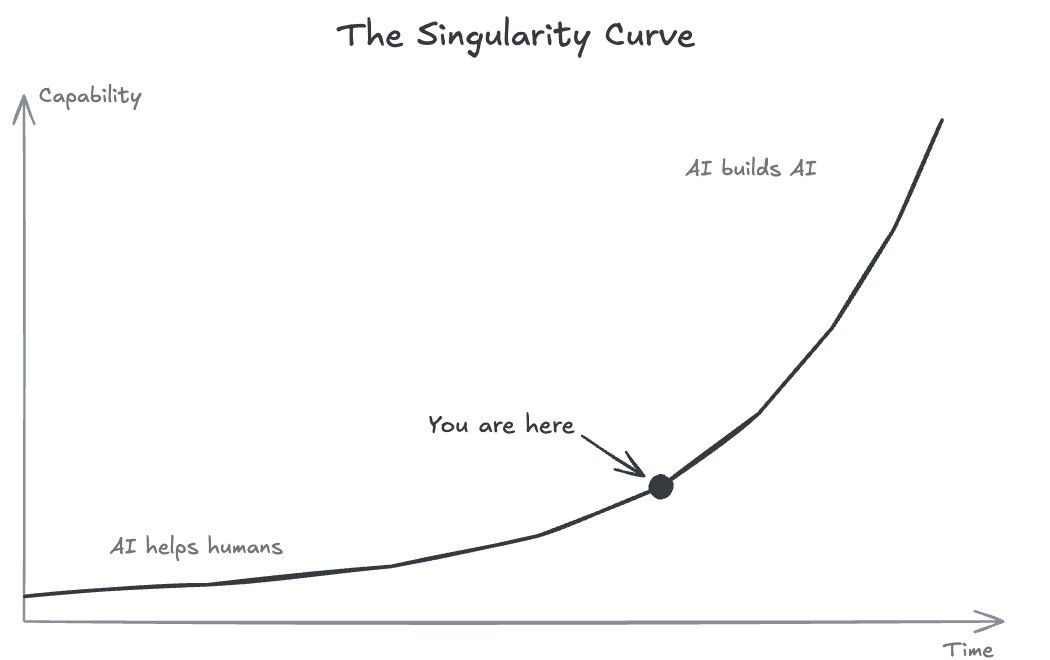
From my research, these are the main "bull" case points for the singularity:
1. AI is now writing the code that builds AI
This is the big one.
As of May 2026, Claude wrote 80%+ of the code merged into Anthropic’s production codebase, not human engineers.
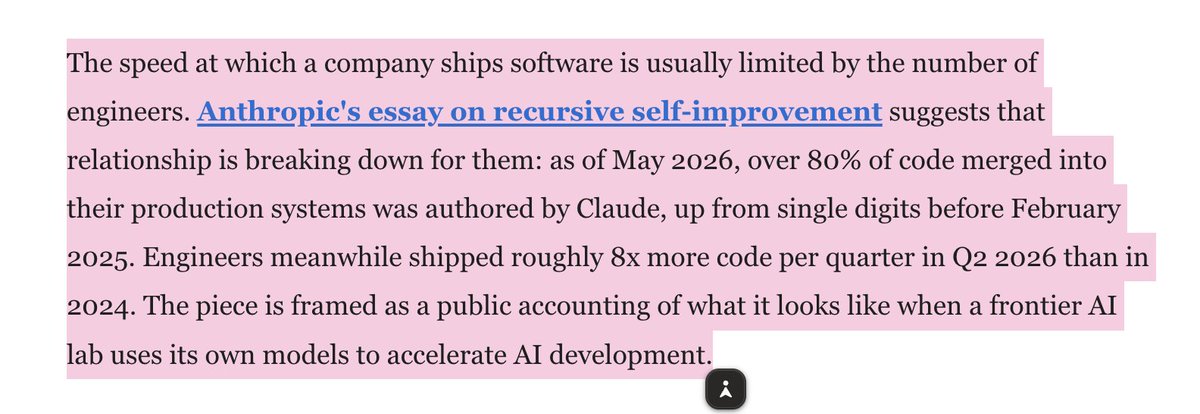
This means Claude is literally building the next version of itself, and this is just one example.
From my anecdotal experience interviewing 25+ devs this year, not a single one is writing code by hand. The entire job has become using AI to train/build other AI workflows/harnesses that complete [x] tasks.
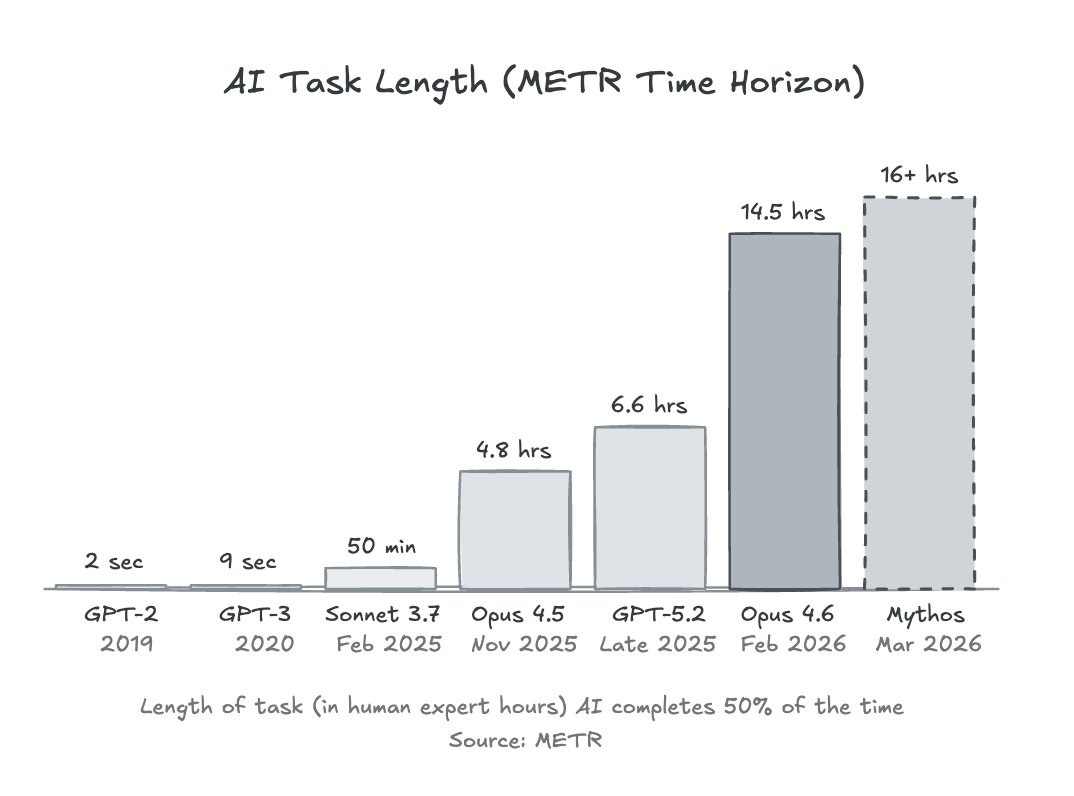
2. AI task length (major breakthrough)
Mythos (Fable) was the real breakthrough in AI task length.
In 2025, the best models could handle tasks that would take a human around 6.5 hours. When Mythos was released in 2026, that number 2.5x'd to 16+ hours.
3. The people building it say it’s happening
It’s not just Elon, Sam, and other major CEOs.
It's also co-founders, employees, technical staff, and so on.
It's hard to ignore the insider perspective of dozens of people actually building the tech.
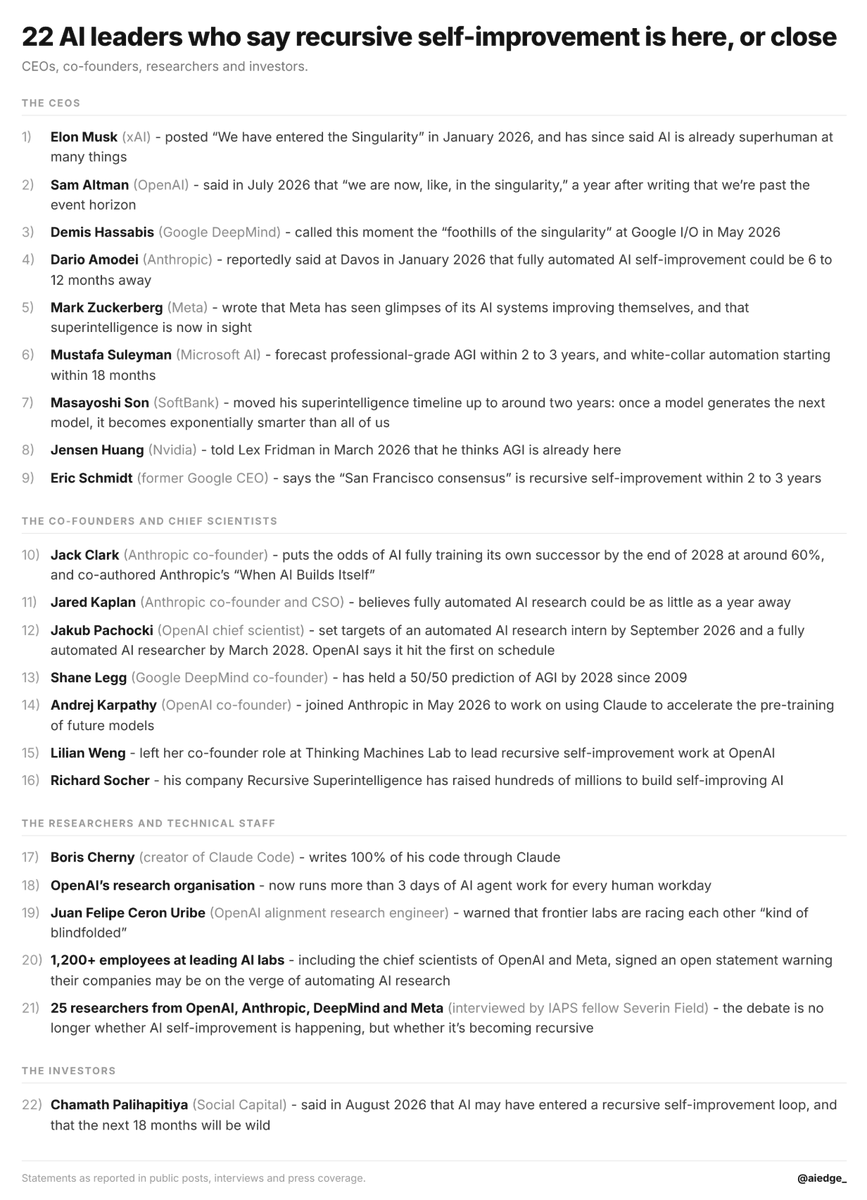
22 AI leaders claiming the singularity is here (or said we were close months ago)
4. Pacing (intelligence, price)
Intelligence is getting cheap, fast
AI inference costs have dropped around -99.7% in three years, from roughly $30 per million tokens in early 2023 to as low as $0.10 in early 2026.
Models
In October 2026 alone, 16 different providers released 20 AI models.
Technically, these two aren't a sign of the singularity itself, but they do put the pace of advancement we're experiencing into perspective.
5. AI is starting to make research decisions
The singularity depends on judgment: what to try next, what to drop, which problems matter.
Anthropic tested this on real research sessions, asking Claude to suggest the next step instead of the human researcher:
• November 2025: Claude Opus 4.5 made the better call 51% of the time
• April 2026: Claude Mythos Preview made the better call 64% of the time
This is the latest data and likely a few % higher now.
Section II: Bear Case, Nuances, Caveats
Before we go any further, it's only fair to steelman the other side. Not everyone agrees we're in the singularity. Plenty of smart, credible people think this is mostly hype.
Here's the strongest version of their combined arguments:
1. Nobody agrees on what "the Singularity" means
This is the biggest problem with the whole conversation. Depending on who you ask, the singularity is:
-
AI that's smarter than the best humans at everything
-
Technological growth that accelerates beyond human control
-
Humans merging with AI through brain-computer interfaces (Ray Kurzweil's version)
TL;DR: the goalpost of the singularity is very easy to move.
2. Anthropic's stance
In June, Anthropic published "When AI builds itself."
In Anthropic's own words: "We are not there yet, and recursive self-improvement is not inevitable."
https://www.anthropic.com/institute/recursive-self-improvement
3. The physical world is limited
Even if the software keeps improving, AI still runs on chips, data centers, power grids, and data.
If we are in the singularity, it would be hard for the physical realm to truly experience the effects of highly capable AI. Most AI development is limited to desktop/computer work.
4. The incentives
Let's say the obvious: every CEO declaring the sngularity is also raising capital or selling a product.
They are (generally) incentivised to hype up their technology and where it's headed.
So, are we in the singularity?
My take: we’ve entered the singularity, but we’re at the very beginning. The loop has just started, which is why it's hard for everyone to agree.
I like Sam Altman's perspective: there’s no single tipping point. You only realise you’re in it when you look back.
I wholeheartedly believe Q3/Q4 of 2026 will be remembered as the obvious shift in hindsight.
However, it really depends on who you ask. Elon says we're in the singularity, while Anthropic recently published a paper saying it's not here.
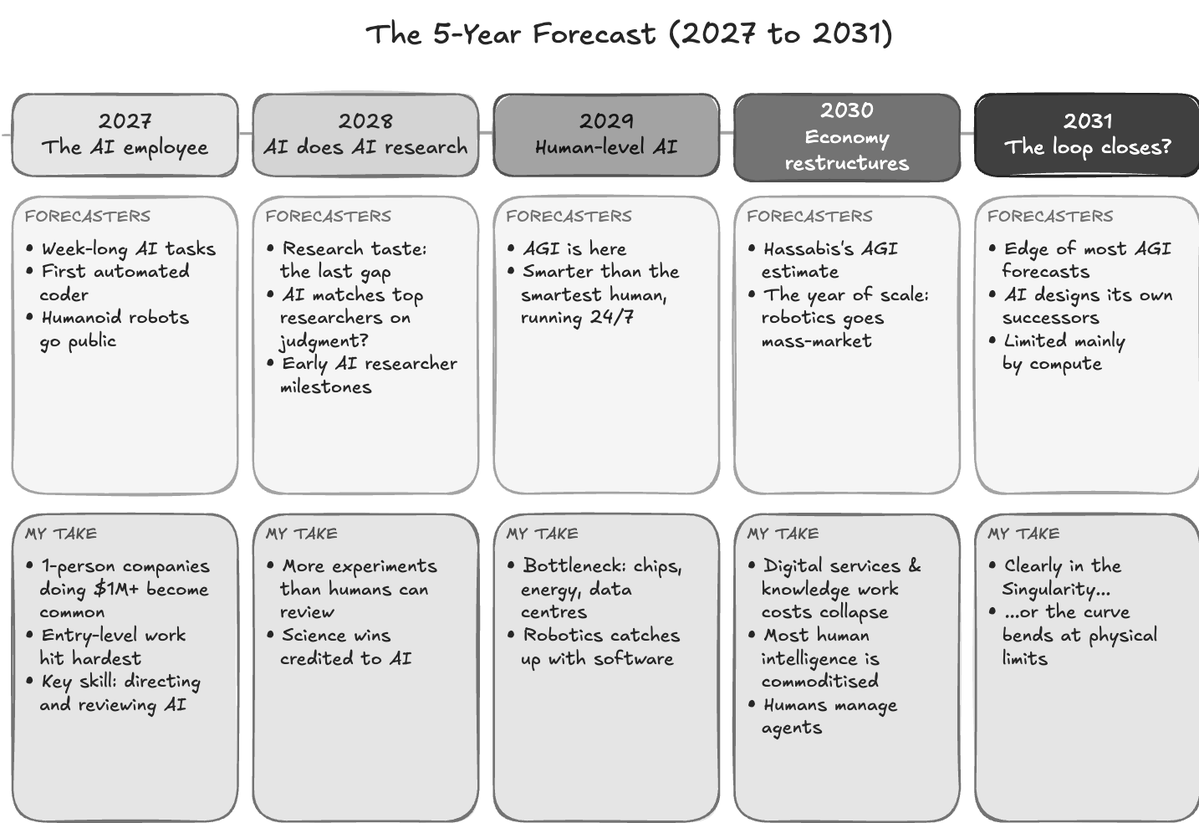
Section III: The 5-Year Forecast (2027 to 2031)
A realistic map of what we can expect to come next (pulled from top experts).
Before the year-by-year, here's what the main forecasters currently expect:
Anthropic        → Day-long AI tasks within 2026, week-long tasks in 2027
AI Futures Project (AI 2027) → Median for an "automated coder" around November 2027 (Kokotajlo)
Demis Hassabis   → AGI around 2030
Ray Kurzweil     → Human-level AI by 2029, the full Singularity by 2045
Elon Musk        → Humanoid robots available to the public by late 2027
2027: The year of the AI employee
What forecasters expect:
-
AI handling week-long tasks (Anthropic's trajectory)
-
The first "automated coder": AI that can do the coding work of an entire engineering team (AI Futures Project median)
-
Humanoid robots reaching the first batch of the public (Musk)
2028: AI starts doing AI research
What forecasters expect:
-
Research "taste" (choosing the right problems) is the last gap. If the trend from 51% to 64% continues, AI could match top researchers on judgment around here.
-
Several forecasters place their automated coder and early AI researcher milestones in 2028.
2029: Human-level AI (by most definitions)
What forecasters expect:
-
AGI is here.
-
AI is smarter than the smartest human alive, running 24/7
-
Physical constraints (chips, energy, data centres) become the main bottleneck, not the models
-
Robotics catches up with software
2030: The economy restructures
What forecasters expect:
-
Hassabis's AGI estimate.
-
The year of "scale" - primary focus becomes mass-adoption for new modern technologies like robotics
-
The cost of most digital services and knowledge work collapses
-
Humans move towards a world of controlling agents
2031: The loop closes (maybe)
What forecasters expect:
-
This is the edge of most AGI forecasts' confidence ranges
-
AI is designing its own successors, and progress is limited mainly by compute.
-
Either we're clearly in the singularity by any definition, or the curve has bent, and we've hit real physical limits.
Section IV: What (realistically) Happens Next
Here’s what I think actually happens over the next five years (practically speaking).
I have 8 specific predictions, in order:
1. The first rung of the career ladder disappears
There’s no mass unemployment yet. US unemployment is sitting around 4.3%. But the damage is concentrated at the bottom: entry-level professional jobs have dropped around 29% since January 2024, and unemployment for young college grads has climbed to 5.3%.
I expect this to keep accelerating. Companies won’t fire their way into the AI era. They’ll just stop hiring juniors.
2. Everyone becomes a manager (of agents)
Every job will be expected to use agentic AI. Not optional, just common practice - much like using a desktop computer.
3. Tiny teams will build giant companies
The doors for building one-person empires will be wide open. I think we'll see several great entrepreneurs build massive businesses with incredibly lean teams.
4. Intelligence becomes nearly free
AI inference costs have fallen -99% in three years. From here, that means most AI becomes free and publicly accessible.
5. The bottleneck shifts to energy and compute
The constraint on AI progress is no longer ideas. It’s power and chips.
I expect energy to become one of the decade's defining AI stories.
6. AI starts making real scientific breakthroughs
Major breakthroughs in cancer treatments, vaccines, etc.
7. The most powerful models get locked away
I think in a few years, gaps will emerge in who has access to the most powerful AI (governments, military, etc.). I don't think what we're experiencing right now, where the top models are all public, will last forever.
8. The AI-native gap becomes the new wealth gap
Workers with AI skills already earn a wage premium of around +62%, according to PwC.
Over the next five years, that gap will likely compound.
Closing Out
I hope you've found this thought piece insightful. It was certainly fun writing something outside the scope of my regular content.
Some practical advice for closing out:
-
Learn to direct AI, not just use it. The most valuable skill of the next five years is knowing what to delegate, how to brief it, and how to judge the output. I'm personally only hiring people who are (or willing to become) AI experts
-
Build leverage while it’s cheap. Intelligence is getting cheaper every month. Use it to do more with less over time.
-
Own something AI can’t commoditise. Distribution, trust, relationships, proprietary data. That’s where the value is moving.
-
Stay close to the frontier. Things are moving too fast to check in once a year. At the very least, you need dedicated time each week to use and experiment with AI tools.
If you enjoyed this read, be sure to follow me here @milesdeutscher.
For deeper AI insights, follow me over @aiedge_.
I created a free AI workflow library to help you level up with AI.
85+ workflows, cookbooks, videos & more. Enjoy!
Access it here 👉 https://milesdeutscher.com/