Clinical Development in an Age of Cheap Molecules

By now, hopefully everyone agrees that clinical work is the new R&D bottleneck. Formation Bio's new $600 million fund is one of the clearest bets yet on this thesis. But as Atlas Venture partner Bruce Booth predicted, commoditized molecule generation may very well worsen the industry’s aggregate R&D productivity for the next three to five years before it improves it. I agree with this belief at a high level: no doubt, a flood of candidates into a clinic with fixed capacity means more programs compete for the same patients and sites, plus capital that gets burned on the way to a no-go. But much of the prose I’ve read thus far about clinical trial congestion reads pessimistic. I was curious how much of the bottleneck is actually fixed: how much of a trial’s timeline reflects biology, and how much reflects needless friction? Here, I hope to make the case that while biological constraints dictate a hard baseline for clinical development timelines, the industry's egregious operational inefficiencies may create massive opportunity for technological value creation — particularly with agentic AI, which I believe is uniquely suited to much of this work. A lot of my thinking is inspired by @BenjamineYLiu's Uneven Frontiers, which touches on some of the themes I’ll discuss here. Writing this piece was primarily my excuse to dig deeper into the technologies being built in this space, update my own mental models, and share my thinking along the way.
Before Agents: Lay of the Land
Development is where a molecule’s upstream hypotheses meet the messy realities of patients, sites, protocols, regulators, and timelines. The baseline operational math of clinical development is staggering. For non-expedited programs approved between 2008 and 2018, 82% had a gap between Phase II and pivotal Phase III, averaging 17 months. That gap grew from an average of 12 months for programs approved in 2008-2013 to 21.6 months for those approved in 2014-2018. Research out of Tufts suggests the direct cost of running a trial averages about $40,000 per day, rising to $55,716 per day for Phase III studies. And trial cost is only the visible side of the economics. Pharma companies and biotechs must also consider (1) finite exclusivity windows: the patent clock typically starts before the first patient is enrolled, and (2) the time value of money: every day spent in development is a day subtracted from on-market revenue after approval.
Enter AI-native drug discovery. If we collectively believe in scaling laws, and that molecule generation will keep getting cheaper with each model generation (as the Formation Bio team was prescient enough to realize sooner than most), the capacity to test them becomes increasingly scarce. Drug development was wildly inefficient before anyone asked it to absorb a flood of new candidates. There’s also a second reason the clinic matters: human trials are the pivotal eval of whether a discovery model’s predictions work in a human body, providing the most valuable ground truth feedback a model can learn from. Thus, clinical throughput will also cap how fast the discovery side can recursively improve.
What, exactly, does a trial consume? AI (and China!) may make molecules abundant, but a trial burns through things that stay scarce:
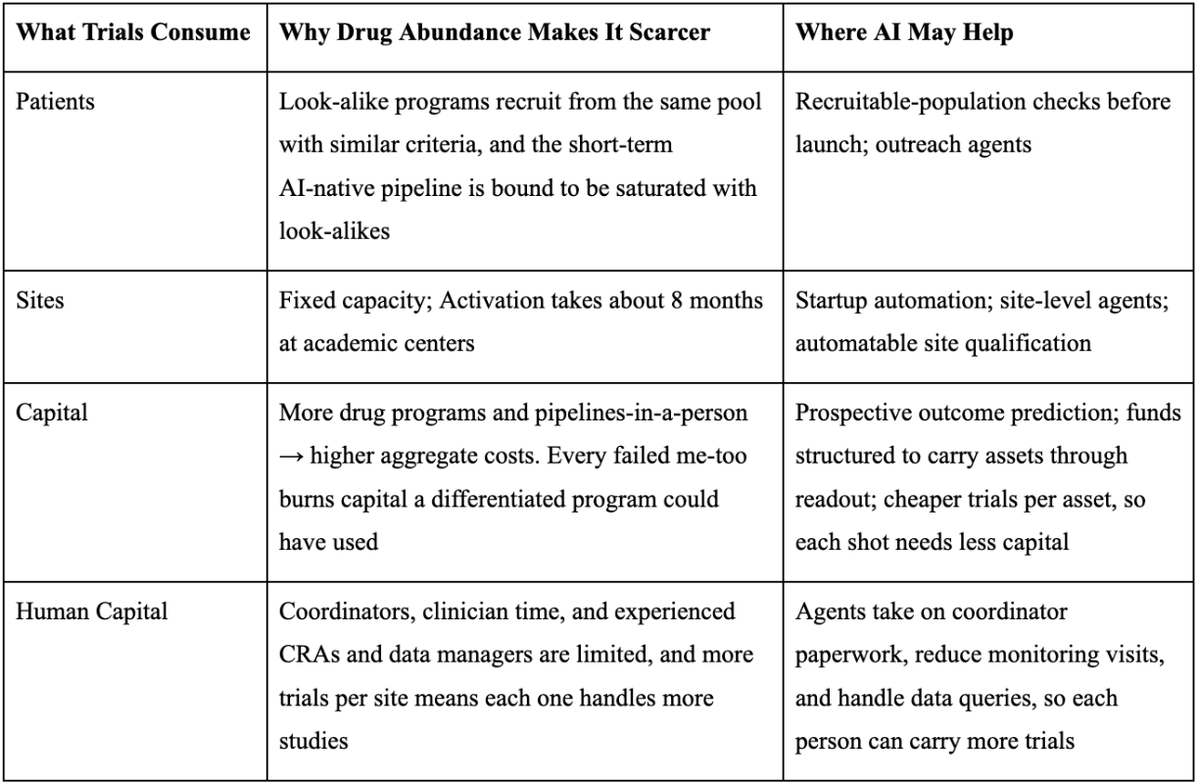
Three things make this table worse than it looks:
(1) Jack Scannell’s “Better than the Beatles” dilemma: the bar for a new drug rises with every drug that clears it. The ODYSSEY trial of alirocumab on top of statins enrolled just under 19,000 patients over about five years, costing about a billion dollars to show a 15% relative risk reduction. To put that in perspective, a dozen AI-generated entrants in a statin-adjacent class would each need an ODYSSEY outcome.
(2) The industry has already saturated itself without any help from AI. This became publicly obvious in 2021, when Dr. Janet Woodcock, then-Acting Commissioner of the FDA, revealed that an enterprise-wide evaluation of global clinical registries found only about 5% of COVID-19 trials were both randomized and adequately powered to act upon. But this trend is just as clear in immuno-oncology, autoimmune disease, and other such indications.
(3) Drug revenues are highly skewed. As @Atelfo has previously shown, top-decile launches capture >50% of all value, and the median launch earns about $1.5 billion in lifetime revenue against a mean near $4.6 billion. The assumption that ‘more shots on goal’ is inherently better than fewer assumes independent draws from a fixed earnings distribution and unconstrained testing capacity, which isn’t necessarily applicable to today’s AI-generated molecules.
Making a drug is hard. Developing one is harder, and getting harder still. AI in the development space aims at every layer of the trial workflow: protocol design, site selection, patient recruitment and matching, safety monitoring, real-time operational analytics. But I expect most of the value to concentrate in four functions:
-
Design: Triaging which programs deserve scarce patients and sites, in which subpopulation, and against which endpoints.
-
Execution: Killing the dead time and administrative stalls between clinical milestones.
-
Recruitment & Operations: Expanding effective clinical capacity by making existing sites and coordinators vastly more productive.
-
Data Management: Beyond consuming finite resources, platforms could also capture value by leveraging the massive amounts of data these trials will ultimately produce, since trial data is also the training substrate discovery AI needs.
The Incumbents
I’m a firm believer that any discussion of AI in biopharma must start with a thorough discussion of what came before, so bear with me for a short history. Cytel, founded in 1987, has been the legacy leader in adaptive trial design and model-informed drug development for nearly four decades; its East® software (extended into East Horizon™ in 2024) is used by the FDA, Japan’s PMDA, and the top 30+ pharmas. Where Cytel specializes in simulation, Medidata is the incumbent in trial data, with more than 38,000 trials and 12 million patients across 140+ countries logged in its platform. Veeva built its reputation in regulatory submissions and commercial software, but its Vault products also manage trial documents, study startup, and clinical data.
These platforms’ decades-long dominance is worth understanding structurally because it illustrates why clinical development has been so resistant to disruption compared to discovery. In discovery, a computational chemist can trial a new AI tool on a side project without changing anything about the organization's core infrastructure. In clinical development, the Electronic Data Capture (EDC) system is the trial's system of record. Every data point, query, audit trail runs through it, and it is an especially sticky product. Additionally, in clinical development, data points pass through the sponsor, a CRO, dozens of sites, an IRB, and a regulator; while gains between phases depend mostly on the sponsor's team, gains within a phase depend on many outside vendors, requiring a shared, centralized ground truth.
But the vendor stack also misses a large part of the AI-for-clinical story. Large pharma companies don’t lack the capability to predict trial outcomes, and most run substantial internal tooling, particularly in Real World Evidence (RWE), Real World Data (RWD), and Pharmacovigilance (PV). They simulate trials by building synthetic control arms from RWD, model counterfactual patient trajectories, and assemble regulatory-grade evidence packages for label expansions and payer negotiations without recruiting a single new patient. They calculate the probability of technical and regulatory success (PTRS, sometimes called POS or PTS) for every program, and roll results into risk-adjusted net present value (rNPV) models.
This leaves AI-native players with two openings. Either deliver solutions orders of magnitude more effective or differentiated than internal tools, or route around what limits internal tooling: silos between functions, teams sized to headcount rather than to the data, and structured meeting cadences rather than real-time information flow.
Without further ado, here are some deployments I find most exciting, across four clusters in the trial lifecycle.
1. Design
The most consequential application of AI in development may be trial design, where bad decisions compound across years of execution. Trial design optimization has far more economic leverage than trial execution optimization: a faulty endpoint, an overly restrictive inclusion criterion, or a misjudged enrollment rate can all doom a program regardless of whether the biology works. As I (breaking the fourth wall here) wrote about not long ago, while individual trials live or die on their primary endpoints, most biotech company failures aren’t failures of science, but failures of design and operations.
Among many companies building in this space, PhaseV, which closed a $50 million Series A in May 2025 co-led by Accel and Insight, is one illustrative example. The company says its Bayesian models let sponsors simulate millions of counterfactual simulations in minutes, compare adaptive and fixed protocols, and test how endpoints, sample size, and interim decisions affect a program’s risk. Its Enrollment Lab “stress-tests” protocols against EHRs, quantifying recruitable patients after accounting for comorbidity overlap, geographic distribution, insurance constraints, and competing studies drawing from the same pool. In March, the company launched AI Conductor, an “orchestration layer” covering everything from statistical analysis plans aligned to ICH E9 standards to case report forms aligned to CDASH (an EDC-compatible format). After all, if a pharma company outsources trial design to software, that software might as well write the protocol too.
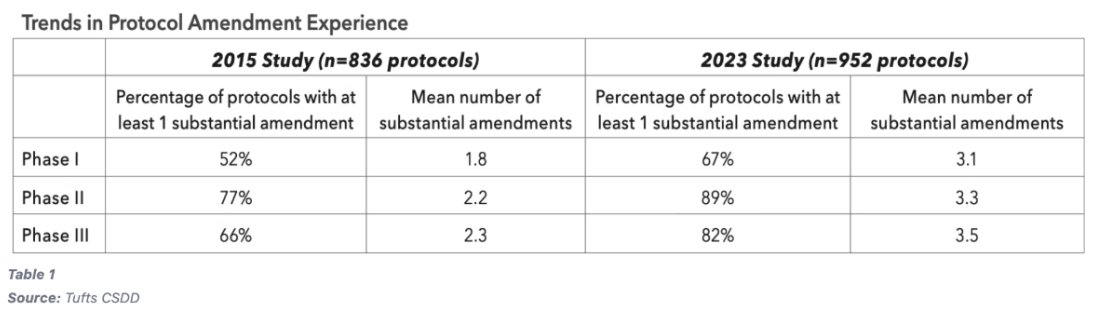
Another lever for design optimization is minimizing the likelihood of trial amendments. As of 2024, one protocol amendment takes 260 days from "we must change this" to the last approval (amended protocols average 3.3 amendments each). A single substantial amendment costs a median $141,000 in a Phase II trial and $535,000 in a Phase III trial, capital that should be directed toward getting medicines to patients faster. Since 2017, trials reporting results on ClinicalTrials.gov have had to post their protocol and statistical analysis plan, including applicable approved amendments, with some of said records including amendment histories and the sponsor’s reasons for changes. A team from the University of Illinois and Medidata published the first public benchmark using this data to train a model in January: AMEND++ rebuilds the eligibility-criteria history of 161,970 drug trials from old versions of their ClinicalTrials.gov records, then asks whether a model that only sees the first version can tell the criteria will change, scoring likelihood of amendment with AUROC 0.71. But the model only looks at eligibility criteria; its labels are registry edits (which trail the actual amendment and lump typo fixes in with real changes), and it only predicts that eligibility criteria will change, not how or why, which is what a sponsor would actually want to know.
Last year, the FDA published more than 200 Complete Response Letters, documents detailing why the agency initially couldn’t approve drug applications as submitted. Together with FDA approval packages, Form 483 inspection reports, and warning letters, these signals could form a powerful supervised training set if leveraged correctly, but selection and redactions limit what a model can learn. Nonetheless, many labs and companies deploying AI into pharma regulatory teams are already toying with models trained on regulatory agency corpora (Biorce, for one), and it will be exciting to see how well a model trained on past rejections can predict the next one.
As many insiders know, predicting clinical trial outcomes has become something of a parlor game in San Francisco. Plenty of biotech investors have built strategies on the thesis that readouts are predictable. The more beautiful expression of this work is predicting outcomes before the trial starts, when the prediction can still change which trial gets run, in whom, and with what endpoint. Many companies, both vendors to pharma and standalone verticalized biotechs, have adopted varying methods for predicting outcomes, the vast majority of which can only be validated on historical data. Liu's own math shows that at a 30% base rate for Phase II success, a company would need 10 to 20 prospective readouts, and would need to hit 6 of 10 or 10 of 20, before it could claim a statistically significant edge. Thus, until a model has been scored against a few dozen readouts it predicted in advance, its track record is a backtest.
2. Execution
Part of why I’m so bullish on agentic AI in clinical trials is that much of what creates dead time in clinops can be described in the same language we use for workflows software already automates. Site activation is a chain of handoffs (contract, budget, IRB, system build). Enrollment is a funnel workflow (screened, eligible, consented, enrolled). Learning across trials should be a standardized feedback loop. Predicting amendments before they hit the sponsor is a supervised learning task. In a crowded class, every day spent on paperwork isn't just a sunk cost; it can quite literally kill a program.
As I wrote earlier, it helps to split a trial’s calendar into two kinds of time. The first is biological: patients have to be dosed and followed long enough to read out an endpoint, and nothing an agent does changes that. The second is everything else. Agents can only touch this second kind of dead time, and even there it’s worth being precise. Most startup steps entail very little actual work (drafting a contract or building a database takes hours or days) and a lot of waiting (for the other side’s lawyers, the next IRB meeting, a signature). Agents can only help with waiting when a step depends on information, like a corrected budget or a consistent set of documents, rather than on a person with authority. But waiting time is where most of a trial’s non-biological time goes, and there is plenty of value to be created in compressing it.
Dead time accumulates in a few places. The first is between phases. When Tufts asked sponsors about the 17-month average gap between Phase II and pivotal Phase III, they named four causes: back-and-forth with regulators, incomplete inputs to Phase III decisions, failure to plan downstream needs such as manufacturing trial supplies, and slow internal agreement. None of these delays depend on "biological time." One sponsor estimated it spent four to five months finalizing the Phase III protocol after its regulatory meeting. One fix is to use agents to optimize Phase III planning from the very beginning. Formation is the clearest example: its Forge system designs the trial during diligence, before Formation even owns the drug, and its new fund commits capital through a readout, so a program never stalls waiting on its next financing. The same logic works inside a single program. If the protocol already lives as structured data, an agent can keep a draft Phase III protocol, supply plan, and regulatory briefing package updated for each plausible Phase II outcome while the trial is still running.
The second is study startup. Median activation, from site selection to signed contract, is 8.12 months at academic medical centers and hospitals, and 4.37 months at independent sites. This gap is egregious. Both kinds of sites run the same trial, so most of the extra time at academic centers comes from institutional bureaucracy (more layers of review, contract offices with backlogs, committees that meet on fixed schedules), which delays getting medicines to patients. Medable, whose tagline is “Clinical development, meet agentic AI,” has released a Digital Data Flow Agent that converts a protocol into CDISC USDM 4.0, a standard machine-readable format, so amendments can flow into connected systems instead of being retyped by hand.
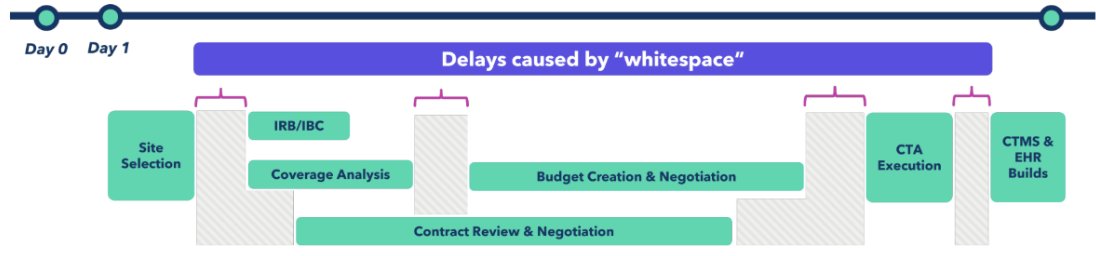
One surprising contributor to startup dead time I came across in my research is health insurance. In the US, a trial’s procedures are billed to two parties: routine care goes to the patient’s insurer, and anything that exists only for the study goes to the sponsor. Before a site can negotiate a budget, it has to decide, line by line, which costs go to which party using Medicare’s published coverage rules. This "coverage analysis" is a big reason nearly 70% of sites name budgets and contracts as their top startup delay. On average, for-profit sites take over a month to negotiate contracts with their sponsor, versus 3-4+ months at academic centers. Small companies like UpSite Clinical and incumbents like Advarra implement coverage analysis as a feature, but the process remains manual for the majority of trials. While much dead time involves back-and-forth redlining, if both sides run agents that evaluate against their own playbooks, negotiations could converge much sooner on a compromise.
3. Recruitment & Operations
Patient recruitment is, by most accounts, the single largest operational bottleneck in clinical development. Finding, qualifying, and getting patients through the door of a clinical site involves shockingly analog work: a site coordinator scrolls through EHR records, plays phone tag with thousands of patients over months, manually checks eligibility criteria against a protocol, and schedules hundreds of visits. With all these barriers, it’s no wonder that ~80% of trials never meet their initial enrollment timelines, and 11% of selected trial sites fail to enroll a single patient. On average, it costs $6,533 to successfully recruit a single patient.
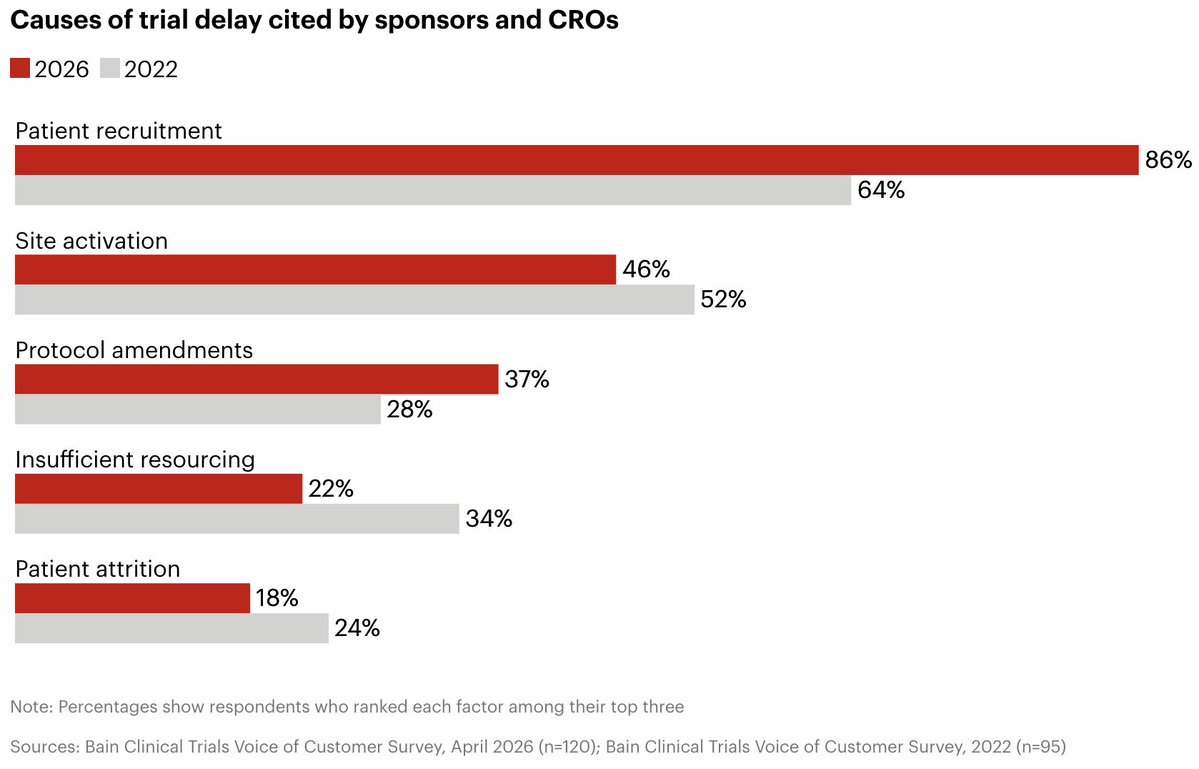
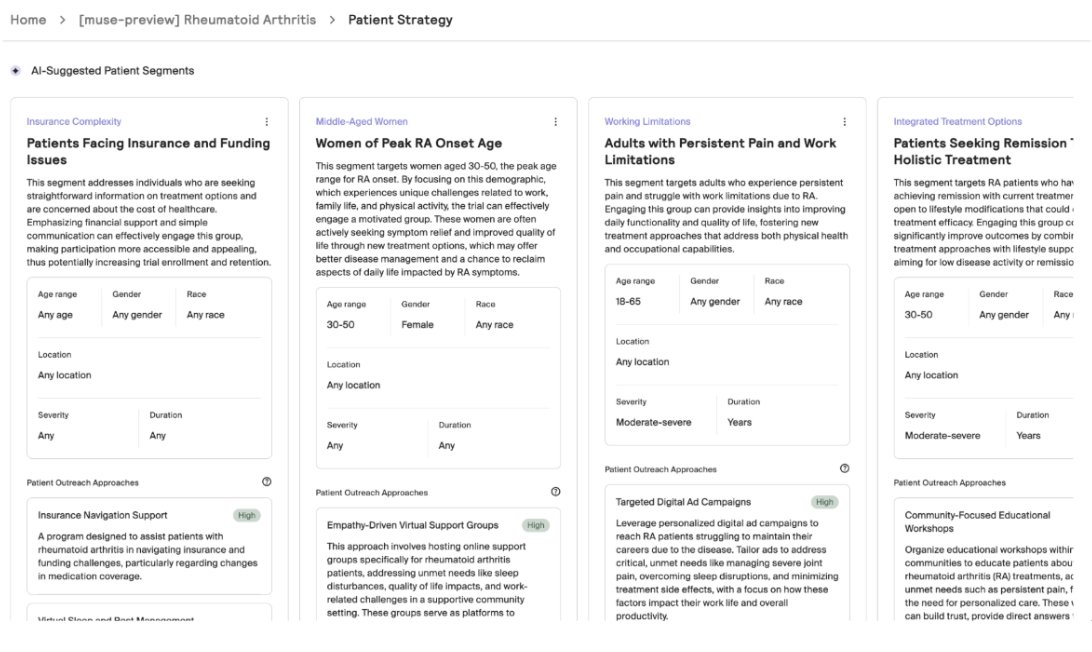
AI entrants in this space attack the problem from three angles. The first is compressing the work of recruitment planning. Formation Bio's Muse, built with Sanofi and OpenAI, works a level upstream of outreach altogether. Rather than automating outreach or adding capacity, Muse synthesizes scientific, clinical, and population data to identify target patient profiles and generates recruitment materials and prescreens for each group, work Formation says used to take months.
The second strategy is to automate patient interaction. Alleviate Health, which raised a $4.3 million seed from a16z in October 2025, runs human-in-the-loop AI agents that engage patients 24/7 via automated texts and calls, verify eligibility, and book screens. The company reports over 500,000 patient engagements across 190+ sites in its first year. Intera sells a similar loop directly to research sites and site networks, with its voice and SMS agent coordinating outreach, prescreening, follow-up, and scheduling, and its platform also routes a patient who fails one study’s prescreen to another study at the same site.
The third angle is expanding the supply of sites that can run trials in the first place. Topography Health, which launched in 2022 with $27.5 million from a16z and BCV, bet on creating new capacity. The company identified, trained, and supported community physicians to run trials in their own practices, then analyzed their patient records to recommend studies likely to enroll. In May, it sold that site business to FOMAT Medical Research, which now runs more than 35 community sites across six states.
Rather than sell discrete trial functions, Lindus Health, the self-described “anti-CRO,” vertically integrated everything — protocol development, site selection, patient recruitment, data collection, monitoring, and biostatistics — through a single platform with access to over 40 million electronic health records. As of January 2025, Lindus had run 42 end-to-end clinical trials across North America and Europe, enrolling over 36,000 patients and funneling them through trials up to three times faster than traditional CRO-managed studies. Their pitch was to remove the handoffs that slow trials run across separate vendors. But this August, Lindus sold its CRO business to Curavit Clinical Research and relaunched as Lindus Therapeutics, which in-licenses and develops its own drugs.
I think the Lindus model and story is worth double-clicking on because it illustrates a broader structural argument about where AI creates and captures value here. The traditional CRO model is built on labor arbitrage: it rents you the staff to run a trial, and its revenue scales with headcount. Lindus's thesis was that vertical integration plus AI automation can break that linearity, delivering the same or better outcomes with a fundamentally different cost structure. Yet the company with perhaps the best claim to running trials faster decided selling “speed as a service” was worth far less than owning the drugs that speed is applied to. After all, a fixed-price contract can capture the value of speed only once, while the sponsor captures a vastly disproportionate share of the value created. I’d expect this pattern to continue: that the best trial-execution teams will drift toward owning assets rather than selling services. Soberingly, the companies most capable of speeding up trials have far greater incentive to accelerate their own pipeline rather than sell those capabilities to pharma.
Tilda’s product, Tilda Sense, inverts the Lindus logic: instead of consolidating trial execution under a single vertically integrated vendor, it distributes capability to sponsors, CROs, coordinators, and sites embedded in existing trial infrastructure. The company is built around "AI teammates” that process the site startup packet, fill in forms, direct said forms to the right party for e-signature, and file away completed documents. As founder Ram Yalamanchili writes, “If we want to modernize trials, we need to start by making the coordinator 10x more effective. Not just faster, but supported, focused, and unburdened.” Coordinators are among a trial’s scarcest inputs, and letting each one carry more studies increases capacity without adding sites.
4. Data
The pre-AI clinical data management (CDM) workflow for a Phase II oncology trial looks something like the following: A data management team designs case report forms (CRFs) manually by interpreting the study protocol before the study starts and then hands over the CRF specs to a different database programming team to build the EDC system. This process takes 2-3 months. Once the study is underway, site coordinators input patient data into the EDC system. A data management team reviews data periodically and manually opens a query (a kind of pop-up box) when the system flags a missing value, an out-of-range value, or an inconsistency (for example, a patient’s weight does not match their BMI, a lab value is not within the expected range for a given dose, etc.). Each opened query initiates a back-and-forth between the data management team and the site that can take days or weeks to resolve. In parallel, a medical monitor manually reviews aggregated safety data, often in spreadsheets, to look for patterns of emerging adverse events. As the database nears lock, a clinical programming team starts writing custom SAS or R code to convert raw data into CDISC-compliant analysis datasets and results tables.
The whole cycle, from CRF design to database lock, for a moderately complex study, involves dozens of people on multiple functional teams working sequentially. Standard operating procedures (SOPs) have traditionally separated these roles: a Clinical Data Manager ensures data accuracy against the protocol and compliance requirements; a Clinical Data Scientist analyzes complex data to uncover insights; a Clinical Programmer ingests, transforms, and manipulates data and builds visualizations.
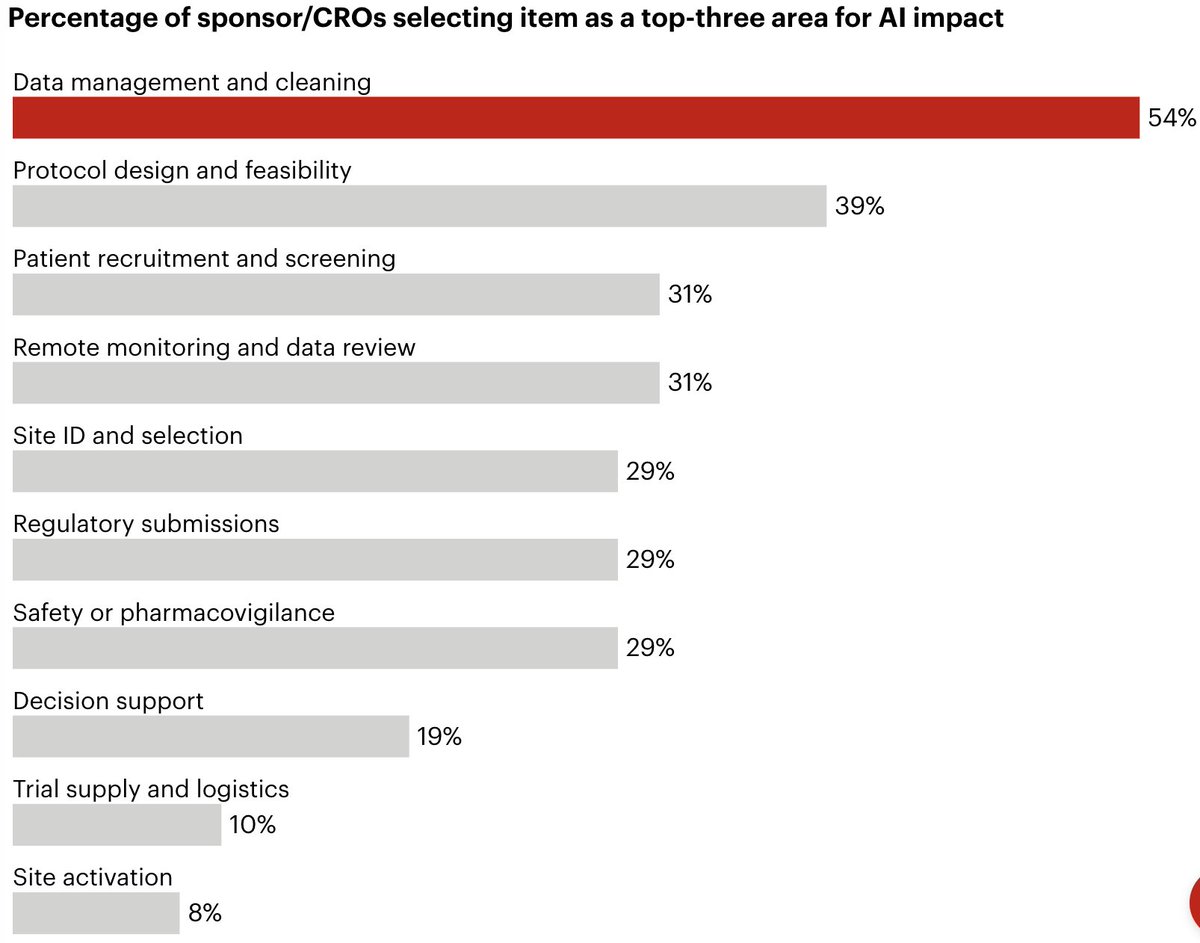
Saama, which automated data review for Pfizer’s COVID-19 vaccine trial and launched modular data-management agents in 2025, is the incumbent answer to this fragmentation, building agents for each role within existing EDC systems. As Chief Products and Innovation Officer Prasanna Rao put it, “As technologists, we are going to look at every single persona in clinical trials. For example, data manager. That’s a persona in clinical trials where they do a lot of these manual activities, and they go across systems. So, a data manager agent could be doing that type of work.” Octozi, a New York startup founded by Roche, Novartis, Merck, and Google alumni, raised a $3 million seed in July 2026 for human-in-the-loop agents that clean, reconcile, and review trial data inside a sponsor’s existing systems, estimating more than $5 million in savings on a representative Phase III oncology trial. Both can find a discrepancy and draft the answer, but investigators are still accountable for trial data under Good Clinical Practice, so corrections themselves have to come from a person at the site. But as regulators and investigators grow comfortable letting agents act within set bounds, perhaps the list of fixes a site has to manually sign off on may shrink, and with it the last stretch of dead time before database lock.
Lastly, consider what happens after the last patient’s last visit. Like me, most people probably assume that after the last data point is collected from a patient, reporting trial results would take a few weeks at most. Yet it takes roughly a month to clean and lock the database, weeks more to run and check the analysis tables, more than ten weeks to write the clinical study report (CSR), and time to assemble the submission itself. The stages overlap, but together, the process takes several months. This section of the pipeline in particular has abundant low-hanging fruit. This is work that is high-volume, rule-based, and specified in advance: ripe for LLM and coding agent overhaul.
The first easy target is a process called statistical programming, writing the code that converts raw trial data into the tables regulators read. This process remains painfully manual because sponsors are expected to conduct “double-programming” (independent replication), verify line-by-line mapping to the statistical analysis plan (SAP), and submit the code in a functional, specialized form FDA reviewers can re-run. At PharmaSUG, the industry’s statistical programming conference, this year’s agenda included a panel on AI’s impact on the profession with speakers from Merck, GSK, Biogen, Regeneron, and Roche, alongside papers on multi-agent pipelines that generate analysis datasets and LLMs that check outputs against statistical review comments. GSK is launching an internally developed agentic code generator for analysis datasets. While there is still a long way to go to compress this laborious phase of the data pipeline, human-in-the-loop coding automation has already shrunk statistical programming cycle time by several weeks, and we can expect it to shrink further as scaling laws hold and regulator trust increases. On the documentation side, Novo Nordisk used Claude to build NovoScribe, an in-house platform that automates clinical study documentation: a process that took more than ten weeks now reaches a reviewable first draft in about ten minutes, with clinical study report writing time down 90%. The team was eleven people, several of them non-technical.
Developments such as these are, of course, incredibly exciting, but there is something sad in how easy it turned out to be. For many drugs on the market today, patients waited months for a result that was sitting in a locked database.
The Pileup
The irreducible timelines of biology create an obvious asymmetry in AI’s impact. A 28-day toxicology study takes 28 days because no algorithm will make a rat metabolize a compound faster. As many writers before me have articulated, the steps AI compresses most dramatically (target ID, lead optimization, regulatory document preparation, competitive intelligence) sit at the bookends of the development process, while the steps that took longest before AI (preclinical toxicology, clinical trials, manufacturing) involve perturbing biological systems that will keep requiring empirical observation, not simulation, for the foreseeable future. As in a factory line, when you speed up every step except the bottleneck, inventory piles up in front of it.
To double-click on the economics of that argument: any sponsor will run a program whose expected value (EV) clears its cost, provided it can secure funding and capacity. Today’s design tools raise that EV, since a drug with presumably cleaner pharmacology run in an optimized trial with a carefully selected endpoint is more likely to work, and cheaper operations and execution simultaneously lower the cost of each shot on goal. But model improvement on the discovery side and generation is far outpacing the ability to triage and differentiate programs, and this uncertainty keeps a band of programs whose EV sits just below the old cost of a trial and above the new one. Pipeline crowding is *already *a widespread phenomenon: market estimates report more than 180 active companies managing 200+ pipeline therapies specifically targeting the PD-1/PD-L1 space, for one. As mentioned prior, the industry’s value distribution is a long tail of adequate drugs, and cheaper trials let more of the tail in. This would be harmless if each marginal program cost only its sponsor: "more shots on goal" is the right philosophy for an independent company's diversified portfolio if it can afford it. But a sponsor deciding whether to run program #12 against a target makes its own isolated rNPV calculation and largely ignores what its enrollment does to the other eleven. When twelve programs recruit from the same pool, sites screen more people per enrollment, sponsors open more sites to reach the same number, recruitment spend per patient rises, and sites charge more in budget negotiations: in this way, molecule crowding risks swallowing those savings whole. The technologies in this piece matter so much because they let us use shared resources better: agents can make up for shortages of coordinators, recruiters, data managers, and statistical programmers, giving essential staff more hours per trial. And those gains will go so much further if we also get better at deciding which programs deserve that capacity.
What Better Looks Like
Ruthless triage of candidates only raises the industry’s average if one decision-maker can look at all twelve candidates in a therapeutic class side by side and decide which ones deserve patients. Today, no single sponsor has that vantage point. The closest thing to one is SURPASS (acronym for "Simulation-augmented, Real-time Platform Adaptive Seamless Trials"), a program ARPA-H launched this September to replace separate Phase I/II/III trials with a standing ‘platform’ trial: many drugs tested under one master protocol, sharing one control group, with data analyzed continuously and agents handling startup and data work. In this paradigm, a single control group serves every arm, so each drug needs fewer patients to read out, and drugs that don’t separate from the common baseline get dropped while the others keep enrolling.
SURPASS won't change how most trials run anytime soon, and until it does, there is enormous room for diffusion of technology that automates clinic jobs. In Bain's April 2026 survey, 49% of sponsors and CROs were piloting AI tools, and only 16% were actively redesigning roles and workflows around AI. Structural barriers and switching costs in this arena are much higher than in the discovery stack, where software is modular and low-risk to pilot. This is why even the most promising AI companies in clinical development are building around the incumbent stack rather than replacing it. Saama integrates with all EDC systems. Tilda operates at the site level, beneath the sponsor's technology choices. In the longer term, my question is whether the vertical-integration thesis, exemplified by Lindus and, to some extent, by Formation Bio, can break the labor-arbitrage economics of the traditional CRO model. If AI genuinely lets a small team run a trial that previously required a large contract organization, it might democratize access to clinical infrastructure for smaller (perhaps pipeline-in-a-person) biotechs that can't afford the overhead of a traditional CRO engagement. In the short term, that democratization will inevitably contribute to aggregate industry pipeline bloat, but it also lets a differentiated program from a tiny team reach a readout that only big pharma could afford before.
I’m as optimistic as ever about companies on the discovery side; there is still much hill-climbing to be done to improve zero-shot generation! But technologies like the ones described in this piece*, which cut the waiting between trial gates and phases, matter just as much, because they decide how quickly the best molecules reach the patients waiting for them. Discovery models are starved of the one thing they need most: human data, which trials produce slowly and at great cost. The answer to this problem isn’t just more trials, but better ones: trials better chosen, run more efficiently, producing clean, structured, reusable data that could serve as feedback signal for the next generation of molecule models.
Thank you to @victor_ljz, @rishabh12ranjan, and @ashokaraj_ for conversations that helped shape this piece!
* I unfortunately could not touch on every company building in this space, but a few more that stand out include QuantHealth, Antidote, Ryght AI (whose AI Site Twins product accelerates feasibility assessment), Unlearn.AI (digital twins that reduce the number of control-arm patients needed in trials), Deep 6 AI (patient matching through EHR analysis), Mendel.ai, which all build for different parts of the clinical workflow, and many, many more. This piece also intentionally left out companies using AI purely for regulatory intelligence, as I consider that another ball game, but an important and interesting one nonetheless!