Song Ads Are The New Trend. Most Of You Will Fail At Them, Because You Think The Song Is What Sells.
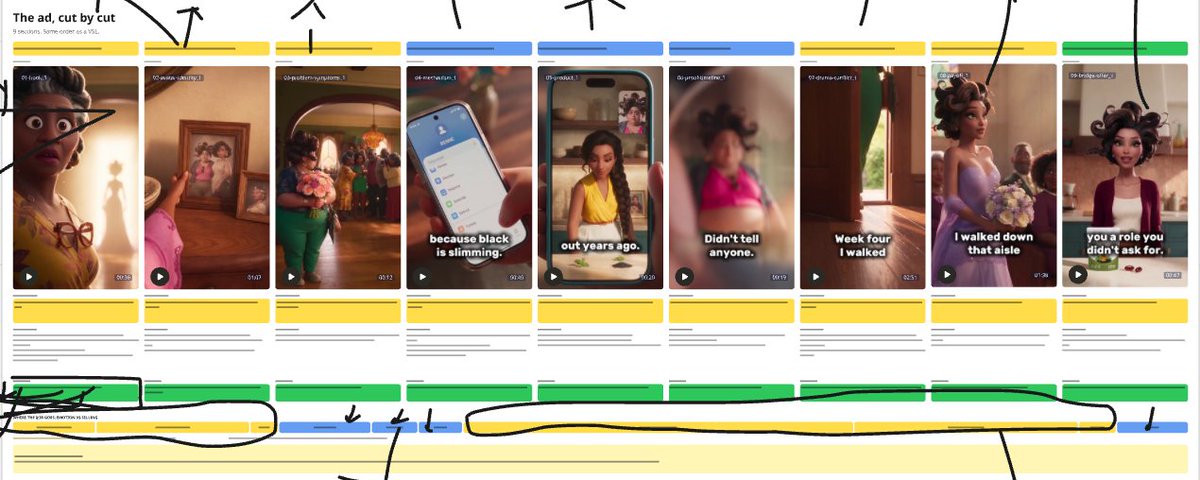
This may be one of the best reads you'll have today. Not only on song ads, but on ads in general, on copywriting, and on selling.
Give me the next few minutes, and by the end you'll understand why song ads are crushing right now.
And why even the best song in the world won't sell a single bottle if there's no real ad underneath it.
Then I'm going to show you what that ad underneath actually is. The thing every winning ad has, whether it's a song, a VSL, a native, a long primary text or just a simple static. The thing most people never master, because they're too busy chasing the next format.
Once you have it, you won't just make better song ads. You'll make better ads. Period.
Let's get into it.
Look.
Song ads are everywhere right now.
Everyone wants one. Everyone's launching one.
And most of you are going to fail at them.
Not because your song is bad. Because you don't even know why song ads work in the first place.
You think the song is what sells.
It's not.
The brands crushing with song ads aren't better at music. They're better at selling. The song is just how they deliver the message.
And if your message is off? The song gets you a great hook rate, a great watch time, and zero sales.
So first, why do song ads actually work?
The hardest part of any long ad was never the selling. It was keeping people there long enough to sell them.
Think about it:
-
A VSL
-
A native ad
-
An advertorial
They all work. You take 5, 10, 20+ minutes to get someone emotionally invested. You explain why nothing worked for them. You show them the fix. You prove it. You close.
But to keep someone there that long, every sentence has to pull them into the next one. Curiosity, open loops, pacing, rhythm.
Most people can't do that for 10 minutes straight.
So the reader gets bored and leaves before the selling even starts.
A song changes that. In a song ad, 2 things are working for you.
1. The song itself.
A song carries you. It can be funny. It can hit you emotionally. It moves with the rhythm.
Be honest, when's the last time you stopped a song halfway?
2. The animation.
The animation is made for the attention span people have today. Every second there's something new on screen.
So even when the ad is 8 minutes long, people stay.
That's why song ads are crushing. They take old school direct response, the storytelling and the copywriting, and they put it on steroids.
The song makes it easy to keep listening. The animation makes it easy to keep watching.
But the message underneath? Same as always. Nothing new.
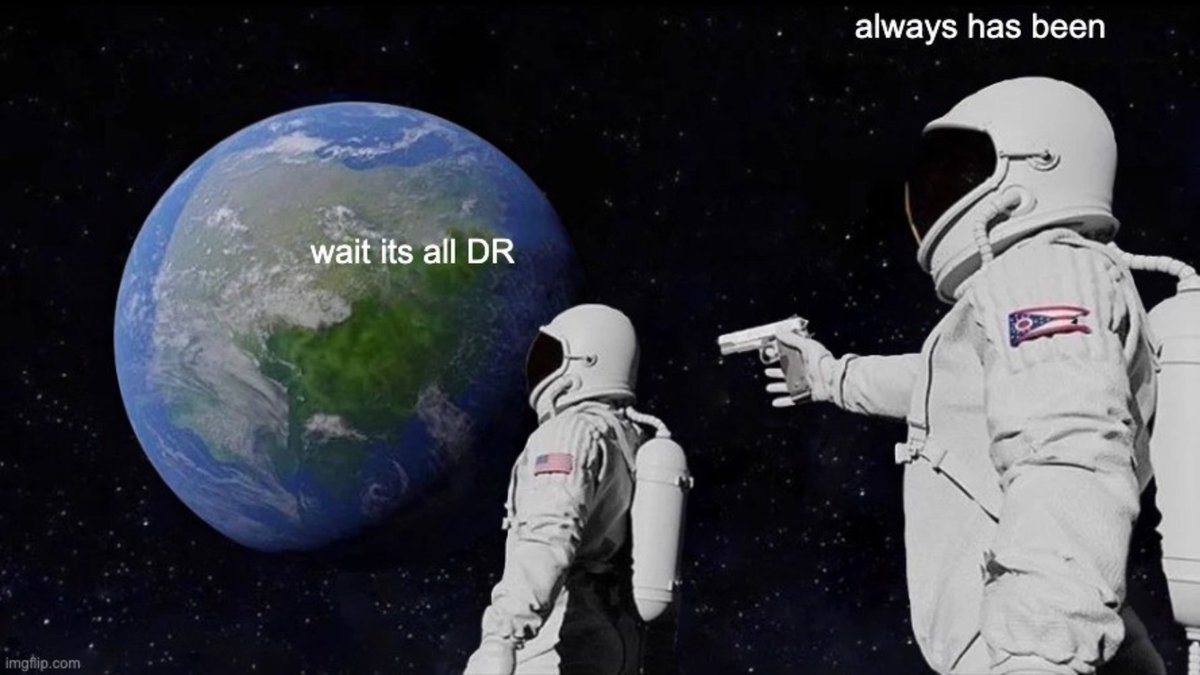
[MEME: astronaut 1 looking at Earth labeled "SONG ADS": "Wait, it's all direct response?" / astronaut 2: "Always has been."]
So who actually wins with song ads?
Be precise about what the song gives you.
The song handles the moment-to-moment retention. The pacing. The rhythm. The "keep going" feeling from one line to the next.
It does NOT write your story. The drama, the loop that runs the whole ad, the payoff at the end. That's still on you.
So:
✅ If you're great at direct response, especially long format (natives, VSLs, advertorials), song ads multiply what you already do.
When our pods turned our winning natives into song ads, they crushed.
✅ If you're decent, this is your format.
A lot of you can already sell. You can explain a mechanism. You can describe your avatar's day-to-day. You can write a decent story.
Where you lose people is the line-by-line pull. In a native, one flat paragraph and they're gone before your selling lands.
In a song ad, the rhythm and the visuals carry them through those flat spots. Same person, same skill, way better results.
❌ If you're bad at direct response, the song won't save you. Your hook rate looks amazing. Your watch time looks amazing. And nobody buys, because there's no story and no reason to believe.
So your first job is never "learn song ads."
Your first job is the foundation.
Every ad has 2 jobs.
Every ad you'll ever write is the same picture:
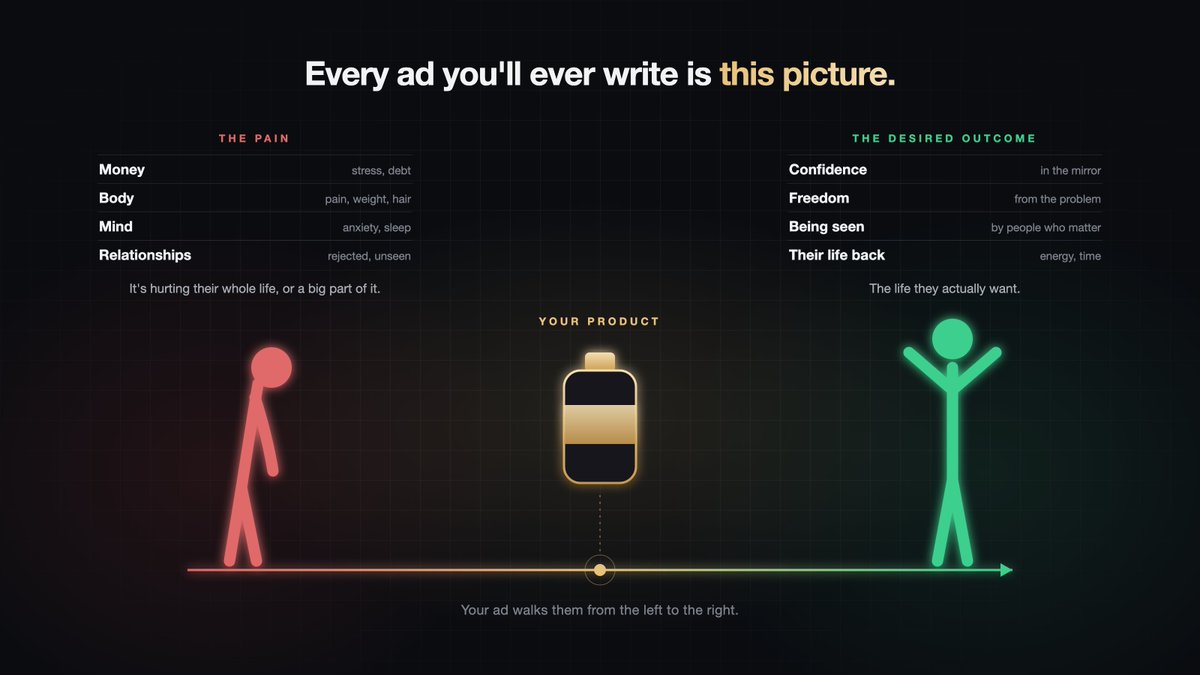
Every ad you will ever write is this picture
On the left, a person stuck with a problem that's making their life worse. Their money, their body, their mind or their relationships.
On the right, the life they want.
In the middle, your product. The bridge.
Your ad's whole job is to walk them across it.
Now picture where that person is when your ad shows up.
They're not shopping. They're scrolling to escape their life. Thumb moving. Brain off. And you're up against AI slop, talking dogs, drama clips, everything.
So every ad has exactly 2 jobs:
-
Get their attention.
-
Make them believe the product works for them.
Job 1 is attention. That's what avatar research gives you:
-
The drama and the exact words that stop their scroll (your hook rate)
-
A description of their life so accurate they go "wait, this is about me" (your hold rate)
Job 2 is belief. That's where most ads die.
You can nail the hook and the hold rate. If the product is weak, or the way you explain it isn't believable, it's over.
Your avatar is not as stupid as you think. To believe, they need:
-
A mechanism (most of the time, this is the key)
-
A product demo (the mechanism shown working)
-
An authority figure
-
Social proof
-
Their objections answered before they even say them
Nail the avatar. Have a product that actually delivers. Explain it in a way that's simple and true.
That's the whole game. The song just carries it.
Now let me prove it.
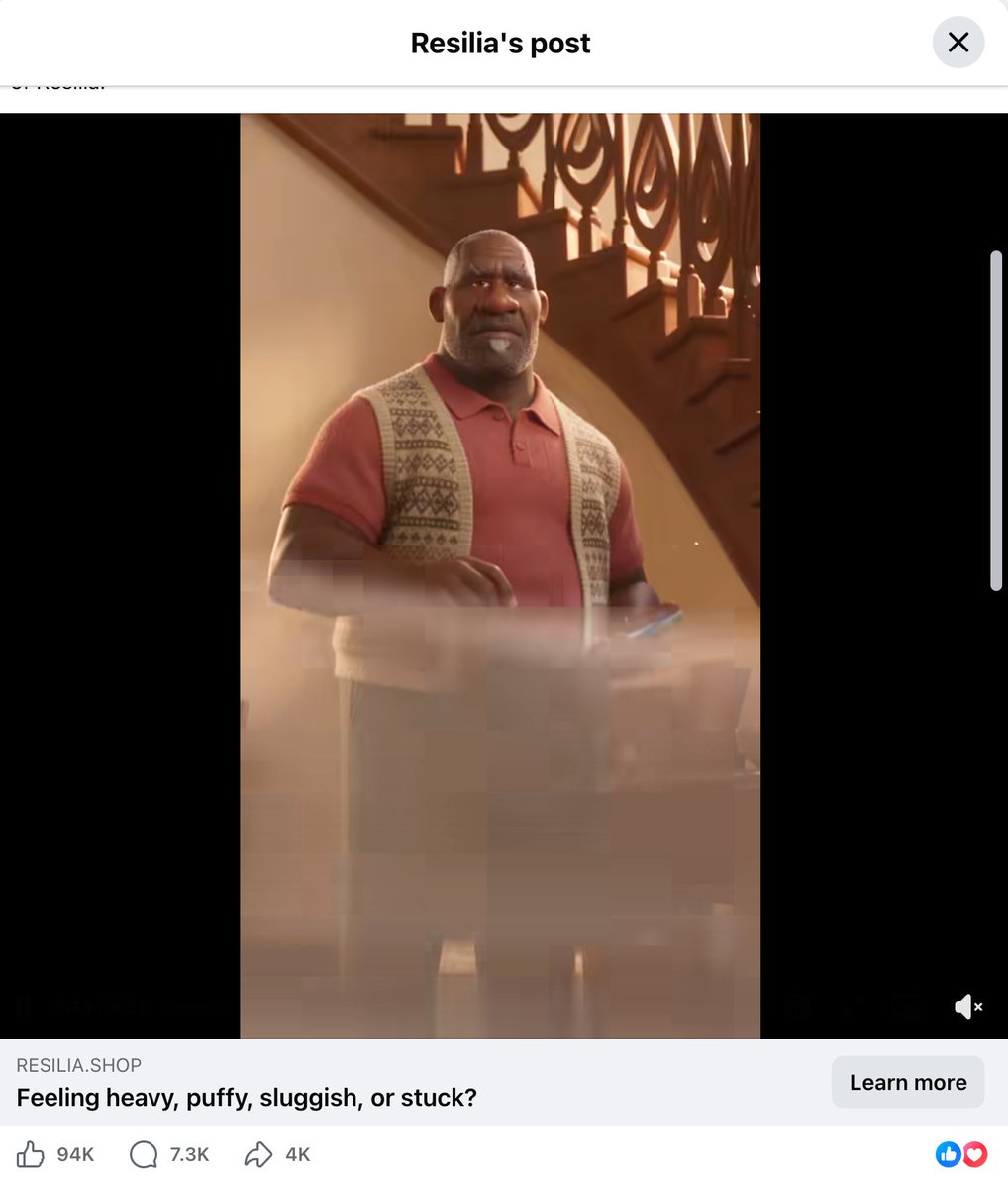
Let's take apart a song ad that's been crushing it.
It's a Resilia ad. 8:30 long. Around 5M views.
Go watch it first:
https://www.facebook.com/100084264282799/posts/1068457039306429
Then come back.
Because once you see what’s under it, you’ll never watch a song ad the same way again.
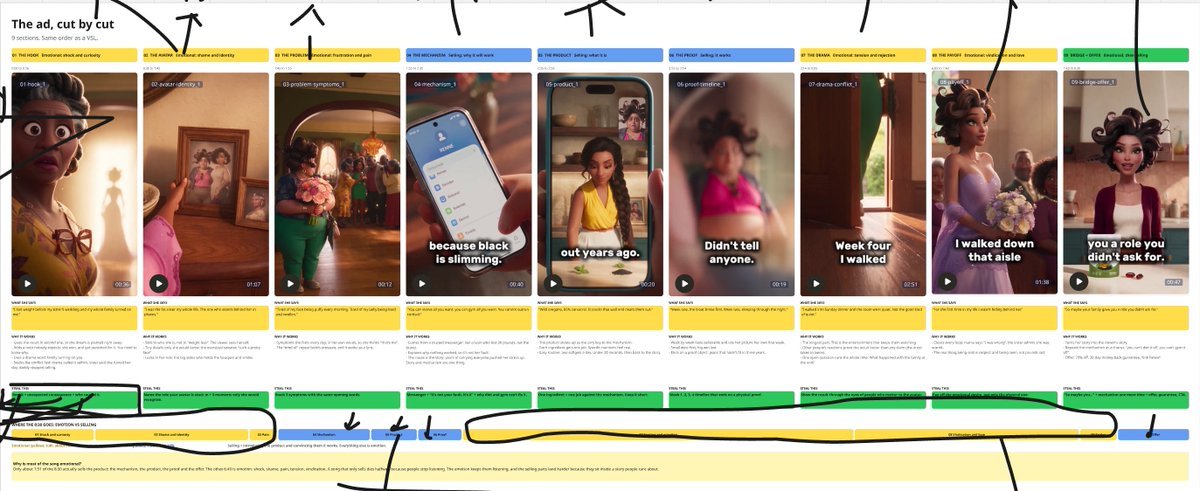
The Resilia song ad, scene by scene
Break it down, and guess what? It's not a song. It's an advertorial. Same 10 beats every winning long ad runs on:
-
The hook. The drama. Open the loop.
-
The avatar. Who she is.
-
The problem. What it's like to live with it.
-
Everything she tried. And why it failed.
-
The messenger. Someone believable who found the answer.
-
The mechanism. The real cause.
-
The product. The answer the mechanism points to.
-
The proof. Small wins, in order.
-
The payoff. The loop from the hook finally closes.
-
The close. Her story becomes your story. Then the offer.
But the skeleton isn't the hard part. Anyone can copy a list. What makes this ad crush is that the skeleton is hidden inside a story.
There's a sister. There's a wedding. There's a family that turns on her. And you need to know how it ends.
So the viewer never feels sold to. She's watching a drama. And every beat of that drama is quietly selling. The hook is a scene. The mechanism comes from a cousin. The proof is her body changing week by week. The payoff is her walking down that aisle.
That's the real skill. Not knowing the beats. Writing a story that carries them.
Let's go beat by beat.
Beat 1: The hook. It decides what the whole story is about.
"I lost weight before my sister's wedding, and my whole family turned on me."
Look at what's happening:
-
The result is in the first second. An overweight viewer hears "I lost weight" and she's in. Qualified.
-
Then a twist nobody expects. She won, and she got punished for it.
-
And a drama word. Nobody wants their family to turn on them.
Then it stacks the conflict, fast:
"My mama called me selfish. My sister said I was trying to ruin her day. My daddy didn't say anything. He just stopped calling."
Now you need to know what happened. They should be happy for her. Why aren't they?
That's an open loop. A question opens in your head, and the only way to close it is to keep watching.
And here's what most people miss: that loop doesn't close after 10 seconds. It runs the whole ad.
Her mama. Her sister. The bridesmaid dress. The wedding day. Her daddy's nod at the very end.
8:30 on one fear: getting rejected by her own family.
So the hook isn't just a first line. It's the drama your whole story runs on.
(We'll come back to where drama that strong comes from. First, the rest of the ad.)
Beat 2: The avatar. Who is our hero?
The hook told you what the story is about. Now you meet the person it's about.
This is where the viewer either sees herself, or scrolls.
"There's two sisters, Jasmine and me. Jasmine is the pretty one. I'm the older one. The big one. The one who stands behind her in photos. The one the aunties tell 'you got such a pretty face.' Which is the polite way of saying the rest of you isn't."
You can't write that without research.
Go read overweight women venting on Reddit. Not asking for solutions. Just venting.
The same thing comes up again and again: living in someone else's shadow. The sister. The friend. The "she's so sweet though."
They took those exact words and turned them into a story.
Beat 3: The problem.
"Tired of my face being puffy every morning. Tired of my belly being hard and swollen."
That's symptom stacking. You list the symptoms one after the other, in the exact words your avatar uses.
Every line starts with "Tired of." By the third one, the viewer is nodding: "yes, me too, me too."
It feels like everything piling up at once. Because that's how it feels to live with it.
And repeating the start of a line is what songs do anyway. So it works as a lyric too.
Beat 4: Everything she tried.
"You can starve all you want. You can gym all you want."
Two lines, and every diet and every gym membership she's ever had is dismissed.
She’s not lazy. She’s not weak. She did everything right.
It was never her fault. She was fighting the wrong enemy.
Hold that thought. That’s what makes the mechanism land.
Beat 5: The messenger.
"I called my cousin. She lost about 30 pounds."
The mechanism doesn't come from the brand. It comes from someone she trusts who already got the result. Living proof.
And it makes sense. Being overweight is common. Of course someone in her family lost weight.
But be intentional here.
Ask yourself: how common is the problem?
Common problem? Weight, skin, bloating, sleep, joint pain. Everyone knows someone who has it. So the messenger can be close: a cousin, a sister, a coworker, a neighbor.
Rare problem? Don't force it into the family. If her cousin happens to have the exact same rare condition AND already found the fix, the viewer goes "come on, what are the chances?" And the second they stop believing the messenger, they stop believing the mechanism.
So put the messenger where they'd naturally meet someone with the same problem. A support group. A clinic waiting room. A Facebook group. The salon chair next to them...
Beat 6: The mechanism. This is where it gets good.
Watch how it starts. Not with cortisol. With stress.
Everyone knows stress. "All those years of being the big sister. Carrying everyone. Swallowing everything."
She's nodding.
Then: "It cooks your cortisol sky high."
Cortisol stores the fat around the belly. Bad bacteria hide behind a wall and slow everything down.
"You cannot outrun cortisol."
Why does it land?
-
The cause is her life. If you believe the story, you believe the mechanism. It's one chain.
-
It's not her fault. Nobody wants to be the problem.
-
It gives her an enemy. The best copy always has one.
-
It explains why everything she tried failed. That's beat 4 paying off. Diets and the gym "can't reach it."
The lesson most marketers miss: the most complete scientific explanation usually loses. Too complex to believe in one listen.
So you start from what your avatar ALREADY believes, then build on top of it.
Beat 7: The product.
"Wild oregano, 85% carvacrol. It cracks that wall and clears them out. Black seed oil flushes the rest and cools the fire. Two softgels a day."
-
One ingredient, one job.
-
It sounds unique. Not "vitamin B6," which she's already tried.
-
Specific numbers feel tested, not made up.
And here's something a song ad does that a native can't. In a native, your metaphor lives in words. Here, they show you the wall on screen. Then they crack it.
When you see it, it's easier to believe it.
Beat 8: The proof.
Week 1, the bloat breaks. Week 2, she sleeps through the night. Week 3, the belly goes down. Then the jeans that haven't fit in 3 years. They button.
The results show up in the exact order the mechanism said they would. Not overnight. Believable.
Beat 9: The payoff.
This is the longest part of the whole ad.
Her mama asks her to "slow down until after the wedding." The seamstress takes the bridesmaid dress in. Then takes it in again. Her sister never says congratulations.
On the wedding day, her daddy just looks up and nods. "That's as close to an apology as that man gets."
The loop from the first line finally closes.
It's the underdog story. The one everyone ignored, beating the people who held her down. And your viewer is living that same life. She wants to be that hero.
Beat 10: The close.
Her story becomes the viewer's story, then the offer. More on how to write it below.
The number that's going to change how you write.
Out of the 8:30, only 1:51 actually sells. Mechanism, product, proof, offer.
About 22%.
The other 78%? Emotion. Shock. Shame. Pain. Tension. Vindication.
A song that only sells dies halfway, because people stop listening. The emotion keeps them there, so when the selling comes, it lands.
But 78% emotion doesn't mean the 22% doesn't matter.
Emotion makes them want it. Logic makes them believe it.
Before they pull out their card, their brain still asks one question: "ok, but will this actually work for me?"
That's the mechanism's job.
And the emotion makes that easier. By the time the mechanism shows up, they've spent minutes inside her story. They're on her side. They're not looking for a reason to say no. They're looking for a reason to say yes.
Story without belief? They cry, they comment "beautiful," and they scroll away. Belief without story? They never stay long enough to hear it.
You need both.
So where does drama that strong come from?
Human nature.
Your brain was built for one job: keep you alive.
And for our ancestors, staying alive meant staying in the tribe.
The tribe gave you food, protection, someone to care for you when you got sick. Pushed out, you were alone in the wild. And alone, you died.
So the brain learned to treat anything that could push you out, or leave you with nothing, like a threat to your life:
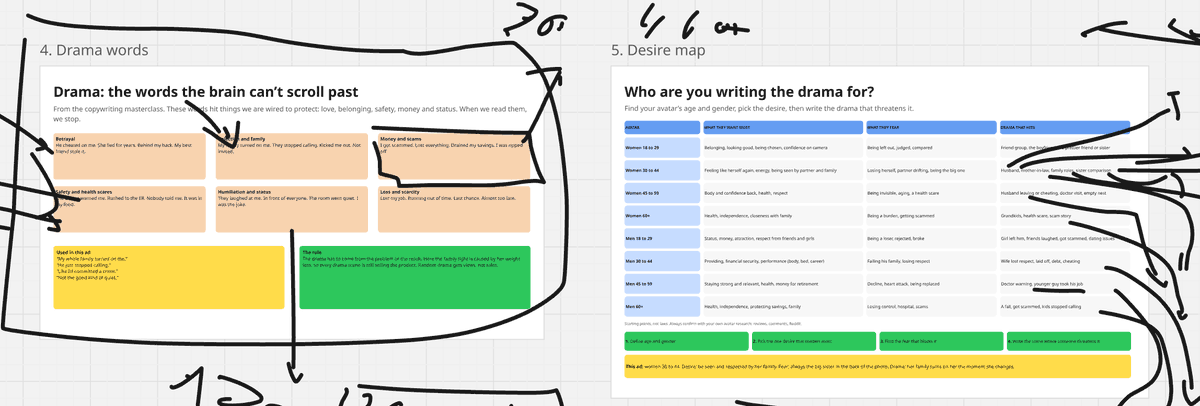
-
Rejection. Your family or your group pushes you out. Back then, that was death.
-
Betrayal. The people closest to you stop having your back.
-
Humiliation. You lose respect in front of the group. Lose enough and you're next to go.
-
Losing your place. Your role, your status. When you're not useful, you're replaceable.
-
Losing your partner. To a rival, to time, to someone younger.
-
Failing to protect your kids. If they don't make it, your bloodline ends with you.
-
A health scare. Sick or injured, you can't keep up. You become a burden, and burdens get left behind.
-
Losing your resources. Lose what you saved for winter and you starve. Today, that's losing your money or getting scammed.
Nobody's getting kicked into the wild today.
But when an ad touches one of these, the oldest part of the brain reacts like it's life or death.
It can't let go.
It needs to know how it ends, because deep down it's asking "could this happen to me?"
That's why "my whole family turned on me" works so well.
In the old days, that's a death sentence. Your viewer's brain still feels it that way.
Every Hollywood movie and every Korean drama runs on these. That's why you can't stop watching them.
So before you write a single word of your hook, you pick the fear.
Pick the fear, and you've picked your hook and your whole story at the same time.
But not every fear hits every avatar.
Becoming a burden? A 70 year old lies awake thinking about it. A 25 year old doesn't know it's a thing.
Losing your looks? Huge for a 45 year old woman watching her face change. A 19 year old guy doesn't care.
Pick the wrong fear and your story falls flat, no matter how well it's written.
Some starting points:
-
Women 18-29: her boyfriend cheats or dumps her. Her friend group leaves her out. She's the "less pretty" one next to her friend or sister.
-
Women 30-44: her husband stops looking at her. Her mother-in-law judges her. She gets compared to the sister who "has it all together."
-
Women 45-59: her husband leaves for someone younger. A scary diagnosis. The kids leave and she doesn't know who she is anymore.
-
Women 60+: her kids stop letting her see the grandkids. A health scare. She gets scammed out of her savings.
-
Men 18-29: a girl leaves him for another guy. His friends laugh at him. He loses his money on a scam.
-
Men 30-44: his wife stops respecting him. He gets laid off. The debt piles up and he can't provide.
-
Men 45-59: a warning about his heart or his weight. A younger guy takes his job, his place, his respect.
-
Men 60+: he falls and can't get up. He gets scammed. His kids stop calling.
Starting points, not laws. Your research decides.
The rule that makes the drama actually sell.
The drama has to be caused by the problem. Or by the result.
Resilia's family doesn't turn on her for some random reason. They turn on her BECAUSE she lost the weight. The result caused the drama.
❌ A woman going through menopause whose husband cheats on her. Great drama. Nothing to do with menopause.
✅ A woman going through menopause. The night sweats are so bad she’s been sleeping in the guest room for a year so he can rest. One night she can’t sleep, so she goes back to their bedroom to apologize. Her sister is in her bed. Her husband looks up and says: “You moved out of this bed a year ago. What did you expect?” Same fear of betrayal, but the problem caused it. The sweats are what emptied her side of the bed.
When the problem causes the drama, every scene is still selling. Even when it doesn't look like it.
Random drama gets you views. Not sales.
Now let's build yours. Step by step.
Any product. Any format.
Step 1: Do the research. By hand.
And if you use AI to pull it, fine. But then read it. Again and again.
Until you know your avatar like you know yourself. period.
Go where your avatar vents…
Reddit. Facebook groups. The 1, 2 and 3 star reviews of your competitors. TikTok and YouTube comments. Your own customer surveys.
Don't read for ideas. Read for words. You're collecting 6 things:
-
Their exact words about the problem. Not "joint discomfort." "I wake up stiff like I'm 90."
-
What they're afraid of. Which fear keeps showing up?
-
Everything they already tried. And why they think it didn't work.
-
What they already believe causes it. "It's my age." "It's stress." "It's my hormones."
-
The life they want. In their words, not yours.
-
What stops them from buying. "I've wasted so much money on this stuff."
Copy everything word for word into one doc.
That doc is your whole ad. You're not inventing anything. You're arranging it.
Step 2: Pick the fear. Then find the scene.
Which fear shows up again and again in your doc? Check it against your avatar's age and gender.
Then find a scene where the problem causes that fear. That scene is your hook, and the theme of your whole story.
Step 3: Lay out the 10 beats before you write.
Same 10 beats as Resilia. One or two lines per beat. Just the bones.
If the story doesn't work in 10 lines, it won't work in 10 minutes.
Step 4: Build the mechanism.
This is job 2. Where most ads die. Take your time.
First, a rule: KISS ("Keep it simple, stupid")
Then run it through this.
The believability checklist:
-
Start from what they already believe. "It's my age." "It's stress." Don't fight it. Build on it.
-
Name the hidden cause underneath. The part nobody told them.
-
Show why everything they tried failed. If it doesn't explain the failures, they go "I tried that already," and you're dead.
-
Name the enemy. And it's never them.
-
Make it visual. One picture a 10 year old would get. Resilia had the wall.
-
One ingredient, one job. Each one attacks one link in the chain. Add real doses and routine.
-
Proof in the same order. Results show up exactly when the mechanism says they should.
-
A believable person explains it. Not the brand.
The difference:
❌ "Our formula has glucosamine, turmeric and collagen for joint support."
That's a list. They've seen it 100 times. Nothing explains why the last 5 bottles didn't work.
✅ "You've been taking glucosamine for years, right? It didn't work because it's trying to rebuild your cartilage while the inflammation keeps eating it. It's like patching a roof in the middle of a storm. You have to calm the storm first."
Now they get why everything failed. It's not their fault. There's an enemy. And they can see it.
Then test it: read it to someone who doesn't know your product. If they can't explain it back to you, it's too complex.
Step 5: Write the outcome and the payoff.
The right side of the picture. The life they want.
Two layers:
-
The outcome. Not "less pain." What their life looks like. Getting down on the floor with the grandkid. Taking the stairs without the rail. Saying yes to the trip.
-
The payoff. The moment the loop from the hook closes. In Resilia, her daddy's nod.
Their win comes first. Proving people wrong comes after. Not every viewer wants revenge. Every viewer wants the outcome.
The revenge is the cherry. Not the cake.
Then pay back the lines from the start. Whatever someone said to hurt them in the hook comes back at the end, flipped. Callbacks feel like a reward. That's what makes people finish an 8 minute ad.
And keep the proof honest. "Week one, nothing. I almost quit." Honest is believable. Overnight miracles aren't.
Step 6: Write the close.
The close turns their story into the viewer's story:
-
Call out the viewer with 2 or 3 details straight from your research. "So if you're the one who..."
-
Tell them it's not their fault.
-
Remind them of the mechanism in one line.
-
Then the offer.
And the guarantee isn't decoration. It answers the biggest objection in your research doc. "I've wasted so much money on this stuff" gets answered right there.
The proof the format doesn't matter.
Take the Resilia story. Same fear. Same drama. Same mechanism. Now put it in any format:
-
Native ad: "Why My Own Family Stopped Talking To Me After I Lost 30 Pounds." Then the story, the cousin, the stress, the softgels.
-
UGC yapping: a real woman on camera: "Six months ago, my own mama called me selfish. Here's what happened."
-
Song ad: what you just saw.
Same ad underneath. Three different outfits.
The people who master the foundation win in every format. The people who chase formats lose in every one of them.
Now, the song. Most people start here. It should be the last thing you touch.
Once the script is done, you turn it into lyrics.
1. Don't cut the script. Adapt it.
**Same story, same copy, same emotion. You only tweak lines so they can be sung. Don't cut the details. The details are what make it feel real.
**2. The verses tell the story. The chorus carries the mechanism.
This is the move most people miss. Your chorus repeats.
So put the thing you need them to believe in the chorus.
By the third time they hear it, they're singing your mechanism back to themselves.
A chorus about how sad she was is wasted.
A chorus about why nothing worked and what finally did is the ad.
3. Pick the style for the avatar, not for your taste.
**Their age, their culture, and the emotion each part has to hit.
A 55 year old Southern woman and a 24 year old in London don't hear the same music.
4. Clarity beats vibe. Every time.
Judge every version on 2 things:
-
Can you understand every single word on the first listen?
-
Do the verses sound like a real person talking?
Some styles sing with emotion and energy. They stick.
Others are pretty and people tune out.
Pretty but unclear loses.
5. The animation shows what the words say.
Every line gets its own visual.
And the mechanism gets the most important one. The wall, the storm, the enemy. That's the one picture they should remember.
AI handles most of the animation and the edit now. That's the easy part.
The song won't save a weak story. The story is what saves the song.
Do this today. Not tomorrow.
-
Find one winning long ad in your niche. Anything running 30+ days. Map it to the 10 beats.
-
Read 50 posts of your avatar venting. Copy 30 lines word for word.
-
Pick the fear that shows up most. Write 10 hooks from it, where the problem causes the drama.
-
Run your mechanism through the believability checklist. Read it to someone who doesn't know your product.
-
Only then, make it a song.
Use AI to go faster. But don't let it write the ad and then ask it "is this good?" It'll say yes. It won't catch the boring mechanism, the line that doesn't follow, the messenger nobody believes.
Judgment is the skill.
Knowing what good drama looks like, and what will feel fake to your avatar. You build it by doing the research by hand, breaking down winning ads (yours and other brands'), and watching a lot of drama.
So let me leave you with this.
Song ads aren't magic. They're a format.
3 things make one work:
-
Drama the problem causes, so it stops the scroll AND sells
-
A mechanism simple enough to believe, and true
-
A story that carries both, from the hook to the close
Miss the first, nobody watches. Miss the second, nobody buys. Miss the third, nobody finishes.
The song just carries it.
The people winning with song ads are the same people who win with advertorials, natives and VSLs.
The ones who do the research. The ones who write the story themselves. The ones who know it was always direct response.
Always has been.
沿着这个主题继续读
从一篇文章,找到相关的教程、经验和阅读路径。