Storing and Filtering Water for an Emergency
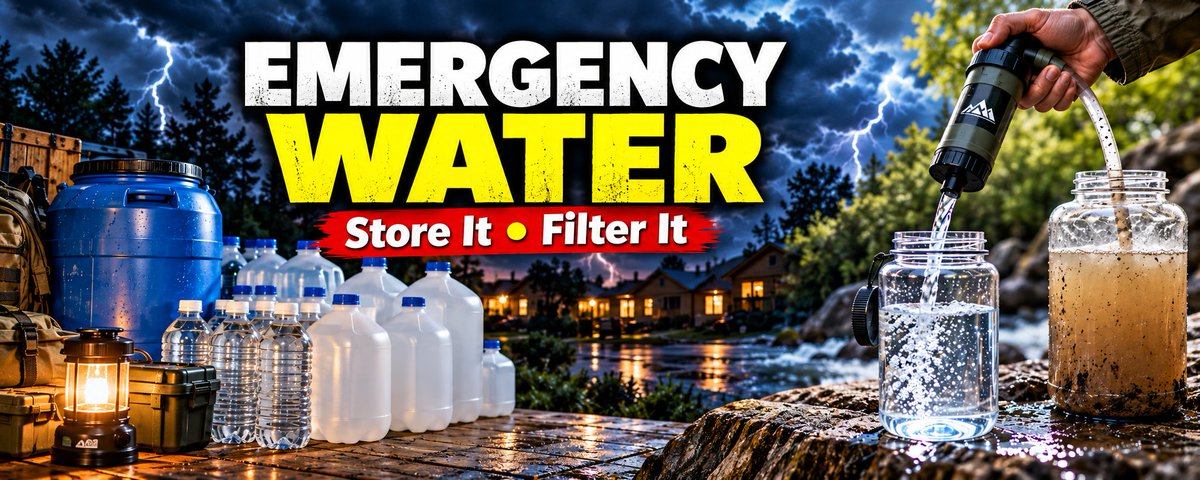
The human body can go without food for over a month, but will die without water in a few days. In a crisis, whether manmade or natural, water can become scarce. Most preppers place water at the top of their priority list.
If you live in a rural setting, you may have access to a private or community well. Well water is less likely to be disrupted than municipal water distribution systems. That said, nearly all water distribution methods rely on electric pumps to move water. During an extended loss of power, water supplies may be temporarily unavailable. Thus, storing a supply of clean drinking water is wise.
While you can use water in your home’s water heater in a crisis, it will run out in a few days. Some people routinely fill their bathtubs with water when a storm is approaching. You can buy a plastic liner to put inside a tub if you don’t want the water contaminated with residue from the tub. Others opt for storing containers of clean water. Fifty-gallon containers can be purchased and filled with water and treated for long-term use. Containers that hold between one and five gallons can be filled at home or purchased prefilled. Some prefer to stock up on small plastic water bottles sold in shrink-wrapped cases at grocery stores.
The first step in preparing for an emergency is setting aside water. As a rule, store one gallon of clean water per person per day for as long as you expect you’ll need it. If you’re unsure how long a crisis will last, set aside enough water for at least one week (7 gallons per person). This is considered the minimum needed for drinking, cooking, and hygiene. Over time, try to build up a larger reserve. Two gallons per person per day will provide a safety cushion. This will be your primary drinking water supply during an emergency. You can chemically disinfect water stored in a clean plastic or glass container for long-term storage by treating each gallon with five drops of unscented liquid chlorine bleach.
Next, try to find access to a secondary water supply, i.e., a water heater, pool, pond, stream, well, spring, collected rainwater, etc.
Most of us take for granted that our tap water is relatively safe for use. If you live in an area where municipal water treatment facilities are compromised—particularly during a crisis—tap water may be unsafe. Sometimes, hazardous water is self-evident; it may be discolored or have a peculiar odor. Other times, unsafe water has no distinguishing characteristics. It’s safest to err on the side of caution and treat questionable water as if it is unsafe.
Water from a chlorinated pool can be purified using one or more of the treatment methods listed below. Water from a saltwater pool cannot, but it can be filtered with a reverse osmosis filter. (Portable reverse osmosis filters cost upwards of $300.) Water from a pond or stream—even if it looks clean and clear—should be filtered and/or chemically treated before it is used. If a neighbor has a pool or pond, consider bartering with them in a crisis for something of value.
While you shouldn’t drink unsafe water as is, that doesn’t mean it is unusable. You can make unsafe water drinkable through chemical treatment, boiling, and filtration. Regardless of how thirsty you are during a crisis, do not knowingly drink unsafe water if there is a way to purify or filter it, or when a better water source is available.
Microorganisms in water can be killed by bringing it to a full rolling boil for several minutes. The drawback of boiling water is that it requires fuel or electricity that may be in short supply. Chemical purification, such as chlorine bleach or chlorine dioxide tablets, can help remove microorganisms. To treat questionable water with chlorine bleach, add 5 to 7 drops of bleach to a gallon of water and let it stand for at least 30 minutes before using. To treat water with chlorine dioxide tablets, follow the instructions provided by the manufacturer.
Boiling and chemical treatment do not remove suspended particles or contaminants. If you treat questionable water with chlorine dioxide, bleach, or boiling, you should also filter it.
Many preppers use large-capacity water filters. They work well for filtering water for a group. The Berkey line of filters is popular, but replacement filters have recently become hard to find, and in my experience, the filtration is unreliable.
We use the ZeroWater filtration system daily. My wife finds the water as good as reverse osmosis. The system consists of a pitcher and a disposable filter. It’s easy to use and inexpensive.
For personal filtration, SurviMate sells a 22-ounce plastic bottle with a built-in four-stage filtration straw that removes bacteria, chemicals, and other impurities. LifeStraw makes a compact filtration device that purifies questionable water. The safest way to use a commercially available filter is to follow the manufacturer’s instructions.
If you’re starting to prepare for a disaster, storing water should be your highest priority. An inexpensive first purchase would be 7 gallons of water for each person in your family (enough water to last each person one week). You might also consider buying a portable water filtration device for each person in your family. Learn what you can about alternative water sources nearby, and add water to your prepper pantry when you can. *For more information, check out my book: *Emergency Preparedness and Off-Grid Communication: