People don't understand SpaceX

文章目录
Caveats: this is not investment advice. Sequoia Capital has a large position in SpaceX so I'm extremely biased. Also, Past performance is not indicative of future results.
After SpaceX's earnings call last week, I built a bottoms up financial model for the company. I haven't done this in over a year. The numbers that came out are breathtaking.
As the markets melt down today over fears of: a) political uncertainty with the midterms next week b) fears of an escalation in the Iran War c) some of the first massive agentic cyberattacks d) governments issuing prepping mandates e) sticky inflation that implies rates will likely go up in the short term, etc. It made me want to take the far other side and release my model, which will seem insane to 90%+ of investors. If nothing else it's fun to stir up a healthy debate :)
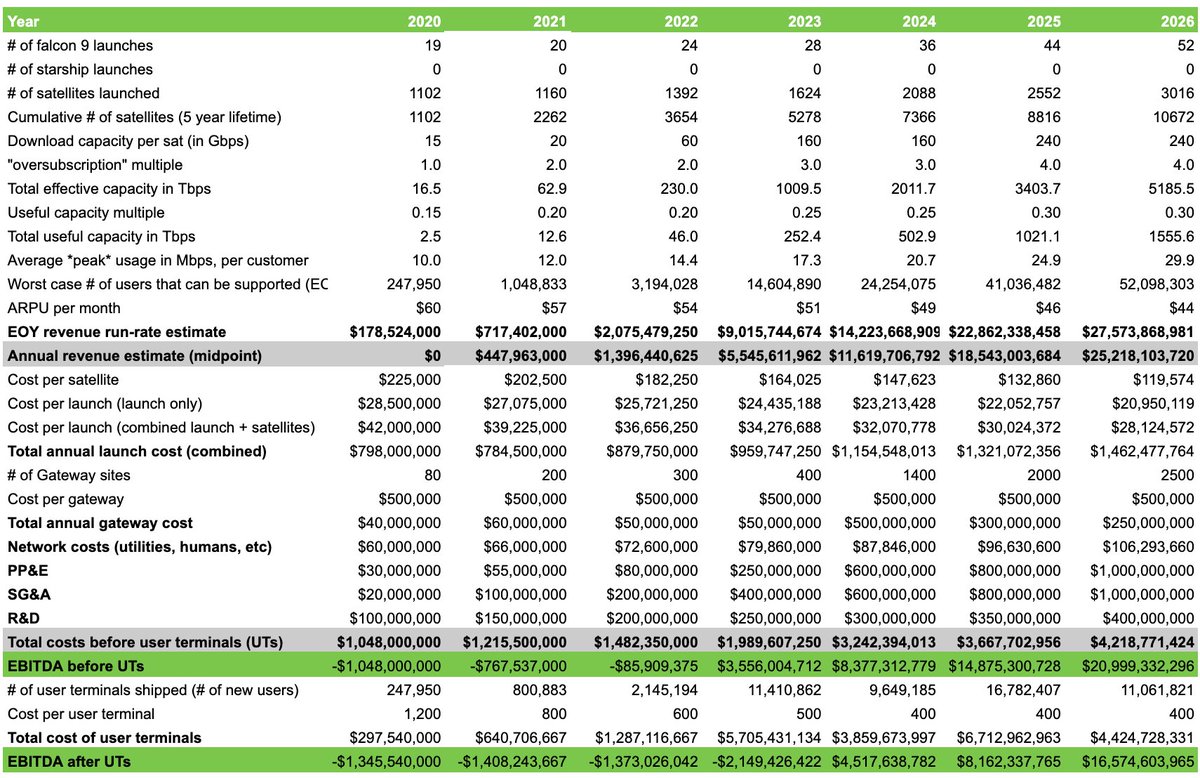
For those of you that don't know me, I've been privileged to be a major SpaceX shareholder since 2020 (having led Sequoia Capital's investments). I'm also a physicist, which is a huge advantage for underwriting SpaceX's next-gen projects. This is the Sequoia internal financial model that I built around Starlink in Q4 2020. Note that Starlink was in its first quarter of revenue when I built this. It seemed insane at the time.
Here is my company wide forecast through 2028. There are wide error bars in certain areas, especially: revenue per gigawatt, CapEx per gigawatt and Terafab CapEx. But this is my 50th percentile forecast.
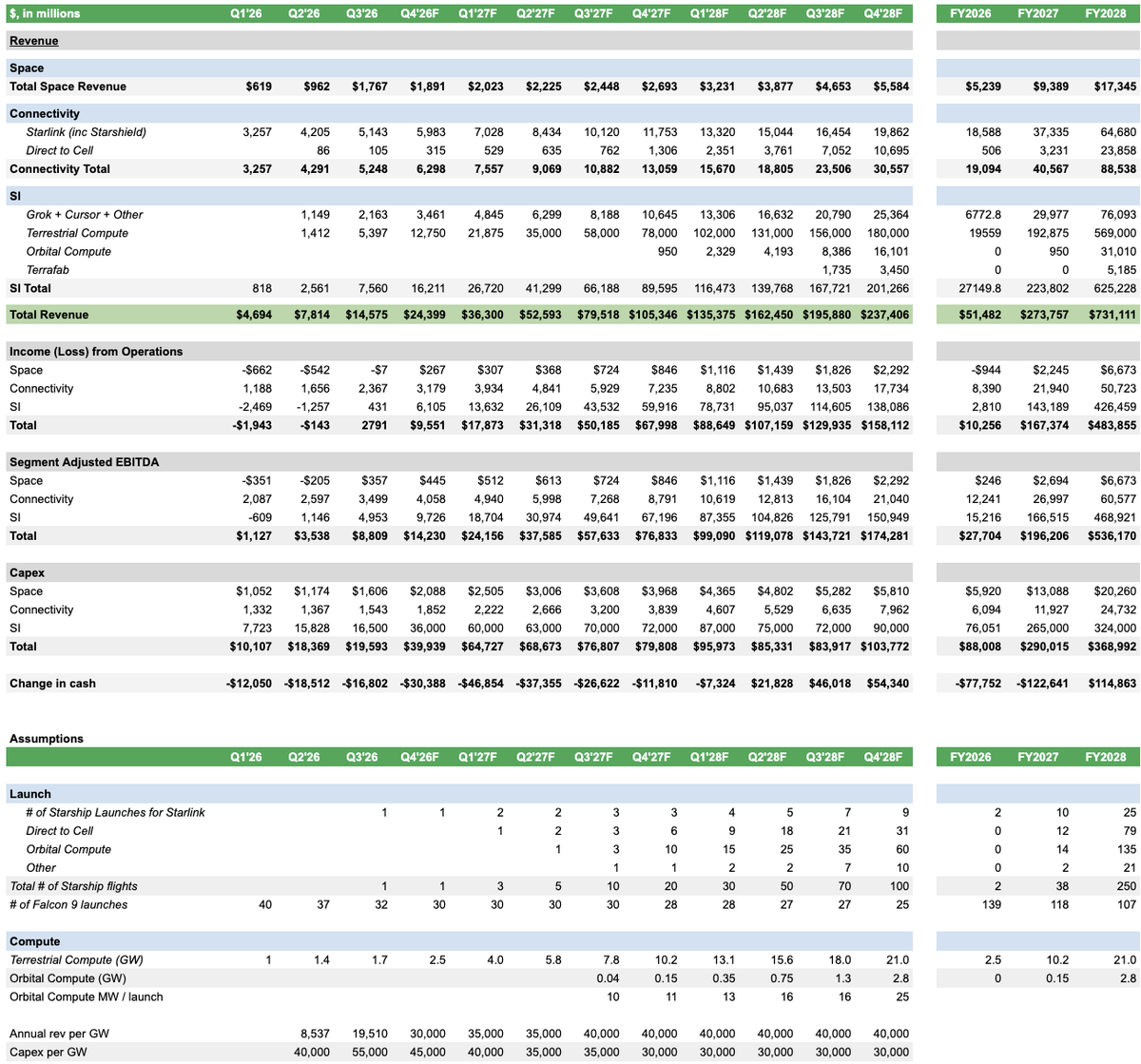
There are lots of nuances here. I'd be happy to debate any number. Some of them can change dramatically with the macro, especially rev/GW. Note though that I believe rev/GW and CapEx/GW are coupled constants. Meaning if rev/GW goes down then CapEx/GW will also go down by a roughly proportionate amount. This would cause SpaceX's total GWs to go up as they're the low-cost provider, which would offset some of the revenue loss, but not by a fully proportionate amount (mainly power delays).
Barring a major disruption (war, AI moratorium, revolution) I think we are about to see a revenue ramp at SpaceX whose only parallel is NVIDIA's ramp over the last three years. I believe that very few investors understand the company right now. In particular here are a few things that I think are under-appreciated.
-
SpaceX has the best team of any company on Earth
-
Starship is the biggest moat in history
-
SpaceX is the low-cost provider in compute
-
The Starlink + Direct to Cell unit economics are astounding. And they improve dramatically with Starship
Let me unpack each of these.
Best team on Earth
China is cracked. I briefly worked at a start-up in Beijing in 2009, during the good old days before we became great power adversaries.
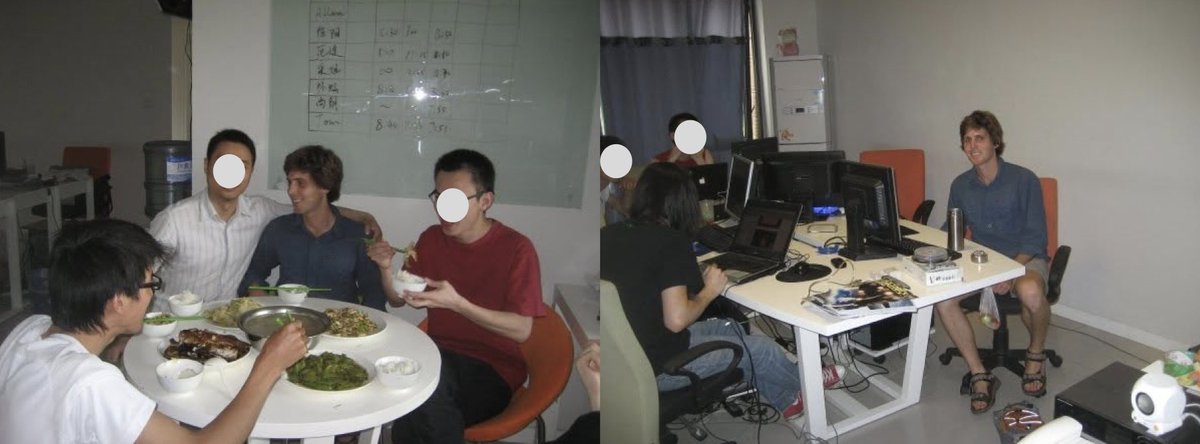
It is hard to explain the work ethic to Americans. The team when I started was 7 people and we all lived and worked in a 4 bedroom apartment on the outskirts of Beijing. It was 16 hour days 6 days per week. It is a level of intensity that doesn't exist outside of China... except in Elon's companies.
SpaceX combines a max intensity culture with the best eval that exists in nature: does the rocket fly or explode? This last point is important and under-appreciated. It's probably only the AI community that will get the metaphor. It is impossible to survive at SpaceX if you're not up to the task. If a subsystem fails in a test all the way up to does the rocket explode, the root failure will be traced. Physics beats politics. SpaceX is the most extreme example of this.
When you then add in the importance of the mission and Elon's superpower for identifying and then empowering outlier young people... and then letting this stew and compound for 25 years against the backdrop of the ultimate eval... the result is by far the most elite team and culture on Earth.
What does this mean? Let's apply it to the AI buildout.
Amazon, Google and the Neoclouds have some great people. But *everyone* at SpaceX is great.
Amazon, Google and the Neclouds have some people who can solve gnarly problems. But SpaceX (+ Tesla) has someone that can solve *any* problem.
Turbines are the bottleneck? SpaceX will make them.
Can't get a permit to turn on a power plant in Tennessee? No problem, turn on a power plant in Mississippi and build high voltage transmission lines across the state border.
Having a network issue? Bring in the Starlink team.
Need to move a giant piece of equipment from Vietnam to Texas? Get the Starship recovery team on it.
We can play this game forever. People think of Gigawatt scale AI datacenters as the same level of difficulty as the tens of megawatt CPU datacenters of yesteryear. They're not. This is one to two orders of magnitude more challenging and it's why the SpaceX team is lapping everyone else.
The only other group of people that have experience dealing with atoms at this speed and scale are in China.
Starship is the biggest moat in history
What do you think are the most complex things humans have ever built? I've spent about a dozen hours walking around like a crazy person debating this with frontier models (voice mode!) The things the models normally come back with are: leading edge chip fab, ASML's EUV, ITER, nuclear submarines, the LHC and the ISS.
I think this is wrong, I think it's Starship. (Leading edge foundation models post RSI are getting close too)
Define it this way: if a group of the smartest humans with unlimited resources wanted to catch up to the frontier of the project, how long would it take?
Note that the answer to this depends on the supply chain you're starting with. If you're starting as cave men then leading edge fabs are almost certainly harder than Starship. But if you're starting with a reasonable assumption about the tools that would be available then I think it's usually Starship (with leading edge silicon being close and which is harder depends on debatable assumptions).
One way to evaluate this claim is to look at China. I'd argue they view semiconductors and space access as roughly equally strategically important. I'd further argue that they prioritized EVs, space, quantum and semis all around the same time.
In my opinion they surpassed the West in EVs in ~one decade. Quantum is much more nascent as a field and they caught up in a decade. For semis the rumors are that they've figured out early versions of EUV and are now perfecting them. I'd estimate China is about 5 years behind TSMC in semis. They are about 10 years behind SpaceX in launch (SpaceX did its first booster catch in 2015, China in 2026). And I'd argue the gap is widening in space with Starship, while shrinking in semis.
This is splitting hairs though, the main point is that Starship is on the short list of machines at the frontier of human achievement. It's not something that can be replicated quickly. And SpaceX will continue to push the leading edge, which benefits America, unless the company is throttled (while China's space efforts will remain unthrottled).
Even if leading edge chip fabrication is harder, the Starship supply chain is vertically integrated within SpaceX. The Starship moat is just unfathomably large, evidenced by how far behind China is, even with the importance of space.
SpaceX is the low-cost producer in compute
Again, this is a point that we think is under-appreciated. Being the low cost producer in a commodity market is an extremely strategic position to sit in.
The price of a commodity can go below the lowest cost production cost for short periods of time, but not for very long. Quickly the high-cost producers go bankrupt, then a combination of: supply goes down and the low-cost producer consolidates more supply. Prices then go up and the low-cost producer actually comes away net stronger than before the pricing crunch.
Personally, I think the pricing dynamics of AI compute will be much closer to oil production rather than to broadband internet (which was massively overbuilt in the dot com boom). The barrier to entry for Gigawatt scale AI compute is vastly higher, the supply chains are tighter, and the timelines are longer.
Even if the cost per gigawatt of compute went down to ~$10B I think SpaceX would come out ahead as the low-cost producer, and most agile player. I also think it's very unlikely we see anything below $20B/GW within the next ~4 years. And even at $20B/GW I think SpaceX's CapEx/GW goes down as the competition decreases and other producers go belly up.
Starlink/DTC/Starship Unit Economics
The current Starlink constellation is at about a $20B/yr of revenue run rate. This constellation was built with about 400 Falcon 9 launches. Each Starship flight will be the equivalent of about 20 Falcon 9 launches.
That means it would take about 20 Starship flights to support $20B/yr in revenue. That's about $1B/yr of revenue per launch with about a 5 year lifetime of this revenue, or $5B in lifetime revenue per Starship flight.
SpaceX will likely take costs down dramatically whether its for Starlink, Direct to Cell or Orbital Compute to increase the available market. But once you understand the scale of what each launch can provide something clicks.
Personally, I'd wager that Direct to Cell will do more revenue than Starlink in 2029 or 2030 under almost any scenario.
Conclusion
This is a very short post. I didn't justify most of my numbers. I'd be happy to do that in a live debate, this is the wrong format. And I'll acknowledge that there are wide error bars. But on the other hand, I feel very strongly that:
a) people are underestimating the revenue ramp that we are about to see
b) that people underestimate SpaceX's moat, and in particular how flexible Starship is
We didn't even talk about Orbital Compute as that really shows up starting in 2029. In a decade I believe that SpaceX will be as vertically integrated in the chip sector as it is today in the rocket sector. But we'll leave these topics for a future post.
The future won't be boring. We need to get it right. I believe that SpaceX will be critical infrastructure for any potential timeline.
*Again, this is not investment advice. And past performance is not indicative of future results.