The Ultimate Guide to Organic Marketing & Content
文章目录
Organic content is the most powerful growth lever in business right now.
Get this right, and you can accelerate your business trajectory significantly.
For the past 6 years, I've been obsessed with creating world-class organic marketing systems and building media engines.
I have billions of lifetime views and have worked with (or have access to) pretty much every major creator and brand.
The strategies I'll cover work for founders, personal brands, businesses - literally everything. This is the high-level, practical framework for crafting a sticky organic brand from scratch.
You'll learn:
-
What organic content does that nothing else can (why you need organic now)
-
Content architecture & strategy
-
How to create world-class content (unique to you)
-
Video vs. written media
-
How to pick the right social channels
-
How to build effective systems that scale
I don't have anything to sell you. All I ask is that you like & follow so I can keep producing valuable content like this. Enjoy!
Why You Need Organic Now
Quickly:
- Competition & saturation
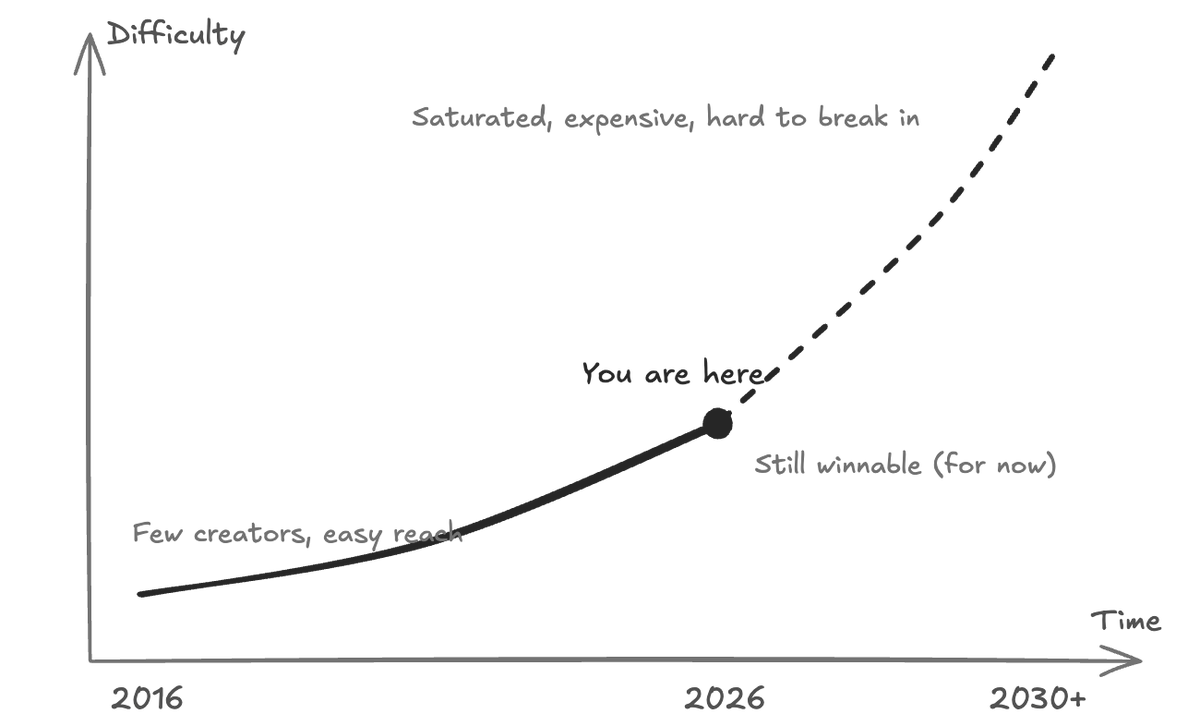
Organic content is becoming extremely saturated.
From what I've seen firsthand, AI is spawning new creators out of thin air. Still, it takes tremendous skill, volume, and creativity to break through.
At the same time, algorithms are getting smarter, which makes building a presence on socials a more sophisticated game every year. So while you're still thinking about building a brand, your competitors are actively taking market share as it gets harder to catch up.
If you've ever wanted to build organic reach, now is the time.
-
**Leverage**
Unlike paid customer acquisition, every piece of content works 24/7. It sells, educates, and builds trust while you sleep.
It is the highest leverage thing for business owners today. Essentially, you're taking a platform's existing user base and distribution and slapping your brand on top of it.
-
**Bizz opportunities **
When organic marketing is built properly, it can become its own business.
Unlocking:
-
Sponsorships and brand deals
-
Platform revenue
-
Partnerships and collabs (better access/network)
-
Hiring (great people want to work with brands they follow)
-
Fundraising (investors notice founders with distribution)
- It's your moat
Distribution is one of the few moats left. Nobody can copy your audience's trust, your authority, and branding.
TL;DR: We live in the new media era. Social media and organic content are the best ways to build real trust and authority with your audience and customers. The window to capitalize is open, but closing.
Content Architecture & Strategy
Before you post on social channels, you need to "craft" your brand. This is Phase 1 of setting yourself up for success.
Honestly I see so many people get this wrong, and it's why they post for months with zero results.
Market Research
Good market research answers four questions:
Who's your audience?     → Avatar, pain points, goals

Who's winning?           → Winners in your niche

What's working?          → Formats, topics, hooks, packaging

What's missing?          → Gaps nobody is filling (this is your opportunity)
How to do market research:
-
Study the top 10 to 20 accounts in your niche. Look for commonalities across multiple social channels (YouTube, X, Reddit, LinkedIn, etc.) - your goal is to uncover the core principles/angles/messaging that work in your niche.
-
Read the replies. This is where your audience tells you exactly what they want.
-
Look at adjacent niches. Look at other niches and pull ideas into yours that people aren't yet executing.
-
Identify the gaps. What questions keep coming up without good answers? What's everyone doing the same way? What would you do differently?
-
Keep a swipe file. Start building a resource you can refer to that contains good content practices.
Note: Content is dynamic; pivot your brand based on what performs well and market demand.
High-level content strategy
Step 1: Pick your content pillars
Pillars are the 3 to 4 topics you'll consistently post about *(I'll cover this in depth below). *
Step 2: Map your content to a funnel
Most content should build trust, and a few should convert.
TOF (top of funnel)   → ~60% of posts Reach. Viral formats, trending topics.

MOF (middle)          → ~30% of posts Trust. Case studies, results, deep dives behind the scenes.

BOF (bottom)          → ~10% of posts Conversion. Offers, testimonials, launches, clear CTAs.
Depending on your brand, you can change the content funnel.
For example, if you sell a high-ticket offer to a very specific person, focus more on MOF/BOF to speak directly to that ICP.
Formats change fast. Here's what's working best right now:
Short-form video        → Raw reach and discovery
Carousels               → Saves and education
Founder-led content     → Trust and personality
Build in public         → Following a journey in real time
Long-form video         → Deep trust and depth; can work for T-BOF
Newsletters             → Owned audience and conversion
Employee-led            → For businesses with 20+ employees for awareness
Step 3: Set a cadence
Setting a posting cadence is an equilibrium between quality and quantity.
The question is essentially: How much quality content can you produce?
I recommend starting with a low commitment (a few posts on 1-2 channels), then expanding based on your resources. If you can hire a team, great. If not, you'll need to focus your energy on a few high-leverage channels (covered in a later section).
How to Create World-Class Content
In one line: You create world-class content by tapping into your unfair advantages that overlap with market demand.
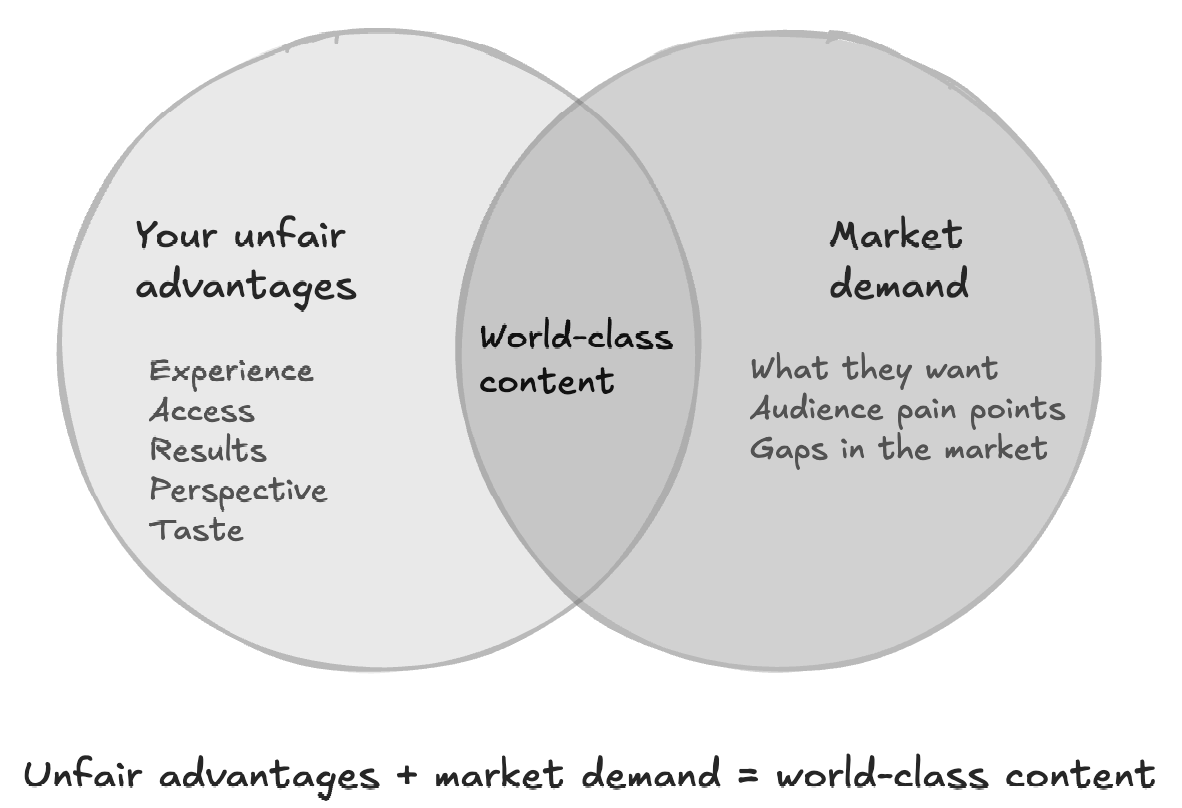
Most people only focus on one side. They either post what they know (and nobody cares), or chase what's trending (and sound like everyone else). The magic happens in the overlap.
Everyone has unfair market advantages. Primarily coming from:
Experience   → Things you've done that others haven't
Access       → People, data or tools others can't reach
Results      → Proof you can show (numbers, case studies)
Perspective  → A take nobody else in your space has
Taste        → Identifying and being exceptional at something
The strongest market advantage is just being good at something and being unique.
Meaning, you're a business with a really strong product, or you're a personal brand with really strong pre-existing skills (this is how I built my brand).
Gaining a market edge in practice
- Lead with value
-
Save people time
-
Make them money
-
Relate to people
- ** Do what others aren't willing t**o
-
Make bold claims
-
Show results, numbers, and PROOF
-
Dox your face
-
Do IRL content
-
Discover value and new ideas
-
Actually be consistent with posting
-
**Spend $$$ to learn content**
-
Hire media specialists or a team
-
Take courses
-
Hire mentors
These are the things that genuinely move the needle and give you an unfair market edge. The biggest brands have in-house media teams for a reason. Obviously, not everyone can do that, but you can invest in learning this skill set yourself.
The problem I see with most brands is that they aren't unique and offer no value.
Video vs. Written Media
At this stage, you've crafted a brand and understand your content pillars, but you still need mediums to express your brand.
There are two:
-
Video media
-
Written media
Each one breaks down into short-form and long-form content.
Video: Long-form (YouTube, 𝕏, podcasts)
• Best for: deep trust, authority
• Funnel: TOF / MOF / BOF
• Effort: Usually high
Video: Short-form (TikTok, Reels, Shorts)
• Best for: raw reach and discovery
• Funnel: Usually TOF
• Effort: Low-medium
Written: Long-form (𝕏 articles, newsletters, Substack)
• Best for: depth, authority, reaching unique audiences
• Funnel: TOF / MOF
• Effort: Medium
Written: Short-form (𝕏 posts, threads, LinkedIn)
• Best for: testing ideas fast, daily presence
• Funnel: TOF / MOF
• Effort: Low
Mix and match strategy
I like the mix-and-match strategy. Your content mix should check off two things:
1. Every stage of the funnel (TOF/MOF/BOF)
2. Both mediums and both lengths
• Video + written, so you reach your audience however they like to consume
• Long-form + short-form, so you get discovered AND trusted
For example
Long-form video    → YouTube (TOF/MOF/BOF)
Short-form video   → Clips from that video (TOF)
Long-form written  → 𝕏 article (TOF/MOF/BOF)
Short-form written → Daily posts (TOF/MOF)
You don't need all four at once. In fact, you can use the same social channel to meet all these requirements.
For example, I only post on 𝕏, but I create articles, long/short videos, and daily posts.
Picking Social Channels
Once you know your mediums, you need to decide where to post.
Start by asking yourself three questions:
1. Where does my audience already spend time?
• B2B, founders, tech → 𝕏, LinkedIn
• Consumers, lifestyle, broad audiences → Instagram, TikTok
• Education, deep dives, search → YouTube
2. What am I best at?
• Writing → 𝕏, LinkedIn, newsletter
• On camera → TikTok, Reels, YouTube
• Talking → Podcasts, YouTube
- How much time can I realistically commit?
• Low → 1-2 channels
• Medium → 2-4 channels
• High → 5+ channels with repurposing
A quick breakdown:
Channel       Best for
──────────────────────────────
𝕏             Ideas, network, intellectual audience
LinkedIn      B2B, professionals
Instagram     Lifestyle, visuals
TikTok        Raw reach
YouTube       Depth, trust, search
Newsletter    Trust, conversion
Every channel can tell a different part of your story. 𝕏 might be more product-focused, Instagram more lifestyle, and your newsletter more personal.
Systems & Scale
To create content at scale (and stay consistent), you need a few things:
- Database
A database like Notion or ClickUp to store and track ideas and various pieces of the ideation process.
-
**SOPs**
-
Write SOPs for ideation, writing, editing, packaging, and posting
-
Build a voice doc so anyone can match your tone
-
Keep a swipe file of hooks and formats that work
-
**Pipeline **
Ideas → Production → Review → Publish → Report
Kanban board views are great for this.
- Measure and iterate
-
Track the metrics
-
Review weekly
-
Double down on outliers: when something pops, make 5 more versions
-
Kill what isn't working
-
**Use AI agents **
AI won't replace taste, but it can take some grunt work off your plate: research, ideation, first drafts, analytics, and tracking.
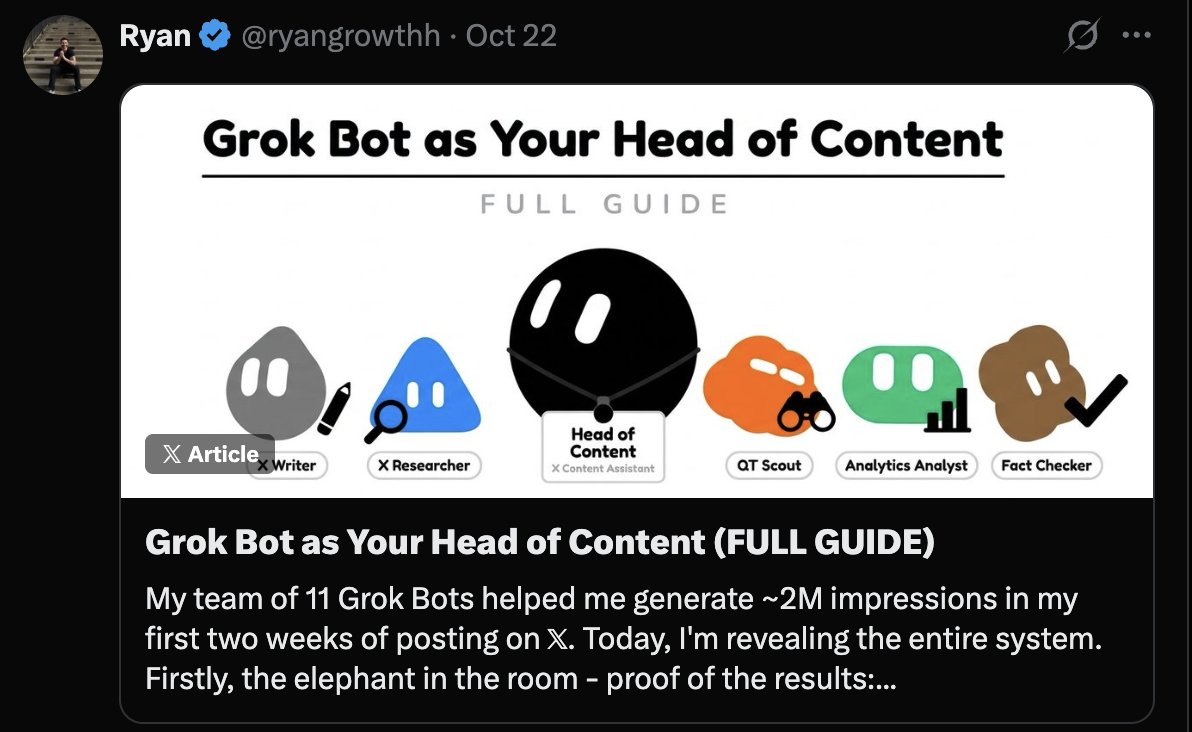
How I use Grok Bot (on my page)
Closing
If you found this valuable, please do like, repost, and follow. These articles take quite a bit of effort to articulate valuable info effectively!
I'm writing 1 to 2 articles a week on this account. If you want me to cover anything next, let me know.
Thank you for reading.
Keep crushing 👊🏼