How the 2026 Milwaukee Brewers could change offensive approaches across Major League Baseball
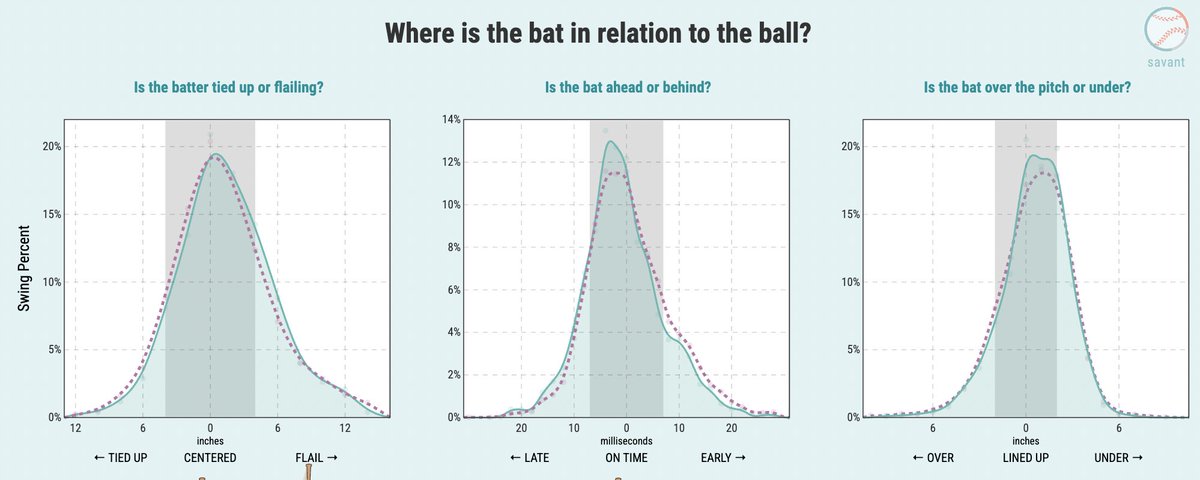
The Milwaukee Brewers are on the cusp of a World Series title.
We know they are fast, athletic, and defensively sound. We know they like to put the ball in play and some people think they are an "old school" team.
But, as a deep dive over at Statcast.com helped illustrate, Brewers hitters are doing things differently than the rest of Major League Baseball.
The Brewers have a unique profile in their set ups at the plate, their swing decisions, and their swing quality. And while different elements of their profile aren’t unique---there are teams who swing just as hard; there are teams who skew contact; there are teams who sit back in the box just as much as them; etc...---but the mix of ingredients that the Brewers have brought to the plate this season is something I really haven't seen before. And I wonder if more teams will try to emulate this moving forward.
So today, I hope to do a decent job of explaining what the Brewers are seemingly doing at the plate (especially in the postseason), and how it stands out from the rest of their competitors in MLB.
Ultimately, the hypothesis that I land on is that the Brewers don't care about "getting the bat head out front." They don't care about being "on time for the fastball." If anything, it seems as if their focus is to "not be early" as often as possible.
Let's dive in.
******
Let's start with the easy stuff that confirms the eye test:
-
The Brewers swing less often than any other team in baseball, both overall and in the zone.
-
The Brewers don't pull the ball. 33% of their hits were pulled in the regular season, the 3rd lowest rate by any team dating back to 2008 (subset of 570 teams). That number has held steady (32%) in the playoffs, the 2nd lowest by any playoff team since 2008.
-
The Brewers don't hit the ball in the air very often. Their average launch angle was 9° in the regular season, one of the lowest in MLB dating back to 2015. It has held in the postseason (10° avg), one of the lowest of any playoff teams as well.
But the numbers go further than this. It's not just the results, it's the process. Out of 48 playoff teams from 2023-26, the '26 Brewers:
-
Have the lowest average attack angle on their swings (7°)
-
Skew to the opposite field more on their swings more than any other team (3° average attack direction)
-
The 2nd deepest average contact point
-
The 6th deepest avg depth in the batter's box
-
The most closed stances on average (though the Brewers have a few guys with very open stances, they have 5 of the 45 most-closed stances in MLB: Contreras, Chourio, Turang, Hamilton, Yelich)
Now, a couple things interest me with that data above:
- The first notable aspect of it is that you would think this set of data would skew to a low bat speed team. But the Brewers aren't that. Despite thinking oppo, despite catching the ball deep, despite closing off stances... they still have a top 5 average bat speed in MLB. This produces a unique combination of short, fast swings:
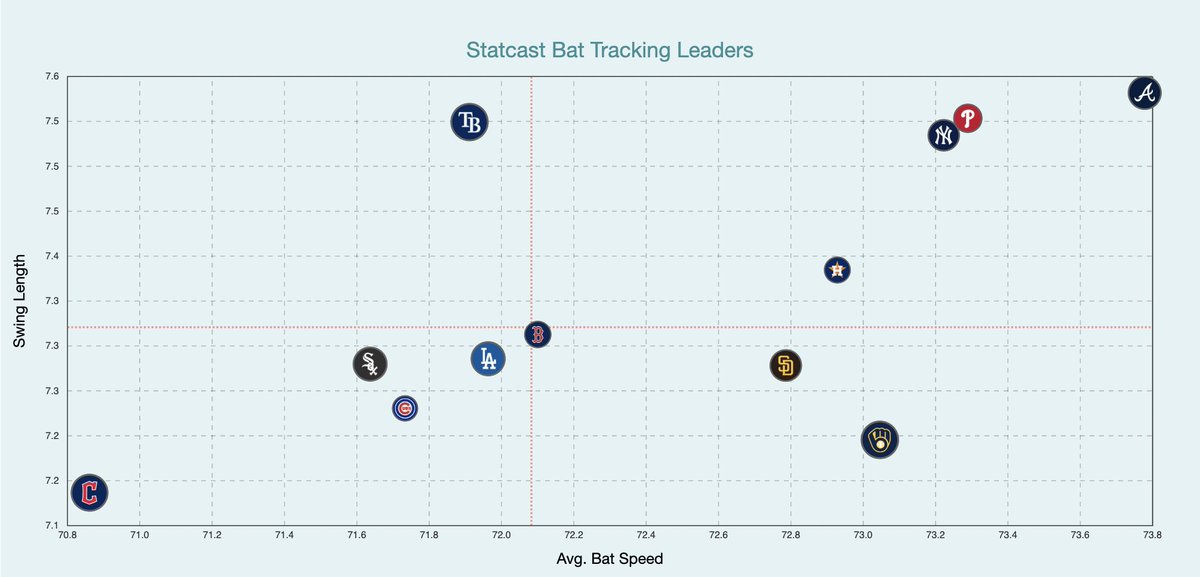
2026 Postseason Teams: Bat Speed & Avg Swing Length. Brewers 4th fastest but 2nd shortest. Interesting, unique profile.
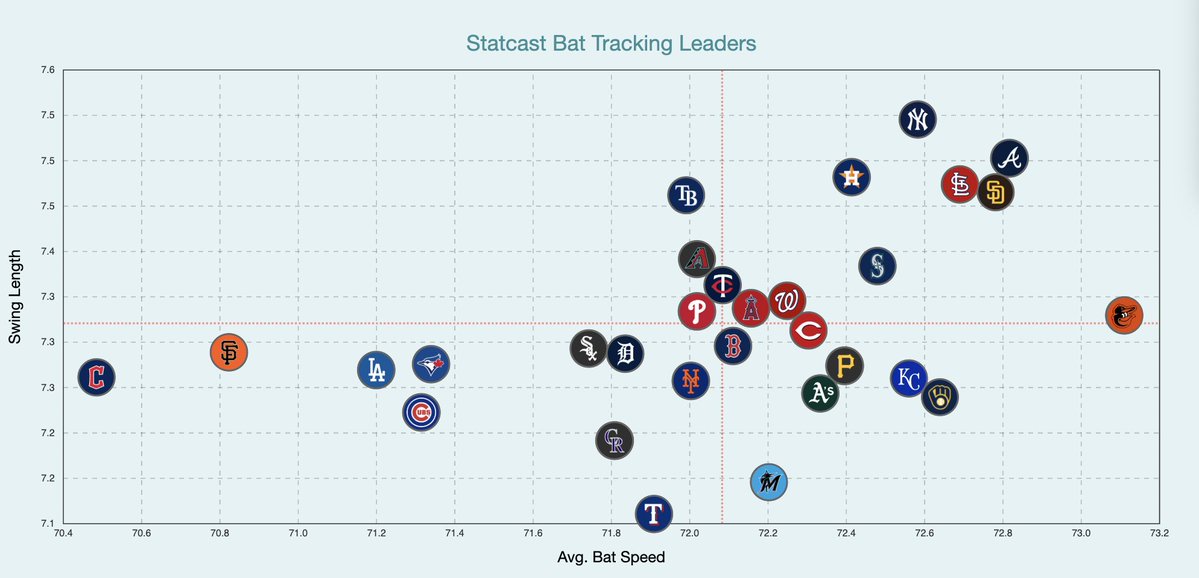
2026 Regular Season Bat Speed & Swing Length: Brewers are top 5 in bat speed & bottom 5 in swing length.
-
The second notable aspect of this data is that the Brewers have been steadily moving towards this style, going all the way back to 2023. Consider: October 2026 is the best average bat speed the Brewers have had in 25 months of data. But also their lowest avg attack angle, their heaviest oppo-slant on attack direction, their deepest average contact point, and their deepest starting depth in the batter's box.
-
That last part was interesting to me. And I first noticed it when looking at data from Jackson Chourio. He's been steadily moving back in the box over the course of the season, and over the course of his career:
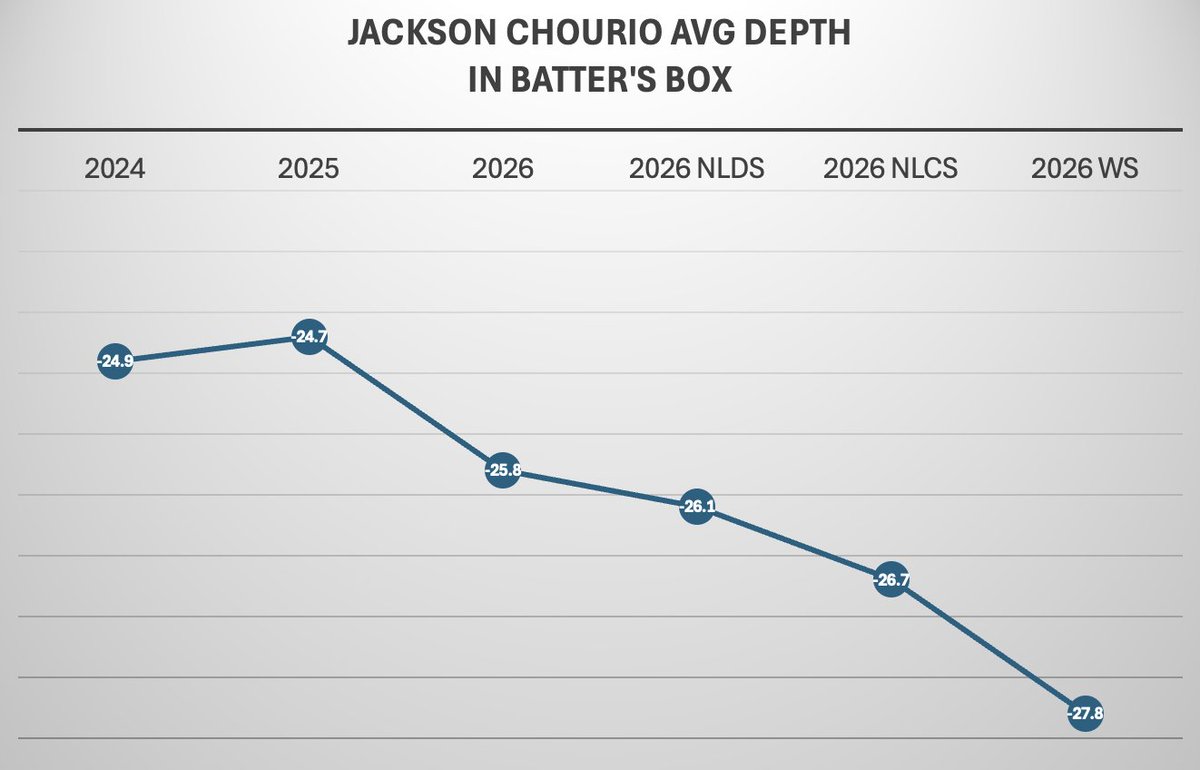
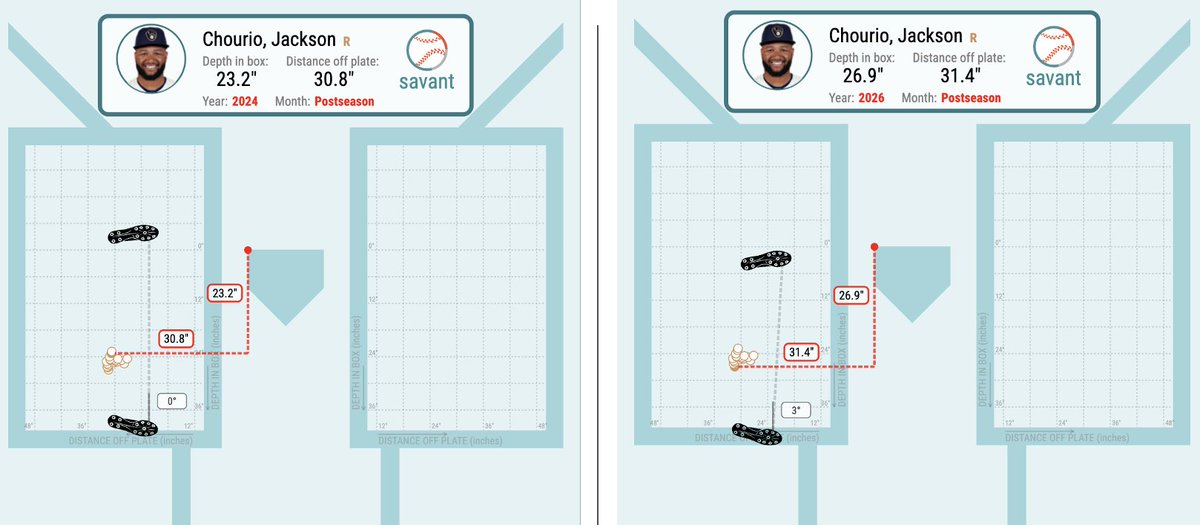
Jackson Chourio: ~3.5" deeper in the box compared to a couple seasons ago (one step back + narrower). Deepest he's ever been.
And what you realize, is that *most *of the Brewers regulars are moving back in the box this postseason:
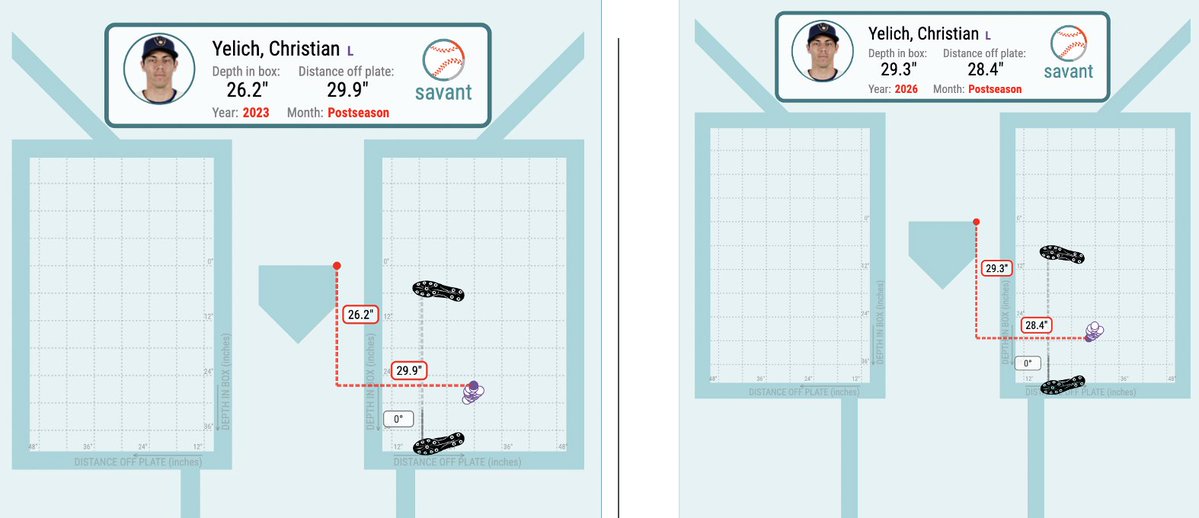
Christian Yelich: 3+" back compared to a few years ago (one step back + slightly narrower). Deepest he's ever been too.
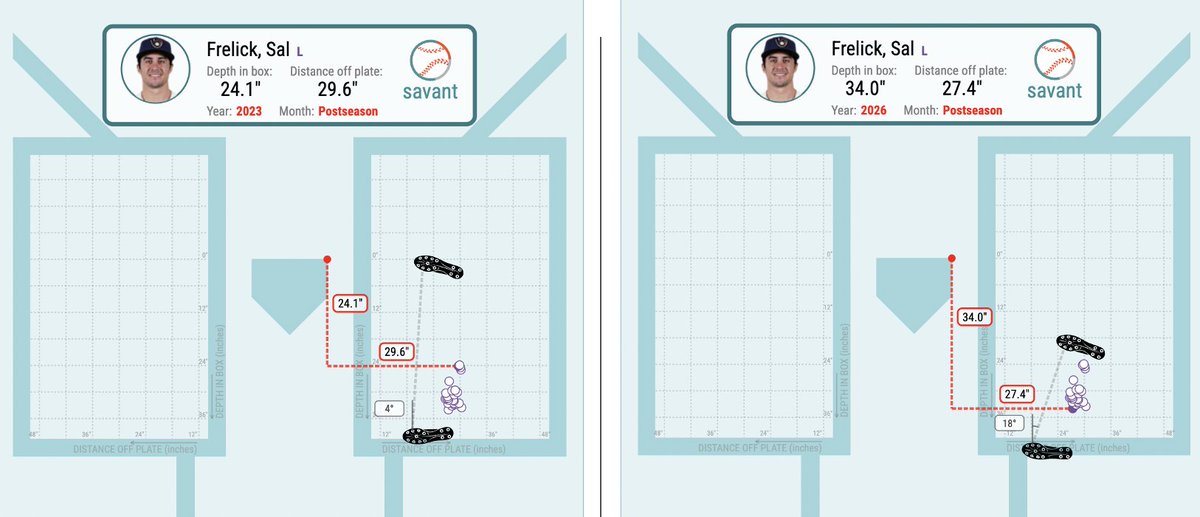
Sal Frelick: 10" (!) deeper in the box compared to a few seasons ago (one step back + narrower stance). Deepest he's ever been too.
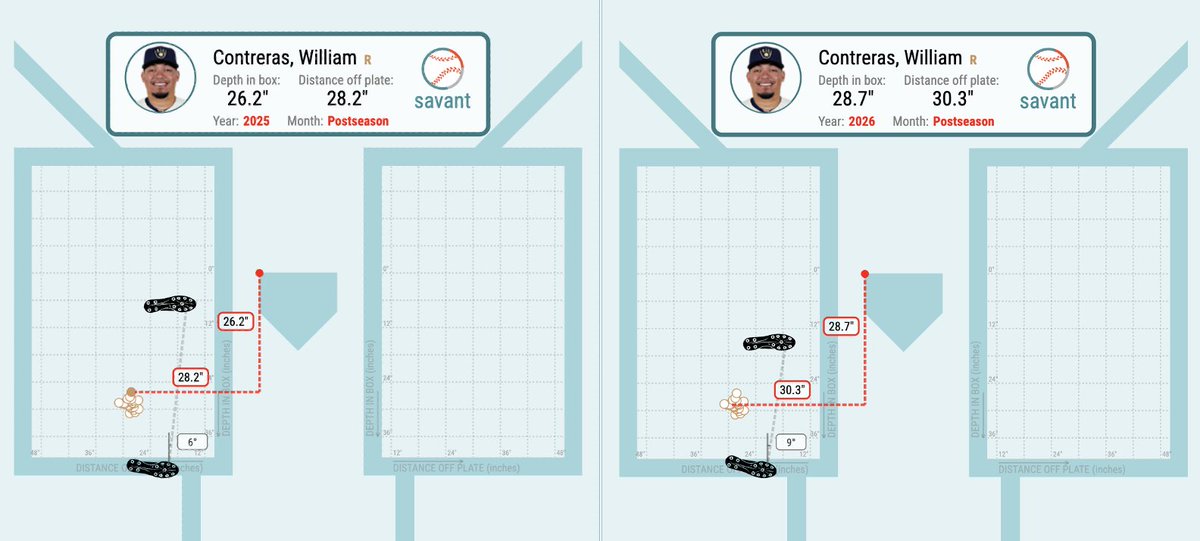
William Contreras: 2" deeper in the box compared to last postseason (mostly because of a narrower stance)
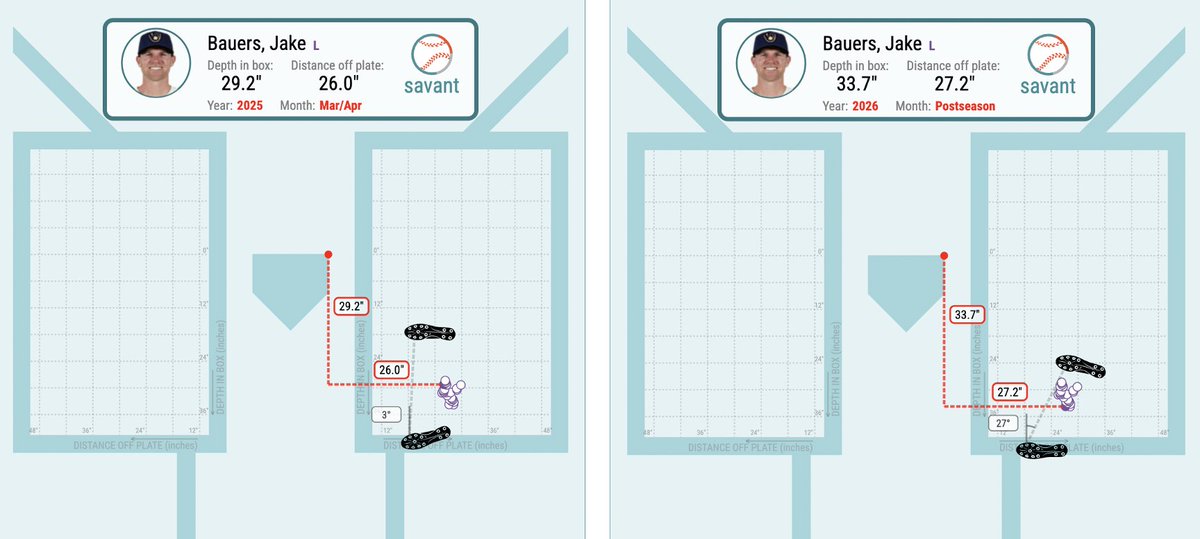
Jake Bauers: 4.5" deeper compared to start of last season (one step back + narrower + more open)
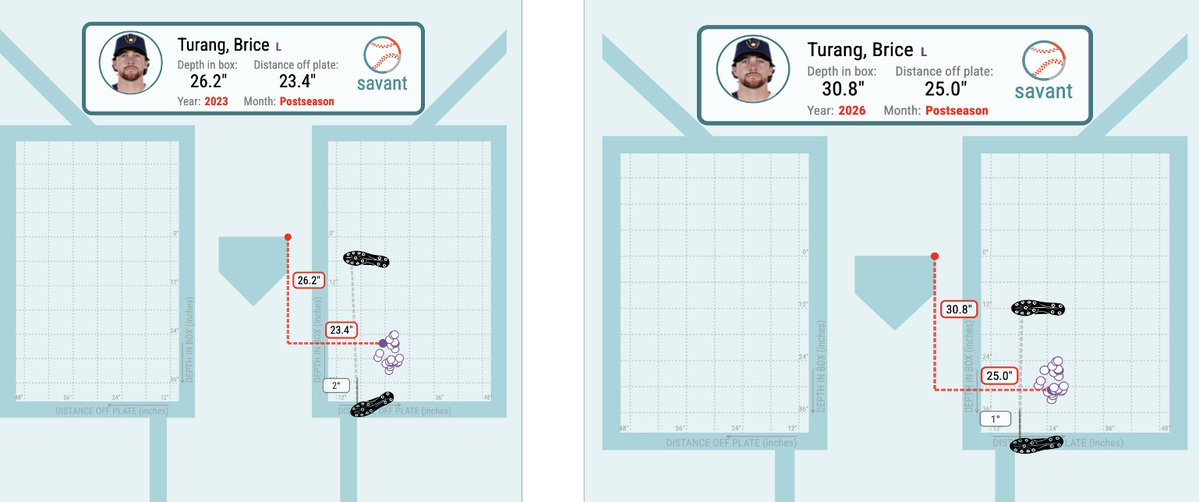
Brice Turang: 3.5" further back compared to a few years ago (one step back + narrower)
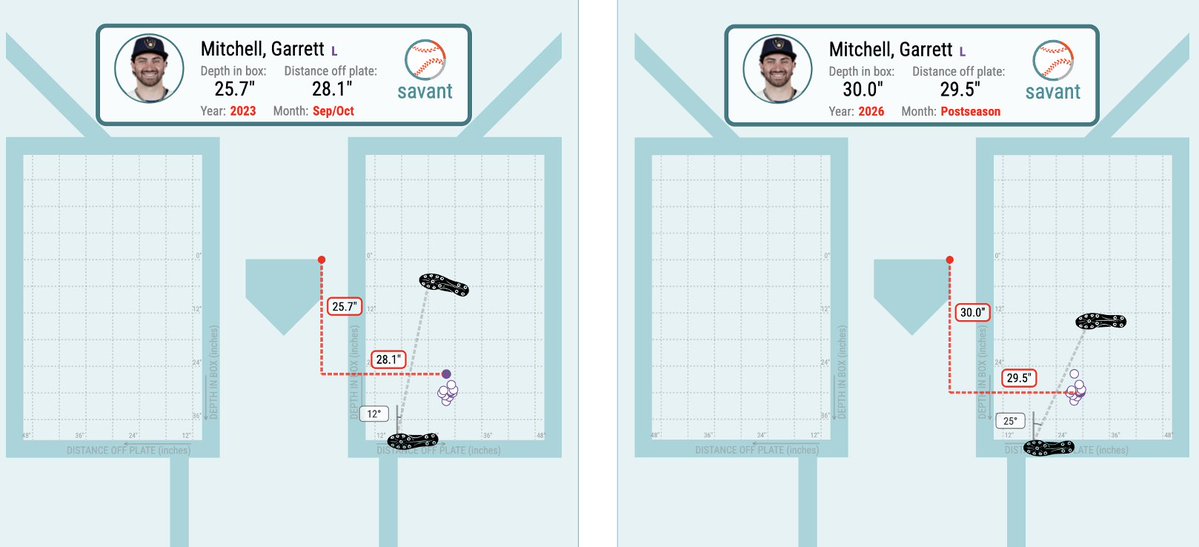
Garrett Mitchell: 4.3" deeper compared to a few years ago (one step back + narrower + more open)
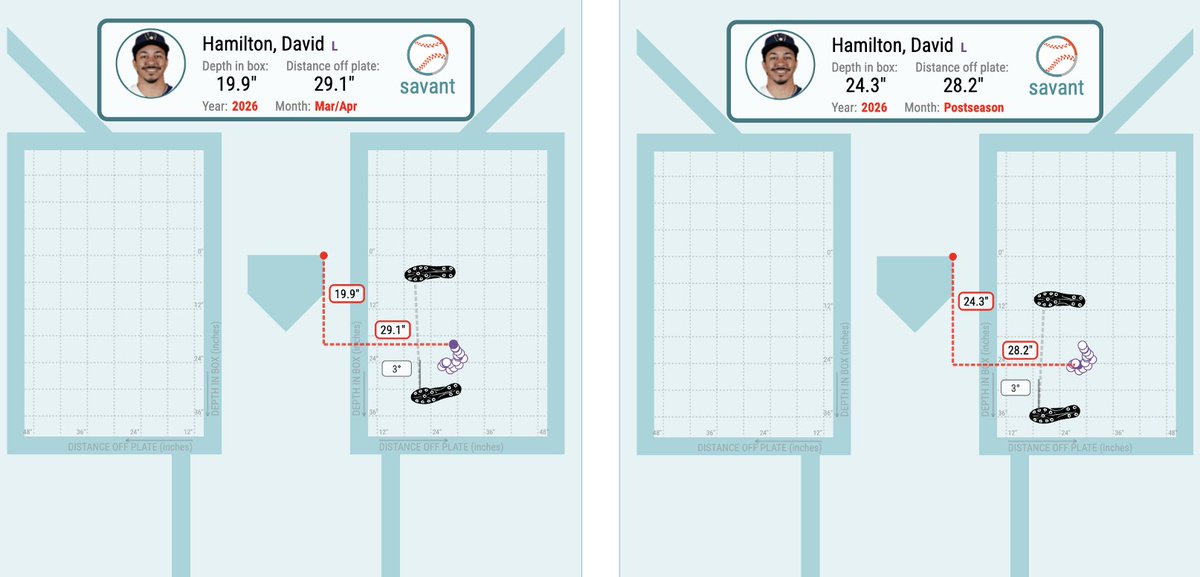
David Hamilton: 4.5" deeper compared to start of season (one big step back)
There obviously seems to be a pattern of Brewers hitters moving back in the box and/or narrowing their stances. But why?
Looking closely at Chourio could again inform our discussion of the entire team: He's swinging harder more often but his swing is shorter than it's ever been. He's barely pulled the ball this entire postseason (especially in the air), yet he's "on time" for fastballs as often as he ever has.
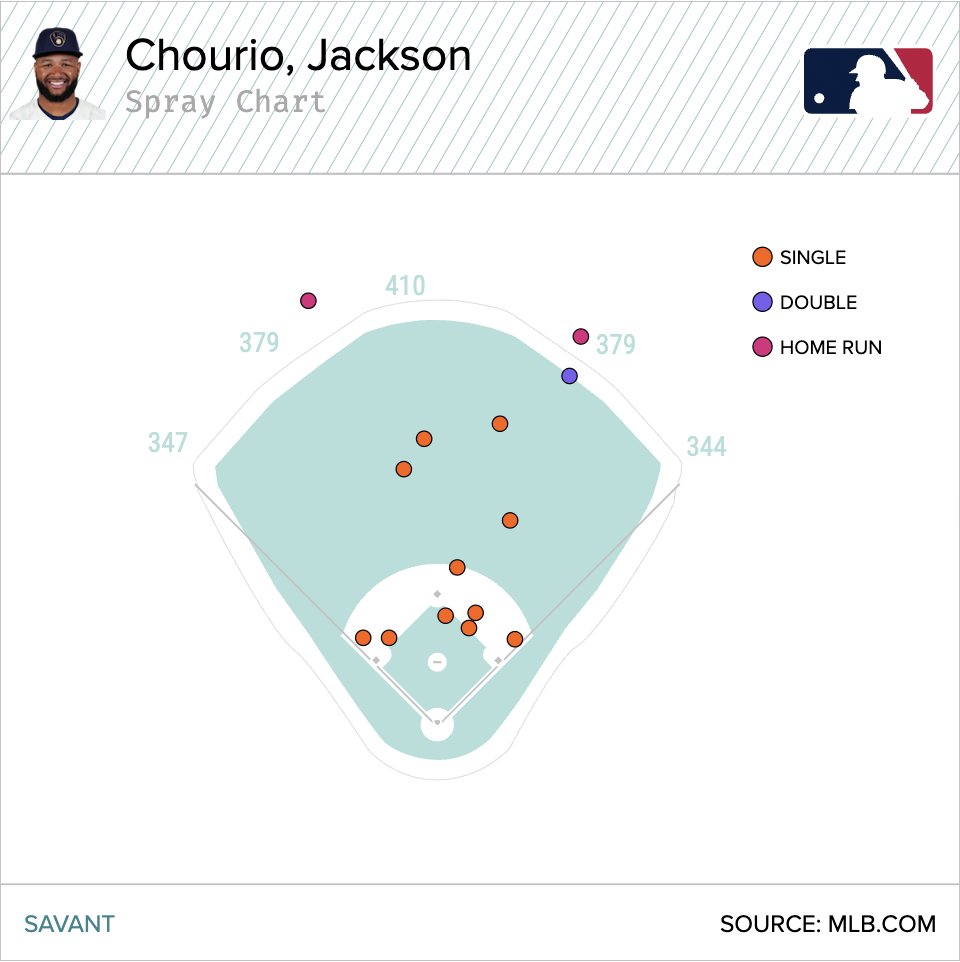
Jackson Chourio's 2026 postseason hits: Almost nothing to the pull side in the air.
This is definitely an aspect of the game where the Brewers truly aren't a "modern analytical" team at the plate. (Generalization alert!) Everyone firmly on the analytical side of baseball thinks you have to pull the ball in the air to be successful. But their logic is flawed. They jump from "pulled fly balls are the most productive batted balls in baseball" to "therefore you should try to pull the ball in the air as much as possible." That logical leap seems accurate, but misses a crucial point of discussion: What happens to your swing and your swing decisions when a player or team tilts heavily to trying to pull the ball in the air?
**
At work yesterday, our very bright analyst & former all-American softball player Madison Shipman & I were talking a lot about the Brewers offensive approach. We talked about a lot of the stuff mentioned above, and we talked about the idea of being "on time." Madison made a point of noticing how the Brewers were seemingly okay with being late on fastballs quite often. And the overall numbers this year back this up:
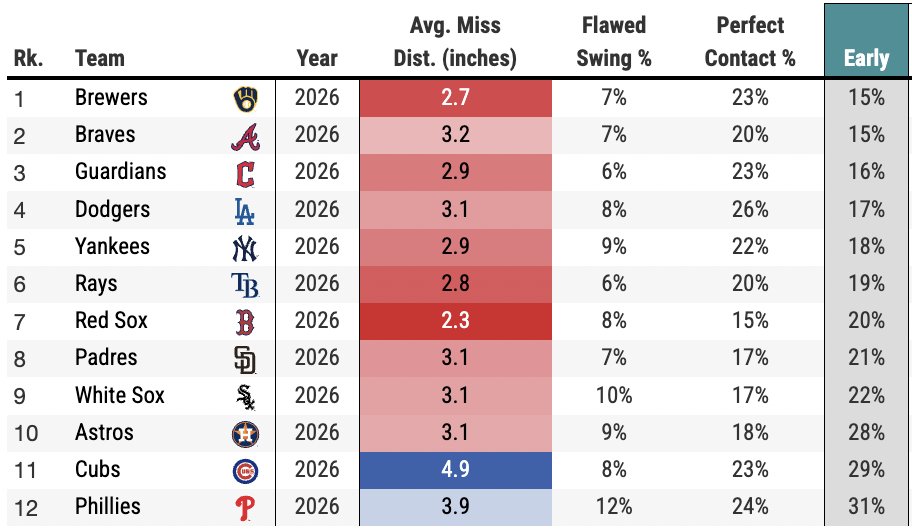
2026 Brewers in postseason: "Early" on pitches less often than any other team.
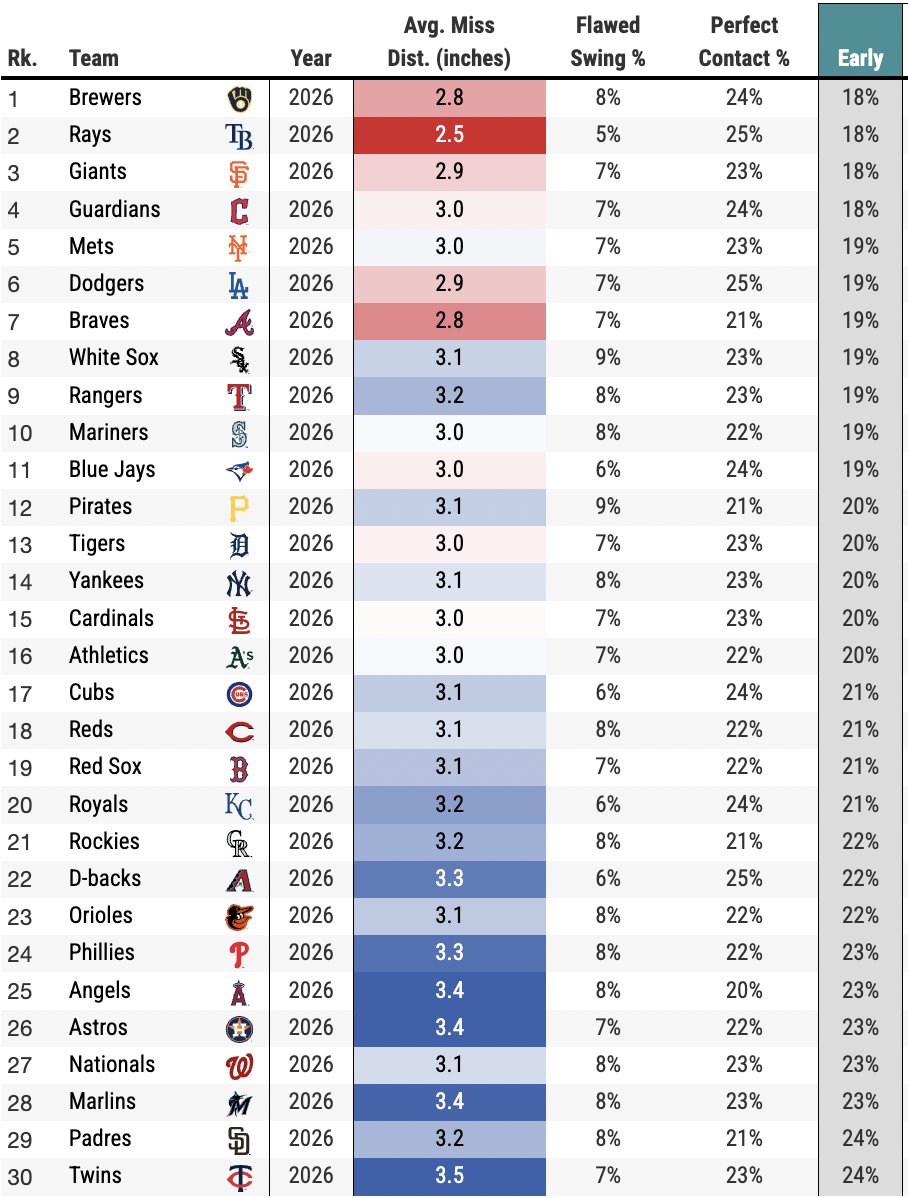
2026 Brewers in regular season: Early on pitches less often than any other team.
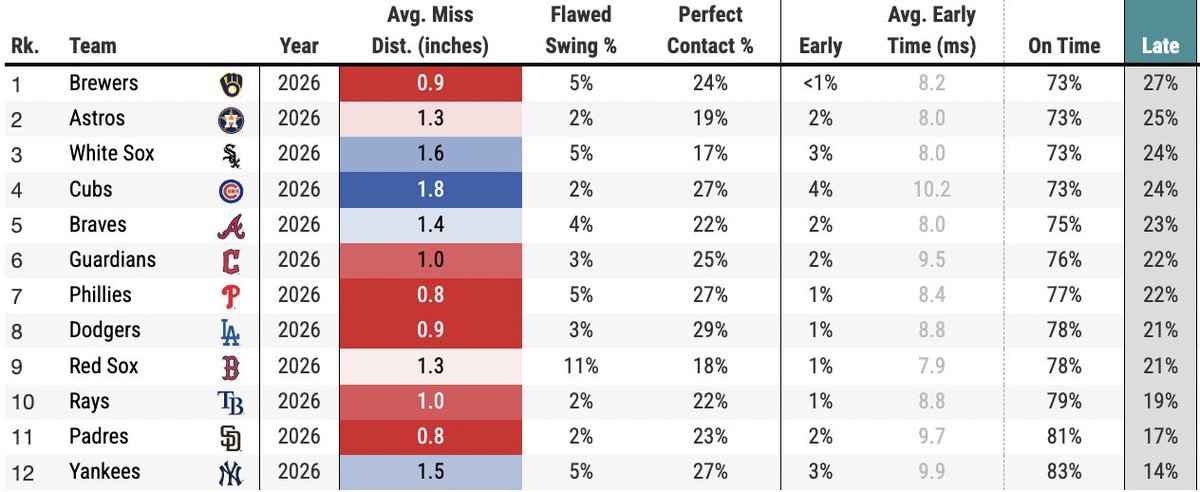
2026 Brewers in postseason: "Late" on fastballs more than any other team.
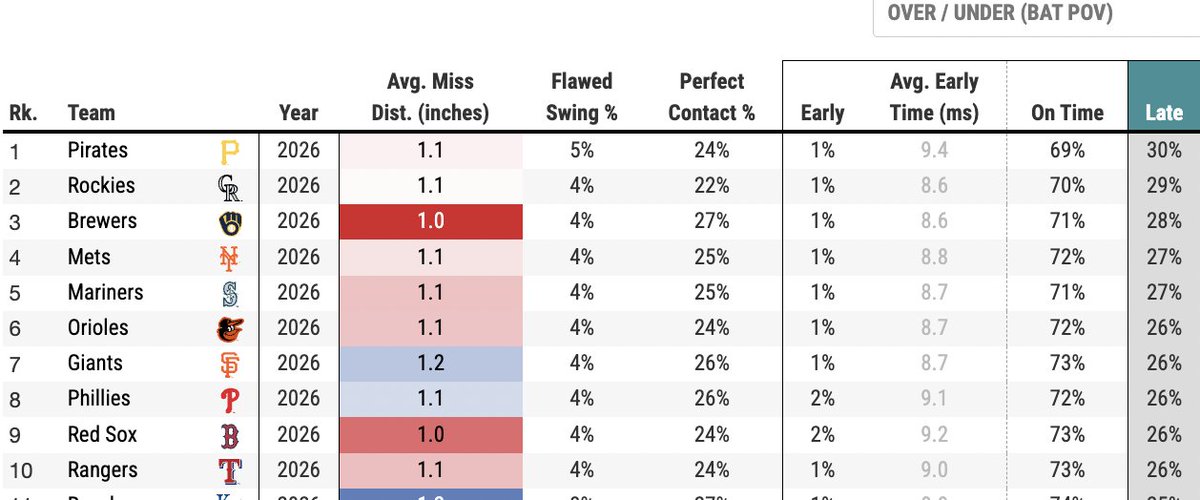
2026 Brewers in regular season: "Late" on fastballs 3rd most often in the league.
Where Madison & I landed is that it seems as if the Brewers are ok with being a bit late on fastballs if it means being "not early" on other pitches. The numbers support this theory, especially when the Brewers are facing spin, and especially before 2 strikes.
Out of 85 playoff teams to see 1000+ pitches since 2008, here is how the '26 Brewers rank when seeing spin:
-
2nd in average
-
2nd in wOBA
-
2nd in run value per pitch
-
3rd in total run value
-
5th lowest K%
-
8th lowest whiff%
And loved this when looking at regular season, Brewers facing spin before 2 strikes:
-
1st in hits, average & run value
-
3rd in wOBA
-
5th in slugging pct
-
And dead last in swing rate
****
Power is the most expensive skill in baseball, at least on the position player side. And that simple statement is the easiest way of proving how the Brewers (& Rays) are very much firmly and fully leaning into analytics. What I believe the Brewers have done/are doing is finding a style and a position player archetype that is both inexpensive and productive.
Find athletes. Move them back in the box. Narrow their stances. Give them as much time as possible to make the best possible swing decisions. Be okay with being late on fastballs.
It all works together.
Sitting back in the box, thinking about catching fastballs deep and thinking opposite field is a way of maximizing the miniscule amount of time that a hitter has to identify a pitch and whether or not a hitter wants to swing at it.
The Brewers have mastered this approach.
The 2025 Blue Jays were very close to this archetype. They hit a lot of line drives and groundballs. They skewed contact. They loved up the middle and opposite field contact. But the Jays' contact-approach didn't correspond with elite swing decisions & the Jays (team-wide) couldn't match Milwaukee's bat speed and aggressiveness when swinging.
But I wonder if we will see more teams try to become like the 2026 Brewers. If we will see more teams try to maximize the decision-making window for their hitters as a pitch is approaching.
Pulling the ball in the air is a great thing, but not if it comes at the expense of a whole bunch of other stuff.
Thanks for reading. Enjoy your Tuesday.