ECHOES: Tucker Carlson, Father Coughlin, and the Politics of Christian Restoration
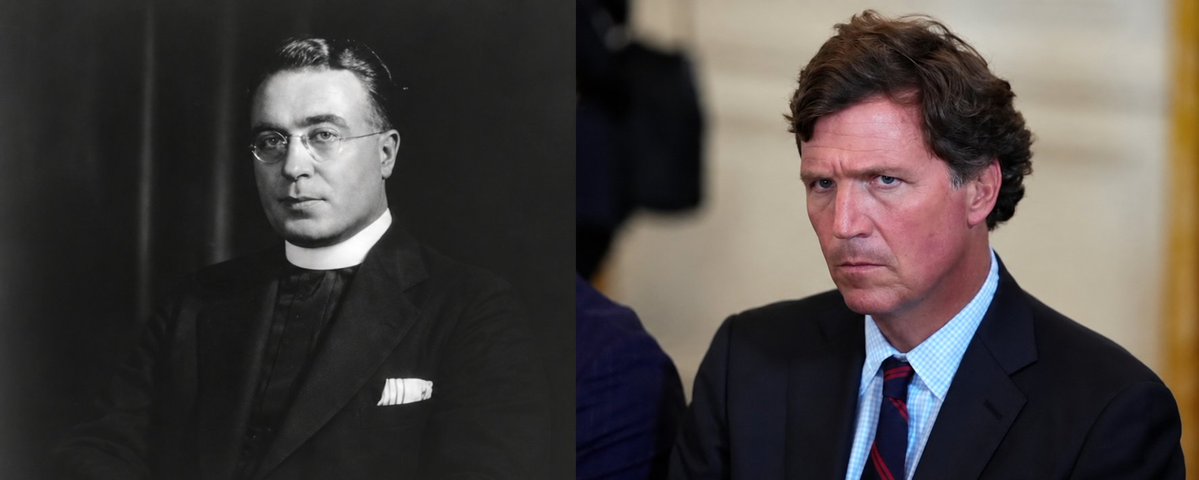
On October 27, 2025, Tucker Carlson conducted one of the most consequential interviews of his career, one that I think has not been sufficiently analyzed. It was a two-hour conversation with Nick Fuentes, a controversial young political activist who built his reputation on openly antisemitic statements and conspiracy theories, including Holocaust denial, and on his admiration for authoritarian leadership. Upon airing, the interview was immediately met with outrage from Republican and conservative religious leaders alike. This was not, in and of itself, surprising given Fuentes's public record on positions that had always been rejected in polite society. What was perhaps more telling was who refused outright to condemn the interview and, in some cases, went a step further and defended it. In analyzing this moment on the conservative right, I feel that many have missed the central dangers it exposed, dangers that have persisted every day since. Thus, I will do my best to convey them through an investigation of fifty Carlson podcast transcripts from 2024 to 2026.
Shortly after the interview, Kevin Roberts, the president of the Heritage Foundation, one of the most influential conservative institutions in the country, took to social media to passionately defend Carlson against the "venomous coalition" that was determined to silence him. The now-infamous video set off a fierce debate and a defining political fight within the American right because both the interview and its defenders exposed divisions that had been developing for years. Conservatives who had occupied the same political camp for decades had, in recent years, found themselves on opposite sides of a line defining acceptable political discourse. They had formed an alliance of interests that contained profound disagreements about what constituted antisemitism, the place and status of illiberal influencers and thought leaders within the movement, and even whether the American constitutional tradition was something they wanted to preserve or merely an obstacle to a more ambitious political and religious project on the horizon.
The Carlson–Fuentes interview brought long-standing disputes on the right, which had largely played out online, into living rooms all over America. What could once be found only in obscure corners of the internet had suddenly garnered a mainstream audience. The arguments that followed over the next days, weeks, and months reflected how conservatives viewed the debate, as they took sides on everything from institutional loyalties to convictions about what the conservative movement should become and, ultimately, what it meant to be an American conservative in 2026. Underneath the Fuentes debate lay the real problem: a deeper battle over what principles would define American conservatism after Donald Trump, and what political order its adherents would build.
At the forefront of these competing visions, according to Carlson and Fuentes, seemed to be the question of antisemitism. Since then, both sides have been unable to agree on whether Tucker Carlson is, in fact, an antisemite.
By the time of this interview, Carlson had already developed a unique defense against these accusations, and even his own conduct during the conversation with Fuentes demonstrated why that question did not have a simple answer. When Fuentes made sweeping generalizations about "the Jews," Carlson challenged the idea that members of any group could be held collectively responsible for the actions of individuals. He also invoked Christianity and reminded his guest that the apostle Paul was Jewish and that God created human beings as individuals rather than undifferentiated members of a tribe, implying that collective blame was immoral. While those objections directly confronted some of the ugliest ideas Fuentes had brought into the conversation, they did not fully absolve Carlson. In the same interview, he praised Fuentes as an exceptionally talented figure and declined to explore his documented record—a troubling omission, to say the least. Most importantly, Carlson gave him access to his vast audience, which heard largely unchallenged assertions about what has historically been called "the Jewish question."
It was the gray space between those two versions of Carlson that piqued my curiosity and prompted me to examine his other broadcasts, particularly those released between 2024 and 2026, so I could begin to understand the shape of that middle ground and its effect on the American public. What I noticed in short order was that the same subjects recurred across conversations with a strikingly varied set of guests. From economists and religious commentators to obscure, nontraditional thought leaders, the discussions kept circling back to themes of control and corruption: liberalism was destroying the West, captured governments served outside interests, immigration threatened the continuity of nations, Christianity was under attack, financial institutions exercised extraordinary power, and American foreign policy appeared to serve goals fundamentally opposed to those of the American people. Taken one by one, none of these topics is particularly troubling. Taken together and examined across broadcasts, however, they reveal a clear pattern: Carlson repeatedly attributes these failures to the deliberate actions of a secret cabal of wealthy, powerful people hellbent on the destruction of America.
On July 31, 2026, Carlson spoke with Elizabeth Lane about liberalism, which he described as an effort to destroy the West, attributing its origins to the "same people" who had destroyed "things" elsewhere. I found this odd given Lane's reported pro-Kremlin record and Russia's own penchant for illiberalism, especially since the conversation included references to oligarchs hostile to Christianity, oligarchs being a staple of Russian power. Carlson also suggested that the United States was no longer useful to certain powerful interests he did not identify. This was followed by a discussion of the outsiders who had supposedly played a decisive role in facilitating the Bolshevik Revolution. These otherwise unconnected subjects were linked through a recurring claim that a concealed group of powerful people was directing unrelated historical events toward some desired, albeit vague, end. The unnamed group's activities stretched from international finance and revolutionary communism to the facilitation of foreign wars. Even demographic change across the country and the weakening of Christianity among its citizens became expressions of a collective American struggle against hidden interests.
It was here that I started to think about the implications these explanations could have for Carlson's audience. How had they changed his listeners' understanding of politics? Carlson was, in effect, asking listeners to see the failures of liberal society as the intended results of a project fundamentally hostile to Christianity. The people directing this project remained unidentified, but the names and ethnic references used throughout his broadcasts supplied the audience with enough clues to assemble an identity.
The topics and the way they were presented sent me back to an earlier moment in American history, when another broadcaster built a movement out of the ashes of the Great Depression. Surprisingly, his influence and techniques are rarely studied today on either the American left or the American right.
Father Charles Coughlin was a Catholic priest who commanded one of the largest political audiences in the United States. Broadcasting from the Shrine of the Little Flower in Royal Oak, Michigan, he too spoke to Americans struggling through the challenges of the Great Depression. His broadcasts systematically condemned financial abuses, concentrated economic power, and political leaders who seemed indifferent to ordinary workers. He promised his listeners that a moral alternative to both unrestrained capitalism and revolutionary communism was possible. His appeal was enormous because the suffering in the country was enormous. Coughlin reached his listeners at a time when millions of Americans had lost their jobs, savings, homes, and confidence in the institutions that had promised them prosperity. He validated their suffering and assured them it had a specific origin. He held himself up as a truth-teller responsible for revealing who had betrayed them, claiming an authority that others supposedly lacked the courage to exercise. The "truth as he presented it" told his listeners that their anger belonged with what he cast as its rightful targets: a shadowy cabal of special interests.
Coughlin would later be remembered for his explicit antisemitism, but it was not a defining feature of his early broadcasting career. Rather, it emerged gradually through the way he constructed his political messages. At first, Coughlin merely drew on Catholic social teaching and the language of social justice to advance arguments about wages, property, banking, and the obligations of government. Over time, however, he increasingly identified the forces he blamed for the economic and political disorder as Jewish financiers. His newspaper, Social Justice, even promoted the fraudulent Protocols of the Elders of Zion as the grand explanation for the mayhem in the world. In November 1938, he went a step further. Nazi violence had just devastated Jewish communities across Germany and Austria during Kristallnacht, and Coughlin used those atrocities to recast Jews as the original oppressors against whom the Nazis had been forced to fight. He excused Nazi persecution as a proper response to the supposed Jewish-linked communism that, in his telling, had perverted German society.
By 1939, Coughlin was encouraging his listeners to support an organization that had become known as the Christian Front. Its members were deeply radical and saw themselves as the true and only defenders of Christian civilization against communism and Jewish influence in the world. They engaged in organized harassment and intimidation of Jews, and some turned to violence. In January 1940, several members were arrested in connection with an alleged plot to overthrow the American government. For his part, Coughlin gave his followers the moral arguments they could convert into action in support of radical causes. The ordinary suffering of the Great Depression and the fears of communism that permeated society were reduced to the work of a secret cabal of Jewish financiers who supposedly controlled the banks and the country. He taught his listeners again and again that the mistakes and financial abuses of the era were evidence of an enemy living secretly within their nation and threatening its very existence.
Economic populism, religious imagery, and opposition to foreign wars are common in American politics and usually carry no undercurrent of antisemitism. Coughlin and Carlson go further, however, in the explanations they give their audiences for the conditions behind their listeners' suffering. Beneath otherwise legitimate criticism lies the recurring claim that powerful, often secretive figures are driving political and economic events. Both broadcasters present themselves as the only true defenders of ordinary Americans against abusive, concentrated power, and both describe the political leaders of their time as compromised by interests operating in the shadows. Both also fold religious and economic arguments into a broader account of national decline driven primarily by influential lobbies, and both confront accusations of antisemitism by casting themselves as the victims of false smears. At the same time, both circulate material that draws upon long-standing suspicions about Jewish influence, loyalty, finance, and responsibility for political upheaval.
Coughlin eventually named Jews openly and repeatedly; Carlson has not done so in the same way. Instead, he often leaves the group unnamed and allows a guest to make the accusation on his behalf. This likely affords him a degree of plausible deniability when charges of antisemitism follow, but it does not make him any less a participant in the claims his guests advance. He has also supplied explicit references and suggestive questions, even while declining to articulate the full accusation himself. The picture is further complicated by Carlson's express condemnation of collective guilt, his interviews with Jewish critics of Israeli policy, and his criticisms of foreign influence, some of which demand examination on their own merits. Across these broadcasts, what matters is that listeners still receive a recurring explanation of who holds power and who belongs to the nation.
Coughlin's popularity rose during a period when Catholic social movements, European reactionary politics, economic populism, fascism, and anticommunism competed to explain the collapse of liberal confidence. Carlson, likewise, operates amid a renewed critique of liberalism advanced by intellectuals who argue that modern Western societies have sacrificed family, community, religious authority, and substantive moral obligations to individual autonomy and supposedly neutral institutions. Patrick Deneen, Adrian Vermeule, and other postliberal thinkers disagree on important questions about religion and political authority, but they share an interest in reconsidering the assumptions of the liberal constitutional order.
Intellectual movements can gain substantial political influence when popular media figures translate their premises into explanations of familiar grievances. Most Americans will never read Deneen's Regime Change, or Vermeule's writings on constitutional interpretation, or even the works of the European reactionaries whose sweeping criticisms of liberal modernity have resurfaced in contemporary debate. They do, however, listen to broadcasters who tell them why their country is failing, who is responsible, and what kinds of political arrangements might solve the problems they face.
I wanted to examine how Carlson channels his audience's resentment of American institutions into a political worldview, how that worldview overlaps with contemporary postliberal thought, and how it incorporates older traditions of conspiratorial antisemitism and Christian reaction. It is important to understand what could become politically possible once people accept that their country's institutions have been deliberately constructed or captured to work against them.
The history of Father Coughlin offers useful insight, though historical analogies are not evidence of identical intentions, and the United States of 2026 is not the United States of 1938. Still, Coughlin's career documents how a broadcaster entangled legitimate grievances with collective accusations, how he used religious identity as a test of national belonging, and how those methods helped prepare an audience for more radical political movements.
It is those patterns that I will draw on in the rest of the analysis.
The Money Changers
On January 2, 2019, Carlson delivered a monologue on Fox News in which he criticized the Republican Party's economic priorities. He argued that markets were merely instruments, not idols Republican leaders should worship. Furthermore, he stated that financial institutions in America had gained far too much influence and that this had produced leaders committed only to protecting those institutions' interests rather than preserving the families and communities the economy was supposed to serve. Republicans, he said, were making the world safe for bankers while supporting costly foreign wars and allowing lenders to extend people credit they could no longer afford to repay.
The monologue was, for all intents and purposes, a rebuke of free-market orthodoxy, and it immediately attracted the attention of a new type of conservative intellectual who had already grown dissatisfied with the Republican Party's long-standing commitment to free markets and limited government. Rod Dreher, one such conservative, responded with an article he affectionately titled "Tucker Carlson for President." Dreher, Patrick Deneen, and Sohrab Ahmari were among the leading voices in the broader postliberal revolt against the conservative economic consensus. They shared the conviction that the old fusionism of the Reagan years was no longer sufficient. A movement devoted principally to limiting government and defending market freedom, they argued, could not adequately protect families, communities, religious institutions, or the moral conditions necessary for a thriving society.
Carlson's 2019 speech was clearly not evidence of antisemitism. Criticism of predatory lending, concentrated financial power, and the effects of economic policy on family life is not, in and of itself, antisemitic. Nevertheless, the speech marked the start of a trend in which Carlson would challenge traditional conservative ideals by systematically portraying them as flawed and irredeemably corrupt. He had begun offering a popular version of the argument postliberal writers had been developing in their books and journals for years. But he had something most of those intellectuals did not: a mass audience that trusted him to explain how the world was supposed to work.
In November 1934, Father Coughlin voiced his own disillusionment with free-market capitalism. He announced the National Union for Social Justice, a political program that drew on Catholic social teaching about wages, economic concentration, and the obligations of the state. He too accused the political leaders of his time of subordinating the needs of ordinary Americans to powerful financial interests. He too flatly rejected the "false" choice between capitalism and communism and declared that both systems had failed the people. In a 1935 address, he called international bankers parasites who grew wealthy from the labor of others through the collection of exorbitant interest. He likened this arrangement to slavery and eventually identified those he held responsible: Bernard Baruch, the Rothschilds, the Warburgs, and Kuhn, Loeb & Company. Every name on that list was Jewish or belonged to a firm founded by Jewish families. Together, in his view, they formed a financial establishment responsible for the enslavement of working people. He made no allegations of illegality. He simply offered Jewish names and identities to explain how the banking industry had turned citizens into slaves, thereby transforming a legitimate debate about economic institutions into an accusation of secret collective ethnic power.
On August 5, 2026, shortly after announcing that he was leaving the Republican Party, Carlson unveiled a ten-principle political program for America that focused heavily on debt. During the presentation, he claimed that the subject itself was being suppressed and that no one could really discuss it in public without fear of retaliation. He told his audience that even mentioning the word usury placed people on some kind of list. He called it a political third rail, and although he did not specify who would be putting people on these lists, the insinuation and the history associated with such claims filled in the blanks for his listeners. His assertion was difficult to reconcile with the public record. President Trump had called for a temporary ten-percent cap on credit-card interest earlier that year, and senators and representatives from both parties had proposed similar measures in Congress. At the same time, Catholic intellectuals in the postliberal movement were openly publishing articles on the moral case against usury. Carlson, however, implied that any discussion of the topic was forbidden.
Carlson implied that the suppression of this topic was the work of an influential lobby he declined to name, and he then asserted that Israel had used bribery or threats to shape American foreign policy. Whether these remarks were intended to form a unified accusation cannot be established. What can be established is that he placed abusive finance alongside allegations of foreign influence and forbidden knowledge, thereby giving his listeners all the elements of a narrative that had been circulating in American far-right circles since the days of Father Coughlin: an unnamed, secret power preventing ordinary Americans from being free. In Coughlin's version, that power had a name.
This message is not innocuous. It has a very particular lineage, one that extends much further back than the fascist ideas of the 1930s. Medieval Christian restrictions on lending helped create the economic circumstances in which Jews would later become associated with moneylending. Over the centuries, hostility toward financial exploitation became entangled with accusations against Jews as a people. In the nineteenth and twentieth centuries, this old slander resurfaced in Catholic reactionary writing, nationalist political movements, and socialist antisemitism. The Nazi Party's 1920 program included a specific demand for "the breaking of interest slavery," while its propagandists portrayed Jewish financiers as parasites exploiting the labor of the nation.
Just as Coughlin had done in his day, Carlson repeatedly moved from identifiable economic problems to claims that hidden actors with foreign loyalties were deliberately trying to destroy the nation.
Hidden Power Behind Liberalism
As noted earlier, Carlson interviewed Elizabeth Lane on July 31, 2026, in a conversation that ranged from Russia's war in Ukraine and immigration to the ancestry of Jewish journalists and hidden oligarchs supposedly responsible for Western decline. Lane brought her own peculiar history into the exchange. Investigative reporting had revealed a strongly pro-Kremlin record, including public statements supporting Putin and a reported personal relationship with a man identified as a member of the Russian military. Carlson raised the allegation at the beginning of the interview, allowed her to deny it, and then dismissed its significance.
Much of the conversation concerned Russia and the political figures who opposed it. Lane questioned the credibility of journalist Peter Pomerantsev by pointing to his Jewish identity and his family's origins in Kyiv. Carlson responded approvingly and extended the line of argument to other commentators, suggesting that certain critics of Putin behaved as though they held a special claim of ownership over Russia. In this framing, Jewish ancestry and inherited historical grievances became explanations for journalists' political judgments, which were presented as compromised by the identities of those who held them.
But it was Carlson's discussion of liberalism that revealed the deeper ideological character of the conversation. Beyond the remarks about oligarchs and the "same people" noted earlier, his account presented liberalism as something constructed to undermine Western civilization. Its failures became evidence that the project was succeeding. The institutions and principles that had shaped the modern West became instruments of its destruction, and the people responsible for creating them became the explanation for its decline.
There is a long intellectual tradition of opposition to liberalism on the political right, but its contemporary revival has produced a new and extensive body of philosophical and constitutional literature. In Why Liberalism Failed, published in 2018, Patrick Deneen argued that liberalism was failing because it had succeeded in realizing its own principles. Liberalism's commitment to individual autonomy had gradually weakened the families, communities, religious institutions, and inherited obligations on which a flourishing society depended. In Regime Change, published in 2023, he developed that criticism into a political program intended to restore the common good. Harvard law professor Adrian Vermeule added to this body of work through constitutional interpretation, advancing a theory of common-good constitutionalism that challenged both originalism and liberal assumptions about the proper purposes and limits of political authority. Both thinkers sought to explain how liberalism had produced conditions they believed were destructive to any society that embraced it.
Carlson's account offered an entirely different explanation for liberalism's failures. Deneen located their causes within the philosophy itself; Carlson attributed liberalism's destructive effects to the intentions of its creators. An intellectual critique of liberalism can be examined through its principles, institutions, and historical consequences, but a theory of deliberate sabotage requires identifying the people supposedly responsible for carrying it out. Once liberalism becomes an instrument of concealed interests, its history is explained through the collective identities and intentions of those who allegedly wield it.
This understanding has deep roots in European reactionary politics and antisemitic conspiracy theory. After the Russian Revolution of 1917, the Judeo-Bolshevik myth spread rapidly, portraying communism as a Jewish political enterprise and attributing the revolution to Jewish influence rather than to the political and social conditions within the Russian Empire. The same tradition of propaganda associated Jews with international finance, liberal capitalism, and the institutions of modern commercial society. Capitalism and communism, despite their competing economic principles, were presented as instruments of a common enemy: the Jews. Their apparent opposition could even be treated as evidence of the conspiracy's sophistication, since the same hidden power was supposedly capable of directing opposing political movements toward a single destructive goal. This interpretation gave its adherents a remarkably flexible explanation for nearly any event. Revolutions, financial crises, political reforms, and the decline of established institutions could all be attributed to the activities of a secret enemy whose influence was presumed to operate behind the visible forces of history.
The Lane interview followed this familiar pattern. Carlson discussed the Russian Revolution in terms that shifted responsibility away from Russia's internal political struggles and toward outsiders. Lane later connected Ukraine and Israel through claims of common liberal ownership, while Carlson spoke of the same people appearing behind different historical developments. The discussion of immigration that followed carried the same conspiratorial framing, attributing demographic change in European countries to influential interests deliberately transforming Western societies. The subjects changed throughout the interview, but the explanation remained consistent. Behind the Russian Revolution, liberalism, immigration, and the decline of the West stood a cabal of powerful people pursuing objectives that ordinary citizens had not chosen and could not control.
The consequences of this interpretation are far-reaching, extending to how political legitimacy itself is understood. If liberalism was created to destroy Western civilization, the institutions built upon its principles are suspect by virtue of their origins, and defending constitutional liberalism can be interpreted as defending a project designed to bring down the West. Political disagreement becomes evidence of complicity, and the ordinary complexity of historical events is discarded in favor of a theory in which opposing movements serve the same concealed interests. The argument also becomes increasingly difficult to challenge. Evidence that appears inconsistent with the conspiracy can be absorbed into it, since the ability to conceal intentions and manipulate competing political forces is already attributed to its supposed architects.
By the end of the interview, Carlson and Lane had offered an account of Western decline in which the failures of liberalism, the upheavals of modern history, and the transformation of Western societies could all be traced to a recurring group of hidden actors. Given the attention paid earlier to the Jewish ancestry of Putin's critics, listeners could reasonably infer who those actors were meant to be.
Who Belongs to the Nation?
The question of national belonging is a common topic in Carlson's broadcasts and has become increasingly tied to ancestry. In a conversation with Sean Ryan, Carlson argued that nations depend on continuity between generations and warned that immigration could replace the descendants of a country's historic population. He asked whether people had the confidence to continue the national project through their genes. He held up Russia as an example of a nation that had preserved a coherent civilizational identity while America had not.
In one respect, Carlson is right: nations do have histories, languages, cultures, institutions, and inherited obligations, and rapid social change can weaken them. Immigration policy also raises legitimate questions about assimilation, civic solidarity, labor markets, and the capacity of institutions to integrate newcomers. But Carlson's references to genes and ancestry introduce a criterion incompatible with constitutional citizenship. When the nation is defined as the continuation of a particular ancestral population, citizenship no longer settles the question of belonging. In America, a citizen holds the same legal rights regardless of ancestry.
This ancestral definition of the nation becomes especially consequential when combined with accusations of foreign loyalty. In several broadcasts, Carlson questioned the priorities of Americans who supported Israel, criticized donors whose political interests he described as directed toward a foreign state, and raised concerns about the influence of dual citizens and immigrant communities on American policy. Democracies routinely regulate foreign agents, campaign contributions, intelligence relationships, and official conduct, but that regulation rests on evidence of what a person has done, not on who that person is. When Jewish ancestry or religious identity is used as a substitute for evidence of misconduct, the argument becomes the dual-loyalty charge, one of the oldest antisemitic tropes.
In some conversations about Israeli influence, Carlson discussed actual foreign lobbying contracts, identifiable political donations, and specific government decisions, which is legitimate political analysis. But in other exchanges, he relied only on associations involving Jewish names, family origins, inherited historical grievances, and presumed religious attachments. There, the accusation shifted from what a person had done to what his background supposedly revealed about his loyalties.
On September 11, 1941, in Des Moines, Charles Lindbergh blamed Jews, the British, and the Roosevelt administration for pushing America toward World War II. He attributed Jewish Americans' support for intervention to the interests of a broader Jewish people and warned of their influence over the press, film, and government. He insisted that he was not attacking Jews as a people, but his speech presented their supposed collective influence as a danger to the nation. It provoked outrage by treating Jewish Americans' political views as evidence of loyalty to something other than their own country.
Coughlin made the same argument when he accused Jewish financiers and political figures of acting against America on behalf of a supposed international Jewish interest. His later references to Judeo-Bolshevism fused religious identity, economic power, and foreign allegiance into a single damning category. In doing so, he subordinated Jewish Americans' citizenship to the transnational loyalties he assigned to them.
Carlson does not go as far as Coughlin or Lindbergh. He has explicitly defended the principle that individuals should not be blamed for the actions of their group. Yet his recurring emphasis on ancestry and loyalty contradicts that principle. If citizenship establishes equal political membership, religious or ethnic origin cannot disqualify a person from participating in political life.
That contradiction becomes particularly important in the context of postliberalism. Many postliberal thinkers argue that political communities require a substantive moral commitment and cannot survive on procedural neutrality. Those arguments do not require ethnic nationalism, and some postliberal writers explicitly reject it. Carlson's language about genes and ancestry belongs to a different tradition, one that defines belonging by blood rather than by conscience or conduct, even when it appears alongside the themes of family, religious renewal, and national solidarity.
In Carlson's broadcasts, a philosophical critique of liberal individualism sits alongside a demographic theory of national decline, a religious account of civilizational conflict, and an accusation that foreign interests are deliberately replacing the historic population of America. The resulting worldview belongs to none of its intellectual sources, and it leads his audience down a dangerous path.
The Religious Question
Carlson's programming has a history of sustained attacks on Christian Zionism. He has repeatedly and pointedly challenged the theological assumptions behind evangelical support for Israel. In his June 2025 interview with Senator Ted Cruz, the interpretation of Genesis 12:3, the promise that those who bless Abraham's descendants will be blessed, was at the center of the dispute. Later that year, during the Fuentes interview, Carlson described Christian Zionism as a "heresy" and a "brain virus." In February 2026, he pressed Ambassador Mike Huckabee at length on Christian Zionism and the treatment of Christians in the Holy Land.
He has also been a vocal opponent of dispensationalism. Christians can reject Christian Zionism while affirming the Jewishness of Jesus, the enduring significance of the Hebrew Scriptures, and the equal dignity of Jewish people. But Christian Zionism is not a heresy, and presenting it as one is an assault on the faith of many American Christians.
In a June 2026 interview with JD Hall, Carlson's audience heard that Jews were collectively responsible for the death of Jesus, that rabbinic Judaism involved blood atonement attained through violence against Gentiles, and that political Zionists engineered Christian Zionist theology through the Scofield Reference Bible. Carlson challenged none of these assertions. In fact, he added that Scofield had been part of an operation to subvert American Christianity, knowingly or not.
Each of these claims is false, but more importantly, each has a long, sordid history. The idea that Jews as a people bear responsibility for the crucifixion of Christ is the ancient charge of deicide, one of the origins of Christian antisemitism. The claim that Judaism requires the blood of Gentiles is the blood libel, a lie that justified centuries of Jewish persecution at the hands of Christians. The story that Zionists secretly engineered dispensationalist theology through Scofield has circulated in conspiratorial literature for decades despite having no historical basis. These are malicious misrepresentations, and the first two have fueled violence against Jews for centuries.
Coughlin's career showed where these claims lead: the formation of the Christian Front, which claimed to defend Christianity, identified Jews as its enemy, and saw some of its members turn to violence.
Like Coughlin's, Carlson's religious programming turns theological ideas into political attitudes. His conversations with Orthodox and Catholic commentators regularly address Christianity's relationship to modernity, the legitimacy of secular government, and the restoration of a Christian social order. These are serious questions. But the same conversations also introduce claims about Jewish financial manipulation, secret religious influence, and historical conspiracies. Placed side by side, those claims appear to belong to the theological argument, but the argument does not support them.
The July 13, 2026, interview with Orthodox commentator Jay Dyer is one of the clearest examples. Dyer discussed Byzantine conceptions of church and state, the Orthodox tradition, and the failures he attributed to modern republicanism. He also tied Jewish banking interests to the Reformation and the French Revolution, credited the Talmud and Kabbalah with shaping European intellectual history, and repeated discredited stories about the Rothschilds financing Lenin and manipulating the London market during the Napoleonic Wars. Carlson used these claims to discuss whether the current political order, built on that foundation, could survive and, if not, what should replace it.
Again, these stories have recognizable histories. The myth that Nathan Rothschild used early news of Napoleon's defeat at Waterloo to manipulate the London markets came out of nineteenth-century antisemitic propaganda and later appeared in Nazi film. The claim that Jewish bankers financed Bolshevism to destroy Christian Russia was a central theme of White Russian propaganda and was repeated by antisemites in Europe and America. Their survival is no evidence of their truth. They endure because they offer a simple explanation for complicated world events.
The danger of these lies is that the audience hears them alongside discussions of Christianity. If Christianity is the foundation of the authentic nation, liberalism its destroyer, and a hidden group the author of that destruction, then theological disagreement becomes heresy, and those on the other side become enemies who must be defeated. This is the reasoning that fueled centuries of expulsions and massacres of Jews in Christian Europe, and the reasoning Coughlin taught the Christian Front.
The Russian Alternative
In 2024, Carlson interviewed Aleksandr Dugin, a sanctioned Russian philosopher with little in common with American conservatism, and introduced him to a vast American audience. Dugin's political philosophy draws on Russian nationalism, Eurasianism, the European radical right, and the esoteric Traditionalist school of René Guénon and Julius Evola. He casts Western liberalism as a civilizational adversary and calls for a world order in which Russia challenges Atlanticist power. His writings reject the liberal constitutional tradition on which the United States was built.
Carlson presented Dugin as an important political philosopher whose ideas Western institutions had branded dangerous and gave him room to lay out his hostility to liberalism and his account of Russia's cultural and religious superiority without challenge. What is particularly instructive is how neatly Dugin's ideas fit the worldview Carlson builds elsewhere.
In several broadcasts, Carlson presents Russia not merely as a geopolitical actor with interests worth considering, but as a civilization that has preserved what the West abandoned. He has discussed Russia in connection with Christianity, demographic continuity, national coherence, and resistance to liberal modernity. He has also hosted guests who repeated the Kremlin's justifications for its war against Ukraine, including claims about denazification, Western provocation, and the supposedly artificial character of Ukrainian nationhood.
The June 29, 2026, interview with Viktor Bout is the starkest example. Bout was convicted in the United States of conspiring to sell weapons to a designated terrorist organization and of conspiring to kill Americans. He was released in a 2022 prisoner exchange and later became a Russian regional legislator. In the interview, he repeated the Kremlin's war narrative and spoke about eliminating Ukrainian President Volodymyr Zelensky. Carlson praised Bout's judgment and described Putin as a force for restraint. He also framed the war's destruction in terms of white Christian civilization, lamenting that one of the last majority-white Christian countries had been devastated and wondering whether that was intentional.
Whether or not Carlson acts on Russia's behalf, his programs fuse Russian state narratives with a wider theory of Western decline, and the two reinforce each other with or without coordination. An audience convinced that liberal modernity is destroying Christianity is primed to see Russia as a Christian counterweight. In turn, blaming Western liberalism for the conflict with Russia lends weight to the larger claim that liberal institutions are hostile to the historic identity of Western nations.
Dugin's Traditionalist roots sharpen the connection. Guénon and Evola rejected the premises of modern egalitarian society, and Dugin incorporated their ideas into his vision of Russia's historical mission against liberal Western power. Carlson's broadcasts do not adopt the full Traditionalist system, but they repeat its central point: a spiritually degraded modern West is failing, while an order built on religious hierarchy, national continuity, and resistance to liberal universalism endures.
Carlson's later conversations go even further, into occult power, hidden spiritual forces, bloodlines, and ritual sacrifices. In his discussions with Sean Stone and others, political authority is cast in supernatural terms: the powerful hold hidden knowledge or gain influence through dark spiritual bargains. These conversations show how the language of spiritual warfare merges with explanations of power that no evidence can defeat.
The danger is not that these ideas are strange. Once political opponents are seen as agents of demonic forces, disagreement is no longer a contest between citizens with different views of the public good. It becomes a war between good and evil, and evil is not something one negotiates with.
The Return of the Old Stories
The most revealing material in Carlson's broadcasts is the return of old conspiracy narratives and their modern descendants: Israeli foreknowledge of the September 11 attacks, foreign manipulation of American presidents, and powerful interests deliberately engineering national decline. Some of these claims come from guests; others Carlson introduces or extends himself. What makes them significant is that they recur across otherwise unrelated subjects.
Take the September 11 material, in which Carlson has questioned the official account, promoted unsubstantiated claims about Building 7, and returned again and again to the Israelis detained after the attacks. In early broadcasts, Israeli foreknowledge was raised as a question. Later, it was presented as an assertion. In a 2026 monologue, Carlson stated that Israeli intelligence knew about the attacks in advance and claimed the FBI had corroborated it. In fact, the FBI had not. Asking about investigative failures is one thing; declaring Israeli foreknowledge a proven fact that official institutions refuse to admit is quite another.
The pattern also extends to the Kennedy assassination. In an interview about the USS Liberty, Carlson suggested that CIA counterintelligence chief James Jesus Angleton had been involved in Kennedy's death and named Israel among those who benefited. Israel's 1967 attack on the Liberty is real, and survivors have long disputed the official finding that it was a case of mistaken identity. But the attack came four years after Kennedy was killed, and nothing about it bears on who killed him. Carlson moved from one documented controversy to an unsupported theory of hidden motives and actions.
This is not simply investigative skepticism, because real inquiry starts with discrepancies, tests other explanations, and accepts the findings that contradict the original suspicions. Conspiratorial thinking, on the other hand, starts with the conviction that a hidden actor exists and reads every piece of evidence through that assumption. One event goes on to explain many unrelated ones. Once Israel, or some unnamed group tied to it, is cast as the hidden author of every past catastrophe, it becomes the ready scapegoat for every future one.
Coughlin's theories worked in the same way, and their power lay in their simplicity. Each told listeners the same story: their nation was the victim, its institutions had been compromised, and a hidden enemy was the architect of their suffering.
Recently, Carlson has extended this treatment to prominent Jewish Americans. He has attacked Ben Shapiro, Bill Ackman, Miriam Adelson, Mark Levin, and Randy Fine on political grounds, which is fair game for public figures. But some of those attacks went further, emphasizing ancestry, implying foreign loyalty, or suggesting that Jewish Americans enjoy advantages denied to others. In one episode, Carlson claimed that white applicants faced greater obstacles to elite universities than Jewish applicants and confidently stated that a court had established this as fact. The litigation he cited established no such thing. Placed beside his attacks on named Jewish figures, the claim revived an old argument: that Jewish success is proof of unfair advantage or hidden influence.
Here, criticism of a donor's political activity became a challenge to her right to take part in American politics at all. Discussing Miriam Adelson, Carlson suggested that her preference for Israel disqualified her from political influence in the United States. Donations, foreign interests, and conflicts of loyalty are all open to scrutiny, but a citizen's right to participate in politics does not depend on inferences drawn from her religion or ethnicity.
Whether a donor funded a campaign can be verified. Whether an official advanced a policy can be checked against the record. Whether Jewish ancestry explains someone's political loyalty cannot be verified or checked; it is an assumption about the collective identity of a group. The same applies to claims about international finance, migration, and foreign intelligence services. Real abuses exist, but they do not prove that a hidden collective power is behind all of them.
The Problem of Deniability
Eventually, Coughlin progressed to naming Jews outright as the enemy. So far, the same cannot be said of Carlson, who stops short of that each time. He does, however, ask the questions, offer suggestive associations, and let his guests make the sweeping allegations. Taken together, his broadcasts carry implications stronger than any single sentence in them.
Questions are a normal part of journalism, and hosts are not responsible for everything their guests say. But Carlson often adds names and associations himself, and what begins as a possibility returns as a certainty. The September 11 material follows this progression. So does his treatment of liberalism, where vague insinuations about hostility toward Russia gave way to references to Jewish ancestry and to the "same people" directing history.
Carlson's echoes of Coughlin also extend to how he handles criticism. He routinely casts accusations of antisemitism as attempts to silence legitimate questions. Sometimes he has a point: criticism of Israeli policy is not hatred of Jews, and the two should not be conflated. But when those objections sit beside claims of collective Jewish power or disloyalty, every accusation becomes confirmation of that power. If powerful interests are suppressing the truth, criticism only proves their power, and the theory becomes impossible to disprove.
Coughlin used the same defense. After Kristallnacht, he posed as a student of history simply explaining Nazism's rise. He described the persecution of Jews as a response to supposed Jewish wrongdoing while maintaining plausible deniability.
The vocabulary of the two broadcasters may differ, but the technique does not. Both men shielded themselves from accusations to evade accountability. Coughlin claimed he was only analyzing history, not endorsing persecution, while Carlson rejects collective guilt even as he hosts conversations that assign enormous collective power to people identified by Jewish names, ancestry, or religion.
From Criticism to Movement
Coughlin's National Union for Social Justice gave his arguments an organization and a program, and gave his listeners a way to act on what he had taught them. His break with Roosevelt turned his disappointment with a president into a charge of betrayal, and in 1936 he backed a third-party challenge through the Union Party. Its candidate, William Lemke, lost badly, but Coughlin had shown that a broadcaster could turn an audience into a political force.
Carlson's ten principles, unveiled in August 2026, show the same desired trajectory from commentary to a new party premised on national restoration. The program addresses fairness, sovereignty, domestic production, beauty, health, family formation, moral wisdom, and national unity, echoing common themes from postliberal and national-conservative writers. Its purpose is filled in by the story his broadcasts have told about who in this nation is responsible for its decline.
If liberal institutions have failed because of fallen people or their own contradictions, reformers can debate whether to amend them, change particular policies, or adopt a different constitutional philosophy. But if those same institutions were deliberately built by the enemies of the nation, the logic demands that they be destroyed. The question is no longer what government should do; it becomes who has the right to govern, who truly belongs, and whether constitutional protections still apply to those deemed not to belong.
Carlson's broadcasts bundle these ideas together: liberalism has failed, institutions have been captured, Christianity and the historic nation are under threat, and restoration requires stronger collective authority. Together, they make exactly the case a postliberal movement would need in order to govern.
What Comes After?
Coughlin's story ended in defeat: public criticism, new broadcasting rules, and a federal investigation steadily diminished his reach. In 1942, the government barred Social Justice from the mail, and his archbishop ordered him to stop all political activity. The movement he encouraged never came to power.
Carlson's story is still being written, but his broadcasts have already revived old antisemitic narratives, brought fringe thinkers to a mass audience, and split conservative institutions over where free expression ends and radicalism begins. Whether they produce a lasting organization, a postliberal governing program, or a permanent shift in public attitudes remains to be seen.
Illiberal change arrives through ordinary channels: legislation, administrative power, judicial interpretation, and the quiet redefinition of public obligations. The decisive question is whether government stays bound by principles that protect people who reject its vision of the common good. The danger begins when authorities claim the right to decide which citizens truly belong and which opponents deserve the same protections under the law.
Coughlin's story serves as a warning about how economic grievance, religious identity, national decline, and collective accusation reinforce one another once they reach a mass audience. History records what has followed once Jews were fixed as the common enemy.
This investigation does not depend on knowing what Carlson privately believes. Across the broadcasts examined here, the same structure recurs: national decline is blamed on hidden actors, those actors are repeatedly linked to Jewish identity or Israeli influence, and the whole account of what went wrong in America is folded neatly into a wider attack on liberal modernity. Carlson now shares this lineage with Coughlin.
Whether today's audiences can tell the difference between criticizing the failures of a political order and believing that those failures prove the order was built by an enemy that must be destroyed is the question this moment poses.
The legacy of these ideas and their effect on the American public will matter more than any individual voice that carried them.