80,000 Towers Can't Fix 64 Megahertz
文章目录
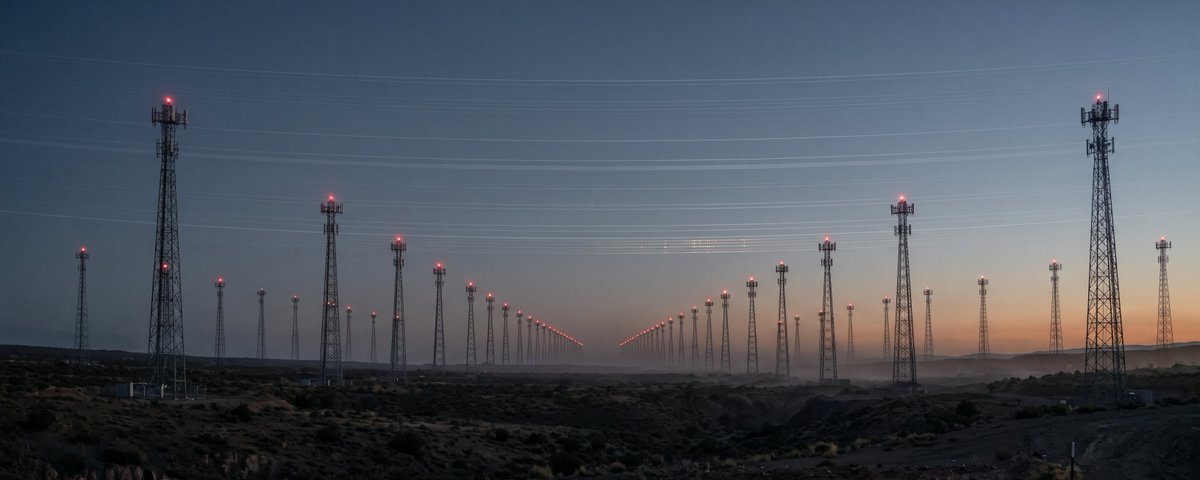
On Thursday afternoon, Bloomberg reported that SpaceX is in talks with Crown Castle and other tower operators to secure access to at least 80,000 cell sites across the United States, with the leasing commitment reaching into the billions of dollars. Crown Castle rose 10 percent after hours.
SpaceX owns about 64 megahertz of US cellular spectrum. Verizon operates with roughly 450 megahertz in a typical metro. The question that has not been asked, in any analyst report I have seen since Monday's Q3 earnings call, is a simple one: how do you run a national cellular network on one-seventh the spectrum of your competitors? The tower deal does not answer it. The tower deal is a coverage decision. Capacity, in a cellular network, is set by spectrum. And no number of towers can substitute for spectrum that is not there.
The commitment
The 80,000 figure matters. Verizon operates roughly 70,000 macro towers nationally. AT&T runs about 65,000. SpaceX is signaling it intends to lease more cell sites than Verizon owns, before serving a single US cellular customer. Crown Castle, the largest independent tower REIT, generates approximately 64 percent EBITDA margins on its leasing revenue. Those margins come from tenant carriers who pay $30,000 to $60,000 per site per year, plus escalators and colocation fees. At typical pricing of $40,000 per site, 80,000 sites represent $3.2 billion in annual tower lease obligations. Over a standard 10-15 year master lease agreement, that is $32-48 billion in contractual commitments, before equipment, backhaul, operations, billing systems, or regulatory compliance. The all-in cost of the US cellular buildout, now visible, lands somewhere between $80 and $110 billion over the 2027-2034 window.
The equation
Cellular capacity at the site level is governed by a simple equation: capacity per sector equals available spectrum times spectral efficiency. Spectrum is measured in megahertz. Spectral efficiency, in modern 5G networks on mid-band spectrum, averages about 3 bits per second per hertz. A Verizon cell site on 450 megahertz with three sectors delivers roughly 4,050 Mbps of aggregate capacity. A SpaceX cell site on 64 megahertz, same configuration, delivers approximately 576 Mbps. Per site, SpaceX gets about one-seventh the capacity Verizon does. This ceiling cannot be improved by adding towers. Cell density gives geographic coverage and lets you reuse spectrum across non-overlapping areas, but it does not multiply the capacity available within any single coverage footprint. The spectrum assigned to each cell is that cell's ceiling, period.
The hole in per-site economics
Tower leases do not scale with spectrum. The lease Crown Castle writes to Verizon costs essentially the same as the one it would write to SpaceX, because the tower structure, ground rights, backhaul, power, and compliance costs are fixed regardless of how many megahertz the tenant lights up. Fully loaded with equipment amortization, each macro cell site costs roughly $105,000 per year to operate.
Against that cost, revenue potential is set by capacity. A Verizon site at 4,050 Mbps aggregate throughput generates $400,000 to $600,000 in attributable annual revenue at typical US wireless pricing. Site-level gross margin: 75-80 percent. That is the structural economic engine that makes incumbent wireless profitable despite the massive capex base.
A SpaceX site at 576 Mbps generates about $55,000 to $85,000 at the same pricing. Against the same $105,000 fully-loaded cost, that is a site-level gross margin of roughly negative 25 to negative 50 percent. Not low margin. Negative margin, at the site level, before any corporate overhead or customer acquisition. Every incremental tower leased from Crown Castle adds roughly $20,000 to $50,000 in annual negative contribution. Scaled to 80,000 sites, the per-site gap compounds into billions of dollars per year of operating losses before customer-facing economics even enter the picture.
The ceiling at scale
Multiply out the full network: 80,000 sites times three sectors times 192 Mbps per sector at 64 MHz equals approximately 46 terabits per second of aggregate network capacity at full theoretical peak. Verizon's equivalent at 70,000 sites and 450 MHz yields approximately 283 Tbps. The Big 3 combined deliver 800-1,000 Tbps. SpaceX, with every one of the 80,000 planned sites operational, caps out at roughly 5 percent of combined incumbent capacity.
The satellite layer adds some capacity, but direct-to-device satellite throughput is measured in gigabits per satellite. Even an optimistic read of 15,000 Mobile V2 satellites at 2-3 Gbps each produces 30-45 Tbps of additional aggregate capacity. Combined, SpaceX's full-stack network delivers 75-90 Tbps of US cellular capacity which is still less than Verizon alone. A "major mobile carrier," to use Gwynne Shotwell's phrase from the Q3 call, needs to carry 20-30 percent of US cellular traffic. SpaceX, with the spectrum it owns and the towers it is now leasing, cannot physically do that. The network does not have the capacity, independent of operational execution.
The spectrum needed to close the gap
To make 80,000 cell sites unit-economically rational and to lift the capacity ceiling to competitive levels, SpaceX needs 240-340 megahertz of additional US cellular spectrum. That spectrum does not exist in acquirable form today. The small-cap plays (Anterix at roughly 30 MHz, NextNav at 8 MHz) together produce 25-30 MHz for $5-10 billion. Globalstar's L-band is contractually locked to Apple. AST SpaceMobile's 45 MHz L-band holdings via Ligado are strategically unavailable; AT&T and Verizon are equity backers of AST specifically to prevent that acquisition.
The realistic path is the FCC's 3.1-3.45 GHz auction, which could offer roughly 350 MHz of mid-band spectrum. The auction is 12-24 months from happening. At recent mid-band pricing, SpaceX's winnable share might be 100-150 MHz for $30-60 billion, with usable spectrum in the deployed network no earlier than 2029-2031. Even then, SpaceX ends 2030 with roughly 200 MHz against incumbent 450 MHz. The gap closes but does not disappear. The total MNO buildout commitment roughly doubles, from $80-110 billion to $150-180 billion.
What they are actually doing
The commitment that just became visible is the terrestrial network buildout at Big 3 scale, before SpaceX owns the spectrum required to make it economically rational, in the belief that future spectrum will arrive to close the gap. The 80,000 towers get leased now. The service launches in early 2028, as Gwynne committed on the Q3 call. For the first three years of operation, the network is capacity-constrained, with per-user throughput well below what incumbents deliver at peak hours. Pricing power is weak because the service is objectively inferior. SpaceX becomes a credible rural and suburban carrier with a limited urban position, serving perhaps 10-20 million subscribers at best, generating $5-15 billion in annual connectivity revenue, structurally unprofitable at the site level until additional spectrum arrives in 2030 or beyond.
Conclusion
The question the Starlink Mobile business case cannot answer, and which the 80,000-tower deal makes impossible to deflect, is a straightforward one: how do you run a national cellular network on one-seventh the spectrum of your competitors? The arithmetic says you cannot, not at the scale and timeline Elon has publicly committed to. The satellites, the custom silicon, the Starship launch economics, the "new pieces that fundamentally alter the strategic landscape" all may be true, and much of it is genuinely novel. But none of it changes the equation. Capacity equals spectrum times efficiency. SpaceX is deploying one-seventh of the first variable while paying full freight for everything else.
It's always possible Elon has a secret card to play. You can never count SpaceX out that is for sure. However, I still question why the aggressive push into a lower margin & high capex business? What is the real end game with this push?