Plank by Plank. Is this still Manchester United?
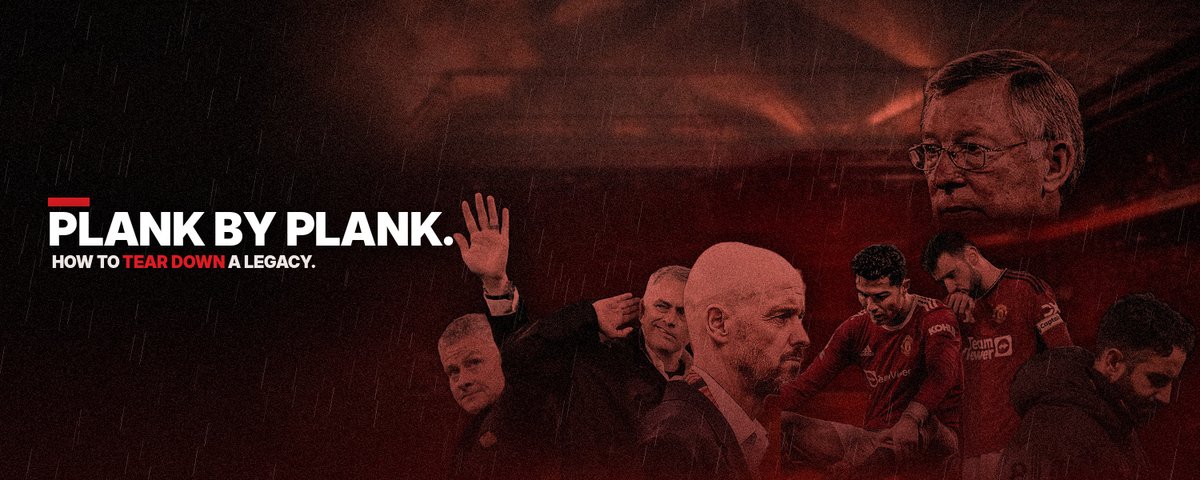
Another one. And another. And another.
Atlético Madrid 2–0 Manchester United. Then Leeds United 1–1 Manchester United. Then Como 4–1 Manchester United. Seven games without a win in all competitions and, if we are being honest with ourselves, nobody is shocked anymore. The reaction has slowly shifted from anger to a shrug. That is the part that should worry you. Not the results themselves, the fact that they feel normal.
Como?
They cut through United with ease, as if United were the Champions League debutants and Como were the club with the pedigree. An abject performance. Not an off night, not bad luck. A performance that told you exactly where this club is.
Every United fan has asked themselves the same question at some point: why? Why is it that no matter what this club does, new manager, new signings, new director, new “project”, we always end up right back here? Stuck in the same vicious cycle of mediocrity.
After the defeat in Madrid, Lisandro Martínez said the part we were all thinking out loud:
“I have to control myself a lot, but sometimes it’s a reflection of how our club is at the moment.”
He didn’t stop there.
“We had a fantastic season last season, and now we expect more from the top, from upstairs.”
Asked whether he expected more investment in the summer: “Yes, 100 per cent.” And then the line that made the headlines: “I expect more from our technical director. I have to be honest.”
Here, I could go in one of two directions. I could walk you through the tactics of these games and why United, under Carrick, look so different from last season, but I’d only be describing one symptom of the actual problem. Or I could talk about the problem itself. When a player stands up and says this is “a reflection of how our club is,” he isn’t just talking about one result, one tactical failure or one director. He is talking about something you can’t buy in a transfer window, and you can’t announce with a slick video on social media.
Culture.
The ship
There’s an old thought experiment from Plutarch. The ship of the Greek hero Theseus was kept in the harbour of Athens for generations. Every time a plank rotted, it was pulled out and replaced with a new one. Eventually, not a single original plank remained. So, the question goes: is it still the same ship?
Manchester United have been pulling planks out for twenty years.
I am not talking about the players. Players come and go, that’s football. I am talking about the planks that held the whole thing together. The standards. The trust in youth. The identity. The people who knew what the club was supposed to feel like. One by one, they were pulled out and replaced with something cheaper, something easier, something that looks good on a commercial deck.
Nobody notices a single plank. Everyone notices the ship.
And today, if you put the Manchester United of the early 2000s next to this one, you’d be forgiven for asking whether they are the same club at all.
What culture actually is
Culture is not the slogans on the wall. Culture is what people do when nobody is watching. It is the standard that gets enforced without anyone having to write it down.
And here’s the thing about culture: it’s contagious.
Breed a culture of excellence in any organization (a football club, a company, an army, a family) and it infects every corner of it. From the boardroom to the kit man to the 16-year-old in the academy. Everyone starts pulling in the same direction without being told to. Breed mediocrity and it spreads just the same. Faster, actually.
Why? Because human beings are social animals. We calibrate our behaviour by watching the people around us. Psychologists call it social proof: when we are not sure how to act, we copy what the group does. A new signing walks into the training ground. He doesn’t read the club’s mission statement. He watches. He sees how hard the senior players train, how they react to a loss, what gets tolerated and what doesn’t, whether the people upstairs actually know what they’re doing. Within weeks, he becomes the average of what he sees.
Will Durant, summarizing Aristotle, put it best:
“We are what we repeatedly do. Excellence, then, is not an act, but a habit.”
A culture of excellence is just that. A collective habit. And habits, good or bad, are learned by watching.
United once learned that lesson the hard way.
When Sir Alex Ferguson arrived in the late 80s, the club’s standards were on the floor. The youth set-up was so poor that a young United fan called Ryan was training at City’s academy. Think about that for a second.
Fergie didn’t start with tactics. He started with the culture. He wanted to go back to the Busby Way, the soul of the club. He rebuilt the academy, he hired scouts all over England, and he bet on youth because, as he said himself, the youth was the spirit of the club.
Sir Matt Busby had laid that foundation decades before:
“If they are good enough, they are old enough.”
That is not just a line about picking young players. It is a statement of courage. It tells everyone in the building that merit is all that matters, not age, not reputation, not price tag. Youth, Courage, Success. Leaders, not followers. The first English club to win the European Cup.
And Sir Alex sealed it with his own law. As José Mourinho later recalled it: “The day a player is more important than the club, goodbye.” In his book Leading, Fergie put uncompromising standards and professionalism right up there with observation, emotional intelligence and adaptability.
Notice something? None of it is a formation. None of it is a system. It’s all culture. The tactics changed many times under Sir Alex. The culture never did.
That’s social proof working in your favour. A kid coming through the academy in those years didn’t need a lecture on standards. He looked around and saw them. He copied them. And when he became the senior player, the next kid copied him. That’s why, in the early 2000s, United could lose a star player and replace him. Lose a game and win the next three. The machine was bigger than any one part, because every part had absorbed the same habits.
How the planks came out
So when did it start rotting?
The takeover in 2005 is the obvious starting point. From that moment, as I’ve argued before, the mission at the top was never “be the best football club in the world.” It was “make as much money as possible.” Slowly but surely, the club’s priorities shifted around Sir Alex. The money that once went into the squad went elsewhere, and “there is no value in the market” became a phrase for a reason. What kept United on top for a few more years wasn’t a transfer strategy. It was the habits already in the dressing room, built over two decades. Then Sir Alex left on a high.
And when he left, the last plank holding the culture together went with him. Not because Fergie was the culture, but because he had become its last guardian. With the people upstairs chasing revenue, he was the one still enforcing the standards. The club never built a structure to carry them after him.
What followed is a pattern you all know by heart. Hire a manager. Fire a manager. Overcompensate by hiring the polar opposite. Repeat. Each new man was sold as the hero who would fix everything. Each one was given a squad assembled for someone else’s ideas. Even Ralf Rangnick, during his short spell, said the club needed open-heart surgery. He fired that criticism at the club’s structure and the way it was run from the top down, not at the squad. On that, he was right, even if his own tactics did that squad no favors.
Then came the man who was supposed to change all that. Dan Ashworth, the man United ran after to build the very structure everyone, and Rangnick, had been crying out for. And He was dismissed a few months later.
What does that tell a player? What does it tell a young academy kid, a staff member, a new signing? That the people in charge don’t know what they want. And if the top doesn’t know, nobody below does either.
The fish rots from the head. It’s an old proverb for a reason.
Normalization
The sociologist Diane Vaughan coined a term while studying the Challenger space shuttle disaster: the normalization of deviance. Small deviations from the standard get accepted because, well, nothing blew up last time. Each deviation becomes the new normal. Then the next one. Then the next. Until one day, the whole thing explodes and everyone asks how it got this bad.
That is Manchester United.
A bad signing that nobody is held accountable for. A sacking where the manager goes but the decision-makers stay. A mediocre performance celebrated because “at least we had 60% possession.” A defeat that gets a shrug. Each one on its own seems small. Together, they become the culture.
And here’s where it ties back to social proof. Normalization doesn’t just happen in the boardroom. It travels down. Every new arrival walks into a building where the bar has already been lowered, plank by plank. He doesn’t know what the standard used to be. He only knows what he sees. So he adopts the new normal, just like the 16-year-old in the academy once adopted excellence.
This is the answer to the question we started with.
United buy a good player. He arrives with a reputation, a highlight reel, a fee that matches. Two seasons later, he looks like half the player. The fans turn on him: “He was never that good.” “Flop.” “Fraud.” Same with managers: a proven coach walks in, and within a couple of years he looks lost.
But were they really bad? Or did they simply become the average of what they saw?
I’ve said it before: any player who walks into United in its current state will have his weaknesses exposed and amplified. He will look ten times less of the player he is. Not because he forgot how to play football overnight, but because the culture got to him. He got intoxicated by it, just like everyone before him.
This is why I’ve always said that signing better players alone won’t fix United. You can put the best planks in the world on a ship, but if the water is already inside, they’ll rot too.
The one who almost got out
And yet, there was a moment when it looked like someone had found a way out.
When Ole Gunnar Solskjær was appointed permanently in March 2019, United were almost unrecognizable. At the end of that season, he said the club needed a complete rebuild. The environment needed changing. He was stunned by the fitness levels; opponents were outrunning United regularly. The commitment and desire of certain players were questioned.
Notice what he was talking about. Not formations. Culture.
And he acted on it. United sold eight first-team players, bought four, and promoted the rest from the academy. Youngsters were thrown in at the deep end. The Busby Way, back again. As Ashley Young famously said when Solskjær walked out of the dressing room:
“Thank f**k we’re talking about being Man United again!”
It worked. From a 33-point gap to Liverpool in 19/20, United finished above them and second in the league in 20/21. The most comebacks by a team in Premier League history, a team that refused to accept defeat. A Europa League final. After losing that final, Marcus Rashford said: “There’s no chance the team gives up. The manager will not give up. He won’t allow us to give up.”
That is what a culture of excellence starting to grow back looks like.
Then the planks started coming out again.
The holes in the team were never filled. The club didn’t invest in the midfield. Instead, it offered Solskjær Cristiano Ronaldo. “I was excited so I said ‘yes’,” he later told Gary Neville on The Overlap, admitting it was a selfish and emotional decision.
He should have known better. Ronaldo didn’t fit the team he was building: quick, direct, pressing from the front, with a forward who linked the play. But ask yourself this. If the right structure and culture had been above him, would Ronaldo ever have been presented to him as an option? A club that knows what it wants doesn’t offer its manager a player who doesn’t fit his team. It fills the midfield.
You can’t expect one man to run everything and be flawless. Solskjær made his share of tactical mistakes, as every manager does. But the one that cost him his job was the emotional one. It changed his team’s direction and ripped up the foundations he had spent two years laying. The club made it possible. The expectation changed overnight from “we can go again” to “we must win now.” The team crumbled, confidence shattered, and he was sacked. The culture he had started to grow back never got the chance to take root. And the one that shrugs at failure came right back.
The immune system
Which brings us back to Martínez.
I’ve used this analogy before: a club rejects what goes against its nature, the way an immune system fights off an infection. Not maliciously. Instinctively.
Martínez speaking out was the immune system reacting. A healthy cell inside a sick body, refusing to accept that this is normal. Look at what he warned:
“If you don’t change, next season is a big problem.”
That’s not a tantrum. That’s a man who can see the deviance being normalized in real time and is refusing to shrug.
And what happened next tells you everything.
Timing matters, and Martínez himself admitted it, speaking afterwards of “a time and place that perhaps were not the right ones.” Fair enough. But look at where the outrage landed. Not on the winless run. Not on the decisions upstairs. On the one person who said out loud that it isn’t good enough.
Two days later, Martínez met Michael Carrick, Jason Wilcox and CEO Omar Berrada, and released an apology:
“Our club is at its best when we are all united, and I recognize that my words in that moment did not help with that.”
According to reports, he was also fined, something the club hasn’t confirmed. Either way, the matter is now considered closed.
This is normalization of deviance in its purest form. When the deviation becomes the norm, the person pointing at it becomes the deviant. The immune response gets treated as the disease.
And when he was asked about Carrick’s future, Martínez offered only this: “I can’t say more.”
Sometimes what isn’t said tells you more than what is.
The real worry isn’t that Martínez said it. The real worry is how quickly he was brought back in line.
Two fingers, two directions
Then came Como, and this time it was the captain’s turn.
Bruno Fernandes didn’t point upstairs. He pointed at the bench. Fernandes said:
“It’s a decision from the staff to not press man-to-man and sometimes leave a little space in behind.”
And then: “That’s on the manager and on the staff to see it, it’s not on me.”
“I think sometimes we have to be more brave on the pressure.”
So now you have two senior players, two public statements and two different targets. Martínez points at the boardroom. Fernandes points at the dugout. And United fans? They’re not choosing. They’ve recognized the pattern, and they’re angry at all of it: the owners, the structure, the manager and the players, who have been given the stick hard. Top to bottom.
And they’re right to be. All of it can be true at once.
The club is rotten culturally. And the managers and players are not helping, with bad tactics and bad attitudes. One doesn’t cancel out the other. One feeds the other.
That is the vicious cycle, and it works like a loop. A top that doesn’t know what it wants hires managers who don’t fit. Those managers inherit squads built for someone else’s ideas and pick tactics to survive the next result rather than build the next team. The players see the uncertainty, and their standards drop to match it. Performances get worse. Results get worse. The top panics and makes the next decision on reaction instead of process. And the loop starts again, one plank lower.
Every link in that chain is guilty. That’s why every finger pointed at United is right, and why none of them, on its own, explains it.
Fernandes said something else after the game, this time to Sky in Italy: “We focus too much at looking at what the club did in the past.” And: “We’re not in the past, we need to look in the future.”
He’s right. And it’s worth being clear about what this piece is and isn’t. This isn’t nostalgia. Nobody is asking United to bring back the early 2000s. The past matters only for what it proves: that this club once had habits that made it excellent, and that those habits were built, not inherited. If they were built once, they can be built again. That is the future.
No excuses
Yes, there are mitigating factors. There’s been a lack of investment. Injuries have hurt. Nobody is pretending otherwise.
But here’s the thing about excuses. Good managers get respectable performances regardless. Good professionals give them regardless. Managers don’t always win, but their look like teams. They compete. They look like they know what they’re doing and why. The same goes for the players. Uncertainty is part of the job in professional football. The best players keep their standards anyway, because their work ethic doesn’t depend on the circumstances.
United did exactly that in 20/21. Same owners, holes in the squad that were never filled. And yet that team finished second and refused to accept defeat. That didn’t come from the budget. It came from the culture inside the dressing room.
Losing 4–1 to Como isn’t a lack of investment. It isn’t the injury list. An abject performance is a habit, and habits are formed long before kick-off.
So, what now?
Not another hero. United fans and the club itself need to stop waiting for the Messiah in the dugout. Sir Alex didn’t succeed because he was a hero. He succeeded because he rebuilt the culture from the roots up, and then everyone (the youth, the scouts, the dressing room)pulled in the same direction. Solskjær got close because he tried to do the same. He failed because the rest of the club didn’t follow.
That’s the job. Decide what Manchester United is. Write it down. Hire people at every level who already live it. Hold every one of them to it, from the owners to the technical director to the last name on the team sheet. Then protect it, even when the results don’t come immediately.
Because if we are what we repeatedly do, then United have spent twenty years repeatedly lowering the bar. Excellence won’t return as one act, one signing or one manager. It has to become a habit again. And culture isn’t rebuilt in a window. It’s rebuilt one plank at a time, the same way it was torn down.
The most dangerous thing about Como isn’t the scoreline. It’s that it barely felt like news but more like “Ah United lost again today, oh well”. Another one. And another. And the shrug gets a little easier every time.
So, is this still the same ship?
The name on the side is the same. The badge is the same. The stadium is the same. But a ship isn’t just its planks. It’s where it’s sailing and the crew that knows why.
Right now, the crew are arguing about who’s steering. And the one who asked out loud where we’re going is the one who had to apologize.
Abdel Rahman