How to Win $2M to $20M Local Businesses as Clients with AI Agents

文章目录
I typed one sentence into my coding agent: find me plumbers in Dallas worth pitching.
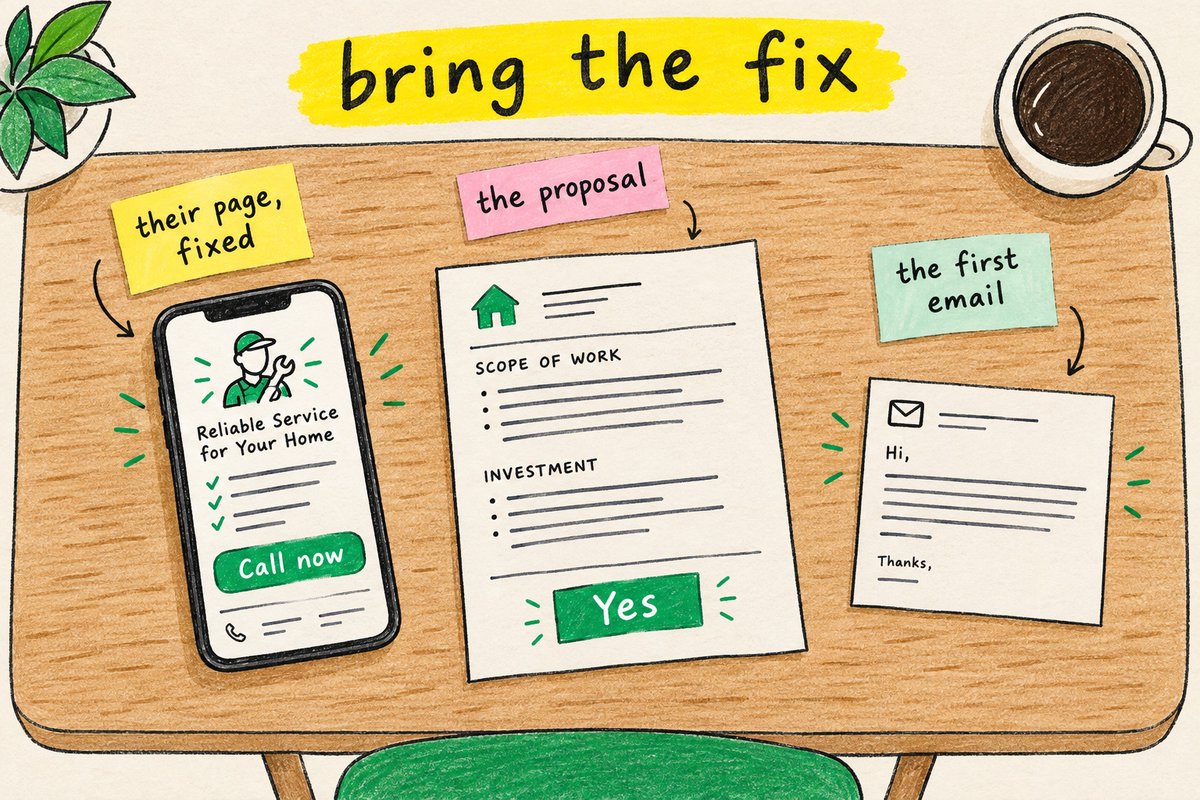
About a minute later it had looked at 100 Dallas plumbers and put a shortlist on a board, best first. A couple of minutes after that, it had opened the top five on a phone, the way their customers see them, and written down what each page was losing. Fifteen minutes after that, it had built a pitch for one of them: a page in their brand that fixed the leaks, a one-page proposal with an offer, and a first email for me to send. About 18 minutes, start to finish.
That part is getting easy. Here's what isn't: getting the owner of a 40-truck plumbing company to open your email, take your call and sign. A fix for their page gets you noticed. It doesn't get you hired.
So I'll keep those Dallas plumbers as the example all the way through. Which of them are big enough to pay you well. How to stay in front of the best 100 plumbing companies in Dallas until they're ready. How to fill a room with their owners, which partners already have their trust, and where agents turn each step from a week of work into a morning. It's long (about a 20 minute read), but it's the whole playbook, from picking the niche to the first signed client.
The gap
The businesses worth your time are hiding in plain sight. Plumbing and HVAC alone is 112,088 companies doing $297.6 billion a year, an average of $2.66 million each (Census, 2022 Economic Census). In HVAC, about 90% of the 167,717 locations are still independent, and the ten biggest private equity platforms own under 8% of the market (Orbital, 2026, vendor data).
They know AI matters, and they don't know what to do with it. In a survey of 1,256 owners in Goldman Sachs' 10,000 Small Businesses program, 76% said they use AI, but only 14% said it's fully embedded in how the business runs, and 73% said more training would help (Goldman Sachs, Babson College and David Binder Research, Mar 2026). Across all US businesses, only about 1 in 5 used AI in any business function (Census, Business Trends and Outlook Survey, May 2026).
And their marketing leaks money they already spend. A click on a plumbing ad averages $10.49, and a lead from those ads $129.02 (LocaliQ, 2025, vendor data). Only 52% of all inbound calls to home services companies reached a person, and 73% of calls longer than 30 seconds did (Invoca, 2026, vendor data). When my agent opened the five best-fit Dallas plumbers on a phone:
-
Four of the five didn't repeat their own Google ad's promise on the first screen.
-
Three didn't show their Google rating anywhere on the page. A fourth showed it far down, with the wrong number.
-
Four made you scroll past the third screen before you could book.
-
Two had no real call button on the first screen (one had a tiny phone icon).
These are good businesses, rated 4.8 or 4.9 on Google with 238 to 1,980 reviews each, and all five were paying for Google ads that week.
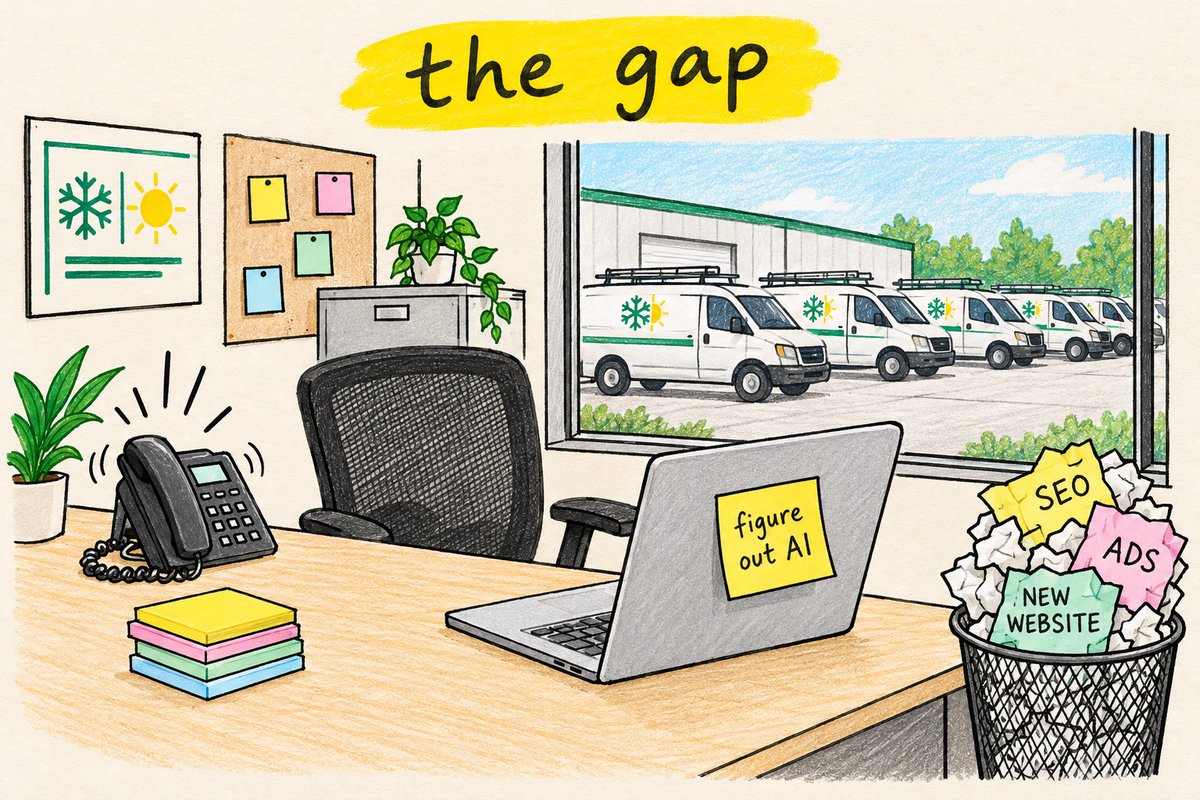
That's the gap: owners who can pay, who know they're behind on AI, with leaks you can see from your couch. In my experience the pitches they get all sound the same: SEO, ads, a new website, "AI automation." Almost nobody shows up with something useful first.
Here's the whole idea
-
Pick one niche in one city, and go after the $2 million to $20 million businesses in it.
-
Write down your Dream 100: the best 100 businesses you could ever work with.
-
Show up useful before you ask: a fix already built, a workshop worth their morning, an introduction.
-
Let agents do the legwork, so you can stay in front of 100 owners instead of 10.
Part 1 is who to go after. Parts 2 to 5 are how to get in front of them and stay there: the Dream 100, teaching first, workshops and partners. Part 6 is how agents do most of the work.
Let's get into it.
Part 1: Who to go after
The smallest shops say yes fastest. One person decides, often on the first call. I've sold millions of dollars of marketing services to local businesses since I started consulting in 2013, and the fast yeses were rarely my best clients. Start your list at $2 million a year in revenue. Here's why that's the floor.
-
They have a budget, not a wish. If a $5 million company spends even 3% of revenue on marketing, that's $150,000 a year (arithmetic, not a survey). A two-person shop doing $400,000 feels every dollar it pays you.
-
Their leaks cost real money. A company buying 100 leads a month at $129 each spends $12,900 a month on leads, about $155,000 a year (arithmetic, using LocaliQ's plumbing average). If its page loses a fifth of those people, that's about $2,580 a month of leads going nowhere (illustrative). The owner can see what you're worth on one sheet of paper.
-
Someone can do the work. A company this size has an office manager, a GM or a marketing coordinator. The owner still decides, but someone else answers the phone, sends the review requests and keeps what you built running. That's the difference between a project that works and one that dies in a drawer.
-
They've outgrown the owner doing it all, and the owner knows it. Peer groups sort owners this way on purpose. Vistage runs separate groups for $1 million to $4 million companies and for $5 million and up, and EO asks for $1 million in revenue to join (Vistage; Entrepreneurs' Organization). These owners already pay to learn from people who've done it. Remember that for Part 5.
-
They're about to compete with private equity. Investors have been buying HVAC companies one by one, and the ten biggest platforms already own under 8% of the market (Orbital, 2026, vendor data). The independent down the street now competes with a rollup that has a marketing team. That's urgency you don't have to invent.
How to size a business from the outside
You can't see their revenue. You can see almost everything that comes with it.
-
Count the people. An HVAC trainer's rule of thumb is $130,000 to $170,000 in revenue per employee (Contracting Business, 2016). So $2 million is roughly 13 to 15 people, and $20 million about 150 (arithmetic). Look at the team page, the trucks in their photos, and how many people list the company on LinkedIn.
-
Look for hiring. Open tech roles mean more work than people. That's a growing company.
-
Count the locations and the service area. Two or three shops, or a service area that spans a metro, usually means a real operation.
-
Read the reviews, newest first. A company adding several reviews a week is doing a lot of jobs every week.
-
See what they spend. Google's Ads Transparency Center and the Meta Ad Library show who's advertising right now.
-
Skip the franchise location. The local manager can't say yes, and headquarters already has an agency.
Start the list from Google Maps, your state's contractor license lookup and the trade association's member directory. Six checks on 100 businesses is then an afternoon of an agent's time, not yours:
I'm building a list of [niche] companies in [city] doing roughly $2M or more a year.
For each business in [list.csv]:
1. Estimate team size from their site, photos and job posts. Say where you saw it.
2. Note open job posts, number of locations and service area.
3. Count their Google reviews from the last 30 days.
4. Check the Google Ads Transparency Center and the Meta Ad Library for ads running now.
Put it in one table with the evidence for each line.
Never state revenue as a fact. Mark anything you couldn't find as unknown.
(Or start from a shortlist. In boringfunnels Pro, tell your agent "find me [niche] in [city] worth pitching" and Client Finder brings back local businesses doing $2 million or more a year by our estimate, best first, with what each one is losing.)
In Dallas: I ran the checks on the five plumbers from the opening. Two show 19 or more people on their team page, three are hiring techs, and four add 15 or more Google reviews a month. Two look like $2 million-plus companies, one looks smaller, and two I couldn't tell from public pages alone. So two make the list, two need a phone call to find out, and one comes off.
Pick the niche
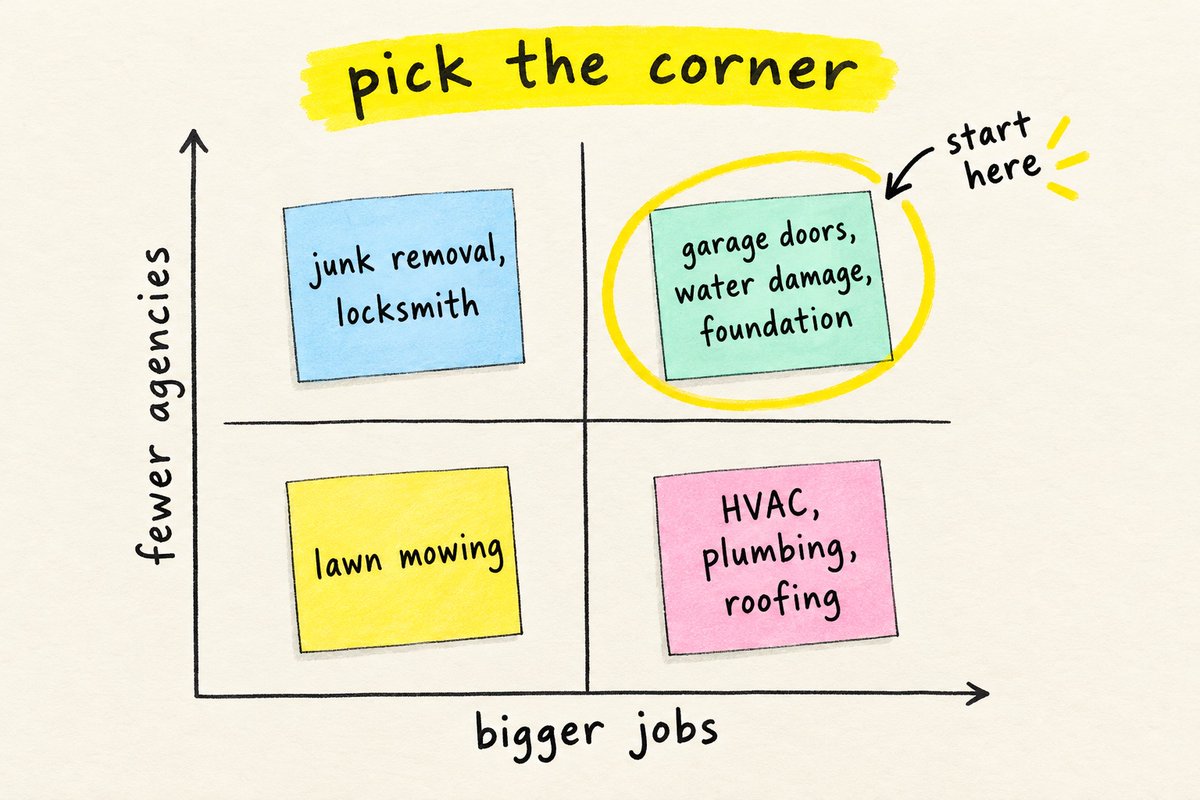
Pick one trade in one city. Everything you build compounds inside it: the proof, the words customers use, the funnels, the partners.
-
Start from the math. Divide what one job is worth by what one lead costs. A plumbing lead from search runs about $129 (LocaliQ, 2025, vendor data) and a plumbing job booked through Google's Local Services Ads averages $1,714 (SearchLight Digital, Feb 2026, vendor data), so one job pays for about 13 leads (arithmetic, from two vendors' numbers). The bigger that number, the easier your pitch.
-
Know if it's an emergency or a decision. Emergency niches (drains, garage doors, water damage) are won on the first screen and the phone. Decision niches (roofs, remodels, implants, pools) are won on trust: proof, a price range, a free inspection. It changes what you bring them.
-
Crowded in a big city? Go one door down, the rule from my AI services masterplan: garage doors instead of HVAC, septic instead of plumbing, gutter guards instead of roofing.
-
Check the density. Most businesses in any niche are too small for you. 58% of plumbing and HVAC locations have fewer than 5 employees, and so do 65% of roofers (Census, County Business Patterns 2023). You need enough $2 million-plus companies in your metro to fill a Dream 100. Not enough? Take the niche across the next city.
-
Mind the season. HVAC peaks in summer and winter, pools in spring, roofing after storms. Show up a month before their busy season, while they're planning.
-
Pick one you can talk. If you've worked in a trade, or a friend owns one, start there. Knowing that "slab leak" and "main line" mean money is worth more than any list.
Where I'd start. Big and proven: HVAC, plumbing, roofing, electrical and dental implants, best in a mid-size city. Big and quieter: water damage, garage doors and foundation repair. A corner of your own: commercial cleaning if you like business buyers, pest control and lawn care if you like plans that renew. Skip to start: personal injury law, where the ad auction is brutal, and solar, where the federal tax credit for homeowners who buy a system ended with 2025 installs (IRS).
In Dallas: plumbing is crowded in a metro this size. I'd keep it, but take the list across Dallas and Fort Worth so there are enough companies this size for a Dream 100, and lead with drain and sewer, the emergency end of the trade.
Part 2: Your Dream 100
The Dream 100 comes from Chet Holmes and his book The Ultimate Sales Machine. His best-known case is a magazine that mailed promotions to 2,200 advertisers every month. When it looked closely, 167 of them bought 95% of the ads in its competitor's magazine (Chet Holmes, Best Buyer). So it stopped chasing all 2,200. The 167 got a letter every two weeks and four calls a month.
For four months, nothing. In month five, one of them bought an ad. In month six, 28 of the 167 came in at once, with full pages and color spreads, not fractional ads. Those 28 alone doubled the year's sales, and the magazine went from 15th in its industry to 1st in just over a year (Chet Holmes, Best Buyer).
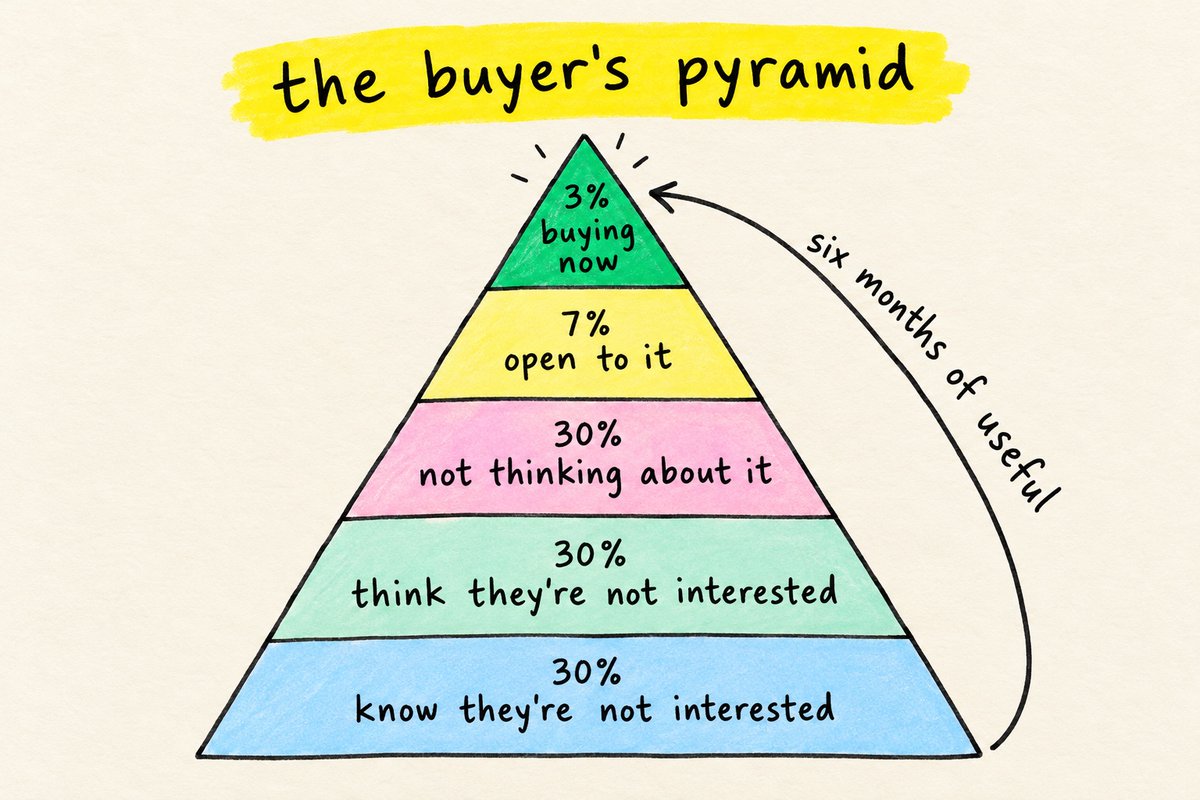
It works because of what Holmes called the buyer's pyramid. At any moment about 3% of your market is buying now and another 7% is open to it. The rest splits into thirds: not thinking about it, think they're not interested, and know they're not interested (Chet Holmes, The Ultimate Sales Machine, ch. 4). Pitch only the ones ready now and you're fighting every agency in town for 3%. Stay useful to the best 100 for six months, and you're the one they call when they move up.
Build the list
Take your trade and your city and list every company that clears Part 1's floor. Rank them by fit: size, how much they already spend on ads, signs they're growing, and whether you can reach the owner. Keep the top 100. If your metro only has 60, take in the next city.
Then find the person. At this size the owner usually still decides, sometimes with a GM or an operations lead beside them. Write down both names. A work email at the company's own domain, the main line, and the owner's LinkedIn are all you need. Never a personal cell, and never a home address.
In Dallas: I'd build the list across Dallas and Fort Worth. The two plumbers from the opening that cleared the floor go near the top, and so do the two I couldn't size, until a phone call says otherwise.
The six-month rhythm
Holmes's rule was a touch every two weeks, with calls in between. Here's a version for a local business owner, where every touch is useful even if they never hire you:
-
Week 1: something about their business. For your top 10, the email in Part 3 that offers the page you already built. For the other 90, a one-page look at their own site on a phone, with the one fix that would pay off fastest.
-
Week 3: something about their market. How their Google rating and review count stack up against the five biggest companies in their trade nearby, and what a lead in their trade costs (LocaliQ's benchmarks are a fine start).
-
Week 5: an invitation. A seat at your next workshop (Part 4).
-
Week 7: a story. What a company in the same trade, in another city, changed and what happened.
-
Week 9: something in the mail. Their page on a phone today, beside the fixed version, printed on one sheet, in a hand-addressed envelope.
-
Week 11 and on: repeat. From week 1, call two or three days after every touch.
By month six you've shown up a dozen times with something useful, and asked for nothing. Most people stop long before month five, which is right where the magazine's campaign started to pay.
This is where agents change the math. Twelve useful touches for 100 businesses is 1,200 pieces of work. By hand, you'd cut the list to 10. With an agent, each round is a prompt:
For each business on my Dream 100 in [dream-100.md]:
Write touch #[n]: [what it is, e.g. a one-page look at their site on a phone with the one fix that pays off fastest].
Use only what's true about that business, and say where you saw each fact.
Under 120 words, from me, in my voice from [voice.md]. No pitch, no link to book a call.
Save each one to touches/[business]/[n].md and log it in touches.md.
Don't send anything. I'll read and send every one.
The Client Finder board keeps every business you find in order: found, leaks found, pitched, sent, replied, won, with what's next for you and for your agent on each card. You mark who replied and who you won.
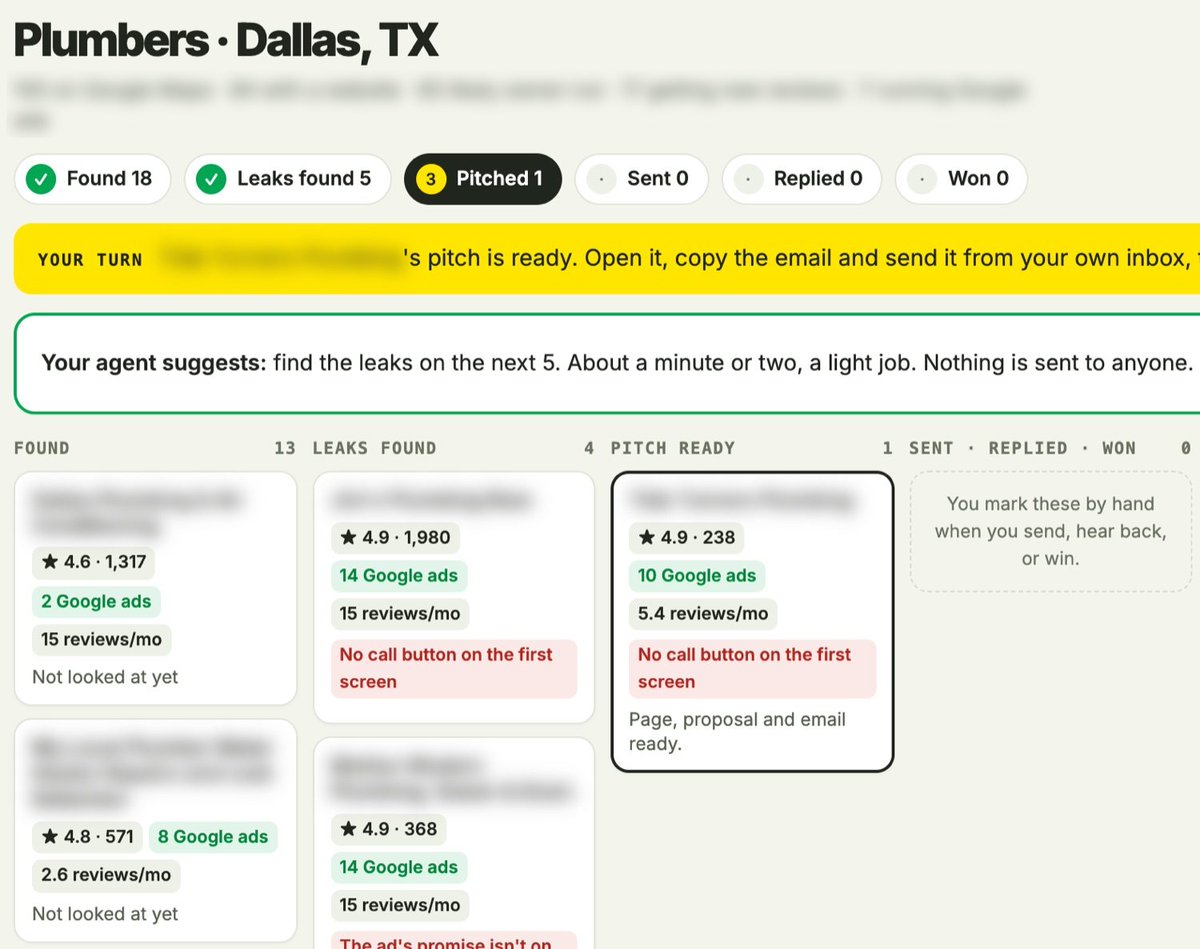
The board, from one sentence. Real run, names blurred.
Part 3: Teach first
Holmes called it the stadium pitch: the talk you'd give if every ideal buyer sat in one stadium. It teaches market data, things about their own world they didn't know, and your product shows up at the end as the obvious next step (Chet Holmes, The Ultimate Sales Machine, ch. 4). Every touch in Part 2 should feel like a small piece of that talk.
The easiest way to teach is to start where it already hurts. Owners of $2 million-plus companies feel two problems right now.
Bookings leak. Calls go unanswered, quotes go out slow, and ads send people to pages that make them work to call. You don't need a tool to see it. Pull up the page their ad points to (Google's Ads Transparency Center shows it, so you don't click their ad and cost them money) and, on a phone, before you scroll:
-
Can you call in one tap? A real button, big enough for a thumb.
-
Does it say what the ad said? If the ad promised "same-day drain cleaning", the page should say it too.
-
Is their proof there? A 4.9 on Google with 800 reviews is the best thing they own. It's usually missing.
-
How far is booking? If you're past the third screen before you can book, so is every customer who gave up.
Four questions, about 30 seconds a site. Four of the five Dallas plumbers missed at least two.
In Dallas: one of the five, a 4.9-star plumber, writes its phone number out for the first time on screen 24 of a 45-screen page. Its Google rating first shows up on screen 22, as "5.0 from 1 review". That's a company paying for every click that lands there.
AI feels like homework. They know they should be using it. 73% of the owners in Goldman Sachs' survey said training would help, and only 14% said it's fully embedded in how they run (Goldman Sachs, Mar 2026). So teach them three things they could set up this quarter, in plain words, with what each one would mean for their week. You become the person who made AI make sense, which is a much better place to start than "we do AI automation."
Bring the fix, already built
I covered the pitch itself in the AI services masterplan: walk in with a page in their brand that fixes what you found, a one-page proposal with one offer, and a short email that leaves the link out. At this size the pitch is the same. What changes is that you've been useful for weeks before you send it, and there's someone on their staff who can keep what you build running.
The offer I like: you build it for free, they point their ads at it, and they pay only if it books more jobs. Agree how you'll count before you build.
One caution. Local businesses run two kinds of Google ads. Search ads send people to a page. Local Services Ads and Maps listings often go straight to a call button. For the first, the page is the leak. For the second, the leak is usually whoever answers the phone. Know which one they run before you pitch the page.
Here's a first email you can copy:
Subject: [their ad's promise], on your page

Hi [first name],

I looked at the page your Google ad sends people to, on a phone.
The ad says "[their ad's promise]". The page says "[what the first screen says]",
and the call button is [where it is].

I built a version of that page in your brand that fixes it. Want me to send it over?

[Your name]
[Your business and address, and a line to opt out]
(This is what one click on a card does in boringfunnels Pro. About 15 minutes later you have the page in their brand, the proposal with the offer, and the first email, ready for you to read and send.)
Part 4: Workshops, the lead magnet that fills a room
One of Holmes's scripts doesn't ask for a meeting at all. It offers a "lunch-and-learn": a meal in a restaurant's private room and a 38-minute talk about the buyer's market, run three times a week (Chet Holmes, The Ultimate Sales Machine, ch. 4). Twenty owners in a room for an hour beats twenty first calls, and they leave thinking of you as the person who taught them something.
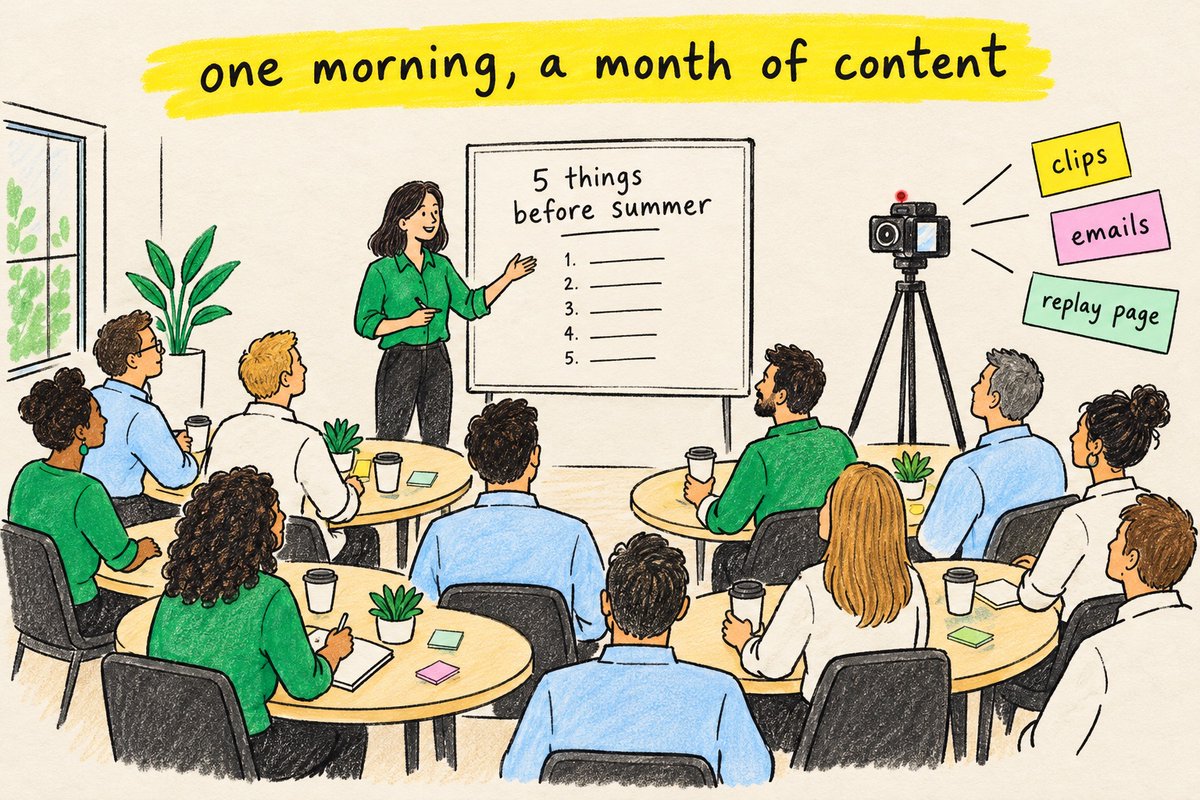
The local version for right now writes itself, because owners already told you what they want: help with AI. In Dallas, I'd call it "Five things Dallas plumbing owners should set up before summer", at a supply house counter, 7am on a Tuesday, for 15 to 30 owners. Teach things they can use the next day:
-
Answering every call, including the ones after 5pm.
-
Getting a review after every job, without asking by hand.
-
Making the page match the ad.
-
Using AI for the office work nobody likes: quotes, follow-ups, job notes.
-
The five numbers to look at every Monday.
Who comes matters more than how many. Put the size in the invitation and the ad ("for owners of plumbing companies with 10 or more trucks"), and ask two things on the registration form: the company's name and how many trucks they run. You'll know who fits before they sit down. 75 minutes is plenty: 10 of coffee, 45 on the five things, 15 of questions, then one offer and a sign-up sheet on every table.
The offer: "If you want, I'll look at your page and build you a better one, free. You only pay if it books more jobs." The ones who raise a hand are your warmest leads of the year.
Fill the room
-
Invite your Dream 100. It's week 5 of your rhythm anyway. Mail, email, then a call.
-
Run Meta ads in a 25-mile radius. A lead on Meta averaged $27.39 across industries and $42.95 for home improvement (WordStream, 2026, vendor data). Expect to pay more: those are consumer leads, and you're asking a few hundred owners in one metro. At $40 to $60 a registration, 30 seats is $1,200 to $1,800 (illustrative).
-
Ask your partners to invite their clients. That's Part 5.
Plan for empty seats. 28% of people who register for a free event don't show, against 17% for paid ones, and small events of 10 to 49 people run 32% (PheedLoop, vendor data). So register 40 to seat 25, charge a small fee, say $20, that you refund at the door (my rule of thumb), and call everyone the day before.
Run the ads from your agent
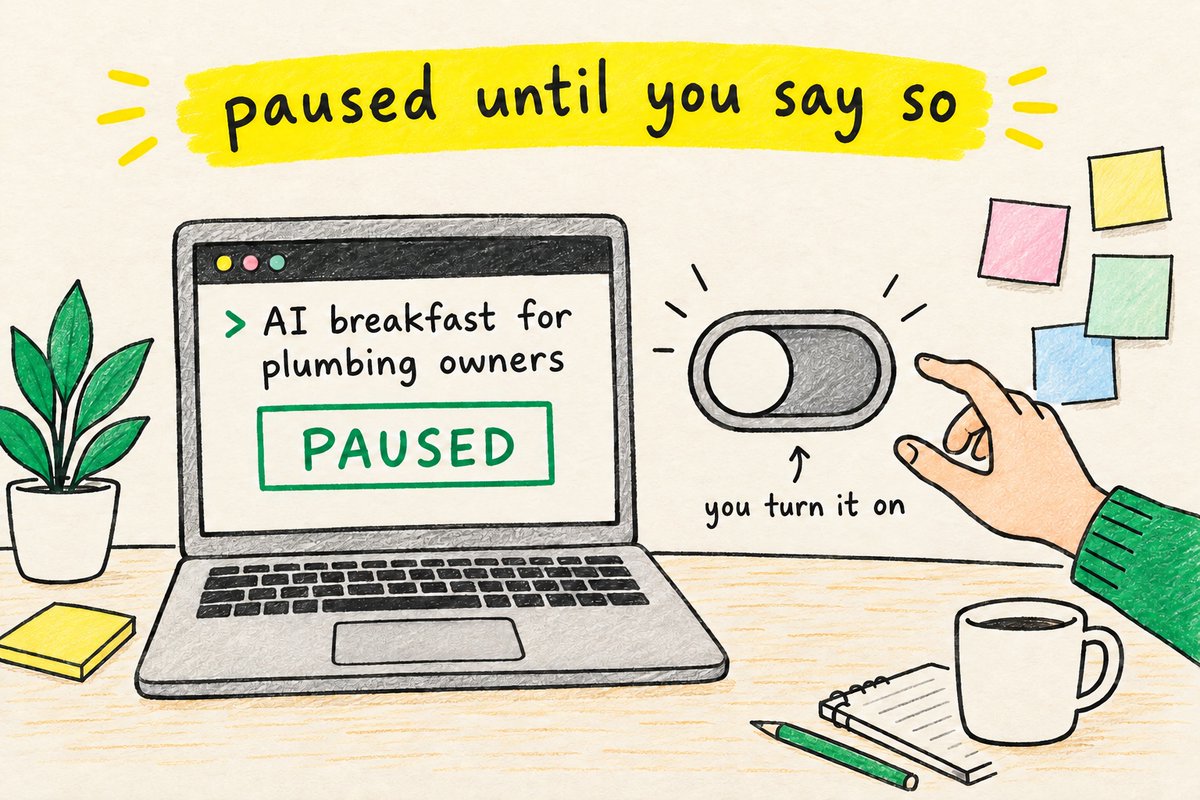
Meta's AI connectors went into open beta on April 29, 2026. They let an agent like Claude Code read and build campaigns in your ad account after you sign in with Facebook, with no developer setup, and everything an agent creates through them starts paused (Meta). Since July 16, anyone with full control of the business can set rules for what an agent may change, like budgets (Meta). Meta is still rolling it out, so if you don't see it in your account yet, you don't have it yet.
Connect it once in Claude Code:
claude mcp add --transport http meta-ads https://mcp.facebook.com/ads
Then run /mcp, sign in with Facebook, and pick your ad account. The workshop campaign is a prompt:
Use the Meta ads connector on ad account [account name].
Create a campaign for my workshop "[title]" on [date] at [venue], [city].
Goal: registrations on [registration page URL].
Audience: 25 miles around [venue address], ages 30 to 65.
Say in every ad who it's for: owners of [niche] companies with [10]+ trucks.
Budget: $40 a day, from [start date] until two days before the event.
Three ads: a photo of the room, me talking to camera ([video file]), and the five things as a list.
Write the words from [workshop.md]. Keep every claim true to what I'll teach.
Leave everything paused and show me a summary before anything goes live.
And a check every morning:
Pull yesterday's spend, registrations and cost per registration for the workshop campaign.
If one ad costs more than twice the others per registration two days running,
tell me and suggest pausing it. Don't change anything yourself.
The connector gives your agent the controls. It doesn't give it the judgment. I put what I've learned running Meta ads with agents (the setup traps, the tracking checks, how Meta crops your video) into a free skill: github.com/boringmarketer/meta-ads-skill.
Three rules before you spend a dollar:
-
One person turns ads on. You. Use Meta's rules so the agent can't raise a budget on its own.
-
Check the tracking first. A test registration should show up in Ads Manager before the campaign starts.
-
Start small. $40 a day for ten days tells you more than $400 for one.
Your agent builds it. You turn it on.
Film it
Point the camera at you, not the room, and say at the start that you're recording. Owners talk about their own numbers at these things, and a clip of someone's revenue is the fastest way to lose a room. A phone on a tripod and a clip-on mic are enough. That hour becomes about 25 short clips, which is two months of posts at three a week (arithmetic), plus a replay page, a five-day email course and next quarter's lead magnet. Most of the work is cutting it up, and that's agent work:
Here's the transcript of my workshop: [transcript.txt]
1. List the 25 best moments, each 30 to 90 seconds, with start and end times and a one-line hook.
2. For the top 10, write a post for LinkedIn and one for Facebook, in my voice from [voice.md].
3. Turn the five main lessons into a 5-day email course, one lesson per email, under 200 words each.
4. Write the replay page: who it's for, what they'll learn, and one button to book a look at their page.
Save everything to workshop/[date]/. Don't post anything.
Build the funnel for it
A workshop needs its own small funnel: a registration page, a confirmation page that gets it on their calendar, reminder emails, and the replay page. Don't invent it. Model it on the free workshop and live training funnels that big advertisers keep running, like Jay Shetty's free coaching workshop and Amy Porterfield's live training. In boringfunnels Pro, tell your agent "build the funnel for my workshop [title]" and it builds the pages and the emails in your brand from funnels like those.
Notice what you just built. Once you can fill a room for yourself, you can do it for a client. That's the service.
Part 5: Partners, and the channels between
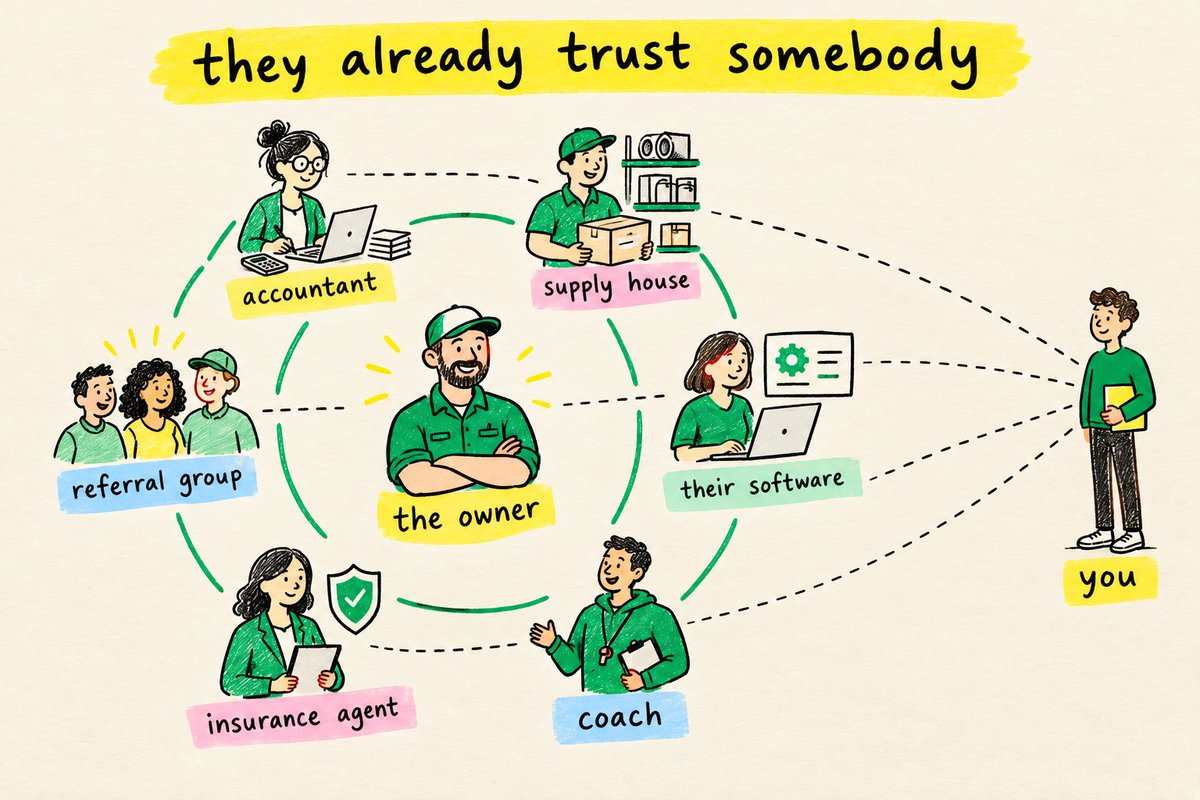
Every business on your Dream 100 already trusts somebody. Find out who, and become useful to them too. Look for the people who already serve your trade and don't compete with you:
-
Their accountant or bookkeeper. 86% of small business owners agreed their accountant is a trusted advisor (OnPay, 2019 survey, vendor data). A bookkeeper who specializes in one trade sees the numbers of dozens of your Dream 100.
-
The supply house and the equipment distributor. Every plumbing company buys from a few of them, and they want their contractors to grow. Many already host training mornings. Offer to teach one.
-
Their software's partner program. The field-service platforms these companies run on, like ServiceTitan and Housecall Pro, run partner programs for consultants and agencies (ServiceTitan; Housecall Pro).
-
Coaches and peer groups. Trade business coaches, and the people who run Vistage and EO groups, know which members are stuck on marketing.
-
Anyone who sees the owner a few times a year: the web designer who doesn't run ads, the insurance agent, the business broker.
-
Referral groups. BNI says its members passed 17.4 million referrals worth $26.4 billion in the year to July 2025 (BNI, self-reported). It's one seat per profession per chapter, so get there first.
Then give before you ask:
-
A workshop for their clients. Co-branded, at their place. They look good, and you meet 20 owners in a morning.
-
A fix for one of their clients, free, so they've seen the work before they put their name behind it.
-
A referral fee, where their profession allows it. 10% to 20% of the first year is common (my rule of thumb, not a survey).
-
A one-page "who's a good fit". The size, the problem, and the words the owner uses ("the phone rings but we don't book"), so they know when to say your name.
In Dallas: I'd start with the plumbing supply houses and the bookkeepers who work with trades. They already sit across the counter from the companies on my list every week.
Finding partners is research, which makes it agent work:
List every [bookkeeper who serves contractors / plumbing supply house / field-service software partner / business coach] in [city].
For each: who they serve, roughly how big, how to reach them, any events they host,
and one thing I could offer that would help their clients.
Rank the top 15 by how many of my Dream 100 in [dream-100.md] they likely work with.
Say where each fact came from. Then draft a short note to the top 5 offering a free workshop for their clients.
Don't send anything.
The channels between
The Dream 100, the workshops and the partners do the heavy lifting. These keep the rhythm going between them:
-
Mail. A printed, one-page look at their own page, in a hand-addressed envelope, is hard to ignore. Save it for the Dream 100, where one reply is worth the stamp.
-
LinkedIn. Connect with the owner and the GM, and comment on what they post. It's a quieter inbox than email.
-
The workshop clips, posted where owners already are: LinkedIn and the Facebook groups for their trade. Every clip is a small stadium pitch.
-
Cold email, small and honest. Business addresses only, your real name, your address and an easy way out. Google requires authenticated domains, one-click unsubscribe and a low spam rate from anyone sending in bulk (Google). And never text a prospect's cell.
Part 6: The agent stack
None of this is new. Holmes wrote it down almost twenty years ago. What's new is that one person can now run all of it for 100 businesses, because agents do the research, the drafts and the building, and you do the parts that need a person: deciding, showing up, and hitting send.
Keep it in one folder, so your agent always has the whole picture:
dream-100/
  CLAUDE.md        # read dream-100.md, offer.md and touches.md before every task
  dream-100.md     # the 100, ranked, with the evidence for each
  offer.md         # what you sell, the guarantee, the price
  touches.md       # who got what, when, and what they said
  voice.md         # how you write, so every draft sounds like you
  partners.md      # who refers, who they serve, what you gave them
  workshop/        # the pages, the emails, the recording, the clips
  pitches/         # one folder per business: their page, the proposal, the email
Three files do most of the work: dream-100.md, offer.md and touches.md. Because CLAUDE.md tells your agent to read them first, the 40th touch to a business still knows what the first 39 said.
Here's what the agents do, next to doing it by hand. The first four agent times come from our Dallas run. The rest, and every by-hand time, are my estimates.
-
Look through 100 businesses in one trade and city, and shortlist the best: a day of open tabs by hand; about a minute with your agent.
-
Check the top five on a phone, with screenshots: about an hour by hand; about 2 minutes with your agent.
-
Find the owner's work email: 10 to 20 minutes each by hand, when you find it at all; about 20 seconds with your agent, checked.
-
Build the page, the proposal and the first email: 1 to 2 days by hand; about 15 minutes with your agent.
-
Draft a useful touch for 100 businesses: a week by hand; with your agent, about an hour of its time, then 2 or 3 minutes per business for you to read, fix and send.
-
Build the workshop funnel: a week with a designer; an afternoon with your agent.
-
Cut the workshop into clips, posts and emails: two days by hand; a morning with your agent.
-
Build and check the workshop ads: half a day in Ads Manager; with your agent, one prompt and then your review.
The first four items are what Client Finder does in boringfunnels Pro: tell your agent the trade and the city, and it brings back local businesses doing about $2 million a year or more, by our estimate, what each one is losing, the owner's work email when you want it, and the pitch from one click. The rest is your agent with the prompts in this piece.
If you already live in a CRM, it can come along. HighLevel and HubSpot both have their own MCP servers now, so your agent can log every touch where your team already looks (HighLevel; HubSpot).
Once it's running, a week looks like this: read the board on Monday, send this round's touches on Tuesday and Wednesday, have coffee with a partner on Thursday, take calls on Friday, and run a workshop once a month.
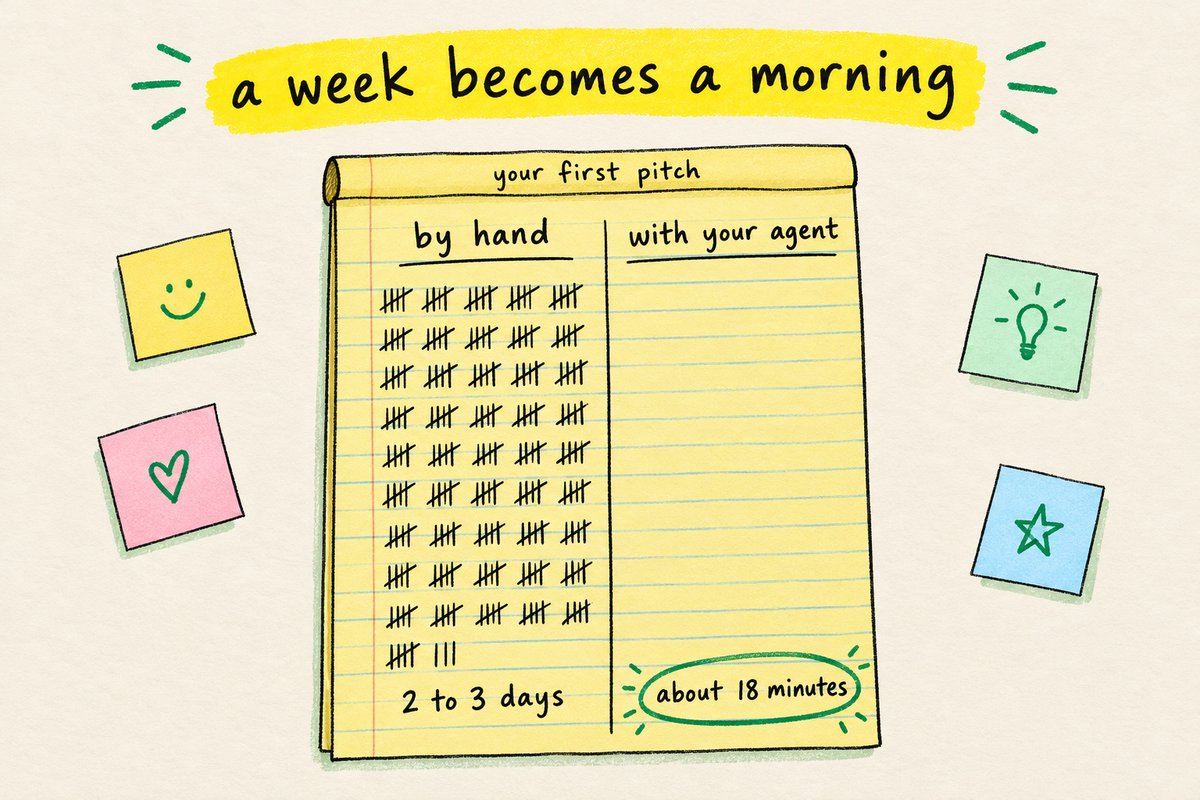
Your first pitch: 2 to 3 days by hand (my estimate), about 18 minutes with your agent (our Dallas run).
What breaks
This works, but not every time. Here's where it goes wrong.
-
Chasing the fast yes. The one-truck shop says yes this week and struggles to keep paying. Fill your calendar with them and you'll never have time for the companies that can.
-
Quitting early. The magazine's 167 bought nothing for four months. In month six, 28 bought at once. Most people stop right before it works.
-
The wrong people in the room. A 25-mile Meta audience reaches technicians, homeowners and one-truck shops. Say who it's for in every ad, ask for the company and its size on the form, and call anyone who doesn't fit before the day.
-
Touches that aren't useful. Twelve emails about you is spam on a schedule. If a touch wouldn't help an owner who never hires you, don't send it.
-
A workshop that's really a pitch. Owners can tell in five minutes. Teach for the whole hour, then make one offer.
-
Partners who take and never send. Give one workshop and one fix. If nothing comes back in a quarter, move your time to the next partner.
-
A Dream 100 that's really 40. If your metro doesn't have 100 companies this size, take the trade across the next city before you lower the bar.
-
Agents that act without you. Your agent drafts, builds and suggests. You send every email and turn on every ad.
-
Believing the headline numbers. Plenty of the numbers in this space come from vendors, including several here. Use them to choose a trade, then use the owner's own numbers to make the case.
If I were starting this week
-
Monday: pick one trade and one city with Part 1, and count the companies that clear $2 million.
-
Tuesday: build the Dream 100, ranked, with the owner's name for each.
-
Wednesday: run the 30-second check on the top 20 and build three pitches: the page, the proposal, the email.
-
Thursday: send the first touch to all 100. List ten possible partners and book coffee with two.
-
Friday: pick a date six weeks out for your first workshop, book the room, and build the registration page.
-
Every two weeks after that: the next touch, and a call.
With Client Finder, Wednesday is one morning.
The close
Somewhere in Dallas, a plumbing company with a 4.9 on Google pays for every click that lands on a page where its phone number first appears on screen 24. Its owner has "figure out AI" on a sticky note that's been there since spring. Nobody has called to teach them anything. That's your first touch.
Want your agent to do the legwork? boringfunnels Pro puts a library of real funnels, taken apart from the ad to the last email, inside your coding agent, so it can build any funnel for you or a client from one prompt. It includes Client Finder: tell your agent a trade and a city, and it brings back local businesses doing about $2 million a year or more, by our estimate, what each one is losing, the owner's work email when you want it, and a pitch in their brand from one click. You send every email.