How to Build a Profitable One-Person Business with AI (Complete 2026 Masterclass)

文章目录
部分视频或图片暂未收录,已在正文保留提示;需要时可查看原文。查看原文 ↗
In the first 90 days of 2026, Amazon announced 16,000 job cuts. Dell cut another 11,000. Oracle also began a major round of layoffs, with reports estimating that up to 30,000 jobs could be affected.
By early May 2026, more than 100,000 tech jobs had been cut worldwide, according to data tracked by Layoffs. fyi.
Behind every headline is someone who thought they'd finally made it.
Someone who spent years studying, worked hard to land a job at a top company, and believed they'd secured their future.
Years of hard work, student loans, and sacrifices, only to realize that the career they built their life around is no longer guaranteed.
That's the reality of depending entirely on a single employer for your income.
And it's why I've become such a big believer in building something of your own.
Now, this isn't an article written to scare you into buying my $20 product, quitting your job, or going all in on an online business.
There are already enough gurus doing that.
I want to give you a practical playbook for building a profitable one-person business, based on the skills I've used to build my own online business and leave my 9-5 behind.
Because having another way to generate income gives you more options.
Let's get into it.
I. The One-Person Business Model
*"It's possible now to start a one-person company that would be worth more than $1 billion."
- Sam Altman*
In the 1990s, building a business capable of generating $100K to $1M a year often required substantial capital, employees, office space, and a network of investors or partners.
Today, you just need a laptop.
Creators like Dan Koe, Justin Welsh, and Matt Gray have built million-dollar businesses without the traditional infrastructure of a million-dollar company.
Because they understood something most people overlook:
Your skills become much more valuable when you can distribute them to the right people.
Think about why Nike pays LeBron $32M a year and Adidas partners with Lionel Messi for $25M a year.
Why not hire an unknown athlete to appear in the same advertisements?
Because these athletes have an advantage that goes beyond their ability to play a sport.
Millions of people recognize them, follow their careers, trust their recommendations, and pay attention to what they do.
That attention gives their work commercial value.
If I had to describe this advantage in one word, I'd choose* influence.*
Historically, that kind of influence was concentrated among athletes, entertainers, and celebrities.
The algorithms changed that.
Today, you don't need to be the best athlete in the world or appear on television to build an audience.
You can build one around your knowledge of finance, your experience in tech, your ability to write, or your understanding of how businesses grow.
And you can turn that audience into a business by selling services, products, education, or access to your expertise.
That's the opportunity behind the one-person business model.
What exactly is a one-person business?
A one-person business is a business built around your skills, interests, expertise, and vision, using the internet to reach customers and deliver value without needing a large traditional organization.
It doesn't necessarily mean working alone forever.
You can hire contractors, use software, and automate repetitive work.
The defining idea is that you can build a profitable business without needing a large team or substantial upfront capital.
Here's how the model works:
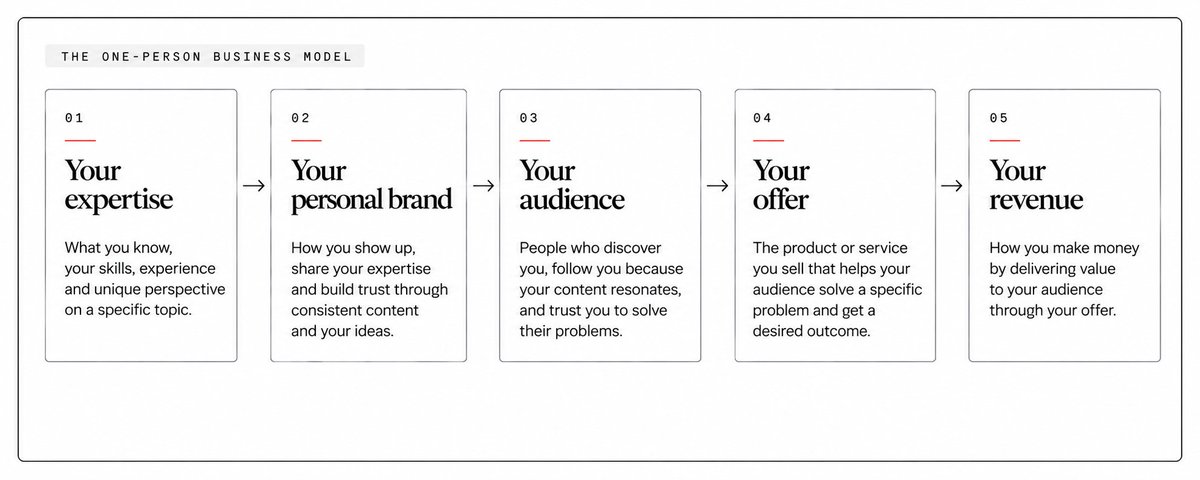
The important part is that these aren't five independent activities.
They work together.
Your expertise gives you something worth sharing. Your content helps people discover and understand that expertise. Your offer gives the right people a way to pay you for solving a problem.
And the entire system can start with nothing more than a laptop and an internet connection.
But to make it work, you need to develop five skills.
By the way, if you're finding this article useful, a like, bookmark or repost helps more people discover it. Appreciate you taking the time to read!
II. The Five Skills You Need to Build a Profitable One-Person Business
When I started building my business, I had no idea what I was doing.
I was working a 9-5, trying to figure out how to build something that allowed me to work on things I actually cared about.
It took me 16 months to reach the point where my business allowed me to leave my job and have much more control over when I worked, where I worked, and who I worked with.
Looking back, there are five skills I wish I'd focused on from day one. They would've helped me get here much faster.
Here's how each one works:
1. Audience-building
There are two very different types of audiences you can build.
-
An audience that knows you exist.
-
And an audience that has a reason to buy from you.
Most beginners focus almost entirely on the first.
They chase viral trends, optimize for likes and impressions, and create content designed to appeal to as many people as possible.
They might gain thousands of followers.
But when they launch a product or service, those followers have little reason to buy.
Why?
Because the audience was built around attention, not demand.
For example, Imagine you're in the fitness niche.
You could create content about celebrity workout routines, gym memes, and trending fitness challenges.
That might attract a large audience.
But if your goal is to sell personalized coaching to busy professionals who want to lose fat without spending two hours in the gym every day, most of those followers might never become customers.
Now imagine building your audience around that specific problem.
You publish content explaining how busy professionals can structure three effective workouts a week, manage their nutrition while traveling, and lose fat without following an unsustainable diet.
You break down why common approaches fail and demonstrate how you'd help someone build a routine around their actual schedule.
You're no longer attracting people simply because they enjoy fitness content.
You're attracting people who recognize the problem you solve.
That's a much stronger foundation for a business.
Here's how to build an audience that can become a customer base:
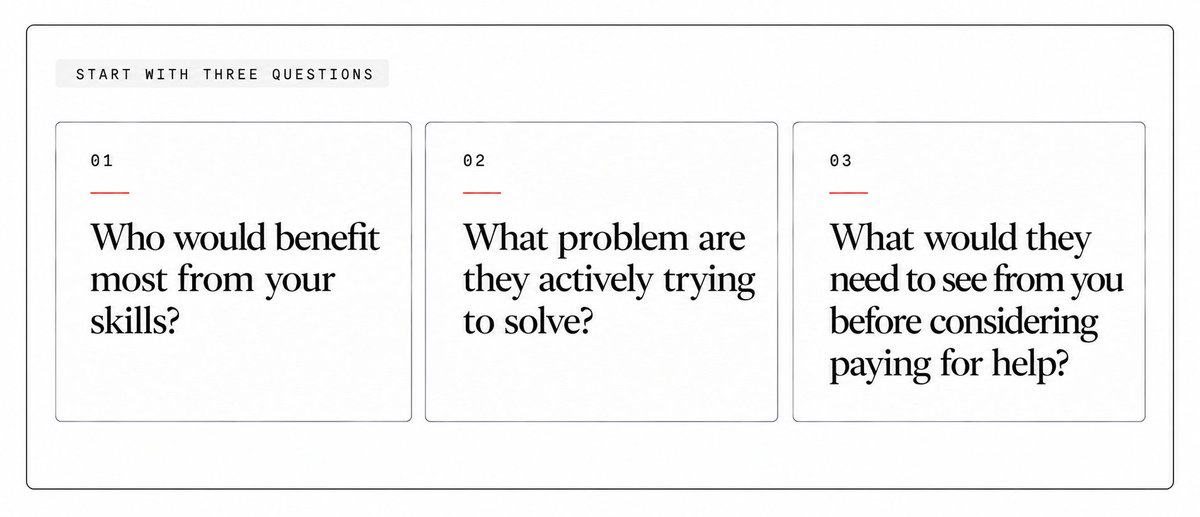
Then build your content around the answers.
A useful starting framework is:
-
Problem: Explain a mistake your ideal customer is making.
-
Process: Show them how you'd fix it.
-
Proof: Demonstrate what happens when the solution works, using relevant examples or evidence.
Repeat this around the problems your offer solves.
Over time, people begin associating you with a specific problem and a particular way of solving it.
That association is what makes your audience commercially valuable.
The goal isn't to attract everyone.
It's to become relevant to the right people.
2. Writing
If audience-building helps people discover you, writing helps them understand why they should care.
This is one of the most important skills you can develop because writing influences almost every part of an online business.
-
Your posts need to attract attention.
-
Your profile needs to explain what you do.
-
Your landing pages need to communicate your offer.
-
Your sales messages need to help prospects understand why your solution is worth considering.
And all of these depend on your ability to communicate ideas clearly.
But persuasive writing isn't about using complicated words or manipulating people into buying.
It's about understanding what matters to your reader and communicating your solution in a way that makes its value obvious.
Consider these two messages for a fitness coach.
Generic writing: "Here are five tips to help you lose weight and get in shape."
Persuasive writing: "If you work 10-hour days and keep abandoning your diet by Thursday, you probably don't need a stricter meal plan. You need one that works with your schedule."
The first message offers general advice.
The second identifies a specific person, describes a problem they recognize, and introduces a different way of thinking about the solution.
That's why it is more compelling to the right reader.
Here's how to become a better persuasive writer:
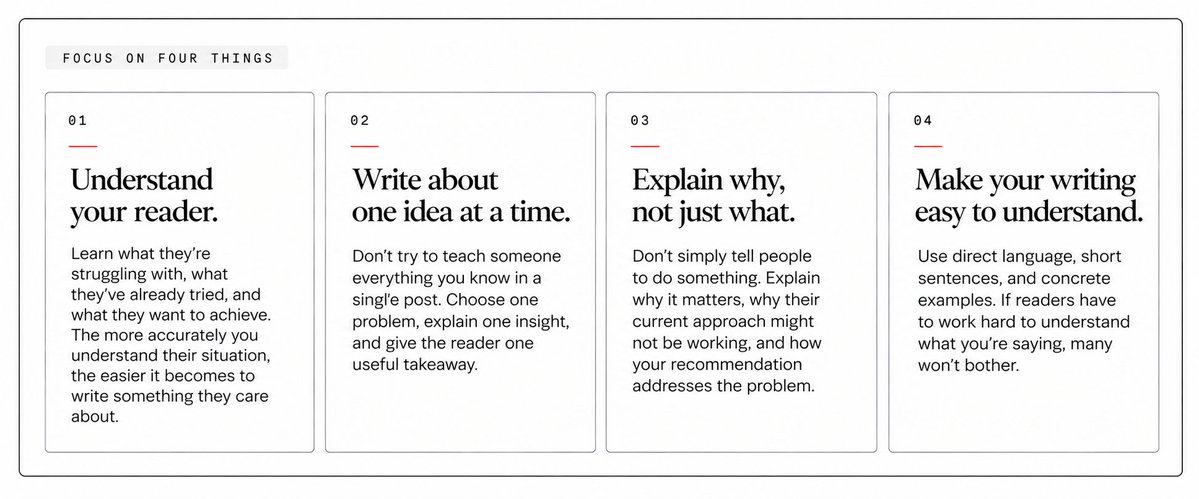
The fastest way to improve is to practice consistently.
Study strong writing, analyze why certain messages resonate, and rewrite your own work until you can communicate the same idea more clearly.
Don't just collect writing tips.
Learn to recognize what makes a message matter to its intended reader.
3. Personal branding
I started building my personal brand with $0.
Since then, I've generated more than 20 million views across my own brand and built an online business that allowed me to leave my 9-to-5.
Those results didn't come from having a fancy website, a large advertising budget, or being famous.
They came from publishing content and giving people reasons to pay attention to what I had to say.
That's the opportunity behind personal branding.
People can learn about a subject from thousands of sources.
But they don't just choose information based on its accuracy.
They also consider who is sharing it, whether that person understands their situation, and whether they trust their judgment.
A personal brand helps you build that relationship.
It's why Alex Hormozi posts 10 times a day on his second YouTube channel, and why Greg LaVecchia, co-founder of Bloom Nutrition, continues creating content on YouTube despite building a business that generates millions in annual revenue.
Their content can help people understand what they believe, how they think, and what makes their approach different.
Over time, that familiarity can create opportunities that would otherwise be difficult to access.
Here's how to build a personal brand from scratch:
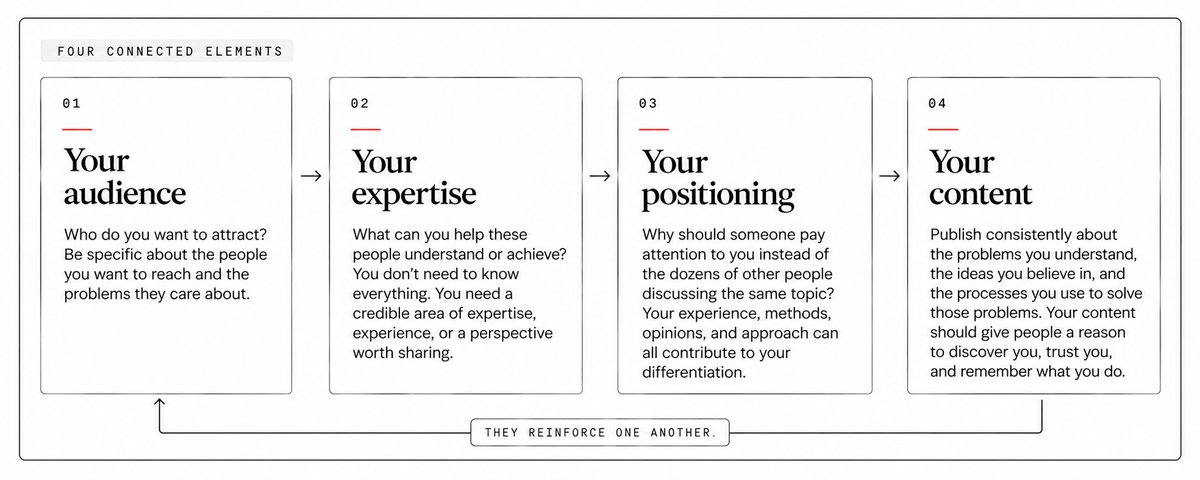
You don't need to pretend to be more successful than you are.
Share what you know, explain what you're learning, and demonstrate your ability to think through real problems.
A strong personal brand isn't built by claiming to be an expert.
It's built by repeatedly giving people reasons to believe you understand what you're talking about.
4. Offer and product creation
This is where many beginners go wrong.
They spend months building an audience, publishing content, and collecting followers.
Then they decide it's time to monetize.
They launch an app, a digital product, or a service.
And almost nobody buys.
The problem isn't the size of their audience.
It's that they spent months attracting people without giving them a clear reason to buy anything.
Your content and personal brand should be connected to the problem you eventually want to solve for customers.
That doesn't mean every post needs to promote your offer.
It means your audience should gradually understand three things:
-
What you help people achieve.
-
Why your approach is worth considering.
-
Why they can trust you to deliver what you promise.
How to create an offer people want
Start with a specific customer and a problem they already care about.
For example, imagine you want to help B2B founders generate more qualified leads.
A weak offer might be: "I'll help you grow your business with content."
It's vague. The buyer doesn't know exactly what you're going to do or what problem you're solving.
A stronger offer might be: "I'll help B2B founders build a LinkedIn content system that attracts qualified sales conversations without requiring them to write posts every day."
Now the audience, problem, and intended outcome are much clearer.
From there, build your offer around four questions.
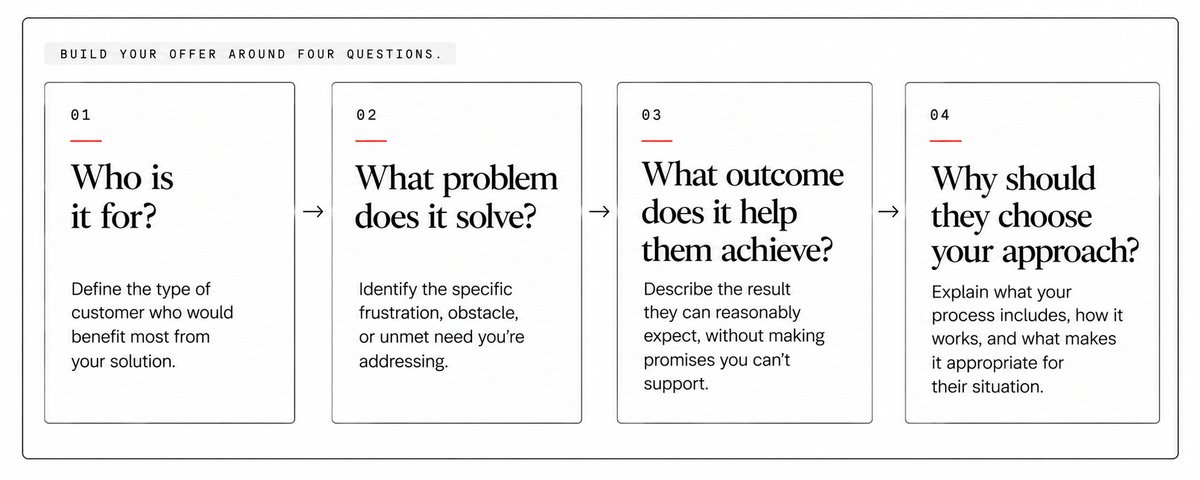
Your offer doesn't need to be complicated.
In fact, a simple offer that solves a painful, clearly defined problem is often easier to explain and sell than a product trying to do everything for everyone.
Start with one customer, one problem, and one solution.
Then validate that people actually want it.
5. Marketing
I genuinely believe:
You don't need to finish building your product before you start marketing it. You start testing demand while the product or offer is still an idea.
Why?
Because building something people don't want is one of the most expensive mistakes you can make.
Imagine spending six months building an app, only to discover that your target audience doesn't consider the problem important enough to pay for a solution.
You could have learned that much earlier by speaking to potential customers and testing your offer.
How to validate an offer before building it:
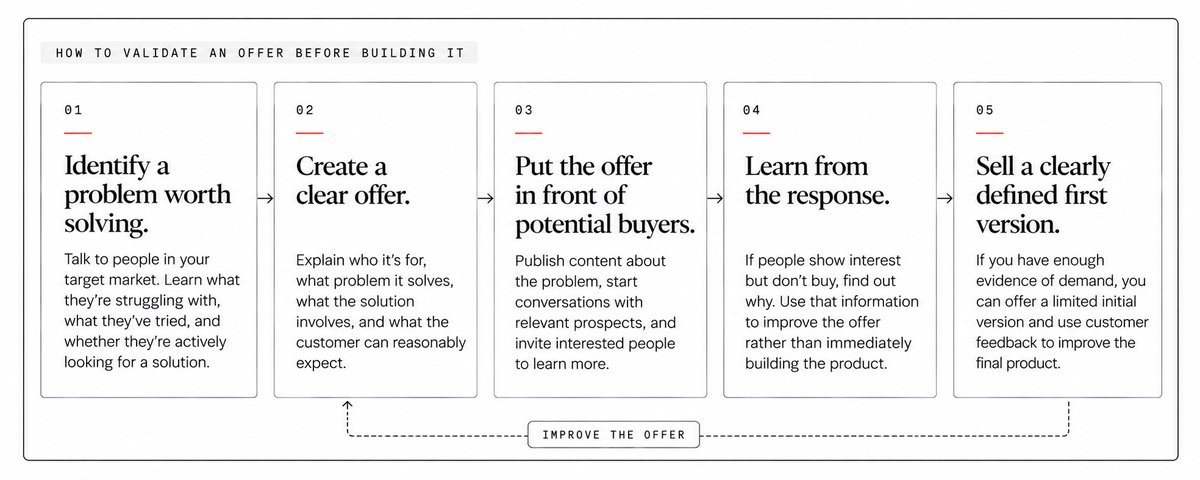
How I think about marketing:
Marketing isn't something you do after building your product.
It's how you learn what to build, who needs it, and how to communicate its value.
The more quickly you can move through this loop, the less time you waste building something nobody wants.
And the better you understand your market before building, the more informed your decisions become.
III. The Wrong vs. Right Mindset for Building a One-Person Business
The five skills above are important.
But how you combine them matters just as much.
There are two ways to approach building an online business.
The wrong approach: Build an audience first, monetize later
This is how many beginners start.
They think:
"Let me grow my following first. Once I have enough followers, I'll figure out what to sell."
So they optimize their content for reach.
They follow trends, post about whatever gets engagement, and attract people with different interests, problems, and buying intentions.
Eventually, they have an audience.
But they have no clear offer, no reliable connection between their content and a product, and no strong reason for their followers to buy from them.
When they finally launch something, the audience doesn't respond.
They've spent months building attention without building much demand for a solution they can sell.
Of course, an audience-first approach can work for media businesses and creators who monetize through advertising, sponsorships, or broad consumer products.
But if your goal is to build a profitable service business or expertise-based business, it can create unnecessary problems.
The better approach: Start with the offer
Instead of asking:
"How do I get more followers?"
Start by asking:
"What problem can I solve for a specific group of people, and how can I reach them?"
Then build your content around that answer.
Imagine you want to help C-level executives improve their performance and decision-making.
An audience-first approach might lead you to publish general motivational quotes, productivity tips, and trending business opinions to attract the widest possible audience.
An offer-first approach would look different.
You'd study the problems executives actually face. Perhaps they struggle to protect their time, make decisions with incomplete information, or maintain performance while managing demanding schedules.
You'd create content that explains those problems, challenges ineffective approaches, and demonstrates practical ways to address them.
Your offer would then provide a deeper solution for the executives who need help implementing those ideas.
The content and the business would reinforce each other.
Your audience wouldn't just know you as someone who posts about productivity.
They'd understand the specific problems you help solve.
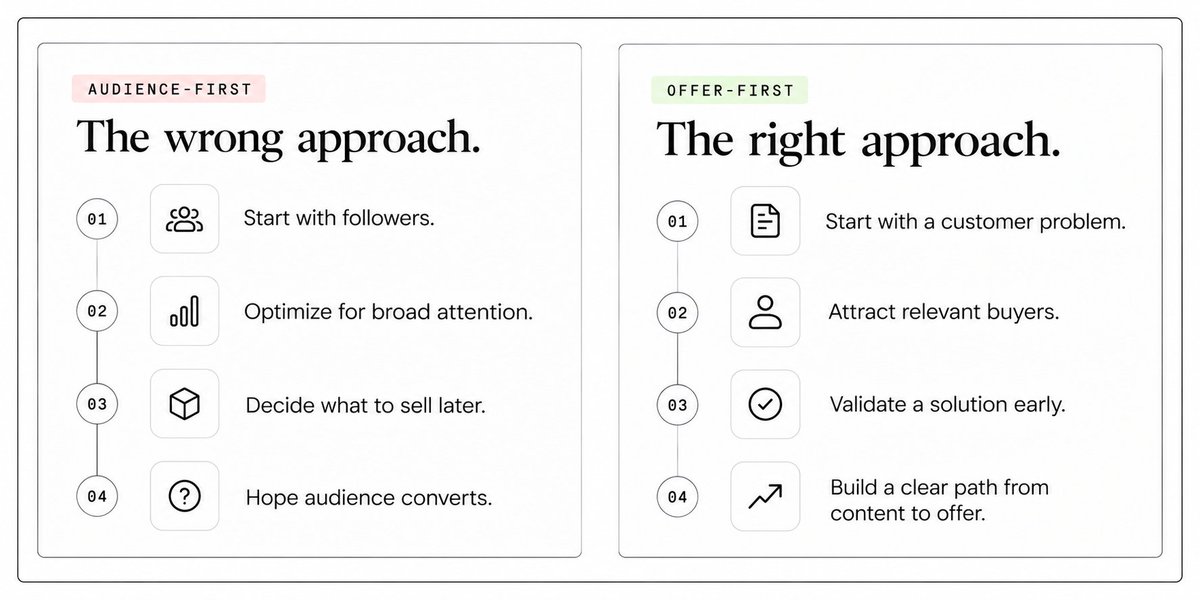
The offer-first approach doesn't guarantee sales or eliminate the need to build an audience.
It gives your content a clearer purpose from the beginning.
You're not simply trying to become popular.
You're building a business that uses content to reach the people who need your solution.
IV. Accelerate Your Progress With AI
AI can make building a one-person business much easier.
But I think many people are using it in a way that makes their work more generic rather than making them better at what they do.
This is how most people use AI:
"Give me five content ideas for my niche." "Write a post about this topic." "Reply to this person."
Then:
"Give me more options." "Make it sound more natural." "Try again."
The problem is what happens when you outsource your thinking to AI every time you face a problem.
Research suggests that relying heavily on AI without actively engaging with the material can reduce the mental effort you put into thinking, reasoning, and problem-solving.
Over time, you risk becoming dependent on AI to do the very work that helps you develop these skills.
Instead of learning to form your own opinions, connect ideas, and make decisions, you get used to letting a tool do it for you.
And guess what? Everyone else is using the same tool so you sound just like every other dude in your industry.
The goal isn't to stop using AI. It's to use it without sacrificing your ability to think for yourself.
Here are three practical ways to do that.
1. Use AI to analyze viral content
Instead of asking AI to generate random ideas, give it examples of content that has performed well in your niche.
Ask it to identify the underlying patterns.
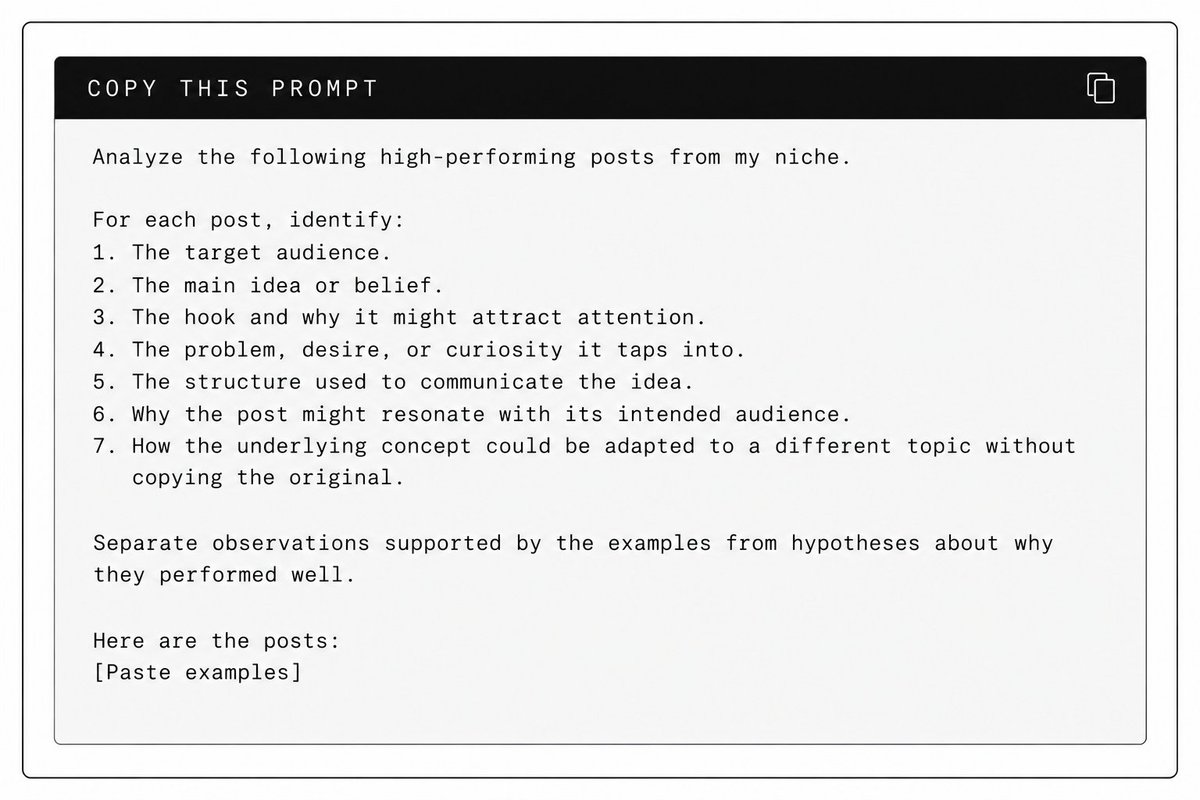
This helps you study why certain content might work rather than simply copying its format.
2. Use AI to improve your writing without replacing your ideas
You don't need AI to invent every post.
You can use it to make your own thinking clearer.
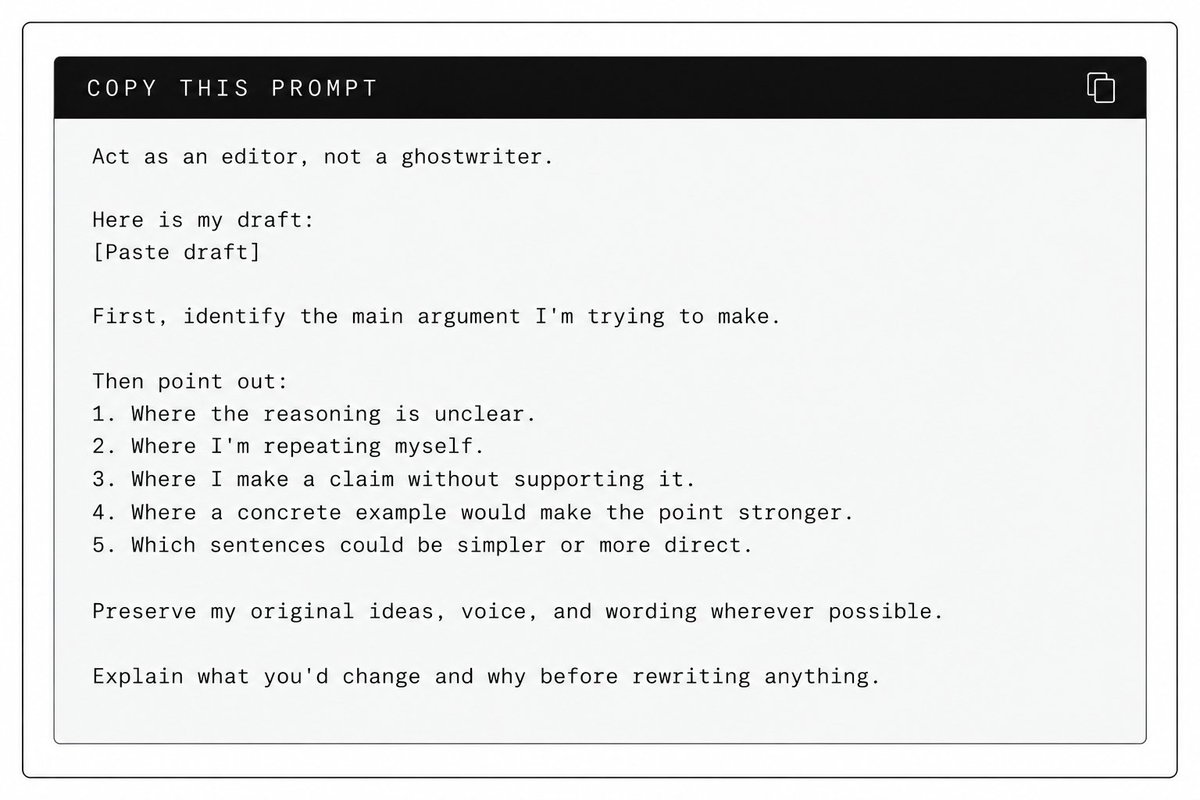
This approach helps you improve the quality of your writing while retaining ownership of the underlying ideas.
3. Use AI to find gaps in your thinking
One of the most useful things AI can do is challenge an idea before you publish it or build a business around it.
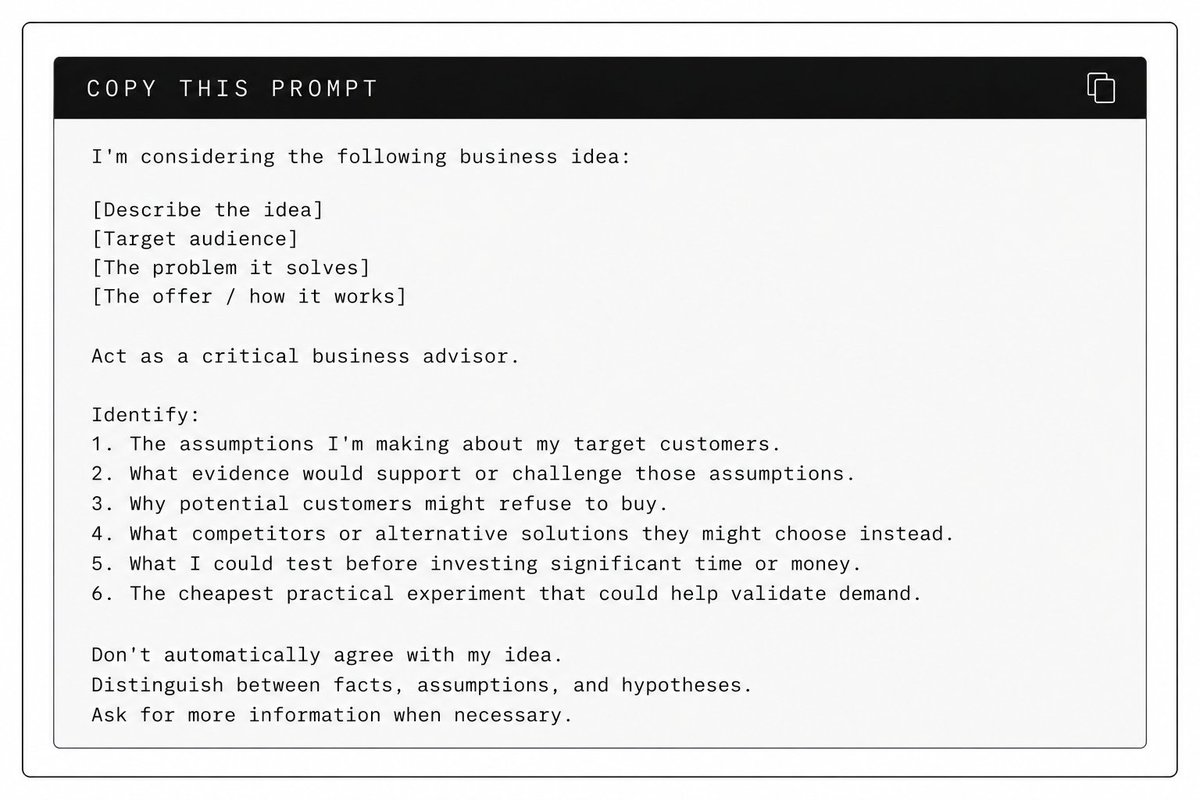
This is particularly valuable when you're deciding what to sell.
Instead of using AI to make your idea sound more convincing, use it to find out where your reasoning might be wrong.
The goal isn't to make AI think for you.
It's to use AI to improve your thinking, reduce repetitive work, and make better decisions.
V. Final Thoughts
If there's one thing I want you to take away from this article, it's this:
You don't need to quit your job tomorrow, build a million-dollar business, or become an influencer to benefit from the opportunities available online.
You can start by developing a valuable skill, sharing what you know, and learning how to solve a problem that people are willing to pay to have solved.
Then you can gradually build a system around those skills.
-
An audience that helps you reach potential customers.
-
A personal brand that communicates what you stand for.
-
An offer that solves a real problem.
-
And a marketing process that helps you understand demand before you invest too much time in building.
None of this guarantees success.
Building an internet business takes time, experimentation, and the ability to deal with uncertainty.
But it gives you the opportunity to develop something beyond a single source of employment.
The stability many people associate with traditional jobs is not guaranteed, just as running a business doesn't guarantee financial security.
The point is to build more options for yourself.
Start small. Develop the skills. Talk to potential customers. Test an offer. And improve as you go.
Want to go beyond this article?
I share practical strategies, frameworks, and lessons on building a personal brand, growing an audience, and turning your skills into a profitable one-person business in my newsletter.
Join here:** **Build your One-Person business
If you found this useful, share it with someone who wants to build a one-person business.
And if you have questions about audience-building, writing, or turning your expertise into an offer, leave them in the comments.
I'll do my best to help.
Sidd