The Most Valuable SEO Article Ever Written... (Part #2)
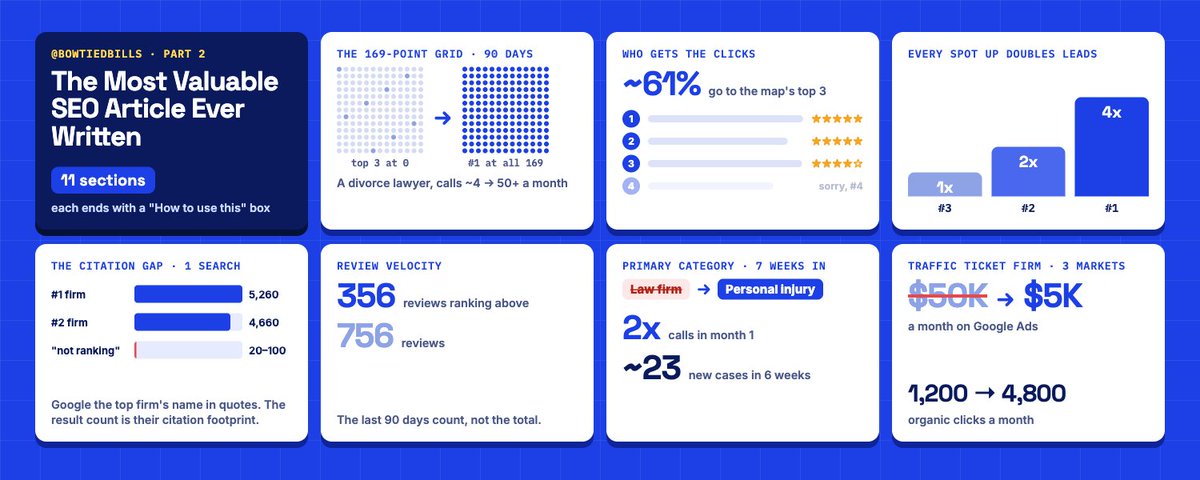
文章目录
Part 1 covered how SEO works:
The 3 places a search sends people, the business profile, the website, content, reviews and links, AI answers and the timeline.
This is part 2.
It goes deeper on every one of those, and it covers the stuff that didn't fit the first time:
How rankings work at the top, citations properly, buying links without getting penalized, turning a click into a call, and what to do when someone online announces SEO is dead again.
Quick reminder of who's writing this.
I worked on ranking and search algorithms as an engineer at FAANG, before I started the agency.
My team has since ranked 50+ law firms at #1 on Google.
In just 3 of those engagements, 619 points on the map moved from outside the top 3 up to #1.
Every section below ends with a "How to use this" box, so you can do something with it the same day.
1. Your ranking moves with the searcher:
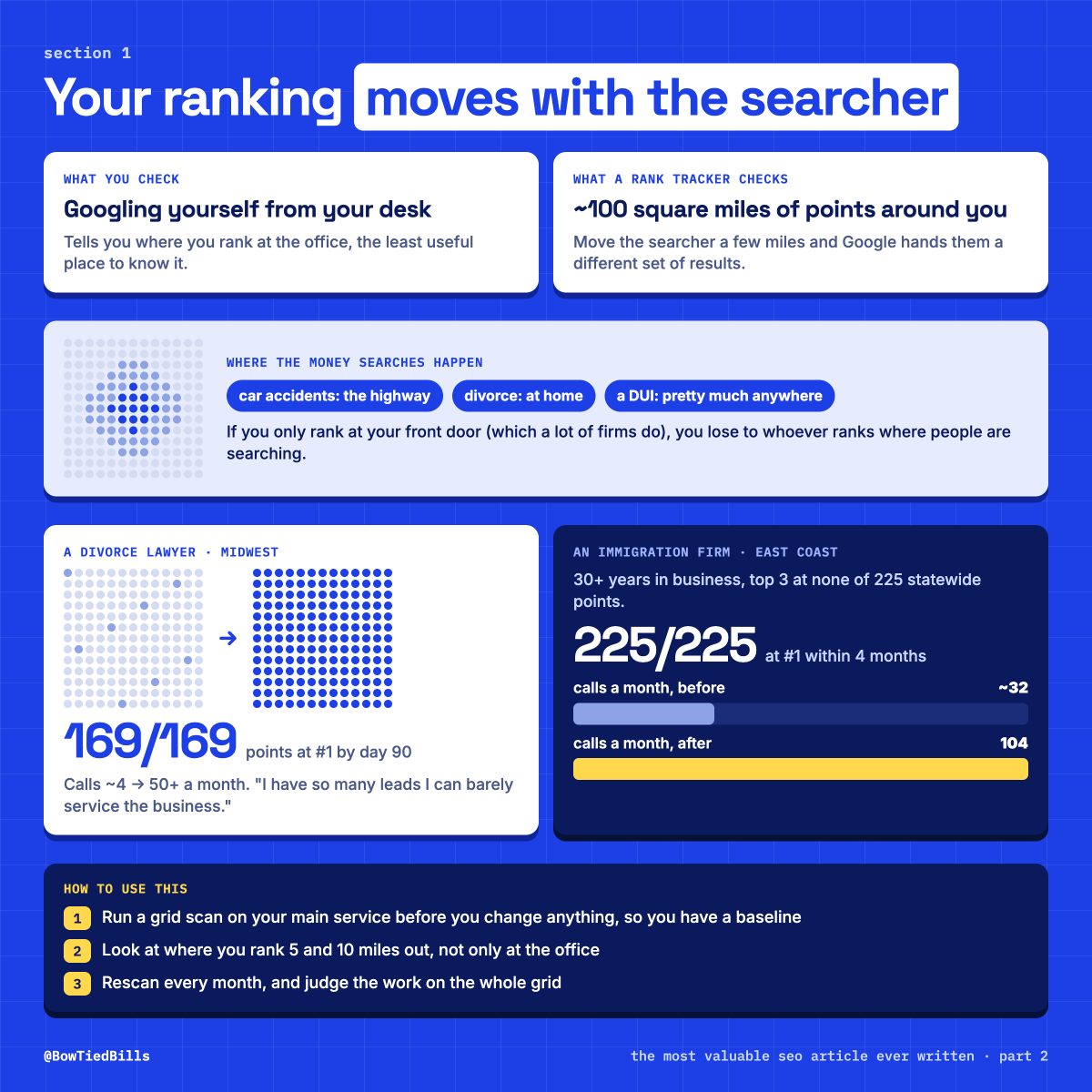
Most business owners check their ranking by Googling their main service from their desk.
That tells you where you rank at your desk, which is the LEAST USEFUL place to know it.
Move the person searching a few miles, and Google hands them a different set of results.
A local rank tracker maps this out across roughly 100 square miles around you, and every dot on that map can show you in a different spot.
Why this matters more than people think:
The searches that make you money happen away from your office.
Car accidents happen on the highway.
Divorce searches happen at home.
A DUI can happen pretty much anywhere.
If you only rank at your front door (which a lot of firms do), you lose to whoever ranks where people are searching.
What the grid looked like for 2 of my clients:
One divorce lawyer (mid size city, Midwest) didn't appear in the top 3 at a single one of the 169 points on his grid.
By day 90, every one of those 169 points showed him at #1.
Google went from sending him ~4 calls a month to 50+, and in his words: "I have so many leads I can barely service the business."
An immigration firm on the East Coast had been in business for 30+ years.
Across 225 points statewide, they ranked top 3 at none of them.
Within 4 months, they were #1 at all 225, and their calls went from ~32 a month to 104.
How to use this:
-
Run a grid scan on your main service before you change anything, so you have a baseline
-
Look at where you rank 5 and 10 miles out, not only at the office
-
Rescan every month, and judge the work on the whole grid
2. The math at the top of the map:
The ranking curve on Google Maps drops off a cliff after #3.
The 3 businesses inside the map pack take ~61% of every click on a local search.
Ads and Local Service Ads at the very top split somewhere between 5% and 10%.
Everyone below the top 3 fights over what's left.
Each spot up is worth more than the last:
Moving from #3 up to #2 tends to double your leads.
The jump from #2 to #1 doubles them a second time.
So a firm sitting at #4 is 1 spot away from getting real calls from the map.
(Sorry, #4.)
You can own more than 1 spot:
Put a strong profile next to a website that sits on page 1, and the same search shows your business 2 or 3 times.
Wouldn't you rather have 50% of that page than pay for 1 ad at the top of it?
Why the leads close easier:
Someone who found you at #1 already trusts you before the first call.
They picked you over everyone else on the page, and nobody had to talk them into it.
That's why my clients find inbound from search easier to close than paid leads.
How to use this:
-
Find out where you rank on the grid, then count how many spots you are from the top 3
-
Check whether your website ranks on page 1 for the same search as your map listing
-
Track calls from search separately from calls from ads, so you can see the difference in close rate
3. Pick what your profile ranks for:
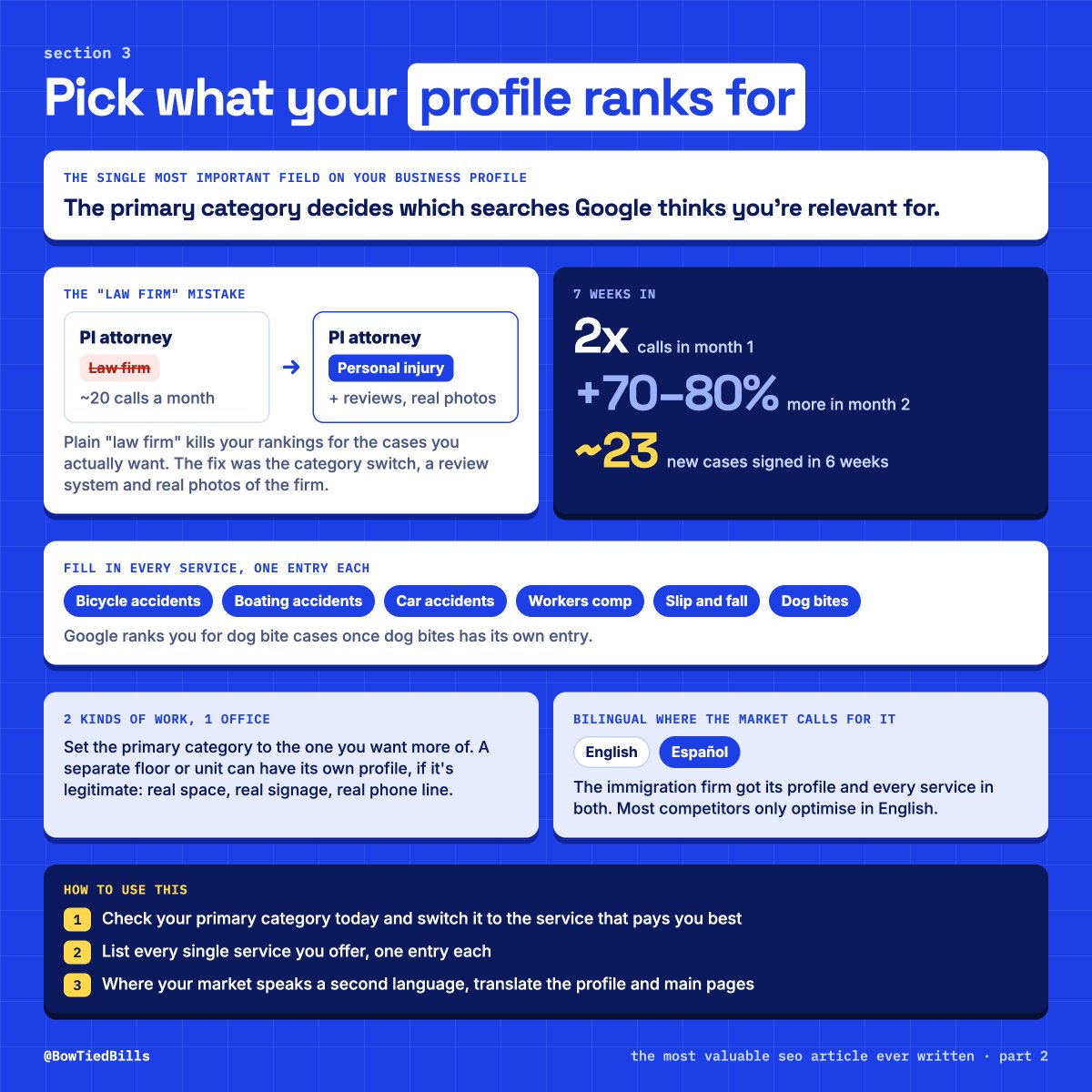
Your primary category on the business profile is the single most important field on it.
Google uses it to decide which searches you're relevant for.
The "law firm" mistake:
A lot of firms set their primary category to plain "law firm," and it kills their rankings for the cases they want.
One PI attorney I took on had "law firm" as his category, with ~20 calls coming in each month.
The fix was a category switch to personal injury, a review system and real photos of the firm.
At the 7 week mark, month 1 calls were up 2x, month 2 added another 70 to 80% on top, and ~23 new cases had signed inside 6 weeks.
If you do 2 kinds of work from 1 office:
Set the primary category to whichever one you want more of.
A family and criminal lawyer picks the one with more search demand and better margins in their city.
To rank properly for both, a separate floor or unit is allowed its own legitimate profile.
The key word is legitimate (real space, real signage, real phone line).
Fill in every service:
A personal injury firm lists bicycle accidents, boating accidents, car accidents, workers comp, slip and fall and dog bites, every one as its own entry.
Google ranks you for dog bite cases once dog bites has its own entry.
Bilingual where the market calls for it:
For the immigration firm, we built the profile and every service in English and Spanish.
The Hispanic market is one that's generally underserved, and most competitors only optimise in English.
How to use this:
-
Check your primary category today and switch it to the single service that pays you best
-
List every single service you offer, one entry each
-
Where your market speaks a second language, translate the profile and your main pages into it
4. Citations, properly this time:
Part 1 explained citations:
Anywhere online that lists your name, address and phone.
This is the part a lot of agencies will skip because it's tedious and boring.
It's also exactly why their clients plateau at position 7, 10 or 12.
The free citation gap audit:
It takes 1 search.
-
Copy the exact business name of the top ranked competitor in your area
-
Google it with quotation marks around it
-
Look at the number of results, which is roughly their citation footprint
-
Do the same for your own business name
On 1 audit, the 2 top ranked firms came back with 5,260 and 4,660 results.
A lot of the firms telling me they're "not ranking anywhere" have 20, 30 or maybe 100.
Aim to be in the same ballpark as your TOP competitors.
Where citations break:
The phone number changed and nobody updated the directories.
The website moved to a new domain.
A new partner joined and the firm name changed.
Each one leaves a trail of old details on the internet, and Google trusts the listing less for every mismatch.
You have to make it as easy as possible for Google, because Google won't do any of the heavy lifting for you.
Statewide, beyond your own town:
If you want to rank across a whole state, you need citations that cover the whole state.
For the immigration firm, that was ~100 citations, statewide, in English and Spanish.
That's part of how they ended up #1 at all 225 points.
Citations matter more for the map than for organic:
They're mostly a trust signal for your business profile.
Your website's blue link rankings depend more on content and links.
How to use this:
-
Run the quotation mark search on yourself and your top 3 competitors
-
Search every old phone number and address you've ever used, and fix every listing that still shows one
-
Aim for 80 to 100+ directories, all showing identical details
5. Review velocity, deeper:
This is the point I repeat more than any other, because almost everyone gets it wrong.
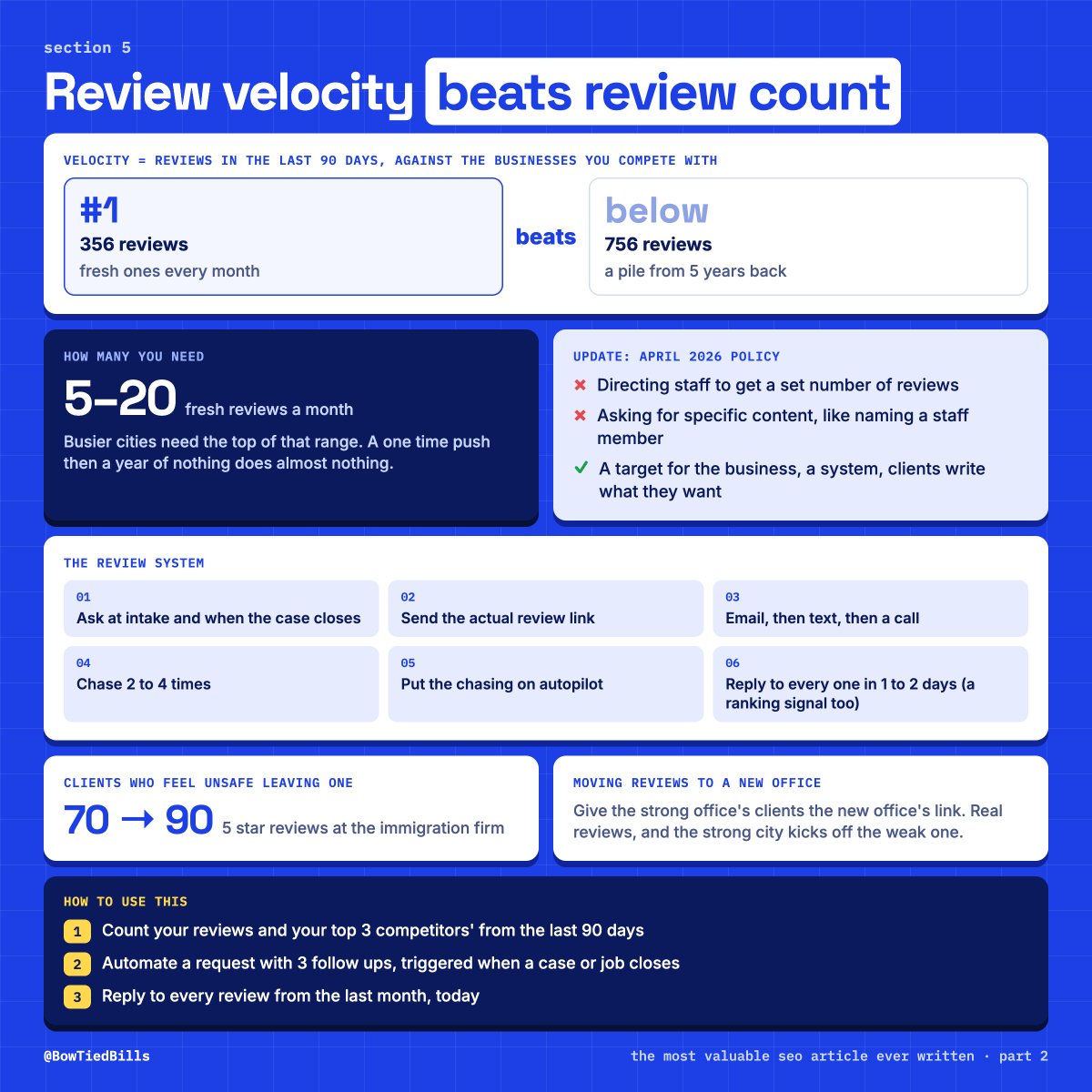
Google cares far more about your review velocity than your total number of reviews.
Velocity means the reviews you picked up over the past 90 days, measured against the businesses you compete with.
I've watched a firm holding 356 reviews rank above a firm holding 756.
A pile of reviews from 5 years back says nothing to Google about how good you are this year.
How many you need:
Somewhere from 5 to 20 fresh reviews every month, with the busier cities needing the top of that range.
A one time push followed by a year of nothing does almost nothing.
The review system, in detail:
-
Build the ask into intake and into the moment the case closes
-
Send the actual review link, because "leave us a review" gets ignored
-
Start with email, move to text, and call when there's time
-
Chase 2 to 4 times, since clients say "yep, absolutely" and then it slips their mind
-
Put the chasing on autopilot, so lawyers stay focused on legal work
-
Answer every review inside 1 to 2 days, the bad ones included
Replying is also a ranking signal, and most firms ignore it.
1 update since part 1:
In April 2026, Google added 2 new clauses to its review policy.
Businesses can't direct staff to get a set number of reviews, and they can't direct them to ask for reviews with specific content, like naming a staff member.
So I've changed my own advice.
Keep a target for the business, keep the system running, and let clients write whatever they want.
Review gating (only asking the clients you expect to be happy) and any kind of incentive were already banned.
Clients who feel unsafe leaving one:
For immigration clients, a review can feel risky.
The process has to feel safe and easy, or nobody leaves one.
That firm went from 70 to 90 reviews at 5 stars while we worked on it, and the owner said, "He feels like an in-house teammate."
Moving reviews to a new office:
If you have more than 1 legitimate location, send review requests to the office that needs them most.
New office in a new city, strong review flow at the old one:
Give the old office's clients the new office's link.
They're real reviews from real clients, so there's no faking going on.
The strong city kicks off the weak one.
How to use this:
-
Count how many reviews you and your top 3 competitors got in the last 90 days
-
Set up an automated request with 3 follow ups, triggered when a case or job closes
-
Reply to every review from the last month, today
6. Pages that rank, and pages that convert:
Search engines care what your website says, and who's saying it.
The 3 things Google reads first:
On any page, the title tag, the description under it and the main heading carry more weight than any other structure.
Each one needs the service and the city in it, written like a person would write it.
H2s and H3s help, but nothing moves a page like those 3.
City pages, done the way the top 1% do them:
A dedicated page for every part of your service area, never a copy of the same page with the town name swapped.
-
A heading built from the service, that specific neighbourhood and your firm's name
-
A Google Map of that area embedded on the page, showing your profile
-
Details only a local would know, like which courthouse handles it and the landmarks nearby
-
Internal links back to the main service page
Rankings still drop with distance, and that's fine.
You can't rank for "divorce lawyer [big city]" downtown from an office 40 minutes out.
The city pages are for the surrounding towns that are on the map but outside the main city.
A page for every case type:
A person with a dog bite injury goes looking for a lawyer who handles dog bite cases.
So dog bites gets its own page, and so does every other case type.
For a family law firm, that's divorce, child custody, alimony and child support.
People searching "alimony lawyer" or "child support lawyer" have either already hired an attorney or are about to.
The immigration firm got separate pages for each visa type, green cards, deportation cases, asylum and family petitions, all in both English and Spanish.
Write for people who'll pay you:
If you build out a pile of "how to do it yourself" content, you attract people who'll try to do it themselves.
Every page should be written to rank and convert.
The traffic ticket firm's version was content about red light cameras, covering new camera locations, the fine amounts and what the firm does about it.
The technical cleanup:
Broken links, 404 pages, oversized images, missing alt tags and missing meta titles.
None of it is exciting, and all of it gets fixed in the first month of every engagement.
How to use this:
-
Check the meta title, description and H1 on your 5 most important pages
-
List every case type or service you want to rank for, and check each one has its own page
-
Build a page for every town you want clients from, with something on it that's only true of that town
7. Turning the click into a call:
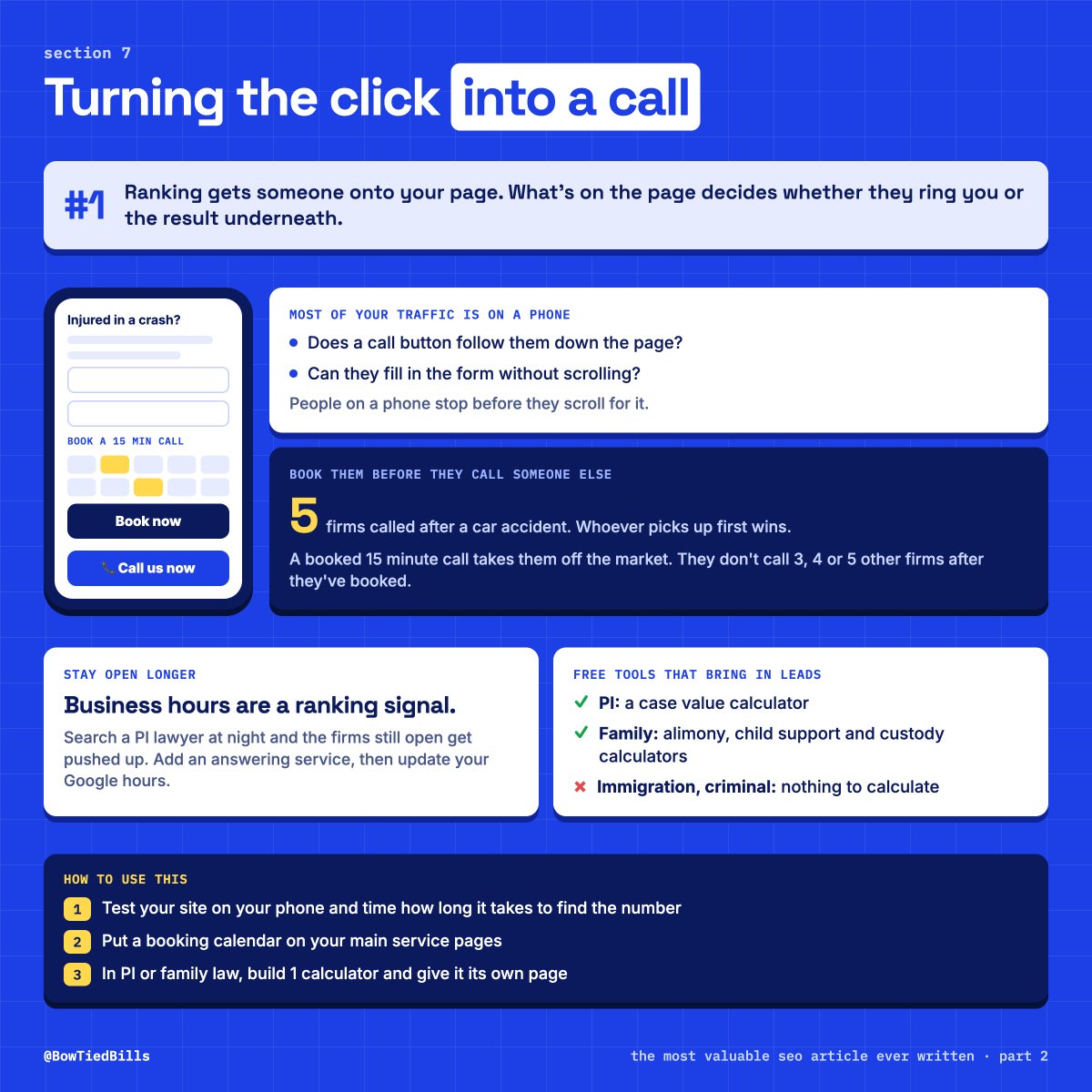
Ranking gets someone onto your page.
What's on the page decides whether they ring you or the result underneath.
Most of your traffic is on a phone:
Open your own website on your phone right now.
Does a call button follow you down the page?
Can someone fill in the form without scrolling?
People on a phone stop before they scroll for it.
Book them before they call someone else:
After a car accident, people call 5 firms.
Whoever picks up first wins.
That's why I embed a calendar booking straight on the site.
A booked 15 minute call takes them off the market, because they're not going to call 3, 4 or 5 other firms after they've booked.
Stay open longer:
Business hours are a ranking signal.
Search for a personal injury lawyer near you at night, and the firms still open get pushed up.
Bring in an answering service for evenings, and update your Google hours once it's live.
Free tools that bring in leads:
A calculator can rank for its own searches and capture the lead before it reaches the attorney.
-
Personal injury: a case value calculator, since every visitor on a no win no fee case already has a number in their head
-
Family law: an alimony calculator, a child support calculator and a child custody calculator
It doesn't work for immigration or criminal, because there's nothing to calculate.
How to use this:
-
Test your own site on your phone and time how long it takes to find the phone number
-
Put a booking calendar on your main service pages
-
If you're in personal injury or family law, build 1 calculator and give it its own page
8. Backlinks, the honest version:
Google says you don't need to buy links.
Put out good content, and people will link to you naturally.
That doesn't work.
So you do need to buy links, and how you buy them decides whether they help you or get you penalised.
Why marketplaces get you in trouble:
When thousands of people buy from the same link marketplace, Google catching it is only a question of timing.
Google knows which sites sell links, and when it acts, it penalises every domain connected to them.
Why the metrics look so good:
A marketplace shows you a domain rating, the traffic and the price.
It'll look fantastic.
Look deeper with a paid tool like Ahrefs, and the site is getting 99% of its traffic from India for random unrelated searches.
So when a client compares my DR 10 to 30 links against a marketplace's DR 70 to 90 links, they're comparing real links against landmines.
What a good link looks like:
A backlink is the online version of a referral.
A retweet from Elon Musk counts for far more than one from an account with zero followers.
Links work the same way.
The relevance rule I use is simple:
-
A site in your industry is relevant
-
A site in your city is relevant
-
A site that's both is ideal, and either one is fine
My team gets them through manual outreach to real sites, which is way harder for Google to flag as a bot link.
Why most generic advice gets this wrong:
AI tools steer people away from buying backlinks, and they have no list of good local sites to get them from.
How to use this:
-
Pull your backlink list in a tool like Ahrefs and check where those sites get their traffic from
-
Disavow nothing on a hunch, but stop buying from anywhere you can't see real local or industry traffic
-
Make a list of 20 local and industry sites, and start reaching out to them
9. Multiple locations, 1 system:
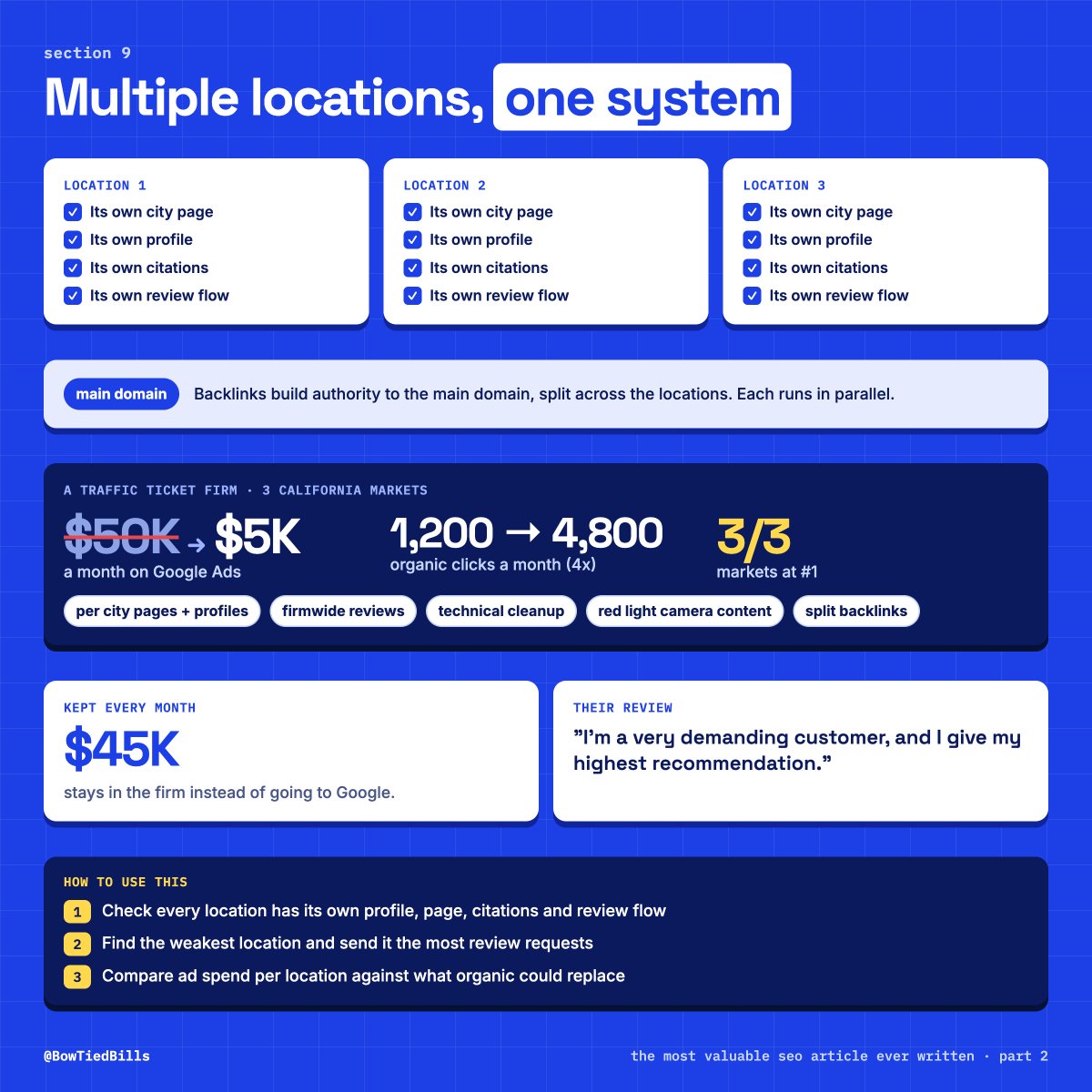
Each location needs its own setup, running in parallel.
-
Each city gets its own page
-
Each profile gets its own citations and its own review strategy
-
Backlinks build authority to the main domain, split across the locations
What it did for a traffic ticket firm:
1 traffic ticket client, with offices across 3 California markets, was paying Google $50K every month for ads.
We built per city pages and profiles, a firmwide review strategy, did the technical cleanup, wrote content on red light cameras and fines, and split the backlinks across the locations.
They got to #1 in all 3 markets.
Monthly organic clicks climbed from 1,200 to 4,800, a 4x jump, which let them drop ads from $50K to $5K.
$45K a month stayed in the firm instead of going to Google.
Their review of us: "I'm a very demanding customer, and I give my highest recommendation."
How to use this:
-
List every location and check each one has its own profile, page, citations and review flow
-
Look at which location is weakest, and send it the most review requests
-
Compare your ad spend per location against what organic could replace
10. When someone says SEO is dead:
Every few months, someone online announces that Google killed SEO.
Here's how to tell whether it's real.
The &num=100 panic:
In 2025, someone claimed a quiet Google update had "destroyed SEO."
What happened: a URL setting that showed 100 results on 1 page stopped working.
Ahrefs and Semrush now needed 10 requests instead of 1, so their costs went up 10x.
It had 0 impact on actual users and actual search.
You can check that yourself by typing any search, scrolling down and clicking page 2.
AI search runs on SEO:
Most of showing up in AI answers is ranking at the top of Google for relevant searches anyway.
You only do that with solid domain authority to begin with.
Get the map and the organic rankings up first, and your AI visibility rises with them.
Yelp is better than your Google profile for getting cited in ChatGPT specifically.
And a 20 to 30 year old firm with case studies it doesn't know how to present is a much easier job than a brand new business.
AI SEO tools:
Anyone expecting to pay for a tool, publish whatever its prompt spits out and land #1 in AI answers overnight should DM me, because I have a bridge to sell you.
The interfaces are nice, and they help a bit with AI keyword research, and that's where the value ends.
How to use this:
-
When you see an "SEO is dead" post, check your own calls and rankings before you change anything
-
Every month, ask ChatGPT to name the top [your service] in [your city], and log the answer
-
Fix your Yelp listing, because it feeds AI answers more than most people expect
11. Who should do this work:
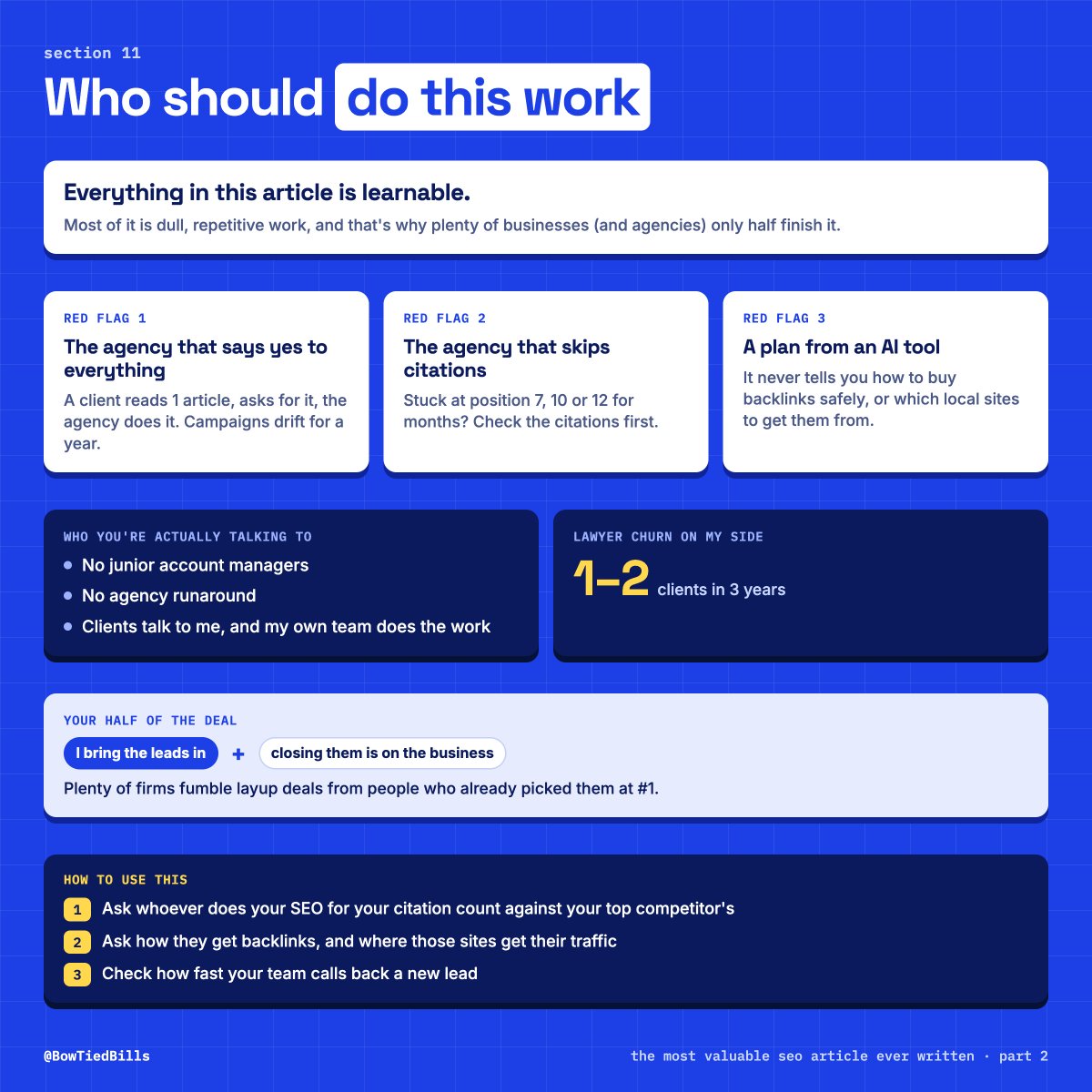
Everything above is learnable.
Most of it is dull, repetitive work, and that's why plenty of businesses (and agencies) only half finish it.
The agency that says yes to everything:
A client reads 1 article online, asks for whatever it said, and the agency does it.
Saying yes too much to a client who doesn't know what they want is how campaigns drift for a year with nothing to show.
The agency that skips citations:
If your rankings have sat at position 7, 10 or 12 for months, check the citations first.
That's the step most agencies skip, and it's where most plateaus come from.
Generic advice from an AI tool:
A lot of owners now get their SEO plan from Claude or ChatGPT.
It'll never tell you how to buy backlinks safely, and it doesn't know which local sites to get them from.
Who you're actually talking to:
On my side, there are no junior account managers and no agency runaround.
Clients talk to me directly, and the people doing the work are my own team.
Your half of the deal:
How good you are at the work still decides a lot of the outcome.
I bring the leads in, and closing them is on the business.
Plenty of firms fumble layup deals from people who already picked them at #1.
That's also why lawyer churn on my side sits at 1 or 2 clients in 3 years.
How to use this:
-
Ask whoever does your SEO for your citation count, and how it compares with your top competitor
-
Ask them how they get backlinks, and where those sites get their traffic
-
Check how fast your team calls back a new lead, because that's where the ranking turns into revenue
How to put this into practice:
Spread all 11 sections across the year, and run it as a routine.
Every week:
-
Post 2 to 3 times on your business profile, with real photos
-
Reply to every new review
-
Check that the review requests are going out
Every month:
-
Rescan your grid and compare it with last month
-
Run the citation search on yourself and your top competitor
-
Count your reviews from the last 90 days against your top 3 competitors
-
Track calls and form fills from Google
Every quarter:
-
Add new city pages and case type pages
-
Review your backlinks and where they get their traffic
-
Ask the AI tools who they recommend, and see if it's you
What the timeline looks like:
Month 1 is where clicks, calls and profile visits start ticking up.
The fastest lead one of my clients got from Google came 6 days in.
By roughly month 3, #1 on the map across 20 to 25 square miles of your office is realistic, and your target searches are climbing into the first 2 pages.
The most competitive cities need closer to 6 months.
Consistency for 3 to 4 months is what makes it build on itself, the same way buying the S&P 500 every month does.
The ones who quit at month 1 or 2 never get the big returns.
TLDR:
Measure the whole grid, because your position moves with the searcher.
The top 3 on the map get ~61% of clicks, and every spot up doubles your leads.
Set your primary category to the exact service you want, and give every service its own entry and its own page.
Fix your citations until you're in the same ballpark as your top competitor.
Get reviews every month, reply to all of them, and don't direct what clients write.
Build pages for paying clients, make the phone number easy to tap, and stay open longer.
Buy links through real outreach to local and industry sites and never marketplaces.
And when someone says SEO is dead, check your own numbers first.
Seems like a skill issue to me.
Also, DM me "VALUABLE" if you want me to run a full SEO service for your local business
(Or just book a call @ https://calendly.com/bowtiedbills/30min)
I've taken 50+ law firms to #1 on Google, and I only work with 1 firm per practice area per city
- BowTiedBills
沿着这个主题继续读
从一篇文章,找到相关的教程、经验和阅读路径。