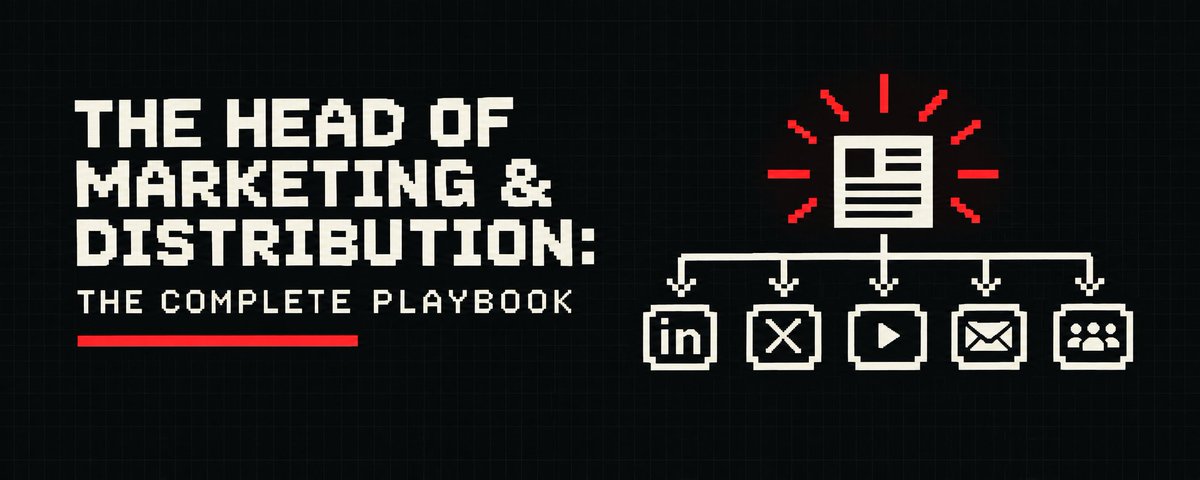
How to Be a World-Class Head of Marketing & Distribution
文章目录
If you run marketing at a tech company, are hiring someone to own content and launches, or want to become that person, this is for you.
I run a LinkedIn agency, a creator platform for content distriburion, and previously owned an X content agency. I've worked with 100+ tech executives over the past 6 years doing this and if someone had handed me this article when I started, it would've saved me years of guessing.
You might not think it's true, but 90% of tech companies still treat LinkedIn and X like a place to post updates.
The best ones treat them like a distribution channel, with one person who owns it the same way a VP of Sales owns pipeline.
That person is what I like to call the Head of Marketing & Distribution, and this is how to be world-class at it.
This article is BEYOND packed, so here's your roadmap:
-
What is a Head of Marketing & Distribution?
-
Part 1: Daily content (research, systems, operations, schedule, and what goes into going viral)
-
Part 2: Launches (research, systems, operations, schedule, and what makes a launch take off)
-
How it all fits together
-
How to hire one
Everything here comes from running these campaigns for founders and tech companies ourselves. None of it came from asking AI what works lol
What is a Head of Marketing & Distribution?
Every company calls this role something different. One startup's Head of Content is another's Head of Social, Head of GTM, or Growth Lead...
The title matters a lot less than the job. Whoever owns it is responsible for 2 things:
-
The daily content going out on the founder's and execs' LinkedIn and X accounts
-
The launches where the company needs the whole feed talking about it at once.
Everything else in this article is what it takes to do those 2 things EXCEPTIONALLY well.
You'll usually report to the founder or CEO at an early-stage startup, the CMO or VP of Marketing at a growth-stage or enterprise company, or clients if you're at an agency or fractional.
Whoever you report to, the same rules apply:
-
Learn what they care about. A founder might say they want more followers, but what they usually mean is they want buyers to know who they are before the sales call.
-
Protect their time. Each exec should spend about an hour a week on content, and you handle everything else.
-
Push back. You'll get asked to post the company announcement nobody cares about. Say no when the data says no, and show them what will work instead (use Grokbot to back X claims and Stanley to back LinkedIn claims)
The skills underneath all of it are copywriting, taste, knowing how LinkedIn and X each work, capturing each exec's voice, directing visuals, and reading the data. You need all of them, and the rest of this article is where they get used.
Part 1: Daily content
Launches get all the attention in the 2026 tech space, but daily content is what builds the audience your launches land on.
If nobody's watching your founder's account on a normal Tuesday, they won't be watching on launch day either (unless you pay for distribution ofc).
The research behind it
I don't know why, but most people skip research and go straight to writing, which is why their posts sound like everyone else's and DO NOT perform.
-
Daily trend scan (20 to 30 minutes). Check X for what's breaking in AI and your category: new releases, viral takes, funding news, debates. Flag 3 to 5 items your ICP will care about that haven't reached LinkedIn yet. LinkedIn runs a few days behind X, so a trend you catch Monday is still new there Wednesday. (use grokbot for this)
-
Weekly swipe-file session (1 hour). Pull the 10 to 20 best-performing posts in your niche from the past week. Log the hook, structure, format, visual, and why each one worked, and tag them by type (trend, playbook, proof, contrarian, story) so writers can grab a proven structure whenever they need one (again use grokbot to speed this up)
-
Buyer research (ongoing). Pull the exact phrases, objections, and questions from sales calls, comments, and DMs into a shared doc. Every objection on a sales call is a post you haven't written yet.
-
Exec material (bi-weekly). One interview with each exec, plus anything they said in Slack, on calls, or in meetings that sparked a strong opinion or story. Each interview should give you 5 to 10 post ideas.
-
Performance review (weekly). Find which posts drove profile visits, ICP follows, comments from target accounts, and DMs, and build next week's plan around what you learn.
The systems behind it
Systems are what let you post 5 times a week across 5 exec accounts without the quality dropping.
-
Idea bank. One central database in Notion, Airtable, or similar, where every idea from trends, interviews, buyer research, and the swipe file goes in, tagged by exec, pillar, and post type.
-
Voice database for each exec. Interview transcripts, best past posts, words and phrases they use, words they never use, their opinions and stories, and a kill list of AI-sounding patterns. Writers read it before every draft. This is what keeps five exec accounts from sounding like one company page.
-
Content pillars. 3 to 5 per exec, each tied to a buyer pain or the company's point of view. Every post maps to one, which keeps the account focused.
-
Templates for each post type. A proven structure for trend takes, playbooks, proof posts, contrarian takes, and behind-the-scenes posts, taken straight from the swipe file.
-
Visual library. Exec photos, brand templates for frameworks and carousels, screenshot standards, and clips from interviews, so a visual takes a few minutes to put together.
-
Tracking sheet. Every post logged with its date, exec, pillar, type, hook, format, visual, impressions, profile visits, ICP comments, and DMs or calls. This is how you find out what's actually driving results.
-
AI workflows. Claude projects trained on each exec's voice database, plus skills that turn an interview or sales call into post drafts in a few minutes. The writer's job becomes editing and adding taste.
The operations behind it
The best distribution leads are creative, but they're also great operators. Most creative people hate this part, which is exactly why getting good at it is such an edge.
Team roles
In a lean setup:
Strategist .......... Positioning, the calendar, reporting, final say
Writers (1 to 2) .... Drafts and voice, ideally one writer per exec voice
Designer/editor ..... Visuals and video clips
Engagement lead ..... First-hour coverage and comments
As you grow, you split these out further. Having one central designer is a huge unlock, because design is usually what stops people from posting at all.
The pipeline
Every post moves through the same steps:
-
Idea
-
Outline
-
Draft
-
Internal edit for voice, hook, and the kill list
-
Visual
-
Exec approval
-
Schedule
-
Post
-
Engage
-
Log results
Exec time and approvals
Hold each exec to about an hour a week: a 30 to 45 minute interview (bi weekly) + one batch approval / feedback. Run approvals as one batch per week (Thursday for the following week works well) with a 24-hour turnaround, and leave room for same-day posts when a trend breaks.
The quality bar
Before anything gets scheduled, check that:
-
The hook stops the scroll
-
The idea feels new
-
It sounds like the exec
-
It ties to a pillar
-
It has a visual
-
Nobody else in the industry could have posted it
The schedule behind it
Weekly operating rhythm
Monday ..... Performance review of last week + trend scan + plan the week Tuesday .... Exec interviews (rotating) + swipe-file session Wednesday .. Drafting + visuals for next week Thursday ... Internal edit + batch exec approvals Friday ..... Schedule next week + buffer for reactive trend posts Daily ...... Trend scan, post, first-hour engagement, comment on niche creators
Per exec account, 5 posts a week (on LinkedIn)
Monday ..... Trend + opinion Tuesday .... Playbook with a visual Wednesday .. Proof (result, case study, screenshot) Thursday ... Contrarian take Friday ..... Behind the scenes
I wouldn't go over 7 posts a week per account on LinkedIn. Past that, the audience gets bored and the quality drops. For X Run this but do 2+ posts a day)
Daily engagement
-
Reply to every comment for the first 30 to 60 minutes after posting.
-
The other execs and the team comment on the post in its first hour.
-
Each exec leaves 5 to 10 thoughtful comments a day on niche creators and ICP accounts on LinkedIn, plus daily replies under the big accounts on X.
What actually goes into going viral
The goal is semi-viral inside your ICP. Broad viral content goes viral because it relates to everyone, which means most of the people who see it will never buy. The posts that hit inside your ICP almost always have most of these:
-
A timely or new idea. Something that just happened, a take nobody has said yet, or an insight only this exec has. Nobody wants to read "5 tips to increase your sales conversions" for the hundredth time.
-
A topic people already care about. Too many people obsess over perfect hooks, when a good hook mostly comes down to what you're actually talking about.
-
A hook built to stop the scroll. A specific number, a bold opinion, an admission, or a clear promise in the first line. The second line earns the "see more."
-
A clear point of view. Opinionated beats balanced, and posts people can agree or disagree with get comments.
-
A proven structure. Lists, before and afters, and step-by-step frameworks, all pulled from the swipe file.
-
A visual. It takes up more of the feed and keeps people on the post longer.
-
Credibility. Hard numbers, screenshots, and lived experience, which make it easy to share without looking foolish.
-
Early momentum. Strong engagement in the first hour from the exec, the team, and peers tells the algorithm to push it further.
-
Timing. Weekday mornings in the ICP's time zone, and for trend posts, getting on LinkedIn while the topic is still new there.
-
Easy to share. Something people want to save, repost, or send to a coworker, which usually means a framework, a strong take, or useful proof.
Then make the next one hit on purpose. Log every post, compare the winners to the flops, and double down on the hook types, formats, and topics that keep working. If a strong idea flops, repackage it and post it again.
Part 2: Launches
Launches are standard in AI and tech now, and most companies still get them wrong.
When we ran Leadpoet's launch, the video totaled 1M+ views and they doubled their client base. That didn't happen because of one good post. It happened because a lot of pieces were working together.
Roadmaps move fast now, so there's always something to launch: new features, new model integrations, milestones, funding rounds, and big customer wins. The more you launch, the more the market feels like your company is everywhere.
The research behind it
-
Find the one-sentence story: what's new, who it's for, and why it matters now.
-
Study the best recent launches in your space on X and LinkedIn. Look at the hook and second line, the video and what happens in its first three seconds, the visuals, the timing, and who amplified them.
-
Map who's in the launch window: execs, team members, customers, investors, creators, and partners. Know which of them actually reach your ICP.
-
Vet every creator before you book them. Check their recent posts, and skip accounts that are mostly sponsored posts or have obviously fake engagement. A smaller account your ICP follows beats a huge account they don't.
The systems behind it
-
Launch brief. The story, ICP, key message, proof points, assets, call to action, date, and time.
-
Asset pack. A launch video or demo clip, screenshots, a one-line description, visuals sized for each platform, and suggested angles for every person posting.
-
Launch roster. Every account posting, its angle, its exact time, and who's covering its comments.
-
Quote post library. A doc of quote posts that have performed well on past launches, used to review drafts and brief creators.
-
Creator database. Every creator you've worked with, their audience, what they delivered, and whether you'd book them again. After a few launches, this becomes one of the most valuable things the team owns.
-
Launch-day war room. A live Slack channel or dashboard where the team shares each post as it goes up and coordinates first-hour engagement.
(we run this all → gottcreators.com)
The operations behind it
-
Each exec gets their own QRT angle, such as the founder story, a technical deep dive, or customer impact, so the feed shows several different takes on the launch.
-
Drafts for every account are written ahead of time and approved, so launch day is just execution.
-
The copy follows a pattern. The first line should sound almost unbelievable, the second line is social proof (an investor your ICP knows, or hard numbers), and the brand name stays out of the hook because nobody knows it yet.
-
The video does the heavy lifting on shares. If your team can't make one people want to watch twice, bring in someone who can.
-
Creators get a brief with the date, time, your post copy, and a few angles for their quote post. Let them write in their own voice, because their audience can tell when they're reading your copy. Review every draft before launch day.
-
Every sponsored post is labeled as a paid partnership. Getting you or your creators banned isn't worth it.
-
Supporters (team, customers, creators, investors) get the date, time, assets, and their suggested angle days ahead.
-
On the day, one person runs the war room, tracks posts going live, makes sure engagement happens in the first hour, and pins or reposts the strongest performers.
-
Creators get paid once their post is live, and every result gets logged in the creator database.
The schedule behind it
2-3 weeks out ... Story, brief, asset production, launch research, launch roster 2 weeks out ..... Shortlist and vet creators, lock the date and time 1 week out ...... Teaser content on exec accounts (the problem, behind the scenes)
Creators booked and briefed
3-5 days out .... All launch drafts approved, creator drafts reviewed, supporters briefed with assets Day before ...... Final check on timing, links, and assets; war room set up Launch day ...... X first (where launches spread), LinkedIn within the same morning Days 1-7 after .. Follow-up content: results, reactions, customer stories, behind the scenes of the launch, answers to questions from comments
Launch day, hour by hour
T-0 ........ Founder posts the launch on X T+15 min ... Team and network start commenting and replying T+30 min ... First wave of creators quote post T+1 hr ..... Founder and execs post on LinkedIn, each with their own angle T+2 hrs .... Second wave of creators quote post All day .... Reply to every comment, pin and repost the strongest posts
Stagger the creator posts. Everyone quote posting at the same minute gets flagged right now. Quote posts beat reposts, always, because they put the launch in front of each creator's audience with their own take attached.
What makes a launch actually take off
-
Everyone posts in the same window, so the whole feed is talking about you at once.
-
Each poster has a different angle, so it looks like the whole industry is talking about it on its own.
-
A demo or video, because people need to see the product working, especially on X.
-
An audience that already exists. If daily content built attention before launch day, the launch lands. If it didn't, no launch plan can fix that.
-
Follow-through. The week after the launch is where you turn attention into proof and keep the story going, and it's where most companies stop.
How it all fits together
Research feeds the idea bank. Systems turn ideas into on-voice posts with visuals. Operations and the schedule keep five posts a week going out per exec with only about an hour of each exec's time. Engagement and tracking show what's working.
The daily content builds the audience, and launches spend it.
How to hire one
This is hard, mainly because anyone who's great at this can usually make more money working for themselves. You have to give them a reason to say yes.
If someone on your marketing team already has a content background and you think they can grow into it, invest in them first. It pays back fast, because they already know the product and the buyer.
If you're hiring from scratch
-
Hire from X and LinkedIn. The best people are already posting. Make a list of accounts in your space that think clearly and write well, and reach out.
-
Look at small accounts. Someone with 2k followers who posts sharp, original takes is often a better hire than someone with 50k who recycles advice.
-
Always run a paid test task. Give them a real exec and relevant info, and ask for 5-10 posts with a written strategy for the next month.
-
Hire for taste and thinking, then train the rest. This role is very coachable, but only if the person can come up with good ideas on their own.
How to get them to say yes
-
Find out what makes this a home run for them, and build the offer around that.
-
Offer stable income. Most people in content don't have it.
-
Tie bonuses to results, so they're rewarded for what actually matters to the business.
-
Give them a team. Don't hire one person and expect them to be the whole department.
-
Give them creative control and let them cook.
-
Support their own brand. Don't make them choose between building your company's audience and their own.
What to look for if you don't know content
-
Be careful with first-timers. If they've never run content and launches for a company before, they should have at least worked closely with someone who has.
-
Ask what their posts turned into. Anyone can show you an impressions screenshot.
-
Read their own writing. If they can't make their own account sound like a person with opinions, they won't make your founder's sound like one either.
-
Borrow someone else's judgment. Ask someone who has hired for this role before to sit in on the final interview.
Final thoughts
This was long, but I don't see anyone else breaking down this role end to end, and it's the hire I'd make first at almost any tech company right now.
If you'd rather have this whole system run for you, from the daily content to the launches, that's what we do at Gott Content. Just DM me.
Drop any questions in the comments and I'll answer any legitamte questions.
If this helped, a like or QRT helps a lot! Thanks!
- Logan