Those viral claims about plummeting Russian ‘bot’ activity have no basis in fact
文章目录
For two days, X has been deluged by claims of a sharp decline in Russian “bot” activity — supposedly a result of Ukrainian strikes on three Yandex data centers this week.
These claims have been promoted by respected analysts, top politicians, and ordinary Ukraine supporters clearly eager for a win during a difficult week.
Unfortunately, they’re based on data that has been misunderstood or appears to be entirely made up:
-
One chart from internet infrastructure company CloudFlare shows a decline in automated web traffic from Yandex. But this is a measure of things like search engine requests, not social media bots.
-
Another chart purportedly shows a decline in activity related to Germany’s right-wing AfD party. But it contains obvious errors and is completely unsourced. My view is that it’s entirely fake.
I’ll go into more detail on both cases below. The bigger picture is that the “anti-Russian-influence” field remains vulnerable to large-scale misinformation fueled by motivated reasoning.
This isn’t the first time I’ve seen exaggerated claims about Russian influence go viral. But last night I was truly struck — really, almost radicalized — watching in real time as experts at the heights of their careers unquestioningly boosted emotionally satisfying narratives that were pretty much entirely wrong.
It’s tempting to ascribe this all to people’s ideological commitments, and I’m sure Ukraine’s enemies will waste no time pointing that out. But of course, this kind of thing permeates the right-wing information environment, too.
More illuminating, I think, is the lens of social psychology: People like to have their views confirmed, they like to cheer on their team, and they like to collect likes and retweets. And I don’t mean to descend into cynicism. Ukraine has had a particularly tragic few days, stabbed in the back by the Trump administration even as dozens of civilians were murdered by Russian drones and missiles. I understand that people are hurting and want to celebrate a win. That’s just human nature.
But it's hugely important for those of us who support Ukraine to practice good epistemic hygiene. If for no other reason than because Russian influence activity, both on- and offline, is absolutely a real, documented threat to the democratic world. I’ve done a good amount of reporting and editing on this topic: Consider the ‘Dear Compatriots’ project, this story on Russian interference in Moldova’s EU referendum, or this investigation into real Russian “cognitive strikes” against the West.
These threats are much harder to address when they’re lost in a cacophony of exaggeration. For example, the actual effects of the Ukrainian strikes on Russia’s walled-off digital infrastructure — as reported, for example, here by @thebell_io — are real and important, and have been totally drowned out.
I'll note that the responsibility to cover this issue truthfully and accurately, and not just to engage in wishcasting, is especially incumbent on people in high-level positions with large platforms.
Now, for the details on the specific claims:
CloudFlare
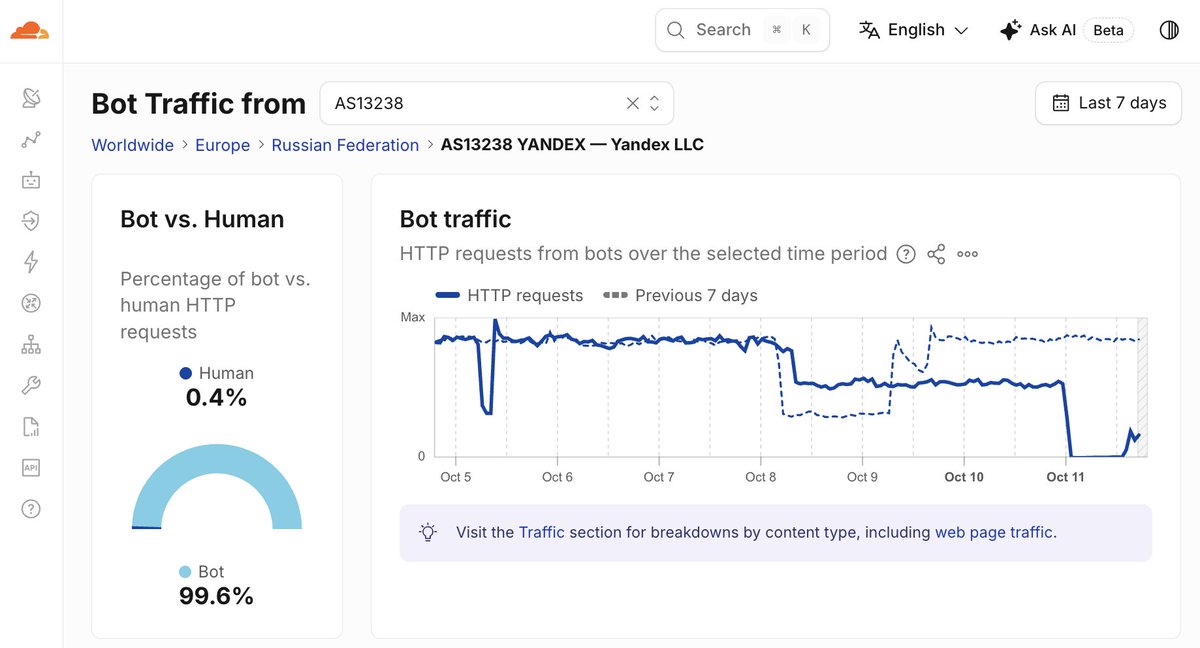
This chart from CloudFlare purportedly shows that Russian “bot activity” has dropped since the Ukrainian strikes. But that technically illiterate interpretation has been thoroughly debunked, initially in this thread by @antibot4navalny, a widely cited group of Russian researchers. “Bots” here refers not to “automated social media accounts” but to any kind of automated requests made to web sites, such as the crawlers that do** **web searches. It stands to reason that these requests fell after the Yandex centers were struck.
AfD
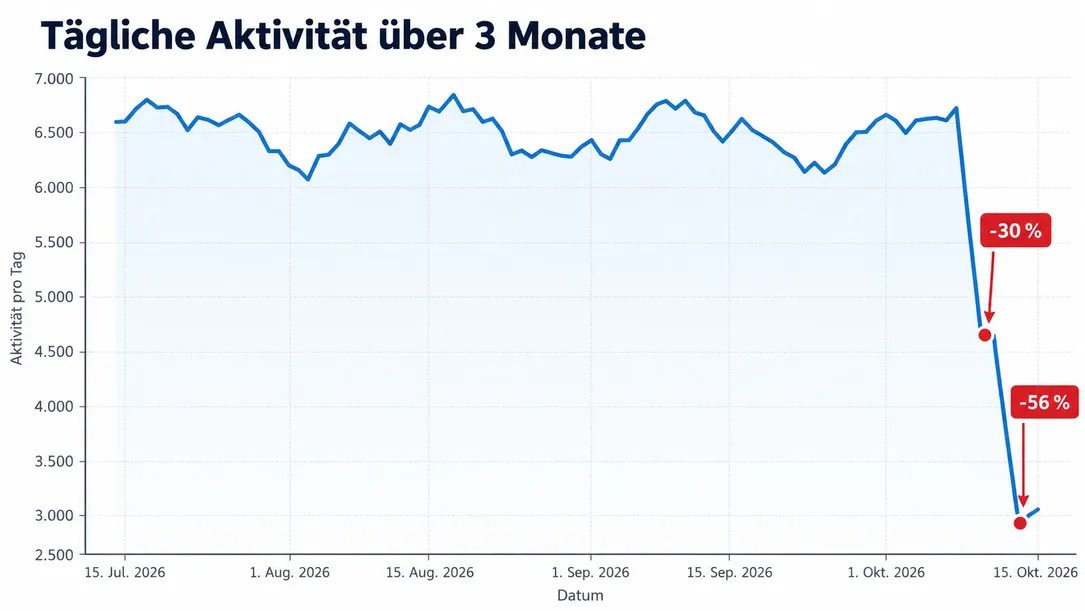
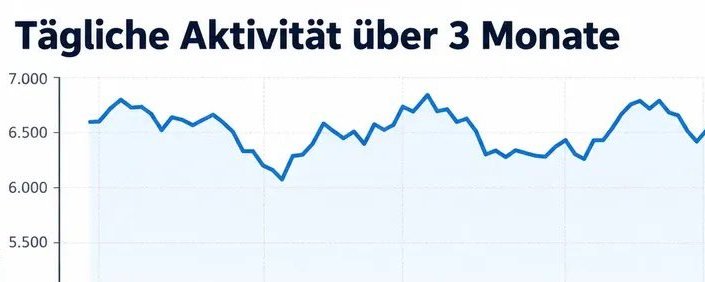
Most virally of all, Czech MEP Tomáš Zdechovský shared this chart, allegedly showing that activity related to the right-wing German AfD party plummeted after the strikes. The implication is that it was all inauthentic Russian influence.
But the chart has a number of issues:
-
It was shared on October 11, but the second marked point appears to fall on a future date, around October 13. The “data” (the blue line) extends all the way to October 15.
-
It has obvious errors, like the bottom interval on the Y-axis being noticeably smaller than the rest. No chart creation software would do that, even if you were feeding it fake data. My assumption (which I can’t prove) is that this was AI-generated.
-
It’s completely unclear what it’s supposed to be measuring. The Y axis is labeled “Activity per day” — so what is that supposed to mean? 4,500 activity per day?
-
Most fundamentally: Any legitimate chart like this would be more professionally labeled and titled, and we would know who made it and what data it was based on. This doesn’t even have a logo. It doesn’t even say AfD on it!
I wrote Zdechovský to ask him about these issues, and where he got this chart. His spokesperson sent a quick and polite reply, but didn’t respond to the latter question. For transparency I’ll paste the entire response below.
Now, all of this doesn’t prove that nothing happened. What it shows is that there’s no proof that anything happened. It’s certainly possible that nefarious Russian bot activity really has been reduced. Tracking this kind of thing is very difficult, and I hope someone does a detailed and rigorous study soon. Until then, I think the widely-repeated anecdotal observations — “wow, social media seems so much nicer today!” — can be dismissed as wishful thinking.
Meanwhile, I'll go back to reading X and grinding my teeth.
Here is the response to my inquiry from Mr. Zdechovský’s spokesperson, reproduced in full. In light of the above, you can decide if you find it convincing:
"In my post, I explicitly used the phrase “If confirmed” to make it clear that the suggested connection was not yet an established fact, but rather an interesting finding that deserves further examination by data analysts. I certainly did not present it as a conclusively proven fact.
At this point, I do not have any additional data available. What we do know for certain is that, according to Cloudflare data, Yandex bot traffic dropped dramatically by 99.6%. Even President Zelenskyy has pointed out that there has been less anti-Ukrainian hate on social media. Is this a coincidence? It is difficult to say. Personally, however, I believe there is a connection.
Regarding your second question, I would like to point out one important inaccuracy. The graph does not actually end on October 15, as you suggest. That date is merely the final label on the horizontal axis, while the plotted data ends before that date. It is therefore incorrect to automatically assume that the graph contains data from the future.
I have been dealing with Russian disinformation operations and foreign interference for many years, including through my work in the European Parliament. Their existence has been extensively documented in numerous reports by European intelligence services and EU institutions. I strongly reject the notion that a single unverified graph should undermine the extensive evidence of Russian influence operations or the need to take decisive action against them.
This is precisely why I am preparing an appeal to the European Commission, urging it to address this issue seriously and decisively. If we continue to allow Russian bots to operate unchecked, we risk losing our democracy."