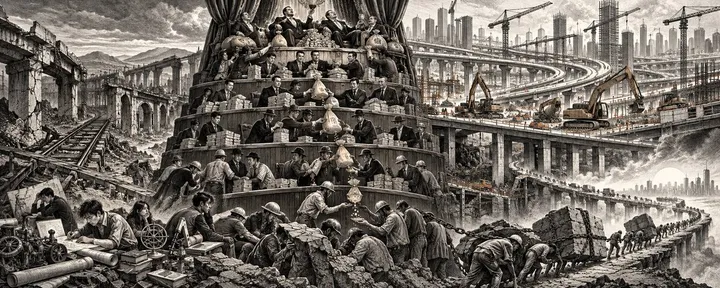
India's Existential Material Trap
文章目录
India threw off one empire's chains, and now its rival holds the reins. Are we about to witness its submission?
**Remember to read Part 2 after you've finished this **
India faces the gravest risk any nation can face: it cannot supply the inputs it needs to stay independent. Every factory it is building to become an industrial power, every electric scooter, solar panel, transformer, medicine and missile, runs on materials controlled by the rival most likely to fight it. China holds the reins of India's seven-headed horse. India holds no published reserve of any of them. Beijing has already stopped Indian production lines with nothing more than a slow export licence, in peacetime, and on 10 November its pause on wider controls runs out.
The irony is bitter. A republic born of the fight to throw off colonial chains, whose first leaders built state plants to make its own rare earths, magnesium and penicillin, put on new chains by choice. It took up the West's financial doctrine, which counts dollars and cannot see smelters. It closed the banks that funded its factories and let its plants rust. Today India is solvent in money and insolvent in matter, and the country that profits is the one it fears most.
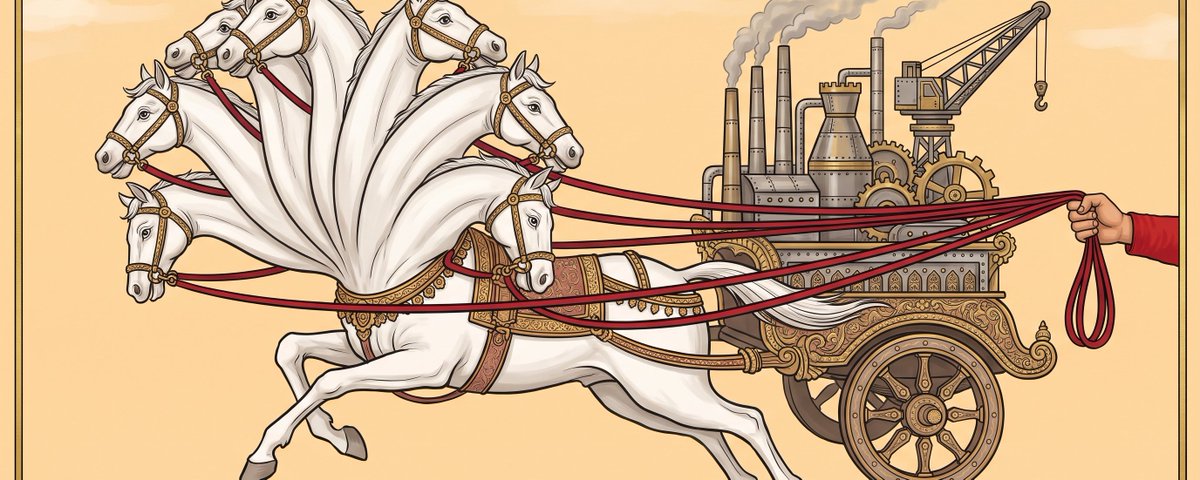
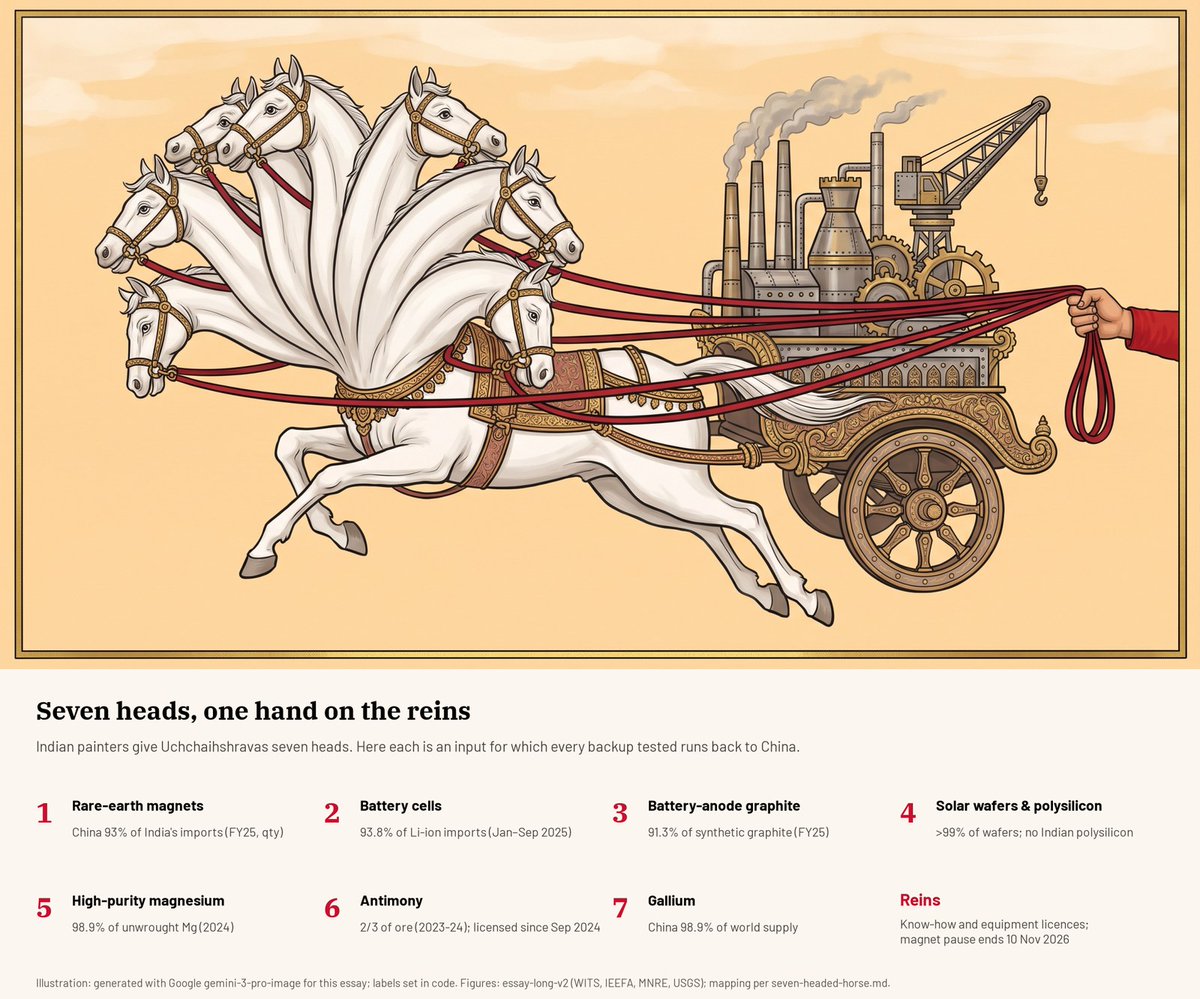
India's painters give Uchchaihshravas, the white horse that rose from the churning of the ocean in the Mahabharata, seven heads. India's industrial build has seven of its own: rare-earth magnets, battery cells, graphite for battery anodes, solar wafers and polysilicon, high-purity magnesium, antimony and gallium. For each one, every backup India has tested runs back to China through the ore, the owner or the licence. India supplies the power and the speed. Beijing holds the reins.
📷Seven heads, one hand on the reins. India's whole build is pulled by seven inputs; China holds every rein.
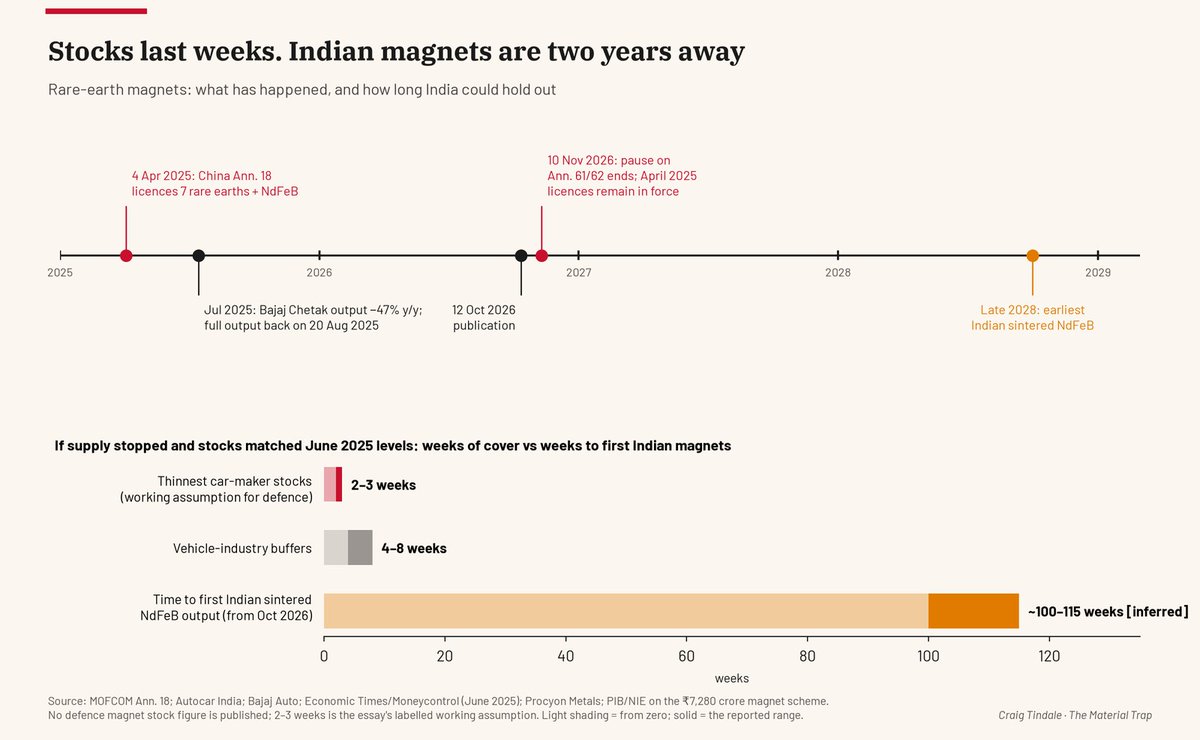
The reins have already been pulled. In April 2025, China put new export licences on rare earths and the magnets made from them. Within three months, Indian lines were slowing. On 4 July 2025, Rakesh Sharma, executive director of Bajaj Auto, told the Economic Times that production of the Chetak electric scooter had been disrupted. Bajaj built 10,824 Chetaks that July, 47 per cent fewer than a year before. Full production did not resume until 20 August, after Bajaj switched to light rare-earth magnets and found fresh supply.
No bomb fell, and no border closed. A clerk in Beijing was slow to stamp a document, or Xi pulled the reins.
China supplied about 83 per cent of the permanent magnets India imported in 2024 by value, according to World Bank trade data. In June 2025, car makers reported magnet buffers of four to eight weeks, and the Indian Express reported that industry was down to two to three weeks of rare-earth magnet supply. A magnet turns current into motion in a scooter motor and in the actuator that moves a missile's fin. India's armed forces draw on the same supply chain, and no government body publishes a defence stock. I use the industry's two to three weeks as the working figure for the thinnest military stocks. No stoppage of a defence line is on the public record. The record shows only that the door to one was open.
In June 2020 Chinese troops killed 20 Indian soldiers in the Galwan valley. Five years later, Indian factories were waiting on Chinese licences to keep their motors turning.
Seven hundred billion dollars that cannot buy a magnet
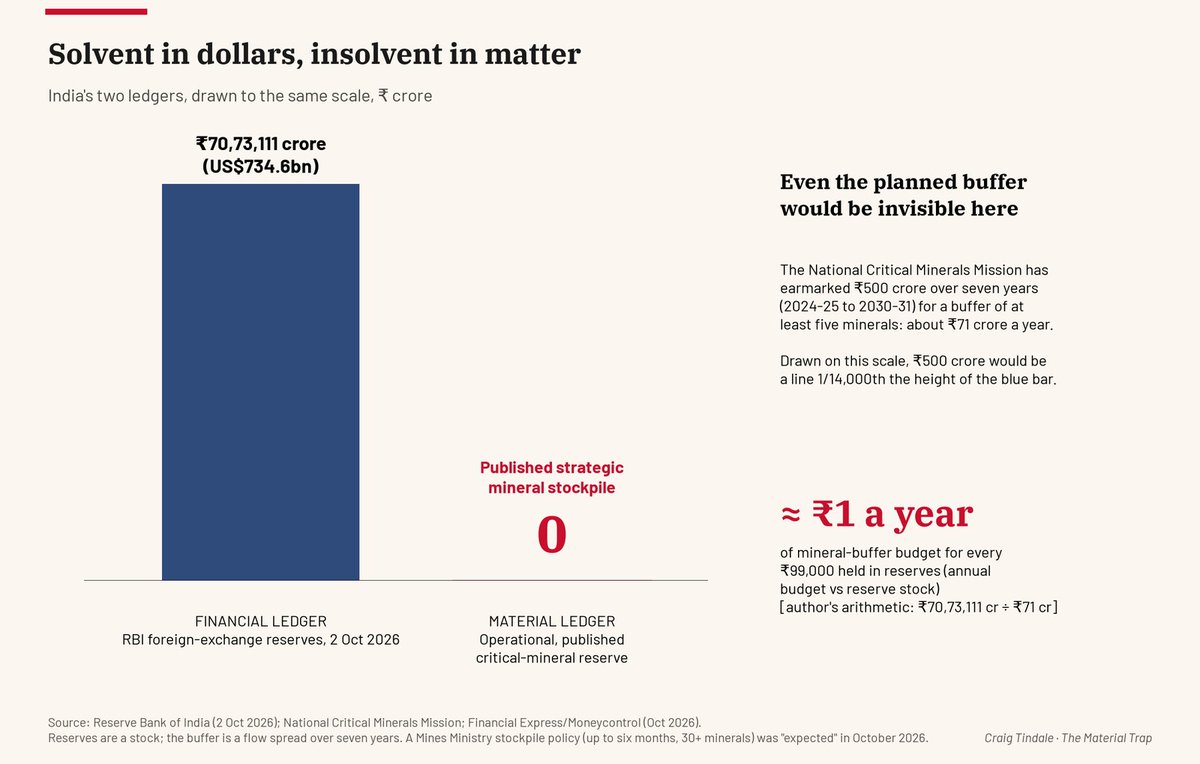
India is rich in the one reserve that cannot help it. On 2 October 2026, the Reserve Bank of India counted US$734.6 billion of foreign exchange, a figure it publishes every Friday. It publishes no reserves of dysprosium, terbium or gallium, because none exist.
📷Solvent in dollars, insolvent in matter. ₹70,73,111 crore of reserves against a published mineral stockpile of zero. Source: RBI, 2 Oct 2026; National Critical Minerals Mission ·
India chose that blindness. A modern state keeps two sets of accounts. One records money, in currency, credit and prices. The other records matter: ore, energy, and the plants that turn rock into metal. The economics India adopted from the West counts the first and assumes it can always buy the second. India trained a generation of officials in that faith. Its statisticians measure output, inflation and jobs, and keep no line for a smelter, a separation plant or a warehouse of rare earths.
The faith holds until a seller refuses. A price rise can be paid. A refusal cannot. When China's commerce ministry withholds a licence, the price of a magnet becomes irrelevant, because no quantity of dollars will release a shipment that a state has decided to stop, and the reserve built to protect India against one kind of shock sits idle in the face of another.
The Reserve Bank can print rupees and spend dollars. It cannot print terbium. A separation plant takes years of capital and trained chemists to build. India would need it in the week a licence is refused.
By every test of money, India is strong. By the test of matter, India cannot stand a month on its own.
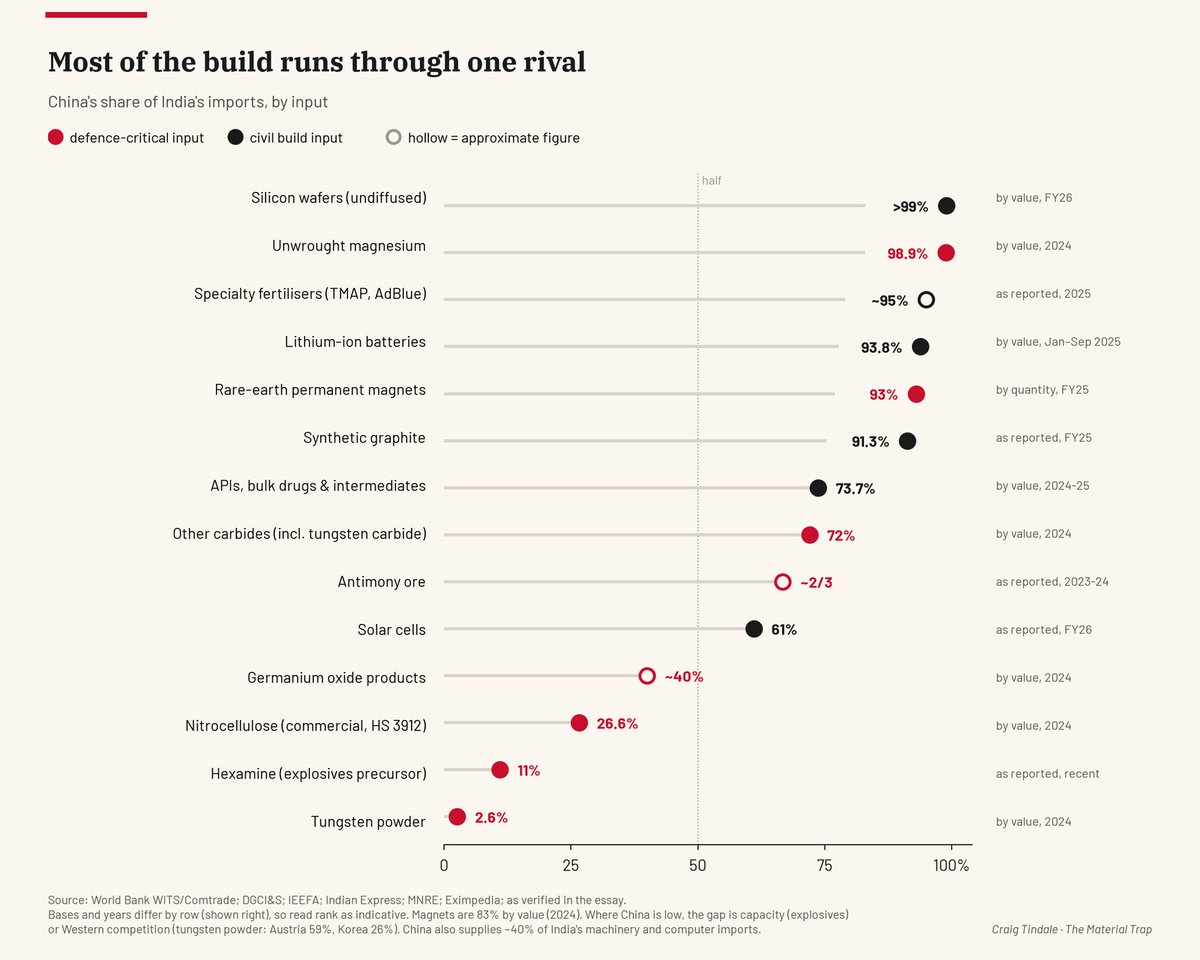
📷Most of the build runs through one rival. Fourteen inputs ranked by China's share, with the low ones shown honestly. Source: WITS/Comtrade, DGCI&S, IEEFA, MNRE, Eximpedia ·
Part Two. The proof
The magnet in the missile fin
The first thing dollars cannot buy is the magnet that moves a missile's fin. India builds no sintered neodymium magnets at industrial scale. Indian factories import what they consume, and the rival they expect to fight controls the supply line to their assembly floors. A licensing office in Beijing can stall an Indian defence line in peacetime.
China cut Japan off. In May 2026, Reuters reported from Chinese customs data that since December 2025 Beijing's exports of dysprosium and terbium to Japan had stopped. A Western customer told Reuters that the Japanese manufacturer Shin-Etsu ceased accepting new orders for magnets containing dysprosium. Japan is the largest magnet maker outside China. In 2024, Japanese industry bought about 14 tonnes of the two rare earths from China every month. Lynas, the Australian company that became the first commercial producer of separated terbium and dysprosium outside China, made 8 tonnes in the March 2026 quarter.
India stands behind Japan in the same broken queue for a component that drives modern machinery. A sintered neodymium magnet combines neodymium, iron and boron. Makers press powdered metal into shape and heat it until the grains fuse into a solid that holds a strong magnetic field for years, a process that converts electrical power into physical motion so efficiently that it drives electric-vehicle motors, industrial robots and the fin actuators of guided missiles. Heat breaks the field, and neodymium magnets lose strength as they warm. Metallurgists fix this flaw by adding small amounts of dysprosium and terbium to preserve the magnetism under extreme thermal stress. Combat aircraft and defence systems carry samarium-cobalt magnets, which use samarium and cobalt to survive even hotter work. If magnet deliveries stop, the assembly line stops.
In October 2026, Shaktikanta Das, Principal Secretary-2 to the Prime Minister, put China's share of the world's rare-earth magnet supply at 80 to 90 per cent. In FY2025, India imported 53,700 tonnes of permanent magnets of all kinds. China supplied 93 per cent of that volume. Within that total, buyers landed 19,573 tonnes of metal magnets, the trade class that covers the rare-earth components. India depends directly on an industrial input controlled by Beijing.
Domestic production offers no immediate shield against a supply shock. The state miner IREL runs India's only magnet plant. That facility makes samarium-cobalt magnets at a microscopic scale of about 3 tonnes a year.
China's export controls on rare earths and magnets, Announcements 61 and 62, are currently paused until 10 November 2026. China's April 2025 export licences covering terbium, dysprosium, samarium, and the magnets containing them remain in force.
📷Stocks last week. Indian magnets are two years away. Weeks of cover against roughly two years to the first Indian sintered magnets. Source: MOFCOM; Autocar India; Bajaj Auto; ET/Moneycontrol; PIB ·
India cannot forge titanium without Chinese magnesium
India cannot forge the titanium required for its airframes and missiles because China controls the magnesium needed to process the raw ore. Licence or default, the effect on an industrial plant is the same. In Kerala the shutdown lasted ten months.
From November 2021 to August 2022, an industrial plant in Kerala fell silent. In 2011, Kerala Minerals and Metals Limited (KMML) commissioned a titanium sponge plant at Chavara. KMML's Chavara plant is India's only titanium sponge maker, with a capacity stuck at 500 tonnes a year. KMML's planned expansion to 1,000 tonnes a year and its joint venture with the Steel Authority of India Limited (SAIL) have yet to materialise. Aerospace manufacturers require unworked titanium sponge to cast high-strength alloys, but turning mined earth into this pure metal demands a continuous feed of high-purity magnesium to strip oxygen from the raw ore in a high-temperature chemical reaction.
A broken supply chain stops that reaction immediately.
India's auditor, the Comptroller and Auditor General (CAG), names one of the two defaulting vendors as Jinxin Minmetals International, a Chinese trading firm. The audit puts the lost output at 182 tonnes, worth ₹32.33 crore. KMML produced 58.12 tonnes of titanium sponge that year, against 153.91 tonnes the year before, a fall of 62 per cent.
Domestic supply trails far behind military demand. The United States Geological Survey (USGS) estimates India's titanium sponge output was about 300 tonnes in 2025. Mishra Dhatu Nigam (MIDHANI), the state-owned defence alloy maker, alone requires around 600 tonnes of titanium sponge annually to meet its manufacturing schedules. By my calculation, this requirement is double India's entire 2025 domestic output. MIDHANI's FY2026 accounts show the company holds about 83 to 129 days of raw material on hand. Consumed raw materials are 50.5 per cent imported.
📷Even at full capacity, India's only plant cannot meet one buyer. One plant, one reagent, one supplier. Source: KMML AR 2022-23; CAG; USGS; MIDHANI ·
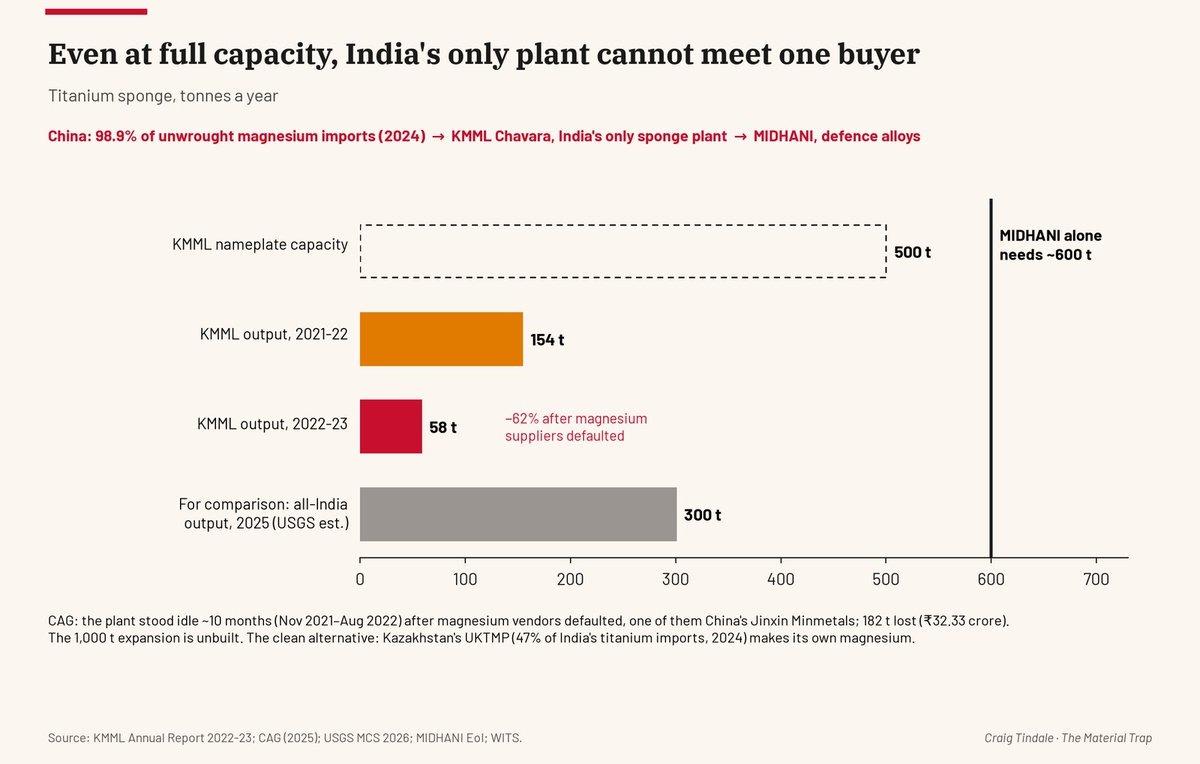
Purchasing finished sponge from abroad covers the physical shortfall. Kazakhstan supplied 47 per cent of India's titanium sponge, powder, and ingot imports in 2024. Kazakhstan's Ust-Kamenogorsk Titanium and Magnesium Plant (UKTMP), a major titanium sponge supplier to India, is 44.74 per cent owned by Belgium's Specialty Metals Holding Company. The Kazakh plant provides a functioning non-Chinese alternative for the metal itself. Importing titanium does not fix the structural vulnerability, because India produces no primary magnesium.
China produced about 86 per cent of the world's primary magnesium in 2025. Indian foundries buy the metal from one dominant supplier. China supplied 97.8 per cent of India's unwrought magnesium imports by value in 2023. The dependency deepened the next year when China supplied 98.9 per cent of India's unwrought magnesium imports by value in 2024. Russia supplied only 1 to 2 per cent of India's unwrought magnesium imports in 2024.
The trade record leaves no working non-Chinese door for the reagent.
Beijing classifies this chemical feed as a strategic asset. China's dual-use export control list controls high-purity magnesium under code 1C228. The controlled grade contains less than 200 parts per million (ppm) of metallic impurities other than calcium and less than 10 ppm boron. China's export control on high-purity magnesium has been in force since 1 December 2024.
The Tejas radar is Indian; its gallium is not
Purity is the choke point again. A radar chip needs gallium refined to a grade India cannot make.
The missing step leaves the country's sovereign air defences running on trace elements controlled by Beijing. The cost is a fighter line vulnerable to a sudden export freeze.
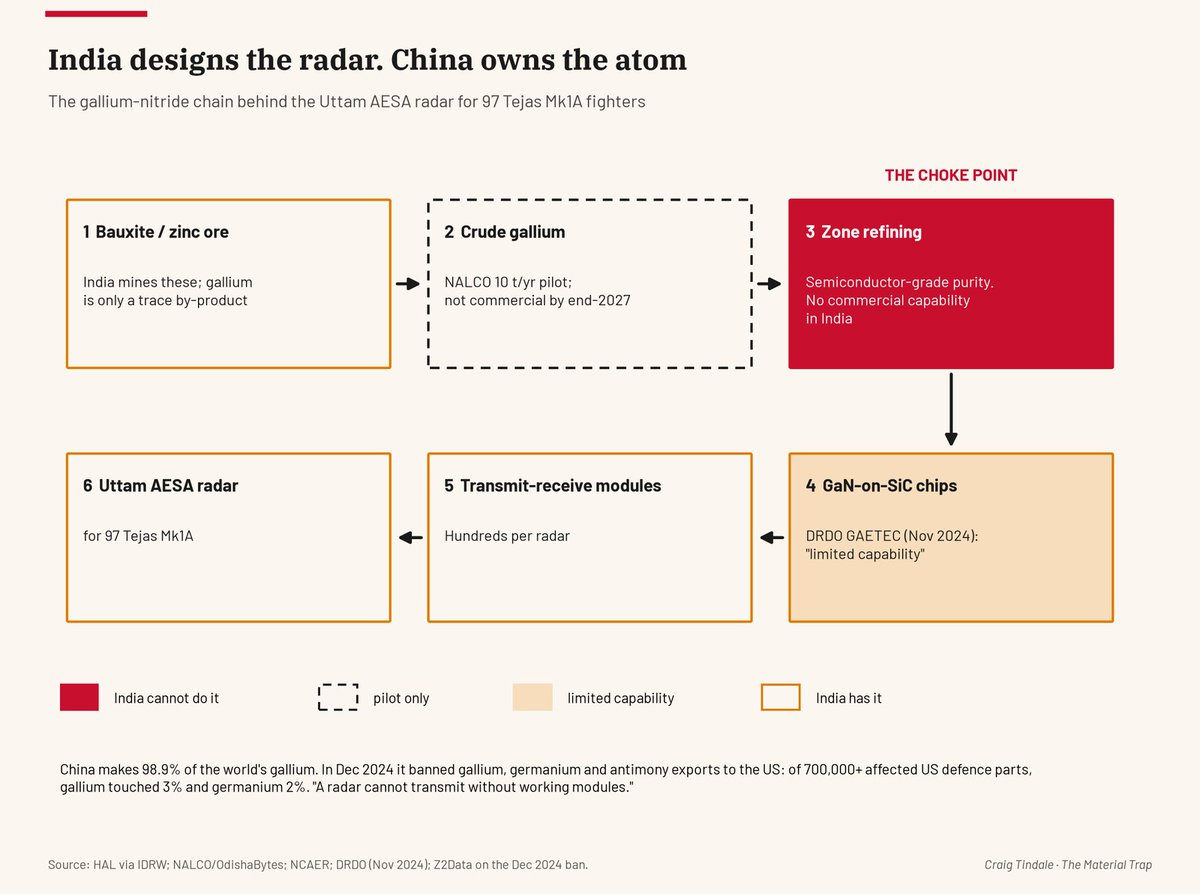
The second batch of 97 Tejas Mk1A fighter jets will be equipped with the indigenous Uttam Active Electronically Scanned Array radar featuring advanced gallium-nitride-based Transmit-Receive Modules. The modules pack hundreds of miniature transmitters across a flat plate to steer radio beams electronically without moving parts. Gallium nitride handles high electrical power and sheds heat efficiently. The Defence Research and Development Organisation (DRDO) designs the chips inside them. In November 2024, the DRDO announced limited capability for indigenous Gallium Nitride on Silicon Carbide Monolithic Microwave Integrated Circuits.
India owns the sovereign radar design, yet it lacks the fundamental chemical processing. Unrefined gallium carries impurities that destroy delicate electronic circuits. Crude metal must undergo an advanced purification process called zone refining, where induction coils melt a narrow band along an impure metal bar to sweep away electrical impurities, leaving behind the semiconductor-grade material required to amplify microwave signals without failing under high voltage. India lacks commercial zone-refining facilities to perform that step. The state is still trying to extract the basic element from domestic ores. Gallium does not exist as an independent mineral deposit.
The National Aluminium Company (NALCO) is establishing a 10-tonne-per-year gallium extraction pilot plant at its Damanjodi refinery. Administrators do not expect the plant to reach commercial production by the end of 2027.
📷India designs the radar. China owns the atom. The choke point is zone refining, which India cannot do commercially. Source: HAL/IDRW; NALCO; NCAER; DRDO; Z2Data ·
Germanium imposes a similar vulnerability across thermal weapon sights. The metalloid allows infrared light to pass straight through precision lenses, which armoured units rely on to spot opposing vehicles through smoke and darkness. India extracts no commercial germanium from its soil. In 2024, the country imported more than US$36 million worth of germanium oxide-related products. China accounted for nearly 40 per cent of those imports.
Beijing has already restricted these exact materials to squeeze a rival military.
In December 2024, China banned exports of gallium, germanium and antimony to the United States. A study of US defence supply chains found the ban could affect over 700,000 parts and nearly 1,000 suppliers across 16 component types. The ban included antimony, which accounted for 94 per cent of the affected parts. Gallium and germanium accounted for only 3 per cent and 2 per cent. Small shares are no comfort. A weapon missing one part is a weapon that does not ship.
Munitions India shops for antimony on a public portal
India cannot manufacture ammunition or build precision optics without buying the core hardening metal from its primary rival. Antimony made up 94 per cent of the parts the US ban touched. In August 2026, India's ammunition maker went looking for it on an open portal. Munitions India Limited published official procurement tenders on the Government e-Marketplace across August and September. The state enterprise sought 5,011 units of 99.5 per cent refined antimony for sovereign defence production. The national armoury was shopping on the open web.
Antimony is a dense, brittle element that hardens the soft lead cores inside bullets and armour-piercing rounds. Modern infantry battalions run on the metal. Infrared sensors and night vision goggles require antimony for their precision optics. A military force stripped of the material loses its ammunition's penetration and its riflemen's sight. The public tender proves that India's ammunition maker relies on external spot markets for a non-negotiable input.
India mines no antimony. During the 2023–24 financial year, two-thirds of the nation's antimony ore imports arrived directly from China. The Indian armed forces bought their most essential mineral feed from the state that disputes the Himalayan border. Beijing choked the trade on 15 September 2024. Chinese export controls now restrict six antimony-related products, covering ore, pure metals, and oxide. Every mineral shipment from the dominant global producer requires an official export licence. A licensing office in Beijing dictates the feed available to Indian foundries.
Procurement officers hunting for regional alternatives find Chinese supply lines at almost every turn. When an Indian buyer tries to bypass Beijing by sourcing metal from the Thai Unipet smelter, or the TALCO Gold plant in Tajikistan, the buyer discovers that the Thai furnace runs on feed from Myanmar and the Tajik venture is half-owned by China’s Tibet Huayu.
In July 2026, TALCO Gold opened a 5,000-tonne-a-year antimony plant inside Tajikistan, but Tibet Huayu exports the produced ore directly back to China. Oman once supplied 33 per cent of Indian antimony metal through its SPMP smelting facility. The Omani plant shut down in early 2024. A facility named Anzob in Tajikistan operates as the only clean source. Commercial availability of Anzob metal to India remains unverified. The regional market offers no safe harbour for an ammunition plant caught short.
📷The back doors mostly lead back to China. Nine of eleven named alternatives fail the independence-and-availability test. Source: KEIA; KED; IEEFA; EIA; Fulcrum; USGS; Times of Central Asia; Almonty; KASE ·
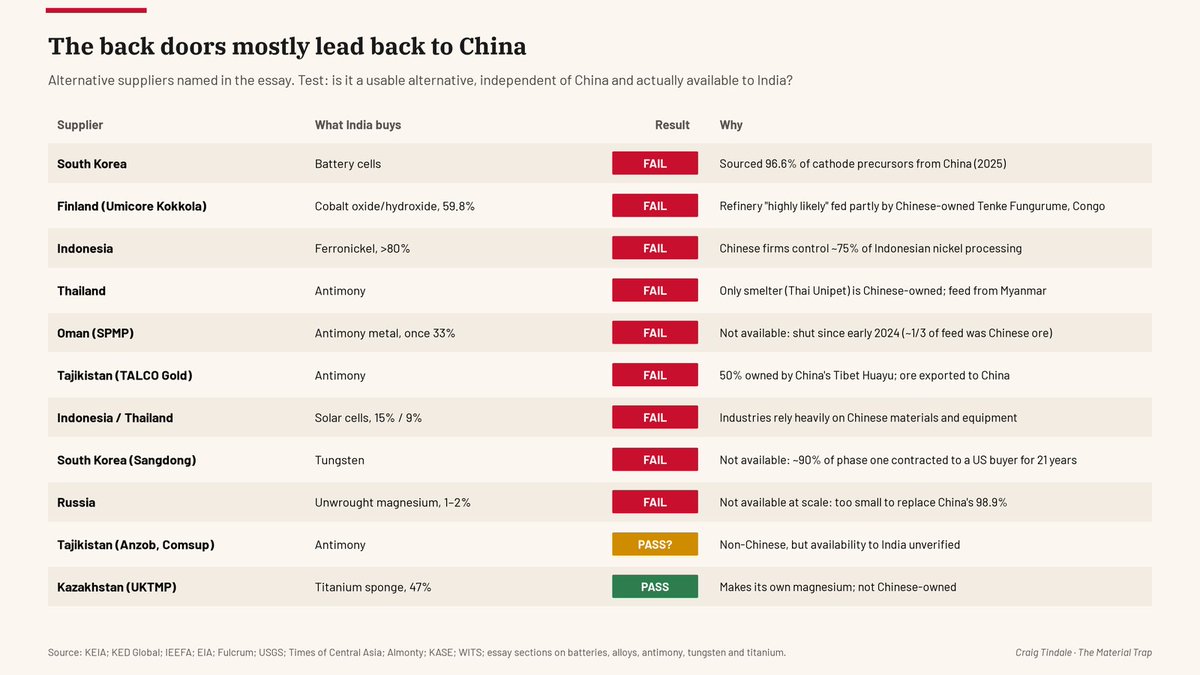
Indian planners attempted to establish an independent processing circuit. Hindustan Zinc holds an environmental clearance to produce 992 tonnes of antimony a year, yet the company disclosed no production of the metal in its FY2026 corporate reports. Indian factories must run down unlisted inventories to keep production lines moving, because the domestic circuit sits completely idle. India's known domestic antimony reserves in the ground total only 255 tonnes. By my arithmetic, the geological reserve equals about two months of India's 2023–24 metal imports.
One tank-round order eats two years of tungsten powder
Antimony hardens the bullet. In a tank gun, tungsten is the bullet. Modern tank guns fire a dense dart of solid metal held inside a lightweight carrier sleeve called a sabot. When fired, the sabot falls away instantly, sending the dart downrange to pierce heavy armour by kinetic mass and speed alone. The Indian Army fires the Russian-designed 125-millimetre 3BM42 Mango armour-piercing projectile from its main battle tanks.
An army that cannot supply its own penetrators cannot sustain tank warfare once foreign shipping stops.
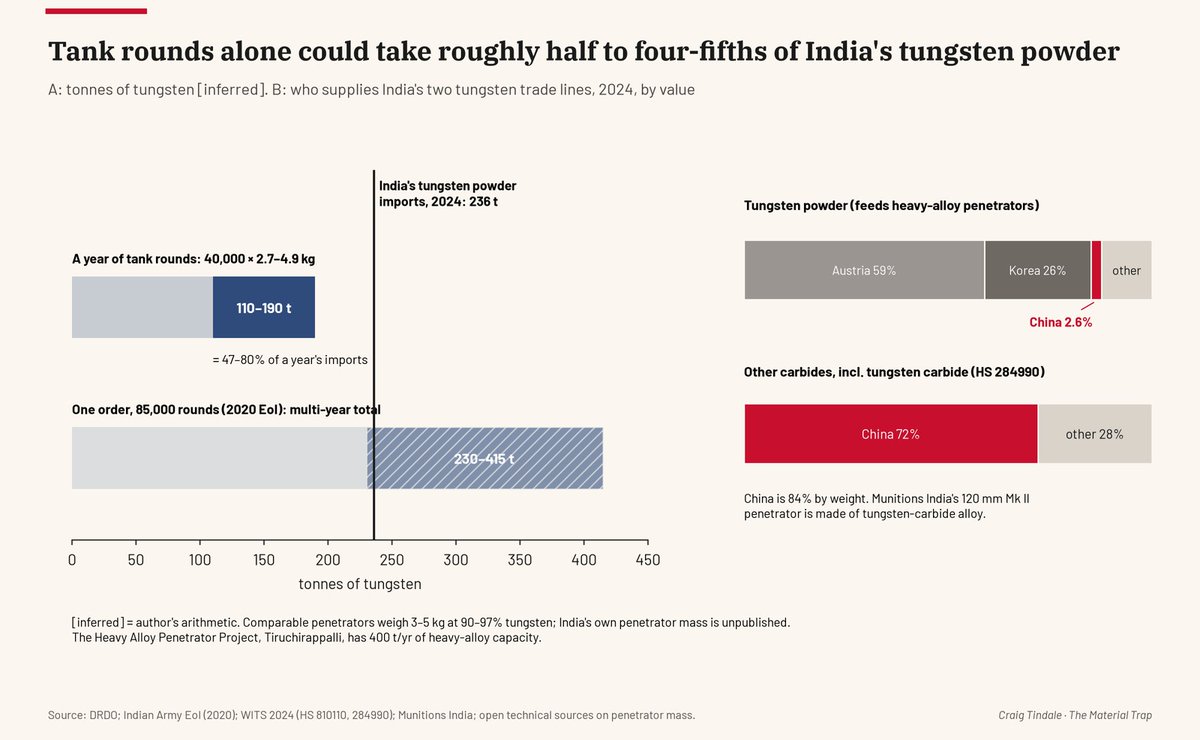
The 3BM42 Mango projectile weighs 4.85 kilograms without its sabot. That 4.85 kilograms is the whole flight projectile, steel body included, not the tungsten. Comparable tungsten-alloy penetrators weigh about 3 to 5 kilograms, and the alloy is 90 to 97 per cent tungsten. The tungsten figures below are my own estimates based on public specifications. That design puts roughly 2.7 to 4.9 kilograms of tungsten in each round. The Defence Research and Development Organisation (DRDO) says India makes 125-millimetre armour-piercing rounds at 40,000 a year. At that production rate, tank ammunition alone takes about 110 to 190 tonnes of tungsten a year.
India imported 236 tonnes of tungsten powder in 2024. Tank ammunition alone could absorb half to four-fifths of that entire supply. In 2020, the Indian Army issued an Expression of Interest to procure 85,000 rounds of 125-millimetre armour-piercing ammunition. By the same arithmetic, that order needs about 230 to 415 tonnes of tungsten, one to nearly two years of India's entire powder imports. The Heavy Alloy Penetrator Project in Tiruchirappalli has a production capacity of 400 tonnes of heavy alloy per year.
Fabricating that single order absorbs most or all of that plant's annual capacity. Austria supplied 59 per cent of India's powder imports by value, while South Korea supplied 26 per cent. China accounted for only 2.6 per cent of India's tungsten powder imports by value in 2024. Western buyers are competing aggressively for that same Austrian and South Korean output. India holds no domestic tungsten mines and refines no tungsten powder within its own borders.
Carbides reveal the direct choke point. India imported 745,404 kilograms of other carbides, the trade line that carries tungsten carbide, in 2024. China supplied 72 per cent of that trade line by value and 84 per cent by weight. Munitions India's 120-millimetre Mk II penetrator is made of tungsten carbide alloy. When a military procures raw powder from Austria and South Korea while Western buyers rush to lock up the same output, and draws almost three-quarters of its imported carbide feed straight from Chinese processors, a sudden embargo leaves domestic ordnance factories without the physical feed required to machine anti-armour darts. A blockade on carbide starves the tooling industry and the ammunition lines at the same stroke.
📷Tank rounds and tungsten. Craig's tank-round arithmetic, shown as ranges against imports, plus the powder/carbide split. Source: DRDO; Army EoI 2020; WITS 2024 ·
In February 2025 China introduced export controls on selected tungsten products.
The powder is Indian; the stock lasts ten days
Not every input runs through Beijing. India makes its own gun propellants and solid rocket fuel, but it builds them on factory lines too small to sustain a modern war.
A field gun cannot fire without propellant to push the shell down the barrel. On 21 September 2026, Munitions India Limited closed a bid on the Government e-Marketplace for 558,962 units of bleached cotton linters to Defence specification JSS 8305-14:2020. The raw linters, the short fibres left on cotton seeds after ginning, are domestic. They yield the nitrocellulose that burns into high-pressure gas inside an artillery breach. China accounted for 26.6 per cent of India's commercial nitrocellulose import value under HS code 3912 in 2024, yet that material feeds paint and printing ink. Munitions India Limited has an open expression of interest for a new 65 tonnes per month nitrocellulose plant at Cordite Factory Aruvankadu, closing on 6 November 2026. The explosives chain follows the same sovereign split. Hexamine acts as the chemical precursor for military high-explosive warheads. In recent shipment data, Russia supplied 62 per cent of India's imported hexamine, while China supplied only 11 per cent.
Missile oxidisers tell a similar domestic story. Solid rocket motors carry no air, so they burn their fuel with ammonium perchlorate, a salt that releases oxygen at extreme heat. The Indian Space Research Organisation's Ammonium Perchlorate Experimental Plant at Aluva was expanded to 800 tonnes per year to supply rocket programs. Private firms add their own capacity. On 14 September 2026, the Defence Research and Development Organisation closed a government portal tender for a new ammonium perchlorate and composite propellant plant in Pune.
Propellant production does not depend on a Chinese licence. The vulnerability sits in the depth of the magazines.
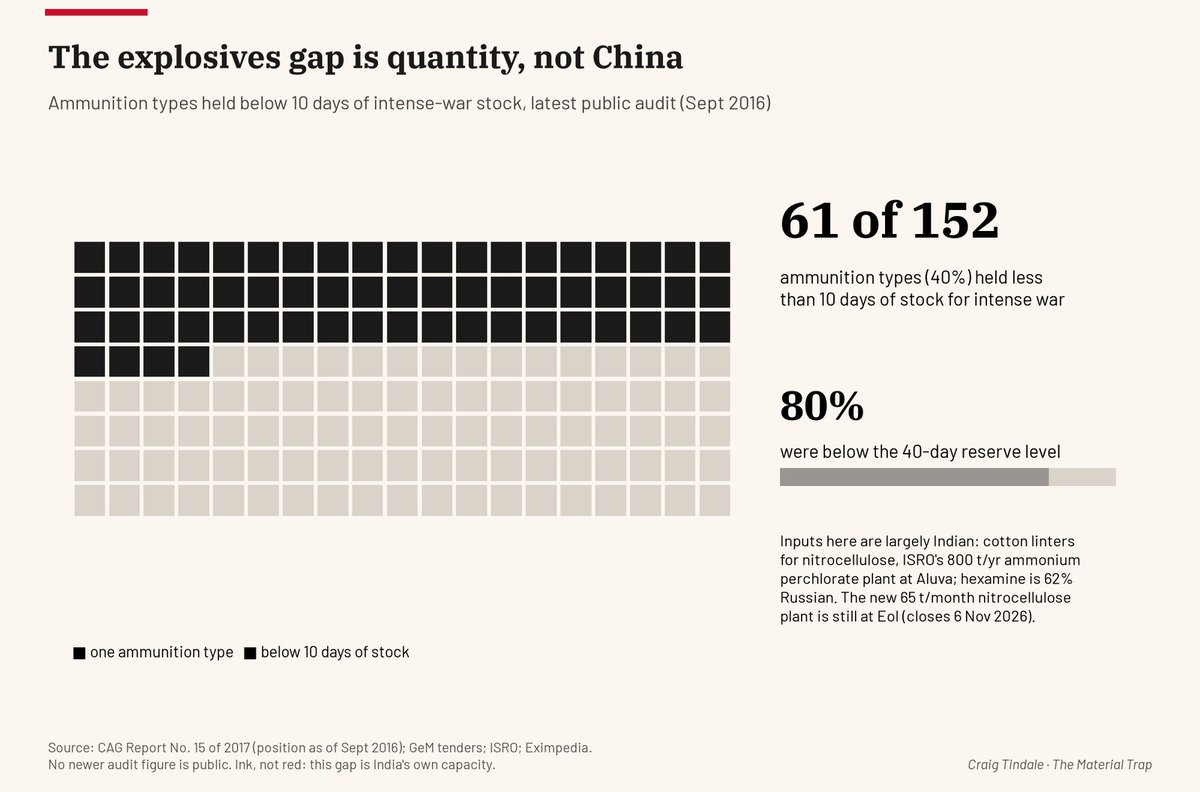
When a high-intensity conflict demands thousands of artillery shells every morning, a peacetime chemical plant's production rate cannot match the expenditure rate of active artillery regiments, and the outcome is decided by the stock in physical storage. India's auditor found in 2017 that 61 of 152 ammunition types, 40 per cent, held less than 10 days of stock for intense war as of September 2016, and 80 per cent were below the 40-day reserve level.
📷The explosives gap is quantity, not China. 61 of 152 ammunition types under 10 days of stock in the last public audit. Source: CAG Report 15 of 2017 ·
Foxconn's three hundred engineers go home
Capacity is people as well as plant, and India cannot build an independent manufacturing base while China controls the skills, machinery, and materials required to run it. In mid-2025, Beijing called the people home. Foxconn recalled over 300 Chinese engineers and technicians from its iPhone assembly plants in India after Chinese officials moved informally to restrict the transfer of know-how. India provides the assembly floor. Beijing retains the technical command that keeps precision production lines running.
Steel reveals that same structural vulnerability at the base of the economy. The heavy industrial push requires basic metal, yet blast furnaces depend on maritime lifelines for both fuel and furnace heat.
Metallurgical coke is baked coking coal dense enough to carry the weight of iron ore inside a blast furnace without crumbling. Indian blast furnaces consume approximately 175 million tonnes of coking coal annually to feed their primary steel output. Domestic mines yield only about 20 million tonnes. Indonesia supplied 68 per cent of India's metallurgical coke shipments in the first half of fiscal year 2027. China accounts for approximately 40 per cent of India's total machinery and computer imports. If those shipments freeze, Indian plants cannot replace worn machine tools, service automated controllers or commission new production lines.
Electronics assembly repeats the pattern in high-value consumer goods.
Industry observers estimate that only 18 to 20 per cent of the value of smartphones assembled in India is added domestically. India imports over $10 billion worth of electronic components from China annually. Across 71 distinct electronics product lines during 2025–2026, Chinese factories supplied at least 80 per cent of total Indian imports. When an Indian facility receives Chinese chips, solders them onto circuit boards, and ships the completed assemblies back to the supply chains that designed them, the plant operates as an outsourced bench inside an industrial network governed by its rival. A printed circuit board assembly serves as a device's physical nervous system, connecting microchips and sensors to an etched plate. India's exports of printed circuit board assemblies to China surged from $36 million in fiscal year 2025 to approximately $1.5 billion in fiscal year 2026. Total exports of those assemblies reached $1.9 billion in fiscal year 2026. Nearly 80 per cent of that volume went to China.
📷A closed circuit. Chinese parts come in; 80% of the boards go back to China. Source: Rediff/CGTN; Outlook Business; ET; Business Standard ·
Two hundred and thirteen gigawatts of frames around Chinese cells
The same loop runs through the solar shed. India cannot make a solar panel or a grid battery without Chinese processing, and every domestic factory it opens deepens that exposure. An Indian workshop soldering blue wafers under glass is assembling foreign material behind an aluminium border.
Upstream, China owns the chemistry. The sequence runs from polysilicon through cast ingots to sliced wafers, which factories print into photovoltaic cells. India has no commercial polysilicon production as of August 2026, according to the Ministry of New and Renewable Energy. More than 99 per cent of India's imports of undiffused silicon wafers during FY26 originated from China. The wafers arrive cut. Chinese furnaces smelted the rock, cast the ingots, and ran the wire saws.
Downstream assembly solves nothing. China accounted for 61 per cent of India's solar cell imports in FY26. Third countries offer no escape from this circuit: Indonesia and Thailand supplied 15 per cent and 9 per cent of Indian cell imports that year, yet both nations run on Chinese wafers and Chinese machinery. Indian cell lines need Chinese silver paste to lay down the conductive grid lines, and China supplies 65 per cent of that input.
📷India assembles the panel; China makes what goes inside. 213 GW of module lines, 32 GW of cell lines, no polysilicon. Source: MNRE; Angel One; Market News Analysis; CSE ·
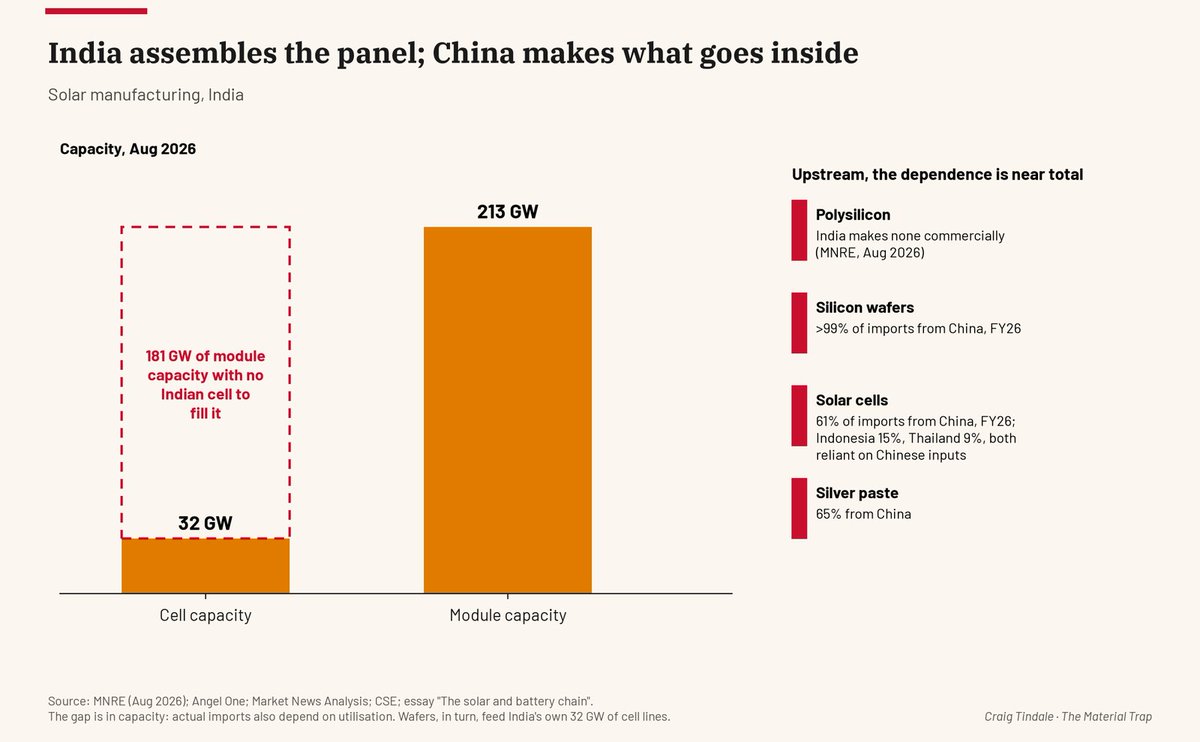
Faced with this bottleneck, the Ministry of New and Renewable Energy blinked. It extended the Approved List of Models and Manufacturers List-II exemption for rooftop and commercial projects until 31 December 2026. By August 2026, domestic cell capacity reached 32 GW, while module capacity reached 213 GW. I count an internal deficit of 181 GW between module assembly and domestic cell production. An embargo would leave those empty glass sheds cold within weeks.
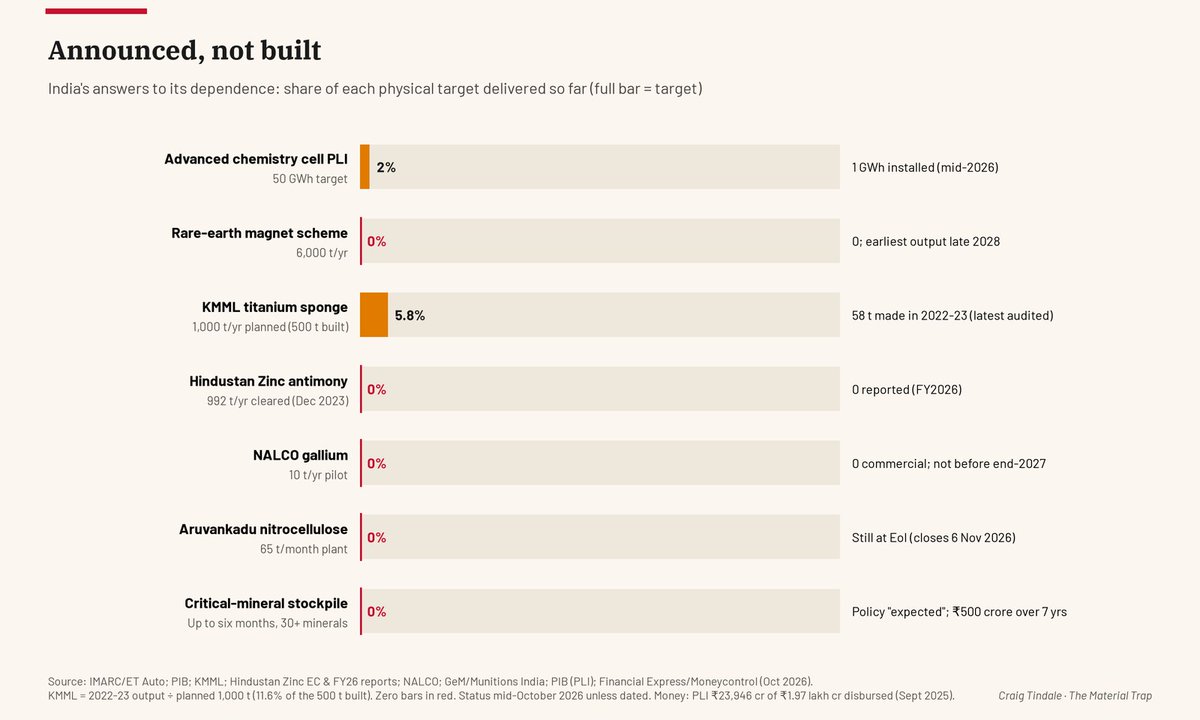
The battery programme repeats the disaster. India imports over 90 per cent of its lithium-ion cell requirements, primarily from China, South Korea, and Japan. Between January and September 2025, China accounted for 93.8 per cent of India's lithium-ion import value. The Advanced Chemistry Cell Production Linked Incentive scheme targeted 50 GWh of manufacturing capacity, but by mid-2026, only 1 GWh of installed capacity had been established.
South Korea cannot serve as an independent backstop. Making an energy-dense battery demands processed cathode precursors and spherical graphite for the anode, yet South Korea sourced 96.6 per cent of its cathode precursors from China in 2025. China supplied 91.3 per cent of India's synthetic graphite imports in FY2025. India bought natural graphite that year from Mozambique at 31 per cent, Madagascar at 29 per cent, and China at 17 per cent.
Refining still dictates the trade. South Korea's POSCO Future M bought 100 per cent of its spherical graphite from China in 2025, and POSCO Future M plans to end this dependence only by 2027. When an Indian builder purchases mineral feedstocks from friendly flags, the supply chain remains a shell game, proven by the fact that India imported 39.7 per cent of its lithium carbonate in FY2025 from Ireland, an island that refines no rock and hosts the booking desks of Chinese trading houses.
Ninety-six per cent of the copper, ninety per cent of the core
Batteries store power. Wire and transformers carry it. India cannot wire or transform its own grid because factories lack the refined copper and magnetic steel required to carry high voltage. Vedanta's Sterlite Copper smelter in Thoothukudi remains closed following a 2018 pollution-related shutdown order. That facility previously accounted for roughly 40 per cent of India's refined copper cathode output, the pure metal drawn into conductive electrical wire. The closure took out a smelter of more than 400,000 tonnes a year, and in 2018–19 India became a net importer of refined copper.
State-owned smelters collapsed alongside private plants.
In 2019 Hindustan Copper suspended operations at its Jhagadia and Ghatsila smelting and refining facilities due to business considerations. Hindustan Copper's domestic mining meets only about 4 per cent of national demand. India imports approximately 96 per cent of its copper concentrate requirement. Because domestic smelters depend on foreign mineral shipments while shuttered plants cap refined cathode output, any export curb by overseas miners or maritime route closure can immediately starve wire factories and halt national power expansion.
Transmission wire forms only half the physical challenge.
High-voltage substations depend on transformer cores made of Cold Rolled Grain Oriented electrical steel, known as CRGO, an alloy whose crystal grains align to cut power loss. India consumes an estimated 400,000 to 450,000 tonnes of CRGO electrical steel across its electrical infrastructure each year. Domestic production provides only 40,000 to 50,000 tonnes annually, forcing the country to import nearly 90 per cent of its CRGO steel requirements. On June 22, 2026, India's Directorate General of Trade Remedies initiated an anti-dumping investigation into CRGO electrical steel imports from China, Japan, South Korea, and Russia. The probe followed a formal petition by domestic producer JSW JFE Electrical Steel. Domestic mills cannot replace those foreign volumes. Even as that trade probe began, Chinese exports of grain-oriented silicon steel to India increased from approximately 54,400 tonnes in the first five months of 2025 to 67,600 tonnes in the same period of 2026.
Ten metals India must import entirely
Electrical steel is one alloy. Every hard steel India wants needs a metal it does not mine. The Mines Ministry has drawn up a register of 24 critical minerals, and China stands among the top three producers for at least 15 of them, including cobalt, molybdenum, nickel, and tungsten. India imports all of its supply of 10 of those critical minerals. In 2024-25, Indian ports landed 12.47 million tonnes of them to keep mills and assembly plants running. The republic remains 100 per cent import-dependent for nickel, cobalt, and lithium.
The packaging industry felt the edge of this exposure first. In June 2024, India imposed anti-dumping duties on easy open ends of tin plate imported from China to shield local manufacturers. These ends are the pull-tab lids used to seal food and drink cans. Tin seals the can, and an army's rations come in cans.
Heavy industry runs on harder feeds. Steelmakers add molybdenum to molten metal to prevent cracking under high heat. China produced about 320,000 physical tons of molybdenum concentrate in 2025, giving it about 48.4 per cent of global supply.
Vanadium does the same work for tensile strength. A fraction of vanadium bonds with carbon inside a melt, allowing structural steel to carry immense mechanical loads without bending. India mines none of it.
Cobalt secures the chemical side of the build. It keeps lithium cathodes stable under rapid electrical load, preventing battery packs from catching fire. India bought 59.8 per cent of its cobalt oxide and hydroxide from Finland in FY2025. The customs declaration names a Nordic partner, but the Finnish refinery feeds on hydroxide mined at Tenke Fungurume in Congo by a Chinese company.
Stainless steel leads back to the same owner. India imports more than 80 per cent of its ferronickel from Indonesia to feed its electric arc furnaces. When an Indian steelmaker signs a purchase order for Indonesian ferronickel to keep its furnaces hot, the metal flows from deep island pits straight through industrial smelting parks where Chinese firms control an estimated 75 per cent of the processing capacity.
Penicillin at thirteen dollars fifty a kilo breaks India's pharmacy
Medicines carry the same false label, because India cannot protect its sick without active chemical molecules controlled by China. In late 2025, Chinese suppliers dropped the international price of Penicillin G to $13.50 per kilogram. Indian manufacturers needed an estimated $25 per kilogram to make the antibiotic profitably under the government's Production Linked Incentive scheme. India once made this itself. Domestic private firms abandoned synthesis as public fermentation units fell into disrepair. Beijing's targeted price cut wiped out commercial margins before new Indian plants could achieve scale.
An active pharmaceutical ingredient is the biologically active molecule inside a pill that attacks bacteria or dampens pain. Without that specific molecule, a tablet does nothing. Everything else inside the finished capsule is inert filler and synthetic dye. Antibiotics like penicillin require industrial fermentation inside sterile stainless-steel tanks, where living microbes synthesise molecules from nutrient broth over weeks of constant power. Chemical intermediates sit between those raw broths and the finished medicine. If one intermediate in the sequence fails to arrive, chemical synthesis stops immediately.
In 2024–25, China supplied 73.7 per cent of India's US$4.35 billion of imported active pharmaceutical ingredients, bulk drugs, and chemical intermediates. The Chinese share rose from 70 per cent just two years earlier. When a foreign competitor floods the market with discounted chemicals, cuts the margins of private domestic fermenters, and controls the precursor molecules that feed local laboratories, sovereign drug production becomes impossible, leaving an unprotected subcontinent exposed to external administrative decisions. The dependency deepens every fiscal year.
From Directorate General of Commercial Intelligence and Statistics (DGCI&S) data for 2024–25, I count roughly 25 to 35 critical active ingredients and intermediates where India relies almost entirely on China for imports. For those specific compounds, domestic Indian synthesis has ceased.
Beta-lactam antibiotics form the backbone of modern clinical medicine, covering the basic penicillins and cephalosporins that protect hospital patients after trauma and surgery. Without beta-lactams, routine operations become lethal. China holds a near-total global monopoly over beta-lactam intermediates, controlling 80 to 90 per cent of the market. An Indian formulation plant can press billions of capsules, but missing Chinese precursors leave its blister packs empty. In February 2020 the ratings agency ICRA put formulation makers' average inventory at 1.5 to 2.5 months. Ten weeks of chemical stock will not outlast an embargo.
Peacetime pressure has already broken this brittle supply system.
In early 2020, factory shutdowns across China abruptly halted chemical shipments to Indian ports. Domestic warehouse stocks drained immediately. Plants across Gujarat and Telangana ran out of raw ingredients for paracetamol, a basic fever reducer needed by civilians and soldiers alike. That stoppage was an accident. A decision would last longer. The 2020 factory shutdowns in China forced India to restrict its own exports of 26 essential drugs to prevent domestic shortages.
China shut the fertiliser gate as the rabi season began
In 2020 the stoppage was an accident of a pandemic. On 15 October 2025 it was a decision. India cannot feed its crops without specialty chemical nutrients Beijing controls, and the export ban struck at the exact moment winter sowing began.
On 15 October 2025, China suspended fertiliser exports to the world market. During 2025, Chinese procedural delays and withheld shipment inspections halted specialty fertiliser imports into Indian ports. India typically imports 150,000 to 160,000 tonnes of these water-soluble products between June and December. Over the full agricultural year, Indian farms consume around 250,000 tonnes of specialty fertilisers. Farmers use 60 to 65 per cent of that volume during the rabi season, the winter cropping window running from October to March. India imports about 95 per cent of its specialty fertilisers, including technical monoammonium phosphate, known as TMAP, and the diesel exhaust fluid AdBlue, from China. When Chinese customs officials hold back port inspections on technical monoammonium phosphate just as winter sowing begins, the delay ripples straight into Indian drip-irrigation lines, leaving cash-crop growers without the soluble phosphorus needed to keep young plants alive. Rajib Chakraborty, President of the Soluble Fertiliser Industry Association, warned that specialty fertiliser prices could rise 10 to 15 per cent.
Bulk fertiliser revealed the exact same exposure.
India imported 22.28 lakh metric tonnes, or 2.23 million tonnes, of di-ammonium phosphate, known as DAP, from China in 2023–24. DAP shipments from Chinese ports fell to 8.47 lakh metric tonnes in 2024–25. I count a 62 per cent drop in Chinese DAP supplies between 2023–24 and 2024–25. Total domestic fertiliser production reached 21.1 million tonnes in 2024–25. Domestic plants produced 16 million tonnes in 2014–15. Indian factories expanded their runs, yet domestic output failed to fill the gap left by Chinese suppliers.
The Indian government quickly sought replacement tonnage abroad before soil ran dry. New Delhi facilitated long-term agreements and memorandums of understanding for the 2025–26 season. Government contracts covered annual imports of 31 lakh tonnes from Saudi Arabia, 30.10 lakh tonnes from Russia, and 25 lakh tonnes from Morocco. Agreements with Morocco's OCP Group secured 2.5 million tonnes of DAP and triple superphosphate, known as TSP. Shipments from Morocco covered 22 per cent of Indian demand over the first ten months of the year. OCP Group holds a 28 per cent stake in Paradeep Phosphates.
Bulk phosphorus can be purchased from North Africa or the Persian Gulf if a government pays the freight. Specialty fertiliser has no such substitute. Beijing controls the clean soluble chemistry that modern drip irrigation demands, and an Indian farmer cannot replumb an orchard when Chinese customs officers pocket the certificates. In the first quarter of 2026, Russia supplied $401.57 million worth of fertilisers to India.
Part Three. The exits are shut
India's hedge buys nine in ten of its chips from China
Russia is the door India opens first: for fertiliser, for oil, for air defence. New Delhi cannot secure its skies with arms from a supplier that relies on China for the equipment to manufacture them. In 2018, India signed a contract to buy five S-400 air defence systems from Russia. The system tracks multiple airborne targets simultaneously and fires long-range interceptor missiles to shield domestic airspace. The contract scheduled delivery of all five systems by 2023. Russia dispatched India's fourth S-400 system in April 2026, with deployment expected by late May 2026. India is expected to deliver the fifth and final S-400 regiment from its 2018 order by November 2026. On 27 March 2026, India's Defence Acquisition Council gave first-stage approval to five more S-400 systems, reported at about $6.1 billion, within a ₹2.38 lakh crore round of approvals across all three services.
Moscow cannot arm New Delhi against Beijing.
Machine tools are computer-guided cutters, lathes and milling units that carve hard alloy into precision weapons parts. In the final quarter of 2023, Russia as a whole imported approximately 900 million dollars in machine tools. Nearly 70 per cent of those imports came from China. The same dominance governs computing. In 2023, about 90 per cent of the microelectronics imported into Russia's economy came from China. Dual-use goods encompass commercial components that feed military assembly lines. China is now the largest supplier of dual-use goods to Russia, accounting for more than 73 per cent of Russian imports of these goods. For Common High Priority goods, China accounts for approximately 75 per cent of reported exports to Russia. Russia pays an increasing premium to China for Common High Priority goods, reaching approximately 300 per cent in 2025.
📷Leaning on Russia is leaning on China at one remove. Russia draws 70–90% of key war inputs from China. Source: DAC; AP; KSE Institute; EurAsian Times ·
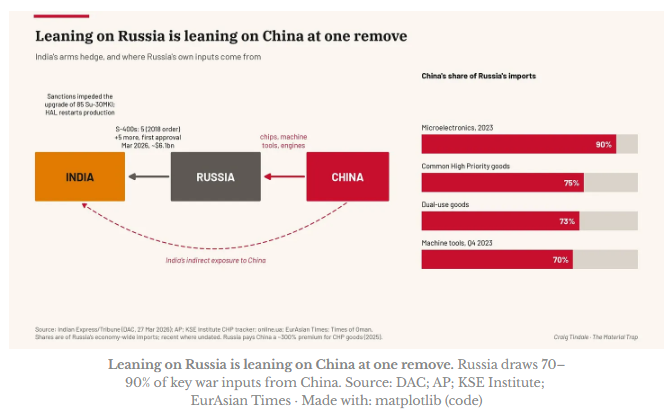
When an air defence battery or a combat aircraft depends on guidance microchips, precision machining and missile electronics routed through Chinese state trading firms, an Indian military facing China across Himalayan passes buys the appearance of strength while handing its rival the switch.
Sanctions exposed Indian hangars to that vulnerability. The Indian Air Force flies the Sukhoi Su-30MKI, a twin-engine multi-role fighter that forms the core of its combat fleet. Sanctions on Russia over the war in Ukraine directly impeded the planned upgrade of 85 of the Indian Air Force's licensed-built Su-30MKI fighters. Halting the upgrades forced the factory lines to shut down. India is restarting Su-30MKI production at Hindustan Aeronautics Limited's Nashik facility, planning to build 12 additional aircraft by 2029 to replace lost fighters.
New Delhi formalised the conduit anyway. Indian payments for crude oil feed a wartime trade channel that buys Chinese electronics to assemble Russian airframes. Russia and India have built a functioning payments infrastructure using rubles and rupees, which now account for 96 per cent of bilateral trade.
The United States imports all of its gallium
If Moscow cannot stand apart from Beijing, Indian planners look to Washington, but the partner they turn to cannot supply the minerals or ammunition India needs to defend its borders. The United States is 100 per cent net import reliant for gallium. American industry relies on foreign suppliers for 91 per cent of the antimony it consumes.
The US National Defense Stockpile held 198,763 pounds of antimony in its unclassified inventory as of September 2022. In September 2025, the US Defense Logistics Agency awarded a $245 million contract to United States Antimony Corporation to replenish that stockpile.
The Pentagon must refill its own bins first.
Artillery ammunition demonstrates the mechanical breakdown of American manufacturing capacity. The US Army spent $469 million to establish a new 155-millimetre projectile metal parts facility in Mesquite, Texas. As of March 2026, the Mesquite facility had produced no parts that met contract specifications. Across all plants, the US Army increased 155-millimetre shell production to only 36,000 rounds per month by March 2026, falling short of its 100,000 target. A Department of Defence Inspector General report found parts factories would reach only 71 per cent of their monthly production capacity goal. A partner 64,000 shells a month short of its own target has none to spare for India.
📷The backstop is short of the same things. The US imports its gallium and antimony and makes 36% of its shell target. Source: USGS; Breaking Defense; DoD IG ·
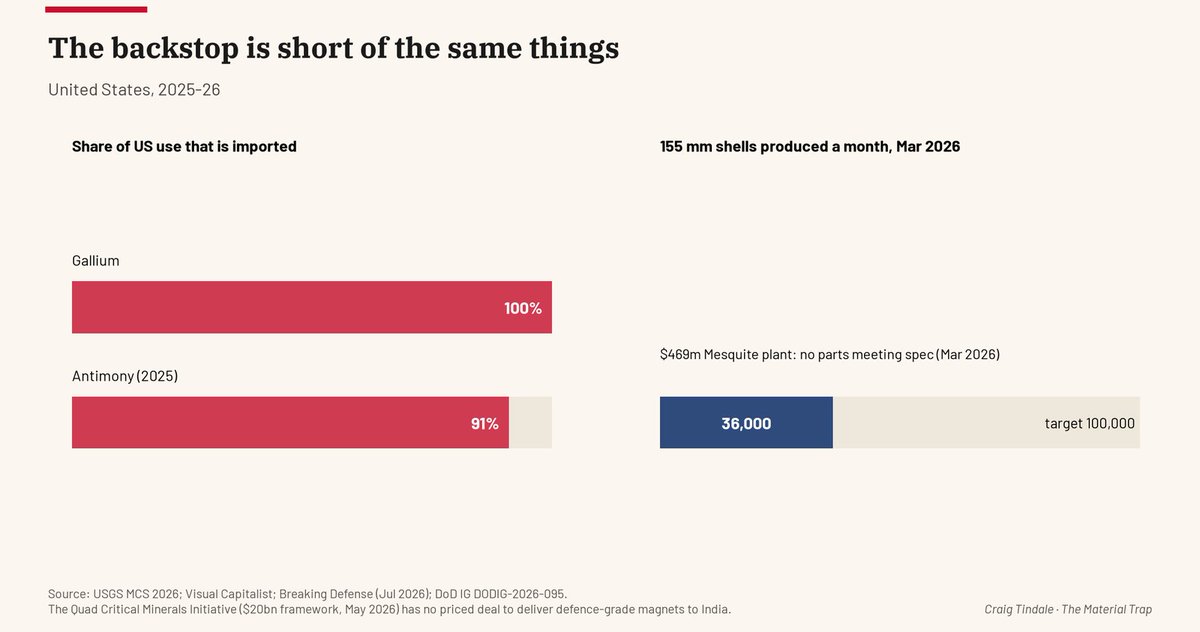
Allied mines offer no escape. Approximately 90 per cent of phase one production from the Sangdong tungsten mine in South Korea is contracted to an American buyer for 21 years. Japan, the largest magnet maker outside China, has already been cut off from Chinese heavy rare earths.
When China chokes off heavy rare earths to Japan, and the United States absorbs nine-tenths of South Korea's new tungsten output, an Indian military that depends on foreign processing finds every Western supply line already booked or starved before a crisis begins.
Diplomacy does not create metal. The Quadrilateral Security Dialogue launched the Quad Critical Minerals Initiative in July 2025 to diversify Indo-Pacific supply chains. In May 2026, member nations announced a framework to mobilise up to $20 billion in combined public and private capital.
Pledges of capital pour no metal into a foundry.
American political history carries an equally severe warning. During the 1965 Indo-Pakistani War, the United States suspended all military aid shipments to both India and Pakistan. In December 1971, the United States deployed Task Force 74 of the Seventh Fleet, led by the aircraft carrier USS Enterprise, into the Bay of Bengal to intimidate India. Sanctions followed every strategic test. On 13 May 1998, the United States imposed severe economic and military sanctions on India under the Glenn Amendment following the Pokhran-II nuclear tests.
On 27 August 2025, the United States imposed 50 per cent tariffs on most Indian imports to punish New Delhi's continued purchases of Russian oil.
A Chinese survey ship berths at Hambantota
Washington punishes India with tariffs. Beijing works on India's map, locking the maritime approaches and land borders until New Delhi cannot transport its own trade or defend its frontiers. In 2022, the Chinese survey vessel Yuan Wang 5 docked at Hambantota Port in Sri Lanka despite formal diplomatic protests from New Delhi. The vessel berthed beside the main shipping lanes of the northern Indian Ocean. It demonstrated that India does not control the maritime approaches to its south.
India relies on foreign bottoms to move its trade. By 2025, 95 per cent of Indian cargo was carried on foreign vessels. The domestic merchant fleet expanded by 36 per cent after 2015, yet India still accounts for only about 1 per cent of world ocean-going tonnage. Chinese shipyards accounted for 71 per cent of global shipbuilding orders in 2024. Even India's industrial champions build there. In February 2026, JSW Group ordered four 8,000 deadweight-tonne cargo vessels from China's Wuhu Shipyard. When an Indian industrial group must purchase its bulk carriers from Chinese shipyards while domestic cargo relies on foreign flags and foreign underwriters, maritime transport ceases to be a commercial convenience and becomes an operational veto held by Beijing. Supplementary war-risk insurance adds 5 to 10 per cent to annual shipping budgets.
The encirclement on land cuts just as deep. Myanmar produced around 31,000 metric tons of rare earth elements in 2024. Active mining pits in Kachin State surged from about 130 in 2020 to over 370 by late 2024. The Kachin Independence Army controls those border hills, and the raw ore trucks go straight into China. Across the border, regional smelting capacity for antimony in Thailand, Myanmar and Vietnam reached about 40,000 metric tons per year. More than 50 companies in Thailand import critical minerals, including antimony, from Myanmar, mostly to sell them to Chinese buyers. The Arakan Army holds Paletwa and the Kaladan multi-modal transit corridor that New Delhi planned to reach the sea. The route is shut.
Beijing is absorbing the rest of the neighbourhood through commerce and engineering. China granted duty-free treatment to 100 per cent of tariff lines for products from Nepal, and in July 2026 proposed a Bilateral Investment Agreement and a Free Trade Agreement to lock in its economic presence. In June 2026, Bangladesh Prime Minister Tarique Rahman signed 13 agreements with Beijing. One pact covers the Teesta River. The proposed Teesta River Management Project includes flood-control infrastructure located just 10 to 12 kilometres from the border near the Siliguri Corridor.
📷The ring of neighbours. Five pressure points around India, on an India point-of-view base map. Source: Natural Earth; Pacific Forum; Mongabay; Kathmandu Post; The Hindu · Natural Earth (India POV) boundaries
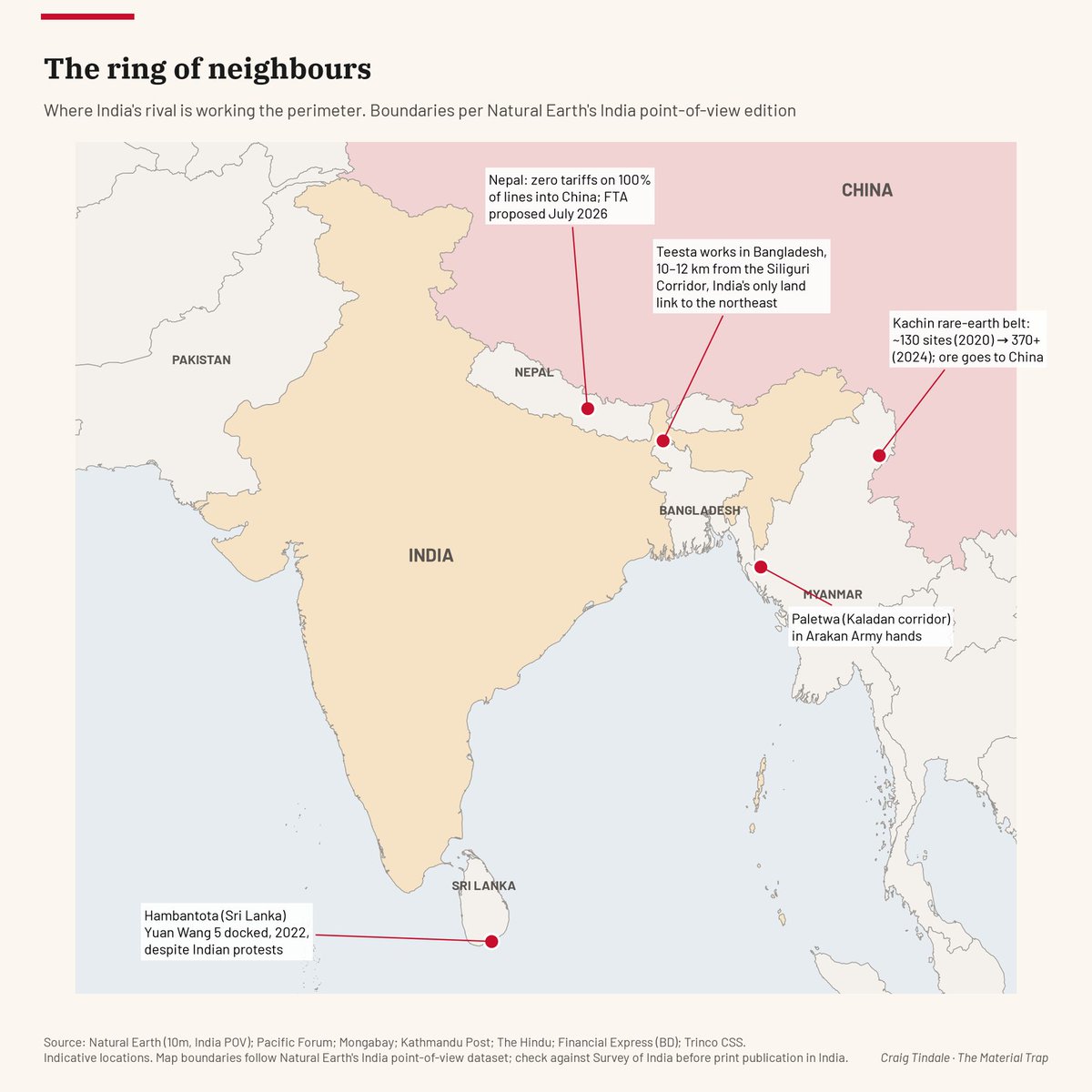
Chinese jets over one front, Chinese licences behind the other
India cannot defend its territory in a two-front war when Beijing arms the western front and holds the export licences for Indian weapons. Siliguri is where India's two fronts come closest, and in May 2025 one of them went live across the border.
India launched Operation Sindoor following a terrorist attack in Pahalgam. Between 6 May and 10 May 2025, Indian and Pakistani forces engaged in an armed conflict. Pakistan deployed Chinese-origin J-10C fighter jets in combat for the first time. The J-10C fighters carried Chinese-origin PL-15 long-range air-to-air missiles with an operational reach of 200 to 300 kilometres. That range enables beyond-visual-range combat, allowing pilots to strike targets they cannot see. Pakistan also deployed Chinese-origin HQ-9 air defence systems, firing ground-based interceptors against incoming aircraft. A report from the United States-China Economic and Security Review Commission noted that China opportunistically used the clash to test its J-10 fighters and HQ-9 defences in high-intensity combat.
Pakistan's Army Chief Field Marshal Asim Munir dismissed Indian claims of Chinese involvement, calling the accusation irresponsible and factually incorrect. His statement carried no figure to explain the Chinese airframes on the tarmac.
The Stockholm International Peace Research Institute documented the physical weapons supply in a March 2026 report. China supplied 80 per cent of Pakistan's arms imports between 2021 and 2025. The institute recorded that China's total arms exports to Pakistan accounted for 61 per cent during those five years. Pakistan is the primary buyer of Chinese weaponry.
When an aggressive rival supplies four-fifths of Pakistan's frontline arsenal and uses a border clash to test its air-defence networks, while simultaneously controlling the permanent magnets required for Indian missile fins, Indian defence planning ceases to be sovereign and becomes an exercise run on Chinese terms. Indian ordnance factories press explosives and propellants. Guidance systems require imported rare earth permanent magnets to steer missile fins in flight. If those magnet shipments stop, assembly lines cannot finish the guidance packages. An army can hold warehouses of artillery shells while its smart weapons halt on the factory floor. Modern precision weapons cannot fly without working guidance units. A military dependent on foreign components cannot fight a prolonged conflict once the supplier shuts the gate.
Every exit leads back to the same supplier.
On 4 April 2025, China's Ministry of Commerce issued Announcement 18, imposing export controls on rare earth permanent magnets. The licences were in force a month before Pakistani pilots fired Chinese missiles at Indian aircraft.
Part Four. How India got here, and what recovery costs
India built its own materials before it surrendered them
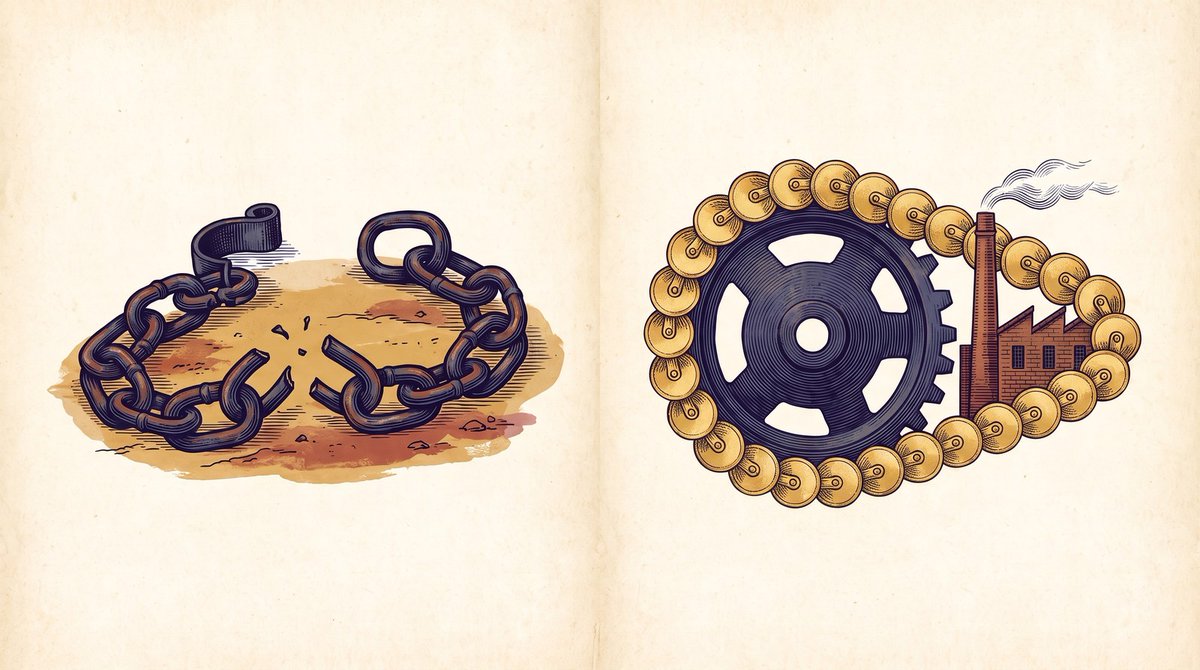
📷The first chains and the second. A broken colonial iron chain; a new chain of coins binding industry.
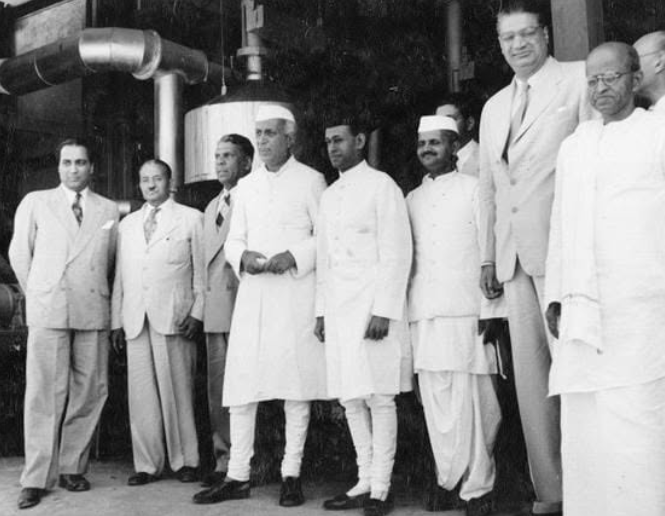
The elements China licensed in April 2025 were being refined in Kerala seventy-three years earlier. On 24 December 1952, Jawaharlal Nehru stood at Aluva in Kerala to open India's first rare-earths factory. The state company behind it, Indian Rare Earths, had been incorporated in August 1950. Built with French know-how, the plant processed coastal monazite beach sands into separated chemicals, and the same town still makes India's rocket oxidiser. Nehru refused to treat foundational chemistry as an optional commercial venture. He regarded domestic mineral refining as the irreducible foundation of sovereign survival.
Nehru opens the Aluva rare-earths plant, 24 Dec 1952.
Some of India's distinguished stalwarts set the course for the nation's Technology building, all together in Cochin in 1952 for the opening of the Indian Rare Earths factory at Aluva.
This powerful photograph was taken during the factory tour, which was inaugurated by Prime Minister Jawaharlal Nehru.
Indian Rare Earths Limited was incorporated on August 18, 1950, and was jointly owned then by the Government of India and the Government of Travancore-Cochin State, with the primary intention of taking up commercial-scale processing of monazite sand , at its first unit, namely Rare Earths Division (RED) at Aluva, for the recovery of thorium. Thorium is radioactive and mainly used in nuclear fuel applications.
Aluva followed a deliberate national doctrine. Prasanta Chandra Mahalanobis, the statistician who framed the Second Five-Year Plan of 1956 to 1961, wrote that "one important aim is to make India independent, as quickly as possible, of foreign imports of producer goods." The plan raised industry and minerals from 4.9 per cent to 24.1 per cent of public spending. The Industrial Policy Resolution of April 1956 went further. The state reserved basic metallurgy, heavy electrical equipment and fuel extraction for public enterprise. The 1956 schedule explicitly reserved copper, lead, zinc, tin, molybdenum and wolfram. Wolfram is tungsten, the dense metal required for the armour-piercing core of a modern tank round. Seventy years ago, Indian legislation named the very materials the republic now buys under Beijing's licensing regime.
This should remind all of India and every Indian what it has forgotten.
Alexander Hamilton addressed this vulnerability in his December 1791 Report on Manufactures. Hamilton argued that real independence required domestic production of all physical essentials for national defence. Friedrich List sharpened that insight in 1841 in The National System of Political Economy. List observed that Britain used state protection to build its manufacturing wealth and then preached free trade to lock competitors out, describing the manoeuvre as kicking away the ladder. Ha-Joon Chang used the phrase as the title of his 2002 book, Kicking Away the Ladder. Chang demonstrated that every modern industrial power used state coordination during its catch-up phase before lecturing poorer countries on the virtues of open markets.
Indian planners grasped that history because they had studied in Western lecture halls. Mahalanobis and his colleagues held Cambridge degrees. Planners borrowed foreign technique and purchased foreign machinery while keeping the sovereign production goal firmly anchored at home. When a developing state directs capital into foundational metallurgy, erects heavy engineering works from foreign blueprints and shields domestic refiners against import price suppression, it establishes the hard physical independence that market theory never measures.
Medicines followed the same material discipline. The state founded Hindustan Antibiotics at Pimpri in March 1954 to make penicillin. The government founded Indian Drugs and Pharmaceuticals in April 1961 with technical assistance from the Soviet Union. Public factories broke the pricing power of foreign drug cartels and trained Indian chemists in complex fermentation. By the 1960s, India was reported to be self-sufficient in penicillin.
Seventeen reserved industries became eight
India cannot smelt its own light metals, ferment its own basic antibiotics or feed its soils without foreign supply because thirty years of economic doctrine treated sovereign production as an expensive mistake. Then came 1991. A balance-of-payments crisis broke Delhi's fiscal cushion and forced the government to take emergency loans from the International Monetary Fund. The licence regime had strangled private enterprise, and parts of the overhaul were overdue. Yet the doctrine that accompanied the bailout went far beyond deregulation. Economic theory assumed that foreign currency earned in services could forever purchase physical inputs on world markets, treating the domestic industrial base as redundant.
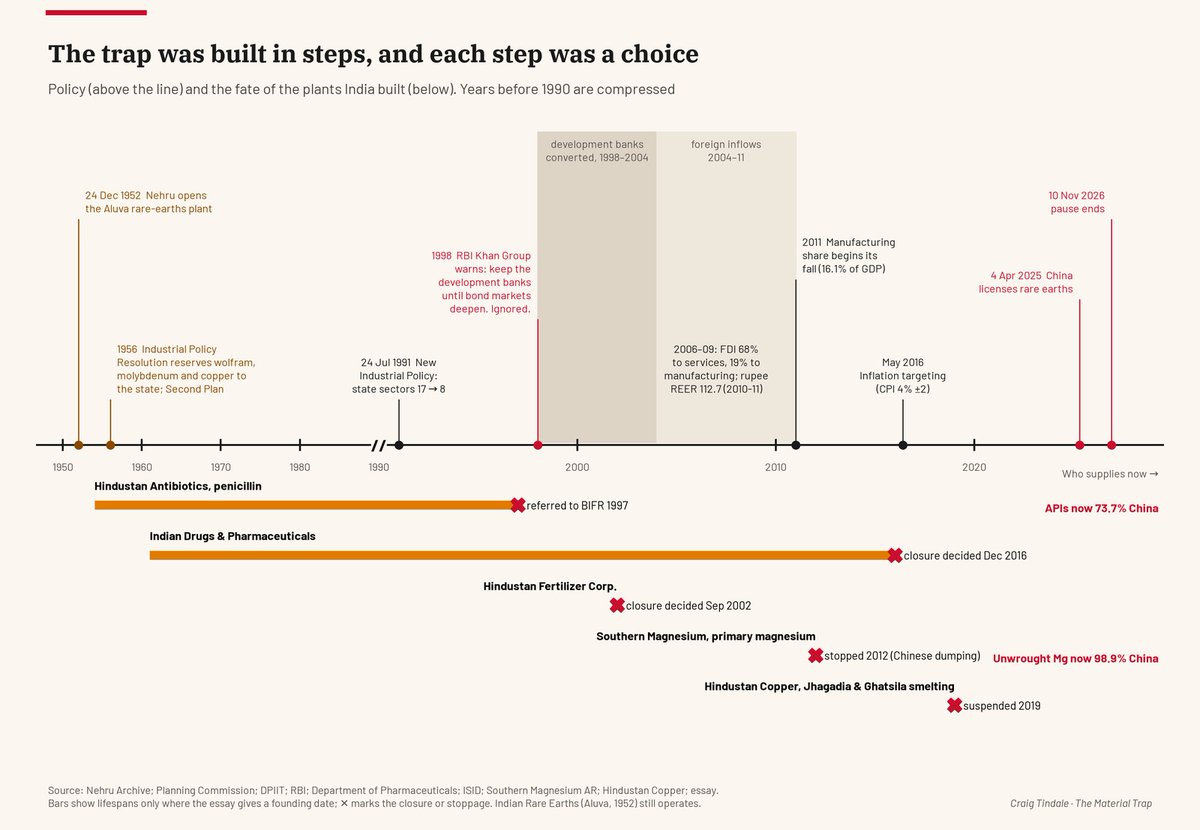
On 24 July 1991, the New Industrial Policy abolished most industrial licensing and cut the industries reserved for the state from 17 to 8. Finance Minister Manmohan Singh and advisor Montek Singh Ahluwalia dismantled the state reservations set in 1956. Neoclassical economic models, imported from Western universities and international lending institutions, tracked financial balances and consumer inflation while ignoring physical capability. When an economic model prices imported materials solely on spot markets while ignoring the capital cost of maintaining domestic furnaces and chemical lines, a momentary flood of subsidised foreign output can shutter an operational plant forever, leaving the buyer defenceless.
State plants closed one after another, and each closure handed another supply line to foreign producers. Hindustan Antibiotics Limited made continuous losses from 1993-94, entered the Board for Industrial and Financial Reconstruction in 1997, and wound down its fermentation lines, withdrawing from penicillin G production in 2003. Fermentation was the biological heart of antibiotic synthesis, turning raw chemical feeds into medicine through living cultures. In December 2016, the Union Cabinet decided to close Indian Drugs and Pharmaceuticals Limited, abandoning the public synthesis of bulk medications. In September 2002, the Indian government decided to close the Hindustan Fertiliser Corporation after declaring its units unviable, leaving domestic agriculture exposed to imported nutrients.
Basic metallurgy shared the same fate. In 2001 the Indian government sold a 51 per cent controlling stake in Bharat Aluminium Company, known as BALCO, to Sterlite Industries, a subsidiary of Vedanta Limited. Aluminium is used to build electrical transmission grids, aircraft structures and armoured vehicles. The Indian government is now preparing to sell its remaining 49 per cent residual stake in BALCO, surrendering the last public equity in an integrated aluminium smelter.
Private domestic producers could not survive the onslaught either. Southern Magnesium and Chemicals Limited shut down its 600-tonne-per-annum primary smelting plant in Andhra Pradesh in 2012 after cheap magnesium imports from India's rival undercut domestic production. The capacity never returned; today China supplies 98.9 per cent of the magnesium.
📷The trap was built in steps. Policy turns above the line, the plants India let go below it. Source: Nehru Archive; Planning Commission; DPIIT; RBI; ISID ·
The banks that funded factories were turned into ordinary banks
A smelter that closes needs a ten-year loan to reopen. After 1998, nobody remained to make it. In 2000–01, disbursements from specialised development financial institutions reached almost 50 per cent of gross fixed capital formation in manufacturing. Development lenders provided patient capital designed to survive lengthy construction schedules and cyclical commodity markets. The Reserve Bank of India’s 1998 Khan Working Group had warned against dismantling them before corporate bond markets grew deep enough to fund heavy industry.
Indian policymakers ignored the warning, converting major development financial institutions such as the Industrial Credit and Investment Corporation of India and the Industrial Development Bank of India into commercial banks between 1998 and 2004.
Commercial banks rely on short-term deposits from ordinary savers. Lenders cannot tie up those deposits in ten-year loans for titanium refineries or magnesium smelters without creating an immediate liquidity mismatch. I call the result the Tindale Trap. When a developing nation adopts Western central-banking doctrines alongside foreign capital inflows, regulatory incentives steer bank lending into mortgages and personal debt while starving the basic chemical and metallurgical industries required to defend sovereign independence.
Foreign direct investment flooded the country, but the money avoided heavy industry. During the peak inflow years of 2006 to 2009, 68 per cent of foreign direct investment went into services. Manufacturing received 19 per cent. Surging foreign capital drove the rupee upward against major trading partners. The Reserve Bank of India’s 36-currency real effective exchange rate—a trade-weighted currency index—rose to 109.2 in 2007–08, and reached 112.7 in 2010–11. An overvalued rupee cheapened foreign industrial imports and undercut domestic processing plants.
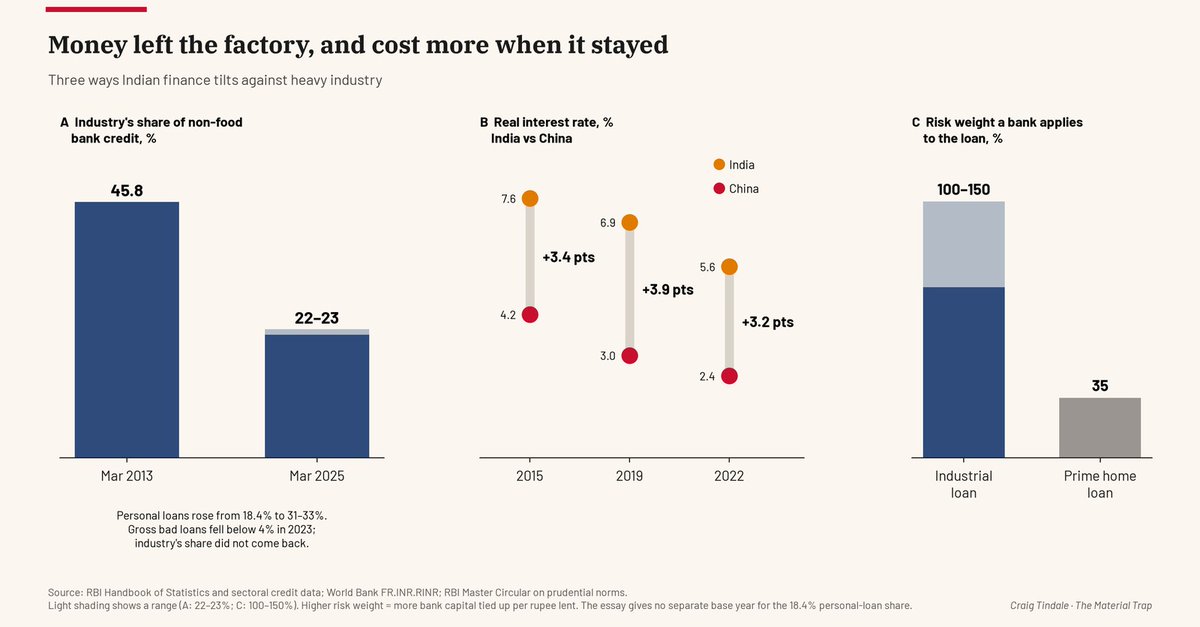
Central bank prudential rules accelerated the retreat. Reserve Bank regulations assign commercial industrial loans a risk weight between 100 and 150 per cent, a figure I cite as the working stand-in for heavy industrial lending risk. Prime residential mortgages carry a risk weight of 35 per cent. Risk weights dictate the volume of equity reserves a bank must set aside against potential default. By my arithmetic, regulations force a commercial bank to hold roughly three to four times more capital behind a smelter than behind an apartment mortgage. Capital fled productive capacity. As industrial lending shrank, personal loans grew from 18.4 per cent to between 31 and 33 per cent of non-food bank credit. Bank lending to Non-Banking Financial Companies increased from about 3 per cent of credit in 2007 to between 15 and 17 per cent in the 2014–24 period. Shadow lenders funnelled that borrowed cash into property deals and consumer purchases.
Industrial credit collapsed across the economy. Industry's share of non-food bank credit fell from 45.8 per cent in March 2013 to about 22 to 23 per cent in March 2025. The decline began during the 2013–18 bad-loan cleanup and continued afterwards. Financial orthodoxies attribute this retreat to non-performing industrial debt. Yet the manufacturing share failed to recover even after gross bad loans fell below 4 per cent in 2023.
📷Money left the factory. Credit share halved, real rates ran 3–4 points above China's, and capital rules favoured home loans. Source: RBI; World Bank ·
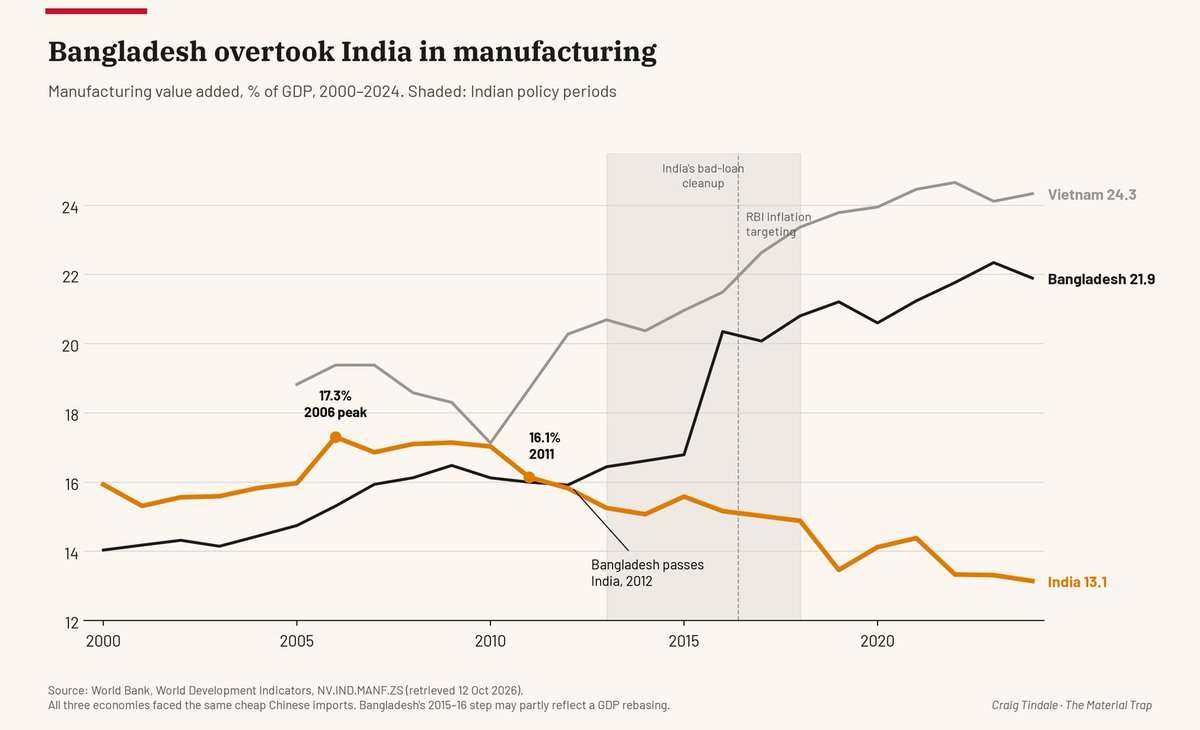
Manufacturing made up 16.1 per cent of India's gross domestic product in 2011, before the credit squeeze took hold. By 2024, that share declined to 13.1 per cent. Regional competitors rejected that doctrine, steering domestic finance directly into factories and industrial machinery. Over the same period, Vietnam’s manufacturing share of gross domestic product rose from 18.7 per cent to 24.3 per cent. Bangladesh's manufacturing share rose from 16.0 per cent to 21.9 per cent.
📷Bangladesh overtook India in manufacturing. India fell from 17.3% (2006) to 13.1% (2024), while peers rose. Source: World Bank WDI NV.IND.MANF.ZS · full World Bank series
Seven per cent money against four hollows out Indian industry
Dhaka and Hanoi borrowed cheaply. In 2016 India set its central bank a different goal. India cannot smelt its own metals or build heavy capital goods when its domestic plants face financing costs designed to suppress consumer prices. In May 2016, the Reserve Bank of India (RBI) adopted a statutory flexible inflation targeting framework, targeting a Consumer Price Index (CPI) headline inflation rate of 4 per cent with a tolerance band of 2 points either way. The retail index measures consumer baskets while ignoring land, smelters and sovereign material resilience.
After introducing the inflation targeting framework in 2016, India's real lending rate ran persistently higher than that of its rival.
World Bank data reveal the cost of that choice. India's real interest rate was 7.6 per cent in 2015 and 6.9 per cent in 2019, compared to China's 4.2 per cent and 3.0 per cent. Between 2015 and 2016, the real interest rate gap was 3.4 points. Between 2017 and 2019, I count a gap of about 4 to 5 points. I count a gap narrowed to under 1 point in 2020–21, before it widened again. By 2022, India's real rate stood at 5.6 per cent, while China's was 2.4 per cent.
When an inflation target rewards cheap imported components for suppressing consumer price inflation while domestic lenders demand punitive real interest rates to finance basic refining, the policy systematically starves the primary plants required to sustain national defence.
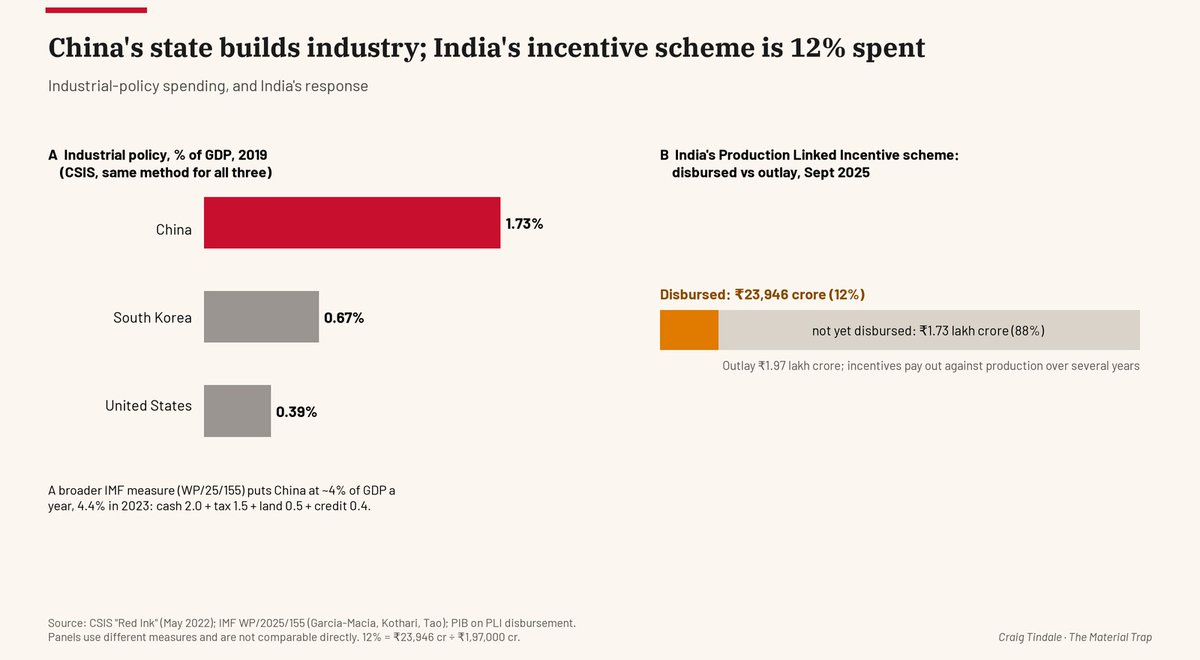
China mobilised state balance sheets. In its Red Ink report, the Center for Strategic and International Studies (CSIS) calculated China’s quantifiable industrial-policy spending at at least 1.73 per cent of Gross Domestic Product (GDP) in 2019. That outlay amounted to about US$248 billion at nominal exchange rates, exceeding China’s defence spending. South Korea spent 0.67 per cent. The United States stood at 0.39 per cent, and CSIS commentary noted that including procurement and other items would put China near 4.9 per cent. European Union (EU) state aid stood at about 1.5 per cent of GDP in 2022.
International Monetary Fund (IMF) Working Paper 2025/155 by Daniel Garcia-Macia, Siddharth Kothari, and Yiqun Tao calculated the equivalent fiscal cost of China’s industrial policy at about 4 per cent of GDP a year, reaching 4.4 per cent in 2023. In that paper, cash subsidies accounted for 2.0 per cent, tax benefits 1.5 per cent, land 0.5 per cent, and subsidised credit 0.4 per cent. The Indian government established the Production Linked Incentive (PLI) scheme across 14 key sectors with an outlay of ₹1.97 lakh crore. The money did not flow. By September 2025, India had disbursed ₹23,946 crore across 12 sectors under its ₹1.97 lakh crore PLI budget.
📷China's state builds industry. China at 1.73% of GDP (CSIS) or ~4.4% (IMF); India's PLI is 12% disbursed. Source: CSIS; IMF WP/25/155; PIB · Made with: matplotlib (code)
Seventy-seven per cent imported, certified Indian
The subsidy pays for output. The defence rulebook pays for a label. India's Ministry of Defence certifies weapons as Indian, even though three-quarters of what goes into them is bought abroad.
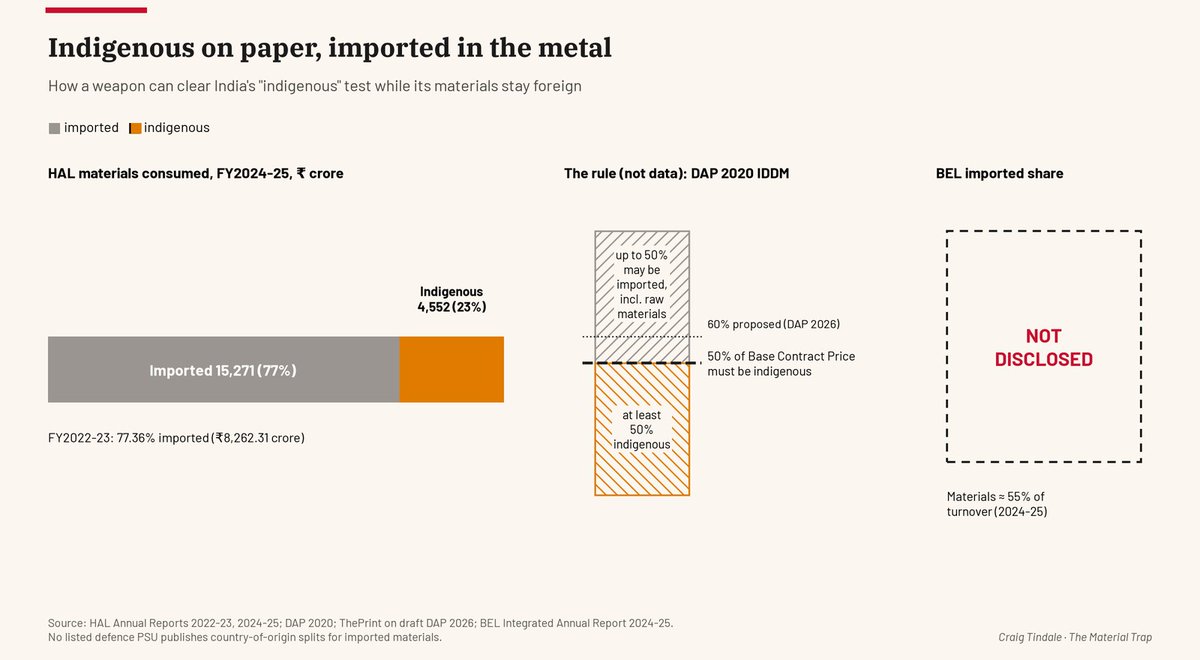
Hindustan Aeronautics Limited (HAL) builds the country's frontline aircraft. In the 2022–23 financial year, HAL imported 77.36 per cent of the raw materials, spare parts, and components it consumed. Those foreign inputs cost ₹8,262.31 crore. Two years later, the ratio did not budge. For the 2024–25 financial year, HAL bought ₹15,271 crore of imported raw materials and components against ₹4,552 crore of indigenous materials. The imported share remained at approximately 77 per cent.
HAL still imports three-quarters of its physical inputs.
India's own procurement rules, the Defence Acquisition Procedure (DAP) 2020, allow it. The rulebook defines Indigenous Content as a financial proportion of the Base Contract Price, which is the contract sum stripped of taxes and duties. Under the priority procurement category, Buy (Indian-IDDM), or Indigenously Designed, Developed and Manufactured, the rulebook requires a minimum of 50 per cent indigenous content. When an aerospace manufacturer tallies local labour, assembly charges, and domestic overheads against the contract value, an aircraft earns an indigenous certificate even though the underlying forgings, composites, and subcomponents arrived from abroad. Under DAP 2020, domestic assembly masked foreign inputs.
The Ministry of Defence attempted to close the gap with positive indigenisation lists. The 405 items on the sixth list include components and raw materials needed for major platforms. These platforms include the Su-30MKI fighter, the Light Combat Aircraft (Tejas), T-90 tanks, and the AL-31FP aero-engine.
Officials now acknowledge the defect. Draft revisions for DAP 2026 acknowledge the raw material loophole. They propose increasing the indigenous content requirement to 60 per cent. The DAP 2026 revisions also propose explicitly incentivising the use of local raw materials.
State-owned defence contractors keep the baseline obscured. Bharat Electronics Limited (BEL) equips the armed services with radars and communication systems. BEL consumes materials equal to about 55 per cent of its turnover. Yet BEL's integrated annual report for 2024–25 does not disclose the imported share of these materials.
📷Indigenous on paper, imported in the metal. HAL 77% imported; the DAP rule; BEL undisclosed. Source: HAL ARs; DAP 2020; BEL AR · Made with: matplotlib (code)
Fourteen crore rupees a mineral a year
What the accounts leave blank, the budget confirms. India funds its strategic material survival with loose change.
The National Critical Minerals Mission earmarked ₹500 crore over seven years, from 2024–25 to 2030–31, to build a strategic buffer covering at least five minerals. In October 2026, the Mines Secretary announced that a national stockpiling policy covering more than 30 critical minerals for up to six months of demand would appear within a month. The arithmetic exposes the scale. Dividing ₹500 crore across five minerals over seven years leaves roughly ₹14 crore per mineral each year, by my calculation. Thirty minerals would thin that allocation to a rounding error.
The armed forces hold nothing better. As of late 2026, no dedicated Ministry of Defence critical-mineral reserve exists. In September 2025, the Defence Secretary, Rajesh Kumar Singh, said India had "reasonable stocks" of critical minerals and that a reserve was being considered. He gave no tonnage and no count of days.
A reserve is cheap. By my arithmetic, a six-month buffer of rare-earth magnets needs about 1,500 tonnes, a small slice of what India already imports in a year. The plan to make magnets at home is slower still. The ₹7,280 crore scheme for 6,000 tonnes a year drew 20 bids by August 2026. By mid-October, no winner had been named, and no Indian sintered magnet will come off a line before late 2028.
Missile propellant proves how little physical capacity costs. Pandian Chemicals spent ₹48 crore to open a plant near Chennai in November 2025, with an installed capacity of 40 tonnes a month of ammonium perchlorate, the chemical oxidiser that supplies oxygen to solid rocket motors. The capital expense of a defence chemical plant is minuscule. Yet the expression of interest for a domestic nitrocellulose line at the Cordite Factory, Aruvankadu, remains open.
📷Announced, not built. Every Indian fix, measured against its own target. Source: PIB; KMML; HZL; NALCO; GeM · Made with: matplotlib (code)
The money exists. When war risks in the Middle East raised shipping costs, the Indian government moved immediately. On 12 May 2026, it launched the Bharat Maritime Insurance Pool to provide domestic cover for Indian hulls and cargo. The state created ₹13,906.50 crore of underwriting capacity, backed by a sovereign guarantee of ₹12,980 crore. The pool cut war-risk insurance premiums by 35 to 40 per cent. By 7 September 2026, it had issued 3,000 Cargo War policies, 92 Hull War-risk policies, and three protection and indemnity contracts.
When it wanted to insure ships, the state found ₹12,980 crore.
Three weeks, again
India has walked back to the edge it swore never to see again. In June 1991 the Reserve Bank of India held US$1.12 billion in foreign currency, less than three weeks of imports. In July it pledged about 47 tonnes of gold with the Bank of England and the Bank of Japan to raise about US$405 million. The gold left the country by air. The humiliation shaped a generation of policy, and India built the dollar reserve that now stands above US$700 billion so that no foreign bank would ever hold its gold again.
India learned the lesson in money and forgot it in matter. Indian industry has stood at two to three weeks of magnets. Against that, the National Critical Minerals Mission sets aside ₹500 crore over seven years for a stockpile of five minerals, about US$60 million by my arithmetic. In 1991, a dollar shortage sent India's gold to London. The next shortage will be of things dollars cannot buy.
Jawaharlal Nehru saw the error coming. Opening India's first rare-earths plant at Alwaye in December 1952, he told his audience that money was "terribly overrated". People spoke, he said, "as if industrialisation is something which you can buy with money". India needed to process "'strategic materials' which are very important", so as "not to be helpless, dependent upon others". And he gave the line his successors forgot: "Industrialisation is not putting money, a penny in the slot machine and out comes a factory."
The republic that heard him has since closed the plants, converted the banks and bought its magnets, its magnesium, its antibiotics and its radar metal from the state its soldiers face across the Himalaya. The cost of reversing that is small beside the cost of being caught without it. A magnet reserve, a reopened smelter, a development bank with ten-year money, a defence rule that counts where the metal comes from: each is within India's means.
On 10 November 2026 China's pause on its wider controls runs out. On that day a licensing office in Beijing, not a ministry in New Delhi, decides whether Indian lines keep running. India's US$734.6 billion cannot buy that signature. Only what is in Indian hands can make it irrelevant.