How to Grow a Massive Brand (Full 2026 Masterclass)
文章目录
TL;DR: The new, updated playbook for growing a massive company and/or personal brand in 2026 and beyond.
Branding is one of the only moats left. Nail this, and it could quite literally change your entire business trajectory.
In today's masterclass, I'll teach you:
-
How to find BMF (brand-market fit) + how to position your brand
-
The secrets behind founder-led and brand-led content (powerful combo)
-
How to grow your brand(s) + best channels to distribute
-
How to build a cult community
-
Final tips & advice
This article comes from 6+ years of organic content experience. This wasn't written by AI, and I spent thousands of dollars and hours of trial and error learning this stuff.
btw, if you enjoy this content, a like, repost, and follow go a long way :)
Note: This is NOT a masterclass on paid acquisition. If you want to learn about ads, I recommend watching @hectorserrranoo's content. I only speak about things I know, and that's mostly organic content.
This IS for you if:
-
You want to grow a massive brand from zero, without much capital commitment
-
You're a founder struggling to tell your brand's story
-
You're a marketer / Head of Content / Creative looking to level up
With that said, let's get right into things:
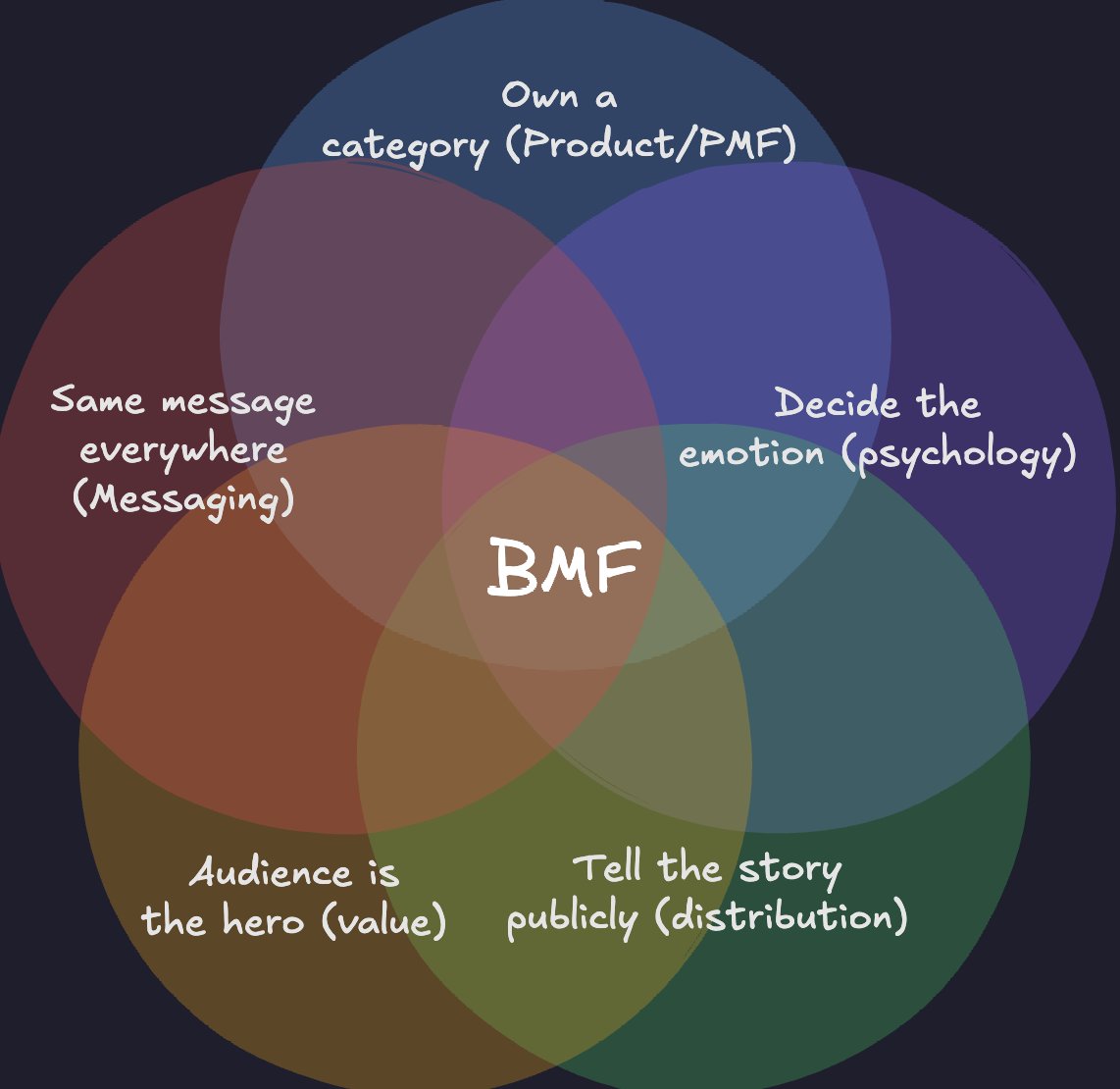
BMF (Brand-Market Fit)
I don't care if you're an AI startup founder, a micro creator looking to grow your brand, or an F500 company. You need to get this right.
Everyone knows about product-market fit. But very few think about brand-market fit.
Brand PMF is when a specific audience instantly understands what you stand for, deeply desires more of it, and can’t easily get it anywhere else.
This is the "DNA" of your brand.
The reality is, most brands position themselves next to 50 other competitors and wonder why they struggle to stand out.
Three questions to get clear on

1. What do you stand for?
   The idea, belief, or promise your brand is built on.

2. Who is it for?
   The specific person you're talking to.

3. Why should they care?
   What they get from you that they can't get anywhere else.
Great positioning 101
- Own a category (or better yet, create one)
The strongest brands aren’t just the best in a category; they’re often the only one in it.
Examples
@fomo - I can't even think of another finance x social trading platform.
@Polymarket & @Kalshi - Again, I don't even know of any other prediction market platforms.
@duolingo - While the company has recently declined due to AI, for a long time, they were the only ones that gamified the process of learning.
I can think of dozens more, but ultimately, you have to think deeply about what makes your product different, and lean into it with your branding. If you're struggling to find the answer, it's a sign you need to revisit your product-market fit. This is why a strong product matters tremendously if you want to build a magnetic brand.
Great category positioning is often:
-
Combining two worlds (often hot niches): AI x trading, social x trading, fitness x finance, gaming x education, etc.
-
First mover advantage. Having a great idea and executing first. Even if competitors emerge in your category, if you build the brand correctly, you'll still be known as the #1.
-
Solving a specific pain point. Again, branding and product tie directly into each other. Think deeply about the specific pain point your product solves, then start building a brand around it (if you're a creator, think about the pain point / value you're adding with your brand)
-
**Decide the emotion**
What do people FEEL and THINK about when they see [your] brand?
Do they feel cool? Do they feel a higher status? Do they respect/relate to you because you have something they want?
WHAT DO YOU WANT PEOPLE TO FEEL?

Smart ........ "I learn something every time"
Early ........ "I'm ahead of everyone else"
Belonging .... "These are my people"
Confident .... "I can actually do this"
Inspired ..... "I want to build something"
Rebellious ... "We do things differently"
-
**Tell the story publicly **
This piece is very important for personal brands
Audiences don’t connect with brands that only ever win. It feels robotic and scripted.
I’m not saying you have to post your lowest moments, but you do need to show the real journey behind the brand.
Share:
-
Your hot / honest takes
-
Raw videos with your face (faceless brands are harder to build)
-
What you're struggling with
-
What you're building
And so on.
-
**Make the audience the hero **
aka: what value do you give your audience? When they interact with your brand/product, what are they tangibly getting in return for spending their attention with you?
-
**Say it the same way, everywhere (messaging) **
The format of your messaging will change across distribution channels, but the story, the product's usefulness, and the emotion shouldn’t.
TL;DR: BMF is a combination of your brand's values, great product, messaging, and your ICP's psychology.
Founder-led versus Brand-led Content
Exploring the various options for how to actually publish your brand
Founder-led
One of the most powerful brand-growth strategies is founder-led content, with the founder serving as the face of the brand. Often in first-person tonality - sharing opinions, stories, and personality.
Content angles for founder brands:
-
How I'm building [x]
-
Behind the scenes of [x]
-
Lessons of a founder
etc.
FOUNDER-LED

Pros
- Builds trust fastest (people follow people)
- Easier to tell the story and share the journey
- Strong opinions to back the brand

Cons
- Key man risk (have to be careful that
personal opinions don't damage the brand)
Brand-led
A more "corporate" approach to content. Often speaking in third-person tonality.
Content angles for brand accounts:
-
Product launches / updates
-
Campaigns
-
Community interactions
BRAND-LED

Pros
- Scaleable
- Often better distribution for products
- More valuable if you ever sell the business

Cons
- Can be harder to build relatability
For companies, in 2026, you should be building both. Think of it as:
-
Founder account: why we’re building this, what I believe, what I’m learning, personal brand
-
Brand account: product launches, updates, general distribution
Note: For personal brands, you are the face. If you're serious about building a brand, you should dox. Your creative options open up tremendously (video content, photos, etc.), and by doxxing, you instantly kill ~80% of the competition that won't show face. Your trust, authority, and relatability instantly go up. It's one of the easiest, highest-leverage things you can do.
(not to mention you'll make more money from sponsors, get access to better private rooms, etc.)
How to Grow the Brand
Ok. We've covered: brand positioning, BMF, and the content angles you'll use (founder and brand), but how do you actually grow?
Funnel construction
You'll use three primary weapons to grow the brand through a funnel process.
THE CONTENT FUNNEL

TOF (Top of Funnel) ....... Get discovered
MOF (Middle of Funnel) .... Build trust
BOF (Bottom of Funnel) .... Convert
Generally speaking
- TOF: Top of Funnel
Goal: reach people / impressions.
This is your growth content. It’s broad and shareable.
-
Trendy content
-
Outlier virality formats
-
Short-form / clipping
-
**MOF: Middle of Funnel**
Goal: turn new followers into people who trust you.
This is where you build more authority with deeper-dive content. Sometimes your MOF content will still go viral.
-
How tos
-
Long-form
-
Step-by-step tutorials
-
Case studies and breakdowns
-
Behind-the-scenes
-
**Bottom of funnel **
Goal: turn trust → customers (if you have a product)
This is where content often asks for a specific CTA.
Content that works:
-
Product demos and walkthroughs
-
Customer results and testimonials
-
Offers, launches, and limited-time deals
-
Free resources that lead into paid ones (lead magnets)
-
FAQs and real-time objection handling
Depending on your brand, you can skew your resources towards different parts of the funnel.
For example, if you're building a finance news 𝕏 account, 90%+ of your content should probably be TOF.
If you're building a product page on Instagram, 90%+ of your content should probably be BOF.
You'll have to work out the exact percentages for each pillar you want to allocate to.
Establishing content pillars
Your content pillars fit inside the three parts of the funnel. They are generally the 3 to 5 topics/formats your brand is known for.
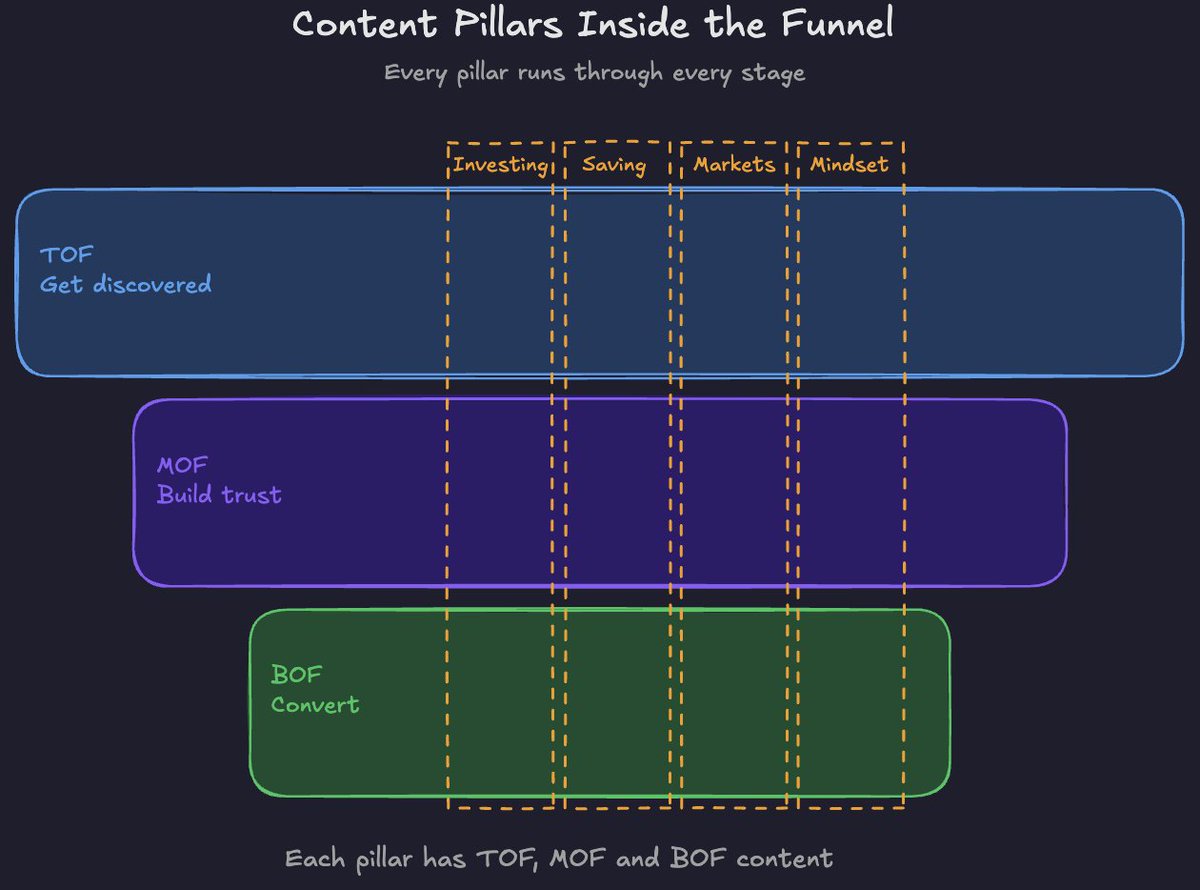
How to choose your pillars
Good pillars sit at the overlap of three things:
-
What your audience cares about: their problems, goals, and interests
-
What you’re credible on: your expertise, experience, and results
-
What connects to your product: topics that naturally lead to what you sell
EXAMPLE: PERSONAL FINANCE BRAND

PILLAR           TOF                      MOF                      BOF
Investing ...... "Most people lose        Beginner's guide to      "Get our free
                 money investing          building a portfolio     portfolio template"
                 because of this"

Saving ......... "I saved $10K in 12      Step-by-step budgeting   Budget tracker
                 months doing this"       system                   (paid product)

Markets ........ Hot take on today's      Weekly market            Premium newsletter
                 market move              breakdown newsletter     (paid tier)

Money Mindset .. "Rich people think       Story: how I paid off    Join the community
                 about money             my debt                  (paid membership)
                 differently"
Every platform has its own audience, format, and culture. Your job is to package and match the content pillars to each respective platform.
CHANNEL BREAKDOWN

TOF Channels:

X ............. Ideas, takes, threads, articles, intellectual, value-driven
YouTube ....... Long-form trust, entertainment
Short-form .... TikTok, Reels, Shorts

MOF Channels:
Newsletter .... Direct, owned relationship
Free communities (WhatsApp, TG, Skool, etc.)
Podcast ....... Deep trust, long attention

BOF Channels:
Paid groups: Skool, Discord, TG, X subs, etc.
Renting vs owning your audience
Social platforms rent you an audience. Algorithms change, accounts get restricted, and you can lose your distribution overnight.
Owned channels (newsletter, community, email list) are generally yours forever, as long as you don't violate TOS or get severely banned.
The goal of every distribution strategy: use rented platforms to find people, and owned channels to keep them engaged with the brand.
Building a Cult Community
There's a massive difference between building an audience and building a community. The best brands in the world have a genuine community to back them.
- Make people feel special for being a part of your inner circle
-
A name
-
Public recognition
-
Visual identity
-
Shared beliefs / language
-
A qualification process to allow access
-
**Give them a home to interact **
CHOOSING A HOME

Discord ...... Real-time chat, great for active, younger audiences
Telegram ..... Fast updates and announcements, popular in crypto
Skool ........ Courses + community, great for education brands
Private group  Simple, familiar, low barrier to entry
Newsletter ... Not a community on its own, but the best entry point
-
**Stay close to the roots of the community **
-
If you're a founder, spend time interacting in your private groups
-
Answer questions
-
Go live-stream for the community
-
Share behind-the-scenes info
And so on.
-
**Create rituals **
-
Weekly events
-
IRL retreats / annual events / meetups
-
Member spotlights
-
Challenges
Good example: think about how tech companies like OpenAI and Google have dedicated "Dev Days."
Final Tips & Some Advice
-
Don't neglect TOF content. This is what allows any brand to grow consistently over time.
-
Pick a couple of platforms to master. If you can master X/YT, then all other channels become 10x easier
-
Stay consistent. Do whatever you need to stay in the game.
-
Set up a content cadence. Establish when you write, film, batch content, etc.
-
Most pieces of organic content should have a job. New eyeballs, build trust/authority, or conversion.
-
Start your newsletter on day one. Even if you can't commit to publishing regularly, build it up anyway.
-
Repackage and study your winners.
If you made it this far, thank you for reading.
A like, repost & follow go a long way :)
If you have any questions, feel free to drop them below - I respond to every comment.
Also, feel free to leave topic suggestions that you'd like to see me write about next.
Now go build a massive brand. It will change your life 👊🏼