How to Cut Your AI Coding Bill to $0 in 10 Minutes (Full Setup)
文章目录
Claude Code costs $2,400 a year.
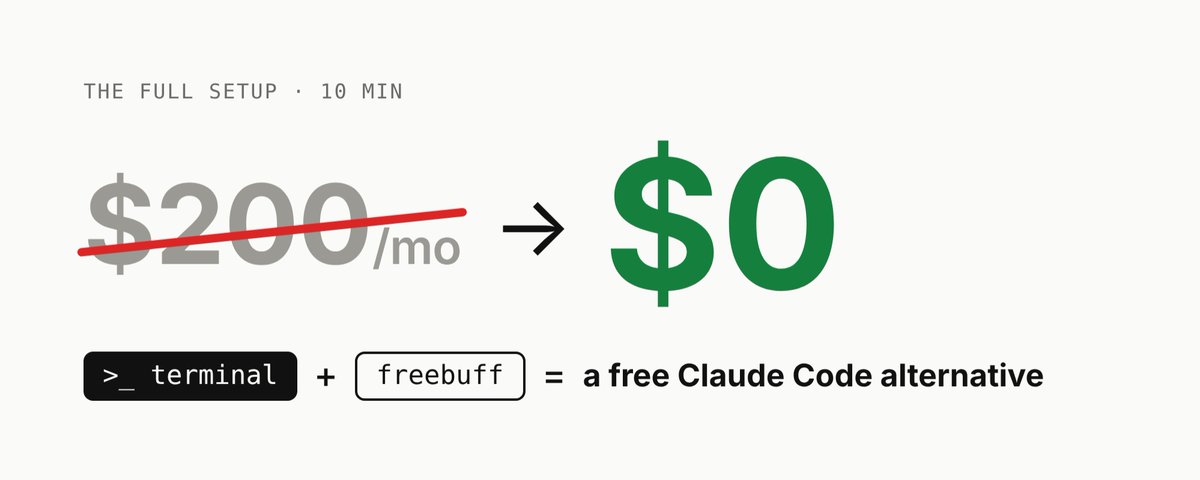
That's the top plan, and it's what a lot of us pay just to code without hitting a wall by lunch. This guide replaces it with a free terminal agent in about 10 minutes: the install, the free models, the daily allowance, the workflow, and the 3 mistakes that burn your free hours.
The math nobody wants to do
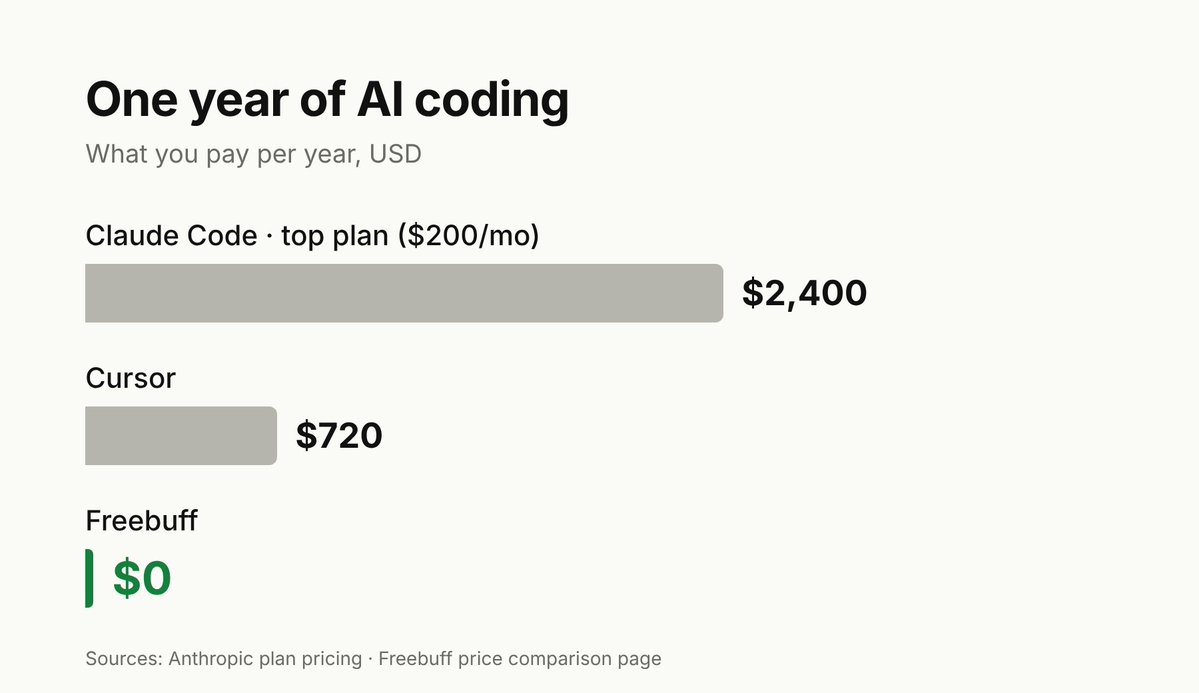
$200 a month doesn't feel like much until you multiply it.
-
Claude Code, top plan: $2,400 a year
-
Cursor: $720 a year (Freebuff's own comparison page)
-
Freebuff: $0
Freebuff is a coding agent that runs in your terminal, on desktop (Mac, Windows, Linux) or in the browser. Text ads pay for the models, not your card. It works in every country.
That last part matters. Most "free AI coding" tricks are US-only or expire after a trial. This one doesn't.
Step 1: Install it (1 minute)
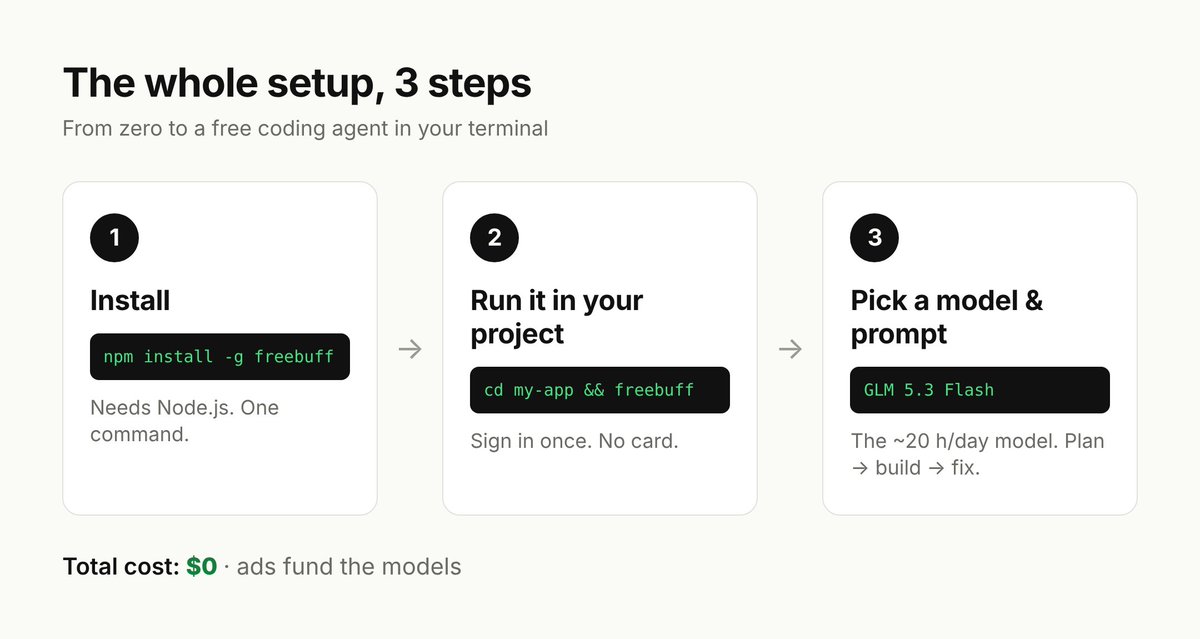
You need Node.js installed. Then run one command:
npm install -g freebuff
That's the whole install. No API keys, no config file, no billing page.
Prefer a window to a terminal? There's a desktop app on freebuff.com that does the same thing.
Step 2: Run it inside your project (1 minute)
Go to any project folder and start it:
cd my-app freebuff
Sign in the first time. No card asked. From here it works like any coding agent: it reads your files, plans changes, edits code and runs commands in your terminal.
Step 3: Pick the right model (this is where people waste hours)
You get a daily allowance that refills at midnight Pacific. No weekly caps. No monthly caps. Just a fresh day, every day.
Different models burn it at different speeds. Roughly:
-
GLM 5.3 Flash: about 20 hours a day. Your default for everything.
-
DeepSeek V4.1 Flash: about 6 hours.
-
GPT-5.6 Luna: about 5 hours.
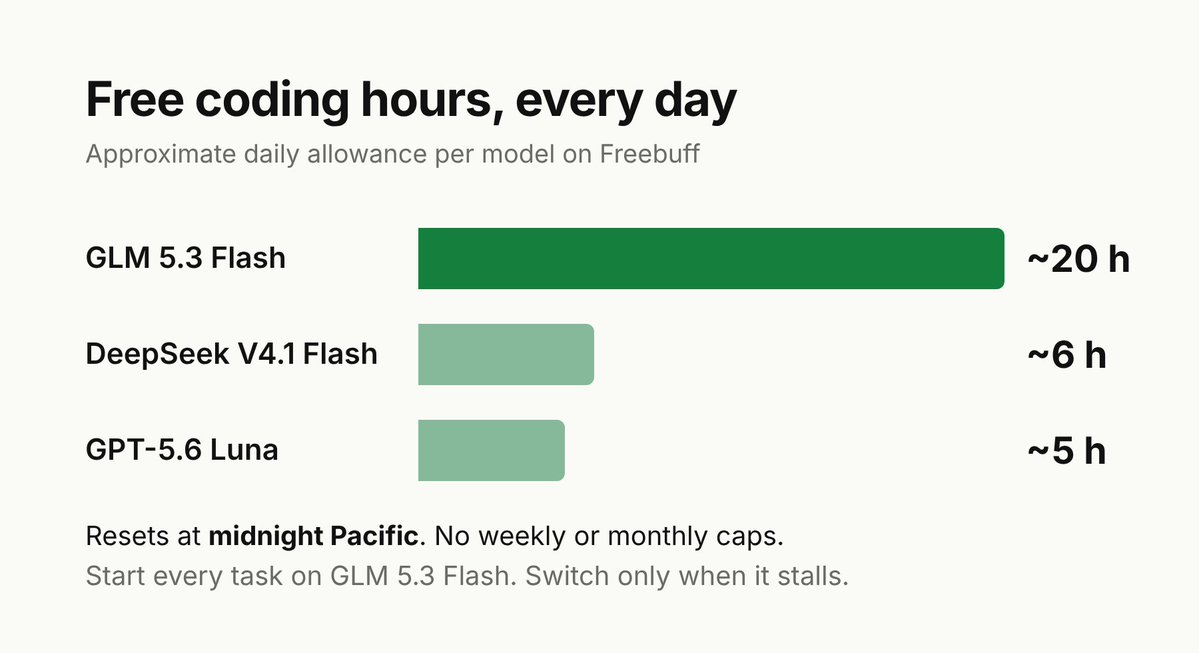
The rule is simple. Start every task on GLM 5.3 Flash. Switch to another model only when it gets stuck on something specific. Most days you'll never touch the others.
Step 4: The workflow that actually ships
Same loop I'd use with any paid agent:
-
Plan first. Ask it to read the project and propose a plan before touching code. Approve or correct the plan.
-
Build in small chunks. One feature, one prompt. Small diffs are easy to review and cheap on your allowance.
-
Fix with the error. Paste the exact error or failing test. Don't describe it, paste it.
-
Commit after every win. If the next step goes sideways, you roll back one commit, not one afternoon.
The 3 mistakes that burn your free hours
1. Starting on the expensive model. Opening every session on a 5-hour model is how you run dry by 3pm. GLM 5.3 Flash first. Always.
2. Running it from the wrong folder. Start freebuff in the project root. Run it from your home folder and it has nothing useful to read, so it guesses.
3. Pasting things you shouldn't. It's ad-funded, and providers may keep what you submit. Don't paste API keys, passwords, or client code under NDA. Use it for your own projects and open-source work.
When to keep paying
Being honest: the free models are good, not frontier. For a gnarly refactor across a huge codebase, a top paid model still wins.
But that's maybe 10% of what most of us do. The other 90% (scaffolding, CRUD, bug fixes, tests, landing pages, scripts) runs fine on free models.
So the real move isn't "never pay again." It's: stop paying $200 a month for work a free agent already handles. Drop to a cheaper plan, or cancel and keep Freebuff for the daily grind.
The 10-minute version
-
npm install -g freebuff
-
cd into your project and run freebuff
-
Sign in, pick GLM 5.3 Flash
-
Plan, build, fix, commit
Total cost: $0.
Bookmark this for the next time your Claude limit hits mid-task.