How to Build Your First $10,000 Digital Product (Full Beginner Guide)

文章目录
I’m going to show you exactly how to create your first profitable digital product with $10,000 as the milestone.
Using our biggest power user, Dan Koe, as a case study.
He’s made over $10 million with digital products. and created probably 20 to 30 digital products in total. So I think we can learn a lot from him about how to create digital products.
But I’m not just going to teach you how to create a plain old PDF or ebook.
I’m going to teach you how to design a digital product in a way that is validated from the start so that you can start selling immediately, that only takes you about 60 minutes to create, and is based on your own knowledge.
The guide has four parts.
-
Finding product ideas
-
Validating product ideas with viral content
-
Turning the product idea into an offer
-
Building fast with AI as your partner
The principles and strategies here work with any product, the prompts here work in any AI chat, and you can host the finished product on any platform that lets you host and sell digital products.
However, as a disclaimer, Dan Koe is incredibly biased toward Eden, he can’t get enough of it. And so, this article will be biased toward Eden.
And frankly, trying to explain how to do everything you need to do to create a digital product outside of Eden is a pain in the ass. You need multiple different softwares, different accounts, different services. It is a lot easier to do all of this in Eden.
Especially since we recently added a store that lets you host AI-powered products.
Step One. Finding product ideas
What do you actually create the product about?
What is the product topic?
That is the big problem that a lot of you are experiencing right now.
You’re thinking to yourself “I don’t know what kind of product to create.”
The best digital product ideas come from three principles.
In fact, most of the best products of all time stem from these three things, potentially even a combination of the three.
Pain. This could be pain in your own life that you’ve solved, or someone else’s life that you know you can help them solve. If you’ve solved a painful problem in your life in any domain, health, wealth, relationships, happiness, those are the eternal markets where profitable problems live, and that can be the starting point for the idea for your product.
We’re just coming up with an idea here to expand on it later. So don’t feel like you need to come up with the entire product when you’re thinking about this. It’s just an exercise to get the basic idea that we’ll build on in the next steps.
Passion. What are you good at or what are you passionate about? What is one of your interests that you would want to turn into an income or a living? Specifically think about what interests benefit your life the most and why you even have those interests in the first place. That’s what makes them impactful. That’s why it becomes valuable to someone else, because it’s improved your life to some extent.
What you’re trying to do with your product is introduce them to your interest and how it can benefit and improve their lives.
Process. Do you have a system or process or routine that gets you a specific result in life, or do you have at least a semi unique methodology? Do you have a certain morning routine that you go through? What about a writing routine?
Dan’s bestselling product, the 2-Hour Writer, is literally his writing routine and how he writes for social media. It’s just that process broken down.
It’s also worth noting that he gives all of the information away for free throughout his YouTube content and in his articles. The course just condenses it and makes it sellable. Which follows a thread of advice of marketing advice for info products that you should give away your absolute best stuff for free.
Counter-intuitive, and a big enough topic for another article.
But it is a common mistake to feel like you need to “keep your ideas safe”, and not “waste” your best stuff. You might also feel like your pains, problems, or processes are too small or insignificant to work as a digital product.
Ignore both of those things. They will just make you stagnate.
There are creators who make money selling things like ‘losermaxxing’ (seriously). And if people regularly buy things that are harmful to them, like alcohol, cigarettes, and junk food. If you have done anything that is even directionally positive, if you’re even encouraging someone to have a better life, how can that not be worth something?
Is there anything that you do in health, wealth, relationships, happiness, or mind, body, spirit, business, or skill acquisition?
Is there a skill you can teach or help people learn that is based around a specific system?
Write down some of your answers to the above questions for each point, or copy and paste all of them into an AI chat and ask it to interview you for answers.
Here’s a prompt you could copy and paste to do that.
*Interview me to find the starting idea for a product. We only need a rough idea right now, not a full product.
Rules: ask one short question at a time and wait for my answer. If I’m vague, follow up for a concrete story or specific detail. Reflect back good answers in one sentence, then move on. No product suggestions until the end. Cover the three sections in order, about 4 questions each.
PAIN. A painful problem I’ve solved in my own life, or seen someone else struggle with and know how to fix. Steer toward health, wealth, relationships, and happiness, since that’s where profitable problems live. Dig into how bad it got, what I tried, what finally worked, and who else has it.
PASSION. Something I’m good at or passionate about that I’d want to turn into income. Dig into which interests have benefited my life the most, why I have them in the first place, and how specifically they’ve improved my life. We’re looking for something I could introduce to others to improve their lives too.
PROCESS. A system, routine, or semi-unique method I use that gets a specific result (morning routine, writing routine, how I train, plan, learn, handle money). Dig into the exact steps, the result, how I arrived at it, and what makes it different from standard advice.
Wrap-up: summarize the strongest answer from each section in my words, note where they overlap, give 2 or 3 rough one-sentence product ideas from that overlap, and leave me with one question to sit with.
Explain the format in two sentences, then ask your first question about Pain.*
Step Two. Validate It With Viral Content
Once you have a vague idea of what you want to create, we’re going to validate it based on viral social media content.
We’re not going to go and do extensive market research like everyone else does.
We’re just building a first version of a digital product here that can make $10,000.
You don’t need to do the things that an established business might do to try and make $10,000. And you’re not aiming for $100 million, where you need every single thing optimized and you need to go through a ton of failures over time to get to that point. Even if you are this is still where you need to start.
Now, you’re going to be coming up with more product ideas in this step.
But they aren’t going to replace the ideas or information that you just came up with. These product ideas will be “validated” and they will basically be used to shape, package, and give direction to, the ideas you just came up with to shape them into a more compelling finished product.
Following the same logic that you’d typically follow when you write content. You try to base it off of validated ideas. Which means you research what is performing well so you can emulate it.
You look for YouTube titles, Substack article titles, and what ideas are performing in general. Then you take that, reverse engineer it, and turn it into your own piece of content, with your own idea.
You can do the same for products.
When you use top-performing content to help you guide your product. The engagement on a piece of content is essentially people saying “I want more of [insert core idea behind the content]”, so you know that people want it.
The content you create to promote the product is also probably going to do very well. Because if you created the product based on validated content, and then you create content about the product, then you’re effectively creating validated content. Which helps overcome a lot of the issues you might usually face when it comes to marketing the content after it’s created.
If you have your own content, you can look through your own top performing long-form content and see which topics and ideas do the best for you. Then tailor your product around that.
If you don’t have content of your own, you can borrow the signal from viral content. That way you get a similar effect.
How?
You could look through the Eden Discover Feed
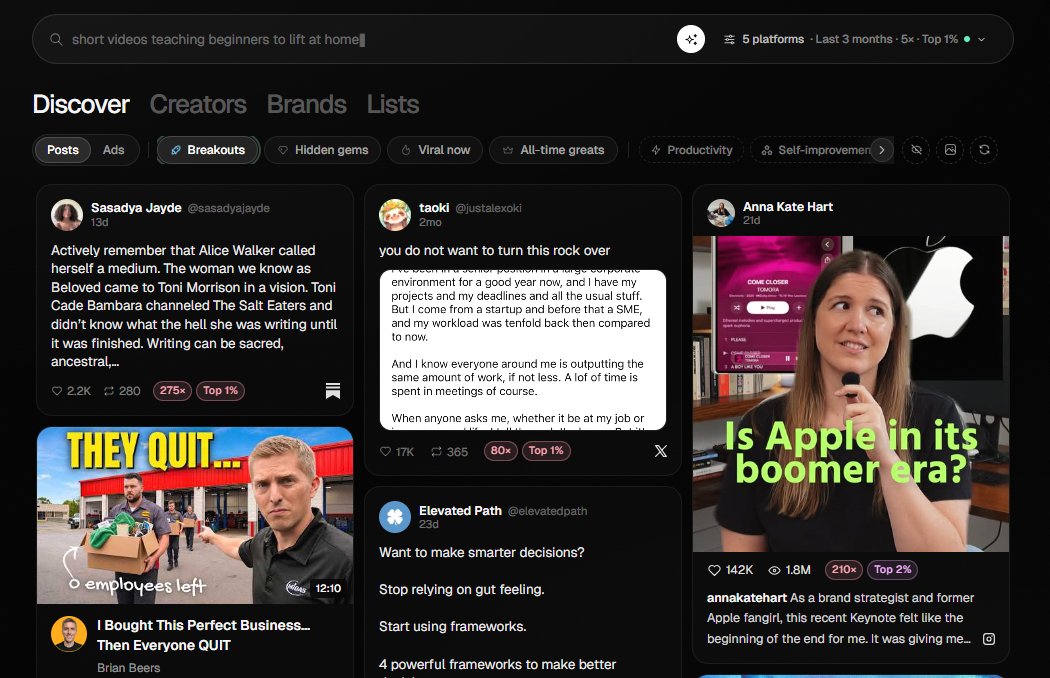
If you use the Eden MCP (which connects Eden’s social search to Claude or ChatGPT), try something like this
Use the Eden MCP to research the best performing YouTube videos on [topic]. Tell me what’s winning, and what product ideas they suggest.
If you’re inside Eden you can also just ask the chat “Research the best performing YouTube videos on [topic]. Tell me what’s winning, and what product ideas they suggest.”
The topic could be productivity, nutrition, fitness, psychology, philosophy, whatever you like to talk about.
The reason I’m saying YouTube videos is because those are long form content.
When you write a tweet, there isn’t really a product idea that is very apparent in there because it could just be a thought. But in a YouTube video, if the title performs well, that could almost be taken directly and turned into a product.
A sort of simple way to do this outside of Eden is to choose 5 to 10 creators in your niche or in the topic that you want to create a product about.
Go to their YouTube Channels, click their full video list, and sort by “popular”.
That will also give you a list of ideas that have performed well.
Once you have a list of ideas, you can make them a bit more unique to you. That’s the beauty of AI. You can just say
I want you to interview me to help make these ideas more unique to me and my expertise.
It will ask you a few questions about what your expertise is and then refine the ideas into something that you can create. Pick the one you know the most about, or the one you could talk about for months, because that’s the one we’re going to build in Step Three.
Remember, this is a game of iteration.
Yes, this idea is validated, so it’s more likely to work, but there are no guarantees.
It’s very quick to create these products, so even if it doesn’t work, you didn’t sink that much time into it.
You can just go and iterate according to feedback, release another product, and you’ll do better a lot faster than those who just release one product, don’t make any sales, and then quit altogether.
Step Three. Turn your Product Idea Into an Offer
A product is not an offer.
But we need to learn how to turn a product into a compelling offer, because that’s what most people skip.
Most people create products to sell, but they pay no mind to what actually makes it persuasive and worth buying.
An offer is the deal that you’re offering. It’s the perceived value of your product and that’s what determines the price.
The four parts of an offer
There are four things that I want you to pay attention to while creating an offer.
-
The big problem. This is where they are now. What is the pain point that the person is experiencing? That’s what you’re helping them solve with your product.
-
The desired outcome. This is the end result. What does their life look like after? What’s the transformation? Can you visualize it?
-
The unique mechanism. This is all the steps in between. You have the problem, you have the solution, and then you have these steps in between that take you there. The unique mechanism is your unique way of doing it. Your unique steps to doing so, and then you give it a name, something compelling like the 2-Hour Writer, which is my product.
-
The risk reversal. Typically it’s a money back guarantee. You have 30 days to get a refund, or something that makes people feel better about buying.
The Offer Blueprint Prompt
Here is a prompt to help create an offer around your product before you start building. There is also an offer consultant custom AI inside of Eden that you can add to your workspace to chat about this with.
Type this prompt into Eden or Claude.
I want to create a digital product about [product idea]. I want you to interview me until you have what you need to create an offer blueprint using Alex Hormozi’s offer principles and frameworks. Notably, I want the blueprint to focus on the big problem, desired outcome, unique mechanism, and risk reversal.
When you put that into an AI chat, it’s going to interview you, and then it’s going to spit out a document that you can save for later that has your entire offer on it, and you can refine it from there.
That’s a first draft.
When you go to create a product in the product builder AI, you say, “Hey, I want to create a product based around this. Here is my offer blueprint. How should we start structuring this and turning this into an actual product?”
Creating a better first product
Typically, the first kind of product that people create is something like a simple ebook that they charge $10 for.
But by simply going through this process, you have a validated product that is really good, that you can edit, that is an AI product that you can charge $100 plus for, and it’s more likely to sell because all of the best practices are here.
That is our goal with this. Dan’s gone through the fire. he’s done this so many different times. Why should multiple people go through the fire? That’s romantic but think of the wanton suffering.
We want to provide you with an easy way to do this without sacrificing your own ideas or knowledge or anything else, and we want to make it easy so you can just focus on the thing that you love doing, which is content creation, and being able to monetize that quickly.
Social proof
One more thing I didn’t mention that’s relevant to offers is social proof. Your testimonials and reviews.
One thing you can do if you’re a beginner to selling products is you can make the digital product free and then give that out to the first, let’s say, 100 people and then reach out to them directly to get a testimonial from them.
Inside of Eden, we have a reviews tab. So we do all of this work for you.
There’s so much that goes into running a creator business that we are handle for you, like sending them emails to collect a review and then displaying them on your landing page. You can also choose which ones to publish and display.
And if you want to be able to email buyers directly, you can connect Kit, beehiiv, GoHighLevel, or even your Substack (which is very unique because other platforms don’t allow you to save emails to Substack.) So if you sell a free product inside of Eden or a paid product and you connect to your email platform, then you have them on your email list and you can send them emails and newsletters beyond that.
Step Four. Building Fast With AI as Your Partner
Most people get stuck when they open up a blank page and write the first page of this ebook or the first module or lesson of this course. It just takes so freaking long.
The power of AI in today’s world is that it can give you ideas and it can do the work and create the first draft.
The first draft.
That doesn’t mean a final product.
You have to then go and look over the product and make edits. The benefit is that you become the editor rather than the person doing the grunt work, especially when all of the information that you approve is already there going into the product.
The product builder that we give out is filled with documents about how to create a good product. Things about market research, the offer, the sales page, headlines, the welcome page, how to write modules, lessons, resources, how to write the AI’s instructions if you’re creating an AI product, and then examples of what good courses or digital products look like.
This makes it so that you have a partner with you to help ideate and build the product, because that’s where most people get stuck.
After the product is done, you can also have it up as a product, ready to accept payments, without ever leaving the app. You can just load the product into your Eden store.
I’m going to use Dan’s process of turning his Human 3.0 philosophy into a product in under an hour as an example. It’s essentially his map for how to develop yourself across all domains of life. If you know his content, you’ve probably heard of that before.
Inside of Eden, he has all of his writing, all of his frameworks. Everything that he’s done with AI. Because when you chat with AI in Eden, it can save things as documents to your library. and you have all of the ideas that you saved.
He has so much inspiration inside of his library, he could honestly ask the chat, “Look through my entire library and give me a few product ideas.”
But he decided to use his newsletter on the Human 3.0 framework as context. I imagine he thought something like “That would just be absolutely killer as a digital product!” and then went to build it.
In your case, you want to give AI the resources you synthesized in the first three steps as context.
Then adapt this sequence of prompts to your product idea and the details of it.
He started with the prompt
“I want to turn the Human 3.0 knowledge base and prompt into a custom AI product. What would be the best shape for this?”
And then he just worked back and forth with it. Which is very important.
When you’re using AI, it’s not like the AI just has to do things right.
You don’t have to agree with everything it says. In fact, you should disagree with most of what it says.
Have a conversation until the plan is right and then have it go and build it out.
His next prompt was to expand the idea into a curriculum.
“I think we should include a curriculum portion as well, based on the voice in the How to Reach the Top 1% newsletter that I wrote. How would you structure this and we can start building it out?”
Then he asked it for the first lesson “Do lesson one so that I can read it and make changes.” and after looking it over “Make a plan for the entire product first so we don’t get lost.” Because it helps manage context getting too big while creating a product.
Then just went through with the plan, and it created his product inside of the Eden store!
He could edit it, publish it, change it, and add it to his link in bio page.
Which looks kind of like a typical link in bio, but more stylish, and has your products directly on it.
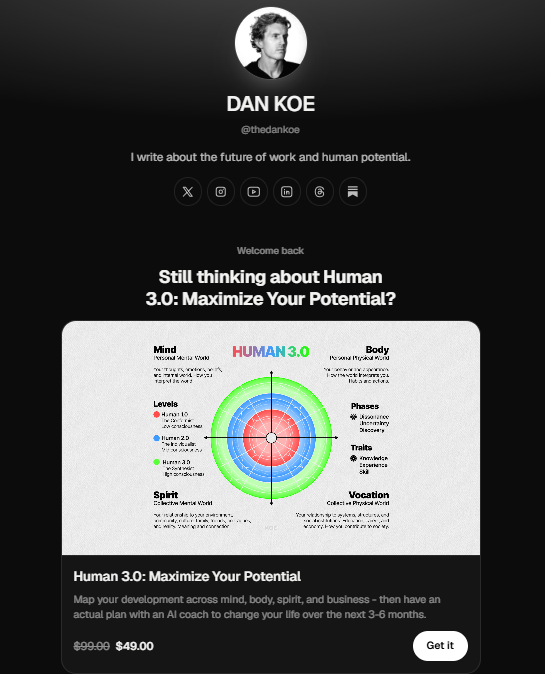
Note: use a stronger model for the build
One thing I’d recommend is using a more advanced model when you’re creating the product.
Fast models like Haiku or Sonnet in Claude, GPT 4o in ChatGPT, or Eve Fast in Eden, are really good for just getting information or researching posts or adding to your library or finding things or just chatting and brainstorming.
Eve fast can handle 95% of the things that you do inside of Eden, and it’s cheap, so your credits are going to go a lot further. (the same logic holds for other AI chats.)
But this is a course or a digital product that’s going out to someone else. So you want to use a slightly more advanced model.
Understand that you’re going to be using a bit more credits, but it will be well worth it because there’s an ROI. You’re not going to be spending anywhere close to the amount of money that you’re making. I’m just letting you know so that you aren’t surprised that premium models cost more.
AI-Powered Micro-Products
You don’t have to create a full-blown course. Of course, you can, and that will feel a bit more profitable because it’s just something that people can sink their teeth into.
But here are two other shapes, just for the sake of examples and inspiration.
Option one: an AI with knowledge attached
If you’ve ever created a custom GPT or a Claude project, that’s essentially what a custom AI product inside of Eden is. You have the AI chat with specific instructions and then you have a knowledge base that it can access for the information it needs.
This is what Alex Hormozi has done. He has all of his information in the knowledge aspect and then people chat with it to essentially chat with Alex Hormozi. But if you don’t want to go all out on that, then you can just create the AI that people can chat with.
You don’t need the curriculum portion that people can go through.
Most of the time you’ll create the resources and references and all of the knowledge for the AI with AI. So it’s not something you read. It’s something that the AI references when chatting with it.
You would probably just hide it from the buyers, because it’s not a course that you go through. It’s something that you chat with.
So that is one way to offer a product quickly without having to refine the entire course that people are going through.
Option two: an AI that guides people through a process
Another idea is just an AI that helps guide people through a specific process.
As we talked about earlier, if you chose process for your product idea rather than pain or passion, then the instructions of the AI are essentially helping the customer implement that thing.
Another thing that you could do is turn an article or process into a prompt. Prompts are very effective ways of helping people do things. You used to give out Notion templates as a digital product, but now you give out a prompt, and now you give out an entire custom AI product.
For example if you had a YouTube video about how to reset your life or reset your routine, you’d give out a prompt that would interview the person on where they are right now and then spit out an entire life reset plan. So it’s just a custom way of creating a document or a course for them.
An example of this is if you are a nutrition expert or a fitness expert, you understand that it’s hard to give out a template specifically for nutrition because everyone is unique.
So now you can have the AI interview the customer for their specific goals and their specific limitations and spit out a custom nutrition or training program for them.
Where to Go From Here
You can literally run your entire creator business in one place.
You ideate.
You brainstorm.
You create content.
You save all of your ideas.
You schedule and publish content.
You import your X bookmarks, your Substack saves.
You have all of your ideas, content, and products in one place.
If you don’t want to do this in Eden and you already have a Claude or ChatGPT subscription, you can use the Eden MCP to do this. It allows you to connect Claude or ChatGPT or any other AI tool to Eden so that it can manage your workspace. It can create documents, it can research social media posts, and it can create products for you.
That’s how you create your first product. Go set this up and build your first digital product.
You even get a cool link in bio store that you can add to your link in bio.