Understanding October 7
文章目录
A lot of people don’t understand October 7.
I don’t mean from a political or a humanitarian standpoint but on a purely physical and spatial level. They cannot create a mental image of the attack, only bring up nightmarish, disjointed scenes that offer no tactical or geographical context.
All they know is that there was an attack from Gaza and a lot of people were killed or kidnapped in horrible ways. The endless atrocity videos and images tell the human story, but they provide no tactical explanation, no sense of space and time.
This is a problem because it opens the gate to absurd theories while failing to provide pro-Israel people with the tools needed to counter them. An abstraction can be twisted into any shape the narrator desires, including a shape that can be used to stab the victim instead of the attacker. So let’s make sure our understanding of October 7 is the correct size and form.
For people concerned about traumatizing content, this is a purely analytical article. It is based on the masterful British 7 October Parliamentary report chaired by Lord Roberts of Belgravia.
I will not describe any atrocities or give any gory details.
So, the first thing that’s vital to understand is that Gaza started the day in a much better position than Israel, which might seem counterintuitive since the IDF is a larger and stronger force than Hamas.
However, Hamas began the operation with thousands of attackers already organized, armed and moving according to a prepared plan. Each one of them knew exactly where he was supposed to go and what he was supposed to do.
Israel had to realize what was happening, move available forces toward hundreds of simultaneous battle sites while knowing no more than the average guy at home, then mobilize hundreds of thousands of reservists, which naturally takes hours in the best of times.
It’s equally important to understand the distances involved. This was not an invasion across an expanse of desert like some people imagine. Only a few hundred meters separated the attackers from the defenders in many places. At most, it was a couple kilometers. In some cases, they were literally a stone throw away.
An attacker from Gaza coulf be inside a home in Israel within minutes.
So let’s talk about the few hours that determined the fate of millions over the next three years.
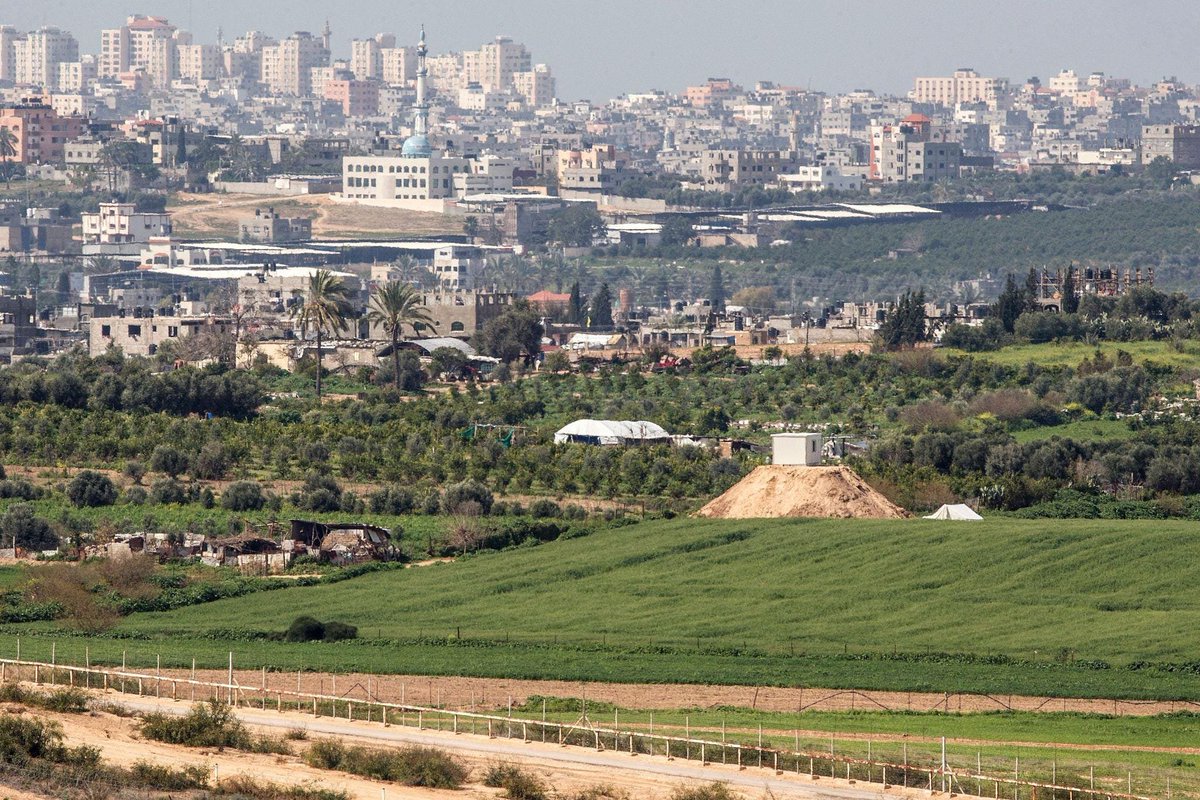
Gaza and Israel before the war. You could walk the distance within minutes.
Why did the Arab forces that invaded Israel found the communities along the border virtually unprotected by the military?
The IDF doesn’t have tens of thousands of soldiers that can be sent anywhere at a moment’s notice. Most soldiers have specific tasks and can’t be recalled from them willy-nilly. For example, you can’t just pull forces from a base on the Lebanon border because then you’ll leave a part of the border exposed.
On the morning of October 7, the IDF force along the border with Gaza was 14 companies in four regional battalions. That is 767 soldiers, including non-combat roles. Some of them weren’t even armed.
These soldiers had to face about 6,000 attackers, about two thirds of whom were heavily-armed and well-trained commandos and the rest were opportunists who saw a chance to loot and rape and wanted a piece of the action. According to Hamas, these unarmed civilians were responsible for the worst atrocities of that day since they didn’t have clear orders, only bloodlust.
That is a 7-to-1 ratio.
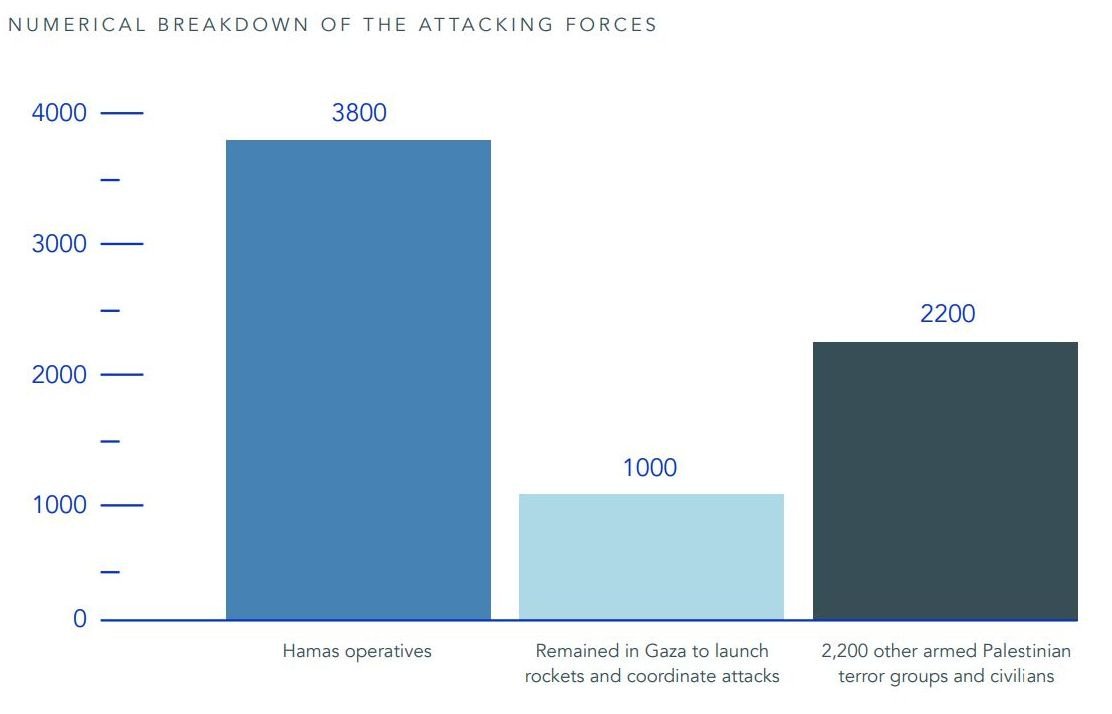
Notice the almost 2,200 “unarmed civilians” among the invaders.
Even where local forces weren’t overwhelmed, they were pinned down, leaving the small communities to fend for themselves until a response could be organized on the state level.
Thousands of volunteers raced to save lives and engaged the invaders almost instantly, but they couldn’t clear hundreds of homes from the occupiers by themselves, especially since they were essentially armed individuals or small groups without a clear chain of command.
The resistance they offered was sporadic and often focused on blocking roads along with the police and small number of available soldiers to prevent the invaders from moving deeper into the country.
Why did such a small force defend such an explosive border despite a plethora of signs the enemy was preparing for an attack?
While it’s easy to blame the chauvinist male officers for not listening to the female observers, the reality is more complex: warning such as these were commonplace for years and were negated by the political echelon. A military cannot be in a perpetual state of high alert, especially when this contradicts government policy.
The result was similar to someone who shuts down a smoke detector that’s constantly beeping without a fire, only to be surprised when there’s an actual fire.
Why wasn’t anything done in response to the constant threats?
That is a question for the politicians.
A military cannot initiate massive action without an order from the government. As a result, many officers just accepted this impossible reality in which dire threats were a daily occurrence and didn’t treat these particular threats as anything different.
Who is more to blame? The officers who failed to impress on the government just how serious the situation was or the government that failed to take into account their concerns as well as hints from the Arabs and act proactively?
This is a question that only an inquiry can answer.
Where were the helicopters and jets?
Surely, an aircraft can reach the border within minutes. Indeed, the first helicopters were already over the border and killing invaders 20 minutes after the attack started. However, the scenario they were prepared for was repelling a small infiltration, not a full-scale invasion spread over almost a 100 kilometers. As a result of the confusion, air force actions were sporadic until about two hours into the massacre.
Nevertheless, the idea that they just hovered there doing nothing or firing into people at random is simply false. It is estimated that about 1,600 of the 6,000 attackers were killed during the attack, of whom approximately 700–1,000 were killed by Air Force strikes.
Many of these were likely the opportunists who stormed into Israel through holes in the fence during the second wave of the attack as militants with concrete plans and goals either returned to Gaza or found cover inside Israel very quickly.
And again, I must stress how small were the distances involved. The helicopters were already over the border in less than 20 minutes, but you can drive from a house in Gaza to a house in Israel *and return *in less than 10 minutes.
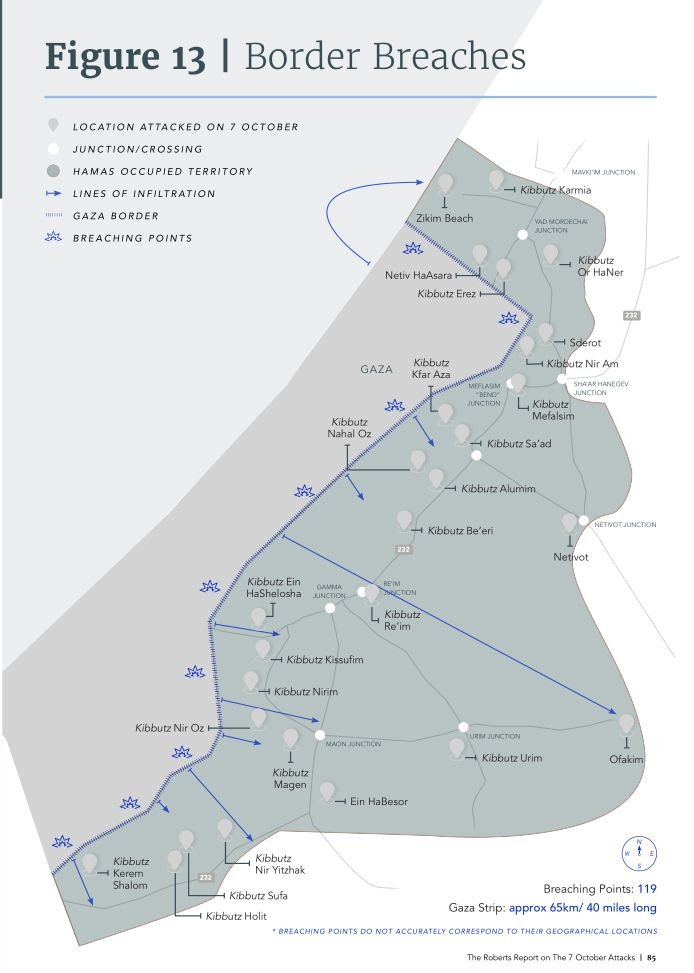
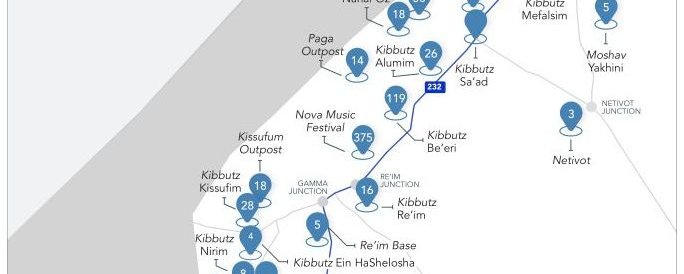
119 breaches over a distance of barely 60 kilometers
Due to the chaotic situation created by hordes of looters from Gaza, fleeing Israeli civilians, volunteers who came on their own to repel the invaders, police, soldiers, enemy militants still moving through Israeli territory, and random people caught in the crossfire, it was often impossible to distinguish between defenders and attackers, which prevented many attacks from the air.
In other cases, the attackers were already barricaded inside houses and were impossible to locate without ground forces going door-to-door, making sure houses were clear of booby traps or militants, possibly holding hostages.
That explains why in some cases terrorists were holed up inside a house for over 10 hours. A relatively small number of Israelis cops and soldiers had to cover a huge amount of ground. Counterintuitive though it sounds, during the first hours of the war, the Gazans enjoyed a numerical superiority in the area.
So, while the air force inflicted heavy casualties on the attackers, due to the confusion of the situation, it was not able to destroy most of them from the air in the very brief time it takes to cross the border.
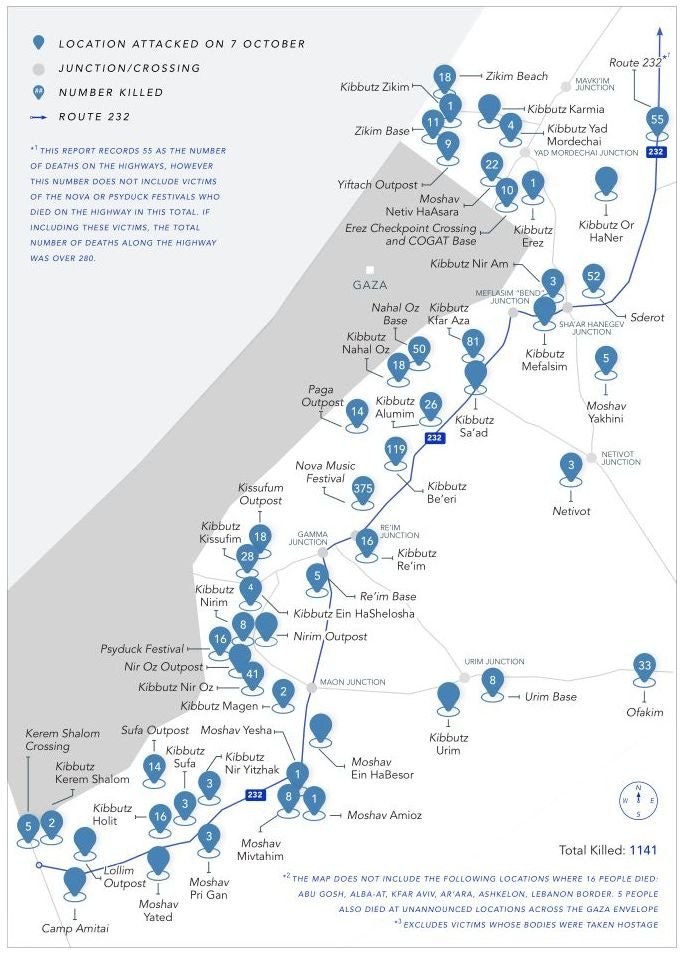
This is a map of the fatalities of the battles that morning, notice the massive spread.
Were Israeli soldiers and civilians killed by Israeli fire?
100% yes.
War is chaos at the best of times, and this invasion was pure madness as far as the IDF was concerned. The fog of war was never thicker. The UN identified up to 14 Israeli civilians killed in two incidents involving Israeli forces. The true number is likely higher and will never be known. Nevertheless, this is still a surprisingly low ratio.
Because most people were raised on action movies, they don’t understand how common casualties from friendly fire are in real wars. Here are a few examples:
-
World War II, Korea and Vietnam: a U.S. Army analysis estimated roughly 15% of casualties from friendly fire.
-
1991 Gulf War: the U.S. recorded 17% of combat casualties as friendly fire. Among those killed in action, the proportion was 24%. Almost one in four American fatalities were the result of American fire.
-
2003 Iraq War: a Congressional Research Service review reported an early estimate of about 10% of U.S. combat deaths from friendly fire. For British forces, the UK government reported that 14% of fatalities were caused by friendly fire.
-
Gaza Ground Operation: 31 of 472 fatalities during the Gaza ground operation were a result of friendly fire incidents. That is 6.6%.
14 out of 1,200 is about 1%. Even if the number is double or triple that, this is a very low friendly fire casualty rate, especially for such a chaotic situation.
The Bottom Line
October 7 was a simultaneous multi-point assault that exploited a border defense designed around deterrence and early warning rather than stopping a sudden invasion. Israel’s immediate response depended on small local forces and individual initiative, since a response forces take time to assemble. Due to the tiny distances involved, these hours proved critical, allowing a force of over 6,000 heavily-armed and well-prepared attackers to murder and kidnap 1,400 Israelis, mostly unarmed civilians, and burn thousands of homes and cars.
If you enjoyed this story, please consider supporting my work on ko-fi.
You aid helps me keep researching, observing, writing, making videos, and annoying the right people!