I mapped 25+ GB of Effective Altruism material. Here's what I learned.
文章目录
Why Effective Altruism should be banned from AI safety, policy-making, and governance.
Tomorrow, I’m going to release my biggest DataRepublican project yet mapping out the Effective Altruism network. Tonight, I’m going to explain why this became my biggest project yet.
On September 8, AI researcher Jacob Coxon came out with his hyper-viral X post - which received an astounding 170 million views and counting - announcing his resignation from Anthropic. In the post, he warned about the dangers of continuing AI research and called for a pause, going so far as to claim that “people building AI earnestly believe that it could kill us all by the end of the decade.”
Almost immediately, the post was picked up and quoted by prominent Democratic figures, frontier AI corporate executives, and figures within the AI Safety movement. Many called for a slowdown or even a cessation to AI development, with some going as far to demand a multilateral solution.
It did not take long for right-wing influencers within 𝕏 to question if this was all a campaign. Kevin Bass followed the money, and in doing so, pointed out the role of nonprofits such as METR. As more posters traced the money, a label kept popping up among the ringleaders of the calls to slow down AI development: Effective Altruism.
What is Effective Altruism (EA), exactly? On its surface, it looks like a good philosophy: it advocates an objective, data-driven approach to charitable deeds and giving in order to maximize good.
You might think - Effective Altruism (EA) just identifies how to help the most lives with the fewest resources. Isn’t that … common sense?
But it includes a couple of important twists.
EAs include future good calculations as a potential factor. Most utilitarian philosophies consider lives to be space-agnostic (no one existing human has more worth than another). EAs consider a life’s worth to hold across time as well as space.
In other words, the first twist is: future value is a factor.
Examples might include:
-
Spend a billion dollars fighting a future AI catastrophe instead of stopping malaria in children.
-
Pour resources into stopping a pandemic that hasn't happened over diseases killing people right now.
-
In one case, an EA even argued that every year spent not securing humanity’s future forfeited the existence of 10^14 potential lives.
These scenarios often get lumped under the label of “longtermism.”
The second twist is: math is species-agnostic. This is one of the more controversial EA topics, but the premise still holds: if you are attempting to derive “good” through math, math does not acknowledge the intrinsic worth of humans. Now, many EAs optimize global health solely through the lens of human beings – but equally many don’t.
This leads to the infamous “shrimp” argument: 400 billion to 1 trillion shrimp are farmed and killed per year, with the possibility for suffering theoretically documented. That’s four orders of magnitude beyond human death. Throw in the time factor, and that’s a tremendous number of “suffering” that can be ended only if we’d eat soybeans instead of shrimp.
This is not abstract. Rethink Priorities, an EA-aligned thinktank with reported revenue over 20 million dollars in 2024, published research assigning lives of various species “moral weight” through a series of quantitative metrics. Within their framework, three chickens have the same “moral weight” as one human, whereas 32 shrimps have the same as one human.
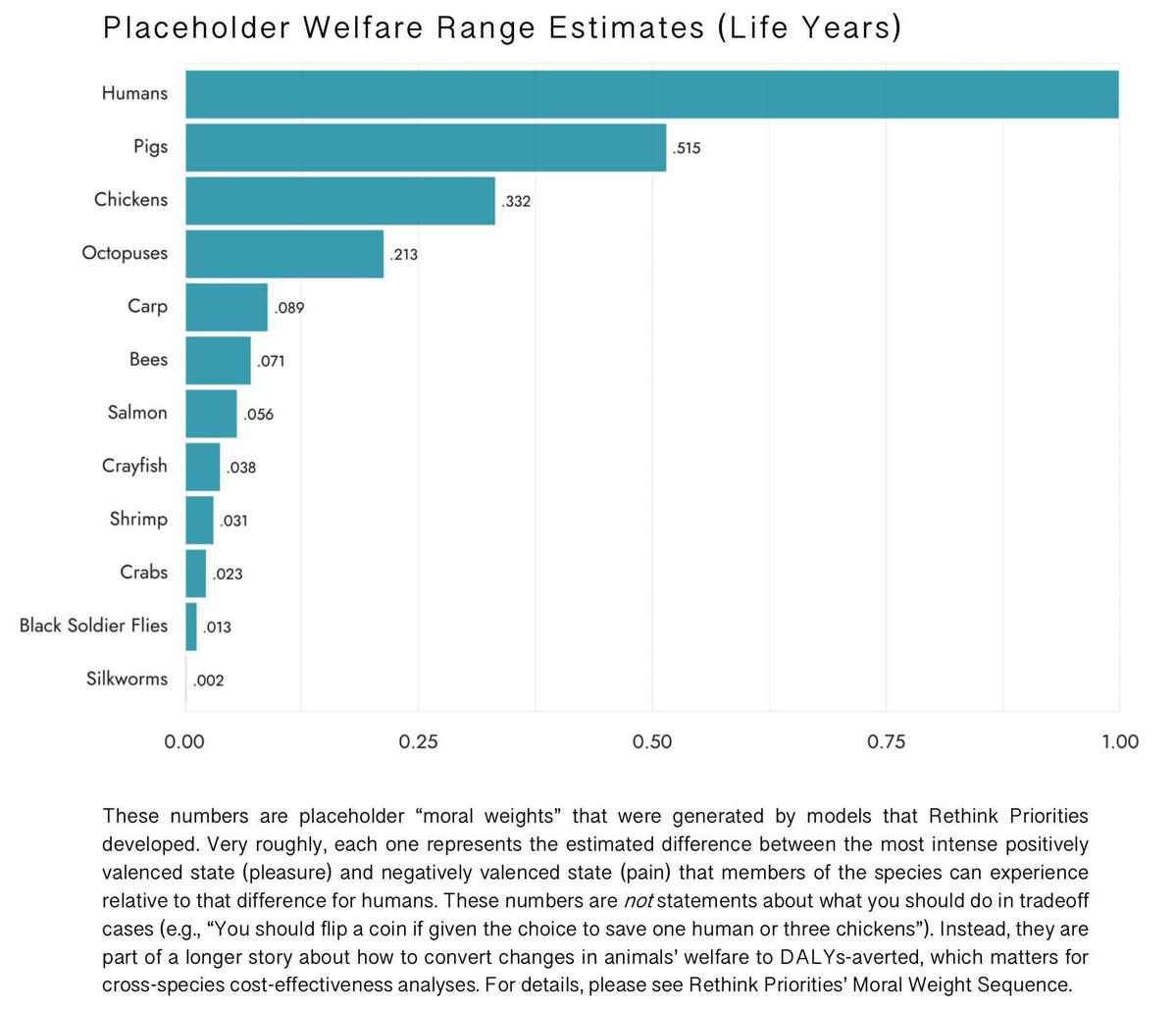
Rethink Priorities Moral Weights by Species
Now, in fairness to Rethink Priorities, they are careful to say that they are not establishing absolute worth ratios. But we can generalize and say that EAs do not necessarily consider themselves to be humanity’s advocates.
So, let’s list the traits of Effective Altruists:
-
EAs tend to be space-agnostic. One life is not necessarily worth more than another just because they occupy different positions on the globe.
-
EAs tend to be time-agnostic. One living life today does not necessarily outweigh a hypothetical future life.
-
EAs do not always emphasize human global health. Whether you go full-blown “you’ve committed the equivalent of one homicide if you eat 32 shrimp” morality or not, EA does place a lot of importance on empirically calculating what life is and thus what good and suffering is.
From the above, I derive:
-
EA sidelines theology. Now, many will argue with this; religious EAs do exist. But religion relies on assumptions beyond the material world, and in the EA world of empiricalism, religion cannot be entered into calculations.
-
EAs are heavily STEM-oriented. A philosophy which reduces everything to esoteric math calculations will naturally find its home in people who already natively think in such terms.
-
EAs are heavily neurodivergent. As documented by their own informal surveys. ¯\_(ツ)_/¯
Why EA and AI are so closely linked
EA as a philosophy lends itself well to stereotypical Silicon Valley demographics as-is. But there’s a simple reason that EA discussions seemingly always involve the future role of AI.
Fundamentally, EA is a maximizing philosophy: it always tries to price future value. And extinction is the “negative infinity” number in the ledger. Once you are determining outcome by probabilities, just having even a tiny chance of extinction dominates every other calculation.
One such scenario that many conservatives might find sympathetic is: do you do gain-of-function research for a 70% chance that you will prevent the next swine flu, or is the 1% risk that the virus escapes containment in Wuhan and kills 10 million people acceptable? Many of us, having lived through COVID-19, would put our foot down on allowing any kind of gain-of-function research again within our lifetimes. That’s one scenario where conservatives can potentially reason their way to the same answer as EAs.
EAs run that same logic in every calculation. What this means, inside their heads: an extinction level event scenario is the greatest threat vector.
This is why EAs have difficulty walking us normies from “AI today” to “AI kills everyone tomorrow.” They do not need to document the causal chain under their own philosophy. They only have to establish the probability isn’t zero. A non-zero chance multiplied by an extinction-level event is the only thing needed to justify acting.
And today, AI represents by far the biggest extinction threat unknown. Under EA philosophy, coercive or norm-breaking motions are often acceptable if it reduces the big negative signal. What this means in practice is that a number of common arguments are simply ineffective on EAs:
-
“This is just hysteria” - They’ve already proven their premise. It’s up to the rest of us to prove that AI has a zero chance of creating a global catastrophe.
-
“China will win if we pause AI development” - If pausing Western frontier AI development reduces the probability of extinction, then altering the global security balance is acceptable.
-
“You are proposing to set up a one world government” - In fact, many EAs consider centralized authority an effective way to maximize future value.
-
“This is a convenient regulatory capture happening right before IPOs” - EAs being endowed with billions of dollars to move the world is a positive to future value.
-
“All your AI safety measures are circularly financed and carry conflict-of-interest” - In fact, it is the desired outcome that EAs are in charge of AI development and AI safety alike.
In fact, it might not be an exaggeration to say that EAs consider it existential under their own philosophy to stop AI development by any means necessary. If it means joining hands with Democrats and China, so be it.
Why not EA?
Leave aside the question of whether thirty-two shrimp are equal in worth to one human. Leave aside the one-world-government aspirations. Grant them their whole framework and ask this one question:
Why are EAs wrong in over-weighting the risk of AI extinction compared to all other outcomes?
The answer is that their entire philosophy is based on a false premise: it is not possible to calculate future value in any meaningful respect. It is trivial to generate any kind of non-falsifiable thought experiment which results in extinction – runaway global warming, gray goo, nuclear winter. p(doom) is simply today’s top candidate.
Which raises a new question: what is the probability that these same people would be at peace in a world where AI was never invented? I submit the answer is none; EAs would be just as scared in a non-AI world as they are in an AI world.
But there *is *precedent. Every ideology that has demanded sacrifice and coercion in exchange for future good has been run by a small class of people who claimed to see far enough ahead to bind everyone else to their vision. Hayek called it the pretense of knowledge — the fatal conviction that a mind clever enough can compute the future and order the living accordingly. Every era already has seen its own crop of would-be tyrants mitigating a future catastrophe, whether that be overpopulation, or climate change, or mass starvation, or nuclear armageddon. It has never materialized, and never will.
Paul wrote, “And why not do evil that good may come?—as some people slanderously charge us with saying. Their condemnation is just.” Christians are ordained to endure the present and entrust the future to God.
The Effective Altruist commits spiritual rebellion all over again: he has appointed himself the God in charge of the future. And like every human figure who has done the same, he is willing to plunge the world into tyranny and damnation to realize a vision only he is wise enough to hold. We must stay alert and always deny them the only thing they truly crave: power.