How fonts can sound
文章目录
It may sound counterintuitive, but each font has its own sound
And in this article, our head of sound design - @Dmtrantnko is gonna explain the logic behind choosing the right font for your website, video, animation, banner, or anything else
I'll let him take it from here:
How should fonts sound?
I've worked with sound for many years. Across 2D & 3D animations, movies, and even games
Recently, I've found myself working more and more in the motion graphics and advertising niche along with the Skale team
Over the years, the same question keeps coming back to me - how should fonts sound?
I don't mean a random click, hit, or tick placed along with the appearance of text. There's something more interesting happening behind that
A typeface has its own geometry, rhythm, and emotional character. Sound has physics, timbre, and dynamics. When they move in the same direction, then everything becomes cohesive. When they do not, there's a small but meaningful disconnect
I decided to look into whether anyone had studied the relationship between sound and visual form
They have. I've found several studies on crossmodal correspondences - the idea that the brain naturally connects sensations across different senses. Sound, shape, color, texture, and even taste can influence one another.
For anyone who wants to go deeper, I'd recommend reading these 2 research papers: first & second
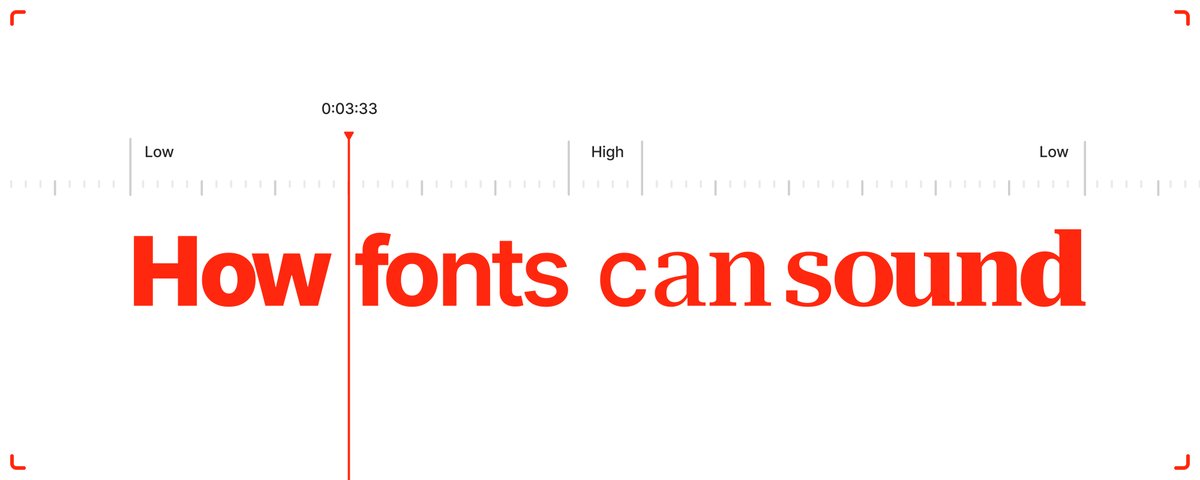
But the concept is fairly simple. High and thin sounds are often associated with lightness, smaller forms, and sharper contours. Low and dense sounds tend to feel heavier, larger, and rounder
In 2025, Monotype and Audiosocket launched Sound & Vision, followed by a tool called Fonic. Their idea was to match typefaces and music through what they call typographic synesthesia
It is an interesting concept. But no tool can replace someone who understands timing, composition, and the overall feeling of a piece
At first, motion graphics seem to follow a simple rule:
- Thin typeface = high, delicate sound
- Bold typeface = low, dense sound
It is a useful starting point. But motion graphics are not made of static logos
Letters do not always appear at the same time. They can rise slowly into frame, assemble from separate parts, fly in from different directions, scale up, break apart, or return later in the animation
And that changes the sound decision entirely
A thin typeface may look light. But if it slowly rises into frame, a short click can feel too fast and too sharp. That movement may need a sound with a soft attack, a longer decay, and a gradual development
The opposite is also true. A bold typeface can enter in a single fast frame. In that case, a short, focused impact may work better than a long, heavy bass sound
So the task is not to mechanically match a sound to a typeface. The task is to understand what the typeface is doing on screen
A simple framework
-
First, read the typeface. Is it light or heavy? Sharp or round? Geometric or organic?
-
Then look at the animation. Is it fast or slow? Smooth or abrupt? Do the letters arrive as a whole, or build piece by piece? Where do they come from, and how do they leave the frame?
-
Then choose a sound that supports both the typeface's character and the movement itself
That is why a thin typeface sometimes needs a denser, lower sound. It may be moving slowly and need support
And that is why a bold typeface can sometimes work with a light, short sound. Its animation may be fast, precise, and not need additional low-end weight
If the music is written in A minor and the sound effects contain clear notes from a different key, they can clash with the track. It works like a wrong note in a melody. Even if the viewer cannot explain why, the whole piece can start to feel less cohesive
This is where sound design can become musical. Fast typing can become an arpeggio. Clicks can become synth notes in the track's key. Impacts can become short chords
At that point, sound design stops being a set of effects placed under animation. It becomes a series of small musical gestures that follow the visuals
When sound effects live in the same musical world as the track, the whole piece comes together more easily
Why sound design matters
This leads to a more important question - why use sound design at all?
Not to add more sounds
Not to make the video louder
Not to make an edit look more expensive
Sound design gives visuals weight
It turns flat movements into something more physical. The brain stops reading the animation as pixels moving across a screen and begins to sense mass, texture, speed, and inertia. And that's the main goal - to make people feel animation and not see it
It's like when you perform any action on an iPhone and get a little haptic feedback. The purpose of that is for you to experience the action that you just did and make it more immersive
In other words, sound design in general is needed to increase the immersiveness of the whole video
It makes the transition believable
The best sound design is often not noticed as sound. People notice the feeling
Bad sound design does the opposite. It pulls attention away, argues with the visual, or breaks the sense of timing
Conclusion
In the end, good sound design should not need to prove that it exists
Its purpose is not for the viewer to notice an individual click, impact, or transition. Its purpose is for the movement on screen to feel natural
For letters to have weight. For animation to have inertia. For transitions to have a reason. For the whole piece to have its own rhythm
Research and trends are useful as a map. They can help explain why some choices feel natural, and others do not
But a map does not make the journey for you. Every project asks for its own answer
Everything in this article comes from practical work. We put together a pack of 100 sounds so you can test these ideas in real projects.
Not as a collection of ready-made answers, but as working material for motion graphics
The pack includes textures, impacts, clicks, tonal elements, and transition sounds
We also created several projects using only these sounds to test how the collection performs in real-world work
And in case you wanna get a launch video from us - feel free to book a call with @Markknd or @dchernyshuk here: